In the early nineteenth century, most multi-owner firms in Britain and the United States were organized as partnerships, in which the members would bear unlimited liability. Unlimited liability was an essential characteristic of partnerships at common law, and was perceived as vital to the mercantile credit networks that financed these firms.Footnote 1 But it also likely limited the circumstances in which the form could be used, and in particular foreclosed the possibility of partners raising capital by taking on passive “outside” investors.Footnote 2 French law, in contrast, recognized a partnership form known as the société en commandite, in which some partners were treated as outside investors and granted limited liability. The commandite was quite successful in France, and over the nineteenth century, repeated attempts were made to introduce it into England.Footnote 3 Yet opponents of this innovation argued the form was “contrary to the whole genius and spirit of the English law,” and successfully resisted its introduction there until the twentieth century.Footnote 4
American legislators, however, were much more willing to experiment with altering the law in order to suit the needs of their growing economy. In 1822 the State of New York introduced the commandite into its laws, with a statute that named it the “limited partnership.” New York thus became the first common law state to authorize the form. By 1886 limited partnerships had been authorized in all but three of the then-existing states and territories.Footnote 5 These statutes represented a significant legal innovation, and at the time were “supposed to be well calculated to bring dormant capital into active and useful employment.”Footnote 6 But it was difficult to anticipate how the new institution would function and how much use it would find. American limited partnership statutes created a new class of partner, called a “special partner,” who was granted limited liability and was required to delegate the management of the firm to the “general partners,” who remained personally liable. To prevent fraud, the statutes imposed strict registration requirements for these firms, as well as regulations on the form of payment made by the special partners, the name the businesses could take, and the publication of the registration certificate. The penalty for failing to comply with these and other terms of the statutes was that the special partners would be stripped of their limited liability.Footnote 7 The special partners thus faced a “lurking danger” that they could be exposed to unlimited liability as a result of minor or accidental deviations from the terms of the statutes, a problem that would be made more acute if common law judges were hostile to the form and interpreted the statutes conservatively.Footnote 8
Most of the modern scholarship on the limited partnership in the nineteenth-century United States has concluded that because of this danger, the institution was utilized only rarely.Footnote 9 Indeed, the notion that the limited partnership was “never widely adopted in America in the nineteenth century” is accepted quite generally.Footnote 10 Yet little evidence exists on the extent to which the limited partnership form was adopted by nineteenth-century American firms. And perhaps more importantly, almost nothing is known about the types of firms that did utilize these statutes, or the contracting problems the limited partnership was or was not used to address.
This article analyzes the effects of the introduction of the limited partnership in New York City from 1822, the year the state authorized the form, until 1858. Using newly collected data, this article investigates the extent to which the city's merchants and manufacturers utilized the limited partnership, and the nature and significance of their use of the form. Two sets of statistical analyses are performed. The first consists of a comparison of firm capital, industrial composition, and performance between a random sample of 320 New York City ordinary partnerships existing in 1853 and the more than 200 limited partnerships that operated in that year. The second focuses on a data set of the special partners, and analyzes their occupations and the connections between these individuals and their firms.
The results indicate that the limited partnership was of increasing importance in New York City over the first half of the nineteenth century, with a total of 1,098 such firms created between 1822 and 1858. Moreover, the form was significant in ways beyond the mere frequency of its use. Compared to ordinary partnerships, limited partnerships had more capital and were less likely to fail (even controlling for firm capital). Perhaps more importantly, the institution of the limited partnership appears to have facilitated investments that were unlikely to have occurred in its absence. Most of the special partners were themselves general partners in another firm, often in the same industry. Limited partnership stakes thus enabled these merchants to invest in multiple partnerships simultaneously, a position that would have been untenable in the absence of the form.Footnote 11
In addition, the personal connections among the members of limited partnerships were quite different from those typically found in ordinary partnerships. Most ordinary partnerships were founded on the basis of kinship ties.Footnote 12 In contrast, the members of limited partnerships were far less likely to be related to one another, either by marriage or consanguinity. These latter differences were not simply due to selection: although the merchants who formed limited partnerships were a wealthy elite, their own ordinary partnerships were quite different from their limited partnerships. Successful, well-established merchants invested as special partners with young entrepreneurs from outside their kinship networks, even though their own ordinary partnerships were likely to be formed with family members.
These results suggest that the limited partnership may have facilitated a more efficient allocation of capital within the mercantile world of New York City. The preference of New York's merchants to form partnerships with members of their own kinship network—either the product of a desire to work with family members, or a solution to the problem of finding trusted associates—restricted the range of potential partners available to a merchant.Footnote 13 If talented, energetic businessmen, perhaps with complementary skills or resources, were less likely to be chosen as partners if they were outside a merchant's kinship network, then the matches that resulted were likely less productive. These matches may have nonetheless been the best among what was feasible, given the constraints posed by the preference to work with family, or the need to find partners who could be trusted.Footnote 14 By offering the protection of limited liability and easing the problems posed by membership in multiple partnership firms, the institution of the limited partnership may have facilitated more efficient matches. If a member of a family partnership learned of a talented businessman or a prospective firm with a promising opportunity, he could invest as a special partner, while remaining with his own family firm.
The results of this article contribute to several areas of historical research. First, they add to a large and growing comparative literature on businesses' choice of organizational form and the significance of the limited partnership.Footnote 15 In common law contexts, there is little evidence on the use of the limited partnership, and much of it has indicated that the form was unimportant.Footnote 16 In contrast, the results of this article suggest that the limited partnership facilitated a large number of investments in New York City firms, even though the corporate form was widely available at the time.Footnote 17 A second literature to which this article contributes analyzes the evolution of American law, and its role in economic development.Footnote 18 Limited partnership statutes were enacted to facilitate new investments, and also represented an important legal innovation, since they grafted a civil law institution into the common law. These statutes, and the case law that developed in response, have therefore attracted considerable scholarly attention.Footnote 19 Lastly, the results presented here contribute to the literature on commercial partnerships in the nineteenth century, and in particular on the role of kinship ties within these firms.Footnote 20
THE LIMITED PARTNERSHIP AND NEW YORK'S 1822 STATUTE
The concept of the limited partnership dates at least as far back as twelfth-century Italy, where it was known as the accomandita.Footnote 21 In France, the société en commandite was recognized in its first commercial code, Colbert's Ordinance of 1673, and a more precise specification of the form was included in its 1807 commercial code, which received significant attention in the United States.Footnote 22 New York's 1822 statute was an adaptation of the 1807 code's terms relative to the commandite. The initial bill, proposed by Assemblyman Philip Brasher of New York City, was in fact little more than a transcription of passages from the 1807 code.Footnote 23 The bill also made the first official use of the term “limited partnership” to denote the organizational form.Footnote 24 In the New York Assembly's Committee of Ways and Means, the granting of limited liability to members of partnership firms aroused concerns about fraud, an issue frequently raised by opponents of corporations.Footnote 25 In response, the committee inserted a provision imposing a fine of $1,000 for fraud, and a clear requirement that each special partner's name and amount invested be included in the registration certificate for the firm. Footnote 26
The New York Statute of 1822 authorized the formation of limited partnerships in virtually any industry other than banking or insurance once a registration certificate was filed with the clerk of the county in which the business would operate.Footnote 27 The partners were required to then publish the contents of their registration certificate for at least six weeks in two newspapers, and dissolutions could be affected only by similar publication. Subsequent modifications to the law required still more detail in the registration certificates, including a statement of the industry in which the firm would operate.Footnote 28 As was the case with the commandite in France, the special partners were forbidden from participating in the management of the firm. But unlike with the commandite, the terms of any partnership contract that the members of the limited partnership executed were not included in the firm's certificate.
In many states, the proponents of limited partnerships argued for their adoption as a substitute for the corporation, and in some cases radical Jacksonian Democrats proposed authorizing limited partnerships as a way to undermine the special privileges of corporations.Footnote 29 In the realm of politics, the limited partnership was therefore closely tied to the corporation, and the introduction of the form can be interpreted as a step in the progression towards granting broad access to the powers normally reserved for incorporated entities.Footnote 30 In a practical sense, however, the limited partnership was quite different from the corporation. Of the many essential attributes of corporations, it retained only limited liability, and the limitation on liability was partial because there were still general partners who were personally liable for the firm's debts. Moreover, a limited partnership had no legal identity separate from that of the individual partners and could not own property or act in law; if a partner left or died, the partnership would dissolve; and the stake of the special partner was totally illiquid—it could not be sold or transferred without dissolving the firm.Footnote 31 A corporation, in contrast, was a distinct legal entity; its shares were tradable; and its shareholders all had voting rights over the management of the firm and limited liability, except in very special circumstances.Footnote 32 The limited partnership, above all else, was a partnership.
NEW YORK CITY AND THE ADOPTION OF THE LIMITED PARTNERSHIP
In the early nineteenth century, New York City emerged as the most important commercial center in the United States, and in particular became the nation's largest port for international trade, the largest market for banking and finance, and a crucial point in the distribution of manufactured goods and primary commodities.Footnote 33 With the exception of banks and insurance companies, which were required by statute to incorporate, many if not most of the firms engaged in these economic activities were organized as partnerships. Did many of them utilize the limited partnership once it became available?
All of the limited partnership certificates filed in the county clerk's office in New York City from 1822 until 1858 were collected and coded for this article. The certificates indicate that New York's businessmen did not begin taking advantage of the limited-partnership option immediately. The first registration was filed on December 16, 1822, but only six limited partnerships were formed before 1827. Figure 1 shows the number of limited partnerships created each year from 1822 to 1858 (a total of 1,098 limited partnerships were formed during this period). It was not until the 1830s that the new partnership form began to catch on.
Several developments may have played a role in its increasing popularity in the 1830s. New York's landmark Revised Statutes, published in 1829, compiled and organized the state's most important laws (including its limited partnership statute) into an accessible format, and were accompanied by efforts to publicize and explain their contents.Footnote 34 Other publications that may have raised awareness of the availability of the form and made it more accessible were collections of template legal documents intended for laymen, which contained examples of limited partnership contracts.Footnote 35
Business conditions certainly played an important role in determining the rate of creation of limited partnerships. The sharp rise and fall in the number of new limited partnerships in the mid-1830s coincided with the speculative boom preceding the Panic of 1837 and the depression that followed. There was a general trend of increasing use of the limited partnership over time, and the number of limited partnerships formed per year within the sample period was highest in the 1850s. The volumes containing the registration certificates also contain the certificates of dissolution and renewal, and from these the annual number of operating limited partnerships can be calculated. Again, the number of operating firms rose over time, reaching a peak at the end of the sample period in 1858, when 277 limited partnerships existed. Because ordinary partnerships did not need to file registration certificates, there is no equivalent official source for the number of ordinary partnerships. However, from business directories it can be estimated that the limited partnerships were equal in number to about 4 percent of operating ordinary partnerships in the 1850s.Footnote 36
LIMITED PARTNERSHIPS IN NEW YORK CITY, 1822–1858

Although limited partnerships were uncommon relative to ordinary partnerships, they may have held a disproportionately large share of the total capital of all partnerships. The lower part of Figure 1 displays the total amount of capital invested by special partners in newly created limited partnerships, and operating limited partnerships, for each year over the sample. In the peak year of the sample (1858), more than $9 million had been invested by special partners in the operating limited partnerships; the total amount invested between 1822 and 1858 was more than $28.2 million.Footnote 37
What stance did the courts take towards these firms? The reason most of the prior scholarship has suggested that the limited partnership was not widely adopted is that there is some case law indicating that judges interpreted limited partnership statutes quite narrowly. The special partners therefore faced the danger of being stripped of their limited liability due to minor deviations from the terms of the statute. In New York, the first reported case relative to one of these firms did not arise until 1836.Footnote 38 In that decision and in the case law that developed subsequently, New York's judges do not appear to have been overly conservative in their interpretation of the statute.Footnote 39 The New York Supreme Court, for example, rejected an attempt by a creditor to strip a special partner of his limited liability because of an error in the spelling of the special partner's name in the publication of the firm's certificate.Footnote 40 Special partners did face the risk that they could lose their limited liability, and some were indeed made personally liable, but this was probably regarded as unlikely to occur as a result of minor violations of the statute.Footnote 41
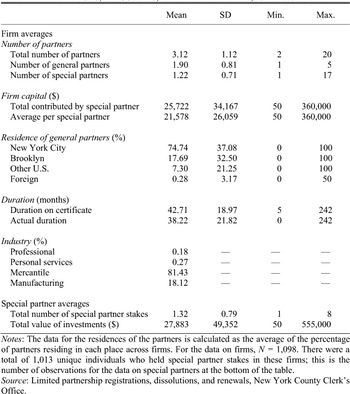
The composition of New York's limited partnerships, as recorded on their certificates, is presented in Table 1. On average, the limited partnerships had a total of three partners, with two general partners and one special partner, who contributed about $21,500. There were 1,013 unique individuals who held stakes as special partners during this period; on average, each invested in 1.32 limited partnerships. The general partners overwhelmingly lived in New York City and Brooklyn, but the special partners were somewhat more likely to live outside the New York City area, often in New Jersey, upstate New York, or Connecticut. The average duration of the firms' existence specified on the registration certificates was about 43 months, but 24 percent of the firms dissolved prior to the limitation date; the actual duration of the firms' existence (including renewals) was on average about 38 months.Footnote 42
The industrial composition of the limited partnerships is also presented in Table 1. The data in the table indicate that the limited partnerships were overwhelmingly engaged in mercantile activities; these firms frequently listed themselves as “jobbers” or “commission merchants” on their certificates.Footnote 43 The categories of “professionals” (which includes attorneys) and “personal services” (which includes tavern keepers, laundry washers, and the like) together accounted for only a small fraction of the limited partnerships. Manufacturers, which mostly included artisans and firms engaged in light manufacturing, such as shoemakers, ready-made clothing manufacturers, and jewelers, accounted for a much larger fraction of the firms.
LIMITED PARTNERSHIPS: FINANCES, INDUSTRIES, AND PARTNER DATA, 1822–1853

Notes:
The data for the residences of the partners is calculated as the average of the percentage of partners residing in each place across firms. For the data on firms, N = 1,098. There were a total of 1,013 unique individuals who held special partner stakes in these firms; this is the number of observations for the data on special partners at the bottom of the table.
Source:
Limited partnership registrations, dissolutions, and renewals, New York County Clerk's Office.
In general, the large sums invested in these firms indicate that the limited partnership was utilized by elite merchants. And indeed many prominent individuals and firms appeared on the registration certificates, including the dry goods retailers Lord & Taylor; Howland & Aspinwall, the shipping firm that played a dominant role in trade between New York and the Pacific; Junius S. Morgan, father of J. P. Morgan; and two German banks, which made enormous investments as special partners with New York City firms.Footnote 44 The nature of the limited partnership contract may have made this pattern of use inevitable, since it forced the special partner to make a completely illiquid investment, something a small investor would have found unattractive. Moreover, the risk that the special partner could lose his limited liability due to violations of the terms of the statute might also have made the form appealing only to the very affluent. But how different were these firms from typical partnerships, and in what ways did they differ? The next section describes the sources and data used to make systematic comparisons between the two types of firms.
DATA ON NEW YORK CITY LIMITED AND ORDINARY PARTNERSHIPS
Cross-Sectional 1853 Sample
Two samples were collected for analysis: a cross-section of partnerships existing in 1853, and a data set of special partners and their firms from 1845 to 1853. The cross-sectional data set presents an opportunity to compare the characteristics of limited partnerships to those of a random sample of ordinary partnerships, in order to observe any systematic differences across the two types of firms. The panel of special partners, in turn, will be used to analyze the connections between the special partners and the firms in which they were copartners, and to investigate the role of selection in determining the differences between the two types of firms.
The cross-sectional data set consists of all limited partnerships existing in 1853, and a random sample of ordinary partnerships existing in that year. The ordinary partnerships were sampled from a New York City business directory for 1852/53 by selecting the first entry on each page corresponding to a partnership (thus excluding sole proprietorships and corporations).Footnote 45 The directory provided each business's name, address, and industry. This produced a sample of 320 ordinary partnerships, or approximately 8 percent of all partnerships listed in the directory, to compare to the 217 limited partnerships found to be operating in that year.Footnote 46 Information on the partners and finances of these firms was then sought in the credit reports of R. G. Dun & Co.Footnote 47 Although the New York City credit reports date back to 1841 when R. G. Dun & Co., then called the Mercantile Agency, was founded, entries are quite sparse until the early 1850s, which is why 1853 was chosen as the year for the cross-sectional sample. Data on 186 of the 217 limited partnerships and 140 of the 320 ordinary partnerships were found in the Dun ledgers. The purpose of the Dun reports was to provide creditors with information on businesses' financial health and prospects, so correspondents would have been most likely to compile reports on businesses that had issued commercial paper to finance purchases or other transactions. The Dun reports are therefore biased towards firms that were large and active in the business world.
Although the extent of the data in the Dun reports varied by firm, several types of information were frequently available for the partnerships in the sample. In addition to a partnership's address and industry and the names of all partners, the reports typically provided a partnership's total capital or net worth, and often provided estimates of the individual partners' net worth as well.Footnote 48 The reports also indicated a partnership's fate, and whether it was dissolved or failed. Finally, the Dun reports often noted how the general partners in a firm were connected to each other and how the special partners were connected to the general partners.
Data Set of Special Partners
In order to investigate the relationship between firm characteristics and status as a limited partnership, a data set of special partners and their firms was constructed. To begin, all 247 special partners in limited partnerships created between 1845 and 1853 who lived in New York City or Brooklyn were identified from the limited partnership certificates. The general partners were then linked to other firms using directories of partnerships from 1849/50 and 1853/54 that listed all partners' names.Footnote 49 The firms were then looked up in the Dun records and data on its members and finances was recorded. In addition, the Dun records were searched for the names of all 247 special partners as individuals, in case some were not members of partnerships but operated as independent merchants, sole proprietors, or officers of corporations.Footnote 50 Finally, city directories and commercial directories were searched for the names of the individuals as well, to see if they operated as independent merchants, and to see if an occupation was listed for them.
Of the 247 New York and Brooklyn special partners, 30 could not be found in the partnership directories, commercial directories, city directories, or the Dun reports. Thus the sample consists of the 217 individuals for which a firm or occupation could be found. For each of these individuals' partnerships, information comparable to that of the cross-sectional data set was obtained, although for many of them, no Dun record could be found, or the records that were found did not include information on key variables.
EMPIRICAL ANALYSIS: CROSS-SECTIONAL COMPARISONS
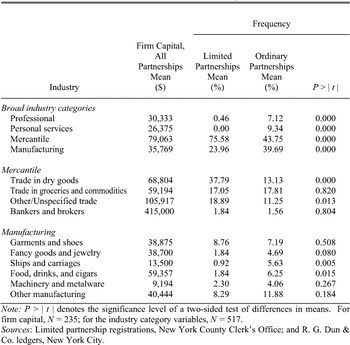
Were limited partnerships distributed across industries in the same way as ordinary partnerships? Table 2 presents comparisons of the industries of the ordinary partnerships and limited partnerships in the cross-sectional sample. In general, the data in the table indicate that limited partnerships tended to be formed at higher rates than ordinary partnerships in the industries with larger average capital, and at lower rates than ordinary partnerships in industries with low average capital.
The top part of the table, which classifies the partnerships into broad industry categories, indicates that the distributions of the two types of firms were quite different. About 44 percent of the ordinary partnerships were mercantile businesses, compared to 76 percent of the
INDUSTRY COMPARISONS: NEW YORK CITY PARTNERSHIPS, 1853

Note:
P > | t | denotes the significance level of a two-sided test of differences in means. For firm capital, N = 235; for the industry category variables, N = 517.
Sources:
Limited partnership registrations, New York County Clerk's Office; and R. G. Dun & Co. ledgers, New York City.
limited partnerships, and essentially none of the limited partnerships were in the professions or in personal services. The lower panel of the table presents additional detail on the activities of the mercantile and manufacturing businesses in the sample. Among mercantile firms, the limited partnerships were more likely to be engaged in the buying and selling of dry goods and also more likely to list themselves as “general commission merchants” or “importers,” which we classified as unspecified trade.Footnote 51 These two categories also had the highest average capital except for bankers and brokers. The ordinary partnerships generally engaged in each subcategory of manufacturing at a substantially higher rate than the limited partnerships. The one exception was in shoe and garment manufacturing, where both types of firms were engaged at similar rates.
The data obtained from the Dun reports on the firms includes great detail on their finances and membership. However, only 44 percent of the ordinary partnerships appeared in the Dun ledgers, compared to 86 percent of the limited partnerships. Since the Dun reports were intended for creditors and therefore likely included the larger and more economically active firms, the comparisons based on the Dun reports that follow show the difference between nearly all of the limited partnerships and a highly selected group of the ordinary partnerships.
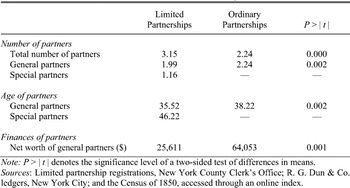
The composition of the limited partnerships differed from that of the ordinary partnerships. Table 3A presents data on the members of the firms. The limited partnerships and the ordinary partnerships had roughly the same number of general partners (two), but the limited partnerships had one special partner as well. The lower part of the table presents the ages of the partners in each type of firm.Footnote 52 On average, the partners in the ordinary partnerships were nearly three years older than the general partners in the limited partnerships (38.4 vs. 35.7 years old). But the special partners were on average ten years older than the general partners in their firms. Finally, the data indicate that the general partners in limited partnerships were worth considerably less than the general partners in ordinary partnerships.Footnote 53
Did the limited partnerships actually have more capital than the ordinary partnerships? Table 3B presents tests of differences in means for firm capital, and, because the distribution of capital for these firms contains some enormous outliers, the medians are also compared. It should be noted that these data represent estimates provided by the Dun agents, and are likely quite imprecise and noisy.Footnote 54 In terms of means, the limited partnerships had about 15 percent more capital, with about 47 percent of the capital supplied by the general partners, and the balance by the special partners. The difference in average capital across firm types is not statistically significant, but the median capital of the limited partnerships ($40,000) was twice as large as the median level of
FIRM COMPOSITION: NEW YORK CITY PARTNERSHIPS, 1853

Note:
P > | t | denotes the significance level of a two-sided test of differences in means.
Sources:
Limited partnership registrations, New York County Clerk's Office; R. G. Dun & Co. ledgers, New York City; and the Census of 1850, accessed through an online index.
CAPITAL COMPARISONS: NEW YORK CITY PARTNERSHIPS, 1853

Notes:
For the limited partnerships, capital per partner is calculated as total capital divided by the number of general partners plus special partners. In some cases, the Dun reports state the “net worth” of a firm, rather than its capital; this is true for 42 ordinary partnerships and five limited partnerships. For these firms, the net worth is used in lieu of capital. If these data are excluded from the comparisons, the results are substantially the same. The p-values reported are for a two-sided t-test of differences in means, or for the tests of differences in medians, the significance level of the Pearson chi-squared test statistic is reported.
Source:
R. G. Dun & Co. ledgers, New York City.
capital for the ordinary partnerships ($20,000), and this difference is statistically significant. The limited partnerships did, however, have one more partner than the ordinary partnerships. The bottom row in Table 3B compares median capital per partner for the two types of firms, and the data indicate that the limited partnerships had about 27 percent more capital per partner, even including the special partners in the total number of partners.
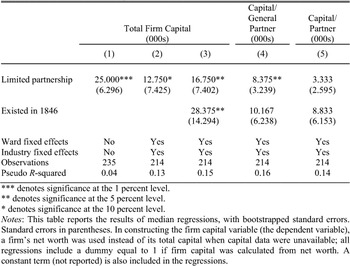
Were these differences in firm capital across firm types due to the fact that they were engaged in different industries, or were they due instead to differences in the merchants who organized the firms? In order to explore this question, Table 4 presents median regressions for firm capital, with a limited partnership dummy as an independent variable, and location and industry dummies as additional controls, along with a dummy variable indicating whether or not the firm existed in 1846.Footnote 55 The location dummies, which indicate the political “ward” within which the firm was located, were included to capture any differences within industries correlated with geography.Footnote 56 The results in column 3 indicate that even controlling for industry and for geography, the median capital of the limited partnerships was much higher than that of the ordinary partnerships (about $17,000 more), and this difference is highly statistically significant. Column 5 presents median regressions for capital per partner. The results indicate that the limited partnerships had over $3,000 more capital per partner, but this difference is estimated imprecisely.
In general, the Dun agents' reports provide little if any information on the performance or profits of the firms, except in a few cases of spectacular success. However, the records very carefully report on any failures of the firms—essentially, bankruptcies.Footnote 57 Although the Dun agents rarely recorded the extent of the firm's losses in these cases, which were therefore simply coded as a binary variable indicating “failure,” these events can be thought of as the worst possible outcome for the performance of the firm. In general, the failure of a firm (conditional on its industry and capital) might be interpreted
MEDIAN REGRESSIONS: FIRM CAPITAL, NEW YORK CITY PARTNERSHIPS, 1853

*** denotes significance at the 1 percent level.
** denotes significance at the 5 percent level.
* denotes significance at the 10 percent level.
Notes:
This table reports the results of median regressions, with bootstrapped standard errors. Standard errors in parentheses. In constructing the firm capital variable (the dependent variable), a firm's net worth was used instead of its total capital when capital data were unavailable; all regressions include a dummy equal to 1 if firm capital was calculated from net worth. A constant term (not reported) is also included in the regressions.
as evidence of excessive risk taking or generally poor management. Therefore, in Table 5, we regress the firm failure variable on a variable indicating status as a limited partnership, and other firm characteristics, to investigate whether the failure rate of limited partnerships was different from that of ordinary partnerships.
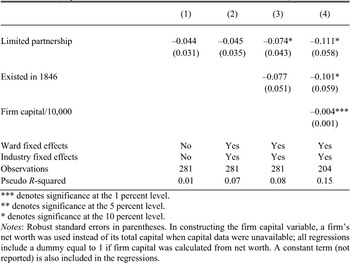
For the sample firms that operated in 1853, we analyzed the determinants of failures in 1853 or 1854; firms that failed in subsequent years were coded as survivors. Limited partnerships whose registrations expired before 1854 were regarded as not having been exposed to the risk of failure for a comparable amount of time, and were excluded from the regressions.Footnote 58 For the 281 firms in the resulting data set, 9.4 percent of the ordinary partnerships failed within 1853/54, compared to 4.9 percent of the limited partnerships, a difference which is substantial but not statistically significant. Columns 2 through 4 of Table 5 present
REGRESSIONS: FIRM FAILURE, NEW YORK CITY PARTNERSHIPS, 1853–1854 (dependent variable = 1 if the firm failed in either 1853 or 1854)

*** denotes significance at the 1 percent level.
** denotes significance at the 5 percent level.
* denotes significance at the 10 percent level.
Notes:
Robust standard errors in parentheses. In constructing the firm capital variable, a firm's net worth was used instead of its total capital when capital data were unavailable; all regressions include a dummy equal to 1 if firm capital was calculated from net worth. A constant term (not reported) is also included in the regressions.
regressions where controls for industry, location, previous duration of existence, and firm capital are added in succession. Firms that had existed since at least 1846 were less likely to fail; since limited partnerships were on average younger firms, controlling for prior existence increases the magnitude of the negative effect of status as a limited partnership on the failure rates of the firms. Controlling for the firms' capital, a powerful determinant of failure, has a similar effect. Although in general, the effect of status as a limited partnership is not precisely estimated, the effects are quite large, relative to a mean failure rate of 7.14 percent. This rough indication of superior performance is at least consistent with average managerial quality being higher among the limited partnerships.
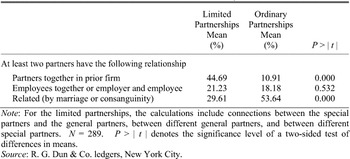
The last and perhaps most interesting characteristic of the firms to compare is the personal connections among the partners. When evaluating the creditworthiness of a firm, the Dun agents frequently commented on the background of the partners themselves, including whether or not they had worked together in a prior firm (and if so, in
FIRM ORIGINS: NEW YORK CITY PARTNERSHIPS, 1853

Note:
For the limited partnerships, the calculations include connections between the special partners and the general partners, between different general partners, and between different special partners. N = 289. P > | t | denotes the significance level of a two-sided test of differences in means.
Source:
R. G. Dun & Co. ledgers, New York City.
what capacity), and whether or not they were related. Table 6 presents summary statistics for data describing the personal connections among the partners in the firms of the sample. The binary variables in the table are coded as equal to one if any two partners had the personal connection described, and for the limited partnerships, they include the special partners. These variables are not mutually exclusive, and in theory could all be equal to one for a given firm.Footnote 59
The personal connections forming the origins of the partnerships in the sample clearly differed by firm type. The limited partnerships were much more likely to have partners who had been in business together in prior firms, either as partners or as employers and employees, compared to the ordinary partnerships. More importantly, the ordinary partnerships were significantly more likely to have partners who were related to one another, compared to the limited partnerships (53.6 percent vs. 29.6 percent). The data on the relationships among the members of limited partnerships presented in the table include all the partners, both special and general. If we consider only the general partners within the limited partnerships, they were related to one another 12 percent of the time. The special partners were related to the general partners 21.2 percent of the time.Footnote 60
Taken as a whole, these results imply that limited partnerships had more capital than ordinary partnerships, and even after controlling for capital, they were more successful. The form was utilized by sophisticated and talented merchants, who were usually not related to one another, but instead met one another in the business world. But were these differences in personal connections among partners simply the result of the elite status of the merchants who formed limited partnerships? Perhaps elite merchants could rely less on family when choosing their investments in firms. These issues will be explored in much greater depth using the second data set collected for this article, the data set of special partners and their firms.
SPECIAL PARTNERS AND THEIR FIRMS
In order to investigate the relationships between the special partners and their firms, a data set was collected of the occupations and firms of the special partners who resided in New York and Brooklyn from 1845 to 1853. Many of the special partners made investments in multiple limited partnerships; the average number was about 1.3, but some invested in as many as four. Who were these men?
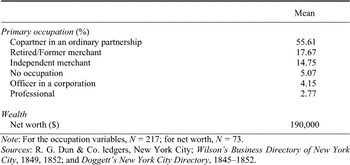
The data in Table 7 indicate that 56 percent of the special partners were general partners in an ordinary partnership at the time of their investments. This is a clear indication that the institution of the limited partnership facilitated investments that were unlikely to have occurred in its absence, since acting as a general partner in two ordinary partnerships would have been untenable: it would have created serious conflicts of interest, and would have exposed the assets of each firm's partners to the creditors of the other partnership.Footnote 61
Most of the remaining special partners were also from New York City's mercantile community. About 18 percent of special partners were retired merchants, 15 percent were independent merchants (in business alone), about 4 percent were officers of corporations, and 3 percent
NEW YORK SPECIAL PARTNERS, 1845–1853: OCCUPATION AND WEALTH

Note:
For the occupation variables, N = 217; for net worth, N = 73.
Sources:
R. G. Dun & Co. ledgers, New York City; Wilson's Business Directory of New York City, 1849, 1852; and Doggett's New York City Directory, 1845–1852.
were professionals in business alone, mainly lawyers. Another 5 percent of the special partners were listed in directories as residing in New York City, but without any occupation. Finally, the average net worth of the special partners of $190,000 is a sign that they were probably among the mercantile community's more successful and wealthy members.Footnote 62
These data on the wealth and occupations of the special partners provide further insight into the use of the limited partnership, in light of the potential concern about the loss of limited liability. For these wealthy and successful merchants, the risk that the courts might strip them of their limited liability may not have represented an unusual or unacceptable source of danger. Moreover, the benefits of status as a special partner extended beyond limited liability: the special partner's arm's-length relationship with the operations of the limited partnership facilitated simultaneous investments in multiple partnerships. It could be that status as a passive “outside” investor in a partnership firm was as important as limited liability to the special partners.
The connections between special partners and their firms were associated less with kinship and more with professional and industrial
SPECIAL PARTNERS AND THEIR FIRMS, 1845–1853

Notes:
The first column presents data for all special partner-limited partnership pairs for limited partnership investments of New York City special partners. The second column presents means only for special partner-general partnership pairs. For all but the last row in the table, N = 270, representing the firms of 144 individuals. In the last row, there are 157 observations from 73 individuals.
Source:
R. G. Dun & Co. ledgers, New York City.
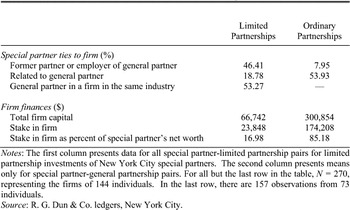
ties. The upper rows of Table 8 indicate that special partners were related to at least one general partner in their limited partnerships only 19 percent of the time, compared to 54 percent of the time for their ordinary partnerships, a dramatic contrast that is quite similar to the difference observed across firm types in Table 6.Footnote 63 For 46 percent of the special partners' investments in limited partnerships, at least one of the general partners was their former employee or partner.Footnote 64 The industry of their own ordinary partnerships and their limited partnerships was the same 53 percent of the time. This is suggestive evidence that diversification motives were of secondary importance in the decision to invest in a limited partnership, at least with respect to diversification of industry risk factors.
In their finances, the two types of firms differed dramatically: the ordinary partnerships had much more capital than the limited partnerships. The data in Table 8 indicate that on average, the stakes in limited partnerships—defined as the partner's net worth minus the value
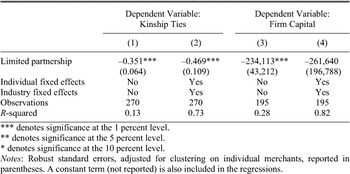
REGRESSIONS: FAMILY CONNECTIONS, FIRM CAPITAL

*** denotes significance at the 1 percent level.
** denotes significance at the 5 percent level.
* denotes significance at the 10 percent level.
Notes:
Robust standard errors, adjusted for clustering on individual merchants, reported in parentheses. A constant term (not reported) is also included in the regressions.
of their stake in their limited partnership–––were equivalent to about 17 percent of the special partner's net worth. For those special partners who were members of ordinary partnerships, their stake in their ordinary partnership was effectively the balance (about 85 percent) of their net worth.
In order to investigate these differences more carefully, and address the issue of selection, Table 9 presents the relationship between family connections and status as a limited partnership after controlling for individual and industry fixed effects. That is, for partner i in firm j, the relationship

is estimated, where kinij is a binary variable equal to one if the partner has kinship ties to some other general partner in the firm; limitedj is a variable equal to one if the firm is a limited partnership; the industry variables are binary variables for each industry; and the δi is a fixed effect for each of the special partners in the sample. The coefficient β is estimated from the variation within individual merchants' partnerships.Footnote 65 The ordinary partnerships included in the data set are those in which a special partner was a member at the same time they were invested in their limited partnership.
The results indicate that even when controlling for industry and when focusing only on the variation within each individual merchant's firms, the special partners were much more likely to form ordinary partnerships than limited partnerships with their relatives. The estimated effect in Table 9 indicates that the merchants in the data set were about 47 percent less likely to be related to their partners in their limited partnerships, compared to their ordinary partnerships, and this difference is highly significant. These merchants chose to form their ordinary partnerships with members of their kinship networks, and their limited partnerships with businessmen with whom they had no kinship ties.
This sharp distinction in the degree of kinship ties between the two types of firms could have been due to the perils of unlimited liability. Merchants may have formed ordinary partnerships with their kin because they believed that they knew their relatives better and could trust them more than other business associates. But these men may have had other reasons to form partnerships with their relatives that had nothing to do with trust–––they may have enjoyed working with family, or brought in their younger relatives to help them learn and profit from the family business. Whatever their motives for forming family partnerships, the limited partnership enabled merchants to make additional investments in other firms, and act something like venture capitalists. Their principal business was their family partnership, but the limited partnership enabled them to simultaneously hold stakes in other partnerships, whose members were generally drawn from the business world, and in particular from outside their kinship network.
In Table 9, when the dependent variable is firm capital, the results indicate that the special partners invested a great deal less of their capital in the limited partnerships than they did in their general partnerships. This holds true even though the limited partnerships on average had more total capital than did the average ordinary partnership. This is yet another indication of just how wealthy the special partners were.
CONCLUSION
The importance of the limited partnership in the nineteenth-century United States has long been doubted, and scholars have speculated on the reasons for its infrequent adoption. However, limited partnerships played an important role in the mercantile sector of antebellum New York, the leading financial and commercial city in America. A total of 1,098 limited partnerships were formed in the city in the years up to 1858, and the investments made with these firms were often quite large, in the aggregate totaling more than $28.2 million. During the years of the sample, the corporate form became increasingly accessible, and the proliferation of corporations enabled investors to purchase shares in firms in a wide range of industries. But the mercantile world remained dominated by partnerships, and the limited partnership, which created the possibility of holding a stake as an outside investor, facilitated investments in these firms. Over the remainder of the nineteenth century, the limited partnership found continued widespread use, and the total number of limited partnerships formed in New York City during the nineteenth century can be conservatively estimated to be at least 3,000.Footnote 66
Compared with ordinary partnerships, New York's limited partnerships had more capital; operated disproportionately in mercantile sectors, particularly in buying and selling dry goods; and failed at a lower rate, even conditional on the amount of capital they had. These were elite firms, formed by wealthy and successful merchants and given abundant resources to pursue lucrative business opportunities. The investors who provided capital to these firms often knew the general partners from previous connections in the business world, and were only rarely related to them. This was quite different from most ordinary partnerships, where the partners were often from within the same kinship network, and this difference is not simply due to selection. The special partners' own ordinary partnerships were much more likely to be formed on the basis of kinship ties. The limited partnership appears to have facilitated investments in the businesses of talented young merchants who wealthy investors knew through their business dealings. The superior performance of the limited partnerships, even conditional on the amount of capital they held, is an indication that these investments were indeed made with men chosen on the basis of their talent and potential.
The reason most of the prior scholarship has concluded that the limited partnership was not widely adopted is that the special partners faced the danger of being stripped of their limited liability due to minor deviations from the terms of the statute. But it is clear that quite a few wealthy businessmen did not see this as a serious impediment to the use of the form. The risk that the courts might impose liability for the debts of their limited partnerships, which were often formed with their former partners and employees, may have been perceived as remote or may not have represented an unusual or unacceptable source of danger for the special partners. Moreover, the benefits of the limited partnership extended beyond limited liability: the special partner's arm's-length relationship with the firm facilitated simultaneous investments in multiple partnerships, which would not have been tenable in the absence of the form.
The introduction of the limited partnership into the laws of New York, an innovation that was copied by most of the other states over the nineteenth century, is an important example of an American state shaping the law to fit its economic needs. The statute created a new class of investor—the special partner—who would hold a stake in a partnership firm as a passive, outside investor. This represented a significant departure from the common law doctrine of partnerships, and the use of the new form in New York City was quite economically important. The question of whether the limited partnership found similar patterns of use in other environments awaits further research.