Introduction
Vector control, with insecticide-treated materials, is an important component of malaria control. The use of insecticide-treated bednets (ITNs) therefore plays an important role in malaria control because multi-centre studies have shown that they can reduce malaria-related morbidity and mortality, especially in children that sleep under the nets (Binka et al., Reference Binka, Kubaje, Adjuik, Williams, Lengeler, Maude, Armah, Kajihara, Adiamah and Smith1996; Lengeler, Reference Lengeler2004). These nets particularly hold promise in Africa where 80–90% of the world's malaria cases occur. Pyrethroids are currently the insecticides of choice for the impregnation of ITNs because they have low mammalian toxicity and a strong excito-repellent effect on mosquitoes (Chandre et al., Reference Chandre, Darrier, Manga, Akogbeto, Faye, Mouchet and Guillet1999a). They are also used for house spraying. However, the emergence of pyrethroid resistance in some malaria vectors in various African countries, such as Kenya (Vulule et al., Reference Vulule, Beach, Atieli, McAllister, Brogdon, Roberts, Mwangi and Hawley1999), Côte d'Ivoire and Burkina Faso (Martinez-Torres et al., Reference Martinez-Torres, Chandre, Williams, Darriet, Bergé, Devonshire, Guillet, Pasteur and Pauron1998; Chandre et al., Reference Chandre, Darrier, Manga, Akogbeto, Faye, Mouchet and Guillet1999a, Reference Chandre, Darriet, Manguin, Brengues, Carnevale and Guilletb, Reference Chandre, Brengues, Dossou-Yovo, Ma, Darriet, Diabate, Carnevale and Guilletc), Ghana (Adasi, Reference Adasi2001; Klinkenberg et al., Reference Klinkenberg, McCall, Wilson, Amerasinghe and Donnelly2008; Adasi and Hemingway, Reference Adasi and Hemingway2009) and South Africa (Hargreaves et al., Reference Hargreaves, Koekemoer, Brooke, Hunt, Mtembu and Coetzee2000) may reduce the effectiveness of this group of insecticides in reducing malaria transmission.
To sustain the use of pyrethroid insecticides for treatment of materials, especially ITNs, in areas of pyrethroid resistance, alternative insecticides could be considered either in mixtures or in rotation with the existing pyrethroids (Curtis, Reference Curtis1985; Curtis et al., Reference Curtis, Hill and Kasim1993, Reference Curtis, Miller, Hodjati, Kolaczinski and Kasumba1998). Options are limited, because a safe and highly active insecticide with a persistence of several months is required, and organophosphates and carbamates have been considered as alternatives (Curtis et al., Reference Curtis, Miller, Hodjati, Kolaczinski and Kasumba1998). Permethrin-treated curtains, rather than bednets, have proved to be protective in Burkina Faso (Majori et al., Reference Majori, Sabatinelli and Coluzzi1987; Habluetzel et al., Reference Habluetzel, Diallo, Esposito, Lamizana, Pagnoni, Lengeler, Traoré and Cousens1997; Cuzin-Ouattara et al., Reference Cuzin-Ouattara, Van den Broek, Habluetzel, Diabaté, Sanogo-Ilboudo, Diallo, Cousens and Esposito1999; Ilboudo-Sanogo et al., Reference Ilboudo-Sanogo, Cuzin-Ouattara, Diallo, Cousens, Esposito, Habluetzel, Sanon and Ouédraogo2001). Moreover, application of the insecticide to curtains should be less hazardous than when using bednets with which people, especially children, make closer contact.
However, one requirement for adopting the replacement insecticides will be the determination of the susceptibility status of the vector population in the area to the new insecticide. Propoxur, a carbamate insecticide, which is used to control cockroaches, flies and mosquitoes and which is one of the insecticides recommended by WHO for malaria control (WHO, 1998), is considered as a possible alternative to the existing pyrethroids. We report below the susceptibility of different Anopheles gambiae s.s. populations to pyrethroid and carbamate insecticides in the Greater Accra region of Ghana.
Materials and methods
Mosquito samples
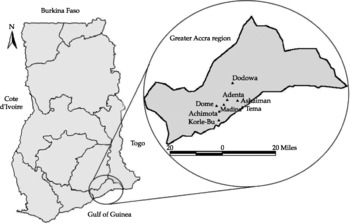
Larvae of A. gambiae s.s. were collected from breeding sites, comprising two urban sites (Tema and Korle-Bu), five peri-urban sites (Achimota, Adenta, Ashaiman, Dome and Madina) and one rural site (Dodowa) in the Greater Accra region (between longitudes 0°30′W and 1°E, and latitudes 5°30′N and 6°N) of Ghana. The co-ordinates of each collection point at the sites were recorded by GPS. A map of the collection sites is shown in Fig. 1. The larvae were brought to the laboratory and reared to adults.
Map of Ghana showing the localities in the Greater Accra region where mosquitoes were collected.

Bioassay
Twenty-five 1- to 3-day-old adult female A. gambiae mosquitoes were used for each bioassay test. WHO adult mosquito test papers with diagnostic doses of 1% permethrin (25:75 cis:trans) or 0.1% propoxur were used for the bioassay tests. A control using papers impregnated with Dow Corning 556 Silicone fluid was set up for each test. Knockdown (KD) of the mosquitoes during exposure was recorded at 10, 15, 20, 30, 40, 50 and 60 min after exposure. Observation of KD at an additional 20 min in the holding tube was recorded wherever KD at 60 min was less than 80%. Mortality was scored 24 h post-exposure. Four separate tests were conducted for each insecticide at each site except Dodowa, where only three tests were performed on each insecticide.
Molecular studies
The polymerase chain reaction was used to identify A. gambiae s.l. mosquitoes from each population (Scott et al., Reference Scott, Brogdon and Collins1993) and to identify the presence of the kdr mutation in survivors of bioassays and individual mosquitoes from the general population (Martinez-Torres et al., Reference Martinez-Torres, Chandre, Williams, Darriet, Bergé, Devonshire, Guillet, Pasteur and Pauron1998). DNA extraction was performed using a previously described protocol (Collins et al., Reference Collins, Mendez, Razmussen, Mehaffey, Besansky and Finnerty1987).
Data analysis
Abbott's formula (Abbott, Reference Abbott1925) was used to correct for natural mortality whenever control mortality was between 5 and 20%. The WHO criteria for determining resistance status were applied, i.e. 98–100% mortality indicates susceptibility, < 80% mortality suggests resistance and 80–97% mortality requires confirmation of resistance (WHO, 1998). Probit analysis was used to determine the KD50 and KD95 times from the KD curves. Significance of differences between means was by Chi-squared test using SPSS version 10.01 for Windows (SPSS Inc., Chicago, IL, USA).
Results
Bioassay
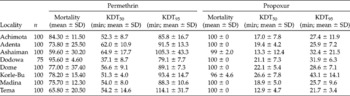
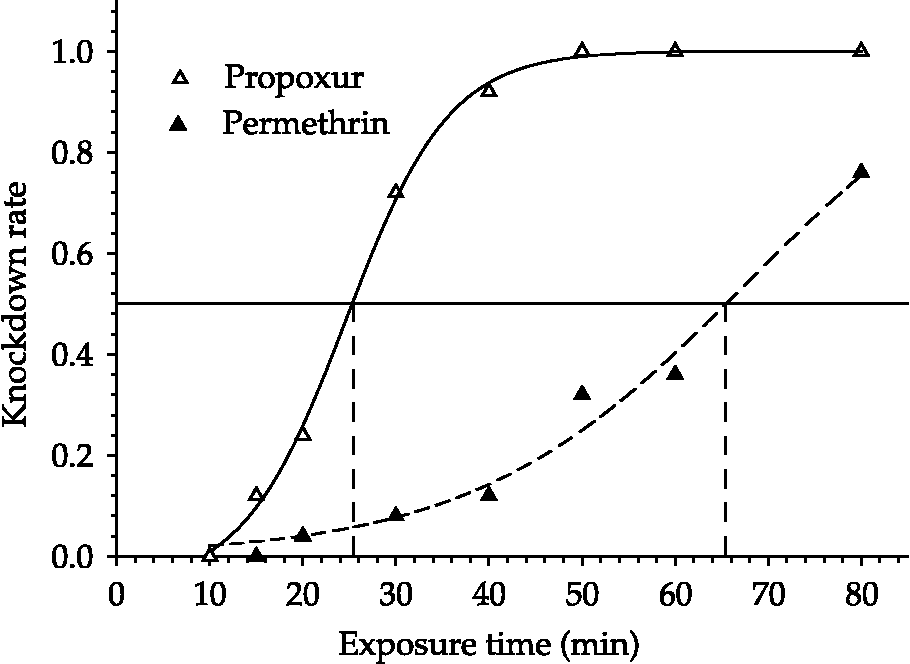
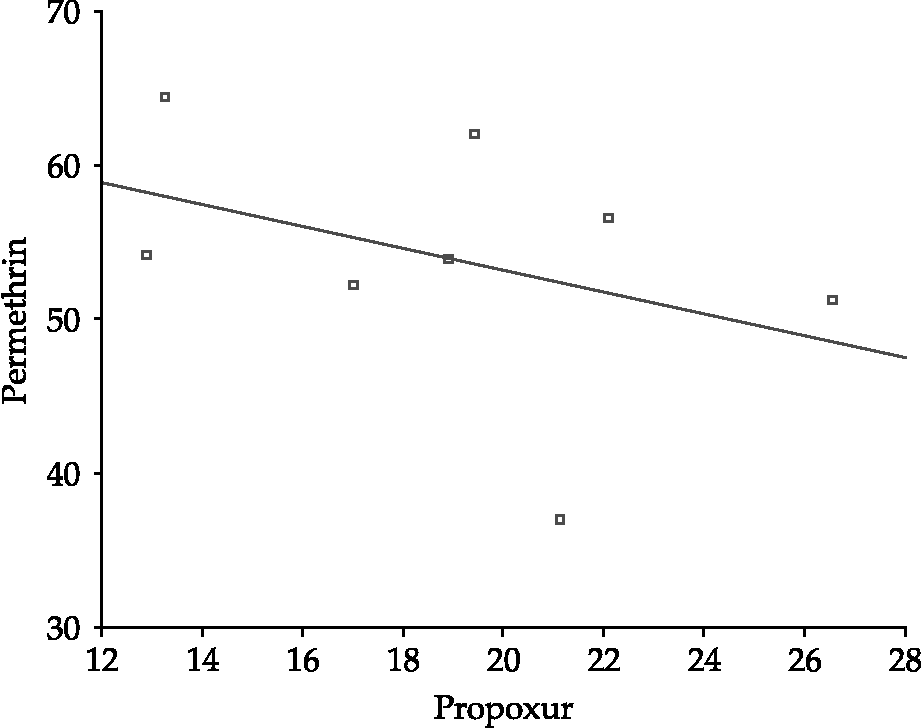
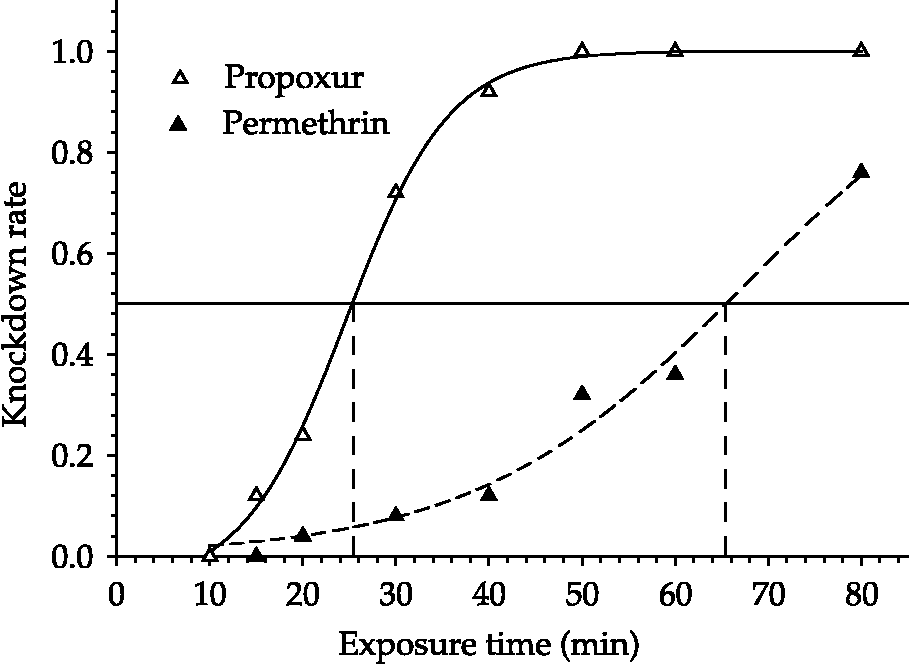
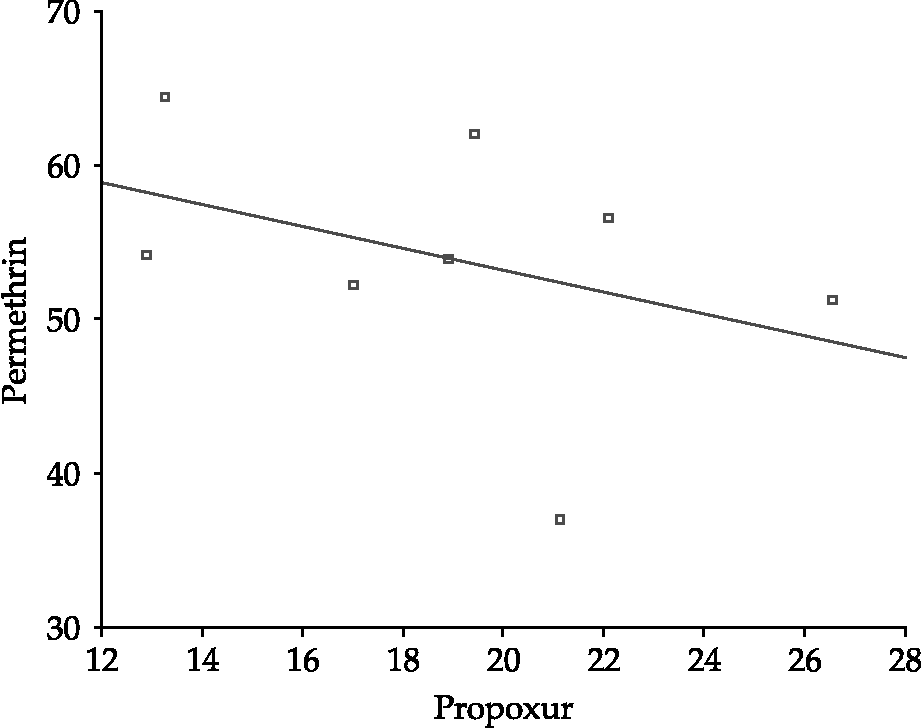
A total of 2325 mosquitoes were used for the bioassays. The control mortalities observed in all tests ranged between 0 and 12%. Where control mortality exceeded 5%, Abbott's formula was applied to correct for this. There was resistance to permethrin at all study sites except Dodowa, ranging from 59.6 to 84.3% mortality. In contrast, all the mosquito populations tested were susceptible to propoxur ranging from 92 to 100% mortality (Table 1). The mean KD50 and KD95 times recorded for permethrin and propoxur are shown in Table 1. Figure 2 shows a representative sigmoidal KD curve for permethrin and propoxur at one locality only. It was observed that, in general, the higher the mortality, the lower the KD times. The KD50 for permethrin was lowest at Dodowa and highest at Ashaiman. A comparison of the KD times for permethrin and propoxur indicated a negative correlation (r = − 0.405, P>0.05, n = 8) between the two insecticides (Fig. 3).
Corrected mortality (%) and knockdown times (KDT in min) obtained with permethrin and propoxur assays at the various study sites

Representative sigmoidal knockdown curves for permethrin and propoxur from Achimota, Ghana.
Correlation between KD50 times of permethrin and propoxur.
Molecular studies
A total of 150 morphologically identified A. gambiae mosquitoes that survived the bioassays were all found to be A. gambiae s.s. Out of a pooled total of 100 survivors of the permethrin bioassay (from all the sites except Dodowa), 79% had the kdr mutation, while 21% did not. Based on the mortality studies, we considered that the population in Dodowa was permethrin susceptible and the populations in the other sites were resistant. We compared the proportion of the kdr mutation in mosquitoes in these two general groups (Dodowa and other sites) that had not been exposed to bioassays. Two out of the 20 mosquitoes from Dodowa and 28 out of 50 of the pooled mosquitoes from other sites (urban Accra–Tema) possessed the kdr mutation. This difference between the two populations was significant (χ2 = 10.53, P = 0.001).
Discussion
The present study shows that there is resistance to permethrin in both urban and peri-urban areas of Greater Accra, but that populations in Dodowa, a rural site outside of Accra, remain susceptible. A recent study in some rural localities of southwest Ghana has also observed full susceptibility of A. gambiae s.s. to pyrethroids (Kristan et al., Reference Kristan, Fleischmann, Della Torre, Stich and Curtis2003). This indicates that the permethrin resistance in Ghana is not evenly distributed and thus necessitates an extensive study to map susceptibility to all pyrethroids used for the treatment of nets and other materials.
There was susceptibility to propoxur at all the sites, indicating that this insecticide could be an alternative to the existing pyrethroid insecticides. The relationship between resistance to permethrin (pyrethroid) and the susceptibility to propoxur (carbamate) was shown by the observed phenomenon of negative correlation between the two insecticides. Comparable relationships have been reported for pyrethroid and organophosphate insecticides (Kurtak et al., Reference Kurtak, Meyer, Ocran, Ouedraogo, Renaud, Sawadogo and Tele1987), giving rise to the hypothesis that negative correlation could be used for the management of resistance should the level of pyrethroid resistance become so high that they can no longer be used effectively. However, investigation of the phenomenon of negative cross resistance (Kolaczinski and Curtis, Reference Kolaczinski and Curtis2004) across different populations of Anopheles mosquitoes concluded that it is not a generalized phenomenon. This conclusion is supported by the observation that a high level of resistance to both propoxur and pyrethroids occurs at Obuasi, Ghana (Coetzee et al., Reference Coetzee, van Wyk, Booman, Koekemoer and Hunt2006).
On a population basis, the kdr mutation was significantly more common in the resistant urban and peri-urban mosquito than in the susceptible rural samples, suggesting that the kdr mutation may be an important resistance mechanism in the Greater Accra region. The proportion of mosquitoes carrying the kdr mutation was higher among the survivors of the bioassay relative to their proportion in the general populations in both the rural and urban areas. However, the finding that a substantial minority of the survivors of the permethrin bioassays did not possess the kdr mutation suggests that additional resistance mechanisms may be involved similar to observations in the Volta Region of Ghana (Kahindi, Reference Kahindi2005), Benin (Corbel et al., Reference Corbel, N'Guessan, Brengues, Chandre, Djogbenou, Martin, Akogbeto, Hougard and Rowland2007) and Nigeria (Awolola et al., Reference Awolola, Oduolaa, Strode, Koekemoer, Brooke and Ranson2008).
Conclusions
Impregnating bednets with permethrin may not be effective in all areas, and indoor residual spraying and treatment of insecticide-treated materials such as curtains and eave screens using propoxur may be an alternative in areas where pyrethroid resistance is a problem.
Acknowledgements
We thank Mr Samson Otoo and Mr Anthony Tetteh for their technical support during the collection of samples for this study. The authors are also indebted to the former Director of Noguchi Memorial Institute for Medical Research, Professor David Ofori-Adjei for permission to have this work published. The manuscript received expert improvements from Professor Maureen Coetzee. This study was supported with funds from the WHO/MIM and a DAAD student fellowship to Ms T.A. Adeniran.