In his 1989 classic film Do the Right Thing, Director Spike Lee explores how inequality and prejudice cause conflict in a racially divided community in New York on the hottest day of the summer. High temperatures make the characters in the film more easily agitated and this is used as a metaphor for the risk of escalating racial conflict in the United States. The message is clear: “On a normal day, tempers might be held in check, the harsh word left unsaid, but today, the hottest day of the year, it's meltdown time and all the emotional hydrants are opened wide.”Footnote 1
This is not just a metaphor. Uncomfortably high temperatures have been linked to aggressive or violent behavior (Anderson, Reference Anderson2001; Burke et al., Reference Burke, Hsiang and Miguel2015). This is not to suggest that this relationship is deterministic; context—politics, economics, and technology—should mediate the effect of climatic conditions on human conflict.Footnote 2 While isolating such mediating factors, we explore whether there is a direct connection between exposure to heat shocks and discriminatory behavior.
Drawing on data from two field experiments conducted in Germany, we show that high temperatures cause members of the majority population to discriminate more against Muslim immigrants in the context of every-day interactions in public spaces. We focus on discrimination in helping behavior, since helping strangers is widely considered a measure of pro-sociality (Saucier et al., Reference Saucier, Miller and Doucet2005) and we want to test the sensitivity of pro-sociality to temperature shocks. We show that excessive heat exposure results in discrimination that cannot be explained by the economic or political context or by instrumental or strategic motives. Our study suggests that there might be physiological triggers to ingroup bias and ethnocentrism (De Dreu et al., Reference De Dreu, Greer, Handgraaf, Shalvi, Van Kleef, Baas, Ten Velden, Van Dijk and Feith2010; Shalvi and De Dreu, Reference Shalvi and De Dreu2014; Aarøe et al., Reference Aarøe, Petersen and Arceneaux2017).
1. Thermic stress and ingroup bias
According to the thermic stress hypothesis, populations facing extreme heat without the economic resources needed to adapt to climate-induced stress will be affected by psychological and physiological mechanisms that predispose them to aggression and different forms of conflict. These negative impulses will be particularly felt with regard to outgoup members (Van de Vliert and Postmes, Reference Van de Vliert and Postmes2012; Hruschka and Henrich, Reference Hruschka and Henrich2013). One pathway is that extreme temperatures increase the costs of delivering benefits to others, particularly when helping others requires some degree of physical exertion. But the higher costs of helping are complemented by physiological changes in the body induced by heat stress. As the costs of helping behavior increase, pro-social behavior should decrease (Saucier et al., Reference Saucier, McManus, Smith, Sturmer and Snyder2010; House et al., Reference House, Silk, Henrich, Barretta, Scelzaa, Boyette, Hewlett, McElreathe and Laurence2012) unless the greater costs of helping are offset by altruistic motives. Such altruism is likely to be directed to ingroup members, consistent with social identity theory and socio-biological theories of the evolution of parochial altruism (Bowles, Reference Bowles2006; Bowles and Choi, Reference Bowles and Choi2007).
Previous studies of the consequences of heat stress for pro-social behavior have not focused on differences in behavior toward ingroup versus outgroup members. We hypothesize that the association between discrimination and high-temperature exposure is driven in part by biological mechanisms. Biological mechanisms are involved both in the processing of temperature and in regulating interpersonal warmth or trust (Kang et al., Reference Kang, Williams, Clark, Gray and Bargh2011). Oxytocin- and vasopressin-related systems can regulate social learning and behavior (Johnson and Young, Reference Johnson and Young2017) and oxytocin has been shown to generate ingroup bias and ethnocentrism (De Dreu et al., Reference De Dreu, Greer, Handgraaf, Shalvi, Van Kleef, Baas, Ten Velden, Van Dijk and Feith2010). Vasopressin-mediated behavioral responses can be triggered by heat stress in animal models and circulating levels of vasopressin have been shown to have antipyretic properties (Yong-Lu and Gordon, Reference Yong-Lu and Gordon2002), suggesting a biological basis for ingroup bias triggered by heat exposure.Footnote 3
As temperatures rise above a threshold that generates physical stress and discomfort, this stress causes physiological changes that could result in ingroup bias and it increases the costs of helping others (Belkin and Kouchaki, Reference Belkin and Kouchaki2017). We hypothesize that when helping behavior requires physical exertion, higher temperatures will reduce helping rates as individuals conserve resources to cope with physical stress; but we expect help toward outgroup members to decline by more than help to ingroup members. The higher costs of helping ingroup members could be offset by increased altruism, as per the extant literature on the evolution of parochial altruism (Bowles and Choi, Reference Bowles and Choi2007). The net effect, consistent with the predictions of the “cost-reward” model of helping (Saucier et al., Reference Saucier, Miller and Doucet2005), is that temperature shocks will result in increased discrimination, manifesting as more negative behavior toward the outgroup.Footnote 4
2. Experimental design
We extend the experimental design in Choi et al. (Reference Choi, Poertner and Sambanis2019) and related studies of helping behavior (Balafoutas et al., Reference Balafoutas, Nikiforakis and Rockenbach2014) to observe whether the degree of assistance offered to strangers who could be ingroup or outgroup members varies across a broad range of ambient temperature points, as naturally induced by within-day as well as across-day fluctuations during our data collection period.
2.1 Measuring discrimination using helping behavior
We analyze patterns of assistance (helping behavior) toward strangers during everyday social interactions. We use a standard definition of discrimination, measured as difference in helping behavior toward different categories of people on the grounds of ascriptive characteristics—in this case, ethno-racial or religious differences between native Germans and Muslim immigrants.
Our intuition that “helping behavior” can be a medium through which to observe discrimination is supported by previous studies that test for systematic differences in individual responses when ingroup or outgroup members ask for monetary donations (Bickman and Kamzan, Reference Bickman and Kamzan1973) or for medical assistance (Piliavin et al., Reference Piliavin, Rodin and Piliavin1969); or when they need help recollecting personal possessions (Balafoutas et al., Reference Balafoutas, Nikiforakis and Rockenbach2014) or finding lost items (Benson et al., Reference Benson, Karabenick and Lerner1976). We design a new intervention that places confederates in need of assistance in a setting that allows us to isolate specific features of the confederate's identity and measure the impact of that identity on helping rates.
The importance of studying discrimination in everyday interactions cannot be over-stated. Much of political science is focused on “big events”—elections, wars, treaties, or independence campaigns. Such events are important because they punctuate the equilibria of our everyday lives that are typically much less eventful. However, the usually less noticed—seemingly mundane—everyday interactions between immigrants and natives occur much more frequently and are usually more personal than those remote, “big events.” They can thus play an immensely important role in shaping our perceptions, biases, and behavior. If native-immigrant interactions are characterized by several, repeated small acts of mutual disappointment, hostility, and discrimination, these daily experiences could result in pervasive, lasting barriers to integration.
2.2 Experimental intervention
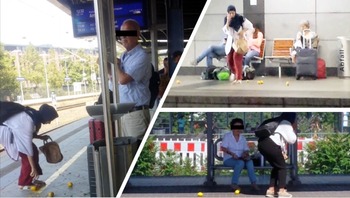
The experimental intervention itself proceeded as follows: a female confederate approached a bench at a train station where other individuals were waiting for their train and conducted a brief call addressing a friend regarding an innocuous personal matter (step 1). During this call, the confederate dropped fruit (oranges or lemons) from a paper bag that had seemingly torn at the bottom (step 2). The fruit dispersed and the confederate appeared to be in need of assistance to pick them up (step 3). We observed whether bystanders (German natives) helped the confederate pick up the fruit (step 4). A pictorial representation of this intervention is included in Figure 1.
Experiment in action.

The key dimension of the intervention—the confederate's perceived membership in the ingroup (German natives) or outgroup (Muslim immigrants)—was manipulated experimentally by randomly assigning a confederate with specific ethno-religious attributes: a Middle-Eastern immigrant wearing a hijab or a white German female.Footnote 5 We used several different actors (15 immigrants and 17 natives across 11 teams) and chose similarly aged confederates of comparable attractiveness and controlled for social class by having confederates wear similar attire across iterations.
Two design features of the intervention warrant note. First, the decision to manipulate the ethno-religious characteristics of the confederate stemmed from the fact that political actors and the media have framed the immigration debate in Germany and Europe around issues of religious difference and there is significant degree of Islamophobia. Previous studies using a similar experimental design have found evidence of discrimination against Muslims by German natives (Choi et al., Reference Choi, Poertner and Sambanis2019).
Second, we study the effect of temperature variation in a natural setting. Taking advantage of several unusually hot days during the summers of 2018 and 2019, we observe behavioral responses to the different treatment conditions across a large range of temperatures. Since the order of iterations was random both within and across days of fieldwork, temperature variation is exogenous and orthogonal to the treatment assignment. Thus, we can explore discrimination in helping behavior toward ingroup and outgroup members in an experimental design that is itself a measurement strategy focused on identifying the effect of temperature on behavior while abstracting from other possible causes of discrimination.
The interventions were conducted in 29 cities across four states (North Rhine-Westphalia, Lower Saxony, Saxony, and Brandenburg). We implemented a total of 1786 iterations of the intervention, involving 5205 bystanders in July/August 2018 and July/August 2019. The main outcome of interest, which was coded at the iteration level, was whether any bystanders offered assistance to the confederate. Enumerators took temperature measurements at the specific train platform using a digital precision thermometer immediately prior to the execution of each iteration.Footnote 6
2.3 Potential selection issues
In order to interpret the estimates of discrimination to be (partially) driven by temperature variation, one needs to assume that temperature variation does not substantially affect the characteristics of the bystander pool. While these concerns are hard to address directly, there is good reason to believe that they do not fundamentally threaten the validity of our inferences. First, many of the bystanders in our sample have little discretion as to whether and when to travel on the train because they have to commute to work or school at fixed times. Second, even with high outside temperatures, it is hard to predict the level of heat exposure in specific train stations at any given point time because the structure and sun protection vary significantly across stations. This is particularly true for non-commuters who only use trains infrequently.
To mitigate any remaining concerns about potential selection effects, we include rush hour and station fixed effects in our regression analysis, which narrows our inferences to within-station and within-time period variation. We find that our results do not substantively change with these modifications of the model. The “rush hour” fixed effects variable is particularly important to include in the model since it captures potentially unobserved differences among people who have to travel to/from work within a specific time interval each day regardless of ambient temperature. Additionally, we probe whether there is heterogeneity in the relationship between temperature and discrimination between iterations conducted during rush hour and other times of the day by including an interaction term between these three variables; the results show that there are no significant differences between the time periods (p-value = 0.22).
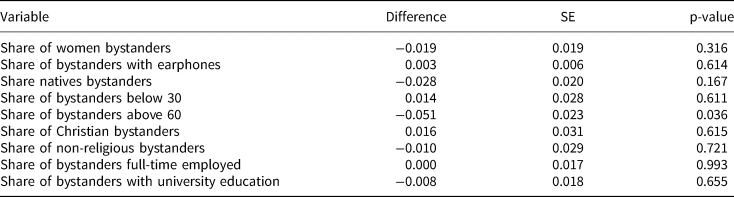
In order to further test for potential systematic differences in the composition of bystanders as a function of temperature, we use information about bystander characteristics obtained through enumerator observations and via a seemingly unrelated, post-intervention survey. Enumerators coding the behavioral outcomes of experimental interventions also coded some of the observable characteristics of the bystander pool at each iteration, such as the share of women, the share of bystanders with earphones, the share of younger versus older bystanders, and the share of natives versus immigrants, which was subjectively coded by our enumerators. Via post-intervention surveys of a random sample of bystanders, we also collected information on bystanders’ religion, their educational background and whether or not they had full-time employment. These variables are potentially correlated with unobserved differences in social preferences. In theory, temperature shocks might differentially affect the likelihood that people with differences in these characteristics would choose to travel on a given day. However, Table 1 shows that, while there is a minor imbalance for the share of bystanders above age 60, generally the differences in the observed covariates are negligible and not statistically significant. Models predicting bystander characteristics using the continuous temperature instead of the binary hot temperature measure, which we present here for its intuitive interpretation, demonstrate qualitatively identical results.
Balance tests: bystander characteristics: hot versus normal temperature

Models are estimated with linear regressions with rush hour, station, and number of bystander fixed effects. Standard errors are clustered at the station level.
Hot temperature: >25°C compared to <25°C (measured at the specific time and location of the intervention).
All variables are coded at the iteration level. Share women and share of bystanders with earphones were observed by enumerators for all iterations. In 2019, enumerators also estimated bystanders’ ages (age brackets) and whether they had an immigrant background or were natives. The variables mean age, share Christian, share non-religious, share full-time employed, and share w/ university draw on putatively unrelated, post-intervention surveys of random samples of bystanders.
3. Results
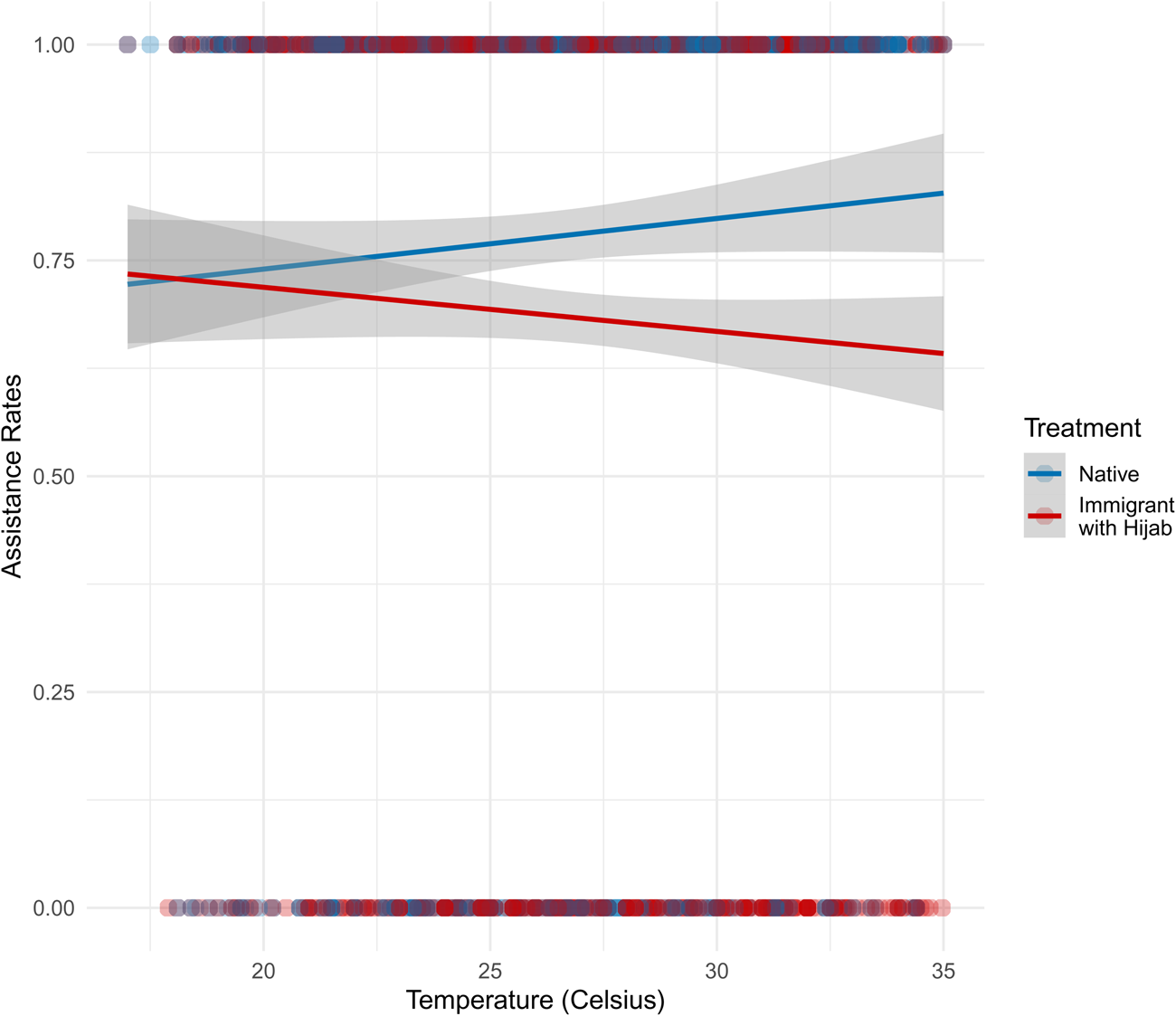
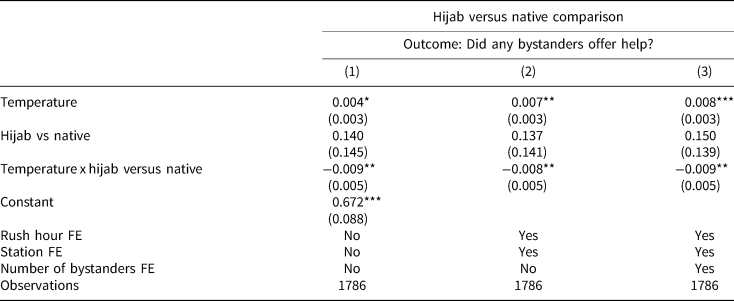
We hypothesized that bystanders would become more biased against outgroup members (immigrants with hijab) relative to ingroup members (natives) with increasing temperatures.Footnote 7 The baseline level of help across treatment conditions is high, consistent with the low-cost nature of the helping behavior we study and reflecting prevalent norms of politeness and kindness toward strangers. Yet we find clear evidence in support of our expectation of discrimination against Muslims. Figure 2 shows that there is separation in helping behavior toward ingroup and outgroup members (see Figure S5 in the appendix for a graph showing LOESS curves). With increasing temperatures, we observe an increasing gap in help rates, indicating more discrimination against Muslims (see Table 2). Our analysis is robust to including controls for possible unobserved differences across states/stations, times of day (rush hour), and number of bystanders (during any iteration). Standard errors are clustered at the station level.
Help rates to natives or immigrants with hijab by temperature level with linear trend lines. The shaded areas around the fitted trend lines show 95% CIs.

Help behavior by temperature

Estimated with linear regression. Standard errors (clustered at the station level) in parentheses. *p < 0.1; **p < 0.05; ***p < 0.01, one-tailed test.
The temperature variable measures the absolute temperature (in °C) at the specific time and location of the intervention.
Increased bias could result from more positive behaviors toward ingroup members (parochial altruism), more negative behaviors toward outgroup members (outgroup bias), or both. We find suggestive evidence of both. First, there is some evidence of a slight increase in positive behavior toward ingroup members (a 1°C increase in temperature is associated with a 0.39 percentage point increase in help behavior toward natives (t = 1.29, p < 0.1, one-tailed)). Second, we observe a decrease in help behavior toward outgroup members (a 1°C increase in temperature is associated with a 0.48 percentage point decrease in help behavior toward outgroup members (t = −1.36, p < 0.1, one-tailed)).
The extent to which any given temperature induces stress in humans is a function of what temperatures are considered “normal” at a particular location (Burke et al., Reference Burke, Hsiang and Miguel2015). Thermic stress is induced when the temperature “feels” hot. For this reason, we also analyze help behavior above and below a cut-off of 25°C, which is a critical temperature in this context. Even during hot years, the average annual temperature for Germany, rarely ever exceeds 10°C (Kachelmann, Reference Kachelmann2020). In fact, even during the hottest months of the year, the average daily high temperature that Germany experiences is merely 20, 21.8, and 21.7°C during June, July, and August, respectively (RTL, 2020). For this reason, numerous German states specify temperatures at around 25° as a threshold for canceling school classes: among the states in our sample, for example, Sachsen and Brandenburg specify thresholds of 25 and 26°C, respectively, for (hitzefrei) (literally translated, “heat free”) (Kramer, Reference Kramer2019). Looking at this heat threshold of 25°C, we observe a similar picture: when people face hot temperatures, the gap in help behavior toward immigrants wearing a hijab versus natives widens: assistance toward outgroup members is 9.22 percentage points lower than for ingroup members (t = −2.44, p < 0.01, one-tailed) (see Table S2 in the SI appendix).
4. Conclusion
We created an intervention that allowed us to test whether temperature shocks could explain discrimination against outgroup members while abstracting from common situational factors that influence helping behavior. By observing how unsuspecting bystanders treat native and immigrant confederates in a natural setting, we showed that heat stress increased discrimination against outgroup members (Muslim immigrants). Set against the background of global warming, this finding has sobering implications if heat shocks become more prevalent in the future. As humans are adaptable, they may become more resilient as average temperatures increase, but deviations from temperatures that are considered normal will increase the scope of discriminatory behavior.
As with any experimental approach, the results presented here are specific to the situation examined and we cannot know for certain whether our results would generalize to other types of behaviors, though we believe they should. Prior research suggests that different forms of helping behavior are correlated and we do not believe that the effects of heat stress on helping are limited to behaviors that involve physical exertion. It is certainly true, as mentioned earlier, that the costs of helping a stranger pick up her groceries would be higher as temperature rises, but the physical exertion required to pick up an orange or a lemon are minimal. We would expect baseline levels of helping behavior to drop if helping becomes harder or costlier, so perhaps we would observe larger effects of heat stress in types of behaviors that require more physical exertion. However, there are biological mechanisms identified in prior literature that connect high temperatures to ingroup bias and these mechanisms are independent of the degree of physical exertion required to help others. These mechanisms are consistent with some of our results—notably the observation that help toward ingroup members does not decline as temperatures increase. It is possible that these biological mechanisms (generated by hormonal changes induced by heat stress) could explain higher pro-sociality toward ingroup members, while the increasing costs of helping behavior under conditions of physical stress could explain the reduction of help toward outgroup members.
Our research design does not allow us to establish the precise mechanism underlying the effects we identify, but the overall pattern we have described should generalize to other behaviors subject to important scope conditions. One condition is that in our setup people are making quick judgements and decisions to help others are likely instinctive rather than deliberative. Thus, our results might not be directly applicable to situations involving higher-order decisions, or situations in which experimental subjects have more time to reflect on the situation before reacting. It is possible that temperature-induced biases might not show up if helping behavior is not instinctive and if the effect of heat stress on the body is counteracted by contemplative responses to everyday situations. Our results might also not be applicable to situations where helping behavior involves collective action. Finally, the effect of heat shocks need not generalize to situations where economic variables/technology could mediate the relationship between climatic conditions and human behavior. To the extent that policy interventions can be designed to shield individuals from the effects of extreme climatic events, the mechanisms proposed in this study would be counteracted and conflict could be avoided.
Acknowledgments
We thank Vivian Bronsoler Nurko, Thad Dunning, Don Green, Dan Hopkins, LaShawn Jefferson, two anonymous reviewers, as well as participants at the University of Pennsylvania, Carnegie Mellon University, Ohio State University, and UC Berkeley for valuable comments and suggestions. We are also grateful to our excellent team of 52 confederates and enumerators for their assistance in the implementation of these experiments. The research protocol was reviewed and approved by the University of Pennsylvania Institutional Review Board (IRB Protocols #829824 and #833206).
Supplementary material
The supplementary material for this article can be found at https://doi.org/10.1017/psrm.2021.17.