





Introduction
Crypto airdrops, the distribution of free tokens to users who engage with blockchain platforms, have become one of the most widespread practices in the contemporary crypto-financial ecosystem. While these airdrops have often been framed as marginal, technical exercises in token distribution, their footprint on social media platforms is vast: across the seven Layer 2 campaigns included in our dataset we identify 11,000 YouTube channels hosting nearly 40,000 videos, tens of millions of engagement signals, and dense patterns of Telegram coordination, forming a transnational, multilingual subculture (English, Vietnamese, Hindi, Turkish, Portuguese, and more). Promoted as tools for decentralisation, community-building, and early adoption, airdrops have become a central mechanism through which users are incentivised to participate in blockchain projects. Yet beyond their technical function, airdrops are profoundly cultural and social: they mobilise user labour, visual narratives, and platform dynamics to generate value and legitimacy for emerging tokens. This phenomenon sits at the nexus of digital culture and finance. Its scale signals not only the growing scale of participation in crypto enthusiasm, but also the way in which platforms now organise financial participation as everyday cultural practice, well beyond the boundaries of self-identified crypto communities (Swartz, Reference Swartz2020; Komporozos-Athanasiou, Reference Komporozos-Athanasiou2022).
In this article, we investigate crypto airdrops as key sites for examining the embedding of finance into digital cultures. We argue that airdrops exemplify a broader transformation of the nature of financial participation, from high-risk speculation towards a structured, platform-mediated, and culturally-embedded form of digital labour. We call this configuration post-speculative finance, a term we use to mark a structural rather than temporal shift. Speculation has not been displaced; its logic has been reorganised around sustained participation. Whereas classical speculation hinges on discrete bets on the future states of prices, post-speculative finance binds the prospect of a reward to ongoing communicative, computational, and affective labour performed across blockchains and social platforms. Following Komporozos-Athanasiou (Reference Komporozos-Athanasiou2022), we view this as the latest mutation of the ‘speculative community’: a setting in which uncertainty itself is collectively produced and managed through sustained participation, rather than absorbed by individuals as a discrete risk. While much academic and industry literature has investigated the economic rationale behind airdrops and their technical optimisation, less attention has been paid to the everyday practices which surround airdrops, and the role they play in cultural production, even though finance is increasingly understood as culturally embedded in social and moral orders. Existing research tends to examine tokenomics, user incentives, or blockchain protocols (Allen et al., Reference Allen, Berg and Lane2023; Messias et al., Reference Messias, Yaish and Livshits2023), or rely on macro-level data correlations across social media and market prices (Tandon et al., Reference Tandon, Revankar, Palivela and Parihar2021). In contrast, this paper shifts the analytical focus to the sociotechnical labour of participation: the work of engaging, signalling, documenting, and navigating airdrop opportunities across platforms like YouTube and Telegram.
To this end, we adopt a Web2-centric lens, studying cultures of engagement and governance through mainstream social media rather than blockchain-native environments (e.g., Discord or on-chain dashboards). This perspective foregrounds how legacy Web2 infrastructures continue to scaffold the visibility, sociality, and perceived legitimacy of Web3 projects, drawing on approaches from digital sociology which emphasise the continuities between online platforms and social life (Marres, Reference Marres2017). In acknowledging these continuities, we address a key gap in blockchain studies, which often overstate the autonomy of decentralised infrastructures while underplaying their entanglement with established platforms and digital publics, as well as with the regulators and governments that shape blockchain ecosystems (Faria, Reference Faria2021). Drawing on digital methods and quali-quantitative analysis, we examine seven Layer 2 (L2) blockchain projects whose airdrops were widely discussed on YouTube and Telegram between 2022 and 2024. Our analysis combines visual vernacular mapping and engagement peak detection to uncover how airdrops generate financial sociality – how they mobilise users, distribute tasks, and signal value through digital cultures.
Our investigation is guided by two research questions: (1) What insights can be gained about the airdrop hunter community by analysing engagement peaks, content creator dynamics, and the volume of participatory channels?; and (2) How do image composition and communicative practices in airdrop content shape digital cultures of finance, and what do they reveal about user agency in crypto-financial participation? Our findings suggest that airdrops produce structured, tactical, and labour-intensive engagement practices that blur the boundaries between financial investment, cultural production, and gamified attention economies. This form of participatory finance is performative and recursive: it depends not only on technical eligibility criteria, but on visible signs of commitment – tasks accomplished on-chain, on social media, and in Web3 gaming – which reinforce a project’s perceived legitimacy. Through these practices, airdrops reconfigure financial subjectivity around digital labour, while simultaneously reproducing the speculative logics they claim to transcend.
In what follows, we first provide a brief overview of the history and mechanics of blockchain infrastructures, with a focus on the evolution of token-based rewards (airdrops). We then situate our contribution within the literature on crypto-finance, platformised cultures, and the performativity of financial infrastructures and legitimacy. Our theoretical framework interrogates how airdrops operate as sociotechnical devices of value construction and community governance. Next, we detail our methodological approach before presenting our findings, which centre on engagement dynamics and visual–narrative repertoires on YouTube and Telegram, measured at the level of unique channels, videos, groups, and users. We conclude by reflecting on the implications of our study for understanding the evolving relationship between finance, digital labour, and governance imaginaries in the crypto space.
Situating airdrops: Infrastructures, incentives, and digital cultures
Blockchain infrastructures and airdrop practices
Blockchain systems are distributed, append-only ledgers that store transactions across a decentralised network. These transactions are grouped into blocks, ordered chronologically, and cryptographically linked to one another (Figure 1). Different consensus mechanisms, such as Proof-of-Work and Proof-of-Stake, validate these transactions, ensuring the integrity of the data. Ethereum, a key programmable blockchain, introduced ‘smart contracts’: self-executing programmes that enable decentralised applications (dApps) and token economies. However, scalability issues persist, prompting the rise of Layer 2 (L2) solutions. These operate on top of Layer 1 blockchains, processing transactions off-chain while maintaining security through periodic settlement on the main chain. Within the L2 ecosystems examined here, airdrops sit at the application layer, using smart contracts to distribute tokens and organise forms of user participation around these blockchain infrastructures.
Blockchain infrastructure and ecosystem layers, with airdrops as an example application.

Figure 1. Long description
A diagram of the blockchain infrastructure and ecosystem layers, with a focus on airdrops as an example application. The diagram is divided into several layers: Application Layer, Contract Layer, Incentive Layer, Consensus Layer, Network Layer, and Data Layer. Each layer is represented by a series of blocks (Block 0, Block 1, Block 2) connected horizontally, indicating the flow of information. The Application Layer includes user-facing interfaces and airdrops. The Contract Layer involves smart contract logic and execution. The Incentive Layer deals with token economics and rewards. The Consensus Layer ensures agreement on the state of the chain. The Network Layer facilitates peer-to-peer communication. The Data Layer handles storage and access to blockchain data. Arrows and icons illustrate the interaction between these layers and the overall network infrastructure.
Airdrops have emerged as a prevalent token distribution method within these systems. In essence, an airdrop involves distributing cryptocurrency tokens to users who fulfil certain criteria – such as performing on-chain transactions (staking, swapping, bridging), using a platform, or engaging in online communities (Figure 2). Technically, this is executed via smart contracts, but socially and economically, airdrops operate as incentivised campaigns to foster user adoption, visibility, and legitimacy. They turn interaction into a form of labour, wherein users invest time, on-chain transactions, and effort in exchange for prospective value. Tasks may include joining Telegram groups, using testnets, creating content, or simply maintaining a presence within specific wallet ecosystems.
Understanding what airdrops are.

Rather than representing a form of generosity, airdrops are performative mechanisms tied to marketing, legitimacy-building, and platform governance. They convert attention and activity into assetised participation, aligning with broader logics of platform capitalism (Gerlitz and Helmond, Reference Gerlitz and Helmond2013; Birch, Reference Birch2017). This evolution repositions the user from a passive recipient to a tactical actor, often termed an ‘airdrop farmer’. Farmers use Telegram bots, watch YouTube tutorials, and develop strategies to maximise eligibility and gain, underscoring the cultural and labour-intensive nature of what is framed as a ‘free’ reward.
Importantly, airdrops are entangled in platform cultures. Airdrop activity operates beyond applications native to blockchain environments like on-chain dashboards. They thrive across Web2 infrastructures such as Discord, X, YouTube, and Telegram, which scaffold user engagement and amplify airdrop campaigns, helping circulate guides, feedback, and rumours. The role of such platforms illustrates how decentralised finance remains embedded within legacy infrastructures, blending the ideals of decentralisation with familiar modes of visibility and algorithmic curation. Airdrops are far from a niche enthusiast practice: their cross-platform footprint spans tens of thousands of channels and tens of millions of engagement signals (see ‘Community dynamics and engagement peaks’), placing them squarely within the wider repertoires of platform-mediated financial participation this paper examines.
Economic and cultural logics of airdrops
The symbolic appeal of airdrops draws from their metaphorical roots in military provisioning: assets are seemingly dropped from the sky into the hands of recipients. However, this framing masks the structured, often repetitive labour behind participation. Users engage in actions that are monitored, recorded, and evaluated for eligibility, despite airdrops being depicted in a way which emphasises spontaneity and generosity over labour and productivity. Legal discourses reinforce this contradiction: to avoid classification as employment or regulated financial distribution, projects rhetorically cast airdrop tasks as voluntary, communitarian contributions.
This ambiguity reflects wider themes in platform capitalism. Participation is encouraged, even essential, but its productive character is often obscured. Users perform marketing, outreach, and even governance tasks, while compensation is never guaranteed. Airdrops thus inhabit a legally and symbolically ambiguous zone, extracting value from users while presenting themselves as gifts.
Airdrops function as narrative devices in crypto’s cultural story, illustrating how financial instruments gain traction through symbolic legitimacy (Nieborg and Poell, Reference Nieborg and Poell2018; Zook and Blankenship, Reference Zook and Blankenship2018). By crafting community myths, success stories, and user-led tutorials, airdrop campaigns embed new tokens in digital culture. These practices help to stabilise a token’s value via collective belief and routine participation rather than any intrinsic property. This performative construction of ‘moneyness’ (Hayes, Reference Hayes2021) aligns with the notion of speculative communities, wherein shared narratives and collaborative engagement actively generate financial meaning (Komporozos-Athanasiou, Reference Komporozos-Athanasiou2022).
Crypto-finance has shifted from pure speculative investment toward participatory, platform-based media practices, a configuration we call post-speculative finance. The promise of financial inclusion and autonomy – amplified by post-2008 anti-bank sentiment (Campbell-Verduyn and Hütten, Reference Campbell-Verduyn and Hütten2019) – echoes fintech narratives of democratisation (Gabor and Brooks, Reference Gabor and Brooks2017). Yet airdrops show that such promises rest on layers of technical gatekeeping and user labour: what appears egalitarian in rhetoric is underpinned by platform-driven eligibility requirements and complex tasks. These participation mechanics often reinforce existing hierarchies and exclusions, including gendered gaps in who engages with crypto-financial communities (Henshaw, Reference Henshaw2023; Náñez Alonso et al., Reference Náñez Alonso, Jorge-Vázquez, Arroyo Rodríguez and Sastre Hernández2023).
Sociotechnical dynamics and airdrop design
Recent empirical studies underscore the complexity of designing effective airdrops. Allen (Reference Allen2024) argues that airdrops should be understood as co-evolutionary mechanisms, through which projects and users adapt iteratively to each other’s behaviours. Projects deploy multi-stage campaigns to retain interest and deepen commitment; users adapt strategies to optimise outcomes, often across multiple wallets and identities.
Allen et al. (Reference Allen, Berg and Lane2023) identify the dual purpose of airdrops: user acquisition and token decentralisation. Yet these goals are frequently undermined by opportunistic behaviours, especially short-term speculation and abandonment post-reward. To mitigate these issues, best practices such as delayed token vesting, conditional allocations, and on-chain behaviour assessments are being implemented. Messias et al. (Reference Messias, Yaish and Livshits2023) find that without such controls, token value and user engagement quickly degrade.
Community role stratification also plays a critical role in explaining divergences in the outcomes of airdrops. Fan et al. (Reference Fan, Min, Wu and Cai2023) propose a taxonomy distinguishing between altruistic and profit-driven users. Their findings suggest that users who earn higher rewards tend to exhibit more constructive behaviours, including content creation and governance participation. These insights emphasise the need for thoughtful reward calibration that aligns with community-building rather than mere extraction.
Analytic firms and platforms have further contributed to the institutionalisation of airdrops by designing tools to shape engagement and user behaviour. One example of this dynamic is the collaboration between Nansen, a blockchain analytics firm, and blockchain platform Arbitrum, which aimed to develop precise eligibility filters and utilise blockchain analytics to disqualify suspected ‘farmers’ and focus on genuine contributors (Nansen, 2023). This form of algorithmic classification sorts users into categories of worth (Fourcade and Healy, Reference Fourcade and Healy2017). While this project improved post-airdrop engagement, it also introduced new exclusionary dynamics. Similarly, OneClick.fi’s study of 15 airdrop campaigns concluded that engagement is higher when participants must complete follow-up tasks, such as staking or governance voting. Yet such requirements may alienate newcomers or less tech-savvy participants, suggesting a tension between depth of engagement and accessibility (OneClick.fi, 2024).
Airdrops thus operate as socio-technical instruments that reflect and reinforce platform governance norms. They structure user behaviour through encoded incentives while simultaneously relying on social media amplification, community validation, and visual culture.
Theoretical framework: Governance, economisation, and digital financial subjectivity
Within our theoretical framework, airdrops exemplify a shift towards post-speculative finance: a mode of participation in which speculation persists but is reorganised around prescribed labour, prolonged engagement, and platform-mediated legitimation. The term names a structural reconfiguration of the speculative act, not its disappearance.Footnote 1 Whereas classical speculation hinges on individuated bets on future prices, its post-speculative form binds eligibility for a possible reward to communicative, computational and affective labour distributed across blockchain interfaces and social platforms. Rather than simply placing trades, participants perform networked tasks (wallet interactions, content production, community moderation) to generate anticipated value. This recasts airdrops as participatory rituals (Muniesa, Reference Muniesa2014) in which financial subjectivity is produced through sustained engagement rather than risk-taking alone. In this register, airdrop hunters emerge as a new kind of financial subject, similar to Preda’s (Reference Preda2001) ‘popular investor’, but acting now as part-educator, part-prosumer (Arvidsson, Reference Arvidsson2013), and part-communicative-worker (Wang, Reference Wang2022) in actively producing the conditions under which a token’s value can be realised.
In this post-speculative paradigm, legitimacy and value emerge through social performance and continuous learning rather than one-off market bets. Financial value is constituted by social practice (Maurer, Reference Maurer2006; Hayes, Reference Hayes2021), and airdrops exemplify this: user labour, memes, tutorials, and social proof collectively convert tokens from mere code into networked assets with cultural resonance. At the same time, participation demands constant knowledge acquisition, echoing Thrift’s (Reference Thrift2005) notion of ‘knowing capitalism’. The mantra ‘doing your own research’ has effectively turned financial engagement into ongoing epistemic labour amid conditions of information overload (Andrejevic, Reference Andrejevic2013), as airdrop hunters navigate Telegram channels, YouTube videos, and analytics dashboards, continually updating their strategies based on community wisdom and evolving eligibility criteria.
To theorise this complexity, we adopt the framework of stacked economisation (Caliskan et al., Reference Caliskan, MacKenzie and Callon2025). Value production in airdrops operates across interrelated layers:
-
• Protocol layer: Smart contracts define eligibility and enforce distribution.
-
• Platform layer: YouTube and Telegram structure attention, algorithmically amplifying specific messages.
-
• Interface layer: Bots, tutorials, and dashboards shape user pathways, creating scripts for participation (Tkacz, Reference Tkacz2019).
-
• Discursive layer: Cultural narratives, memes, and community lore stabilise legitimacy and motivate labour.
Each layer performs a different kind of economisation: protocols economise access, platforms economise visibility, interfaces economise interaction, and discourse economises legitimacy. Together, they coordinate financial activity in ways that are not reducible to technical design or speculative logic alone.
One of the key claims that this paper makes is that the labour sustaining post-speculative finance is not generic engagement but a specifically communicative form of work. We use the term ‘communicative labour’ in the precise sense developed by Wang (Reference Wang2022), who reframes digital affective and circulatory labour as the production of rhetorical effects that move capital. This builds on a longer rhetorical-economic tradition. McCloskey’s (Reference McCloskey1985) argument that economic claims are constituted through persuasion, and Aune’s (Reference Aune2001) analysis of how ‘free-market’ speech reshapes the very domain it purports to describe both find contemporary instantiation in the way in which airdrop campaigns make ‘voluntary contributions’ meaningful and profitable. Our account also extends Terranova’s (Reference Terranova2000) account of free digital labour by foregrounding its rhetorical register: airdrop participants do not merely produce attention or data; they produce legitimacy effects – explanations, endorsements, exemplary participation, narrated success – that render a token eligible to circulate as money (Swartz, Reference Swartz2020; Hayes, Reference Hayes2021). What is rhetorically cast as community is, in operational terms, distributed marketing, governance, and reputational work, none of which is paid in advance and much of which never accrues to those who perform it. This rhetorical-economic register is what makes the ‘voluntary contribution’ framing legally and culturally durable: it disguises demands for work which might qualify as wage labour in the language of gift, fellowship, and self-investment, in line with broader logics of platform capitalism (Srnicek, Reference Srnicek2017; Couldry and Mejias, Reference Couldry and Mejias2019).
Decentralisation and governance contradictions
Airdrops are framed as democratising tools which disperse power and ownership. Yet project teams retain significant control over designing tasks, determining eligibility criteria, and executing distribution. This centralised gatekeeping contradicts the rhetoric of decentralisation (Plantin et al., Reference Plantin, Lagoze, Edwards and Sandvig2018). Even within supposedly open systems, token allocation is often skewed towards early adopters or ‘power users’ (Messias et al., Reference Messias, Pahari, Chandrasekaran, Gummadi and Loiseau2024).
Efforts to address this include anti-Sybil mechanisms and tiered rewards, but these also introduce new complexities. Projects walk a fine line between protecting legitimacy and alienating potential users. The requirement for technical fluency, available time, and on-chain presence creates barriers, privileging those already embedded in crypto cultures.
Community, prosumerism, and platform labour
Airdrop communities exemplify the productive paradox of digital labour first named by Terranova (Reference Terranova2000): they host activity that is at once voluntary and structurally compelled, recreational and value-producing, autonomous and incorporated into platform circuits of accumulation. The figure of the prosumer (Ritzer and Jurgenson, Reference Ritzer and Jurgenson2010) is, in this context, sharpened by the speculative wager that binds it: participants produce content, knowledge, and exemplary participation in the expectation that these activities will retroactively be recognised by the project as labour worth rewarding. Arvidsson’s (Reference Arvidsson2013) account of productive publics – communities whose collective sense-making generates value precisely because it is not coordinated by an employment relation – provides perhaps the closest fit for this dynamic. Whereas the productive public of a brand community generates affective surplus that circulates as goodwill, however, the productive public of an airdrop community generates surplus that circulates as legitimacy, and may, conditionally, be converted into tokens. This adds a distinctive financial-incentive register to ongoing debates on digital labour and prosumer culture (Scholz, Reference Scholz2013; Fuchs, Reference Fuchs2014). Here, work is not merely unpaid, but speculatively paid, and this conditionality is itself a central mechanism of governance.
Users generate value by creating content, sharing knowledge, and signalling commitment. Meme creation, tutorial production, and social policing (e.g., shaming ‘dumpers’) form a cultural infrastructure around token economies. These processes reinforce platform legitimacy, embedding tokens within affective networks of belief and participation. Airdrops are performative rituals that signal inclusion and reward. As Muniesa (Reference Muniesa2014) notes, economic rituals do not merely reflect value but help to create it. Distributing tokens to thousands of users projects an image of decentralisation, reinforcing perceived legitimacy. Yet, this image can backfire. Opportunistic behaviour – such as multiple wallet farming and rapid sell-offs – can destabilise trust.
Proposed solutions include vesting schedules and task-based bonuses. However, these too must strike a balance between complexity and usability. At their best, airdrops function as legitimacy-building devices that align community behaviour with governance objectives. At their worst, they devolve into speculative gimmicks that expose rather than resolve the fragility of decentralised finance (Gudgeon et al., Reference Gudgeon, Perez, Harz, Livshits and Gervais2020).
Ultimately, airdrops exemplify a post-speculative mode of finance that is as much a cultural performance as a technical exercise. They crystallise the entanglement of code, labour, and community in the construction of financial value, underscoring the need to interrogate not just what finance does, but how it is felt, enacted, and lived in digital spaces. By foregrounding these sociotechnical dynamics, we extend current debates on digital finance, platformisation, and financial cultures to account for the emergent social logics and subjectivities shaping participatory finance. Viewed through this lens, airdrops are not mere crypto gimmicks but harbingers of a broader transformation in how financial practices are collectively performed and governed.
Methods
This section first introduces the seven Layer 2 (L2) airdrops that are the object of our study. We justify the relevance of YouTube and Telegram – the web environments from which we draw our data – for studying crypto finance practices and present a dataset overview, discussing its representativeness and characteristics in digital methods research. We then outline a chain of four digital methods: query design, dataset building, navigational procedure and visual models. In order to ensure their reproducibility, we describe the iterative procedures and techniques implicated in this chain in a level of detail rarely undertaken in the existing literature. Methodologically, our work extends research on blockchain and social media (Omena et al., Reference Omena, Messias, Cossu, Gouveia and Falcão2024a) by advancing a quali-quantitative approach (Venturini, Reference Venturini, Felt and Irwin2024) to reproducible digital methods and by foregrounding a situated approach to data analysis (D’Ignazio and Klein, Reference D’Ignazio and Klein2020; Rettberg, Reference Rettberg2020). This approach stands in contrast to the large-scale data perspectives that dominate blockchain research (Li and Palanisamy, Reference Li and Palanisamy2019; Zilius, Spiliotopoulos & Van Moorsel, Reference Zilius, Spiliotopoulos and Van Moorsel2023).
Situating the cross-platform study of crypto airdrops
Our study focuses on seven L2 airdrops (Table 1) identified through DappRadar’s ranking.Footnote 2 The airdrops are categorised by whether they are organised around retroactive or future action. Starknet, Optimism, and Taiko are retroactive airdrops that reward prior activity; Arbitrum, Celestia, Polyhedra, and ZKsync are future airdrops that require ongoing task completion. The airdrop list supports the exploration of the temporal and cultural logics of airdrop farming and how they manifest across YouTube and Telegram.
List of crypto airdrops.

Table 1. Long description
A table categorizing seven blockchain airdrops by type, network, token, and company. The table has two grouped rows: Future actions and Retroactive actions. It contains four columns: Airdrop type, Blockchain network, Token, and Company behind airdrop. Row 1: Airdrop type, Future actions; Blockchain network, ZKsync; Token, ZK; Company behind airdrop, Matter Labs. Row 2: Airdrop type, Future actions; Blockchain network, Arbitrum; Token, ARB; Company behind airdrop, Offchain Labs. Row 3: Airdrop type, Future actions; Blockchain network, Polyhedra; Token, ZK; Company behind airdrop, Polyhedra Network. Row 4: Airdrop type, Future actions; Blockchain network, Celestia; Token, TIA; Company behind airdrop, Celestia Foundation. Row 5: Airdrop type, Retroactive actions; Blockchain network, Optimism; Token, OP; Company behind airdrop, Optimism Foundation. Row 6: Airdrop type, Retroactive actions; Blockchain network, Taiko; Token, TKO; Company behind airdrop, Taiko Labs. Row 7: Airdrop type, Retroactive actions; Blockchain network, Starknet; Token, STRK; Company behind airdrop, Starknet Foundation.
For airdrop hunters, YouTube offers curated content and evaluations of which airdrops are worth pursuing, including video tutorials on how to farm and become eligible. Telegram serves as an emerging environment for automation and real‑time dialogue. Bots such as CosmosPUG and Farmer FriendsFootnote 3 streamline airdrop farming, while engines like TeletegFootnote 4 reveal Telegram’s role as a hub for airdrop-related groups and channels (Figure 3).
Example of an airdrop community on Telegram (A) and how to stay updated using Telegram bots (B).

Airdrops dataset overview and representativeness in digital methods research
Table 2 summarises the seven airdrop projects included in our study, specifying their action types, announcement and release dates, and the temporal windows used to collect platform data. For each airdrop, we report the number of unique YouTube videos and channels, as well as Telegram messages and groups/channels where available, yielding a corpus of 37,519 YouTube videos from 11,785 channels and 928 Telegram messages from 107 Telegram users. ZKsync occupies a distinctive position in the dataset because it operated as a longer-term campaign, generating substantially more activity than the other airdrops. We focus our Telegram analysis on the ZKsync airdrop because it is the only case in our dataset that exhibits sustained, large-scale Telegram activity over an extended time window, including active bot-mediated coordination, public discussion channels, and cross-platform circulation of airdrop-related content. The header rows also indicate the shared entry points and research software used for data curation. The methodological rationale behind these choices is developed in the subsequent sections.
Airdrops data summary. Documentation available at Airdrops_List making&datasheet4datasets and Methods of Query Design for Airdrop Datasets developed in the context of the 2024 Digital Methods Summer School.

Table 2. Long description
A table summarizing seven airdrop projects, detailing their action types, announcement and release dates, and data collection windows. The table includes columns for the airdrop project name, action type, announcement and release dates, YouTube entry points, Telegram entry points, and unique data points. The unique data points are further divided into YouTube videos, YouTube channels, and Telegram messages/channels. The table lists specific dates and ranges for each airdrop project, along with the corresponding data points collected. ZKsync is noted for its longer-term campaign and higher activity levels compared to other airdrops. The table also indicates the shared entry points and research software used for data curation.
What the quantitative and computational social sciences might frame as a lack of representativeness, implicating certain limits and biases, takes on a different meaning in digital methods. Here, quantification is not an end in itself. Metrics and AI outputs are treated as starting points for inquiry rather than as self-evident findings. Accounting for media ephemerality and the repurposing of dominant platforms and online data is also of core practical and conceptual concern (Rogers, Reference Rogers2013). A dataset is approached as a relational and situated entity rather than an incomplete or limited picture of a broader phenomenon – not a proxy for ‘the whole’ but a way of staging questions about specific platform cultures/practices. Resultantly, the robustness of a dataset is in part a reflection of the researcher’s technicity perspective (Omena, Reference Omena and Ceron2022), their ability to orchestrate methods and computational media, to read visualisations and metrics through knowledge of platform grammars and cultures of use, and to repurpose the cultural logics and technical grammar of the web/social media for methodological reasoning.
Four digital methods to study crypto airdrops
Our methods draw on Omena’s technicity thinking-praxis (Omena, Reference Omena and Ceron2022; Omena et al. Reference Omena, Lobo, Tucci, Bitencourt, de Keulenaar, Kerche, Chao, Liedtke, Li, Paschoal and Lavrov2024b), which names a conceptual and practical orientation for digital methods in which computational media are approached as both technical objects and research environments, enabling researchers to ground findings in the web’s own environments, data, and technologies. This perspective requires researchers to see computational media in the relational settings in which they are embedded by becoming acquainted with research software, platform technical grammars and cultures of use, while mobilising data visualisation as a mode of enquiry rather than as a final representational output. As praxis, it turns technical awareness into methodological practice, enabling researchers to repurpose computational media through technical imagination and to design methods responsive to the web’s own operations.
In this paper, this epistemic practice is operationalised through four interrelated digital methods: query design, dataset building, navigational procedure and visual models (Figure 4). Together, these methods align research software and tools, platform-specific technical grammars, cultures of use, and visual inquiry to curate data, analyse engagement patterns, and stage findings from YouTube and Telegram. In Figure 4, the green layer marks the web as both technical object and research environment, the dark layer indicates the computational media required to implement the methods, and the pink layer identifies data visualisation as a mode of inquiry and staging.
Four digital methods for studying crypto airdrops.

Figure 4. Long description
Panel A: Query Design Method. An illustration of a magnifying glass over a computer screen, representing the process of curating entry points through keyword selection and query testing. Panel B: Dataset Building Method. An illustration of a database, representing the process of defining data parameters, making image collections, and creating datasheets. Panel C: Visual Navigation Method. An illustration of a pie chart, representing the use of data visualizations to navigate and inquire into data. Panel D: Visual Staging Methods. An illustration of a computer screen displaying a bar chart, representing the staging of findings through visual models.
What follows is documentationFootnote 5 of the decision-making processes involved in deciding which data was collected, and how it was processed, analysed, and presented. This is intended to support the reproducibility of our methods.
Method of query design: Making lists of keywords and digital objects to curate airdrop data
The first step involves designing queries (Rogers, Reference Rogers, Schäfer and van Es2017) by curating lists of keywords and channel/group names that resonate with airdrop discussions on YouTube and Telegram. List-making in digital methods is not a purely technical exercise but a qualitative, two-stage process (Omena et al., Reference Omena, Messias, Cossu, Gouveia and Falcão2024a) consisting of engaging with the platform and testing within the platform. The former prepares the researcher by attuning them to the platforms’ technical grammars and cultures of use; the latter refines the lists in situ, while interacting with search results and recommendation flows.
Engaging with the platform (before list-making)
Designing the data-curation strategy began with an examination of the platform-specific technical grammar of YouTube and Telegram. To grasp the underlying structures and processes that shape user interactions, we analysed their front-end interfaces and API documentation. This stage helped us to understand how data is captured, (re)organised and made available, and to identify possible entry points for data requests or scraping. In tandem, we determined the computational media tools necessary for data retrieval and scraping. In this study, we relied on two primary tools: YouTube Data Tools (Rieder, Reference Rieder2015) and TeleCatch (Ruscica et al., Reference Ruscica, Tucci and Carneiro2025).
The second step focused on identifying airdrop documentation in order to develop a grounded understanding of each airdrop, thereby informing potential search queries. We gathered official airdrop documentation, including announcement links, general information, and eligibility criteria. This collection process was instrumental in defining relevant categories that guide the formulation of search queries for dataset curation. The categories and some of their associated queries include:
-
• The airdrop itself, such as: ZKsync airdrop, $ZKS airdrop, #zksyncairdrop
-
• Airdrop eligibility criteria, such as: eligibility criteria ZKsync airdrop, ZKsync Airdrop Breakdown
-
• Airdrop tutorials, such as: ZKsync Airdrop guide, How to be eligible for ZKsync
-
• Airdrop claims, such as: ZKsync Airdrop claim, ZKsync airdrop rewards
-
• Airdrop farmers and Sybil attacks, such as: how to farm ZKsync airdrop, telegram bot ZKsync airdrop
These preparatory steps situated the object of study (airdrops) within both project documentation and platform cultures of use and provided initial categories and queries to test within the platform environment.
Testing within the platform (during list-making)
With the categories in place, the next stage focused on query testing within platform environments. On YouTube, the goal is to identify the meanings that search queries take on within the platform. This includes detecting explicit or implicit connections (Rogers, Reference Rogers, Schäfer and van Es2017) made by content creators when discussing airdrops and analysing the videos recommended by the platform. This approach is attentive to the vocabularies that emerge across scroll depth and algorithmic recommendations. Initial queries were refined in response to how terminology and associations surfaced through the platform’s search and recommendation layers. For example, searching for ‘Celestia airdrop’ initially returned irrelevant results, leading us to replace it with ‘The Genesis Drop’ – a term used in official airdrop documentation and by YouTube creators.
On Telegram, predefined categories were used as prompts for ChatGPT via the Teleteg Search Engine, which helped to compile a comprehensive list of Airdrop’s official, news, and bot channels and groups. List-making was approached as an iterative process of engagement with platform interfaces and outputs, ensuring that the final lists of keywords and digital objects genuinely resonated with the airdrop discussions under investigation.
Method of dataset building: Defining API request parameters and treating data according to unique items
We input the final list of ZKsync channels and groups into TeleCatch (Ruscica et al., Reference Ruscica, Tucci and Carneiro2025), which uses the Telegram API to retrieve textual and visual data based on the search queries. Using YouTube Data Tools (Rieder, Reference Rieder2015), we applied the final search queries to retrieve related videos from YouTube using the following parameters:
-
• Timeframe: ∼1 month before announcement and after release (first week of July 2024) or until the data request (first week of July 2024), depending on the airdrop.
-
• Iterations: 10 (each retrieving 50 items).
-
• API requests: Two per query – one sorted by relevance, another by date.
-
• Geographic scope: specific region codes for the ZKsync dataset involving central countries investing in blockchain and countries adopting crypto or emerging adopters.
We used DownThemAll (Parodi and Verna, Reference Parodi and Verna2019) to download images from a list of YouTube image thumbnail URLs. TeleCatch outputs conveniently include separate image folders, making image metadata easier to identify.
Treating the data at the level of unique items and actors, situated in time, means identifying distinct content objects and the accounts producing or circulating them. This approach provided a robust understanding of airdrop-related content by emphasising unique YouTube videos and channels, as well as unique Telegram messages, channels and users, allowing us to examine temporal peaks in engagement, the distributed nature of content production, and audience reactions. Image collections were analysed for visual clustering and thematic recurrence, adding a layer of visual semiotics (Aiello, Reference Aiello, Pauwels and Mannay2020) to the study of engagement dynamics.
Navigational procedure and visual inquiry as method
Our navigational procedure supported data interpretation by allowing us to use visualisation as a mode of inquiry – a methodological device (Gray et al., Reference Gray, Bounegru, Milan, Ciuccarelli, Kubitschko and Kaun2016; Jacomy, Reference Jacomy2021) that leveraged research software, dataset structures, and platform-specific characteristics. Visual representations were used as the basis for navigating data environments and uncovering contextual insights across micro and macro aggregates (Latour et al., Reference Latour, Jensen, Venturini, Grauwin and Boullier2012). The navigational procedure which we deployed involved the visual models themselves, a spreadsheet or code notebook for data verification which linked specific videos or messages to actors within YouTube and Telegram, and a shared file (e.g., Figma) for collaborative annotation. We used line and beeswarm charts to analyse engagement peaks over time across unique YouTube channels/videos and Telegram channels/messages, and bubble charts and beeswarm diagrams, created using RAWGraphs and Flourish, to detect dominant actors (Mauri et al., Reference Mauri, Elli, Caviglia, Uboldi and Azzi2017). To organise image collections by visual similarity and facilitate the identification of temporal trends, we used ImageSorter (Visual Computing Group, 2018) and Figma.
Visual models: Staging findings
The final stage consisted in presenting our findings through visual models (Colombo et al., Reference Colombo, Bounegru and Gray2023), combining visual data summaries, temporal and bubble charts, an overview of airdrop vernaculars, and visual narratives based on unique items created over time, measured by the sum of likes and shares. Within these visual models, numbers and shapes do not speak for themselves: their interpretation depends on a technicity thinking-praxis (Omena, Reference Omena and Ceron2022; Omena et al., Reference Omena, Lobo, Tucci, Bitencourt, de Keulenaar, Kerche, Chao, Liedtke, Li, Paschoal and Lavrov2024b), which reads visualisations through technical grammars and cultures of YouTube and Telegram, and repurposes their technical mechanisms as analytic resources. We established a consistent and effective visual language through fonts, colours, and legend design, while remaining committed to offering both broad and granular overviews (Few, Reference Few2012; Munzner, Reference Munzner2014).
Limitations
We note three methodological limitations. First, despite careful query design and list creation, we cannot fully guarantee that all the YouTube videos that we captured are genuinely and exclusively associated with airdrops, as API requests inevitably surface content shaped by users’ own appropriation of keywords, hashtags and titles, which we cannot fully control. Second, although the data collection protocol specified capturing activity roughly one month before and one month after each airdrop announcement or release, the actual windows varied because multiple team members conducted the queries; occasional missteps extended some windows to approximately two months before and after the announcement. Third, ZKsync data was curated using slightly different parameters (including location filters). ZKsync operated as a long-term airdrop campaign, which resulted in a dataset significantly larger than those of the other samples and introduced asymmetry in cross-airdrop comparisons.
Findings and discussion
Community dynamics and engagement peaks
Our analysis identified an expansive airdrop-hunter community spanning multiple platforms. We found over 11,000 unique YouTube channels and nearly 40,000 videos associated with the seven major airdrop campaigns we studied, attracting tens of millions of likes and comments in total (see Figure 5). This immense output demonstrates how an ostensibly niche crypto practice can achieve massive scale through user-driven activity. Even though each airdrop targets a specific project, the sheer volume of participation shows that token giveaways have become a widespread phenomenon embedded in everyday digital culture. Content creation is highly decentralised: thousands of independent YouTubers – from amateur enthusiasts to reputable influencers – contribute tutorials, updates, and discussions. This diversity suggests that no single source monopolises knowledge. At the same time, there is a stratified pattern to content production because within the swarm of creators, a handful of dominant channels garner a disproportionately large share of engagement. For example, UloggersTV (912 airdrop videos) and Crypto Currency State (436 videos) each accumulated millions of reactions, and one standout channel, VirtualBacon, amassed 133 million likes and comments across 227 videos (see Figure 6). Such figures illustrate a power-law distribution of attention: many participants contribute content, but a few emerge as focal points rallying the community. The airdrop space on YouTube thus operates as a distributed network of influence, uneven but widespread. This global, multilingual subculture (our ZKsync dataset included content in English, Vietnamese, Hindi, Turkish, Portuguese, and more) underlines that airdrop hunting is transnational, unified by the pursuit of ‘free’ crypto tokens.
Mapping crypto airdrop community on YouTube and Telegram.

YouTube airdrop community through channels over time: Mapping dominant and authoritative channels across airdrop projects. Interactive visualisation: https://public.flourish.studio/visualisation/22895333/.

Figure 6. Long description
Panel A: A scatter plot representing the YouTube airdrop community through channels over time. The horizontal axis represents the publication date from January 2021 to July 2024. The vertical axis lists different airdrop projects such as Arbitrum, Optimism, Celestia, Starknet, Polyhedra, Taiko, and ZKsync. Each circle represents a channel, sized by the number of videos posted and colored by engagement (likes plus comments). The plot shows clusters of channels with varying levels of activity and engagement over time. Notable patterns include increased activity around specific dates for certain projects.
Crucially, engagement surges in concentrated peaks tied to key campaign moments. Each project exhibited temporal spikes in activity corresponding to major milestones such as official token releases or much-anticipated announcements. During these periods, both content volume and audience interaction skyrocketed. For instance, during the ZKsync campaign we observed a pronounced crescendo of YouTube uploads and views around the token distribution (see Figure 9). Creators rushed to publish tutorials (e.g., ‘How to claim your ZKsync tokens now!’) while viewers flocked to learn how to receive rewards or confirm rumours. Immediately after such events, engagement often remained elevated as users discussed outcomes and shared experiences. In ZKsync’s case, community attention persisted through post-mortem commentary and memes – for example, satirical videos criticising the perceived unfairness of the token allocation circulated widely after the drop (see Figures 9 and 10). These peaks highlight how airdrops galvanise short-lived but intense bursts of participatory energy that can rival mainstream viral internet trends (see Figure 7).
Mapping users’ engagement across airdrop projects: Channel’s video production over time. Interactive visualisation: https://public.flourish.studio/visualisation/16614747/.

A visual overview of crypto airdrops: Understanding core elements constituting airdrop visual vernaculars on YouTube.

Figure 8. Long description
Panel A: Airdrop. Four images showing how airdrops are introduced. The images include embedded YouTube aesthetics, high-reward promises, a ‘get rich quick’ narrative led by male creators acting as financial guides, and rare female presence with AI-generated content. Panel B: Wallets. Four images presenting software crypto wallets. The images depict easy access to wealth, the absence of technical barriers, strategic farming through wallet actions, and proof of empowerment. Panel C: Airdrop project. Four images showing visual and linguistic common patterns in airdrop projects. The images include video thumbnails using the same color as the chain network, over-exaggerated emotions, symbol repetition, and textual repetition. Panel D: Airdrop instructions. Four images detailing token allocation and eligibility criteria. The images show step-by-step guides, web3 game playing, how to claim tokens, and transaction and eligibility checking.
ZKsync airdrop on YouTube: Visual narratives and YouTube unique videos created over time according to the sum of likes and shares.

ZKsync airdrop lifecycle on Telegram: Visual narratives and Telegram unique messages over time according to views.

Figure 10. Long description
The image contains one bar graph and six photos. The bar graph shows the number of ZKsync airdrop messages on Telegram over time from April 2023 to July 2024. The x-axis represents the timeline, and the y-axis represents the number of messages. The bars are colored by the number of views, ranging from 0 to 100000. The graph is divided into four phases: Airdrop announcement, Airdrop updates, Sybil threat, and Airdrop release. Below the graph, there are six photos illustrating different aspects of the airdrop lifecycle. The photos show various activities such as comparing ZKsync airdrop with others, building trust among airdrop investors, checking ranks for ZKsync airdrops, sharing experiences and preventing Sybil attacks, receiving tokens, and complaints.
Our cross-campaign comparison of YouTube data reveals variation in participation structure. Some ‘mature’ projects like Arbitrum and Optimism attracted large numbers of content producers (a dense cloud of creator channels) alongside a few extremely high-engagement influencers (see Figures 6 and 7). By contrast, the Celestia airdrop saw a more homogeneous spread, with many channels attracting moderate levels of engagement and fewer high-engagement outliers. This could indicate a ‘grassroots’ dynamic to the buzz around this campaign – though it might also hint that some promoters artificially boosted engagement to inflate perceived interest (suggested by suspiciously even metrics across certain videos). Even campaigns with relatively fewer active channels (e.g., Starknet, Taiko, Polyhedra) still generated millions of reactions in aggregate. In other words, even ‘smaller’ airdrop events created viral content within the community, reaffirming that the airdrop format consistently elicits significant audience response regardless of project scale. Notably, the highest-engagement campaign in our dataset saw over 50 million total likes and comments on YouTube – a level on par with popular entertainment or news topics – underscoring that crypto airdrops have broken out of obscurity and are attracting mainstream attention (at least within YouTube’s algorithmic reach).
Telegram emerged as a second hub for airdrop activity, especially for real-time coordination and discussion. From April 2023 to July 2024 (focusing on ZKsync), 928 Telegram messages were posted by 107 users alongside YouTube content – an indication of rapid information flow in a shorter timeframe (see Figure 5). Content often flows cross-platform: a YouTube tutorial might be instantly propagated through Telegram groups to reach avid hunters, for instance. Dedicated Telegram channels (e.g., RetroactiveVietNam, Whitelist1) posted frequent updates on airdrop tasks, with some messages garnering tens of thousands of views. One prominent channel’s 51 posts accumulated over 770,000 total views, while a single message in one of the group chats we monitored exceeded 50,000 views. This indicates an active dialogical dimension: participants ask questions, share tips, alert others to ‘last chance’ tasks, and commiserate or celebrate together when tokens drop. The multi-platform peaks we observe – YouTube for broad reach and instruction, Telegram for quick dissemination and dialogue – form a complementary ecosystem. Together, they enable airdrop hunters to coordinate and amplify their efforts, effectively crowd-sourcing information in what amounts to a real-time participatory campaign around each token drop. In sum, the community dynamics of airdrops are defined by broad decentralised participation punctuated by intense surges of collective activity at key moments, all facilitated by an interplay between content creators, audiences, and platforms.
This empirical mapping demonstrates that crypto airdrops function not as discrete speculative moments but as extended socio-technical arrangements that organise participation over time through platform infrastructures, communicative labour, and affective coordination. In this configuration, speculation is not merely intensified or dispersed across digital channels; it is qualitatively reconfigured, shifting from a focus on price volatility and individual risk-taking to a regime in which value is anticipated, performed, and differentially distributed through sustained engagement, visibility, and compliance with infrastructural rules. Seen in this light, airdrops reveal how contemporary financial participation is increasingly produced through cultural and platform-mediated practices, calling for an understanding of speculation that foregrounds its social organisation, its unequal conditions of access, and its entanglement with the governance logics of digital platforms.
The rise of speculative communities and the ‘popular investor’
These findings suggest that the airdrop community can be understood as a paradigmatic speculative community in the sense of Komporozos-Athanasiou (Reference Komporozos-Athanasiou2022). Here, to ‘speculate’ becomes ‘to connect’: users bond through shared uncertainty and the collective pursuit of future rewards. The thousands of everyday participants which coalesce around financial giveaways represent an updated form of what Preda (Reference Preda2001) labelled the ‘popular investor’. However, unlike the relatively passive 19th-century stockholders Preda describes, today’s airdrop farmers are active prosumers who must work for their tokens. Participation has shifted from simply buying into investment tips, to a form of performative labour in which the investor both qualifies for and publicises token rewards through on-chain actions and social media content. In this sense, airdrop communities function as digital publics that do not just react to opportunities but constitute them: without thousands of users performing tasks and spreading the word, an airdrop would fail to produce the network effects it promises. This extends Preda’s insight by showing that financial knowledge today circulates not via newspapers or brokers, but through YouTube tutorials, Telegram tips, hashtags, and memes. The ‘popular investor’ of the 1830s has evolved into the platform-savvy, networked prosumer of the 2020s – one who learns of an airdrop on social media, participates in it, and even creates content to recruit others, thereby simultaneously consuming financial information and producing financial value.
This active participation blurs the line between investment and work. Airdrop hunters effectively become unpaid speculative workers for the projects they participate in – performing promotional, technical, and community tasks in exchange for probabilistic future payoffs. In line with Arvidsson’s (Reference Arvidsson2013) concept of productive publics, users here act as both audience and marketer, investor and labourer. For example, an enthusiast who makes on-chain transactions in order to qualify for an airdrop, then shares a referral link or tutorial with friends, is actively producing value for the project (by expanding its user base and activity) even as they pursue personal profit. The labour they perform in creating extra wallets, spending hours on testnets, and participating in community chats, is not compensated upfront but undertaken in the hope of an airdrop that might materialise later. In effect, much of this activity becomes a form of performative, speculative labour: by enacting the role of loyal users and network participants, individuals help conjure the very conditions under which the token’s value can be realised. This dynamic exemplifies the performativity of finance writ large. Similar to the way in which financial theories can shape markets, the mere promise of future tokens in this context drives users to behave in ways that fulfil the project’s goals (e.g., sustaining high engagement or locked liquidity). We name this configuration post-speculative finance. The term marks a structural rather than chronological shift: speculation has not ended but has been redistributed across time, infrastructures, and social practices. In the classical form, the speculative act is concentrated in a price-based wager on a future state. In the post-speculative form, the wager is dispersed into prescribed labour – communicative, computational, affective – performed in advance of the reward and over an extended horizon, often in public view on social platforms. What looks like community work is, in operational terms, the prerequisite of eligibility; what looks like marketing is, in operational terms, the production of moneyness (Hayes, Reference Hayes2021). Speculation is thereby transformed into a productive, collaborative enterprise (Komporozos-Athanasiou, Reference Komporozos-Athanasiou2022): one that requires not only belief but the visible enactment of belief. In capturing this dynamic, our analysis extends debates on digital finance and participation by highlighting an emerging mode of value creation which emerges after the hype – a mode in which user connectivity, creative labour, and platform algorithms collectively generate financial legitimacy beyond the initial speculative episode.
Participation and its platform constraints
While airdrop communities display significant agency and ingenuity, their freedom is circumscribed by the structures in which they operate. The design of airdrop campaigns remains largely top-down: project teams set the eligibility rules, define the tasks, and ultimately control who receives tokens. Users cannot negotiate these rules – at best, they choose whether to opt in or to try to game the system (e.g., via multiple accounts), though such attempts are often thwarted by anti-Sybil measures. Moreover, the visibility of any individual’s contributions is heavily shaped by platform algorithms. YouTube’s recommendation system and Telegram’s channel dynamics determine which voices gain traction, meaning the community’s knowledge production can become siloed around leading figures. Even though the ecosystem is broadly participatory, then, it is not a flat meritocracy of ideas – it remains subject to the influence of platform power-laws and the agendas of project developers. Though airdrops are framed as democratising tools dispersing power and ownership, in practice significant control is retained by central actors, revealing a contradiction in the decentralisation imaginary. Projects walk a fine line between fostering genuine community engagement and wielding centralised gatekeeping. The decentralisation imaginary that paints crypto participation as radically egalitarian (Nelms et al., Reference Nelms, Maurer, Swartz and Mainwaring2018; Swartz, Reference Swartz2018) is tempered by these realities: even in ostensibly open airdrops, early adopters and highly-skilled users tend to capture outsized benefits. Our evidence prompts a sceptical appraisal of the usual rhetoric. Airdrops may symbolically ‘empower the little guy’ by giving anyone a shot at tokens, but in practice inequalities and new hierarchies emerge quickly. Those already embedded in crypto culture, with greater technical fluency, time, and know-how, are better positioned to profit, while newcomers face steep learning curves and opaque rules. In summary, the airdrop phenomenon encapsulates a dual reality: it represents both a bottom-up, user-driven innovation and a highly structured, platform-mediated process. This duality calls for nuanced analysis of how user agency is enabled and constrained in platformised financial ecosystems.
Visual culture, narrative, and user agency
To analyse the visual and narrative dimensions of crypto airdrops systematically, this section draws on an iterative reading of YouTube video thumbnail images and Telegram posts, focusing on three interrelated analytical dimensions: (i) the visual economisation of anticipation through recurring aesthetic cues, (ii) narrative framings that progressively reconfigure participation as labour, and (iii) patterns of visibility and authority that shape who appears as a legitimate financial subject. Rather than treating images, memes, and narratives as surface-level representations, the analysis examines how these elements coalesce into a shared repertoire that structures expectations, normalises effort, and coordinates participation across platforms.
Moving beyond raw metrics, our study delved into the visual culture that animates airdrop communities, via analysis of hundreds of YouTube video thumbnails and related graphics. A clear visual vernacular of crypto airdrops emerge across this content (see Figure 8) which translates complex blockchain concepts into sensational, easily-digestible imagery. The videos’ thumbnail images consistently employ a bright, clickbait-style aesthetic with bold text, emoji icons, and dramatic graphics. Many feature the symbols of quick riches – ‘$$$’, rocket emojis (‘
 ’), or treasure chest icons overflowing with coins – alongside captions like ‘FREE AIRDROP – $1000 Reward??’ in oversized fonts. This platform-based sensationalist styling is a deliberate strategy to entice viewers with the promise of fast wealth. Across all seven airdrops, the narrative of getting rich overnight was ubiquitous, communicated through recurring icons of wealth and urgency. Ironically, while this flashy, meme-like aesthetic might seem hyperbolic, within crypto microcultures it fosters familiarity and even trust. The unpolished, crowd-sourced feel of these images leads viewers to interpret them as authentic tips from fellow enthusiasts rather than advertisements (which might be characterised by more polished, corporate marketing). In this way, the frenetic and exaggerated imagery operates as a form of social currency: it signals membership in an online subculture where ‘aping in’ on the next airdrop is the norm. The repetition of certain motifs (rockets, coin showers, money-bag emojis) across countless videos solidifies a shared visual language that creators and viewers alike understand, reinforcing a communal identity around the excitement of the hunt (see Figure 8).
One striking aspect of this visual culture is the central image of the crypto wallet as the nexus of user agency and financial possibility. In numerous thumbnails and tutorial graphics, a digital wallet (often the fox-head MetaMask logo or a generic wallet icon) is front and centre – frequently shown being filled with tokens or plastered with dollar signs. The wallet is depicted as a magical container waiting to be filled, implying that simply having a wallet is tantamount to gaining wealth. The more complex reality (that a wallet is just a tool requiring security and that using it incurs transaction fees) is backgrounded. Instead, interacting with blockchain apps is presented as effortless and routine – just a few clicks before one’s wallet starts filling up with airdropped tokens. This imagery glosses over critical steps like safeguarding seed phrases, navigating networks, or understanding on-chain costs, rendering invisible the real labour and expertise required. The thumbnails promise simplicity and instant reward, dramatically lowering the perceived barrier to entry for newcomers. In short, the visual narratives construct an illusion of simplicity that contrasts sharply with the actual demands placed on participants.
Qualifying for major airdrops is often a labour-intensive, weeks-or months-long process – involving numerous tasks which are rewarded both retroactively (for past on-chain actions) and prospectively (for completing specific tasks during the campaign such as trading, providing liquidity, or even playing blockchain games). Far from entailing a single click, airdrop hunting can involve setting up multiple accounts, interacting regularly with testnets, and vigilantly following social channels to avoid missing any criteria. Thumbnails, however, almost invariably use words like ‘now’, ‘instantly’, ‘soon’, paired with phrases like ‘don’t miss out’ or ‘get $$$ fast’, reinforcing an expectation of immediacy. Emoji like ‘
 ’ and ‘
 ’ pepper titles and graphics, further embedding the idea of effortless gain. Through sheer repetition, these cues construct an overarching fantasy that anyone devoting a few minutes of attention could reap significant financial reward. It is a powerful lure for engagement – after all, who would not be intrigued by content suggesting a life-changing opportunity is just a click away? Yet it simultaneously masks the true nature of airdrop participation as work. The heavy lifting – learning steps, executing transactions, enduring uncertain outcomes – is obscured behind flashy promises. In effect, the visual culture performs a magic trick: it focuses users on the glittering reward while the real effort remains out of sight.
Our analysis found that this imagery-driven illusion of simplicity creates a tension between narrative and practice (see Figures 9 and 10). The thumbnails promise easy riches, while the videos and community conversations often end up documenting meticulous step-by-step efforts and even frustration over unrewarded labour. This dissonance does not go entirely unnoticed by participants. In fact, users actively negotiate the meaning of the airdrop experience through their own creative responses. During and after airdrop events (see Figures 9 and 10), community members share memes and reaction images that encapsulate collective emotions. For example, we observed popular meme posts joking about ‘waiting forever for the airdrop that never comes’, or cartoon graphics lampooning a project that under-delivered on its promises. Some memes expressed glee and triumph (celebratory GIFs when a token finally arrives in one’s wallet), while others voiced frustration or cynicism (mocking impossible eligibility tasks or highlighting how only a few ‘whales’ got the lion’s share of rewards). In creating and circulating such grassroots content, users assert a measure of narrative control – either amplifying the hype with humour or subverting the official messaging with satire. This suggests that user agency in airdrop communities operates on two levels. First, at a practical level, users exercise agency by choosing to participate, completing tasks, and even teaching others (as many YouTubers do). Second, at a discursive level, they shape the community’s culture by reinforcing the excitement through sensational visuals of their own, or by injecting scepticism and realism through memes and commentary. In sum, the visual culture surrounding airdrops is a double-edged sword for user agency: it powerfully steers imaginations with promises of wealth and ease, yet it is also repurposed and responded to by users in ways that can either amplify the collective fantasy or critique it. This ongoing visual dialogue is central to how finance is being experienced and reimagined in the context of social media platforms.
How speculation is made social: Stacked economisation in practice
These overlapping dynamics of participation, narration, and representation can be understood through the lens of stacked economisation. Each layer of the airdrop phenomenon – protocol, platform, interface, and discourse – contributes a distinct logic of value. Smart contracts (protocols) economise access (by defining eligibility and automating distribution); social platforms (like YouTube/Telegram) economise visibility (by algorithmically amplifying certain messages); user tools and bots (interfaces) economise interaction (by scripting how tasks are performed); memes, narratives, and community lore (discourses) economise legitimacy (by motivating labour and sustaining belief). Together, these layers form a coordinated ‘stack’ that is not purely technical or financial, but profoundly cultural. What appears as spontaneous user agency is in fact scaffolded by multi-level infrastructures of code and community, much as markets more generally are constituted by their technical infrastructures (MacKenzie, Reference MacKenzie2015). The proliferation of memes, the gendered imagery of enthusiastic young men, and the recurring visual tropes all function as a cultural interface aligning user expectations with platform metrics and project timelines. As Caliskan et al. (Reference Caliskan, MacKenzie and Callon2025) suggest, this stacked economisation reflects the distributed and heterogeneous ways in which economic coordination is achieved – an insight which frames airdrops as coordinated performances of financial sociality. By extending this framework into our empirical case, we see that airdrops succeed not only through tokenomics or technical design, but because they mobilise a whole stack of performative, visual, and social mechanisms. In other words, the legitimacy and value of these tokens are composed across layers of infrastructure and culture, rather than given by intrinsic properties. This layered perspective helps explain why airdrops, as a post-speculative form of finance, are such effective engines of participation: they engage users on multiple fronts – technical, social, and affective – all at once.
Gender and inclusion in the airdrop scene
Our visual findings index a broader cultural-historical pattern that economic sociology and feminist political economy have long described: finance is not gender-neutral in either its symbolic repertoire or its sociological recruitment. La Berge (Reference La Berge2014) traces how late-twentieth-century mainstream literature and popular culture cemented a hyper-masculine imaginary of finance – the ‘big swinging dicks’ archetype of trading-floor mythology – that in turn shaped how financial platforms were imagined, built, and operated. Adkins et al. (Reference Adkins, Cooper and Konings2020) extend this argument into the contemporary asset economy, where gendered asymmetries in access, risk, and wealth accumulation are produced and reproduced through the very infrastructures of platform finance. The visual culture of airdrops, seen in this light, is not an idiosyncratic outlier but a recent, distinctively-networked instalment of a longer iconography in which the financial subject is figured as male, autonomous, and adventurous. What is new is the channel: the trading floor has migrated into the YouTube thumbnail, and the hyper-masculine repertoire – the excited face, the upward-trending arrow, the visible reward – is now produced bottom-up by participants themselves rather than imposed top-down by financial institutions.
Importantly, our findings on visual culture also intersect with questions of gender and inclusion in digital finance. The human figures populating airdrop content are overwhelmingly male. Video hosts in thumbnails are almost invariably young men with excited or triumphant expressions, while female participation is usually presumed absent. Female figures, when they do appear, are fantastical or symbolic objects of visual allure – stock images, AI-generated or anime-style characters – rather than actual women from the community. The absence of diverse representation can signal to some viewers (women and other marginalised groups) that they are outsiders in this arena, potentially dampening their sense of belonging or willingness to participate. Conversely, those who identify with the depicted male archetype may feel validated: seeing people like themselves portrayed as successful encourages them to follow suit. Recent research on gendered digital cultures echoes these observations. For example, Henshaw (Reference Henshaw2023) argues that while decentralised finance promises inclusion and empowerment, it remains ‘explicitly gendered’ in its foundations. This ‘hyper-masculine ethos’ is consistent with what we observed. Studies have documented persistent gender gaps in cryptocurrency participation, with women often deterred by hostile cultures or higher perceived risks (Náñez Alonso et al., Reference Náñez Alonso, Jorge-Vázquez, Arroyo Rodríguez and Sastre Hernández2023). Maclean (Reference Maclean2026) further highlights the gendered psychodynamics at play, describing how crypto’s culture and even its regulation can be shaped by hyper-masculine narratives. Our findings underscore these points: the cultural imaginary of the crypto ‘everyman’ adventurer can inadvertently perpetuate exclusion, even as the technology itself purports to democratise finance. By drawing attention to who is – and who is not – represented in airdrop media, we contribute to a growing conversation about inclusion in digital finance which asks: which bodies and identities are envisioned as part of the future of finance? Addressing this question is crucial as crypto communities strive to broaden their reach, and as scholars of digital finance bring economic sociology’s longstanding concern with gendered exclusion into productive contact with platform studies and prosumer-culture research.
We treat these patterns with appropriate caution. Our dataset, drawn from YouTube and Telegram, does not give us reliable access to participants’ gender identification. We can therefore document the visual culture of representation but not the demographic composition of the airdrop-hunter community. The interpretation we offer here concerns the iconography of participation rather than its sociological distribution. The question of who actually participates and on what terms calls for further empirical work that combines on-chain identification techniques with ethnographic and survey-based participant research, ideally across the linguistic and regional divides which our YouTube dataset already makes visible.
In summary, crypto airdrops exemplify a post-speculative mode of finance that is simultaneously social, performative, and stratified. On the one hand, airdrops show how financial value in Web3 is actively produced rather than merely speculated upon by communities through content creation, cooperative labour, and culturally charged narratives. On the other hand, airdrops reflect how this new form of financial participation is layered with contradictions: it is broadly participatory yet selectively rewarding, directed towards decentralisation yet reliant on centralised platforms, and promises inclusion while reproducing familiar exclusions. By examining airdrops as sociotechnical and cultural phenomena, we see how finance in the digital age is stacked – built from interactions between code and community, algorithms, and affect. This integrated perspective now allows us to consider the broader implications of these findings for the governance and future of digital finance.
Conclusion
This study has examined crypto airdrops as cultural and sociotechnical devices that embed finance into everyday digital practices. We conclude by reflecting on broader implications for digital governance, financial cultures, and inclusion. Our case of airdrop communities highlights a significant shift in how finance operates in the digital era: value creation has become deeply entangled with social media platforms, user labour, and participatory culture. Digital governance frameworks will need to reckon with this entanglement. Airdrops show that ostensibly decentralised financial activities still rely on Web2 platforms (YouTube, Telegram) and their opaque algorithms. This suggests that regulators and platform operators must collaboratively address the hybrid nature of such phenomena. Governance in the age of Web3 may require joined-up approaches that span blockchain protocols and traditional digital platforms. For instance, ensuring fair and transparent token distributions might involve not only on-chain rules but also oversight of how information circulates on social networks. Likewise, managing the risks of fraud or hype could mean engaging communities themselves in co-designing safeguards. More broadly, as finance becomes woven into social media, questions arise about accountability in these spaces. Who moderates or oversees a Telegram group coordinating financial actions? How do platforms handle financial misinformation or the exploitation of user labour for token promotions? The governance imaginaries of decentralisation – which celebrate disintermediation and community self-regulation – must confront the reality that new intermediaries (influencers, algorithms, data analytics firms) have emerged. Our findings urge a recalibration of governance discourse beyond an idealised framing of decentralisation and toward a pragmatic understanding of power and coordination as flowing through multi-layered digital ecosystems. Policymakers, platform designers, and community leaders should consider mechanisms that bolster transparency and accountability across these layers without stifling the participatory energy that drives innovation.
Second, our study speaks to the evolution of financial cultures in a platformised society. Airdrops exemplify how investing has morphed into a form of online culture – complete with its own memes, rituals, heroes, and villains. This blurring of finance and everyday digital life carries both promise and peril. On one hand, the gamification and socialisation of finance (as seen in airdrop hunting) can make financial systems more accessible and engaging to laypeople. The excitement and the narrative framing of these events can draw in participants who might never engage with traditional finance, effectively popularising financial knowledge and fostering communities of peer learning. On the other hand, the same spectacle can obscure risks and impose new forms of unrecognised labour. When financial participation looks like joining an online game, people may underestimate the potential for loss or burnout. Moreover, the fusion of finance with influencer culture can generate echo chambers and fads, where financial decisions hinge on viral trends rather than robust information.
The broader implication of this is that critical finance scholarship and education need to broaden their scope. Understanding contemporary finance requires paying close attention to the cultural and media practices through which it is lived. As our analysis shows, financial value in crypto is not simply a product of market mechanisms, but is performed and narrated into existence by thumbnails, hashtags, tutorial videos, and collective storytelling. Scholars and practitioners should thus treat platforms, memes, and online communities as integral parts of financial systems. Considering the performative and socially embedded dimensions of contemporary financial practices allows us to see how belief and legitimacy are cultivated, or undermined, in real time. Reimagining financial culture for the digital age may therefore require taking seriously the forms of creativity and collaboration that emerge in these settings, while also developing norms and institutional arrangements capable of recognising and rewarding the labour that sustains so-called ‘community-driven’ finance.
Finally, our findings underscore critical issues of inclusion and equity in digital finance. Airdrops are often touted as tools of financial inclusion, rewarding users regardless of background and distributing ownership far and wide. In practice, however, we observed that participation in these ‘open’ campaigns is skewed by knowledge, time, and social capital. Those with the technical fluency, free time, and existing crypto savvy are far more likely to succeed in airdrop hunting. By contrast, newcomers and less tech-savvy users face steep barriers to entry and can easily be alienated by complex requirements. This dynamic risks reproducing the very inequalities that decentralised finance purports to solve. The gendered imagery and discourse we documented – wherein the archetypal participant is a young male ‘crypto bro’ – may further discourage those who do not see themselves represented. As recent analyses point out, decentralised finance’s promise of empowerment for women and marginalised groups often remains unfulfilled. Rather than automatically democratising finance, airdrops can inadvertently concentrate benefits among a narrow, already-privileged cohort. Recognising this is the first step toward change. Efforts to make crypto participation more inclusive might include designing airdrop tasks that reward diverse contributions (not just technical tweaks or large transactions), providing multilingual and accessible educational resources, and fostering community norms that welcome newcomers and under-represented groups. The onus is also on the projects and platforms: inclusion by design should be a guiding principle. Just as fintech initiatives in the past have had to critically examine why women and certain populations were not being reached, the Web3 community must grapple with who gets left out of the current paradigm.
Our study contributes to discussions in this area by showing empirically where gaps arise – be it in representation, skill requirements, or allocation outcomes. Going forward, bridging these gaps is crucial if the benefits of participatory finance are to be broadly shared. In short, if airdrops hint at the future of finance, we must ask: whose future, and on what terms? Ensuring that the answer can be ‘everyone’s’ will require conscious efforts in education, design, and community governance to counteract new forms of exclusion. These questions also mark out a research agenda. While our analysis has shown how gendered iconographies are produced and circulated within airdrop media, important questions about who actually participates, and how participation is differentiated by gender, geography, language, and platform fluency, remain open. We see promising work ahead in combining the digital methods deployed here with on-chain identification techniques and ethnographic studies of airdrop publics, both to test the reach of the prosumer figure we have theorised and to track the gendered and geographic asymmetries that platform-mediated financial participation is producing in real time.
In conclusion, crypto airdrops should be understood not just as promotional token giveaways, but as complex cultural artefacts that are reimagining financial participation. They reveal a world in which finance is crowdsourced and story driven, built through the interactions of code, content creators, and communities. This carries profound implications. For technologists and regulators, it means that the social layer of finance can no longer be an afterthought – it is where credibility and trust are forged or lost. For scholars of finance and society, it offers fertile ground to rethink core concepts: the performativity of markets, the political economy of participation, and the new infrastructures of legitimacy in a post-platform capitalist era. Airdrops, in effect, are windows into the evolving relationship between money, technology, and society. They show how financial innovation today is not only a matter of algorithms and cryptography, but also of images, narratives, and social bonds. As blockchain technologies continue to develop, so too will the cultures and communities that animate them. Understanding these human dimensions will be key to guiding digital finance toward a more equitable and imaginative future.
Statement on AI use
OpenAI’s ChatGPT web search assisted in identifying and organising relevant literature on dApps and crypto airdrop farming research. Its GPT open model provided structural revisions to the text and helped streamline analytical processes. However, all interpretations and conclusions are the authors’ responsibility.
Acknowledgements
This study builds upon the foundational work conducted in the project

 Digital Methods for Blockchain Research developed in the 2024 Digital Methods Summer School context. The contributions of collaborators and participants were essential in shaping that research. Without their work, this paper would not have been possible. We are also grateful to Richard Rogers for the introduction that first connected the collaborators behind this project, a reminder of how much research benefits from being part of a trusted network. Augusto Falcão was invaluable to the project’s development, contributing with his expertise as a blockchain practitioner. Minye Huang and Linqi Ye significantly contributed to the data curation process. Huang has also operationalised quantitative data summaries, whereas Ye offered initial visual media analysis findings, providing valuable insights. Fabio Gouveia was instrumental in merging datasets, developing code to scrape NFT images, generating quantitative visual summaries, and providing support throughout the data integration process. Finally, Andrea Benedetti contributed design inputs, effectively visually communicating the study of airdrops within Web2 while linking it to Web3.
Appendix
List of flourish visualisations including links and QR codes


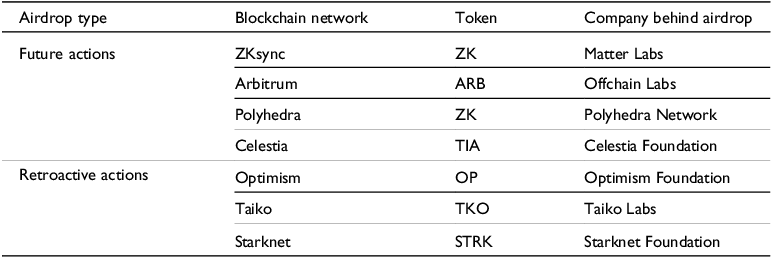

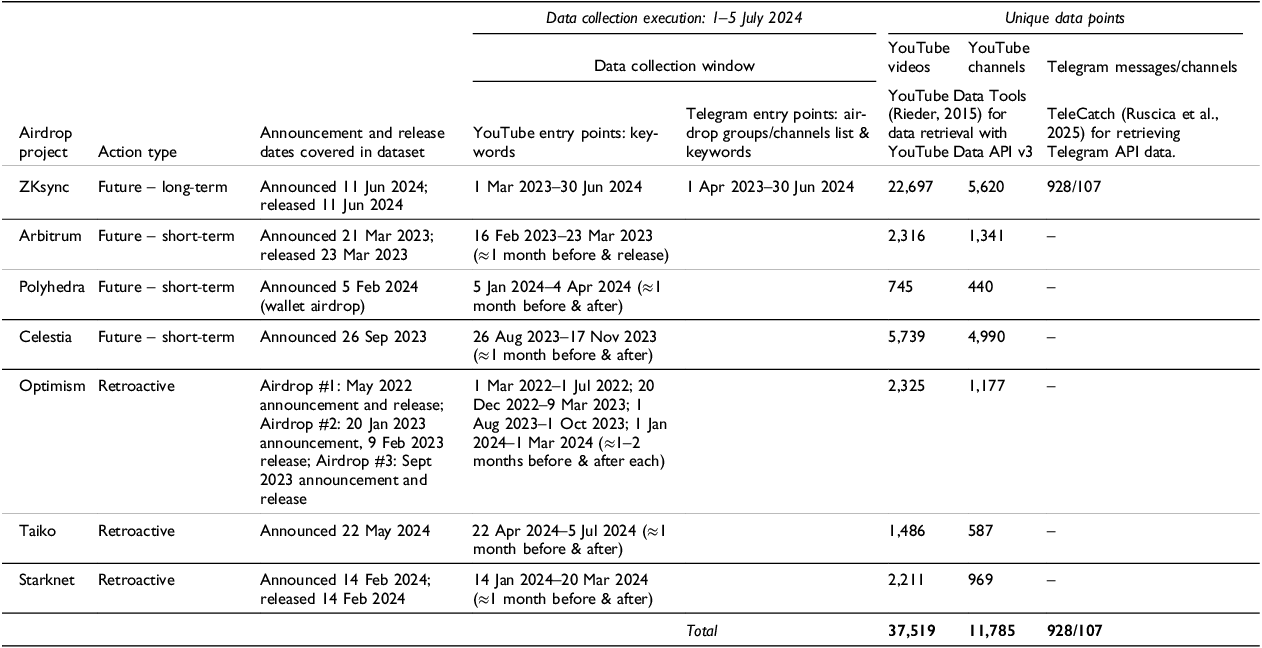


 Open access

