Introduction
Utilizing natural enemies to control aphids is an essential part of integrated pest management strategies. Many of the cues that parasitoids use in foraging have been identified (Poppy et al., Reference Poppy, Powell and Pennacchio1997; Rehman & Powell, Reference Rehman and Powell2010), aphid sex pheromone being one. Methods are already being investigated to incorporate aphid-associated cues such as their alarm pheromone, (E-β-farnesene), into biological control programmes (Beale et al., Reference Beale, Birkett, Bruce, Chamberlain, Field, Huttly, Martin, Parker, Phillips and Pickett2006; Yu et al., Reference Yu, Pickett, Ma, Bruce, Napier, Jones and Xia2012) and it is likely that the aphid sex pheromone could serve a similar role in enhancing parasitism. In addition to attracting male aphids, the synthetically produced pheromone has been shown to attract female parasitoids within the field (Hardie et al., Reference Hardie, Nottingham, Powell and Wadhams1991) either as an isolated compound mix (Glinwood et al., Reference Glinwood, Powell and Tripathi1998) or as individual components (Hardie et al., Reference Hardie, Hick, Höller, Mann, Merritt, Nottingham, Powell, Wadhams, Witthinrich and Wright1994a), and this attraction leads to increased rates of parasitism of various aphid hosts (Glinwood et al., Reference Glinwood, Powell and Tripathi1998). Parasitoid species have been shown to respond innately to the aphid sex pheromone (Poppy et al., Reference Poppy, Powell and Pennacchio1997; Powell & Pickett, Reference Powell and Pickett2003). An innate response could confer an advantage in manipulating foraging behaviour over relying on plant volatiles or host-related cues that often require learning experiences to achieve an optimal response. Learning of host/plant complexes can be particularly problematic for commercially reared biological control agents that are unlikely to be maintained on the same complex they will encounter in the glasshouse. Having an odour present that parasitoids respond to innately may override or compensate for previously learned preferences. The potential for aphid sex pheromone components within biological control programmes has not been overlooked, although an optimum strategy for its incorporation is still to be achieved. However, any beneficial results of introducing the pheromone in biological control may be negated if they lead to increased fitness of aphid populations.
The potential multifunctionality of an odour signal is frequently overlooked by researchers once a role for the odour within the environment has been ascribed. In many situations, it is likely that production of a semiochemical initially served a distinct function, such as aggregation, alarm responses or mating. However, once the pheromone is present within the environment, the opportunity is there for natural enemies, allies or prey to evolve a distinct response to it.
During the reproductive phase of the aphid life cycle, sexual (oviparous) females release a sex pheromone to attract mates (Pettersson, Reference Pettersson1970; Hardie et al., Reference Hardie, Nottingham, Dawson, Harrington, Pickett and Wadhams1992). Populations that tend to be most problematic in the glasshouse are asexual morphs (virginoparae), which produce no sex pheromone (Hardie et al., Reference Hardie, Holyoak, Nicholas, Nottingham, Pickett, Wadhams and Woodcock1990). As the sex pheromone is not produced in their natural environment, it is not known how its components may affect virginoparous aphids. If virginoparae are capable of detecting aphid sex pheromone components, this may cause them to be dispersed by, attracted to, or even to alter their rate of reproduction, any of which may lead to an overall increase in aphid damage. The aphid sex pheromone is comprised predominantly of two cyclopentanoids that are well described: (1R,4aS,7S,7aR)-nepetalactol and (4aS,7S,7aR)-nepetalactone, and in some cases may involve a third component (1S,2R,3S)-dolichodial (Dewhirst et al., Reference Dewhirst, Birkett, Fitzgerald, Stewart-Jones, Wadhams, Woodcock, Hardie and Pickett2008). We studied the impact that nepetalactone may have on virginoparous morphs of one of the most prevalent aphid pests, the peach-potato aphid, Myzus persicae by assessing short-term implications that may be observed through behavioural changes and long-term effects that may be manifested as changes in the aphids’ performance throughout their life or over generations.
Materials and methods
Aphid and plant cultures
M. persicae was maintained on Chinese cabbage plants, Brassica rapa sp. Pekinensis Cv. Wong Bok in a controlled environment room at 20±1 °C and 16L:8D. The aphids had no contact with the sex pheromone and were maintained as asexual morphs.
(4aS,7S,7aR)-nepetalactone and (1R,4aS,7S,7aR)-nepetalactol
Pheromones used in experiments were 98% pure (4aS,7S,7aR)-nepetalactone and (1R,4aS,7S,7aR)-nepetalactol extracted from catmint Nepeta cataria as part of the SEMIOCHEM project funded by BBSRC/DEFRA LINK CIMNFC (Competitive Industrial Materials from Non-Food Crops). A full description of the steam distillation and extraction process can be found in Birkett & Pickett (Reference Birkett and Pickett2003). Redistilled n-hexane was used as a solvent for the compounds (Sigma-Aldrich, UK).
Y-tube olfactometry
A glass Y-tube olfactometer (12 mm Ø, 100 mm stem and 100 mm arms at 60° angle) was employed to investigate the odour preference of aphids when no visual cues are present. The Y-tube and set-up were as described by Pope et al. (Reference Pope, Girling, Staley, Trigodet, Wright, Leather, Van Emden and Poppy2011), except that an internal copper wire was connected in the middle of each arm, allowing the aphids to walk down the centre of the tube. The apparatus was laid flat on an unmarked white surface and air was pumped through Teflon tubing using a Capex L2 pump (Charles Austen Pumps Ltd, UK). The air passed through a charcoal filter and distilled water before entering a chamber containing an intact Chinese cabbage plant, a plant infested with 50 aphids for 72 h or an empty chamber. Glass adaptors (25 mm Ø, 55 mm length) containing filter paper (25 mm Ø, Whatman, UK) were connected in series to the chambers, ensuring that the treatments had no direct effect on plant chemistry. Treatments applied to the filter paper were hexane, 1 mg ml−1 of nepetalactone or 10 mg ml−1 of nepetalactone at a volume of 1 μl. Airflow was adjusted through a flow meter to ensure that a consistent stream of 200 ml min−1 filtered air entered each arm of the Y-tube. After every five replicates, the Y-tube was turned over so that the treatments were now on the opposite sides; this was done to avoid any directional bias. When the Y-tube was turned over or treatments were changed, the internal copper wire was removed and cleaned with 70% ethanol. Aphids were stored in individual glass vials for one hour before the experiment commenced to allow them to acclimatize to the environment. To start the bioassay, an aphid was placed at the base of the wire using a size 0 paintbrush. The aphid was then given 5 min to move towards the odour sources and make a choice. Following the criteria used in previous studies (Girling et al., Reference Girling, Hassall, Turner and Poppy2006; Pope et al., Reference Pope, Kissen, Grant, Pickett, Rossiter and Powell2008), a choice was determined as the aphid spending more than 30 s in the upper half of one of the arms.
Effect of nepetalactone on aphid performance
The mean relative growth rate (MRGR) of the aphids was evaluated using batches of aphids. Owing to the light weight of M. persicae during their first instar, the weight of the individual cannot be easily obtained. For this reason, the group weight of a batch of ten was used. Eighty one-day-old aphids were separated into eight batches. Each batch was then weighed using a 5-point balance (Ohous Corporation, Nänikon, Switzerland) and placed on a three-week-old Chinese cabbage plant, giving a total of eight plants, each infested with 10 M. persicae. Four of the plants were placed in a large ventilated Perspex cage containing nepetalactone, and the other four plants were placed in a cage containing hexane. Hexane was administered by placing a clear 5 ml vial (15 mm Ø, 6.5 mm height, Chromacol, UK) containing 200 μl of hexane in the centre of the cage. The same was done in the treatment cage, with the vial containing 200 μl of 10 mg ml−1 nepetalactone in hexane. Treatment vials were replaced every seven days, approximately one aphid generation. Both cages were kept in a controlled environment (20±3 °C, 16L:8D) with a regular airflow. Vents above the cages removed air and fans at the rear provided airflow ensuring that the movement of odours in the environment did not cause contamination between samples.
The data provided by these experiments were then put into the MRGR formula (taken from Leather & Dixon, Reference Leather and Dixon1984).
 $${\rm MRGR(mg, mg}^{ - {\rm 1}} {\rm, day}^{ - {\rm 1}} {\rm )} = \displaystyle{{{\rm ln}\,W_{\rm 2} ({\rm mg})-{\rm ln}\,W_{\rm 1} ({\rm mg}){\rm}} \over {t_{\rm 2} - t_{\rm 1}}}, $$
where W 1 represents the weight at birth and W 2 represents the adult weight. The time of birth is shown as t 1 and t 2 is the time of maturity measured in days. The values obtained were divided by the number of individuals in the batch providing an estimate of the individual MRGR. Generation time varied between 6 and 8 days with a mean of 7.4 days before an individual began reproducing. The mean was taken from the four samples run simultaneously and contributed to an N of one, therefore, the complete experiment allowed four pseudo replicates within each real replicate for each generation.
Effect of nepetalactone on aphid population growth
The intrinsic rate of natural increase (r m) was calculated for M. persicae virginoparae. A population of M. persicae was exposed to nepetalactone, or hexane in the control, for four generations prior to the commencement of the study. One-day-old virginoparae were separated into eight batches of ten, four batches in the control group and four in the treatment. The aphids were then placed on three-week-old Chinese cabbage plants. Exposure to the nepetalactone and hexane was conducted in the same way as the MRGR trials: a vial containing 200 μl of 10 mg ml−1 solution was placed in the centre of the cage containing the plants and 200 μl of hexane was used as the control sample.
The position of the treatment and control samples within the room was switched between each trial. Each day, the adults were moved onto a new plant and the offspring that they had produced in the 24 h period were counted. This was done for the number of days that it took the adult to reach maturity, i.e., if it took the aphid 7 days to develop from first instar to a reproductive state, the r m counts would take place for 7 days after the birth of the first offspring. Data collected this way could be input into the r m formula (taken from Wyatt & White, Reference Wyatt and White1977).
 $$r_{\rm m} = 0.74(\ln \,F_{\rm D} /D),$$
where F D is the number of offspring produced in the same number of days it took for the aphid to reach maturity.
Electrophysiology
Electroantennogram (EAG) recordings from M. persicae virginoparae were made using Ag–AgCl glass electrodes filled with saline solution (composition as in Maddrell, Reference Maddrell1969 but without glucose). The head of an apterous virginopara was excised and placed within the indifferent electrode, with the antennae protruding. Both antennae, after the tips had been removed, were inserted into the recording electrode, while ensuring that the primary and secondary rhinaria remained exposed. The signals were passed through a high impedance amplifier (UN-06, Syntech, the Netherlands) and analysed using a customized software package (Syntech). The delivery system, which employed a filter paper in a disposable Pasteur pipette cartridge, has been described previously (Wadhams et al., Reference Wadhams, Angst and Blight1982). The stimulus (2 s duration) was delivered into a purified air stream (1 litre min−1) flowing continuously over the preparation.
Samples (10 μl) of the nepetalactone and nepetalactol, diluted in hexane (50 μg ml−1, 1 mg ml−1 and 10 mg ml−1), were applied to filter paper strips and the solvent was allowed to evaporate (30 s) before the strip was placed in the cartridge. The control stimulus was hexane. Fresh cartridges were prepared immediately prior to each stimulation. EAG responses to the two sex pheromone components were normalized to the response to the aphid alarm pheromone, (E)-β-farnesene (1 mg ml−1), applied at the beginning and end of each run (N=5).
Cleaning of Perspex and glassware
Volatiles may adhere to glass and Perspex surfaces used in the experiments; to ensure that these did not persist and affect the results of subsequent experiments, it was necessary to clean all equipments thoroughly. Following use in experiments, all glassware were cleaned in a solution of Decon 90 (Decon Laboratories Limited, UK), rinsed and washed with acetone then distilled water before being placed in the oven at 200 °C for a minimum of 3 h, as used by Pope et al. (Reference Pope, Girling, Staley, Trigodet, Wright, Leather, Van Emden and Poppy2011). All Perspex equipments were washed in Decon 90, rinsed, washed in a 70% ethanol solution and rinsed in distilled water before being left in a ventilated space to air dry.
Statistical analyses
Aphid preference
The significance of odour preferences in a Y-tube olfactometer were evaluated using a heterogeneity G test. This provided values on the preference within each trial and confirmed that the preferences did not vary significantly between sampling days.
Aphid performance
A two-way repeated measures analysis of variance (ANOVA) was conducted to analyse differences in the MRGR between treatments and generation. Repeated measure analysis was necessary as the aphid generations are not independent variables. The analysis was conducted as a part of a general linear model on SPSS (IBM© SPSS© Statistics v 20).
Population growth
The natural rate of increase of M. persicae was compared using a one-way ANOVA on Minitab (Minitab® 16).
Electrophysiology
Responses of aphid antennae to treatments were compared with the response to the hexane control using a Mann–Whitney rank sum test on Minitab (Minitab® 16).
Results
Aphid preference
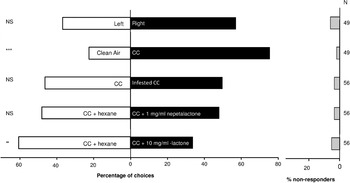
In a Y-tube olfactometer, right and left arms were equally attractive to M. persicae in the absence of odour stimuli (G 1=2.19, P=0.139), confirming that there is no directional bias shown by the aphids and that preferences seen will be to the odours presented (fig. 1). M. persicae virginoparae preferred the arm containing Chinese cabbage odour (G 1=19.27, P<0.001) (fig. 1) to clean air, which demonstrates the utility of the bioassay in distinguishing aphid odour preferences. M. persicae virginoparae showed equal levels of attraction to the aphid-infested and non-infested plant (G 1=0.07, P=0.785).
Responses of M. persicae virginoparae in a linear wire Y-tube olfactometer to volatiles in a series of dual-choice assays where CC is Chinese cabbage and infested refers to a plant infested with 50 aphids continuously for 72 h. *P<0.05, NS=not significant. Percentage of aphids that failed to choose an arm within the 5 min period or dropped from the internal wire more than three times during the assay is also shown.

Nepetalactone (1 mg ml−1) alongside Chinese cabbage remained equally attractive as the control plant (G 1=0, P=1). Significantly more aphids chose the arm containing Chinese cabbage+hexane than the Chinese cabbage+10 mg ml−1 nepetalactone (G 1=4.3, P=0.038). This result confirms that the nepetalactone is responsible for any deterrent effect, as all other conditions of the arms remained equal, though concentration appears to be a factor. The low number of non-responders across all treatment groups suggests that none were repellent to the aphids, as non-attractive odour choices in a Y-tube tend to be reflected in poor rates of overall response (Wang et al., Reference Wang, Svensson, Rosenberg, Bengtsson, Jirle and Löfstedt2010).
Aphid performance
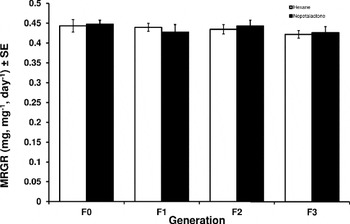
The long-term study of nepetalactone on aphid MRGR did not distinguish any growth rate differences between virginoparae subjected to nepetalactone and those exposed only to the hexane control (F 1,3=0.001, P=0.976) (fig. 2). Physiological effects that were not immediate may have been observed as a difference across generations, but MRGR did not change throughout the generations exposed to nepetalactone (F 3,9=0.56, P=0.654). No difference in growth rate was seen as a result of the interaction between treatment and generation (F 3,9<0.001, P=0.728).
MRGR of M. persicae virginoparae in an environment containing either nepetalactone or hexane. No significant difference was seen between nepetalactone and hexane treatments in any of the generations or between any of the generations.

Population growth
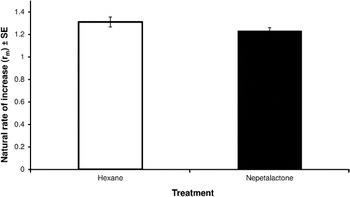
Nepetalactone did not affect the natural rate of increase for M. persicae virginoparae, although there was a strong trend representing a higher r m in the control group (F 1, 7=5.42, P=0.059) (fig. 3). The mean natural rate of increase for M. persicae virginoparae exposed to nepetalactone was 1.229 compared with a mean of 1.309 in the hexane control group, which relates to a mean production of 5.34 and 5.93 offspring per aphid per day, respectively.
Natural rate of increase of M. persicae virginoparae on Chinese cabbage when exposed to a treatment of either nepetalactone or hexane. Nepetalactone was applied as 200 μl of 10 mg ml−1 dissolved in hexane; hexane alone was used as the control. No difference was found between treatments (F 1, 7=5.42, P=0.059).

Electrophysiological response
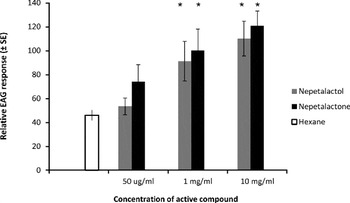
M. persicae virginoparae showed a greater EAG response to (4aS,7S,7aR)-nepetalactone and (1R,4aS,7S,7aR)-nepetalactol at concentrations of 1 mg ml−1 (df=4, P<0.05) and 10 mg ml−1 (df=4, P<0.05) compared with the hexane control (fig. 4). No significant response was observed at the lower concentration of 50 μg ml−1 (df=4, P>0.05).
Electrophysiological responses of M. persicae virginoparae to (1R,4aS,7S,7aR)-nepetalactol and (4aS,7S,7aR)-nepetalactone at three concentrations. *P<0.05. Responses are expressed as a percentage of the response to (E)-β-farnesene at 1 mg ml−1.

Discussion
The virginoparae, which were shown to avoid high doses of nepetalactone, may be utilizing it as an indicator of the presence of a large grouping of aphids which would offer competition for resources. The competition for the plants as a resource is relatively weak as apterae are unlikely to leave the plant, and competition remains similar throughout the plant. Furthermore, it is unlikely for virginoparae that the nepetalactone would be a reliable cue, because of the scarcity with which they would encounter it. For an aphid avoiding a population of conspecifics, the stress volatiles produced by the plant, induced by aphid feeding, would be reliable and readily detectable cues (in the sense defined by Vet & Dicke, Reference Vet and Dicke1992); however, the aphids showed no such avoidance behaviour when presented with the odours of a stressed plant. The increased movement of aphids caused by their avoidance of nepetalactone could reduce the time available for feeding as they try to move away from the odour source. The reduced feeding time would result in a decrease in available energy, which would in turn be reflected in reduced growth rate or fecundity. The fact that aphid performance is not altered may be indicative that plant odour alone is preferable, and not that the nepetalactone is deterrent. It is interesting to note that the environment containing nepetalactone is not sufficiently unfavourable to the virginoparae to cause an increase in the production of alatae, as is often observed in less favourable environments (Sutherland & Mittler, Reference Sutherland and Mittler1971; Mcvean & Dixon, Reference Mcvean and Dixon2001). This may be an encouraging result for biocontrol programmes, because an increase in alatae could accelerate the spread of the population and also improve their ability to escape natural enemies within the area, though this would trade-off with a decreased individual fitness (Peters & Barbosa, Reference Peters and Barbosa1977). The r m of M. persicae was not significantly different between treatments of hexane and nepetalactone (P=0.059) though it is recognized that if sample error had been reduced or the sample size increased marginally (N=4) it may result in a lower rate of growth for nepetalactone. If a difference was observed, it would represent an r m of 0.08 greater in the hexane group over the nepetalactone treatment. The difference initially appears small though, from the means provided, it would represent 3.5 more offspring per aphid for the six days after becoming a fully developed adult; scaled-up to account for the number of reproductive females within an aphid population this could represent a substantial difference in real terms.
At concentrations of 1 mg ml−1 or above, both the nepetalactol and nepetalactone elicited a significant electrophysiological response from the antennae of virginoparous M. persicae. To the authors’ knowledge, this is the first time that a response of M. persicae virginoparae to the aphid sex pheromone has been demonstrated. Studies have demonstrated that male M. persicae are attracted to the sex pheromone components (Geng et al., Reference Geng, Xiangyu, Li, Zhang, Han and Li1997), as are males of other aphid species (Boo et al., Reference Boo, Choi, Chung, Eastop, Pickett, Wadhams and Woodcock2000). Studies involving field trapping suggest that they use it to locate sexual females (Hardie et al., Reference Hardie, Nottingham, Dawson, Harrington, Pickett and Wadhams1992). Work by Campbell et al. (Reference Campbell, Cook, Pickett, Pope, Wadhams and Woodcock2003) using single-cell recording confirmed that gynoparae of the damson-hop aphid, Phorodon humuli, responded electrophysiologically to nepetalactone, as do the P. humuli spring migrants and the alatae virginoparae of Sitobion avenae (Woodcock, unpublished data, 1992–1994). Why they would detect the odour is not fully understood, but it is suggested that it may be used to discriminate plants already colonized by sexual females of other species. It is possible that the gynoparae have a greater selection pressure to avoid colonies of sexual females, as it is their offspring that will compete to attract mates. This may also explain the greater response seen to nepetalactone by gynoparae over virginoparae in Aphis fabae and Rhopalosiphum padi (Park & Hardie, Reference Park and Hardie2002). Both virginoparous and gynoparous females (alatae and apterae) of the black bean aphid, Aphis fabae, have demonstrated an electrophysiological response to nepetalactone and nepetalactol, with a greater response seen in the males (Hardie et al., Reference Hardie, Visser and Piron1994b). An explanation may be that the response elicited is, in fact, an evolutionary relic. The morphology of the antennae of male and female aphids in various species shows many similarities (Hardie et al., Reference Hardie, Visser and Piron1994b) and it is possible that the associated cost of the sensory cells has not been great enough for other evolutionary pressures to ‘weed-out’ the ability in parthenogenetic clones. If the ability to detect sex pheromone components holds no additional benefit for virginoparae females, it is hypothesized that the response would be weaker than in male M. persicae (although this would be relative to the time over which the asexual forms evolved) and that the strength of response would diminish over evolutionary time. A comparison between the females within more recently formed species and those closer to the ancestral forms may offer some support for this theory.
It is known that various natural enemies are capable of detecting the aphid sex pheromone, for example, lacewings (Boo et al., Reference Boo, Chung, Han, Pickett and Wadhams1998), ladybirds (Leroy et al., Reference Leroy, Schillings, Farmakidis, Heuskin, Lognay, Verheggen, Brostaux, Haubruge and Francis2011) and parasitoids (Powell et al., Reference Powell, Pennacchio, Poppy and Tremblay1998; Glinwood et al., Reference Glinwood, Du, Smiley and Powell1999). The avoidance of a large population is likely to reduce the susceptibility to attack from these natural predators. A ‘selfish herd’ (Hamilton, Reference Hamilton1971) may exist when the predator has an increased handling time, but with the high fecundity and rate of attack in parasitoids, greater distribution will benefit the hosts. A dense population is particularly susceptible to parasitoid attack because those remaining are in immediate danger from the emergence of the next generation of parasitoids among them. The high concentration of nepetalactone in our experiments may have confused the aphids’ sensory detectors by producing a different level of odour quality (Baker et al., Reference Baker, Hansson, Löfstedt and Löfqvist1988), causing the level of deterrence observed. In sexual populations, the presence of high levels of pheromone may hinder the ability of males to locate calling females, leading to a reduction in the population, a method of control that has already seen success primarily for moth species (for review see Cardé & Minks, Reference Cardé and Minks1995). With new technologies increasing the efficacy of mating disruption (Nansen et al., Reference Nansen, Macdonald, Rogers, Thomas, Poppy and Baxter2007) pest sex pheromones may see greater application in the field. With our current understanding of M. persicae, it is not possible to conclude whether virginoparae actively try to avoid other aphid populations in the natural environment.
If nepetalactone lures are to be introduced into the field, it is likely that there would be no immediate effect on behaviour or growth of virginoparae M. persicae populations. A very high concentration may influence aspects of the aphids’ performance, though it is unlikely that such levels of the compounds would ever be applied. It remains unclear as to why M. persicae virginoparae are capable of detecting the aphid sex pheromone compounds, though an understanding of why could provide insight into the evolutionary history of aphids.
Our research demonstrates the need for future studies to broaden their focus and consider the impact of pheromones in a multitrophic context. The results are promising for the application of aphid sex pheromone technologies in agricultural practices, though it is recognized that experiments need to be trialled out of the laboratory to better reflect real world situations.
Acknowledgements
Thanks to Owen Jones and Jamie Sutherland for getting the project started and Ye Min for making the internal copper wire used in Y-tube assays. G.M. Fernández-Grandon was supported by a BBSRC CASE Studentship with AgriSense BCS Ltd. Rothamsted Research receives grant-aided support from the BBSRC.