INTRODUCTION
Common bean is an important grain legume in many countries across the globe and it serves as a vital and inexpensive source of protein, vitamins and mineral nutrients. However, bean plants compete poorly with weeds for incident solar radiation, soil nutrients and soil moisture, and weed interference in common beans can result in substantial yield losses (Blackshaw Reference Blackshaw1991; Liebman & Gallandt Reference Liebman and Gallandt2002). Management practices that lead to efficient absorption and utilization of available growth resources could increase the competitive ability of common bean. Improving the competitive ability of dry bean over weeds with agronomic approaches is among the safest, cheapest and most sustainable strategies in weed management approaches.
Nitrogen (N) is the major soil nutrient influencing grain yield and outcomes of crop–weed competition (Liebman & Gallandt Reference Liebman and Gallandt2002; Blackshaw et al. Reference Blackshaw, Semach and Janzen2002). Although common bean is a grain legume with N fixation ability, the levels of nodulation and N fixation are low and variable across bean genotypes (Bliss Reference Bliss1993; Graham & Ranalli Reference Graham and Ranalli1997). Nitrogen fertilizer is generally required to improve grain yield and economic returns for high yielding common bean production. It can be a limiting factor for early growth in common bean, even if the plants are well-nodulated and there are no visible signs of N deficiency (Westermann et al. Reference Westermann, Porter and O'Deen1985). A late-season N supply during seed-filling is vital to obtain a high seed yield for some legumes (Westermann et al. Reference Westermann, Kleinkopf, Porter and Leggett1981; Salvagiotti et al. Reference Salvagiotti, Cassman, Specht, Walters, Weiss and Dobermann2008). Seed yield, leaf area and photosynthetic rate of symbiotic beans are frequently observed to be lower than those of N fertilized plants (Thies et al. Reference Thies, Singleton and Bohlool1991; Liebman et al. Reference Liebman, Corson, Rowe and Halteman1995), but while N effectively promotes crop growth in monoculture, many studies have shown that N fertilizer benefits weeds more than other N-fixing plants (Liebman & Robichaux Reference Liebman and Robichaux1990; Di Tomaso Reference Di Tomaso1995; Blackshaw et al. Reference Blackshaw, Semach and Janzen2002). However, conscious application timing and placement of N fertilizer can favour crop growth at the expense of weeds (Angonin et al. Reference Angonin, Caussanel and Meynard1996; Blackshaw et al. Reference Blackshaw, Molnar and Janzen2004). Banding fertilizers within the row of common bean has been shown to not only increase crop yield compared with broadcast applications, but also to reduce weed density and biomass (Di Tomaso Reference Di Tomaso1995). Timing N applications close to the peak period of N demand by a crop and after the period of maximum nutrient absorption by an associated weed may reduce the competitiveness of weeds (Angonin et al. Reference Angonin, Caussanel and Meynard1996).
Natural genetic diversity for growth habit characteristics exists in some legumes, which represents an excellent opportunity to use varieties with higher weed suppressing ability for long-term integrated weed management (Wortmann Reference Wortmann1993; Wang et al. Reference Wang, McGiffen, Lindquist, Ehlers and Sartorato2007). It has been reported that bean plants with erect compared with semi-erect growth habits not only vary in shoot architecture, including leaf area index (LAI), leaf size, leaf weight, stem length and the distribution of branches, but also in some root characteristics, including root length, root mass and the number of basal roots (Lynch & van Beem Reference Lynch and van Beem1993; Wortmann Reference Wortmann1993; Ramírez-Vallejo & Kelly Reference Ramírez-vallejo and Kelly1998). Common bean genotypes with root traits that allow nutrients to be acquired more effectively would benefit in mixed stands. Indeterminate genotypes with a higher biomass yield have been found to have higher nutrient uptake (Westermann et al. Reference Westermann, Terán, Muñoz-Perea and Singh2011). It has also been reported that indeterminate genotypes have a higher N fixation rate, N uptake, biomass and seed production than determinate growth habits (Silim & Saxena Reference Silim and Saxena1992; Dorcinvil et al. Reference Dorcinvil, Sotomayor-ramírez and Beaver2010). Furthermore, it has been proposed that the competition for N and light might be inter-related (Corre-Hellou et al. Reference Corre-hellou, Fustec and Crozat2006). The effect of N fertility on increasing the maximum LAI and leaf chlorophyll content as well as promoting faster ground cover (Tollenaar et al. Reference Tollenaar, Nissanka, Aguilera, Weise and Swanton1994; Liebman & Gallandt Reference Liebman and Gallandt2002; Ugen et al. Reference Ugen, Wien and Wortmann2002) may improve the ability of bean plants to intercept light over competing weeds. For example, it has been shown that the leaf area, leaf chlorophyll content, photosynthetic rate and light absorption can often be increased by N fertilizer application (Tollenaar et al. Reference Tollenaar, Nissanka, Aguilera, Weise and Swanton1994; Liebman et al. Reference Liebman, Corson, Rowe and Halteman1995). It has also been reported that light can play an important role in determining plant response to N availability and plant N demand (Harbur & Owen Reference Harbur and Owen2004).
Understanding the influence of N on crop–weed competition is important because it may be possible to use fertilizer management as an option in the development of an integrated weed management programme. Although many studies have documented the impact of N rates on the outcomes of crop–weed competition (Tollenaar et al. Reference Tollenaar, Nissanka, Aguilera, Weise and Swanton1994; Di Tomaso Reference Di Tomaso1995; Blackshaw et al. Reference Blackshaw, Semach and Janzen2002), few studies have examined the effect of N fertilizer rate on weed–legume competition. It may be possible to improve competitive ability of a legume plant with fertilization strategies, due to the lower metabolic cost of N assimilation via root uptake than that for N2 fixation (Pate & Layzell Reference Pate, Layzell, Miflin and Lea1990).
The effects of growth habit on weed competition has received some attention (Wortmann Reference Wortmann1993; Wang et al. Reference Wang, McGiffen, Lindquist, Ehlers and Sartorato2007), but so far no one has studied the interaction of N application and canopy architecture on weed–bean competition. The objective of the current study was to investigate how N fertilizer and growth habit influence common bean growth and N uptake and to determine whether the effects are influenced by weed density.
MATERIALS AND METHODS
Study site
Two experiments were conducted at the experimental station of Tarbiat Modares University, Tehran, Iran (51°10′ E, 35°44′ N, 1305 m a.s.l.), in 2009 and 2010. The soil at the study site is classified as an Entisol with a sandy clay loam texture (4% silt, 23% clay, 73% sand, by volume), organic matter of 10 g/kg and a pH of 7·7. Tehran is characterized by a long-term annual average rainfall of 233 mm and an average air temperature of 18 °C. Further details of the soil analysis and characteristics, as well as daily weather data have been presented elsewhere (Saberali et al. Reference Saberali, Modarres-Sanavy, Bannayan, Baghestani, Rahimian Mashhadi and Hoogenboom2012).
Experimental design
The experimental design was a randomized complete block with a factorial arrangement of treatments with three replications. The treatments included common bean growth habit, N fertilizer rates and redroot pigweed densities. The common bean cultivars were determinate erect (cvar D81083) and indeterminate semi-erect (cvar Gholi). Nitrogen was applied at rates of 0, 50, 100 and 200 kg N/ha for the semi-erect bean growth habit and 0, 35, 70 and 140 kg/ha for the erect bean growth habit. The N application rates were 0 (N0), 0·25 (N25), 0·50 (N50) and 1·00 (N100) of recommended N rate on the basis of the seed yield target for each genotype. Average attainable seed yield for the semi-erect and erect bean growth habits are 3900 and 2600 kg/ha, respectively. The highest recommended N rates (140 and 200 kg/ha) represented the amount of N that would meet or slightly exceed the recommended rate on the basis of a grain yield target of 2500 and 3800 kg/ha for the semi-erect and erect growth habits, respectively. Finally, the redroot pigweed densities were 0, 4 and 28 plants/m2. Redroot pigweed was selected to represent a weed species shown to be highly responsive to soil N levels (Blackshaw & Brandt Reference Blackshaw and Brandt2008).
Experimental methods
In both years, the field was mouldboard-ploughed in the autumn, then cultivated (with discs) in the spring for seedbed preparation. The size of each individual plot was 2·5 × 7 m and the bean row spacing was 50 cm. Seeds of common bean were hand-planted at 4–6 cm depth on 11 July 2009 and 26 June 2010, and subsequently thinned to the recommended plant density (40 plants/m2). Redroot pigweed seed was sown in a 1 cm-deep furrow; seeds were sprinkled by hand into this furrow, covered with soil and packed firmly. These trenches were located 5 cm away from the common bean rows. The weed seeds were planted at a high density and subsequently thinned to the target densities. All weeds other than redroot pigweed were removed by hand, inter-row cultivation and through selective herbicides throughout the growing season. Nitrogen fertilizer was applied as urea, with half of the total amount applied at planting and the remainder applied at the early pod formation stage (R 3) (Schwartz Reference Schwartz, Schwartz, Brick, Harveson and Franc2004). An 80 cm long probe was inserted into the middle of the weed-free treatment plots and calibrated prior to the start of the experiment. Soil volumetric water content was monitored daily for the top 60 cm of the soil using time-domain reflectometry (TDR, model 4593, Soil Moisture Equipment, Santa Barbara, USA), and the average soil water content based on the TDR readings of the weed-free treatments was used to determine when to apply irrigation.
Data collection
In both years, destructive plant samples were periodically taken in each plot to quantify crop growth and canopy dynamics. Destructive samples were collected every 10–15 days starting on 9 August 2009 and 26 July 2010, respectively. A 1 m sample was taken by cutting the stems of both bean and weed plants at ground level. At least 50 cm of the row and adjacent rows were left intact between each sample area to avoid edge effects. Harvested plants were then separated into stems, green leaves (green area > 0·50) and reproductive tissue (pod walls and seeds). Green leaf area was determined using a leaf area meter (Delta-T Devices, Cambridge, UK). Tissue samples were dried at 70 °C for 48 h to constant weight and then weighed. Dried plant materials were ground to pass through a 1 mm sieve, and analysed for N content using Kjeldahl procedures. Nitrogen assimilation was computed by multiplying N concentration and the biomass for each plant part, and total N assimilation was estimated by the sum of N assimilation of all the organs at certain points during the growing season. The uppermost leaves of the three plants at the R 5 stage from the central two rows were collected, chopped and mixed, and a 200 mg leaf sample was used for chlorophyll extraction using 80% acetone. The extraction was performed in the dark for 2 h at 4 °C with agitation. The extracts were centrifuged at 10 000 g for 15 min. Then the transparent supernatant was filtered and made up to 10 ml with 80% acetone. Chlorophyll concentration was computed using a spectrophotometer (Cintra 6, GBC, Dandenong, Australia) and the formula given by Arnon (Reference Arnon1949). At the end of the growth period, the middle two rows of 3 m length were harvested for seed yield determination. After drying and threshing, grain yield was determined. Final seed yield was corrected on the basis of 13% moisture. The leaf area data collected at each sampling date were used to calculate leaf area duration (LAD); LAD and N assimilation rate were calculated as:
 $${\rm LAD} = ({L_1}{\rm +} {L_2})({T_2} - {T_1})/2\,({\rm day})$$
 $${\rm N\,assimilation\,rate} = ({{\rm N}_2}-{{\rm N}_1})/({T_2} - {T_1})\,({\rm kg}/{\rm ha/day})$$
where L and N, respectively, represent the leaf area and N assimilation of the common bean, T represents the time (day) elapsed since the crop was planted, and the subscripts 1 and 2 represent the start and finish of a time interval (Hunt Reference Hunt1990). Season-long LAD was calculated as the sum of LAD values for the three harvest intervals per growing season. The period from the first to the last measurement prior to the final harvest was used to calculate N assimilation rate.
Statistical analysis
The effects of growth habit, N application rate and weed density treatments on LAI, LAD, leaf chlorophyll, N assimilation and N assimilation rate was tested using Analysis of variance (ANOVA), with the general linear model procedure of Statistical Analysis System (SAS, SAS Institute 2003). The UNIVARIATE procedure within SAS was used to examine the residuals for normality and to check for outliers in the data. Polynomial contrasts were performed to evaluate the existence of linear, quadratic and cubic relations for each variable as a function of N application rate. Means were separated using Fisher's protected least significance difference test at P < 0·05. Stepwise multiple regression analyses were performed with different sets of independent growth variables (chlorophyll, LAI, LAD, N assimilation and N assimilation rate) and seed yield or yield loss as dependent variables. The regression analysis (REG) procedure was used to perform stepwise multiple regression analysis with P < 0·05 selection level.
RESULTS
Leaf area index
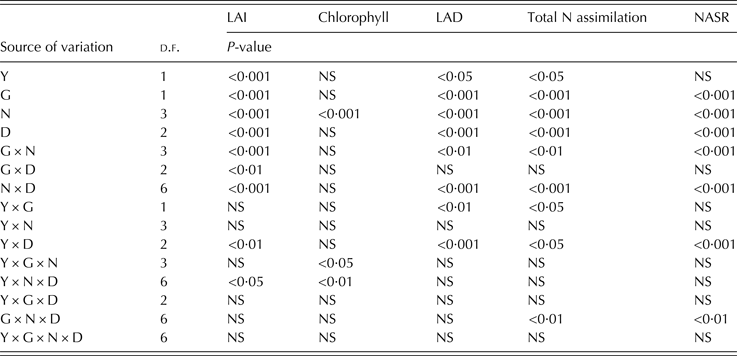
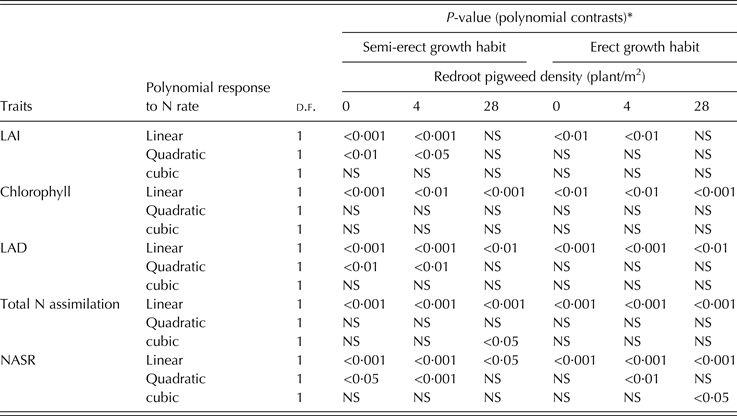
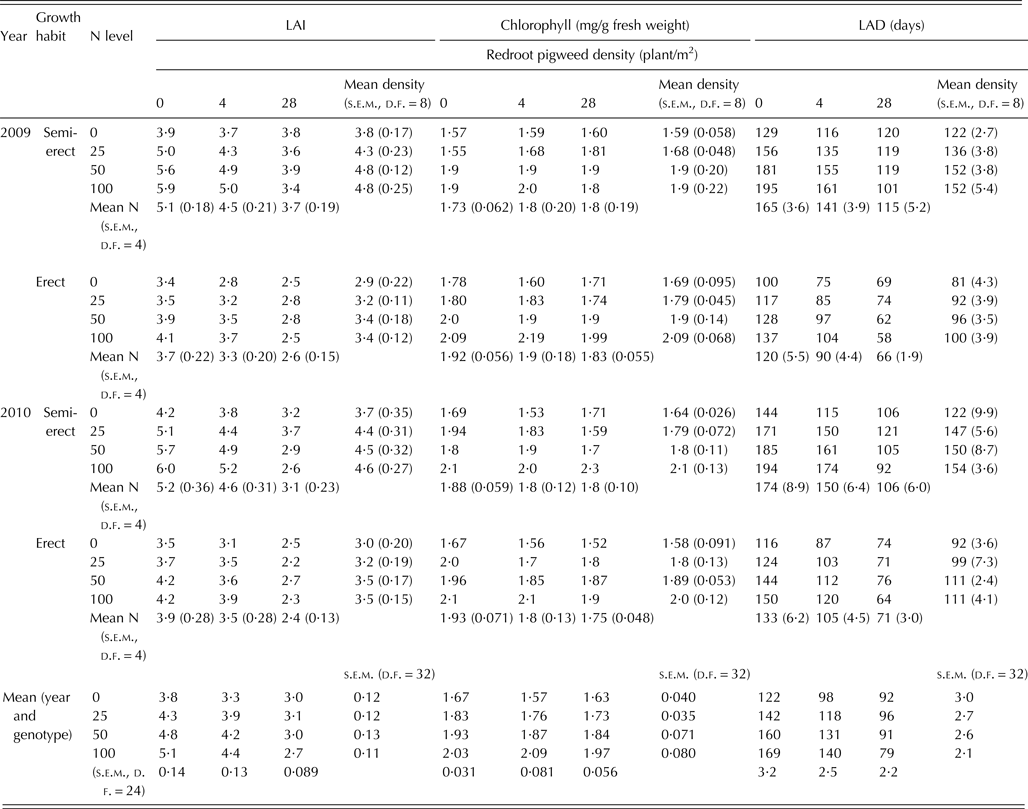
The analysis of variance showed that maximum LAI was affected by year (Y) (P < 0·001), genotype (G) (P < 0·001), N (P < 0·001) and redroot pigweed density (D) (P < 0·001). There were interactions of G × N (P < 0·001), G × D (P < 0·01), Y × D (P < 0·01), N × D (P < 0·001) and Y × N × D (P < 0·05) (Table 1). Polynomial contrasts showed that there was a linear relationship between the amount of N applied and LAI of the erect growth habit under no and low weed density. For the semi-erect growth habit, there was both a linear and quadratic relationship between the amount of N applied and LAI under no and low weed density (Table 2). The LAI increased with N applications under no and low weed pressure, but generally was unchanged or decreased by N application rate for the high weed density. For example, under no and low weed density, LAI increased by 35 and 34% in 2009 and by 31 and 33% in 2010, as the N rate increased from N0 to N100. For the high redroot pigweed density, LAI decreased by 5 and 12% for the N100 treatment compared with the N0 treatment in 2009 and 2010, respectively (Table 3). The effect of weed competition on LAI was associated with N application rates, especially for the high weed density. For example, the redroot pigweed competition reduced LAI by 12 and 11% for the low weed density and by 14 and 27% for the high weed density compared with weed-free, under no N application in 2009 and 2010, respectively (Table 3). The LAI with the highest N application decreased by 13 and 11% under low weed density and 41 and 52% under high weed density compared with weed-free in 2009 and 2010, respectively (Table 3). The N × D interaction showed that the mean LAI across the N application rates increased by 26% with N applications at both no and low weed densities compared with N0, but unchanged with N applications at a high weed density (Table 3). The G × N interaction showed that LAI of semi-erect and erect growth habits, respectively, increased by 25 for the semi-erect and 16% for the erect growth habit as the N rate increased from N0 to N100. Mean LAI losses due to weed competition were 13 and 11% at low weed density and 35 and 34% at high weed density for the semi-erect and erect growth habits, respectively. The Y × D interaction showed that LAI was reduced with low and high weed density compared with weed-free by 12 and 29%, respectively, in 2009, and 12 and 40%, respectively, in 2010 (Table 3). Leaf area index was higher for the semi-erect compared with the erect growth habit.
ANOVA significance levels for common bean leaf area index (LAI), leaf chlorophyll, leaf area duration (LAD), N assimilation and N assimilation rate (NASR)

NS, not significant; Y, Year; G, Genotype; N, Nitrogen; D, Weed density.
Polynomial model significance levels for common bean leaf area index (LAI), leaf chlorophyll, leaf area duration (LAD), N assimilation and N assimilation rate (NASR) in response to N rates
NS, not significant.
*Polynomial contrasts (linear, quadratic and cubic) were calculated separately for each bean growth habit and weed pressure level, because of the significant interaction between N rate and bean growth habit as well as N rate and weed pressure.
Common bean maximum leaf area index (LAI), leaf chlorophyll and seed leaf area duration (LAD) influenced by nitrogen(N) rate and redroot pigweed density in 2009 and 2010
Leaf area duration
Leaf area duration was affected by Y (P < 0·05), G (P < 0·001), N (P < 0·001) and D (P < 0·001), and by the G × N (P < 0·01), N × D (P < 0·001), Y × G (P < 0·01), Y × D (P < 0·001) interactions (Table 1). The effect of N on LAD was associated with weed pressure level. There was both a linear and quadratic relationship between the amount of N applied and LAD for the semi-erect growth habit for all weed densities. For the erect growth habit, there was a linear relationship between the amount of N applied and LAD for all weed densities (Table 2). Mean LAD across the bean varieties increased by 38% under no and 42% under low redroot pigweed densities as the N rate increased from N0 to N100. However, the differences in LAD were not significant between the N0 and N25 treatments, as well as N50 and N100 treatments (Table 3). Under a high redroot pigweed density, LAD decreased by 15% for the N100 treatment compared with the N0 treatment (Table 3). The effect of redroot pigweed competition on LAD was associated with N application rate. Under no N application, the competition of redroot pigweed resulted in LAD decreases of 20% for the low and 25% for the high weed density compared with the LAD for weed-free conditions. However, LAD decreased by 17% for low and 54% for high weed density compared with weed-free conditions with N100 applications (Table 3). The G × N interaction effect resulted in LAD increases of 26% for the semi-erect and 22% for erect growth habit with N100 applications compared with N0. The Y × D interaction effect showed that LAD decreased by 19 and 17% for low and by 39 and 42% for high weed density compared with weed-free, in 2009 and 2010, respectively (Table 3). The LAD of the semi-erect growth habit was higher than the LAD of the semi-erect growth habit and the LAD in 2010 was greater than in 2009.
Leaf chlorophyll
The main effect of N (P < 0·001) and the interactions of Y × G × N (P < 0·05) and Y × N × D (P < 0·01) had a significant effect on leaf chlorophyll at the R 5 stage (Table 1). There was a linear relationship between the amount of N applied and leaf chlorophyll for both bean growth habits for all weed densities (Table 2). Regardless of weed pressure level, leaf chlorophyll increased when N was applied compared with N0. Chlorophyll concentration increased by 19 and 23% for no, 33 and 34% for low and 14 and 28% for high weed pressure in 2009 and 2010, respectively, as N rate increased from N0 to N100 (Table 3). The Y × G × N interaction showed that leaf chlorophyll increased with N100 treatment compared with the N0 treatment, by 20% for the semi-erect and 23% for the erect growth habits in 2009, and 29% for the semi-erect and 27% for the erect growth habits in 2010 (Table 3).
Total Nitrogen assimilation
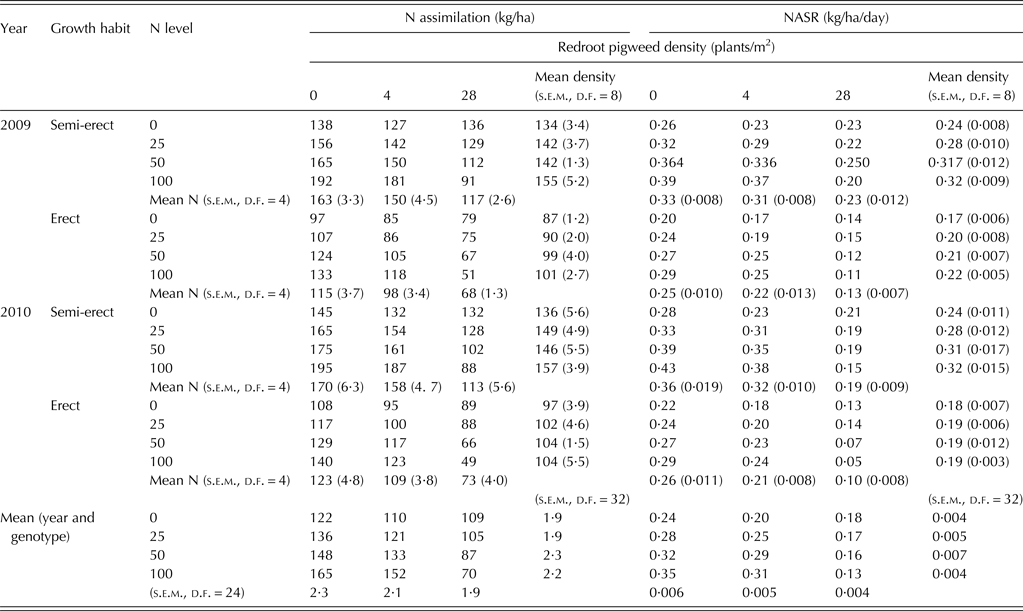
Common bean total N assimilation was affected by Y (P < 0·05), G (P < 0·001), N (P < 0·001) and D (P < 0·001), and by the G × N (P < 0·01), N × D (P < 0·001), Y × G (P < 0·05), Y × D (P < 0·05) and G × N × D (P < 0·01) interactions (Table 1). There was a linear relationship between the amount of N applied and total N assimilation for both growth habits under no and low weed densities. For a high weed density, the relationship between the amount of N applied and total N assimilation was linear for the erect growth habit and the relationship was both linear and cubic for the semi-erect growth habit (Table 2). For no and low weed pressure, N assimilation was higher with N application compared with no N application, but generally was lower with N application for the high weed density (Table 4). Under no and low weed density, N assimilation increased by 37 and 42% for semi-erect and by 33 and 34% for erect growth habits, as N rate increased from N0 to N100 (Table 4). Under high redroot pigweed density, total N assimilation was 33 and 40% lower for the N100 treatment compared with the N0 treatment for the semi-erect and erect growth habits, respectively. The effect of redroot pigweed competition on N assimilation was associated with N application rate, especially at high weed density (Table 4). For the no N application, the competition of redroot pigweed resulted in 8 and 12% less N assimilation at low weed density and 5 and 18% at high weed density compared with the weed-free conditions for the semi-erect and erect growth habits, respectively. For the highest N application, N assimilation was 5 and 12% lower for the low weed density and 54 and 63% for high weed density compared with the weed-free conditions for the semi-erect and erect growth habits, respectively (Table 4). The N × D interaction showed that N assimilation increased by 22% for the no and 23% for the low weed density with N application compared with no N application. Under high weed density, N assimilation was 20% lower for the N application compared with no N application. The G × N interaction showed that N assimilation, regardless of weed density, increased by 15% for the semi-erect and 11% for the erect growth habits, as N rate increased from N0 to N100 (Table 4). The Y × D interaction showed that N assimilation was less for low and high weed density compared with weed-free, respectively, by 11 and 33% in 2009 and 9 and 37% in 2010. Nitrogen assimilation in 2009 and 2010, respectively, was 52 and 44% greater for the semi-erect than the erect growth habits.
Common bean nitrogen (N) assimilation and N assimilation rate (NASR) influenced by N rate and redroot pigweed density in 2009 and 2010
Nitrogen assimilation rate
The main effect of G (P < 0·001), N (P < 0·001) and D (P < 0·001), and the interactions of Y × D (P < 0·001), N × D (P < 0·001), G × N (P < 0·001) and G × N × D (P < 0·01) had a significant effect on N assimilation rate from 32 to 77 days after planting (DAP) (Table 1). For the semi-erect growth habit, there was both a linear and quadratic relationship between the amount of N applied and N assimilation rate under no and low weed densities. The same responses were observed under low weed densities for the erect growth habit, but the linear response was only observed under weed-free conditions. For the high weed density, the relationship between the amount of N applied and the N assimilation rate was linear for the semi-erect growth habit and it was both linear and cubic for the erect growth habit (Table 2). For the no and low weed pressure, the N assimilation rate increased with N application compared with no N application, but usually decreased with N application at a high weed density (Table 4). Under no and low weed density the N assimilation rate increased by 61 and 70% for the semi-erect and by 48 and 53% for the erect growth habits, respectively, as the rate of N fertilizer increased from N0 to N100. Under a high redroot pigweed density, N assimilation rate decreased by 14 and 49% for the semi-erect and erect growth habits, respectively, at the N100 treatment compared with the N0 treatment. The N assimilation rate decreased in response to redroot pigweed competition, and the magnitude of decreased N assimilation was associated with N application rate, especially at a high weed density. Under high weed density, decreased N assimilation rate associated with weed competition increased from 21 to 58% for the semi-erect and from 30 to 76% for the erect growth habits, as N rate increased from N0 to N100. The N × D interaction showed that the N assimilation rates increased by 38% for the no and 48% for the low weed density, with N application compared with no N application (Table 4). Under high weed density, the N assimilation rate decreased by 13% with N application compared with no N application. The N assimilation rate was reduced for the low and high weed density compared with weed-free conditions, respectively, by 11 and 35% in 2009 and 13 and 49% in 2010.
Relationship between seed yield and growth traits
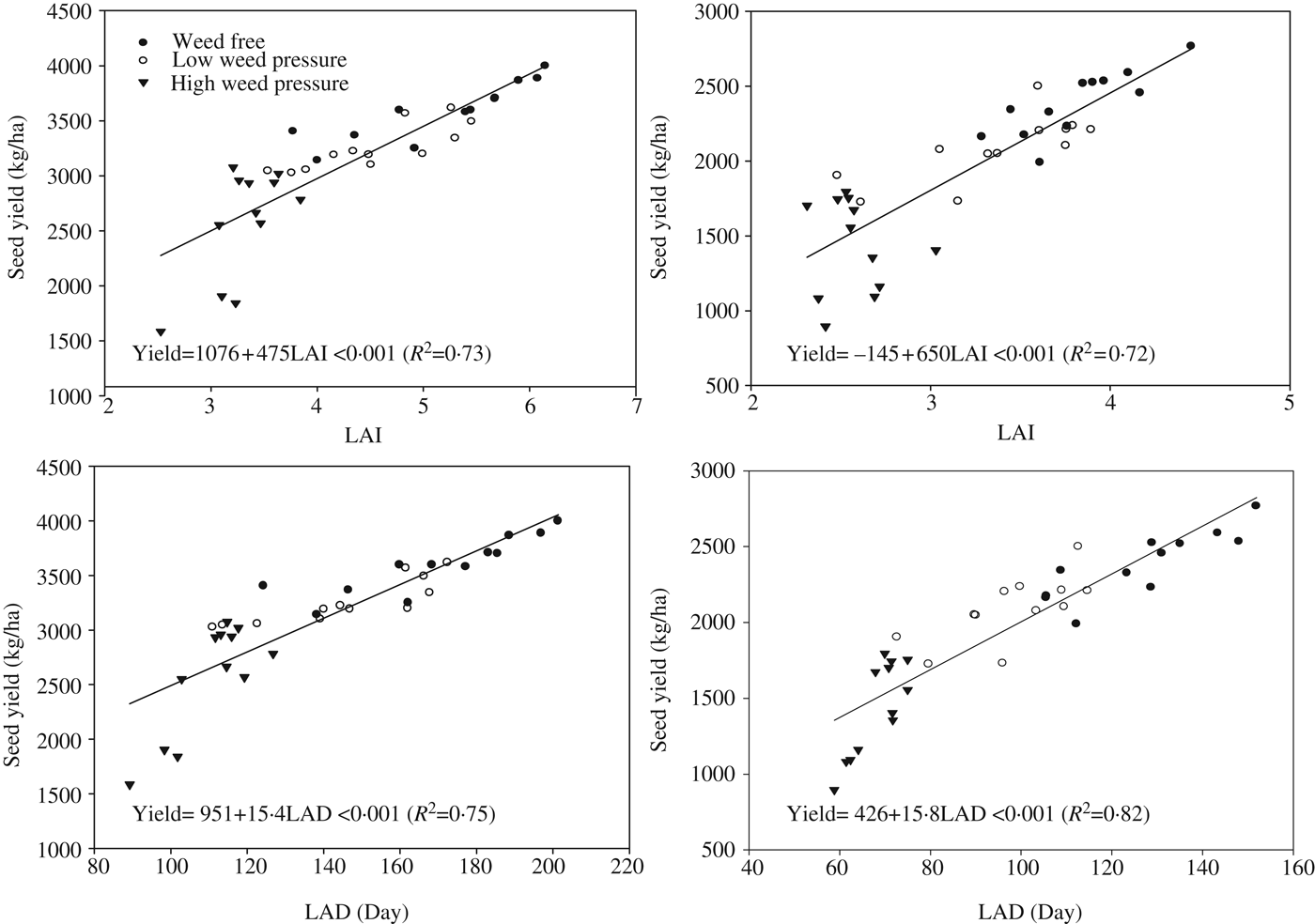
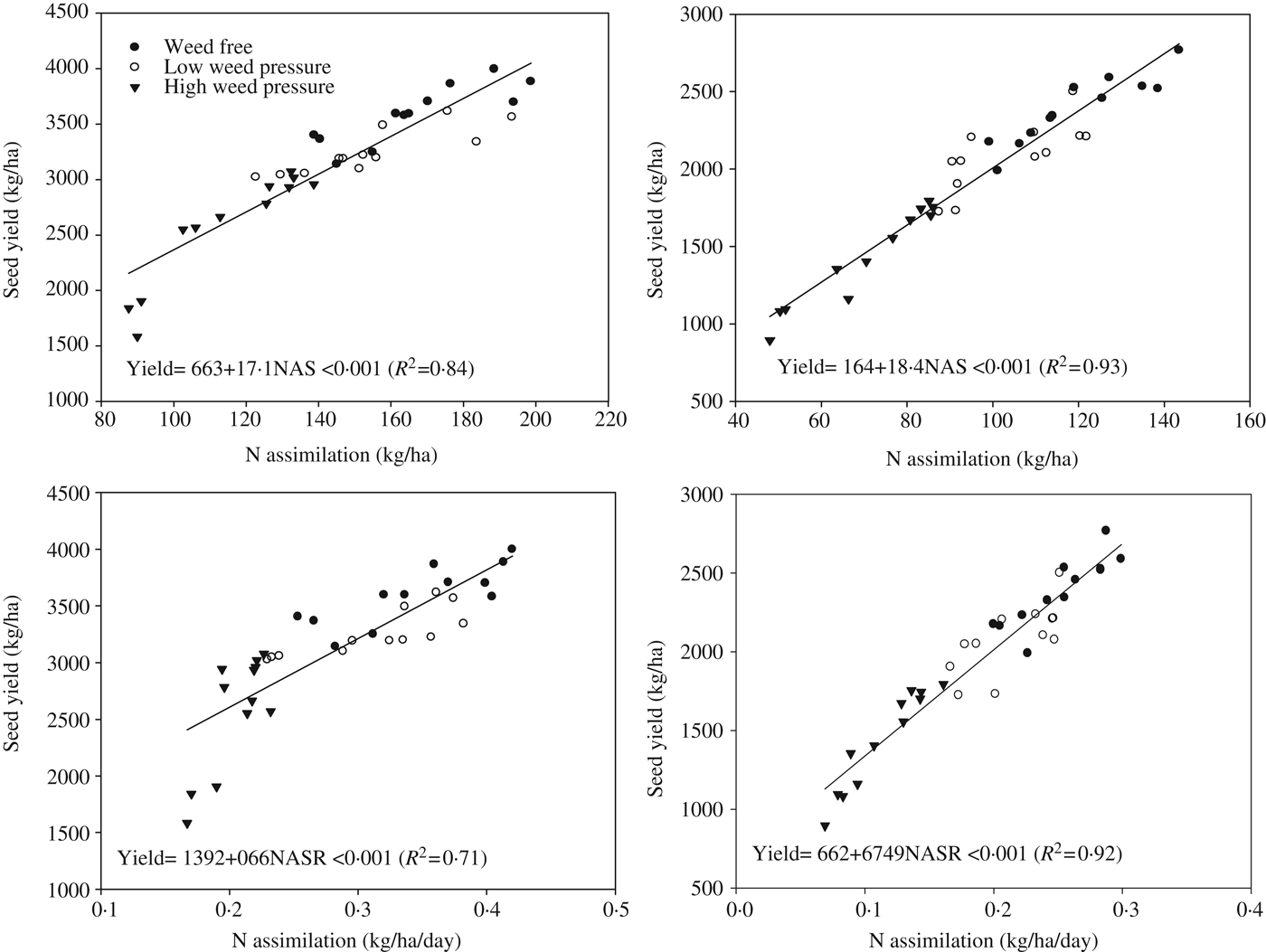
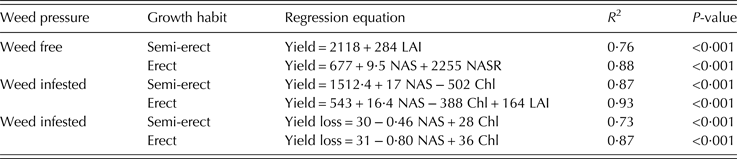
The regression analysis showed that there was a linear relationship between seed yield and maximum LAI (R 2 = 0·72–0·73), LAD (R 2 = 0·75–0·82), total N assimilation (R 2 = 0·84–0·93) and N assimilation rate (R 2 = 0·71–0·92) for all weed densities for both common bean growth habits (Figs 1 and 2). Stepwise multiple regression analysis was used to determine which of the growth traits could account most for variation in seed yield and yield loss. Although all models were statistically significant, R 2 values ranged from 0·73 to 0·93 suggesting that traits not considered here may be responsible for variation in seed yield and yield loss between bean growth habits (Table 5). Under weed-free conditions, high LAI for semi-erect and high N assimilation and N assimilation rate for erect growth habits contributed most to high seed yield. Under weed-infested conditions, high LAI for erect growth habit and high N assimilation and low leaf chlorophyll for the semi-erect and erect forms increased seed yield, while lower N assimilation and higher leaf chlorophyll led to higher seed yield loss in both growth habits (Table 5). Furthermore, the importance of N assimilation to determine seed yield loss was greater for erect than semi-erect growth habits.
Relationship between common bean yield and maximum leaf area index (LAI), leaf area duration (LAD) as a function of nitrogen rate and weed density for semi-erect (left) and erect growth habits (right).
Relationship between common bean yield and nitrogen (N) assimilation, N assimilation rate as a function of N rate and weed density for semi-erect (left) and erect growth habits (right).
Summary of separate stepwise multiple regression analysis for common bean seed yield or yield loss, as dependent variable, and maximum leaf area index (LAI), leaf chlorophyll (Chl), N assimilation (NAS) and N assimilation rate (NASR) as independent variables
The order of the variables in the equation is arranged according to the step number in stepwise regression analysis. Independent variables of leaf area duration and relative growth rate were also used to perform regression analysis, but their effects were not statistically significant.
DISCUSSION
The negative effect of redroot pigweed competition on LAI, LAD, N assimilation and N assimilation rate depended on the N application rate and redroot pigweed density, and increased with higher N application rate at high weed density. Previous studies have shown that there was a decrease in LAI (Ugen et al. Reference Ugen, Wien and Wortmann2002), LAD (Liebman & Gallandt Reference Liebman and Gallandt2002), leaf chlorophyll (Tollenaar et al. Reference Tollenaar, Nissanka, Aguilera, Weise and Swanton1994) and N assimilation (Liebman & Gallandt Reference Liebman and Gallandt2002) under weed competition compared with weed-free conditions. Blackshaw & Brandt (Reference Blackshaw and Brandt2008) found an increased competitiveness of redroot pigweed with an increase in soil N level.
The current results also showed that the responses of LAI, LAD, chlorophyll, N assimilation and N assimilation rate to N rate was affected by weed density, as was observed in common bean yield and yield components (Saberali et al. Reference Saberali, Modarres-Sanavy, Bannayan, Baghestani, Rahimian Mashhadi and Hoogenboom2012). For the no and low weed pressure, LAI, LAD and leaf chlorophyll increased with N application compared with no N application, and they were affected more by high than low N application rate. At the high weed density, leaf chlorophyll increased and LAI and LAD generally decreased with the highest N application rate compared with the no N application, suggesting that high N rates enhanced the relative competitiveness of the redroot pigweed in the current study. Ugen et al. (Reference Ugen, Wien and Wortmann2002) found that the LAI of common bean was generally favoured by N application, but the benefit from N was insufficient to increase the relative competitiveness of bean against weeds. Liebman & Gallandt (Reference Liebman and Gallandt2002) reported that bean LAD increased with ammonium nitrate application compared with no N application at weed-free condition, but LAD was unchanged at the presence of wild mustard with N application. Nitrogen application also improved leaf chlorophyll of maize under weed competition conditions (Tollenaar et al. Reference Tollenaar, Nissanka, Aguilera, Weise and Swanton1994).
Common bean N assimilation and N assimilation rate increased with N application rate under no and low weed density compared with no N application, but decreased with N application at a high weed density. The same response for N uptake and N uptake rate was observed for maize (Lindquist et al. Reference Lindquist, Barker, Knezevic, Martin and Walters2007). The N content of the bean plant increased with N application compared with no N application under weed-free conditions, but decreased in the presence of wild mustard (Liebman & Gallandt Reference Liebman and Gallandt2002). A more competitive ability of redroot pigweed associated with high soil fertility (Blackshaw & Brandt Reference Blackshaw and Brandt2008) could result in lower access of common bean genotypes to soil N. Low light (Wahua & Miller Reference Wahua and Miller1978) and water stress (Wallace Reference Wallace1990; Schubert Reference Schubert1995) along with high weed competition might also be limiting factors for N uptake and N2 fixation (Corre-Hellou & Crozat Reference Corre-hellou and Crozat2005).
Common bean growth habits differed in their response to N application rate, with a greater increase in LAI (9%), LAD (4%), total N assimilation (4%) and N assimilation rate (14%) for the semi-erect than for the erect growth habits when comparing high N application with no N application. In the semi-erect growth habit, higher responsiveness of the leaf canopy to N application could lead to the establishment of a dense foliar canopy and closure of the canopy over the soil surface early in the season. Common bean plants that develop more quickly may be able to pre-empt weeds from capturing available light in weed-crop stands. Wortmann (Reference Wortmann1993) reported that bean genotypes with an indeterminate growth habit were more effective in weed suppression than bush types, and weed suppression ability of a bean plant is related to its leaf size, LAI and rate of canopy closure. Common bean growth habits also differed in their response to weed competition, with a greater reduction in total N assimilation (8%) and N assimilation rate (10%) for the erect than for the semi-erect growth habits when comparing weed-infested conditions with weed-free conditions. The difference between growth habits was slight for the response of maximum LAI to weed interference. However, LAI at the grain-filling period showed a greater reduction for erect than for semi-erect growth habits when comparing weedy conditions with weed-free conditions (data not shown). The greater N assimilation was accompanied by lower weed growth (data not shown) for semi-erect compared with erect growth habit, suggesting that bean plants with semi-erect growth form may have more potential to absorb N in the presence of competing weeds. Westermann et al. (Reference Westermann, Terán, Muñoz-Perea and Singh2011) reported large differences in biomass, seed yield and plant uptake of nutrients among common bean genotypes.
The regression analysis showed that seed yield increased linearly for both bean genotypes with an increase in LAI, LAD, total N assimilation and N assimilation rate for all weed densities. However, the stepwise regression showed that N assimilation and leaf chlorophyll for both growth habits were the first and second most important traits that affected common bean seed yield under weed-infested conditions. However, leaf chlorophyll was not an important trait that affected bean seed yield under weed-free conditions. The decreased LAI was accompanied by a progressive increase of leaf chlorophyll content in presence of the competing weed. This response may be considered as a possible mechanism used by bean plants to compensate for decreased leaf area and finally photosynthesis rate. This compensatory mechanism can explain the negative relationship between leaf chlorophyll and seed yield production under weed-infested conditions. Negative correlations between leaf area and chlorophyll have been reported under stress conditions (Songsri et al. Reference Songsri, Jogloy, Holbrook, Kesmala, Vorasoot, Akkasaeng and Patanothai2009). The bean seed yield was significantly correlated with LAI, leaf N concentration and LAD (Tanaka & Fujita Reference Tanaka and Fujita1979; Laing et al. Reference Laing, Jones, Davis, Goldsworthy and Fisher1984; Liebman et al. Reference Liebman, Corson, Rowe and Halteman1995), and using stepwise regression analyses also indicated that leaf N status and leaf area were the most important factors affecting yield performance (Liebman et al. Reference Liebman, Corson, Rowe and Halteman1995). High rates of N assimilation could promote N acquisition in common bean and finally reduce N availability to weeds. Thus, the competitiveness of the high N-responsive species redroot pigweed progressively diminished as soil N availability decreased. A higher N assimilation rate in semi-erect than erect growth habit could also be the cause of its higher competitive nature against weeds (Saberali et al. Reference Saberali, Modarres-Sanavy, Bannayan, Baghestani, Rahimian Mashhadi and Hoogenboom2012), via the effect of more N supply on rapid canopy closure and leaf longevity, and finally improving the bean's ability to intercept light before the weeds. Actually, the amount of radiation absorbed by a plant canopy is strongly related to LAI and canopy structure. Studies have shown that above-ground plant performance is often mediated by below-ground nutrient acquisition, and vice versa (Wilson Reference Wilson1988; Casper & Jackson Reference Casper and Jackson1997). For example, the ability of a species to take up available nutrients quickly can also provide an advantage in competition for light and water (Carlson & Hill Reference Carlson and Hill1986; Liebman & Robichaux Reference Liebman and Robichaux1990). The climbing ability of the semi-erect growth habit may also confer a high above-ground competitive ability for light interception because climbing habits can reach higher positions in the mixed canopy, especially when a weed plant can provide physical support required for climbing beans. Therefore, greater sink strength, through increased photo-assimilate production, promoted a higher N demand (Ten Berge et al. Reference Ten Berge, Thiyagarajan, Shi, Wopereis, Drenth and Jansen1997; van Kessel & Hartley Reference van Kessel and Hartley2000) and was probably the cause of the higher N uptake (Westermann et al. Reference Westermann, Terán, Muñoz-Perea and Singh2011) and N2 fixation (van Kessel & Hartley Reference van Kessel and Hartley2000).
CONCLUSIONS
The application of N improved common bean growth and seed yield under no and low weed pressure. However, no N application or reduced N doses can be favourable under high weed pressure. Common bean growth habits differed in their response to weed interference and N application rate. The growth of common bean with a semi-erect growth habit was more responsive to high N levels in comparison with an erect form. The semi-erect growth habit also was a better competitor against weeds than the erect form. Under weed-infested conditions, a higher bean seed production and competitiveness was associated with higher N assimilation. Therefore, increasing bean N derived from the atmosphere and soil could enhance the relative competitiveness of bean against weeds, which could be achieved with varieties that have relatively high N2 fixation and N uptake rates.
The authors gratefully acknowledge financial support from Tarbiat Modares University.