On 1 April 1974, the Japan Broadcasting Corporation (Nihon Hōsō Kyōkai, hereafter NHK) aired the first episode of its drama series, Hatoko no umi (Hatoko's Sea). The opening scene features a woman in her mid-thirties strolling along a sandy beach and gazing out to sea. As the camera zooms in, she turns to face us and her features dissolve into a blank screen labeled, “Shōwa 20 [1945], August.” We see the mushroom cloud over Hiroshima and hear a child crying. A new scene opens: a scorching day, and a little girl limps along the side of a railway track, disheveled and crying. A passenger train trundles by, overflowing with refugees fleeing a destroyed city. A woman falls off and begs for water, her hands bearing the unmistakable scars of the bomb; the girl has nothing to give and must watch the woman's agonizing death.
Hatoko's Sea traces the story of this girl as she recovers from what Oe Kenzaburō, recalling the Biblical flood, called “the worst ‘deluge’ of the twentieth century” (Oe Reference Oe, Swain and Yonezawa1995, 118). By the end of the series she has become the smart young woman returning to the beaches of her childhood in Kaminoseki, a small town in Yamaguchi prefecture, some seventy kilometers southwest of Hiroshima. Kaminoseki, as the drama reveals, is the place to which the little girl is taken by a soldier in the aftermath of 6 August. Adopted by local people, the girl is given—in reference to the Biblical symbol of peace—the name Hatoko, “dove child.” At the age of twenty she will leave her adopted hometown and move to Tokyo, where she falls in love with a nuclear physicist named Kiyohisa. After a brief, unhappy marriage in which Hatoko struggles to adapt to family life in Tōkaimura, the village where Kiyohisa works in Japan's first atomic reactor, she gives birth to a son and ends up back in Tokyo in 1970; but in order to give her son a chance to grow up in the unpolluted air of the countryside, she eventually returns to Kaminoseki. The 312th and final episode, broadcast on 5 April 1975, ends with mother and son strolling on the beach almost thirty years after she herself was first brought to the town. The camera focuses on Hatoko's face as she looks out to sea—a recapitulation of the drama's opening shot.
As with many other NHK morning dramas broadcast since the genre's inception in 1961, Hatoko's Sea constitutes a lens on the social fabric of postwar Japan. At its most basic level, the story of an ordinary woman overcoming family hardships—a common theme in such dramas—serves as a metaphor for the recovery of Japan from the depths of war (Harvey Reference Harvey and Martinez1998, 134–36). Thus Hatoko's memory loss, triggered by her witnessing the atomic bomb, might be taken to stand for the collective trauma of 1945, while her growth to adulthood, according to a newspaper retrospective thirty years after the first broadcast, “traced the path of the postwar Japanese people” (Yomiuri Shinbun, 28 May 2004). In this sense, our heroine is similar to that of another NHK morning drama in the 1980s, Oshin, in which grandmother Oshin is “Japan itself, and her life therefore takes the viewer on a guided tour of the landmarks of twentieth-century history” (Morris-Suzuki Reference Morris-Suzuki1998, 132).
But for the purposes of this article, Hatoko's Sea is significant for one of its sub-plots, namely its references to the development of the nuclear power industry in postwar Japan. It is noteworthy that the story of husband Kiyohisa, who works on peaceful atomic energy in the 1960s, is framed by reference to 6 August 1945. In this way, Hatoko's Sea highlights and reflects the acute sensitivities of atomic energy-related discourse in postwar Japanese society. The drama's timing, too, is significant: it was filmed and first broadcast only six months after the 1973 oil shock, at a time when policy makers were anxious to overcome Japan's “nuclear allergy” (kaku arerugi) and to promote an atomic future for the Japanese economy. Policy makers envisioned atomic energy as a way of weaning Japan off its reliance on oil imported from the politically unstable Middle East and of building instead an indigenous source of power.
Past research on the nuclear power industry in Japan has focused primarily on state management of the industry (Samuels Reference Samuels1987), the utility companies responsible for the siting and maintenance of nuclear plants (Lesbirel Reference Lesbirel1998), and the national government's support of nuclear power through policy instruments and financial support (Aldrich Reference Aldrich, Hayden Lesbirel and Shaw2005, Reference Aldrich2008.). This article, however, breaks new ground by examining the interactions of national government, power utility firms and local residents within one particular municipality—Kaminoseki, hometown of the eponymous Hatoko. For in an unusual but apparently coincidental example of art and life coming together, the on-screen story of the nuclear power industry visited off-screen Kaminoseki some seven years after the drama's broadcast, culminating in a town council debate in 1984. At the end of the debate, town councilors voted—by a margin of sixteen to one—to request that the local utility company, Chugoku Electric Power Company, carry out a preliminary investigation in the town: the first step toward construction of a nuclear power plant. Fictional sub-plot became political reality for Kaminoseki, and has remained so to this day.
In order to understand the reasons why municipal politicians chose to embrace an industry widely recognized to be among the worst of modern society's “public bads” and commonly the object of anti-facility protests, a long-term historical approach is necessary (Dusinberre Reference Dusinberre2012). We sketch one part of that history in the first section of this article, juxtaposing the story of the nuclear industry's postwar rise to that of Kaminoseki's socio-economic decline in exactly the decades depicted in Hatoko's Sea. The second section focuses on governmental institutions that were established to distribute financial incentives both to actual and potential nuclear plant host communities between the first (1973) and second (1979) oil shocks. These developments notwithstanding, the private utility companies faced increasing resistance in municipalities throughout Japan—a problem we highlight by discussing Chugoku Electric's unsuccessful siting campaign in Yamaguchi prefecture in 1977–78. Section three threads together the experiences of central government, Chugoku Electric and Kaminoseki town in order to show how the nuclear plant proposal was broached at a local level and how townspeople reacted to and influenced those discussions.
Our study of Kaminoseki is significant for three reasons. First, by tracing the ebb and flow of “laying the groundwork” (nemawashi) discussions of the nuclear plant proposal, we underscore the role of local residents not just as passive receivers of government plans but also as active agents in their own right (see Broadbent Reference Broadbent1998). Borrowing from practitioners of microhistory, we thus posit “multiple contexts” (Brown Reference Brown2003, 19) to the pro-nuclear decision arrived at by the overwhelming majority of town councilors in 1984. In so doing, we secondly offer a more holistic view of Japanese nuclear policy at the turn of the 1980s than that given in past research. Although scholars acknowledge that the rise of the nuclear power industry in the postwar period is not solely a top-down story (Tabusa Reference Tabusa1992), the Kaminoseki case study highlights the complex interaction of national, regional and local factors in any one siting decision. This is also important because from the early 1990s onward (at least until 2011), Japan was recognized as “an international standard-bearer for the development of nuclear power” (Donnelly Reference Donnelly and Curtis1993, 179). The intertwining of the macro- and micro-level analyses of the site selection decision thus provides lessons for those nations, particularly in East and Southeast Asia, that have utilized Japanese technological and policy expertise in pursuit of their own nuclear power programs (Gunn Reference Gunn2008), and that now seek to understand the future of the Japanese nuclear power industry.
Finally, the municipal-level case study contributes to ongoing debates over the nature of civil society in contemporary Japan (Schwartz and Pharr Reference Schwartz and Pharr2003; Haddad Reference Haddad2010). Previous research has argued that advanced democratic states avoid siting “public bads” in localities that demonstrate strong civil society—as measured by high membership in horizontal associations (such as unions, volunteer groups, and parent-teacher associations) that are autonomous from the state (Aldrich Reference Aldrich2008). Building on this research, we show that in terms of leadership, many of Kaminoseki's horizontal associations were not in fact autonomous from the state. Instead, a powerful oligarchy of men who were active in both state and civil society spheres and who held multiple positions in town life tried—and mostly succeeded—to influence the political choices of less powerful townspeople. It was thus the strength of vertical, hierarchical relations within the town's civil society that enabled both central government and utility company to advance early discussions of the power station plan.
But the management of Kaminoseki's civil society by local and national government also went spectacularly wrong in the early 1980s. In one remote district of the town, an island with unusual political and social characteristics, a powerful anti-nuclear campaign was organized, with the consequence that the construction of a power plant first proposed in 1982 was delayed until February 2011—and, in the wake of the Fukushima crisis, has been suspended indefinitely. To understand the emergence and complexities of that campaign requires a separate study in itself (Dusinberre Reference Dusinberre2012); in this article, we merely sketch the opening scenes of the pro-nuclear plotline—a story that tells us as much about human relations and motivations in postwar Kaminoseki as the three-decade drama depicted in Hatoko's Sea.
1945–73: New energies and new allergies
In real life as in television dramas, the first discussions of nuclear power at a policy level in early 1950s Japan were framed by collective memories of Hiroshima and Nagasaki. In August 1951, the physicist Taketani Mitsuo argued that in principle, atomic power was a “wonderful thing” (subarashii mono), but acknowledged that the nuclear age today had a “tragic meaning” (quoted in Taketani Reference Taketani1976, 8). Meanwhile, aspiring young politician (and later Prime Minister) Nakasone Yasuhiro actually saw the Hiroshima mushroom cloud from Takamatsu city, in Shikoku island: “Since that moment,” he later told an interviewer, “nuclear power weighed on my mind” (Nakasone Reference Nakasone1996, 166–67).
Yet following Japan's own failed attempts to develop a nuclear program during World War II (Dower Reference Dower and Dower1993), Nakasone himself helped guide Japan's re-entry into the field of nuclear power research. After Japan's surrender, the General Headquarters (GHQ) had banned further research in the field, and this ban stayed in effect until 1952 (Yoshioka Reference Yoshioka1999). But in 1951, Nakasone petitioned both General Douglas MacArthur and John Foster Dulles (soon to be Secretary of State) that Japan be allowed to conduct nuclear research, and he visited the United States to consult with Japanese physicists and study the science of nuclear power (Nakasone Reference Nakasone, Connors, Hood and Nishikawa2002, 171–72). At the beginning of March 1954, he requested from the Lower House a 250 million yen budget for science, of which 235 million would be spent on nuclear power research under the Ministry of International Trade and Industry (MITI)'s Agency of Industrial Science and Technology. Nakasone and his pro-nuclear colleagues went to present their budget for Japan's first reactor to the Diet on 16 March 1954.
Nakasone's enthusiasm for nuclear power may partly be attributed to President Eisenhower's famous speech to the United Nations General Assembly in December 1953, in which the President had called for an “Atoms for Peace” program. Yet even as Eisenhower outlined his new vision, the United States continued its testing of nuclear weapons in the Pacific Ocean. On 1 March 1954, winds blew debris generated by the “Bravo” hydrogen bomb test on the Bikini Atoll, in the Marshall Islands, onto a Japanese fishing boat sailing approximately 100 miles east of the test site. All twenty-three crewmen of the Lucky Dragon Number 5 were exposed to radioactive fallout, and when the boat returned to Japan on 14 March, some were hospitalized due to early signs of radiation sickness (Homei forthcoming). Thus news of the Lucky Dragon incident began to be reported by the Japanese media the day before Nakasone's budget went before the Diet (Low, Nakayama, Yoshioka Reference Low, Nakayama and Yoshioka1999, 73).
The coincidence of the Bikini test and the nuclear budget in many ways set the pattern for the polarized nature of nuclear power discourse in postwar Japan. On the one hand, grassroots opposition to both nuclear weapons and atomic power erupted in the wake of widespread media coverage. Headlines on the morning of 16 March blared that the fishermen had been “dusted by the ashes of death” (Dingman Reference Dingman, Cohen and Iriye1990, 192). Even as Kuboyama Aikichi, the radio operator onboard the Lucky Dragon, passed away in September 1954, activists in the Tokyo ward of Suginami were mobilizing an anti-nuclear weapon petition which would garner more than 20 million signatures by August 1955. The Lucky Dragon incident also served as a catalyst for the creation of one of the earliest national anti-nuclear movements, known in Japanese as Gensuikyō, the Japan Council against Atomic and Hydrogen Bombs. Gensuikyō would, in the future, be a regular presence at anti-nuclear demonstrations around the country and a founder of the Citizens' Nuclear Information Center (CNIC, Genshiryoku Shiryō Jōhōshitsu), which has continued to supply information to citizens and coordinate many anti-nuclear protests. These movements tapped broader concerns among many Japanese about nuclear technology in general—suspicions that journalists termed, Japan's kaku arerugi (nuclear allergy).
On the other hand, lobbying from pro-nuclear politicians led not only to the passing of Nakasone's proposed new budget in March 1954—it was passed in a single day despite the growing coverage of the Lucky Dragon incident—but also to the establishment of new core institutions in the field of nuclear power. In 1955, under Nakasone's leadership and with the assistance of industry leaders, the government set up the Atomic Energy Commission (AEC, Genshiryoku Iinkai, which began operating in 1956), the Japan Atomic Energy Research Institute (JAERI, Nihon Genshiryoku Kenkyūjo) and Keidanren's forum for atomic energy (which later became the powerful Japan Atomic Industry Forum (JAIF), Nihon Genshiryoku Sangyō Kaigi).
But the market, more than politicians and bureaucrats, played the most critical role in stimulating new energy technologies. The government had devolved national energy policy to individual utility companies in 1952: the regions of Hokkaido, Hokuriku, Chubu, Chugoku, Kyushu, Shikoku, Kansai, Tokyo and Tohoku (and eventually Okinawa, in 1972) each received their own private firms, which were tasked with supplying power and in return granted monopolies over their areas of jurisdiction. In 1955 almost all electric power generated in Japan came from coal, but as the price of oil became more competitive the importance of coal diminished, such that by 1965 roughly half of electric power was generated through oil (Samuels Reference Samuels1987, 113, 131). Even as this shift was occurring, the government and the utility companies were developing longer-term responses to the declining significance of coal: in 1966, the first nuclear reactor for commercial use was opened by the Japan Atomic Power Company in the village of Tōkaimura, northeast of Tokyo.
Both the opposition movements to nuclear power and the institutional and market incentives to promote nuclear power thus developed in parallel in the 1950s and 1960s. Each step forward in the industry was marked by protests, such as the mobilization of 1000 fishermen's boats in 1969 against plans to build a fuel recycling facility on the Tōkaimura site. As the decade closed, MITI officials began to understand that rather than altering public opinion across Japan as a whole, the most efficient key to future success would be to site nuclear power plants in areas where resistance would be least likely and weakest (Aldrich Reference Aldrich2008). The next task, then, would be for MITI officials to assist regional utility firms in identifying potential hosts among villages and towns.
* * *
In his fictional courtship of Hatoko, nuclear physicist Kiyohisa does his own small part to address her “nuclear allergy.” After listening to how she was brought to Kaminoseki in August 1945, having lost her memory, he pleads (unconsciously echoing Taketani's 1951 arguments), “Atomic power in itself is not evil; rather, it's the humans dealing with atomic power who have the problem” (Hayashi Reference Hayashi1974–75, Vol. 2, 310). Whether this particular appeal or Kiyohisa's all-round charm are decisive to Hatoko is unclear, but she ends up starting her married life in Japan Atomic Power Company housing in mid-1960s Tōkaimura.
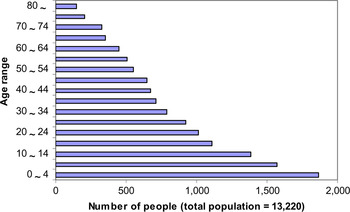
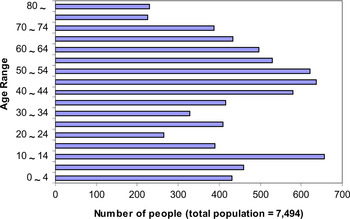
Hatoko had left Kaminoseki in 1959, just before her twentieth birthday. In so doing, her fictional path traced the real paths of Kaminoseki residents in the immediate postwar decades. Between 1955 and 1960, the period in which Hatoko first left for Tokyo, the town's population fell by 1,566 people, or 12.3 percent; between 1960 and 1975, when the series ended and Hatoko is shown once again walking the Kaminoseki beach, the population fell by another third (see figures below).Footnote 1 Perhaps more significantly, the majority of those leaving the town between the mid-1950s and the mid-1970s were young workers: Figure 2 is particularly noteworthy for the gaping hole in the sub-section of the population aged between fifteen and thirty-nine. Kaminoseki's startling demographic transformation within the time frame of just one generation may explain why town leaders first started talking about “depopulation countermeasures” (kaso taisaku) in their public pronouncements from 1970 onwards (Kaminoseki Kōhō, 20 January 1970; hereafter KK).
The population of Kaminoseki by age, 1950Footnote 2

The population of Kaminoseki by age, 1975

In fact, the story of municipal economic decline predated the 1950s and 1960s. In the late-Tokugawa period (1603–1868), Kaminoseki's port location, on the main domestic trading arteries of the Inland Sea, had made it one of the most prosperous counties in one of the most highly developed proto-industrial domains in the whole of Japan (Smith Reference Smith1969; Nishikawa Reference Nishikawa1978). Yet by the mid-1880s, the complex economic transformations wrought by Japan's opening to the West threatened to turn the town into a backwater of the new Meiji state—a metamorphosis not dissimilar to that traced by Kären Wigen for the Shimoina valley in central Japan (Wigen Reference Wigen1995). In 1894, for example, four town merchants petitioned local bureaucrats to complain that due to “transformed” world conditions, commercial ships and merchants were no longer coming to port. “Our merchants have lost their work,” they wrote, “and now continually present us with the pitiful sight of bankruptcy, or with taking up fishing, or with descending [to the level of] day labor and out-migration to other provinces” (Kaminoseki Chōshi Hensan Iinkai, hereafter KC, 1988, 450). These concerns in some ways foreshadowed those of town leaders in the 1970s—in particular the merchants' reference to “out-migration to other provinces.” Interestingly, the mayor of Kaminoseki from 1971 to 1983, the late Kanō Shin, was himself the sixth-generation head of a merchant household that had prospered greatly in the Tokugawa period but hit hard times thereafter.
By the early 1970s, however, the nature of the economic crisis was of a different order even to that described by the 1890s merchants. At the end of the nineteenth century, there was still a range of different employment openings for local men and women. In addition to domestic out-migration, for example, many townspeople emigrated overseas, such that transnational employment networks expanded dramatically in the first decades of the twentieth century (Dusinberre Reference Dusinberre2008). Equally significant were opportunities for enterprising businessmen in the municipality itself: in the fishing industry, in the ubiquitous “water trade”—the number of town brothels had increased substantially by the mid-1920s—and in the marine transportation industry, particularly in the transportation of domestic coal from Kyushu to the Kansai region. Despite losses suffered by local owners as coal-freight ships were requisitioned for the Japanese merchant navy during the final years of World War II, the 1920s to the 1950s were boom decades for Kaminoseki's marine transportation industry, which generated forty-one percent of the town's total income in 1955 (Yamaguchi-ken sōmubu tōkeika Reference Yamaguchi-Ken1957, 13).
Kaminoseki was therefore particularly vulnerable to the energy shift that occurred in the late 1950s as national policymakers decided to drive Japan's postwar economic recovery through cheap oil imports rather than domestic coal. Unlike coal, which could be transported in wooden hybrid (steam-sail) ships, oil transportation required steel tankers powered by diesel engines—the tankers beyond the financial means of most of Kaminoseki's ship-owning households, and the technologies beyond the capacities of the town's small-scale shipbuilding and engine manufacturing industries. Bigger ships also required port facilities over and above those available in Kaminoseki: the decline of the hybrid coal-transporting ships in the 1960s thus negatively affected not only those directly involved in the industry, but also secondary service industries in the town. With the impending collapse of some of the town's main economic pillars, and with the draw of higher factory wages in industrializing cities such as Tokuyama, Iwakuni, Hiroshima and even far-off Osaka, it is not surprising that many of Hatoko's real-life contemporaries joined the exodus of young people from Kaminoseki.
Yet in the economic gloom of the 1960s, there were a few success stories. Katayama Hideyuki, born in Shiraida hamlet in 1931, was the grandson of a shipbuilding carpenter and the son of a hybrid ship owner.Footnote 3 Katayama himself became a ship owner in the 1950s, and in around 1960 he became one of the first and only men in the hamlet to make the transition from wooden coal transporter to steel oil tanker. By 1970, his company, Matsuyama Kisen, owned five such tankers, each of which employed several local crewmembers; each time he upgraded to a newer ship with bigger tonnage, Katayama passed on his older vessel to a neighboring ship-owning household. In this way, he created a web of social and financial dependencies that would serve him well when, in 1970, he was apparently prevailed upon to become a town councilor. As councilor and eventually as speaker of the Kaminoseki town assembly in the late 1970s, Katayama would thus be a key figure in local politics as the municipality, led by Mayor Kanō, sought ways to “halt depopulation,” and as the national government sought to accelerate its next major shift in energy policy—this time, in the wake of the 1973 Oil Shock, from oil to the atom.
“Shock” all round: anti-allergic sweeteners and their efficacy
The Organization of the Petroleum Exporting Countries' (OPEC) oil shocks, beginning in October 1973, transformed Japan's national energy landscape. As the global price of oil skyrocketed, Japanese manufacturers and power producers, both of whom depended heavily on Middle Eastern oil, were forced to pay ever higher prices for petroleum products: in early 1973, the market price for a barrel of oil rested around $3, but by January 1974 the price had nearly quadrupled (Aldrich Reference Aldrich2008, 132). Agencies within the Japanese state moved quickly to deal with the crisis. One scheme involved the creation of quasi-governmental agencies that would promote non-oil energy sources: the Ministry of Construction, for example, established the tax-exempt Japan Dam Federation in 1974 to promote the construction of hydroelectric dams. But it was the civil servants responsible for atomic energy who felt particularly intense pressure to help Japan move beyond oil. Until the early 1970s, these bureaucrats had largely allowed the “market” for commercial atomic energy to rule, with only occasional assists—such as MITI's detailed surveys of hundreds of coastal areas, starting in 1960, which were intended to provide advance topographical and geological knowledge of potential host communities to utility companies (Nihon Genshiryoku Sangyō Kaigi, hereafter NGSK, 1970, Vol. 14 No. 10, 26). The oil shocks, however, in combination with the strengthening anti-nuclear movement, forced the government to become far more interventionist and creative in its handling of nuclear politics.
Japanese governmental interventionism could have included coercive measures—land expropriation, for example—to force through the construction of nuclear power stations. However, the fear of a backlash from anti-nuclear constituencies in civil society in the late 1960s and early 1970s kept the government from employing such explicitly coercive tools.Footnote 4 Instead, bureaucrats identified specific demographic groups within civil society that might obstruct the siting process—farmers, fishermen, local government officials, and (perhaps recalling the 1955 anti-nuclear petition) women—and then designed new incentives to appeal to those constituencies. This was an example of the state moving beyond basic coercive tools to develop more sophisticated policies that rewarded cooperation rather than punishing resistance (Aldrich Reference Aldrich2008). One such innovation was the Three Power Source Development Laws (Three Laws, Dengen Sanpō), which institutionalized previously ad hoc compensation to communities hosting major energy-generating plants. As initially established in 1974, these laws allowed for tax revenues paid by electricity users to be funneled back into the host communities to fund major infrastructure projects (roads, schools, port development) over a five-year period. Although the money was available to all municipalities that hosted hydroelectric, fossil, and nuclear plants, the amount available to the latter communities was the largest (Lesbirel Reference Lesbirel1998, 35–38). A new government bureau, the Agency for Natural Resources and Energy (ANRE, Shigen Enerugi chō) was created in 1973 to handle the promotion of commercial nuclear power through the Three Laws and other incentives.
At the same time, the government expanded existing initiatives such as Nuclear Power Day (established in 1964) and “atomic energy centers” (founded in 1972) so as to broaden its distribution of pro-nuclear information. The governmental agency Japan Atomic Energy Relations Organization (established in 1970), for example, sponsored an annual high school student essay contest to “gather positive opinions, comments, and expectations related to nuclear energy” (NGSK 1975 Vol. 19 No. 11, 43). During these years, MITI's expenditure on pro-nuclear materials to spread “understanding about the safety of nuclear power” in host or potential host communities exceeded 900,000 yen annually. In the summer of 1976, representatives of the industry publicly discussed the plan to introduce more “populist” measures such as public hearings and environmental impact assessments, both of which were aimed at making the nuclear power siting process appear more democratic and “reflect the opinion of local residents” (NGSK 1976, Vol. 20. No. 4, 37; NGSK 1976 Vol. 20 No. 5, 22).
Yet despite these targeted campaigns and the development of other incentive-driven policies, and despite opinion polls in the mid-1970s showing that close to 70 percent of respondents supported Japan's continued nuclear program (Aldrich Reference Aldrich2008, 127), the “lead times” for nuclear power plants increased from 90 months in 1975 to 160 months by 1980 (Lesbirel Reference Lesbirel1998, 31). In other words, by 1980, the time between the initial planning application and a power plant coming on line was more than thirteen years.
One explanation for this apparent paradox—that greater state intervention in the siting process coexisted with greater lead times in planned host communities—may be the increased mobilization and cross-organizational cooperation of anti-nuclear groups in the 1970s. On Nuclear Power Day in 1977, twenty-three anti-nuclear organizations, including the Japan Consumers' Union, housewives' organizations, and the Japan Congress against Atomic and Hydrogen Bombs (Gensuikin), gathered for the first time in Tokyo to campaign against nuclear power. Significantly, their activities included a “post-nuclear seminar” to which victims of the atomic bombs were invited—a reminder of the uniquely Japanese frame of nuclear power discourse in postwar Japan. But anti-nuclear campaigners could also draw on international events, in particular the Three Mile Island accident (28 March 1979), to bolster their case: by November 1980, opinion polls indicated that only 30 percent of citizens were now supportive of Japan's nuclear plant-building program, down from 50 percent in the month before the accident (Aldrich Reference Aldrich2008, 136). These low figures occurred despite the second oil shock of 1979, following the revolution in Iran.
Such was the backdrop to Chugoku Electric Power Company's increasingly desperate attempts, by the turn of 1980, to find a municipality willing to host the construction of a new nuclear plant. Of all the regional power companies, Chugoku Electric faced a particular problem in that its headquarters were in Hiroshima: as a government official commented in 1985, any attempt to locate a plant within the vicinity of the city would be “committing corporate suicide” (quoted in Lesbirel Reference Lesbirel1998, 23). This left the company dependent on the cooperation of the other four prefectures within the Chugoku region—Tottori and Shimane on the Japan Sea coast, and Yamaguchi and Okayama respectively to the west and east of Hiroshima. Although Chugoku Electric had been one of the first companies nationwide to open a nuclear plant (in northern Shimane prefecture, in 1974), it had failed to gain prefectural support for a new development in Hinase town, Okayama, in 1973. The following year, MITI estimated that if no new plants opened in the company's jurisdiction by 1979, it would face an electricity shortfall of some 850 megawatts (Lesbirel Reference Lesbirel1998, 108)—a shortfall roughly equivalent to two more Shimane-sized reactors.
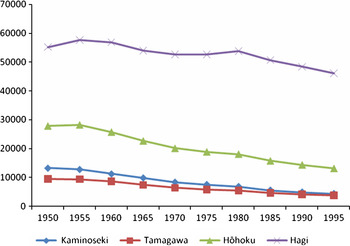
In June 1977, Chugoku Electric made an official application to Hōhoku town, in the northwest of Yamaguchi prefecture, to start a preliminary investigation (jizen chōsa), the first step toward the eventual construction of a nuclear power station. Hōhoku, like many other potential host communities, was hemorrhaging residents: between 1950 and 1980, its population declined by more than a third (see Figure 3). But as the regional newspaper, the Chūgoku Shinbun (hereafter CS), reported in early July, the company had already reached its “time limit” in terms of rising electricity demand. There would thus be no time for the preliminary sounding-out phase of negotiations within the municipality; instead, the company would publicly try to persuade local residents to allow construction (CS, 2 July 1977). To this end, it had the full support of the Yamaguchi prefectural bureaucracy, including Governor Hirai Tōru (served 1976–96), and central government also played its part by using its new incentive-based tools to designate Hōhoku as an Important Electricity Resource Site—thus making the town eligible for greater central government subsidies (CS, 19 January 1978).Footnote 5
Depopulation in Four Potential Nuclear Plant Host Communities

Hōhoku had been the object of a MITI coastal survey in 1969. This gave local residents (especially local fishermen) an awareness of the issue that was crucial to their quick mobilization of an anti-nuclear campaign eight years later (CS, 28 August 1977). To the surprise and concern of town officials, some 1,500 fishermen and residents (out of a total population of 18,400) protested against the nuclear plan in July 1977. By February 1978, pressure had built on the town mayor to the extent that he finally announced he would not accept the company's application—to the “shock” of the prefecture. Two months later, a barely quorate town council also voted to oppose the application, and in mid-May (following the resignation of the previous mayor), a new anti-nuclear mayor was elected by a two-to-one landslide.
In the aftermath of the election, a front-page article in the Chūgoku Shinbun argued that a combination of the company's public relations campaign, the overwhelming pressure exerted by the prefecture and the hastiness (seikyū) of the central government had provoked local residents into opposition (CS, 15 May 1978). These events suggest that the legislative non-coercive tools of the immediate post-oil shock years were in themselves of only limited effect. What would be needed to produce a better outcome for the pro-nuclear lobby would be a combination of more subtle “behind-the-scenes” maneuvering by the company and “soft social control” tools by the government, in ways that spoke most effectively to the local community.
Kaminoseki, 1981–82: the how and the why
The 271st episode of Hatoko's Sea, broadcast on 17 February 1975, depicts several characters discussing two real-life events from March of the previous year: the return of Lieutenant Hirō from the Philippines, and the ongoing toilet paper shortage, caused by the 1973 oil shock. Yet from Hatoko's perspective, the biggest concern in March 1974 is not these events but rather the health of her young son: he has had a bad outbreak of asthma, and has missed school. Indeed, it is his condition—symbolic of Tokyo's then notorious smog problem—which will soon lead Hatoko to send him back to live and attend school in the purer air of Kaminoseki, where she too will return in the drama's final episodes.
In many ways, the fictional character of Hatoko was fortunate to have a hometown to which she could return. For by the mid-1970s, there were many young men and women living in Japan's cities who were at least two or three generations removed from their ancestral hometowns (kokyō, furusato) and who had very few or no familial ties to what they perceived to be the more traditionally “Japanese” lives of people in rural communities. It was thus particularly the young adults of Hatoko's generation who participated in the so-called “furusato-boom” of the 1970s, when millions of city-dwellers vacationed to the countryside in search of an idealized “hometown” community that might help them re-discover their sense of Japanese identity (see also Ivy Reference Ivy1995, 29–65). Yet the general idealization of rural Japan during the furusato-boom—and the particular idealization of mid-1970s Kaminoseki in Hatoko's Sea—merely underlined the growing gap between urban perceptions of the countryside and the reality on the ground. In fact, Kaminoseki's leaders were so anxious to “halt” (hadome) depopulation that in 1976 they initially welcomed a proposal to destroy the very beaches and mountains depicted in the final shots of the television series—the kind of landscape celebrated by furusato-boom iconography.
In November 1976, Mitsubishi Corporation made an application to construct a major storage depot for Liquefied Petroleum Gas (LPG) in Nakanoura, a tiny seaside hamlet four kilometers to the west of the town center on the northern side of Nagashima, the largest of the many islands that comprise Kaminoseki municipality (KC, 580–81).Footnote 6 Due to unexpectedly strong opposition from influential landowners in and around Nakanoura, the plan was quietly shelved in 1980, but it was nevertheless significant for three reasons. First, the LPG plan indicated that town bureaucrats were open to any and all proposals that might fulfill their avowed aim of “attracting business” (kigyō yūchi) to Kaminoseki. Second, among the pro-Mitsubishi supporters could be found many of the political and civil society elites—the Mayor (Kanō Shin), the Speaker of the Town Assembly (Katayama Hideyuki), the Chair of the Chamber of Commerce, the Head of the Ward Association, and so on—who would later become key local lobbyists for the nuclear power plant plan. With hindsight, the LPG proposal, though a failure, thus ultimately served as a “dry run” for the infinitely more difficult task of selling nuclear power to local residents. Third, and perhaps most importantly, the disappointment experienced by those elites happened to coincide with Chugoku Electric's own failed nuclear proposal in Hōhoku, 1977–79, and with Yamaguchi prefecture's desire to find a new host partner for a company already approaching its electricity-generating “time limit.”
It is perhaps not surprising to discover that the first approach to Kaminoseki leaders thus apparently came from prefectural officials who had close personal ties to the town elites, rather than from the company itself. Indeed, the new Speaker of the Prefectural Assembly, Yoshinaga Shigeru (served May 1981 to April 1983), and the Mayor of Kaminoseki, Kanō Shin (served 1971–83), allegedly knew each other from high school in the early 1930s and were good friends. Other approaches were also allegedly made from the prefecture to senior officials in the municipal bureaucracy,Footnote 7 and from these initial contacts came introductions to Chugoku Electric. Most probably, this process began in the summer of 1981, a date which is consistent with the first lone voices in the prefectural assembly (in September) and the town assembly (in December) seeking to clarify whether and why Chugoku Electric was conducting “fishing trips” and “investigations” in the vicinity of Kaminoseki (Asahi Shinbun 2001, 16–19). In other words, despite the official company narrative of the Kaminoseki nuclear plant proposal taking June 1982 as its start date (Chūgoku Denryoku Kabushiki Gaisha 2001, 380), the first—and highly secret—“groundwork” discussions probably occurred up to twelve months before that.
One reason that Chugoku Electric and its local supporters were keen to keep the plan secret may have been their memories of the 1978–79 anti-nuclear election results in Hōhoku town. Indeed, the experience of the Ashiyama dispute in Mie prefecture in the mid-1960s—the first time in Japan that a proposed nuclear power station was successfully rejected by local residents—had taught all nine power companies the dangers of allowing a situation to develop in which anti-nuclear campaigners could gain access to political power (Lesbirel Reference Lesbirel1998, 61–79). By delaying any official announcement until after Kaminoseki town council elections, scheduled for February 1982, and by cultivating the “groundwork” (nemawashi) in the meantime, Chugoku Electric may have considered that it had gained four additional years before the issue would have to go to the electorate. To this end, the company was aided by the fact that Kaminoseki had not been subjected to an initial MITI topographical survey in the 1960s. As a result, the town's fishermen in particular were less aware of the potential environmental implications of hosting a nuclear power station than their Hōhoku counterparts, who had mobilized quickly in 1977.
Except for the lack of a MITI survey, however, Kaminoseki appeared to tick many of the central government's boxes for a potential nuclear host community, especially in terms of the town's civil society characteristics. Such characteristics were important because research has demonstrated that, despite claims that site selection around the world is based solely on technocratic criteria,Footnote 8 decision makers in both government and industry regularly evaluate potential host communities based on their capacity to resist (Hamilton Reference Hamilton1993; Sherman Reference Sherman2006; Aldrich Reference Aldrich2008). That is, controversial or unwanted projects are placed in areas which are least likely to mobilize in opposition.
Quantitatively, the data from Kaminoseki at the turn of the 1980s was inconclusive in terms of indicating potential resistance to a nuclear proposal. On the one hand, Kaminoseki—along with Hōhoku and two other Yamaguchi sites considered by Chugoku Electric—had been slowly hemorrhaging population over the previous three decades. As we have seen, between 1950 and 1980, the town lost roughly half of its population (see Figure 3 above) and those losses were particularly concentrated in its young working population. On the other hand, compared to other primary industries in the town, Kaminoseki's fishermen—the support of whom would be crucial for the nuclear plant—maintained their strength: relative to farming, which comprised 49 percent of the town's workforce in 1950 but only 16 percent in 1980, the fishing industry only fell from 22 percent to 16 percent in the same period.
Nevertheless, local government officials perceived Kaminoseki as having weak civil society, especially in terms of organized horizontal associations. The majority of Kaminoseki's fishing cooperatives, for example, were considered to be “weak,” with only tenuous connections to the “fishing lifestyle.” (Significantly, only the nearby Iwaishima cooperative, which would lead the anti-nuclear campaign, was noted for its strong social bonds.) Moreover, officials spoke of “weak labor unions in Kaminoseki” compared to Hōhoku, Hagi and Tamagawa, which all successfully resisted nuclear plant proposals.
Yet horizontal associations were not the only measure of civil society in early 1980s Kaminoseki. Equally important were vertical ties within Kaminoseki's civil society, the contours of which may be sketched by tracing the trickle-down quality of Chugoku Electric's “groundwork” strategy in the town. As newspaper reports indicated, one of the company's “mistakes” in Hōhoku town had been to focus only on the very highest level of government administration—what the Asahi Shinbun termed the “boss” level (Asahi Shinbun 2001, 26). In Kaminoseki, by contrast, company strategy was to focus on the community, especially on the district wards (jichitai), the smallest units of political control (CS, 25 October 1982). In order to access this level, Chugoku Electric needed introductions from the “bosses” of Kaminoseki—men such as Mayor Kanō, Speaker Katayama and other councilors, and the district head (kuchō, the elected head of the jichitai). It would also be in company interests to talk with the heads of the farming and fishing cooperatives in the town, and the chair of the Chamber of Commerce (Shōkōkai). In other words, Chugoku Electric would need to prepare the ground for its formal announcement of Kaminoseki as a candidate site—which occurred in June 1982—by liaising carefully not only with elected local government representatives but also with key groups in local civil society.
But in a small community such as Kaminoseki (population c. 6,700 in 1981–82), elected town representatives and civil society leaders were often one and the same man (the first female town councilor was not elected until 1986). The chair of the Chamber of Commerce in 1981, for example, was the late Tanaka Masami, who had been the speaker of the town assembly between 1970 and 1978. The then head of Kaminoseki district (kuchō) was also a former town councilor, an anti-crime activist, and chair of a pro-Mitsubishi/LPG lobby group. Meanwhile, on the island of Iwaishima, one long-serving councilor was the former head of the Iwaishima junior high school Parent Teacher Association (1970–74), while another of his council colleagues was head of the farming cooperative and hereditary elder (sōdai) of the island's main parish shrine. After the 1982 council elections, one of the island's new councilors would be the head of the Iwaishima fishing cooperative (KK, 1970–82). Back in the hamlet of Shiraida, on Nagashima Island, Speaker Katayama drew on his aforementioned web of social and financial dependencies to become, in April 1983, Kaminoseki's first explicitly pro-nuclear mayor.
Thus one characteristic of civil society in early 1980s Kaminoseki was that due to the multiple roles that some of the municipality's most influential men performed, many of the associations within civil society's sphere—the chamber of commerce, farming and fishing unions, lobby groups, PTAs, shrine associations—were only nominally autonomous from local government and thus, by extension, from the state itself. By targeting these men as the first stage of its secret “groundwork” strategy, Chugoku Electric's officials could hope to create multiple opportunities to penetrate town society below the level of the “bosses.” If they were to gain the support of Tanaka Masami, for example, they would have potential introductions to a range of other Chamber of Commerce members who might benefit either directly or indirectly from the nuclear plan—construction businesses, the local service industry, small retailers, and so on. Likewise, if company officials were to gain the support of the head of Kaminoseki district, they might next be able to access to the individual ward heads (hanchō) who comprised the jichitai. And by approaching the heads of the farming and fishing cooperatives, officials might hope eventually to receive a favorable hearing among the rank-and-file membership. Such connections suggest that in addition to Japanese siting authorities deliberately avoiding communities which displayed high social capital and horizontal bonds, they may have actively targeted communities in which they could influence opinion through strong vertical bonds.
Nemawashi, or the practice of “laying the groundwork” (literally, “root-binding”), has been described as “frequent chats over lunches, dinners, drinks, and during social events,” which serve “as a congenial, informal context for discussion of proposals, possible courses of action, decision-making, and potential negotiating table strategies” (Goldman Reference Goldman1994, 155–156). Although it is generally very difficult to gather evidence of such sensitive meetings, one way in which Chugoku Electric allegedly reached out to townspeople below the “boss” level was through hospitality in local inns: middle-ranking members of various civil society groups would be invited to dinner and drinks, during which the topic of nuclear power might be broached. Another strategy, starting from at least March 1982 (KC 1988, 581–582), if not earlier, was to sponsor “study trips” (kengaku) for large numbers of townspeople. The destinations of these trips ranged from Chugoku Electric's own nuclear power station, on the northern coast of Shimane prefecture, to Kyushu Electric's plant in Genkai (Saga prefecture) and Kansai Electric's facility in Mihama (Fukui prefecture). In interviews, local utility officials saw these kengaku as “attempts to build consensus” by habituating Kaminoseki residents to the idea of living in the shadow of nuclear power plants through extended exposure to them.Footnote 9
This notion of familiarizing local citizens with existing nuclear sites as a way of convincing them of the “normalcy” of life near potentially dangerous facilities was also found in postwar France. Residents living near the proposed nuclear waste processing plant in La Hague, for example, were flown in the early 1960s to view the nuclear complex at Marcoule; it was hoped this would dispel rumors of seven-kilometer exclusion zones, deformed children and so on. But the Marcoule trips had a secondary purpose as well. In the words of one visitor, “We flew down there and had a pretty good time, actually…In the afternoon we saw over the plant…Next day we were shown round the co-operative wine cellars…Oh, we had a good time, all right, and there were those who took advantage” (Zonabend Reference Zonabend and Underwood1993, 22). As for the residents of La Hague, so for the residents of Kaminoseki the available evidence suggests that the study visits were a good time, with the emphasis apparently placed on townspeople imbibing as much alcohol as hard facts. Many visits included an overnight stay in an inn, and a side trip to some famous tourist site—an opportunity to “discover Japan” for Kaminoseki's fishermen, farmers and their families. Thus by the autumn of 1982, around 1,000 townspeople (one-sixth of the total population) had participated in these free study visits—although this figure may include a number of ersatz students who were so enthusiastic about their studies that they went on four or five separate trips (CS, 25 October 1982).
Both the local hospitality and the study visits created a social bond which connected ordinary townspeople to their political and civil societal “bosses”—a process which Jeffrey Broadbent has termed, “status seduction” (Broadbent Reference Broadbent1998, 190). If, for example, one was invited to wine and dine with company officials in a local inn, one might feel a sense of obligation both to the company and (perhaps more importantly) to the host of the evening or the acquaintance who had been kind enough to make the invitation in the first place. If one had enjoyed a free “study visit”—especially under the auspices of a neighborhood club or association—the sense of social reciprocation when it came to a decision about nuclear power might be considerable. In other words, within a small community such as Kaminoseki, the structure of civil society meant that an ordinary citizen's pro-nuclear decision was as likely to be based on social, political and even historical obligations as it was on a clear grasp of atomic energy issues. While incentives from the central government (provided through institutions such as the Three Laws) no doubt had some impact on local residents, the nature of residents' social bonds to town elites and to the wider community proved most critical in determining their attitude towards the proposed nuclear power plant.
Conclusion
The case study presented in this article highlights the potential benefits of combining research methodologies from a number of disciplines—in our case, history and political science—in order to offer a more holistic view of the rise of the nuclear power industry in postwar Japan. In particular, we have attempted to avoid a potentially misleading “snapshot” model of institutional and policy developments (see Pierson Reference Pierson2004), instead to offer a more nuanced view of the industry at both the national and local levels.
From the perspective of Tokyo-centered discourse, two factors make the 1984 invitation vote in Kaminoseki seem counterintuitive. On the one hand, in the aftermath of the 1945 atomic bombings and the 1954 Lucky Dragon incident, many Japanese developed an instinctively anti-nuclear stance, and it was this “nuclear allergy” that central government bureaucrats and utility companies struggled to address in the late 1960s and 1970s. On the other hand, the furusato discourses of the 1970s constituted a paean to those declining rural communities that had escaped the ravages of industrial pollution and that thus appeared to be depositories of an amorphous “Japaneseness”—to the extent, in Kaminoseki's case, that the town could become the stage for an NHK drama of postwar national recovery and growth. Yet despite the nuclear allergy and the rural-idyll rhetoric of the furusato-boom, Kaminoseki town leaders voted permanently to alter the idealized “hometown” landscape so as to allow the construction, of all things, of a nuclear power station. This was also despite Kaminoseki's relative proximity to Hiroshima.
But seen from a local perspective, and with a longer historical perspective, this willingness to “invite” Chugoku Electric makes better sense. Behind the “invitation mood” of 1981–84 (CS, 25 October 1982; 16 March 1984) lay townspeople's memories of the decline of the local economy in the 1880s, waves of out-migration from the 1890s onward, and the failed attempt to site a liquefied petroleum gas depot in the town in the late 1970s. Thus by the early 1980s, Kaminoseki's economic and demographic decline was not merely a postwar phenomenon (although it had clearly accelerated during the decades depicted in Hatoko's Sea); rather, it dated from the “transformed” world conditions of the late-nineteenth century. Moreover, it was wired into the household DNA of the town's then mayor, Kanō Shin; and similarly, the speaker of the town council and subsequent mayor, Katayama Hideyuki, himself had first-hand experience of the local dislocations caused by Japan's postwar energy shift from coal to oil—although his own business had ridden the waves of change with great success. Central government “sweeteners” of large grants, loans to attract new businesses, and new infrastructure thus appealed to leaders such as Kanō, Katayama, and the Chair of the Chamber of Commerce, to the extent that they could present the nuclear plan to townspeople as a way of saving the furusato—a discourse that continues to this day. Ultimately, these leaders appear to have considered the risks posed to the hometown by population decline and concomitant loss of identity greater than any risks posed by a nuclear power station itself.
In this way, the discursive frame of the siting decision in 1981–82 bypassed issues of atomic safety. Although the anti-nuclear campaign on Iwaishima island, which emerged in the autumn of 1982, would emphasize atomic “danger,” as seen at Hiroshima, Nagasaki, and later at Chernobyl, this was not a debate directly engaged by pro-nuclear lobbyists in the period before the 1984 invitation vote (although it was of course addressed by sponsored “study visits” away from Kaminoseki). In other words, one way to overcome the “nuclear allergy” in Kaminoseki was to avoid contestation through agenda setting and nemawashi—a point similar to that made by Susan Pharr (Reference Pharr1990) in her investigation of the privatization of conflict in Japan.
Such avoidance of contestation depended on the management of local civil society by a small number of highly influential men in the town. Our focus on identifying those men and their motivations in 1981–82 underlines the importance of understanding the role of individual agency in any scholarly analysis of civil society and industrial development. Much work on industrial planning in Japan initially emphasized the role of central government ministries (Johnson Reference Johnson1982), a focus which expanded to encompass the weaknesses of civil society (Pekkanen Reference Pekkanen2006) and central government's attempt to manage it (Garon Reference Garon1997; Schwartz and Pharr Reference Schwartz and Pharr2003; Aldrich Reference Aldrich2008). In this article, however, we have attempted to present an even more nuanced picture which highlights the fluidity of state-society interaction and particularly the agency of local citizens.
The men and women of Kaminoseki were not merely passive recipients of the central government's soft social control tools, such as habituation and education; instead, many of them participated enthusiastically in “study visits” during 1982. Doubtless they had a number of reasons for doing so. Indeed, we have suggested that one reason that townspeople followed their leaders' pro-nuclear decisions in 1982–84 was because of the simultaneous positions of authority those leaders held both within the town administration and within civil society organizations. Nominally horizontal, cooperative associations existed in Kaminoseki of the type that past scholarship has studied with regard to understanding local resistance to siting decisions (Hamilton Reference Hamilton1993; Sherman Reference Sherman2006). By noting the relative lack of autonomy of those organizations from the state and the concomitant political influence of their leaders, however, we have suggested that the role of vertical ties in binding ordinary townspeople to their political and civil society “bosses” was a critical factor in determining the level of support for the nuclear proposal when it was eventually made public in June 1982 (see also Broadbent Reference Broadbent1998, chapter 6). But even here, we must once again acknowledge the importance of individual agency: on the island of Iwaishima, many people rebelled against these vertical relations in the autumn of 1982, thus leading to the emergence of a vociferous anti-nuclear campaign within the town.
We have attempted to show how international events and national schemes impacted on residents at a local level—but also how local townspeople utilized and refined policy initiatives in ways that it would have been impossible for central bureaucrats to predict. In the wake of the 2011 Fukushima crisis, it is particularly important that we grasp how this local dynamic works. The historical context to the pro-nuclear decision in early 1980s Kaminoseki was obviously unique to that town, but the more general processes by which such a decision was reached are applicable to nuclear communities throughout Japan: the management of local civil society, the fear of hometown decline, the intervention of a power company in daily life, the attraction of central government subsidies, and not least the bypassing of a debate about safety. Understanding the postwar structures of the nuclear power industry and the historical role of local civil society in promoting atomic energy will be crucial also to our understanding of Japan's post-Fukushima nuclear future.
Acknowledgements
The authors would like to thank Victor Ban, Aya Homei, Ann Waswo, and three anonymous readers for their comments on earlier drafts of this article, and members of the Radiation Sickness and the Politics of Nuclear Energy workshop at the Needham Research Institute, University of Cambridge, in August 2009.