




No CrossRef data available.
Effects of input manipulations on the word learning abilities of children with and without specific language impairment
Published online by Cambridge University Press: 27 April 2004
Abstract
Three input variables were manipulated during a story-viewing task to examine the word learning abilities of children with and without specific language impairment (SLI). The variables were presentation rate, sentence complexity, and word type. Fifty-four children participated: 18 were identified as SLI and 36 served as normally developing age-matched or language-matched controls. The stimuli involved a videotaped reading of two stories that had novel words embedded in the narrative, and word learning was measured by examining the children's ability to infer the meanings of the novel words from the story viewing context. A picture pointing task and a real word synonym task served as comprehension probes. A nonword repetition task and a battery of language tests were also administered. Two of the three input manipulations affected the children's scores. Across both probes, word type resulted in a main effect, with children from all three groups earning higher scores for verbs than nouns. On the picture pointing probe, presentation rate interacted with group. The interaction reflected lower scores in the fast rate than the slow rate for the children with SLI but not for the controls. Children's nonword repetition scores and standardized tests of vocabulary and syntax were moderately correlated with each other, and together these variables accounted for significant variation in the children's story viewing scores even after age, IQ, and articulation ability were controlled. The vocabulary and syntax tests contributed unique variance whereas nonword repetition contributed shared variance.
Information
- Type
- Research Article
- Information
- Copyright
- © 2004 Cambridge University Press
The word learning difficulties of children with specific language impairment (SLI) have been documented in several experiments (Dollaghan, 1987; Ellis Weismer & Hesketh, 1993, 1996, 1998; Kiernan & Gray, 1998; Oetting, Rice, & Swank, 1995; Rice, Buhr, & Nemeth, 1990; Rice, Buhr, & Oetting, 1992; Rice, Oetting, Marquis, Bode, & Pae, 1994). Proposals by Baddeley and Wilson (1993), Gathercole and Baddeley (1989, 1990a), Ellis Weismer and Hesketh (1996), Montgomery (2002), and others tie these children's vocabulary difficulties to limitations in phonological working memory and/or general processing ability. Others such as Rice (1990) highlight specific semantic and syntactic deficits of the SLI system as factors contributing to the lexical limitations of these children.
Manipulating the input characteristics of stimuli during tasks of novel word learning is one method researchers have used to test these different hypotheses. The primary goal of the current study was to continue this line of research by manipulating a number of processing- and language-based input variables within a task that simulated a naturalistic word learning context, that of listening to story-books being read.
PREVIOUS INPUT STUDIES
In a series of studies, Ellis Weismer and Hesketh (1993, 1996, 1998) manipulated four different input variables during a novel word learning task. The variables were presentation rate (fast vs. normal vs. slow), use of emphatic stress (±), presence of visual cueing (±), and internal syllabic structure of the target words (consonant–vowel–consonant [CVC] vs. CVCC). The rationale driving these manipulations was a working memory model developed by Just, Carpenter, and colleagues (Daneman & Carpenter, 1980; Just & Carpenter, 1992; MacDonald, Just, & Carpenter, 1992). The model posits a global pool of resources supporting language comprehension. This account predicts that when demands placed on one's system exceed available cognitive capacity, performance breaks down. This model also predicts that individual performance differences in language comprehension may be explained by variations in processing efficiency or in the total amount of resources available to the system.
In all three of Ellis Weismer and Hesketh's studies, novel labels for unfamiliar objects were presented five times within a target sentence (e.g., “Sam is by the X.”), and word learning was assessed immediately after presentation of each word through probes of comprehension (e.g., “Put Sam by the X.”), production (e.g., “What's this called?”), and/or recognition (e.g., “This is a X,” upon which the child responded by pushing a button to indicate yes/no). The age of the children in the study ranged from 6 to 9 years, and language matching involved raw scores from the Peabody Picture Vocabulary Test—Revised (PPVT-R; Dunn & Dunn, 1981).
Across studies, presentation rate was found to have the most reliable effect on word learning and children with SLI were affected by this variable more than were the controls. The strongest evidence for this claim came from the production probe data reported in Ellis Weismer and Hesketh (1996). On this probe, children with SLI performed like the controls during the slow rate condition, but in the fast rate condition their scores were lower. Scores of the children with SLI, but not those of the controls, were also lower in the fast rate as compared to the slow rate.
Montgomery (1995b) also manipulated an input variable in his study of children with and without SLI. His study examined 5- to 11-year-olds' comprehension of sentences, and the Test of Reception of Grammar (Bishop, 1989) was used to match children in terms of language ability. Montgomery's input variable was sentence type, which he defined as the presence or absence of nonessential (i.e., redundant) phonological content in a sentence. By design, however, redundant sentences (e.g., “The girl who is pushing the boy is smiling.”) also contained more words and, depending upon one's grammatical theory, potentially more forms of complex syntax than the nonredundant sentences (e.g., “The girl pushing the boy is smiling.”).
Montgomery's study was based on Gathercole and Baddeley's (1993) model of phonological working memory. According to this model, children with language impairments present limitations in the ability to process the phonological content of language. Based on this model, Montgomery predicted that children with SLI would have more trouble comprehending the redundant sentences because of the extra phonological content but the normal controls would not. As predicted, the children with SLI earned lower scores with the redundant as compared to the nonredundant stimuli, but a within-subjects difference was not observed for the controls.
Finally, in six different studies, Rice and colleagues examined the effects of a number of input variables on children with and without SLI (Oetting, 1999; Oetting et al., 1995; Rice et al., 1990, 1992, 1994; Rice, Cleave, & Oetting, 2000). The age of the children who participated in these studies ranged from 3 to 8 years, and language matching when completed, involved mean length of utterance. Unlike the other studies reviewed, a major goal of this research was to examine word acquisition in situations that simulated a natural learning context. Thus, videotaped stories of animated characters, puppets, and/or human actors were used to introduce unfamiliar words to children, and word learning was assessed through picture comprehension tests before and after viewing.
In these studies, linguistic input manipulations included type of word referent (object, attribute, action, affective state), word class (noun vs. verb), syntactic frame used to introduce a word (transitive vs. intransitive), and presence of morphosyntactic cues (±). Processing-based variables were also manipulated and these included the insertion of a pause before a target word (±) and presentation frequency (3 vs. 10). Three variables, presence of a pause, word referent/word class, and presence of morphosyntactic cues, were found to interact with group. The group by pause interaction, however, was found to involve the younger, language-matched (LM) children rather than those with SLI. Specifically, the LM children earned higher scores when a pause was included than when it was not. For children with SLI and the chronological age (CA)-matched controls, the pause condition led to lower scores than the no-pause condition.
Type of word was found to interact with group in two of the three studies that included this variable (Oetting et al., 1995; Rice et al., 1994). In both cases, verbs and/or words referring to actions were found to be more difficult for children with SLI as compared to controls. In Oetting et al. (1995), the SLI verb weakness was revealed through an analysis of the children's posttest scores. In Rice et al. (1994), the SLI verb deficit did not surface at posttest because children with SLI and the CA controls earned higher posttest scores for verbs than nouns. Nevertheless, when the children's retention of the words was tested 1–3 days after the experiment, the verb scores of the children with SLI decreased whereas those of the controls did not.
Finally, the presence of morphosyntactic cues before words was shown to differentially impact children with and without SLI in one study (Rice et al., 2000). In this experiment, children were presented two noun labels and two object referents simultaneously. In one condition, the morphosyntactic cues a and some preceded the target words to help the children map the words to their referents (i.e., a X and some X). In the other condition, the target words were preceded by the neutral determiner the (i.e., the X and the X), leaving the word–referent mappings unspecified. Children who exploited the morphosyntax during the task were expected to perform above chance when presented with a and some and at chance when presented with the. Only the CA children presented this pattern of findings. Scores of the SLI and LM groups did not exceed chance in either condition.
In summary, a number of input variables have been manipulated in previous studies of SLI. Variables that have been shown to differentially affect the language comprehension skills of same-aged children with and without SLI include presentation rate, word type, and morphosyntax. Presentation rate and word type, along with sentence type, have also led to differences between children with SLI and their LM peers. In the current work, the effects of rate, word type, and sentence type were studied in greater detail. Manipulating these three variables in the same study allowed us to test the replication of previous studies. Based on the literature review, we predicted that a fast rate, verbs, and a sentence type condition that added syntactic complexity to the stimuli would pose more problems for the children with SLI than for the controls.
Another reason to examine all three of these variables within a single study was to see if we could document interactions between them. Recall that previous rate effects were interpreted as indicating a general processing limitation in SLI, whereas word type effects have been used to identify language-specific strengths and weaknesses. If an interaction between these two variables were found, then characterizations of these variables as being either processing-based or language-based would be less tenable because their effects would be shown to be dependent upon each other.
Interactions between a syntactically based sentence type manipulation and the other two variables were also of interest for two reasons. First, the grammatical deficits of children with SLI are well documented (see Leonard, 1998), but only a few studies have examined how these deficits affect children's acquisition of words (e.g., Oetting, 1999; Rice et al., 2000). Second, recall that previous sentence type effects have been used to argue that SLI involves a specific phonological processing deficit; however, in the one study that examined this variable, the sentence type manipulation resulted in changes to the phonology, semantics, and syntax of the stimuli. The goal here was to manipulate only the syntax of the sentences to see if we could replicate the sentence type effect without manipulating other aspects of the sentences. Such a finding would implicate a more general and/or different type of language deficit rather than a specific phonological deficit because by design, the phonological content of the stimuli would be controlled.
Although there are a number of ways to alter the syntactic complexity of a sentence, adding subject-modifying relative clauses prior to clauses that contained the unknown nouns and verbs was chosen for the current work. Sentence embedding was a method utilized by Montgomery in the study we were attempting to replicate. Manipulation of embedded clauses, unlike the addition of negative clauses or other coordinated/embedded clauses, also allowed us to control the semantic and phonological content of the sentences across the different sentence conditions.
A videotaped presentation of two stories being read by an adult was selected as the word learning activity. In at least four studies, children have been shown to learn words while listening to adults read books (Eller, Papas, & Brown, 1988; Elley, 1989; Robbins & Ehri, 1994; Senechal & Cornell, 1993). In these studies and the videotape work of Rice and colleagues, novel or unfamiliar words are presented to children within the context of a narrative. Specific to the current study and the work of Robbins and Ehri (1994) and Rice and colleagues (Rice, 1990; Rice et al., 1990, 1992, 1994, 2000), the meanings of the unknown words were not directly expressed within the narrative. As an example, in one of the story-viewing conditions, the word pimel was used to describe a soap dish that a mama bug used as a bathtub to give her baby bug a bath. The pictures in the story depicted the soap dish within the context of a child's bathroom. The accompanying narrative was “Mama Bug, knowing it is time to wash, says into the pimel you go.” Therefore, the word learning skill examined here was the children's ability to infer novel word meaning (e.g., pimel means something like a bathtub) from the story context. Although the act of learning a novel word also involves the identification, encoding, and storage of the word's phonological and syntactic properties, these aspects of word learning were not examined.
THE RELATION BETWEEN NONWORD REPETITION AND LEXICAL LEARNING IN CHILDREN
A second goal of the study was to further examine the claim that the vocabulary limitations of children with SLI are related to nonword repetition deficits. A relation between nonword repetition and vocabulary ability has been well documented. Nonword repetition, however, is a controversial measure, with much of the debate centered on interpretations of the underlying mechanisms that drive children's ability to complete this task (Dollaghan, Biber, & Campbell, 1993; Edwards & Lahey, 1998; Gathercole & Baddeley, 1989, 1990a, 1990b, 1995; Howard & van der Lely, 1995; van der Lely & Howard, 1994). Also debated are the direction and/or causal nature of the relation between children's nonword repetition skills and their concurrent and subsequent vocabulary abilities (Bowey, 2001). Nevertheless, children with SLI repeatedly earn lower nonword repetition scores than normal controls (Bishop, North, & Dunlan, 1996; Conti–Ramsden, 2004; Conti–Ramsden, Botting, & Faragher, 2001; Dollaghan & Campbell, 1998; Ellis Weismer et al., 2000; Montgomery, 1995a). In a few studies, the nonword repetition skills of children with and without SLI were also linked to skills needed for novel language learning (see Montgomery, 2002).
Montgomery's (1995b) study of sentence comprehension is an example of an experiment that employed a nonword repetition task. His stimuli included 48 nonce words that were one to four syllables in length, and the task required children to listen to each word and repeat it. Consistent with previous studies, children with SLI had significantly more difficulty with this task than the controls. This group difference remained even after vocabulary differences between the groups, as measured by standard scores on the PPVT-R, were factored out. Moreover, Montgomery reported a .62 positive correlation between children's nonword repetition scores and their performance on the sentence comprehension task. These findings were interpreted as documenting the important role of phonological working memory deficits in the language comprehension difficulties of children with SLI.
Including a nonword repetition task in the current study allowed us to further test the phonological working memory claims of Montgomery and others. Note that although Montgomery (1995b) reported a moderate correlation between nonword repetition and sentence comprehension, he did not examine intercorrelations among his variables. He also did not evaluate the relation between nonword repetition and sentence comprehension after controlling for the participants' general vocabulary abilities. Researchers, who have used regression to examine partial correlations, report smaller (albeit sometimes significant) degrees of association among different measures of children's language abilities and their nonword repetition skills (Bowey, 2001; Sahlen, Wagner, Nettelbadt, & Radeborg, 1999).
The following research questions guided this study: (a) Are children with SLI less able than normal controls to comprehend the meanings of novel words during a story-viewing activity? (b) Do input manipulations involving presentation rate, word type, and sentence type affect the novel word comprehension skills of children with SLI to a greater degree than normal controls? (c) Does performance on a nonword repetition task help explain the novel word comprehension skills of children with and without SLI?
METHODS
Participants
There were 54 participants: 18 children with SLI, 18 normally developing CA children, and 18 normally developing LM children. For the SLI group, there were 8 African American (AA) and 10 White (W) children; for the CA and LM controls, like ratios were 6 and 12, and 9 and 9, respectively. Nine SLI, 10 CA, and 8 LM children were males. All children came from one rural parish in southeast Louisiana. Children in the SLI and CA groups were selected from the same kindergarten classrooms. The children in the LM group were recruited from day care centers and Head Start programs that were located in close proximity to the target elementary schools. All children were monolingual English speakers, although nonmainstream dialect was free to vary (for data related to dialect use in this community, see Oetting & McDonald, 2001).
The children in the SLI and CA groups were between the ages of 5 and 7 years. Criteria for the SLI group included the following: (a) diagnosis of language impairment by a certified speech–language pathologist, (b) language performance below classroom peers as confirmed by the classroom teacher, (c) normal nonverbal intelligence as evidenced by an age deviation score of 85 or above on the Columbia Mental Maturity Scale (CMMS; Burgemeister, Blum, & Lorge, 1972), (d) normal hearing based on a hearing screening conducted within 6 months of the study, (e) limited vocabulary as measured by the PPVT-R, and (f) limited syntactic ability as measured by the syntactic quotient (combined scores of subtests III–V) of the Test of Language Development—Primary (TOLD; Newcomer & Hammill, 1988). The Goldman–Fristoe Test of Articulation (GFTA; Goldman & Fristoe, 1986) was also administered for descriptive purposes.
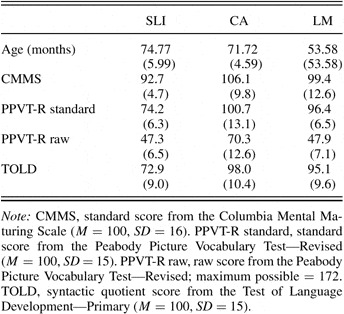
Criteria for the normally developing groups included: (a) average classroom performance as indicated by teacher report, (b) absence of a history of speech and language impairment, and (c) performance within or above 1 standard deviation of the mean on the CMMS and PPVT-R. The age of each CA child was within 5 months of a SLI child. Children in the LM group were at least 18 months younger than their SLI child match. Raw scores on the PPVT-R also were used to match each LM child to a child in the SLI group. The average PPVT-R raw score difference between each match was ±4.78 (SD = 4.1). Group profiles of the participants are provided in Table 1.

Materials
Word learning stimuli
The books used for the videotaped stimuli were Wake Up, Sun (Harrison, 1986) and Snug Bug (Dubowski & Dubowski, 1995). These books were chosen to ensure that the picture referents of the novel words and the general narrative of the story were age appropriate. Both books are described in their respective series as level 1 preschool material. The picture pages from each of these books depicted a sequence of related events that involved two to three central characters. In both books, these characters were animals (i.e., chicken, cow, dog, pig, and two bugs). The first book is about a dog who wakes up before the sun rises. As the story unfolds, the dog wakes his friends and together they search the farm for the sun. The setting of the other book is a house that is occupied by people, but also living in the house are a mama bug and a baby bug. The story follows the mama bug and baby as they get the baby ready for bed. Similar to a child's bedtime routine, the baby bug hides from his mother because he knows it is bedtime; then he takes a bath, brushes his teeth, listens to a bedtime story, and goes to sleep with a teddy bear.
To create the stimuli, the pages from these books were turned by a hand and videotaped; video fading in and out occurred at the beginning and end of each picture page. Next, four audiotaped versions of two stories were created to manipulate the variables of interest. There were two levels of presentation rate, fast and slow. In the fast rate condition, the average reading was 5.79 (SD = .67) syllables/s and in the slow condition it was 2.07 (SD = .40) syllables/s. Rate was measured by digitizing the audio signals with Cooledit freeware. For two versions of each story, the first half was read at a fast rate and the second half at a slow rate. For the other two versions, the fast and slow rates were reversed.
There also were two versions of sentence type, complex and simple. The complex condition presented a target word in one sentence with an added subject-modifying embedded clause (e.g., noun, “Mama Bug, knowing it is time to wash, says into the pimel you go.”; verb, “Chicken, because she was so excited, kootled her wings in the air.”). The simple condition presented the same content as the complex condition, but the added embedded clauses were presented as separate sentences (e.g., noun, “Mama knows it is time to wash. She says into the pimel you go.”; verb, “The chicken was very excited. She kootled her wings in the air.”). As demonstrated by these examples, the simple condition contained sentences with some complex noun and verb phrases because these types of structures are often used when telling a story. In both conditions, the embedded clauses (or separate sentences) were presented prior to the clauses/sentences with the nonce nouns and verbs. The complex conditions had the same number of syllables as the simple conditions. Half of the target words were presented in the complex condition, and the others were presented in the simple condition. Complex and simple sentences occurred in a fixed order, but they were counterbalanced across the two rate conditions.
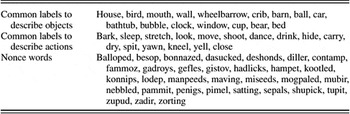
Finally, there were two levels of word type, nouns and verbs. Eight novel nouns and 8 novel verbs were presented one time in each story (16 of each across both stories). The objects and actions to which the words referred were chosen based on the presence of picture support (see Table 2). In addition, all of the objects and actions to which the novel words referred were thought to be familiar to children of the age range studied here because (a) they were included in a book that was written for preschool children and (b) common word labels to describe all but three of the referents (i.e., barn, yawn, and wheelbarrow) were found in Hall, Nagey, and Linn (1984), a reference book that provides a list of words spoken by middle class and working class preschool children (21 AA, 18 W) during conversations at school, home and en route between the two.1
Nonce words that referred to barn, yawn, and wheelbarrow earned the 3rd, 5th, and 13th lowest correct scores of the 32 nonce items during the real word synonym task, but for the picture pointing probe, an item analysis did not indicate that words referring to these objects and action were more or less difficult than the others.

Within the narrative, the nonce nouns took typical morphological markers for nouns, with seven following a determiner, six following a possessive pronoun, two following an adjective, and one following a verb. In addition, three of the novel nouns were produced with a plural ending. The nonce verbs took typical morphological markers for verbs. Six were produced with regular third person marking, three were produced with present progressive marking, six were produced with regular past tense marking, and one followed the auxiliary would. All novel words were two syllables in length. Each novel word appeared in each rate condition and each sentence condition, counterbalanced across children in each group.
Comprehension probes
The children's understanding of the novel words during the story-viewing task was measured with two probes, one involving picture pointing and the other involving the production of real word synonyms. For the first probe, children were asked to identify the picture referent from the story that went with each novel word. For each item, four photocopied pictures from the original stories were shown to the child. The target and two of the foils were pictures of objects or actions that were present on the same page as the target referent, whereas the third foil was a picture of an object or action from a previous page. The examiner's prompt for this task was “Show me X.” At test time, the nonce words were produced in the same way as they were presented in the story to maintain the phonological form of each item. Therefore, the 3 novel nouns that were presented as plurals and the 15 novel verbs that were presented with bound verb morphology were produced with their inflections at test time.
For the real word synonym probe, the comprehension probe was removed and the children were asked to produce a “real” word that meant the same thing as each nonce word (i.e., “Tell me a real word that means the same thing as X.”). This probe was designed to help us further interrogate the children's understanding of the novel words through an in-depth error analysis. Correct responses were those that matched the target in meaning and syntax (e.g., for “he dasucked [looked] at the sky,” correct responses were “look” and “looked”). We also coded three different types of errors that were semantically related to the target. An in-class error was semantically related to the target, and although it could not be produced in the sentence, it matched the grammatical class of the nonce word (e.g., for “she koenips [dries] her…”, an in-class error was “wash”). An out of class error was semantically related to the target but it did not match the grammatical class of the nonce word (e.g., for “she koenips [dries] her…”, an out of class error was “towel”). The third semantically related error was a paraphrastic response; these responses included multiple words, so the grammatical class of the response could not be determined (e.g., for “she kootled [moved] her wings in the air,” a paraphrase was “wings up like that because she's scared”). The other three types of errors were: repetitions of the nonce word, responses that were unrelated to the meaning of the nonce word (e.g., for “poenigs [drops] his toothpaste into the bathroom sink,” an unrelated error was “bed”), and “I don't know.”
Nonword repetition task
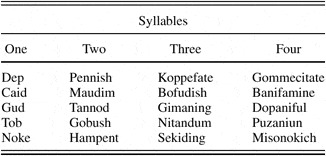
Twenty of the 48 nonwords used by Montgomery (1995b) were selected as stimuli.2
Given that Montgomery's nonce items included real word syllables and that similarity to known words has been shown to facilitate children's repetition, we also asked all but two of the children to complete the nonword repetition task of Dollaghan and Campbell (1998). Their task involves 16 one to four syllable words that do not have real word syllables. The results with the Dollaghan and Campbell list were consistent with the findings reported here. Montgomery's results are reported here because we were testing the replication of his findings.

Procedures
Standardized testing was completed in three sessions. The story-viewing task and nonword repetition task were completed in two additional sessions. Each session was completed in a quiet room at the child's school. Forty-six (85%) of the children studied also completed an earlier experiment by Oetting (2004).
For the story-viewing task, children were told that they would watch a videotaped story with some silly words, and that they should help the examiner figure out what the words meant. After each target word was presented in the story, the examiner paused the tape and administered the two comprehension probes for that item. For the nonword repetition task, the children were asked to listen to each word and repeat it. Each child was allowed no more than two opportunities to produce each item.
Reliability
Twenty percent of the real word synonyms were given to another examiner for coding. Intercoder reliability was 99%. In addition, 20% of the audiotapes from the nonword repetition task were independently transcribed by a second person. Reliability between transcribers was 95%.
RESULTS
Story-viewing task
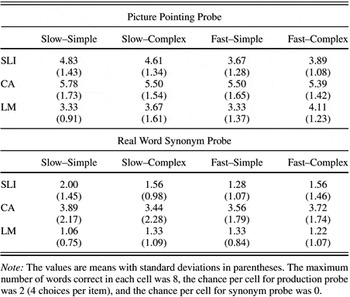
The picture pointing scores of all three groups were above chance (chance = 8; 32 items/4-item choice); SLI t (17) = 14.53, p < .001; CA t (17) = 12.16, p < .001; LM t (17) = 14.26, p < .001. In addition, the real word synonym scores of all three groups were greater than zero; SLI t (17) = 7.33, p < .001; CA t (17) = 8.65, p < .001; LM t (17) = 11.08, p < .001. Table 4 shows these scores for each group. Additional preliminary analyses were completed to examine whether earlier participation in Oetting (2004) and/or the variables of race and gender impacted the results. For both the picture pointing probe and real word synonym probe, nonsignificant findings were found for study order and gender, but race was found to interact with group. Therefore, race was retained as a variable in the analyses.

For the picture pointing probe, a five-way analysis of variance (ANOVA) was run to examine the effects of presentation rate, sentence type, word type, group and race. A significant main effect was found for word, F (1, 48) = 78.81, p < .001, but unexpectantly, the verb scores of all three groups were higher than the noun scores. Main effects were also found for rate, F (1, 48) = 4.87, p < .05; group, F (2, 48) = 22.73, p < .001; and race, F (1, 48) = 8.39, p < .01. These main effects were qualified by two two-way interactions between rate and group, F(2, 48) = 3.64, p < .05, and race and group, F (2, 48) = 7.31, p < .01.
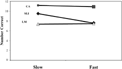
To examine the rate by group interaction, one-way ANOVAs were completed for the fast and slow rates. For both rates, group differences were present; slow F (2, 53) = 15.21, p < .001, and fast F (2, 53) = 17.01, p < .001. Tukey tests (p < .05) indicated that scores of the CA group were higher than those of the SLI and LM groups in the fast condition, but in the slow condition, scores of the CA and SLI groups were higher than those of the LM group. Next, three paired t tests were run to examine whether the individual groups were affected by the rate conditions. Children with SLI earned lower scores in the fast rate as compared to slow, t (17) = 2.52, p < .05. Rate effects were not significant for the CA and LM groups (see Figure 1).

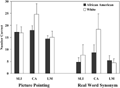
To examine the group by race interaction, scores for each rate condition were combined, and one-way ANOVAs with follow-up Tukey tests were completed for the W and AA children separately. Group differences were identified for both races; W: F (2, 29) = 23.14, p < .001; AA: F (2, 23) = 6.24, p < .05. For the W children, scores of the CA group were higher than those of the SLI and LM groups. For the AA children, scores of the SLI and CA groups were higher than those of the LM group (see Figure 2).

A second five-way ANOVA was completed using the real word synonym data. This analysis also revealed a main effect for word type, F (1, 48) = 12.54, p < .001, with all three groups again earning higher scores for verbs than nouns. Main effects also were found for group, F (2, 48) = 24.79, p < .001, and race, F (1, 48) = 13.10, p < .001, but these were qualified by a two-way interaction between these variables, F (2, 48) = 8.39, p < .001. The Group × Race interaction reflected within-group differences for race. For the CA group, scores of the W children were higher than those of the AA children, t (16) = 3.70, p < .01; this race effect was not observed for the SLI and LM groups. Across both the W and AA children, scores of the CA group were higher than those of the SLI and LM groups (see Figure 2).
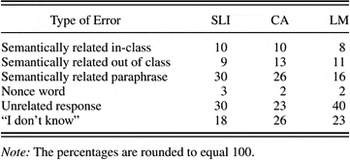
Table 5 presents an error analysis of the real word synonym data. Recall that six different types of errors were coded; three were semantically related to the targets and three were not. Of the semantically related error types, responses involving multiword paraphrases were the most common for all three groups. For the other response types, the CA group produced slightly more “I don't know” responses, whereas the SLI and LM groups produced slightly more unrelated comments. Although the rates of the different response types did not vary dramatically across the groups, the grammatical class of the nonce targets was found to affect the children's rates of in-class and out of class errors. Only 28% of the nonce noun errors involved an in-class synonym whereas 61% of the nonce verb errors involved this type of response.

Nonword repetition task
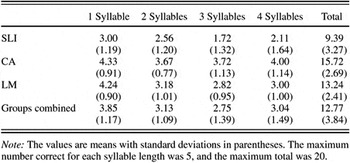
Following Montgomery (1995b), the number of correctly produced items was calculated for each syllable length. The maximum number of items at each syllable length was five and the maximum total was 20 (see Table 6). One LM child was unable to complete the task, so the data are from 53 children. A three-way ANOVA was used to examine the variables of group, race, and syllable number. Neither a main effect nor any interactions were found for the variable of race. A main effect was found for group, F (2, 50) = 22.96, p < .001, with the scores of the SLI group being lower than those of both control groups, and the scores of the LM group being lower than those of the CA group. A main effect was also found for syllable number, F (3, 48) = 9.59, p < .001. For all three groups, scores on the one syllable words were higher than scores on the two, three, and four syllable words; one versus two: t (52) = 3.40, p < .001; one versus three: t (52) = 5.22, p < .001; and one versus four: t (52) = 3.32, p = .002.

Correlational analyses
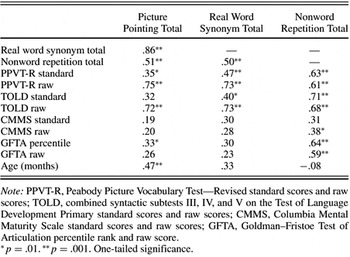
Pearson correlations were completed to examine the relation between the children's comprehension scores on the story viewing task and their age, nonword repetition totals, and scores on the standardized test battery (see Table 7). Note that this table includes standardized scores and raw scores from the PPVT-R, CMMS, TOLD, and GFTA. The GFTA raw score reflects the number of errors each child produced on this test multiplied by −1, so that children who made fewer errors earned higher scores. The other test scores reflect the number of items scored as correct. As can be seen, the children's picture pointing and real word synonym scores were positively related to their nonword repetition totals and their standard and raw scores on the PPVT-R and TOLD. The children's picture pointing scores also were positively related to the children's age and their percentile ranks on the GFTA.

Visual inspection of the table also indicates a great deal of multicollinearity among the variables. In particular, the children's nonword repetition scores were moderately correlated with their standard and raw scores of the PPVT-R and TOLD and their raw scores and percentile ranks of the GFTA. A low, but significant, correlation also was found between the children's nonword repetition totals and their raw scores on the CMMS.
Recall from the introduction, we argued that the relation between nonword repetition and novel word comprehension should be examined within the context of other language abilities. Montgomery's (1995b) approach to this was to use a covariance design to examine group differences on nonword repetition after controlling for the children's PPVT-R standard scores. When we replicated Montgomery's procedures, we also found a significant group difference in nonword repetition after controlling for the children's PPVT standard scores. This approach, however, does not allow one to study the relation among multiple variables simultaneously.
Another way to examine these data is to complete a series of multiple regression analyses. This approach allows one to determine the individual and joint contributions of a number of variables to the children's picture pointing and real word synonym scores. Since the children's nonword repetition scores, TOLD and GFTA scores could not be age-corrected, raw scores were chosen for these analyses (see Bowey, 2001). The use of raw scores is particularly important for the current work because two groups of normally developing children were selected as controls, and these groups varied in age and language experience. Indeed, while both of the control groups received relatively similar standard standard scores on the PPVT-R (CA = 100.7 vs. LM = 96.4), their raw scores were quite different (CA = 70.3 vs. LM = 47.9).
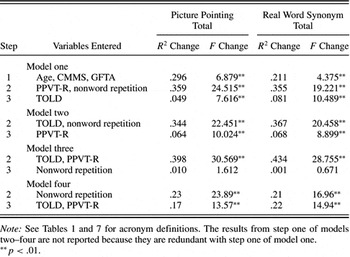
For both the picture pointing task and the real word synonym task, three hierarchical multiple regression analyses were completed. In all cases, the children's age, CMMS and GTFA were entered first. Entered into the second step were two of the three language variables (TOLD, PPVT-R, nonword repetition). Finally, the variable that was not entered in step two was entered in step three. The TOLD was entered last in model one, the PPVT-R was entered last in model two, and nonword repetition was entered last in model three.
As can be seen in Table 8, variables entered into the first step of the models accounted for a significant amount of variance in the children's picture pointing and real word synonym totals. In all three models, variables entered in step two also contributed a significant amount of additional variance in the children's scores. When the TOLD and PPVT-R were each entered into the models after controlling for everything else, they also continued to contribute to the predictability of the models. The TOLD accounted for 5 and 8% of additional variance in the children's scores (model one), and the PPVT-R accounted for 6–7% of additional variance (model two). Nonword repetition did not account for a significant amount of unique variance in the children's scores after all other variables were entered (model three), but it did contribute to the models through the variance it shared with the TOLD and PPVT-R (models one and two). Indeed, when two additional regressions were run, entering only nonword repetition after age, CMMS and GFTA, it accounted for 23% of additional variance in the children's picture pointing scores and 21% of additional variance in the children's real word synonym scores. Of course, a significant amount (17 and 22%) of unique variance continued to be accounted for by the TOLD and PPVT-R when they were entered after nonword repetition (see model 4). What this finding again shows is the shared contribution of the TOLD, PPVT-R and nonword repetition task as well as the additional unique contribution of the TOLD and PPVT-R for predicting the word learning scores of the children.

DISCUSSION
For theoretical models of SLI, the most useful finding from the input experiment was the rate by group interaction. This finding was found for only one of the tasks (i.e., picture pointing) examined here. Inspection of Table 4 suggests that low scores of the children with SLI (M = 6.4 out of 32, or 20%) may have contributed to the lack of an interaction for the real word synonym task, even though these scores were significantly greater than zero. Ellis Weismer and Hesketh (1996) also found a rate by group interaction on only one of their three word learning probes. For the two probes that did not show a rate effect, high scores (at or above 70%) were offered as a possible explanation. Taken together, the findings of these two studies suggest that the word learning abilities of children with SLI are affected by rate manipulations more than controls, but that influences of rate are most pronounced when tasks are moderately difficult.
A number of other studies have shown that children with SLI perform more slowly on a variety of tasks, but most if not all of these studies used tasks that are far removed from the everyday language learning experiences of children (i.e., finger tapping, picture rotation, picture matching, picture naming, and grammaticality judgments; for a review of studies, see Windsor, Milbraith, Carney, & Rakowski, 2001). Therefore, an important contribution of the current work is the demonstration that children's inability to process language quickly has a negative and direct impact on their ability to comprehend the meanings of novel words during at least one type of naturalistic word learning situation, that of listening to storybooks being read.
Recall that rate was initially chosen by Ellis Weismer and Hesketh (1996) as a general capacity variable. Although our findings for rate support the claim that children with SLI present a reduced ability to process rapidly presented sentences, we were unable to learn additional information about the general versus specific nature of this variable because a lack of an effect for sentence type and a large main effect for word type made it difficult to test for potential interactions between these variables. Additional studies are needed to further examine whether factors such as rate, sentence complexity, and word type constitute interactive or additive influences on the everyday experiences of the SLI child. This type of information is needed to further explicate the nature of these variables as well as further understand the nature of SLI.
Another important finding was the race by group interaction because any account of SLI should cut across a wide range of child profiles. Recall that when the data from the fast and slow rates were combined on the picture pointing task, a difference between the children with and without SLI was found for the W children but not the AA children. This Race × Group interaction was unexpected and was not found in our other word learning study with these same children (Oetting, 2004; see also Oetting, 1999). Nevertheless, our findings lend support to other researchers' claims that some traditional testing formats may be biased against particular groups of minority children (see Fagundes, Haynes, Haak, & Moran, 1998; Pena & Quinn, 1997). Including participants from diverse backgrounds in future studies and empirically manipulating the characteristics of the experimental protocol is the only way to further examine this issue.
The lack of a sentence type effect and parallel effects for word type across groups are less useful for theoretical models of SLI. Perhaps what these findings do best is testify to the methodological difficulties associated with input manipulation studies. Consider first the unexpected verb advantage result. Although the storybooks and object/action referents were selected because of their age appropriateness, the particular type of book and narrative probably contributed to the high verb scores. Finding child materials that present enough salient actions to study children's learning of verbs is difficult compared to finding materials to study children's learning of nouns. Thus, in the current study, the actions of the characters (and thus the target verbs selected) played a central role in the stories. Rice et al. (1994) provide a similar explanation for their unexpected findings of higher scores for verbs than nouns. Our use of verb inflections at test also may have contributed to the high verb scores. Recall that over twice as many in-class errors (i.e., responses that matched the grammatical class of the target) were produced for nonce verbs as compared to nonce nouns.
To further examine the impact of the test format on the results, we asked two children (aged 4 and 6) and an adult to complete the picture pointing task for 16 of the nonce words (8 nouns and 8 verbs from one of the books) without watching the videotaped story. Scores of all three did not exceed chance (4-year-old = 2, 6-year-old = 3, and adult = 4; chance = 16/4 = 4). We also asked all three individuals to provide a real word synonym for each of the 32 nonce words. All three earned a correct score of zero. Of the 96 responses (32 × 3), 67 were nouns, 19 were verbs, 9 were adjectives, and 1 was a quantifier. Moreover, present progressive marking was the only morphological ending that generated a consistent verb interpretation (i.e., three items carried this marker; all three generated a verb response from the adult and two generated a verb response from the children). Thus, like the results for the picture pointing task, the use of inflections at test seemed to contribute minimally to the current set of results.
The findings for both of these tasks were not surprising. The pictures in the book used for the pointing probe were created for story telling purposes rather than to illustrate prototypical examples of objects and actions. As such, the noun referents were often depicted with movement and/or expression and the verb referents were carried out by fully illustrated objects and/or characters. In other words, both actions and objects were illustrated within many of the individual pictures used for the pointing task. Also, for the real word synonym probe, the surface features of two of the morphological markers (/ed and /s) have a variety of uses in English (i.e., /s can occur at the end of a bare stem or it can be added to a bare stem to indicate plurality, possession, or third person singular; /ed can occur on adjectives and verbs).
Nevertheless, these findings are useful for ruling out the possibility that the children's high verb scores on the picture pointing task can be accounted for by the inflections used at test. A more likely explanation is that the children's picture pointing scores and real word synonym responses related to their exposure to, and use of, the stories they heard. Linguistic features within the stories that may have helped the children comprehend the novel words included where the word was placed within a sentence, its surrounding morphological context, and the meanings of the rest of the words in the sentence. How exactly children use these cues for novel word learning when they are listening to stories needs to be further studied in the future.
Next consider our failure to replicate Montgomery's (1995b) sentence type effect. Whereas Montgomery manipulated the semantics, syntax, and phonology of his sentences, we manipulated syntax alone. It would be interesting to determine whether our null result was related to the type of syntax manipulation or to the limited number (one vs. three) of language features that were changed. If the SLI deficit is specific to weaknesses in phonological processing, only manipulations that involve phonology should be implicated in these studies. If the deficit is more language general, then positive results should be found for a greater range of manipulations, including those that involve syntax and semantics. A challenge for future studies with this aim will be finding ways to vary stimuli in one of these three linguistic variables without changing the others.
In addition to completing an input study, we examined nonword repetition as a measure of phonological processing ability. Consistent with previous findings, children with SLI earned lower nonword repetition scores than did both control groups. Nonword repetition scores also did not vary as a function of race. This result is consistent with at least two other studies that have included minority children as participants (Campbell, Dollaghan, Needleman, & Janosky, 1997; Ellis Weismer et al., 2000). Thus, our findings support the use of nonword repetition as a non-biased tool for distinguishing children with SLI from those that are developing language normally.
Nonword repetition was also moderately correlated with children's scores on standardized tests of vocabulary and syntax and with their novel word comprehension totals on the story-viewing task. Moreover, nonword repetition and the standardized language tests together accounted for significant variation in the children's comprehension scores. After all other variables were controlled, the standardized tests of vocabulary and syntax contributed unique variance to the regression models, whereas nonword repetition's contribution was shared with the two language tests.
Findings from the regression analyses contribute to the literature in two ways. The first is that they provide ecological validity for previous studies that have examined the relation between nonword repetition and vocabulary development. Most of the previous research in this area has assessed children's vocabulary abilities with standardized tests. Measuring vocabulary skills with formal tests does not allow the researcher to study the acquisition of words within naturalistic learning situations. Furthermore, reliance upon formal tests does not allow the researcher to control for differences in the frequency at which children are exposed to words and in the conditions under which novel words are presented. In the current work, a standardized test was given but vocabulary ability was also measured by examining children's ability to infer novel word meaning from a story-viewing context. Using different tools to assess vocabulary skill did not prevent us from documenting a link between nonword repetition and word learning ability.
The second contribution relates to our findings of the unique and shared variances that were attributed to the TOLD, PPVT-R, and nonword repetition scores. Given the nature of the story-viewing task, perhaps it is not surprising that the syntax and vocabulary tests, but not nonword repetition, provided unique contributions to the children's word comprehension scores. A child must understand the syntax and semantics of a sentence in order to notice words that she does not understand and to infer the meanings of those words from the available linguistic information in the sentences and the available visual scenes. In addition, the measures we used to examine the children's vocabulary knowledge tapped into the semantic aspects rather than the phonological or syntactic aspects of the novel words. An important point, though, is that our experimental task and testing probes simulated the types of everyday learning experiences and testing experiences of the children. To describe nonword repetition skills (or any phonological processing skill) as important for vocabulary development without also considering children's existing semantic and syntactic systems reflects a failure to recognize and appreciate how it is that children build their lexicons in the real world.
Nevertheless, the next step in this line of research should expand the number and type of word learning situations studied and more rigorously interrogate children's knowledge of the novel words. Gathercole, Hitch, Service, and Martin's (1997) study is an example of this type of work. Their study involved three different word learning tasks, one of which embedded novel words into a story about a spaceman. In their story, the definition of each nonce word (e.g., sleepy talking frog) was presented in the story along with the nonce target (e.g., kipser). After two target words and their definitions were presented, two prompts were administered. One involved the recall of the nonce word (e.g., “Can you tell me what name the spaceman gave to the sleepy talking frog?”) and the other involved recall of the definition (e.g., “Can you tell me what a kipser is a name for?”).
Gathercole et al.'s (1997) analysis involved, among other things, an examination of the partial correlations among the children's standardized vocabulary scores, two measures of phonological working memory (nonword repetition and digit recall), and their recall scores on the story task. Consistent with our results, a great deal of multicollinearity was found among the variables and children's scores on both recall prompts were significantly related to their standardized vocabulary scores even after variance attributed to their age, nonverbal IQ, nonword repetition, and digit span was controlled (partial correlations = .55 and .56). As in our study, the same was not true of nonword repetition. Partial correlations between nonword repetition and the children's recall scores were not significant after all other variables were controlled. However, after controlling for all of the other variables, digit span was found to relate to the children's word recall, but not their definition recall (partial correlations ranged from .37 to .43). These results highlight the central role of a child's existing lexicon for learning new words, but they also indicate that phonological working memory (as measured by digit span) may independently contribute to children's encoding and storage of novel word pronunciation. These findings warrant further study.
The findings of the current study have practical implications for educators, speech language therapists, and parents, because replicated, evidence-based data now exist to support the reduction of speech rate as a general intervention method for children with SLI. In addition, the high degree of multicollinearity found between children's performance on the language content tests (i.e., standardized vocabulary and syntax tests) and the language processing task (e.g., nonword repetition) should remind educators of the importance of assessing and treating all aspects of a child's language system rather than focusing on one aspect (either content or processing) in isolation.
ACKNOWLEDGMENTS
The research was completed as part of a doctoral dissertation by the first author. Funding for the work was provided by a predoctoral fellowship from the National Institutes of Health (F31DC00276). Appreciation is extended to Penguin Press and Random House for copyright approval to videotape and photocopy the storybooks for the research; Rebecca Bonnett, Amy Brock, Julie Cantrell, Jennifer Depew, Lesley Eyles, Lesli Habans, Dia McGowen, and Myra Redlich for help with data collection and coding; Drs. Janet McDonald, Jan Norris, and Paul Hoffman for help with the design and analyses; and the teachers, parents, and children of Ascension Parish, LA, who participated in the study.
References
Baddeley, A., &
Wilson, B. A.
1993.
A developmental deficient in short-term phonological memory: Implications for language and reading.
Memory,
1,
65
78.Google Scholar
Bishop, D.
1989.
Test of Reception of Grammar.
Manchester, UK:
University of Manchester.
Bishop, D.,
North, R., &
Donlan, C.
1996.
Nonword repetition as a behavioural marker for inherited language impairment: Evidence from a twin study.
Journal of Child Psychology and Psychiatry,
37,
391
403.Google Scholar
Bowey, J.
2001.
Nonword repetition and young children's receptive vocabulary: A longitudinal study.
Applied Psycholinguistics,
22,
441
470.Google Scholar
Burgemeister, B.,
Blum, H., &
Lorge, L.
1972.
Columbia Mental Maturity Scale.
New York:
Harcourt Brace Jovanovich.
Campbell, T.,
Dollaghan, C.,
Needleman, H., &
Janosky, J.
1997.
Reducing bias in language assessment: Processing-dependent measures.
Journal of Speech, Language, and Hearing Research,
41,
433
444.CrossRefGoogle Scholar
Conti–Ramsden, G.
2004.
Processing and linguistic markers in young children with specific language impairment (SLI).
Manuscript submitted for publication.
Conti–Ramsden, G.,
Botting, N., &
Faragher, B.
2001.
Psycholinguistic markers for specific language impairment (SLI).
Journal of Child Psychology and Psychiatry,
42,
741
748.Google Scholar
Daneman, M., &
Carpenter, P.
1980.
Individual differences in integrating information between and within sentences.
Journal of Experimental Psychology: Learning, Memory, and Cognition,
9,
561
584.Google Scholar
Dollaghan, C.
1987.
Fast mapping in normal and language impaired children.
Journal of Speech and Hearing Disorders,
52,
218
222.Google Scholar
Dollaghan, C.,
Biber, M., &
Campbell, T.
1993.
Constituent syllable effects in a nonsense-word repetition task.
Journal of Speech and Hearing Research,
36,
1051
1054.Google Scholar
Dollaghan, C., &
Campbell, T. F.
1998.
Nonword repetition and child language impairment.
Journal of Speech, Language and Hearing Research,
41,
1136
1146.Google Scholar
Dubowski, C., &
Dubowski, M.
1995.
Snug bug.
New York:
Grosset & Dunlap.
Dunn, L., &
Dunn, L.
1981.
Peabody Picture Vocabulary Test—Revised.
Circle Pines, MN:
American Guidance Services.
Edwards, J., &
Lahey, M.
1998.
Nonword repetitions of children with specific language impairment: Exploration of some explanations for their inaccuracies.
Applied Psycholinguistics,
19,
279
309.Google Scholar
Eller, R. G.,
Pappas, C., &
Brown, E.
1988.
The lexical development of kindergarteners: Learning from written context.
Journal of Reading Behavior,
20,
5
24.Google Scholar
Elley, W.
1989.
Vocabulary acquisition from listening to stories.
Reading Research Quarterly,
24,
174
187.Google Scholar
Ellis Weismer, S., &
Hesketh, L.
1993.
The influence of prosodic and gestural cues on novel word acquisition by children with specific language impairment.
Journal of Speech and Hearing Research,
36,
1013
1025.Google Scholar
Ellis Weismer, S., &
Hesketh, L.
1996.
Lexical learning by children with specific language impairment: Effects of linguistic input presented at varying speaking rates.
Journal of Speech and Hearing Research,
39,
177
190.Google Scholar
Ellis Weismer, S., &
Hesketh, L.
1998.
The impact of emphatic stress on novel word learning by children with specific language impairment.
Journal of Speech, Language and Hearing Research,
41,
1441
1450.Google Scholar
Ellis Weismer, S.,
Tomblin, B.,
Zhang, X.,
Buckwalter, P.,
Chynoweth, J., &
Jones, M.
2000.
Nonword repetition performance in school-age children with and without language impairment.
Journal of Speech, Language, Hearing Research,
43,
865
878.Google Scholar
Fagundes, D.,
Haynes, W.,
Haak, N., &
Moran, M.
1998.
Task variability effects on the language test performance of Southern lower socioeconomic class African American and Caucasian five-year-olds.
Language, Speech, and Hearing Services in the Schools,
29,
148
157.Google Scholar
Gathercole, S. E., &
Baddeley, A. D.
1989.
The role of phonological memory in normal and disordered language development.
In C. von Euler,
L. Lundber, &
G. Lemerstrand (Eds.),
Brain and reading
(pp. 245
255).
New York:
MacMillan.
Gathercole, S. E., &
Baddeley, A. D.
1990a.
Phonological memory deficits in language disordered children. Is there a causal connection?
Journal of Memory and Language,
29,
336
360.Google Scholar
Gathercole, S. E., &
Baddeley, A. D.
1990b.
The role of phonological memory in vocabulary acquisition: A study of young children learning new words.
British Journal of Psychology,
81,
439
454.Google Scholar
Gathercole, S. B., &
Baddeley, A. D.
1993.
Working memory and language.
Hove, UK:
Erlbaum.
Gathercole, S. B., &
Baddeley, A. D.
1995.
Short-term memory may yet be deficient in children with language impairments: A comment on van der Lely & Howard (1983).
Journal of Speech and Hearing Research,
38,
463
472.Google Scholar
Gathercole, S. B.,
Hitch, G.,
Service, E., &
Martin, A.
1997.
Phonological short-term memory and new word learning in children.
Developmental Psychology,
33,
966
979.Google Scholar
Goldman, R., &
Fristoe, M.
1986.
Goldman–Fristoe Test of Articulation.
Circle Pines, MN:
American Guidance Services.
Hall, W.,
Nagey, W., &
Linn, R.
1984.
Spoken words: Effects of situation and social group on oral word usage and frequency.
Hillsdale, NJ:
Erlbaum.
Harrison, D.
1986.
Wake up sun!
New York:
Random House.
Howard, D., &
van der Lely, H.
1995.
Specific language impairment is not due to a short-term memory deficit: Response to Gathercole and Baddeley.
Journal of Speech and Hearing Research,
38,
466
472.Google Scholar
Just, M. A., &
Carpenter, P. A.
1992.
A capacity theory of comprehension: Individual differences in working memory.
Psychological Review,
99,
122
149.Google Scholar
Kiernan, B., &
Gray, S.
1998.
Word learning in a supported-learning context by preschool children with specific language impairment.
Journal of Speech, Language, Hearing Research,
41,
161
171.Google Scholar
Leonard, L. B.
1998.
Children with specific language impairment.
Cambridge, MA:
MIT Press.
MacDonald, M.,
Just, M., &
Carpenter, P.
1992.
Working memory constraints on the processing of syntactic ambiguity.
Cognitive Psychology,
24,
56
98.Google Scholar
Montgomery, J.
1995a.
Examination of phonological working memory in specifically language impaired children.
Applied Psycholinguistics,
16,
355
378.Google Scholar
Montgomery, J.
1995b.
Sentence comprehension in children with specific language impairment: The role of phonological working memory.
Journal of Speech and Hearing Research,
38,
187
199.Google Scholar
Montgomery, J.
2002.
Understanding the language difficulties of children with specific language impairments: Does verbal working memory matter?
American Journal of Speech–Language Pathology,
11,
77
91.CrossRefGoogle Scholar
Newcomer, P., &
Hammill, D.
1988.
Test of Language Development—Primary.
Austin, TX:
Pro-Ed.
Oetting, J.
2004.
Children with SLI make use of prepositions to learn verbs.
Manuscript submitted for publication.
Oetting, J.
1999.
Children with SLI make use of argument structure cues to learn verbs.
Journal of Speech, Language, and Hearing Research,
42,
1261
1274.Google Scholar
Oetting, J., &
McDonald, J.
2001.
Nonmainstream dialect and specific language impairment.
Journal of Speech, Language, and Hearing Research,
44,
207
223.Google Scholar
Oetting, J.,
Rice, M., &
Swank, L.
1995.
Quick incidental learning (QUIL) of words by school-aged children with and without SLI.
Journal of Speech and Hearing Research,
38,
434
445.Google Scholar
Pena, E. D., &
Quinn, R.
1997.
Task familiarity: Effects on the test performance of Puerto Rican and African–American children.
Language, Speech and Hearing Services in School,
28,
323
332.CrossRefGoogle Scholar
Rice, M.
1990.
Preschooler's QUIL: Quick incidental learning of words.
In G. Cont–Ramsden &
C. Snow (Eds.),
Children's language (Vol. 7,
pp 171
196).
Hillsdale, NJ:
Erlbaum.
Rice, M.,
Buhr, J., &
Nemeth, M.
1990.
Fast mapping word-learning abilities of language-delayed preschoolers.
Journal of Speech and Hearing Disorders,
55,
33
42.Google Scholar
Rice, M.,
Buhr, J., &
Oetting, J.
1992.
Specific-language-impaired children's quick incidental learning (QUIL) of words: The effect of a pause.
Journal of Speech and Hearing Research,
35,
1040
1048.Google Scholar
Rice, M.,
Cleave, P., &
Oetting, J.
2000.
Use of syntactic cues in lexical acquisition by children with SLI.
Journal of Speech Language Hearing Research,
43,
582
595.Google Scholar
Rice, M.,
Oetting, J.,
Marquis, J.,
Bode, J. &
Pae, S.
1994.
Frequency of input effects on SLI children's word comprehension.
Journal of Speech and Hearing Research,
37,
106
122.Google Scholar
Robbins, C., &
Ehri, L.
1994.
Reading storybook to kindergartners helps them learn new vocabulary words.
Journal of Educational Psychology,
86,
54
64.Google Scholar
Sahlen, B.,
Wagner, C.,
Nettelbadt, U.,
Radeborg, K.
1999.
Language comprehension and non-word repetition in children with language impairment.
Clinical Linguistics and Phonetics,
13,
369
380.Google Scholar
Senechal, M., &
Cornell, E. H.
1993.
Vocabulary acquisition through shared reading experiences.
Reading Research Quarterly,
28,
361
374.Google Scholar
van der Lely, H. K., &
Howard, D.
1994.
Children with specific language impairment: Linguistic impairment or short term memory deficit?
Journal of Speech and Hearing Research,
36,
1193
1207.Google Scholar
Windsor, J.,
Milbrath, R.,
Carney, E., &
Rakowski, S.
2001.
General slowing hypothesis in language impairment: Methodological considerations in testing the hypothesis.
Journal of Speech, Language, Hearing Research,
44,
446
461.Google Scholar
Group profiles
Object pictures, action pictures, and nonce words used in the storybook task
Stimuli for nonword repetition task
Picture pointing and real word synonym scores for each group
Percentages of children's error types on the real word synonym probe
Total number of items correct on nonword repetition task for each child group
Pearson correlations between independent and dependent variables
Hierarchical multiple regression analyses predicting story-viewing scores from syntax, vocabulary, and nonword repetition after controlling for all other variables
 You have
Access
- 34
- Cited by