Implications
Shearing removes the insulative property of the ewe’s fleece and may result in subsequent decreased core body temperature in cold climates. Therefore, a common husbandry practice involves providing pregnant ewes with a higher plane of nutrition post-shearing in an attempt to limit the negative effects of cold stress. Under conditions of the present study, late gestation shearing did not alter ewe BW or dry matter intake (DMI). These results suggest that, depending on climatic conditions and the severity of cold stress, finewool ewes managed in a drylot may not require additional feed resources post-shearing.
Introduction
Shearing pregnant ewes before parturition is a common husbandry practice in the United States. It creates a more sanitary environment for the periparturient ewe and lamb, and can result in greater birth weight (Symonds et al., Reference Symonds, Bryant and Lomax1986; Vipond et al., Reference Vipond, King, Inglis and Hunter1987; Corner et al., Reference Corner, Kenyon, Stafford, West and Oliver2006, Reference Corner, Kenyon, Stafford, West and Oliver2007 and Reference Corner, Kenyon, Stafford, West and Oliver2010) and enhanced neonatal survival (Rutter et al., Reference Rutter, Laird and White1971; Maund Reference Maund1980). Since an estimated 50% of lambs are born in April and May (i.e. 100 to 160 days after winter solstice) on operations with 500 or more breeding ewes (United States Department of Agriculture National Animal Health Monitoring System, 2014), shearing can occur during periods of cold and highly variable climatic conditions in many regions. One property of a fleece is to provide insulation and shearing may make sheep more susceptible to hypothermia in cold climates (Gregory, Reference Gregory1995). As ambient temperatures decline below lower critical thresholds, sheep thermoregulation becomes more reliant on metabolic heat production from dietary sources and the mobilization of tissue reserves (National Research Council (NRC), 1981).
Although several authors have reported that shorn, pregnant ewes consume more feed (14% to 36%) than unshorn ewes when both are managed indoors (Maund, Reference Maund1980; Glanville and Phillips, Reference Glanville and Phillips1986; Vipond et al., Reference Vipond, King, Inglis and Hunter1987; Keady and Hanrahan, Reference Keady and Hanrahan2009), others have reported no differences (Symonds et al., Reference Symonds, Bryant and Lomax1986; Vipond et al., Reference Vipond, King, Inglis and Hunter1987; Black and Chestnutt, Reference Black and Chestnutt1990). Similarly, the effect of shearing when pregnant ewes are managed outdoors has had an inconsistent (Dabiri et al., Reference Dabiri, Morris, Wallentine, McCutcheon, Parker and Wickham1996) or no effect on pasture intake (Parker et al., Reference Parker, Morris and McCutcheon1991; Husain et al., Reference Husain, Morris, McCutcheon and Parker1997; Kenyon et al., Reference Kenyon, Morris, Revell and McCutcheon2002). The methods used to calculate feed intake in previous reports are constrained by their accuracy (i.e. chemical markers or average pen performance) or their ability to model ewe behavior in a group (i.e. individual pens). To our knowledge, no reports exist where a comparison of voluntary feed consumption between shorn and unshorn pregnant ewes, using technology that records individual intake of animals managed in a group, was presented. Therefore, the objective of the present study was to determine if late gestation shearing induces differences in individual BW, intake and plasma metabolites of finewool ewes managed outdoors during winter in the Northern United States.
Material and methods
Animals and management
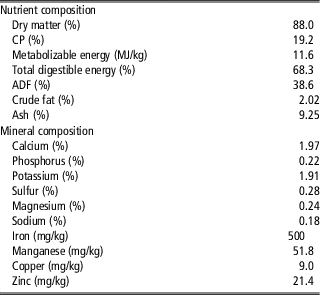
Stage of gestation of Rambouillet ewes was estimated by ultrasonography 57 days after initial exposure to Suffolk or Rambouillet rams in single sire breeding groups (7 to 23 November 2016). Thirty-six mature ewes (3.8±0.45 years; 76.8±11.4 kg) were estimated to have conceived within the first 17 days of the breeding season and transported from the Montana State University Red Bluff Research Ranch (Norris, MT, USA) to the Fort Ellis Research Farm (Bozeman, MT, USA; 15 January 2017). Ewes were then managed in drylot (22×54 m, 33 m2/ewe) where they had ad libitum access to grass hay and were gradually introduced to pelleted alfalfa (Medicago sativa; Table 1) until it became 100% of their diet by 18 February 2017.
Nutritional composition of sun-cured alfalfa pellets (Medicago sativa) consumed by gestating ewes throughout the trial

From then, pelleted alfalfa was offered ad libitum in four GrowSafe bunks (GrowSafe Systems Ltd, Airdrie, AB, Canada) which were located under a roofed structure that provided little relief from the environment. After fitting animals with a unique radio frequency identification ear tag, the GrowSafe system records individual intake at each feeding event and sums them within each day (McAllister et al., Reference McAllister, Gibb, Kemp, Huisma, Olson, Milligan and Schwartzkipf-Genswein2000). This enables the quantification of individual daily feed intake of animals managed in a group. Ewes were adapted to the GrowSafe feeders for 2 weeks (19 February to 3 March 2017) before the start of the trial.
The 3-week experiment took place from 4 to 24 March 2017. In the previous year, all ewes were sheared on the same day (18 March 2016) and had 12 months of wool growth at the start of the experiment. The treatment group consisted of ewes sheared at ~5 weeks before the estimated parturition date (shorn; n=18). Unshorn ewes (n=18) remained in full fleece throughout the experiment and were shorn on the last day of the experiment ~2 weeks before the estimated parturition date. Average starting BW, predicted litter size and service sire (n=5) were balanced between shearing treatments. While shorn ewes were being sheared, unshorn ewes were ‘sham sheared’ in an effort to equalize environmental stressors across groups. All ewes were sheared with a nine-tooth comb (Beiyuan Shearing Supplies, Victoria, Australia; 96-mm wide) which left behind ~6 mm of wool stubble. Two days after the end of the trial (26 March 2017), all ewes were transported back to the Red Bluff Research Ranch for lambing.
Greasy fleece weight was collected on all ewes at their respective shearing date and subtracted from their BW when appropriate (i.e. if they were weighed while in full fleece) to estimate sheared BW. Unfasted BW was recorded on consecutive days at the start and end of the trial. Total DMI was determined for each of the 3 weeks between shearing events. Daily minimum, maximum and average temperatures (18 February to 24 March 2017) were obtained from a weather station (Station USC00241047, Bozeman 6; NOAA National Centers for Environmental Information) located 15.1 km from the site of the experiment.
Blood was drawn on days 0 (before shorn group shearing), 7, 14 and 21 (before unshorn group shearing) via jugular venipuncture into 7-ml K3 EDTA collection tubes (Benton, Dickson, and Co., Franklin Lakes, NJ, USA), centrifuged within 30 min of collection at 1011×g for 30 min (VS-3400; Cole Parmer Instruments Co., Vernon Hills, IL, USA) and the resulting plasma was aliquoted and stored at −20°C. A subsample of plasma aliquots were selected (n=10/treatment) after balancing for BW, actual lambing date and actual litter size between shearing groups. Non-esterified fatty acid (NEFA; NEFA-HR (2) Kit, 993-34691; Wako Diagnostics, Mountain View, CA, USA) and β-hydroxybutyrate (BHB; β-hydroxybutyrate Reagent Set, P803-H7587-01; Pointe Scientific, Canton, MI, USA) concentrations of plasma subsamples were later quantified at a commercial laboratory (Animal Disease Research and Diagnostic Laboratory, Brookings, SD, USA). Plasma glucose (GLU; Glucose Colorimetric Assay Kit, 10009582; Cayman Chemical, Ann Arbor, MI, USA; inter-assay CV=0.8%; intra-assay CV=3.4%) concentration was quantified in house. Actual litter size of all ewes in the study was observed at parturition and individual lamb BW (n=60) was recorded within 2 h of birth.
Statistical analysis of results
Weekly DMI was analyzed as repeated measures in the MIXED procedure of SAS (v. 9.4; SAS Institute Inc., Cary, NC, USA) with fixed effects of week pre- (−1) and post-shearing (1, 2 or 3), shearing group, and litter size and the random effect of ewe nested within shearing group. Ewe BW at the start and end of the trial was analyzed using the MIXED procedure with fixed effects of trial day (0 or 21), shearing group, and litter size and the random effect of ewe nested within shearing group. Plasma NEFA, BHB and GLU concentrations were analyzed as repeated measures with fixed effects of trial day (0, 7, 14 or 21), shearing group, and litter size and the random effect of ewe nested within shearing group. An autoregressive (co)variance structure was determined to be the most parsimonious for all repeated measures models. Lamb BW at birth was analyzed in the MIXED procedure with fixed effects of birth type (single or multiple), sex, sire breed (Rambouillet or Suffolk), and ewe shearing group and the random effect of sire nested within breed and ewe nested within shearing group. All interactions in the aforementioned models were tested.
Results
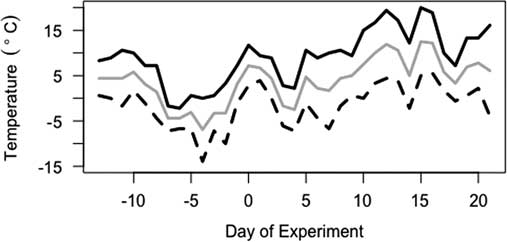
The average (±SD) daily minimum, maximum and average temperatures during the present study were −0.1±3.9°C, 12.0±5.0°C and 5.9±4.12°C, respectively (Figure 1). Ewes were exposed to average daily temperatures (±SD) of 2.2±3.4°C, 7.8±3.07°C and 7.8±3.39°C during the 1st, 2nd and 3rd weeks of the experiment, respectively.
Daily minimum (black dashed), maximum (black solid) and average (gray solid) temperatures. Rambouillet ewes were exposed for 2 weeks before and 3 weeks throughout the trial.

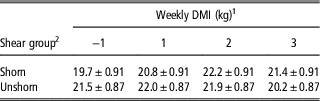
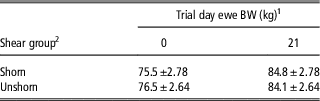
The two-way interaction between week of trial and shearing group was significant (P<0.01) for DMI and means between shearing groups were compared within each week of the trial (Table 2). Weekly DMI did not differ between shorn and unshorn ewes before (P=0.17) or any week of the trial (P⩾0.35). The two-way interaction between trial day and shearing group was significant (P=0.01) for BW and means between shearing groups were compared within each trial day (Table 3). However, ewe BW did not differ (P⩾0.79) between shorn and unshorn ewes at the start or end of the 3-week trial. Therefore, the interaction was likely due to slight numerical differences in BW between the groups at the start and end of the trial.
Least squares means (±standard error) for the interaction of shear group and week pre- or post-shearing for weekly dry matter intake (DMI) of Rambouillet ewes

1 −1=1 week before shearing shorn group; 1, 2 and 3=1, 2 and 3 weeks post-shearing shorn group, respectively.
2 Shorn=ewes sheared at the beginning of the trial; Unshorn=ewes in full fleece and sheared after completion of the trial.
Least squares means (±standard error) for the interaction of shear group and trial day for Rambouillet ewe BW

1 0, 21=start and end of the trial, respectively.
2 Shorn=ewes sheared at the beginning of the trial; Unshorn=ewes in full fleece and sheared after completion of the trial.
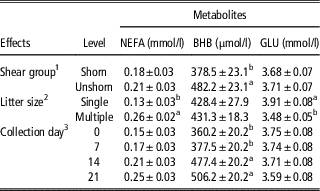
No interactions were detected (P⩾0.09) in the analyses of plasma NEFA, BHB or GLU and least squares means for the main fixed effects of litter size, collection date and shearing group on these traits are displayed in Table 4. Litter size had no effect (P=0.93) on plasma BHB concentration, but ewes carrying multiple fetuses had 0.13 mmol/l greater (66.7%; P<0.01) plasma NEFA and 0.43 mmol/l less (11.7%; P<0.001) plasma GLU concentrations than those carrying a single fetus. Plasma NEFA and GLU did not differ (P⩾0.14) throughout the course of the trial. A date effect was detected (P<0.0001) for plasma BHB, and its concentration increased by 146 μmol/l (33.5%) from the start to the end of the trial. Plasma NEFA and GLU concentrations were similar (P⩾0.36) between shorn and unshorn ewes. However, plasma BHB concentration was 103.7 μmol/l less (24.1%; P<0.01) in shorn ewes.
Least squares means (±standard error) for the main effects of shear group, litter size and collection day for plasma non-esterified fatty acids (NEFA), β-hydroxybutyrate (BHB) and glucose (GLU) concentrations of Rambouillet ewes

a,bMeans within an effect and column with no superscript in common are different (P<0.05).
1 Shorn=ewes sheared at the beginning of the trial; Unshorn=ewes in full fleece and sheared after completion of the trial.
2 Single=ewes gestating a single lamb; Multiple=ewes gestating multiple (2+) lambs.
3 0, 7, 14 and 21=the day of (immediately before shearing) and 7, 14 and 21 days post-shearing, respectively.
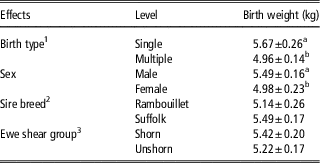
No interactions were detected (P⩾0.11) in the analyses of lamb birth weight, and least squares means for the main fixed effects of birth type, sex, sire breed and ewe shearing group on it are displayed in Table 5. Birth weight was similar (P=0.30) between lambs sired by Rambouillet and Suffolk rams. Males were 0.51 kg heavier at birth (P=0.01) than female lambs. In addition, single born lambs had 0.71 kg heavier (P=0.02) birth weight than multiple born lambs. However, there was no difference (P=0.38) in lamb birth weight between shearing treatments.
Least squares means (±standard error) for the main effects of birth type, sex, sire breed and dam shear group for lamb birth weight

a,bMeans within an effect and column with no superscript in common are different (P<0.05).
1 Single=lambs born as a single; Multiple=lambs born with 1 or more siblings.
2 Rambouillet=lambs born to a Rambouillet ewe and sired by a Rambouillet ram; Suffolk=lambs born to a Rambouillet ewe and sired by a Suffolk ram.
3 Shorn=lambs born to ewes sheared ~5 weeks before parturition; Unshorn=lambs born to ewes sheared ~2 weeks before parturition.
Discussion
The lower critical temperature is a threshold value below which a sheep must increase its rate of heat production in order to maintain core body temperature (Webster et al., Reference Webster, Hicks and Hays1969). Estimates of the lower critical temperature for shorn sheep range from –15 to 13°C, depending on environmental conditions such as wind speed and precipitation (Alexander, Reference Alexander1974; NRC, 1981). Although body temperature was not measured in the present study, 100% of the daily minimum and average temperatures and 57% of the daily maximum temperatures fell below 13°C during the course of the trial. Therefore, it is possible that shorn ewes in this study could have been exposed to conditions that would cause cold stress and may have responded metabolically.
The majority of reviewed studies concerning pregnant ewes that were managed outdoors during winter have reported no effect of shearing on pasture intake (Parker et al., Reference Parker, Morris and McCutcheon1991; Husain et al., Reference Husain, Morris, McCutcheon and Parker1997; Kenyon et al., Reference Kenyon, Morris, Revell and McCutcheon2002). However, the effect of shearing on housed-ewe performance is less clear as some authors report shorn ewes consume 14% to 36% more feed (Maund, Reference Maund1980; Glanville and Phillips, Reference Glanville and Phillips1986; Vipond et al., Reference Vipond, King, Inglis and Hunter1987; Keady and Hanrahan, Reference Keady and Hanrahan2009), and others have found no difference (Symonds et al., Reference Symonds, Bryant and Lomax1986; Vipond et al., Reference Vipond, King, Inglis and Hunter1987; Black and Chestnutt, Reference Black and Chestnutt1990).
Post-shearing feed intake has been estimated on individually penned ewes (Symonds et al., Reference Symonds, Bryant and Lomax1986; Vipond et al., Reference Vipond, King, Inglis and Hunter1987; Black and Chestnutt, Reference Black and Chestnutt1990), as a pen’s average performance (Keady and Hanrahan, Reference Keady and Hanrahan2009), or through the use of chemical markers (Parker et al., Reference Parker, Morris and McCutcheon1991; Dabiri et al., Reference Dabiri, Morris, Wallentine, McCutcheon, Parker and Wickham1996; Husain et al., Reference Husain, Morris, McCutcheon and Parker1997; Kenyon et al., Reference Kenyon, Morris, Revell and McCutcheon2002). These methods differ in their accuracy to estimate individual feed intake and their ability to mimic ewe behavior in a flock setting. The present study utilized a technology capable of accurately measuring individual feed intake of ewes managed in a single group and observed no difference in ewe DMI post-shearing.
The effect of shearing on BW or gain of pregnant ewes wintered indoors and offered harvested feeds ranged from insignificant (Symonds et al., Reference Symonds, Bryant and Lomax1986) to a slight (4% in Keady and Hanrahan, Reference Keady and Hanrahan2009) or large (168% in Glanville and Phillips, Reference Glanville and Phillips1986) advantage for unshorn ewes. Husain et al. (Reference Husain, Morris, McCutcheon and Parker1997) observed that unshorn ewes on pasture gained 177% and 102% more than shorn ewes when grazing swards of 3 and 5 cm in height, respectively. Still, many studies have reported no effect of shearing on ewe BW when managed under pastoral conditions (Parker et al., Reference Parker, Morris and McCutcheon1991; Dabiri et al., Reference Dabiri, Morris, Wallentine, McCutcheon, Parker and Wickham1996; Kenyon et al., Reference Kenyon, Morris, Revell and McCutcheon2002; Corner et al., Reference Corner, Kenyon, Stafford, West and Oliver2006, Reference Corner, Kenyon, Stafford, West and Oliver2007 and Reference Corner, Kenyon, Stafford, West and Oliver2010; De Barbieri et al., Reference De Barbieri, Montossi, Viñoles and Kenyon2012 and Reference De Barbieri, Montossi, Viñoles and Kenyon2014). Although ewes in the present study were offered a harvested feed ad libitum, they were managed outdoors and no difference in BW between the shorn and unshorn group was observed.
Pre-lamb shearing has increased lamb birth weight in many early (Symonds et al., Reference Symonds, Bryant and Lomax1986; Vipond et al., Reference Vipond, King, Inglis and Hunter1987; Kenyon et al., Reference Kenyon, Morris, Revell and McCutcheon2003) and recent studies (Corner et al., Reference Corner, Kenyon, Stafford, West and Oliver2006, Reference Corner, Kenyon, Stafford, West and Oliver2007 and Reference Corner, Kenyon, Stafford, West and Oliver2010; Sphor et al., Reference Sphor, Banchero, Correa, Osório and Quintans2011). However, the majority of these studies compared lamb birth weight between ewes that were either sheared during gestation or in full fleece at lambing. All ewes in the present study were sheared before lambing and no difference in lamb birth weight were detected between shearing treatments.
Symonds et al. (Reference Symonds, Bryant and Lomax1986) found no difference in serum GLU between shorn and unshorn ewes; however, others have reported greater serum GLU in shorn ewes throughout various stages of pregnancy (Symonds et al., Reference Symonds, Bryant and Lomax1988; Black and Chestnutt, Reference Black and Chestnutt1990; Clarke et al., Reference Clarke, Bryant, Lomax and Symonds1997). Symonds et al. (Reference Symonds, Bryant and Lomax1988) reported greater serum NEFA 3 days post-shearing but no differences thereafter. The results of Symonds et al. (Reference Symonds, Bryant and Lomax1986) and Clarke et al. (Reference Clarke, Bryant, Lomax and Symonds1997) agree with the present study where no effect of shearing on serum NEFA concentration was detected.
The majority of the reviewed literature has found no effect of shearing on BHB concentration (Symonds et al., Reference Symonds, Bryant and Lomax1986 and Reference Symonds, Bryant and Lomax1988; Black and Chestnutt, Reference Black and Chestnutt1990; Clarke et al., Reference Clarke, Bryant, Lomax and Symonds1997). However, Vipond et al. (Reference Vipond, King, Inglis and Hunter1987) reported that shorn ewes had 47% lower serum BHB concentration than unshorn ewes, which is in general agreement with the present study. The lower BHB concentrations in shorn ewes might be attributable to the increased metabolic energy demand of fetal tissues, particularly the placenta, and thus greater clearance rate of plasma BHB (Battaglia and Meschia, Reference Battaglia and Meschia1988; Moallem et al., Reference Moallem, Rozov, Gootwine and Honig2012). It is possible that a short-term repartitioning of energy is required for thermoregulation post-shearing, which may lead to greater utilization of BHB in shorn ewes. In contrast, the greater plasma BHB concentrations in the unshorn group might indicate the underutilization of BHB produced in the liver, due to the lack of transient metabolic change imposed by shearing treatments (Moallem et al., Reference Moallem, Rozov, Gootwine and Honig2012). Considering treatment diet consumption exceeded requirements in both shearing groups, it is unlikely that greater BHB concentration observed in the unshorn group was due to increased metabolic demand or metabolic substrate deficiency.
Scenarios of nutritional restriction and climatic extremes, in combination with shearing during late pregnancy, may present different results and lead to increased metabolic demands and disorders. Nevertheless, results from the present study suggest that finewool ewes managed in drylot post-shearing may not require additional feed resources to lessen the severity of cold stress.
Acknowledgments
The authors wish to thank W. Helle, C. Page, B. Roeder, and the Montana State University and US Sheep Experiment Station’s technical staff for animal procedures and data collection.
Declaration of interest
Mention of trade names or commercial products in this publication is solely for the purpose of providing specific information and does not imply recommendation or endorsement by the US Department of Agriculture (USDA). The USDA is an equal opportunity provider and employer. The authors confirm that there are no known conflicts of interest associated with this publication and there has been no significant financial support for this work that could have influenced its outcome.
Ethics statement
All husbandry practices and experimental procedures in this study were approved by the Montana State University Agricultural Animal Care and Use Committee (2017-AA01).
Software and data repository resources
None of the data were deposited in an official repository.