Introduction and background
Each time we tell a story, it is an opportunity to feed another person's spirit and plant the story's wisdom deeper into our own souls. (Banks-Wallace, Reference Banks-Wallace2002: 423)
This review explores the potential for the development of a life-story work intervention specifically for Deaf people who are sign language users and who experience dementia by considering the significance of storytelling in Deaf people's lives. Although life-story work has become a routine component of dementia care in many settings amongst hearing people (Gridley et al., Reference Gridley, Brooks, Birks, Baxter and Parker2016), amongst Deaf people who are sign language users, it is largely unknown. Furthermore, there is currently no such intervention available that is linguistically and culturally tailored to Deaf people who experience dementia and no available resources on which to draw. We first briefly describe this population and define life-story work in the context of dementia before focusing on why the cultural significance of stories and storytelling practices within Deaf culture and Deaf communities should be attended to as a precursor to the development of a bespoke life-story intervention for sign language users with dementia. Throughout, we use the term ‘story’ to refer to the content, themes and form of a narrative, ‘storytelling’/‘storytelling practices’ to include aspects of the context and conditions of telling, and ‘storying’ as the process of transformation of experience or knowledge into stories.
Deaf people who use a signed language, such as British Sign Language (BSL), conventionally referred to using an uppercase ‘D’ (Woodward, Reference Woodward1975), are distinct from the larger populations of deaf people (lowercase ‘d’) who use spoken language (Young and Hunt, Reference Young and Hunt2011) and the majority of whom will have experienced age-related hearing loss (Lin, Reference Lin2012). Their distinction lies in the recognition of Deaf people's cultural-linguistic identity (Lane, Reference Lane1995; Ladd, Reference Ladd2003). In the United Kingdom (UK), BSL is officially recognised as an indigenous language (Department of Work and Pensions, 2003; BSL (Scotland) Act 2015) and signed languages are recognised in many nation's constitutions (Wheatley and Pabsch, Reference Wheatley and Pabsch2012; Jepsen et al., Reference Jepsen, De Clerck, Lutalo-Kiingi and McGregor2015). Linguistic scholarship has established that signed languages throughout the world are fully grammatical, visual, spatial, living languages distinct from the spoken languages of the nations in which they exist with no vocal elements and no orthographic form (Sutton-Spence and Woll, Reference Sutton-Spence and Woll1999; MacSweeney et al., Reference MacSweeney, Waters, Brammer, Woll and Goswami2007). For sign language users, to be Deaf is not regarded as a deficit, but rather a source of positive identity and marker of cultural affiliation with shared values and life experiences (Ladd, Reference Ladd2003), some of which transgress national boundaries (Haualand et al., Reference Haualand, Kusters, Friedner, Gertz and Boudreault2016). From an ontological perspective, Deaf sign language users are visual beings (Bahan, Reference Bahan, Bauman, Nelson and Rose2006, Reference Bahan and Bauman2008) whose use of a visual, spatial language is both means and embodiment of their narrative (Young et al., Reference Young, Ferguson-Coleman and Keady2014). This unique epistemological positioning is increasingly being explored in a range of research studies (e.g. Hauser et al., Reference Hauser, O'Hearn, McKee, Steider and Thew2010; Paul and Moores, Reference Paul and Moores2010; Friedner and Kusters, Reference Friedner and Kusters2014).
As a narrative method, life-story work is used extensively in hearing communities to support people with dementia (McKeown et al., Reference McKeown, Clarke, Ingleton, Ryan and Repper2010; Department of Health, 2011; Gridley et al., Reference Gridley, Brooks, Birks, Baxter and Parker2016; Social Care Institute for Excellence, 2017). At its heart, life-story work enables the person to reflect on their life experiences and position themselves as the primary narrator of their life regardless of their dementia, as well as providing a means to acknowledge and reinforce personal preferences and choices within their care (Keady et al., Reference Keady, Williams and Hughes-Roberts2007). Life-story work as a process has also been used as a tool to improve connections between people living with dementia, their families and care professionals (Hansebo and Kihlgren, Reference Hansebo and Kihlgren2001; Gridley et al., Reference Gridley, Brooks, Birks, Baxter and Parker2016), with Kitwood (Reference Kitwood1997), in his seminal work, identifying that life-story work is a cornerstone of authentic person-centred care. It builds on retained strengths for long-term memory and its practice typically culminates in the development of a physical product, such as a life-story book which may utilise a range of visual, photographic and written media (McKeown et al., Reference McKeown, Clarke and Repper2006; Baynes, Reference Baynes2008). Although the evidence base for its clinical effectiveness as an intervention remains contested (Kindell et al., Reference Kindell, Burrow, Wilkinson and Keady2014), its benefits in terms of inter-subjective interaction and positive sense of wellbeing, both for the person with dementia and their care partners, is stronger (Gibson, Reference Gibson2011; Kaiser and Eley, Reference Kaiser and Eley2010).
However, the extent to which the practice of life-story work requires cultural adaptation to be meaningful and effective for those from a diversity of linguistic and cultural backgrounds has barely been considered, other than in terms of ensuring the resources used in its practice have a resonance with the community of users (e.g. Moriarty et al., Reference Moriarty, Sharif and Robinson2011). Yet from anthropological, sociological and psychological perspectives, it is acknowledged that storytelling as praxis and narrative as mode of interaction are of themselves cultural artefacts insofar as they encompass the history, reflect the values and perpetuate the positionality of cultures and communities (e.g. Howard, Reference Howard1991; Banks-Wallace, Reference Banks-Wallace2002; Eder, Reference Eder2007). Analysis of stories and storytelling practices, particularly with respect to indigenous peoples, is also regarded to be of epistemological significance because it is through how experience is storied that it is possible to understand how the world is known (and re-formed and resisted). Furthermore, for ‘oral’ (non-orthographic) cultures in particular, the primarily inter-subjective nature of storytelling practice has ontological significance because no tale can be told in isolation from those who ‘hear’, grounding the self in commonalities of identification and response to the narrative.
It is, therefore, not unreasonable to contend that the practice of effective life-story work will, in part, be influenced by the extent to which it coheres with the cultural significance of the practices of storytelling in any give cultural-linguistic community. In developing a tailored, culturally sensitive, life-story work intervention, the issue thus becomes the meaning and impact of storying practices in people's lives, not just the nature of the resources that may be available to support life-story work. In relation to Deaf peoples, it has been argued that storytelling is a centrally defining cultural feature of sign language communities around the world (e.g. Sutton-Spence and Napoli, Reference Sutton-Spence and Napoli2011; De Clerck, Reference De Clerck2017). In some respects, this is similar to the importance of stories in hearing ‘oral’ cultures. Without traditions of written texts in which to inscribe histories and knowledges, the signed story, as a form of remembering, memorising and transmission, takes on an additional cultural significance. The implications of this perspective for working with Deaf people with dementia and for the development of a life-story work intervention is the focus of this review.
We start from seeking to understand the cultural meanings, practices and significances of storytelling in general for Deaf people who use signed languages before relating these to the practice of life-story work in the context of people with dementia. In so doing, we refer to available evidence about Deaf sign language users with dementia and wider literature concerning signed languages and Deaf culture(s). Finally, we draw attention to potential conditions that might promote effective life-story work as an intervention with this population based on the insights from the review.
Method
There is an in-built contradiction and irony in undertaking a structured literature review of published work focused on the significance of storytelling in sign language communities. Signed languages have no orthographic form and the publication of academic, evidence-based and research literatures in a visual language is rare (for an exception, see http://dsdj.gallaudet.edu/). Also scholarly work that is published in a signed language usually remains un-catalogued in the major searchable data bases of published articles, books and theses. Therefore, relevant literature published in non-signed languages have predominantly been written in the past by hearing scholars (Young and Ackerman, Reference Young and Ackerman2001; Sutton-Spence and West, Reference Sutton-Spence and West2011) and more recently by the small but growing number of Deaf academics who publish in written languages and reflect on that process (Kusters et al., Reference Kusters, De Meulder and O'Brien2017a).
There is, however, a proliferation of grey literature in signed languages in the form of vlogs (visual blogs), recorded performance pieces such as those of signed poets and Deaf actors (http://www.bslpoetry.co.uk/), and more formal policy, informational and educational resources translated into or produced in a signed language (e.g. health literacy materials such as https://www.bhf.org.uk/heart-health/preventing-heart-disease/heart-health-in-bsl). Mindful of the potential for the reproduction of exclusion of knowledge by adopting a literature identification process that of itself would exclude signed literatures, but nonetheless wishing to focus attention on scholarship and evidence of a high quality, we adopted a three-stage process for the identification of available literature for the review: Stage 1 – a conventional and systematic search of key databases using specific search terms followed by a process of refinement of hits in order to isolate highly relevant texts; Stage 2 – a forward-searching approach based on references within those articles to other literatures, whether written or signed, evidence-based or grey literatures, that potentially were of relevance; and Stage 3 – new searches for specifically identified areas of interest, based on the results of Stages 1 and 2, in order to contextualise or expand features of the review that were emerging based on how the identified literatures had been thematically organised. These steps are expanded below.
Stage 1
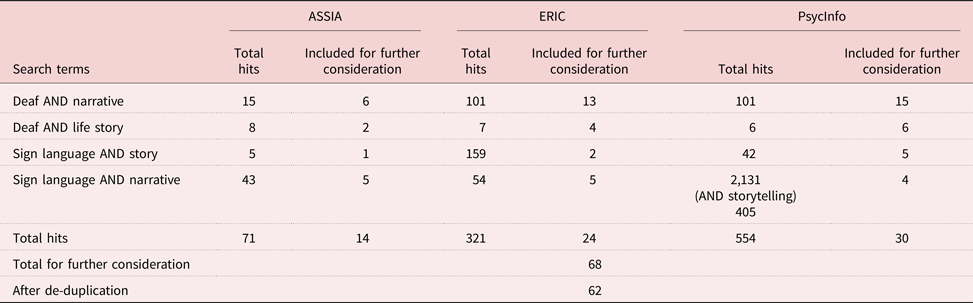
A literature search was carried out of three databases ASSIA (Applied Social Sciences Index and Abstracts), ERIC (Education Resources Information Centre) and PsycINFO (American Psychological Association Information database) using the search terms Deaf AND narrative, Deaf AND life story, Sign Language AND narrative, Sign Language AND life story. The inclusion criteria were: published in the English language; published between 1980 and 2017 (this was because prior to 1980 there was no formal recognition of signed languages as languages in most countries in the world and therefore little research associated with the language and its users); focused on Deaf adults, not children; and involving any kind of storytelling or narrative practice including autobiographical and autoethnographic stories (see Table 1).
Initial hits with specified search terms for systematic review of the literature

Notes: ASSIA: Applied Social Sciences Index and Abstracts. ERIC: Education Resources Information Centre. PsycINFO: American Psychological Association Information database.
The abstracts of 62 hits were read, from which a set of further exclusion criteria were imposed. These were: (a) if the article primarily concerned Deaf children; (b) if the narrative focus was exclusively from a linguistic perspective; (c) if the focus of the work was not culturally Deaf people; (d) if the narrative practice concerned studies of working memory and cognition; (e) if the main focus was on narrative within written language production; (f) if the word ‘story’ was included with a generalised meaning rather than specifically concerning storytelling; and (g) if the literature item was primarily focused on sign language interpreters and the exploration of their domain of professional practice. The imposition of the second set of exclusion criteria resulted in a reduction from 68 hits to 12 hits.
Stage 2
From the reference lists of the identified literature, a further 24 references to written material were identified as potentially relevant, 13 of which were books, plus an additional seven Web-based resources, four of which were in a signed language. Less strict exclusion criteria were imposed on these identified literatures at this stage in order to provide contextual breadth to the review and the potential inclusion of specific illustrative examples, e.g. of particular performances or a category of literature in general, e.g. folklore. We are not assuming the list of identified Stage 2 literature is exhaustive. At the end of Stages 1 and 2, the identified literature was read several times independently by Readers 1 and 2 in order to develop a thematic structure by which the literature might be presented and discussed. Two questions guided this process whilst reading: (a) ‘What are the purposes, roles and practices of stories and storytelling for Deaf peoples?’ and (b) ‘What might these imply for the development of life-story work with Deaf people with dementia?’
Stage 3
Stage 3 of the literature review was iterative and occurred simultaneously to the writing out of themes while issues requiring broader theoretical contextualisation emerged as well as specific linkages to life-story work with people with dementia. It consisted of targeted searches for identified issues, e.g. literature concerning stories of resistance in histories of oppressed peoples, or narrative as a form of educational practice. Twenty-eight sources were identified.
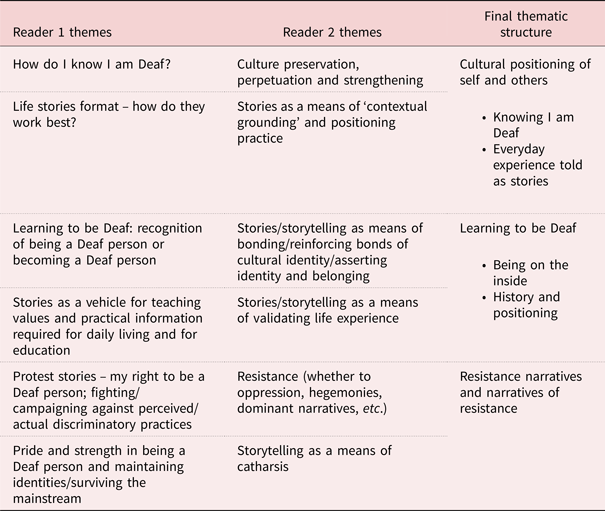
The initial themes identified by each reader are shown in Table 2 and, following discussion, the final ones used to structure the review. It is perhaps of relevance to emphasise that the authors (readers) who carried out this analysis differ in their academic and personal biographies which was viewed as strength in this process. Reader 1 is a culturally Deaf person who has specialised in the academic study of dementia amongst Deaf people. Reader 2 is a hearing person who has worked with Deaf people throughout her academic career as a social scientist and whose academic biography includes the study of fiction and literature.
Summary table of the process underpinning thematic structure of the literature review

In presenting the review, our approach is one of conceptual thematic review rather than thematic metasynthesis (Thomas and Harden, Reference Thomas and Harden2008) as very little empirical literature was identified. Given our main sources did not constitute primary data, no formal assessment of the quality of the literature identified was undertaken.
Cultural positioning of self and others
Storytelling is repeatedly identified in the literature as a distinct cultural practice evident in Deaf communities (De Clerck, Reference De Clerck2017). There are many stories amongst Deaf peoples that, with only slight variations, are similar around the world (Carmel, Reference Carmel1987; Bahan, Reference Bahan, Bauman, Nelson and Rose2006; Sutton-Spence and Napoli, Reference Sutton-Spence and Napoli2011) and which have been regarded as one indicator of Deaf people's unique transnational identity (Haualand et al., Reference Haualand, Kusters, Friedner, Gertz and Boudreault2016). However, stories have meaning, not only as representations and expressions of Deaf culture, but also storying practices are an active means through which cultural identity may be explored and formed. As De Clerck (Reference De Clerck2017) argues, Deaf identities emerge through contextual and collective learning practices between Deaf peoples in signed languages; storytelling is one vehicle of such practices as the recurring themes and subjects of shared stories reveal.
Knowing I am Deaf
The vast majority of Deaf people worldwide do not grow up with an understanding of being Deaf as a source of cultural identity and without the use of sign language. Fewer than 10 per cent of Deaf people have Deaf parents (Mitchell and Karchmer, Reference Mitchell and Karchmer2004) and thus cultural-linguistic identity is rarely transmitted intergenerationally. How one realises one is Deaf is a universal story, told and retold by individuals around the world. It charts the transition from awareness in a medical sense of not-hearing (deaf), to an acknowledgement of affiliation with other Deaf sign language users and that this could be a source of linguistic pride and cultural identity that is positive. Such narratives are variously described in the literature as a ‘discovery story’ (Bahan, Reference Bahan, Bauman, Nelson and Rose2006), a ‘coming out story’ (Sutton-Spence and Napoli, Reference Sutton-Spence and Napoli2011) or a ‘conversion narrative’ (Hole, Reference Hole2007). As McIlroy, a then oral deaf adult, remarks on first having had access to the personal stories of Deaf people who signed (McIlroy and Storbeck, Reference McIlroy and Storbeck2011: 503): ‘I found Deaf people who proudly affirmed themselves to be Deaf. This revelation blew my mind.’ Sutton-Spence (2011) comments that the significance of Deaf people sharing their stories about when they first realised they were Deaf lies in the opportunity that the story provides for a shared experience to be acknowledged and reinforced – the story becomes the cultural marker of identity to self and others. Hole's (Reference Hole2007) suggestion that such stories are ‘conversion narratives’ perhaps misses the point of the person's cultural-becoming through the telling of new identity, emphasising instead identity as an affiliation to which one publicly testifies and therefore is recognised.
However, in other examples, the transcendence to ownership of a cultural identity is not so clear-cut, with some authors exploring positions of ‘in-between status’ within their biographical narratives (Brueggemann, Reference Brueggeman2009; McDonald, Reference McDonald2014a; De Clerck, Reference De Clerck2017). For example, McDonald (Reference McDonald2014b) argues that she became deaf through narrativising her experiences through writing down her personal journey as a memoir, and in so doing, answering her own questions about her newfound identity. Although recent scholarship has increasingly emphasised the situational, transactional, fluid and intersectional nature of Deaf identity(ies) (e.g. Napier and Leeson, Reference Napier and Leeson2016), with some scholars rejecting a d/D distinction (e.g. De Clerck, Reference De Clerck2010), nonetheless stories emphasising ‘knowing I am Deaf’ claim an important identity for many Deaf people in response to perpetual experiences of marginalisation by majority societies, an approach Ladd (Reference Ladd2003) refers to, after Spivak (Reference Spivak1990), as one of ‘strategic essentialism’.
Everyday experience told as stories
Personal life experiences told as stories is another frequently recurring use of storytelling in Deaf communities. Several functions appear in the literature, all in some way connected with the building, affirming and strengthening of cultural identity and a sense of belonging. For example, it is common for Deaf people to tell each other stories that are about the realities of everyday life as a Deaf person (Bahan, Reference Bahan, Bauman, Nelson and Rose2006). Many of these occur in performance, in signed languages and, until relatively recently, rarely captured or regarded as visual literature.
Being Deaf can be an isolating experience as much of it is lived in the mainstream amongst others who do not sign or who do not share an understanding of the cultural identity that being Deaf embraces, or who assume Deaf people should be treated as disabled or have low expectations of what a Deaf person might be able to do. Consequently, many stories challenge these assumptions and stereotypes, e.g. they might portray how a Deaf individual was able to overcome barriers imposed by individuals (usually hearing) or systems that directly or indirectly discriminate against Deaf people's participation; a genre described by Ladd (Reference Ladd2003: 330) as ‘1,001 small victories’. It is suggested that the sharing of such stories produces a collective recognition of a common experience that enables the discovery of solidarity and building of resilience. The well-known ‘Deaf comedians’ in the 1980s and early 1990s in the UK had many sketches that essentially lampooned the poor hearing people who perpetually underestimated the cleverness (in the sense of canniness) of Deaf people.
From Bahan's (Reference Bahan, Bauman, Nelson and Rose2006) point of view, the response to such stories provides an indication of the extent to which a person might recognise and affiliate with Deaf cultural values and Deaf identities ranging from simple recognition of a shared life experience but remaining resistant of belonging; to something more evocative such as embracing that one is Deaf, with a lifelong membership of a community, sharing its culture and values. Bienvenu (Reference Bienvenu, Erting, Johnson, Smith and Snider1994) argues that humorous reflections on everyday life as a Deaf person create the opportunity to bond over shared experiences and to share the knowledge that one is not alone. They also serve to reinforce the boundaries of the ‘in group’ and its values and characteristics and by which the ‘out group’ might be known (Sutton-Spence and Napoli, Reference Sutton-Spence and Napoli2011).
Summary of relevance to the creation of life-story work
These examples reveal the close relationship between identity development and storying practices amongst Deaf people, the majority of whom will have been born outside sign language communities. They also reveal the function of shared stories and storytelling as interactive and inter-subjective practices in combating ontological insecurity in societies that may fail to recognise the visual orientation and linguistic of Deaf peoples. Their impact on strengthening and perpetuating the bonds of mutual kinship is fundamental.
One of the rationales for life-story work with people with dementia is the potential of the method to enhance and perpetuate someone's sense of identity. This may seem fragile both as a result of the effects of the progression of dementia which cognitively threatens the relationship between memory, identity and sense of self (Kontos et al., Reference Kontos, Miller and Kontos2017; Caddell and Clare, Reference Caddell and Clare2011) and as a result of the attitudinal responses of others to someone with dementia, who may no longer see the individuation of the person but rather only the illness (Sabat, Reference Sabat, Moghaddam and Harré2003). In the case of Deaf people, stories of cultural positioning of self and others reveal how such conditions of identity threat and invalidation are hardly new experiences and how storying practices have been an essential means of combating these effects.
Learning to be Deaf
Being on the inside
Ladd (Reference Ladd2003) coined the term ‘Deafhood’ to describe not just the process of cultural and linguistic acquisition but the more existential processes of being and becoming in order to be Deaf. He locates the process firmly within community, the collective and history of sign language peoples. Fundamental to his argument is that the ‘I’ of an individual journey is not possible without the ‘we’ of the community. For De Clerck (Reference De Clerck2017), (Deaf) identity is inseparable from a process of learning that is continual, contextual and contingent on the indigenous knowledges of other Deaf people and a personal experience of awakening. Shared stories and the practices of storytelling are therefore conceived of by both authors as epistemological in that they are one of the vehicles by which these processes of identity discovery and learning to be Deaf may take place. Stories offer a positive way in which Deaf people may challenge their own perceptions of being outsiders in wider society and learn to become insiders of their own community.
Bahan (Reference Bahan and Bauman2008), for example, a well-known Deaf storyteller and academic, instigates such a sense of belonging by sharing his personal viewpoints on what it means to be a sign language user, or in his own words, ‘a visual variety of the human race’. This term is a neat inversion of the title of a notorious tract by Alexander Graham Bell (Reference Bell1884), ‘Memoir on the formation of a deaf variety of the human race’ where Bell argues for the sterilisation of d/Deaf women and the banning of d/Deaf people marrying each other in order to prevent the reproduction of a new generation (Lewis, Reference Lewis2007). Through his stories, both written and in performance in America Sign Language, Bahan (Reference Bahan and Bauman2008) sets out to show Deaf people what it means to be Deaf by putting the spotlight on everyday practices that they may not value or consciously recognise as indicative of being Deaf. For example, in one of his stories Bahan (Reference Bahan and Bauman2008) describes ‘hearing’ a person walking downstairs into his lounge. He has not actually physically heard footsteps, but he uses his ‘Deaf Eyes’ to notice that his dog has pricked his ears up in hearing the sound of movement and therefore deduces from this that someone is entering the room. This innate visual peripheral reaction is common to Deaf people but may not be positively appreciated until shared within a storytelling form through which the familiar is made strange and a process of recognition and value initiated.
The above example is one small feature within a larger story; background context within the flow of the narrative that serves to highlight and reinforce the fundamental visual orientation of Deaf people, sometimes referred to as ‘people of the eye’ (Lane et al., Reference Lane, Pillard and Hedberg2010). However, other stories in their entirety are designed to foster mutual recognition of shared experience and reinforcement of tacit cultural knowhow. For example, one story told in many Deaf communities in different nations (with slight variations) is about the Deaf man who returns to his hotel late at night only to realise he has forgotten his room number where also his Deaf partner is asleep. His solution is to honk his car horn loudly and repeatedly. He scans the external-facing windows of the hotel bedrooms to spot the one where nobody has put the light on (because they have not been disturbed by the sound). That is his room. The humorous reaction to such a story amongst other Deaf people unites around a sense of shared experience, pride in finding a ‘very Deaf’ solution and an awareness of the advantages of being Deaf over those who unfortunately hear.
History and positioning
In learning to be Deaf, historical learning about ancestry and roots is important also and reflected in storytelling. For example, the Canadian Deaf Association's honouring of Deaf elders is firmly rooted in the significance of their life stories for the freedoms enjoyed by the present-day Deaf community:
The Canadian Association of the Deaf–Association des Sourds du Canada recognizes the special talents and knowledge of Deaf seniors. It was their generation which fought for the right to recognition, dignity and acceptance of the Deaf languages and cultures in Canada. They led the long fight for better quality Deaf education, better jobs and training, more accessibility to universities and to society … They kept the Deaf culture alive and thriving at a time when non-Deaf society still resisted accepting its existence and its legitimacy. (http://cad.ca/issues-positions/seniors/)
This sense of present values and identity appreciated through the stories of the past is also evident in the growing number of Deaf life-history projects, archives and exhibitions throughout the world, such as the Ugandan Deaf Community's work on Deaf history, community and emancipation (De Clerck, Reference De Clerck2015, http://blog.britac.ac.uk/telling-the-full-storydocumenting-the-emancipation-of-deaf-ugandans/) and the British Deaf Association's online heritage archive (British Deaf Association, 2015; https://bda.org.uk/share-deaf-visual-archive/).
It is also through the (re)telling of stories about events of significance in Deaf cultural heritage and history that it becomes possible for a Deaf individual to position another person in relation to their own and the community's history. For example, whether someone was also present at that event, such as the Deaf President Now! protests in the United States of America (USA) (Christiansen and Barnartt, Reference Christiansen and Barnartt2003), creates an affiliation. In the UK, whether someone understands a particular allusion such as the ‘out of the shell’ conference (British Deaf Association, 1990) or the BSL marches that were organised in the late 1990s by the Federation of Deaf People (Beschizza et al., Reference Beschizza, Dodds and Don2015) would serve to place that person within the UK's Deaf historical landscape. Stories of presence, recognition and place thus serve to map Deaf individuals against others’ histories and chart bonds of kinship.
Personal and community stories are also a primary means by which Deaf people have conveyed to non-Deaf people the richness of Deaf lives and meaning of Deaf culture. Padden and Humphries's (Reference Padden and Humphries1988) book Deaf in America: Voices from a Culture is an early example of this genre. Deaf film-makers and theatre companies, such as Deafinitely Theatre in the UK and the National Theatre for the Deaf in the USA, amongst many other such companies, have also played their part in storying Deaf ways of life to the external world through films such as Love is Never Silent (1985; http://www.imdb.com/title/tt0089510/) and Through Deaf Eyes (2007; http://www.imdb.com/title/tt0487158/). These are distinguished from the more controversial portrayals of Deaf lives that have been created by hearing, non-Deaf affiliated writers and producers such as La Famille Belier (2014; http://www.imdb.com/title/tt3547740/). Through stories of Deaf families, growing up Deaf and leading a life as a Deaf person, those unfamiliar with the culture gain a window into it and those who know it well see Deaf lives proudly represented to the mainstream, external world. The narrative form is a powerful medium through which to build knowledge and awareness amongst outsiders through its ability to imply, infer and feel, not just inform about Deaf cultural life.
Summary of relevance to the creation of life-story work
These functions of stories and storytelling clustered around ‘learning to be Deaf’ reveal both inward (community centred) and outward (wider society) processes that utilise creative means of communication and knowledge transfer (the narrative form) to develop bonds, enable expressive connections between past and present, chart the fluidity of insider and outsider positioning, and generate pride in roots and contribution to one's own and others futures as Deaf people. One of the functions and theories of change effects associated with life-story work in dementia care is its potential to create a platform for interaction and communication between carer and those cared for (Gibson, Reference Gibson2011; Gridley et al., Reference Gridley, Brooks, Birks, Baxter and Parker2016). It is also seen as a means of contextualising current behaviours in the context of an individual's past to render these more explicable and care more sensitised to them. For the majority of Deaf people with dementia who will require professional care, this will be from hearing people usually with no experience or understanding of sign language and Deaf culture, and often in environments that are aural, speaking places (Hunt et al., Reference Hunt, Oram and Young2011). Furthermore, the heritage and milestones of Deaf people's lives do not necessarily follow those of the hearing majority as research on Deaf life scripts is beginning to demonstrate (Clark and Daggett, Reference Clark and Daggett2015).
Consequently, an important facet of life-story work with Deaf people with dementia in care environments lies in its potential to unlock carers’ awareness and understanding of the alternative histories of Deaf people's lives which cannot be summarised as the same as others only without the ability to hear. Evaluations of the processes of change and mechanisms of outcomes in life-story work currently are unable to differentiate easily between the effects of the actual life-story work process and/or the effects of simply having provided quality time and means of inter-subjective communication (Gridley et al., Reference Gridley, Brooks, Birks, Baxter and Parker2016). However, if this approach is to work in care situations where carers will mostly be hearing outsiders to the Deaf community, then the function of stories in learning to be Deaf will also be essential for those non-Deaf people.
From Deaf communities’ perspectives’, learning to be Deaf with dementia is a relatively new consideration. There has been both a lack of accessible information in signed languages about dementia and poor understanding of its effects within the Deaf community (Drion and Semail, Reference Drion and Semail2016; Ferguson-Coleman et al., Reference Ferguson-Coleman, Keady and Young2016) which together have meant general awareness has been underdeveloped. Deaf people's personal stories of living with dementia or caring for Deaf people remain rare (for exceptions, see Parker et al., Reference Parker, Young and Rogers2010; Ferguson-Coleman, Reference Ferguson-Coleman, Keady and Young2016). However, the storying of the experience of dementia through Deaf people's eyes to other Deaf people in a narrative form is starting to be explored as a potentially more effective and culturally suited means of knowledge transfer than the presentation of information bites, be those in a signed language and accessible via digital means (Ferguson-Coleman et al., Reference Ferguson-Coleman, Keady and Young2016).
Resistance narratives and narrative as resistance
Shared stories and narrative practices have long been recognised as integral to the cultural, political and liberation experiences of many oppressed peoples throughout the world (Banks-Wallace, Reference Banks-Wallace1998; Jackson, Reference Jacksonnd). The content of stories is powerful both in (re)producing and preserving proud histories of struggle and in creating alternative discourses to counteract those that might predominate about one's life and culture. Thus, narratives both chart resistance and serve as a means to resist.
Many of these features of the function, cultural role and experience of shared stories and the narrative form are found also amongst Deaf peoples throughout the world (De Clerck, Reference De Clerck2017) but until relatively recent times have not been recognised by those who stand outside the culture. In part this is because Deaf people's ‘oral’ tradition is silent, from the hearing world's point of view, and signed languages are not fully recognised as language. Until the era of democratisation of film and digital technologies, stories have not been easily recorded or shared beyond those who could be present in real time and place (Young and Temple, Reference Young and Temple2014: chap. 8). Furthermore it is argued that it is only in the past 30 years that Deaf scholars have been able to access the academy and begin to take their place in capturing, interpreting and telling Deaf resistance narratives (Kusters et al., Reference Kusters, De Meulder and O'Brien2017a).
Nonetheless, there is an increasing number of autobiographical and autoethnographic accounts by Deaf people (for a comprehensive list, see McDonald, Reference McDonald2014b; Snoddon, Reference Snoddon2014), although not all are cast as narratives of resistance. Many have at their heart concerns to reflect, explore, and position life experiences and personal journeys (e.g. McDonald, Reference McDonald2014b). Such exploration may itself be regarded as a resistance process to those versions of self that individuals may have felt imposed upon them by a hearing world. However, some autoethnographic and autobiographical work is deliberately cast as narratives of resistance with the purpose of exposing the rationale for systems to which Deaf people have been subject and caused harm, to challenge apparent truths about the limitations of Deaf people or expose sites of power over Deaf people's lives. See, for example, O'Connell's (Reference O'Connell2016, Reference O'Connell2017) personal narrative of deaf education in Catholic Ireland and Alker's (Reference Alker2000) personal account of experiences in a senior management role in a deaf organisation.
The importance of such stories lies not just in their ability to produce an alternative narrative to which wider society becomes exposed but to support the social mobilisation of other Deaf people who recognise in the personal narratives aspects of their own lives. These motivations were strong and effective following the recognition of signed languages as fully grammatical, living languages in many post-industrial nations where there was a surge in publications which sought to chart aspects of Deaf cultural life and lives led through sign language as a form of linguistic resistance (e.g. Padden and Humphries, Reference Padden and Humphries1988; Lang, Reference Lang2000). Some of these earlier books took the form of biographical collections of first-hand stories exposed to the outside world and in print for the first time (e.g. Bragg, Reference Bragg1989; Taylor and Bishop, Reference Taylor and Bishop1991). The impact of such stories at the time was not just to contribute to growing conceptualisations of Deaf cultural identity as an alternative discourse to that of the impairment and disability narratives that had predominated with respect to Deaf people, but also to legitimise that oral history that previously had not been seen in print. Whilst Deaf scholars today may challenge that process as a reproduction of the dominant hegemony through the requirement for Deaf stories in signed languages to be seen in a written language (O'Brien and Emery, Reference O'Brien and Emery2014), at the time their publication was an act of resistance, in challenging those other books ‘about’ Deaf people and creating rich counter-narratives. As Maia and Garcêz (Reference Maia and Garcêz2014: 366) note in their study of deaf storytelling on the internet:
telling stories to a wider audience is a way to sensitize people who have different experiences, so that they may understand the harm and oppression that others have gone through … Narratives, thus, unfold specificities that need to be recognized.
Such a specificity emerging over the past 20 years within Deaf communities and scholarship is an emphasis on Deaf diversity and a resistance to the common representation of Deaf sign language users as predominantly white, heterosexual, able-bodied people living in the developed nations of the world (e.g. Fernandes and Myers, Reference Fernandes and Myers2010). Biographical stories have been integral to this new emphasis, with collections created and shared within and without the community charting gay and lesbian Deaf lives (Luczak, Reference Luczak1993, Reference Luczak2007; Sinecka, Reference Sinecka2008), Black Deaf lives (Vasishta, Reference Vasishta2010), and nation-specific Deaf diversities and commonalities (De Clerck, Reference De Clerck2011; Friedner and Kusters, Reference Friedner and Kusters2014). In growing the internal and external narratives of what it is to be Deaf, stereotypes are resisted originating both from Deaf people and the hearing majority. However, the question remains as to who is storying Deaf lives and to what effect, as the exposure of some of these narratives originates from outsiders and ontological others, whether by class, hearing status, culture, sexuality or any other ‘identity’ marker. Debates over who legitimately might or might not record, interpret and tell the stories of a diversity of Deaf people(s) continue to engender new resistances against those seen as continuing to contribute to hegemonic (often interpreted as ‘hearing’) discourses about Deaf people (see e.g. Kusters et al., Reference Kusters, O'Brien, De Meulder, Kusters, De Meulder and O'Brien2017b). However, as Fernandes and Myers (Reference Fernandes and Myers2010: 19) caution, it is important to be wary of ‘proscribing terms of membership in order to preserve Deaf culture at the expense of sustainability and social justice’. If epistemology in part concerns who has the right to be a knower, how do we know and what constitutes knowledge, then who controls the sharing of the story to which audiences and in which form (language) is also of primary relevance to narrative as resistance.
Summary of relevance to the creation of life-story work
One of the functions of life-story work is conceptualised as a means of supporting and continuing the personhood of the individual with dementia and retaining control over how they are seen and known. This is linked with the perpetuation of wellbeing through the restoration of presence, not absences as a result of effects of dementia on one's mind. It is an argument that is easy to recognise in Deaf people's resistance of discourses about them that are reductionist, constraining and diminishing of the richness of Deaf people's lives and potential. These stories have also highlighted the important function of Deaf people storying their own lives, not their stories being told by others. There are inherent resistances in who owns the narratives and therefore who controls the scope of a person's portrayal and, by extension, their life chances. It is a dynamic familiar to many groups of people who identify with having been oppressed and for whom the creation of a counter-narrative is an engine of the processes of achieving equality.
Discussion
Polletta and Lee (Reference Polletta and Lee2006: 699) remark in their study of public deliberation after 9/11, ‘the capacity of reason-giving, storytelling, and other rhetorical genres to foster deliberation depends on social conventions of the genre's use and popular beliefs about its credibility relative to other genres’. As the previous review has demonstrated, stories, the narrative genre and the act of storytelling are fundamental practices in Deaf communities and amongst a diversity of Deaf people(s) around the world. They serve key functions of cultural bonding and positioning, transmission of knowledge, challenges to dominant discourses about Deaf people's identity and social worth, and foster mechanisms of inter-subjective empowerment. To see one's life, values and experiences reflected back to self and possessing the power to reflect back to others an alternative vision, life storytelling in its numerous forms is a familiar, acceptable, credible and powerful praxis for, with and by Deaf people. Life-story work with Deaf people who have dementia is, therefore, likely to be a culturally coherent practice that builds on lifelong traditions of storying. We have outlined some of these in the short summaries after each thematic section. However, the review has also started to reveal some potential conditions that also must be fulfilled for life-story work with Deaf people with dementia to be effective. It is to these we now turn.
The first is that the life-story work must be carried out in a signed language, such as BSL. This might seem somewhat obvious but it is not, given the range of commonly held myths amongst hearing society about Deaf people and signed languages, e.g. that signed languages are not real languages, that most Deaf people can lip-read and that signed languages are just a visual version of English, so it is perfectly possible to ‘manage’ without communication in that language and make sense of hearing speaking people (Young and Hunt, Reference Young and Hunt2011; Humphries et al., Reference Humphries, Kushalnager, Mathur, Napoli, Padden, Rathmann and Smith2017). Our review has demonstrated that a Deaf person's (sign) language is a fundamental marker of their identity and sense of self in the world, portrayed and reinforced by the content and modality of many stories. Not to use that language is not to acknowledge that identity. The small amount of available direct empirical data from older Deaf people with dementia supports this perception that in losing one's language one is losing oneself (Young et al., Reference Young, Ferguson-Coleman and Keady2014); a sentiment all the more powerful for people whose language has been perpetually unrecognised or denied.
The second is the crucial role that Deaf person to Deaf person communication plays. Again this may seem a rather simple thing to assert but it is not something that Deaf people can take for granted in everyday life in all situations and contexts. As our review has revealed, it is the inter-subjective and collective opportunities stories present to assert those fundamental bonds of belonging and shared experience that are valued. This has been summarised from an anthropological perspective as DEAF-SAME-ME (Friedner and Kusters, Reference Friedner and Kusters2014): an ontological and epistemological statement in signed discourse that the translated phrase barely captures. For life-story work to be undertaken by someone who is not Deaf with a Deaf person with dementia immediately breaks this identification of seeing oneself in others. Within what, for many, may be a struggle to retain an identification of one's self and one's place in the world in the face of dementia, it is a barrier that would be easy to remove.
Third, it is important to recognise that the personal and social history of Deaf people will not necessarily mirror the history of the hearing majority for four distinct reasons:
(1) For the majority of Deaf people who are sign language users, linguistic and cultural identity has been a process of awakening, learning and becoming which, whilst an individual journey, is also a shared narrative.
(2) National historical events will not necessarily have the same significance or be remembered/experienced in the same way (Deaf people's memories of the Second World War is a good example of this (http://www.bslzone.co.uk/watch/world-war-ii-unheard-memories-episode-1/).
(3) There are historical, social and cultural events that are unique because of their particular importance to that community's social history which may not overlap with those of the majority community.
(4) For Deaf people, in common with others who share a history of oppression, cultural heritage is also evidenced by the ways in which the social relationships and political/historical discourse between majority and minority (Deaf people) have also shaped Deaf people's lives.
Consequently, the structuring of life-story work and its processes will have to begin from Deaf people's positioning in their own and others’ histories which may not follow expected steps or usual trajectories.
Fourth, the review has revealed that integral to storytelling practices is the visual, not just in the sense of signed languages being visual languages but in the ways in which stories use Deaf people's visual orientation in both content, form and narrative effects. Much of this is familiarity with the expressive potential of space, positing of objects and visual expressions. In this sense, Deaf people's lifelong experience of the visual/gestural as language is very different from an understanding of the use of gestures, facial expressions and bodily enactments as compensation for verbal communication difficulties in dementia (Novy, Reference Novy2018: 95). Therefore, whatever technology may assist in the development and practice of life-story work with Deaf people with dementia is unlikely to be successful unless it is able to exploit and follow Deaf people's visual, embodied habitus. For Deaf people with dementia, the challenge may not lie in the loss of words and speech, but potentially in the failure of others to enable their visuality, regardless of whether they have retained fluent sign language.
Conclusion
The review set out to consider the potential for the development of a life-story work intervention specifically for Deaf people who are sign language users and who experience dementia. As there has not been any previous work in this area to help guide practice, the review adopted a transcending narrative position by exploring the place of stories in the everyday life of a Deaf person and the cultural significance attached to storytelling for the Deaf community as a whole. Whilst hearing and Deaf people share the same moments in time and connection to the real-world environment, the biographical cues and markers in the trajectory of a Deaf person's lifecourse to make sense of such connections are different from the experience of hearing people. Not better or worse, just different. As the review has highlighted, by applying this transcending narrative position to the specific situation of Deaf people who live with dementia, it became clear that any developed life-story intervention must, first and foremost, focus on the value and visual meaning of the story in the context of its biographical, relational and cultural heritage. For Deaf people with dementia, stories will continue to be shared in the real-world environment and they will continue to be expressed through the sensory, visual and embodied actions that inform its telling. Consequently, cognition can also be considered to be sensory, visual and embodied. The need for an ‘insider’ (Deaf sign language user) perspective to both take and make meaning from such shared stories is a relational connection that will help to advance understanding and, more importantly, the continuation of cultural identity for a Deaf person living with dementia. Moving from this theoretical abstraction to meaningful life-storied practice becomes the next step in this particular journey.
Author contributions
AY and EF-C conceived the original idea and carried out the literature searches and thematic classification of literature; AY was the lead writer and EF-C and JK the co-writers. All authors contributed written sections of the manuscript and reviewed the final version.
Financial support
This work was supported by the Economic and Social Research Council (ESRC) and National Institute for Health Research (NIHR). The review forms part of Work Programme 7 of the ESRC/NIHR Neighbourhoods and Dementia mixed-methods study (reference ES/L001772/1; www.neighbourhoodsanddementia.org).
Conflict of interest
There are no conflicts of interest to report.
Ethical standards
No ethical approval was required for a conceptual thematic review of pre-existing literature.