During the last few years, entrepreneurship has gained an important role in many economic and social policies, with the consequent growth of entrepreneurial research in many social areas (Brandstätter, Reference Brandstätter2011; Katz, Reference Katz2003; Sánchez & Gutiérrez, Reference Sánchez and Gutiérrez2011). In the European Union, several measures have recognized the role of entrepreneurship in economic development as a leading actor in the difficult ending of the financial crisis. For example, in 2003, the European Commission initiated the debate on entrepreneurship with the Green Book on Entrepreneurship Spirit in Europe (European Commission, 2003).
In this context, several studies have focused on individual, environmental, and organizational factors that affect or define entrepreneurship. Some authors have investigated marketplace behaviors that lead to new and creative use of resources (Drucker, Reference Drucker1985). Others focused on firms’ behavior and entrepreneurial practices (Lumpkin & Dess, Reference Lumpkin and Dess1996). Some others have studied the psychology or personality of individuals who may behave as entrepreneurs (Miner, Reference Miner1997). For example, entrepreneurial orientation of firms was defined, in 1983, as the exhibition of innovation, risk-taking and proactivity (Miller, Reference Miller1983). Dess and Lumpkin (Reference Dess, Lumpkin, Hitt, Freeman and Harrison2001) expanded the number of dimensions, by adding competitive aggressiveness and autonomy. Also, although traditionally entrepreneurial measurement has focused on business success outcomes, the latest studies have shown that starting up a business and running it successfully require the same personality characteristics (Rauch & Frese, Reference Rauch and Frese2007; Zhao & Seibert, Reference Zhao and Seibert2006). Measures of entrepreneurs’ attitudes seem to be appropriate for the diagnosis of entrepreneurial success, and firm characteristics have been gradually transferred and redefined for individuals. Current study is focused on individuals approach, specifically students’ entrepreneurial attitudes.
Definition and instruments of entrepreneurs’ characteristics appeared in the literature. There is evidence pointing to the measure developed by Covin and Slevin (Reference Covin and Slevin1989) as the one most commonly used (Covin & Wales, Reference Covin and Wales2012; Rauch, Wiklund, Lumpkin, & Frese, Reference Rauch, Wiklund, Lumpkin and Frese2009). Hughes and Morgan (Reference Hughes and Morgan2007) based on Dess and Lumpkin’s (Reference Dess, Lumpkin, Hitt, Freeman and Harrison2001) offered a wider measurement framework not only considering risk-taking, innovation, and proactivity dimensions, but also competitive aggressiveness and autonomy. However, popular entrepreneurial orientation instruments are mostly focused on firms and not individuals. As solution, more complete instruments have been developed also tapping into the problem of neglected dimensions. Characteristics such as empathy or professional ethics are also considered (Hermansen-Kobulnicky & Moss, Reference Hermansen-Kobulnicky and Moss2004). Mainly based on Hermansen-Kobulnicky and Moss’ (Reference Hermansen-Kobulnicky and Moss2004), this study conceptualizes individuals’ entrepreneurial attitudes, which is underpinned by six characteristics: proactivity, professional ethics, empathy, innovation, autonomy, and risk taking. Proactivity has been defined as “a forward-looking perspective that is accompanied by innovative or new-venturing activity” (Lumpkin & Dess, Reference Lumpkin and Dess1996, p. 146). Entrepreneurs’ proactivity must be understood as initiative and long-term planning. Students with this attitude may identify and exploit opportunities (Dyson, Reference Dyson2001). Professional ethics is one of the two new attitudes proposed by Hermansen-Kobulnicky and Moss (Reference Hermansen-Kobulnicky and Moss2004). It is referred to as having a strong work ethic, and it has been related to entrepreneurial research previously (Schafermeyer & Hobson, Reference Schafermeyer and Hobson1997). Empathy, the ability to understand another person's feelings, is the other contribution to entrepreneurial attitudes by Hermansen-Kobulnicky and Moss (Reference Hermansen-Kobulnicky and Moss2004). These authors explained the importance of having the ability to empathize well with others, contributing to society and the desire to help others (Bonnarens, Reference Lumpkin and Dess1996; Hermansen-Kobulnicky & Moss, Reference Hermansen-Kobulnicky and Moss2004; Miner, Reference Miner1997). Innovation is referred to as the “tendency to engage in and support new ideas, novelty, experimentation, and creative processes that may result in new products, services, or technological processes” (Lumpkin & Dess, Reference Lumpkin and Dess1996, p. 142), which has been traditionally applied to firms but is easily extrapolated to individuals. Autonomous individuals are independently minded people that do not allow organizational superiors or processes to inhibit them (Lumpkin & Dess, Reference Lumpkin and Dess1996). Finally, risk-taking is defined, at a firm level, as the firm’s proactivity to engage in risky projects (Miller, Reference Miller1983). When applied to individuals, risk-taking individuals will be those are comfortable with risk and confident in their own abilities (Evans & Jovanovic, Reference Evans and Jovanovic1989; Puri & Robinson, Reference Puri and Robinson2005).
Some studies have been centered on entrepreneurs’ attitudes and personality traits (see, for example, Brandstätter, Reference Brandstätter2011; López & García, Reference López and García2011). In a recent review, Brandstätter (Reference Brandstätter2011) gathers together the most important results of five meta-analyses on entrepreneurship and personality traits. Zhao and Seibert (Reference Zhao and Seibert2006), for example, found that higher scores on conscientiousness, openness to experience, and extroversion were positively related to entrepreneurship, with averages of effect sizes of .45, .36, and .22, respectively. These authors also found a negative relation between entrepreneurship and higher scores on neuroticism (d = –.37) and agreeableness (d = –.16). Similar results were found in 2010, in which profitability and operational effectiveness of entrepreneurs were positively related to conscientiousness, openness to experience, and extroversion, and negatively to neuroticism and agreeableness (Zhao, Seibert, & Lumpkin, Reference Zhao, Seibert and Lumpkin2010).
Current issues in the entrepreneurial research arena are the dominance of the US context studies (Kreiser, Marino, & Weaver, Reference Kreiser, Marino and Weaver2002) and the demand of entrepreneurship instruments properly validated (Bird, Schjoedt, & Baum, Reference Bird, Schjoedt and Baum2012). Additionally, there exist an increasing demand for education on entrepreneurship. The European Commission understands education for entrepreneurship as a driver for growth in the Entrepreneurship Education at School in Europe National Strategies, Curricula and Learning Outcomes (European Commission, 2012a). This education, however, is still not implemented, as the Eurobarometer of August 2012 (European Commission, 2012b) stated that less than 50% of surveyed students considered the education received at school had helped them to develop initiative and business attitudes. In order to meet such demands, in 2013 the Entrepreneurship 2020 Action Plan was developed (European Commission, 2013a), pointing to entrepreneurship as a key element to reactivate the competitiveness of national economies. Among its three basic pillars, the Plan highlighted the development of the entrepreneurial education. The Entrepreneurship Education – A Guide for Educators (European Commission, 2013b) aims to improve this education, by offering examples of entrepreneurial practices at different education levels. Because of this, the study of entrepreneurship at the educational context is needed, encompassing not just the last years of education (i.e., graduate or postgraduate studies), but also earlier years (i.e., high school). To accomplish this goal, easily implemented, and psychometric sound instruments are required.
In the Spanish context, few researchers in psychology have addressed entrepreneurship as their focus (Sánchez & Gutiérrez, Reference Sánchez and Gutiérrez2011). Moreover, there is not a single scale that considers the gaps above mentioned: psychometric validation and tapping into the new attitudes of entrepreneurship emerged in recent literature.
The aim of this study is to present and validate a new scale, the Entrepreneurial Attitudes Scale for Students (EASS), in two samples of high school and university Spanish students, offering evidence on three sources of validity: dimensionality of the scale, reliability and criterion-related or external evidence. As regards to this last source of validity, the hypotheses on the relation between personality and entrepreneurial attitudes are:
Hypothesis 1: Entrepreneurial attitudes will be positively related to conscientiousness, openness to experience, and extraversion (Zhao & Seibert, Reference Zhao and Seibert2006; Zhao et al., Reference Zhao, Seibert and Lumpkin2010)
Hypothesis 2: Entrepreneurial attitudes will be negatively related to neuroticism and agreeableness (Zhao & Seibert, Reference Zhao and Seibert2006; Zhao et al., Reference Zhao, Seibert and Lumpkin2010)
Method
Development of the scale
Entrepreneurship literature was reviewed by a focus group of 4 experts (75% women). They were selected based on their holistic experience as applied researchers, psychometric experts, and entrepreneurial motivators (ADEIT Formative Program). They identified the key questions to develop the Entrepreneurial Attitude Scale for Students, based on the Pharmacy Student Entrepreneurial Orientation (Hermansen-Kobulnicky & Moss, Reference Hermansen-Kobulnicky and Moss2004). This focus group defined 6 interdependent dimensions of entrepreneurship: proactivity, professional ethics, empathy, innovation, autonomy, and risk taking. As experts in psychometrics work through these contents developing the exact wording for 18 items (3 items per dimension), avoiding any method effect or typical potential bias.
In a first pilot testing, high school and university students were surveyed. As no problems arose, current research was undertaken.
Design, participants and procedure
Data comes from a cross-sectional survey of high school and undergraduate students. The questionnaire was distributed in a high school of Valencia and in the Universitat de València (Spain) class setting, where participants voluntarily participated. Researchers gave the instructions for completing the survey, assisting during the process.
High school sample
This sample was composed of 267 students from a high school of Valencia (Spain). 53.7% were women. Age ranged from 13 to 20 years old, with a mean age of 15.12 (SD = 1.60).
University sample
University sample consisted of 257 students from the University of Valencia (Spain). 68.1% were women. Age ranged from 18 to 47 years old, with a mean age of 21.44 (SD = 4.48). 76.7% of the students were studying Psychology and 23.3% were Physiotherapy students.
Instruments
The survey included socio-demographic information, the Entrepreneurial Attitudes Scale for Students and the Big Five Inventory (Trapnell & Wiggins, Reference Trapnell and Wiggins1990). The EASS is an instrument that assesses the main entrepreneurial attitudes: proactivity, professional ethics, empathy, innovation, autonomy, and risk taking. Each dimension is evaluated with 3 items scoring in a Likert scale, from 1 (“strongly disagree”) to 7 (“strongly agree”). The scale is available in the Appendix, and their psychometric properties are now reported. The Spanish version of the Big Five (Benet-Martínez & John, Reference Benet-Martínez and John1998) was also used. This is a 44-item scale, scoring in a Likert-type scale, from 1 (“strongly disagree”) to 5 (“strongly agree”). The scale assesses 5 personality traits: extroversion, agreeableness, conscientiousness, neuroticism and openness. In the high school sample, alphas were: .66 for extraversion, .55 for agreeableness, .53 for conscientiousness, .76 for neuroticism and .72 for openness. Alphas in the university sample were: .82 for extraversion, .60 for agreeableness, .61 for conscientiousness, .81 for neuroticism and .77 for openness.
Analyses
Construct (factorial) validity was assessed via structural equation models (SEM). Two confirmatory factor analyses (CFAs) were specified, estimated, and tested in the two samples, with the six-factor a priori structure. The models plausibility was assessed using several fit criteria, as recommended in literature (Hu & Bentler, Reference Hu and Bentler1999; Tanaka, Reference Tanaka, Bollen and Long1993): (a) chi-square statistic (Kline, Reference Kline1998); (b) the comparative fit index (CFI; Bentler, Reference Bentler1990) of more than .90 (and, ideally, greater than .95; Hu & Bentler, Reference Hu and Bentler1999); (c) the root mean squared error of approximation (RMSEA; Steiger & Lind, Reference Steiger and Lind1980) of .05 or less (the RMSEA uses errors of prediction and measurement to assess the degree of match between the hypothesized and true models); (d) the GFI as a measure of proportion of variance-covariance explained for the model, with values of more than .90 as indicative of adequate fit (Hoyle & Panter, Reference Hoyle, Panter and Hoyle1995); and (e) the standardized root mean squared residuals (SRMR) of .05 or less (Hu & Bentler, Reference Hu and Bentler1999).
The statistical analyses of the Entrepreneurial Attitudinal Scale included items’ means, standard deviations, inter-item correlations, and items’ homogeneity (corrected item-total correlations). Reliability was estimated using Cronbach’s alphas, Glb and Rho. Although Cronbach’s coefficient alpha is the most widely used estimator of the reliability of tests and scales, it has been criticized as being only completely appropriate with essentially tau-equivalent items (and tests), and being a lower bound for the true reliability (Raykov, Reference Raykov2004). Popular alternatives to coefficient alpha are Glb and the Rho, which are usually calculated via structural equation modeling results (Graham, Reference Graham2006).
Evidences for the validity were estimated correlating entrepreneurial dimensions with the five dimensions of personality: conscientiousness, openness to experience, extraversion, neuroticism, and agreeableness, as relations among these constructs have built the corpus of international knowledge in entrepreneurship literature.
Results
High school results
Confirmatory factor analysis
A confirmatory factor analysis was specified, estimated and evaluated with an a priori six-factor structure. Overall fit indexes supported the factor structure of the scale: the scaled chi-square was 163.19, with 120 degrees of freedom (p < .01), GFI was .906, CFI was .959, SRMR was .044, while RMSEA was .040 (confidence interval ranged from .022 to .054). Altogether, the indexes assessed the model as an adequate representation of the observed data.
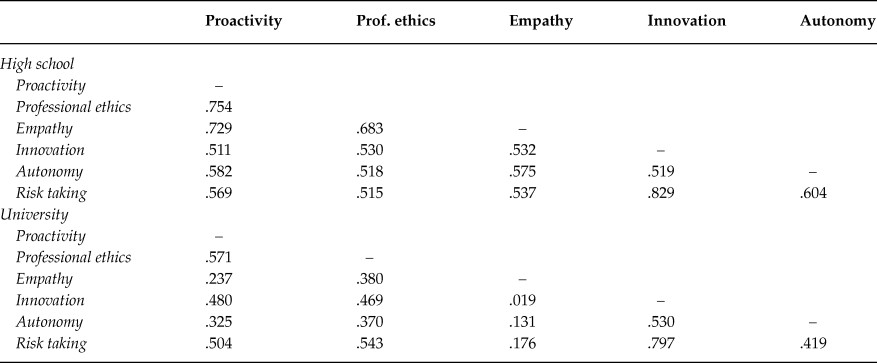
An examination of the factor loadings gave an idea of the analytical fit of the model, complementing the overall fit information. Every indicator loaded significantly (p < .05) and high in the hypothesized factors, giving support to the six factors structure. The standardized factor loadings for the six factors were within a minimum of .472 (item 18, “I’d rather take a chance and lose, you later realize I wasted a great opportunity”) and a maximum of .905 (item 12, “I can see myself starting something innovative in the workplace”), as shown in Figure 1. All factor loadings were well above the values considered indicative of an adequate consistency with the a priori factors. Correlations among factors were also statistically significant, and are shown in Table 1.
Structural Equations Models of the Entrepreneurial Attitudes Scale for Students.
Note: All factor loadings were statistically significant (p < .05). For the sake of clarity, errors are not shown, and correlations among factors are shown in Table 1.

Correlations among the factors in the confirmatory factor analyses of the Entrepreneurial Attitudes Scale for Students

Note: Except for the correlations between Empathy and Innovation and Empathy and Autonomy, all the correlations were statistically significant (p < .01).
Internal consistency
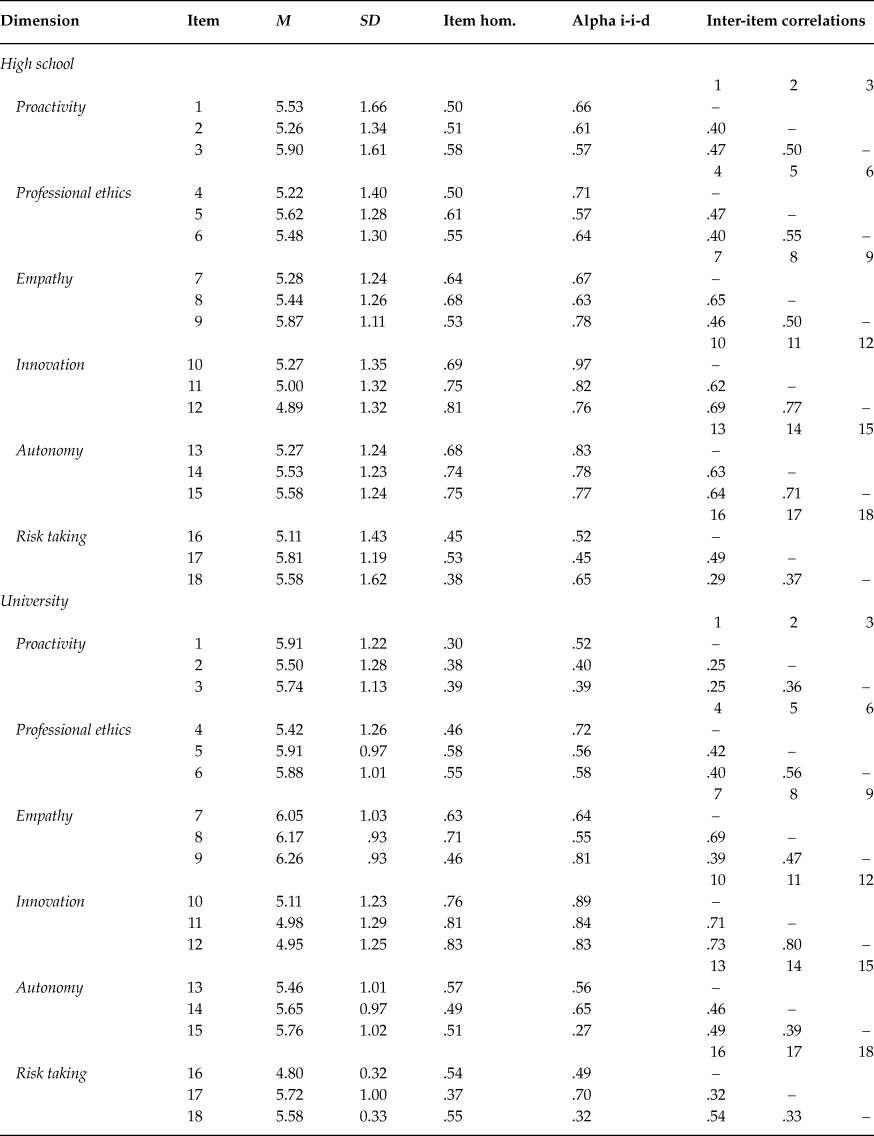
Cronbach’s alpha had a value of .70 for the proactivity factor, .72 for professional ethics, .78 for empathy, .87 for innovation, .85 for autonomy, and .63 for risk taking. Glb and rho were also estimated and were .70 for proactivity, .73 for professional ethics, .79 for empathy, .87 for innovation, .85 for autonomy, and .63 for risk taking. Descriptive statistics, item homogeneity, alpha if-item-deleted, and inter-item correlations for the six dimensions of the scale are presented in Table 2. In general, the internal consistency of the scale in this sample may be considered satisfactory for the six-factor solution.
Means, standard deviations, item homogeneity, alpha if item deleted, and inter-item correlations for the Entrepreneurial Attitudes Scale for Students

Note: Item hom. = Item homogeneity; Alpha i-i-d = Alpha if-item-deleted. All correlations were statistically significant (p < .01).
Evidences for the validity
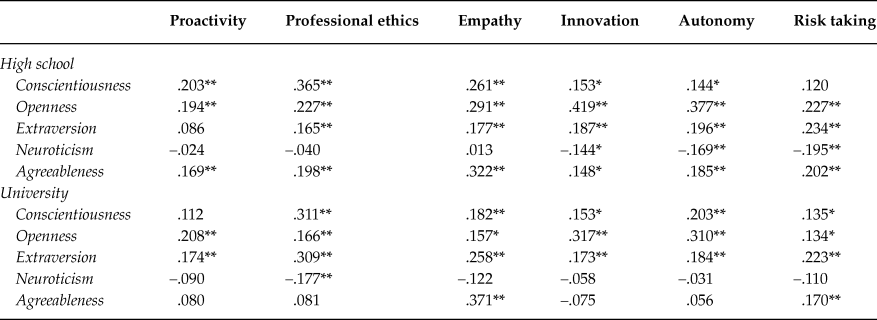
Criterion-related validity was estimated for the scale in this sample by correlating the six dimensions of the EASS with the Big Five dimensions. Proactivity correlated positively with conscientiousness, openness to experience and agreeableness. Professional ethics and empathy correlated positively with conscientiousness, openness to experience, extraversion and agreeableness. Innovation and autonomy were positive related to conscientiousness, openness to experience, extraversion, and agreeableness, and negative related to neuroticism. Finally, risk taking was positive related to conscientiousness, openness to experience and extraversion, and negative related to neuroticism. Correlations regarding hypothesis 1 (relation among entrepreneurial attitudes and conscientiousness, openness to experience, and extraversion) were in the expected direction, with the three personality traits related positively to individuals’ entrepreneurial attitudes. As regards to hypothesis 2 (relation among entrepreneurial attitudes and neuroticism and agreeableness), it was partially supported. Whereas neuroticism was negatively related to entrepreneurial attitudes, agreeableness was positively related.
University results
Confirmatory factor analysis
A confirmatory factor analysis was specified, estimated and evaluated with an a priori six-factor structure. Overall fit indexes supported the factor structure of the scale: the scaled chi-square was 185.78, with 120 degrees of freedom (p < .01), GFI was .906, CFI was .944, SRMR was .066, while RMSEA was .047 (confidence interval ranged from .033 to .060). Altogether, the indexes assessed the model as an adequate representation of the observed data.
An examination of the factor loadings gave an idea of the analytical fit of the model, complementing the indexes of fit information. Every indicator loaded significantly (p < .05) and high in the hypothesized factors, giving support to the six factor structure. The standardized factor loadings for the six factors were within a minimum of .372 (item 1, “Planning future opportunities after the graduation has been, is or will be an important part of my university formation”) and a maximum of .917 (item 12, “I can see myself starting something innovative in the workplace”), as it is shown in Figure 1, and all factor loadings were well above the values considered indicative of an adequate consistency with the a priori factors. Correlations among factors are shown in Table 1.
Internal consistency
Cronbach’s alpha had a value of .542 for the proactivity factor, .705 for professional ethics, .762 for empathy, .900 for innovation, .705 for autonomy, and .664 for risk taking. Both Glb and Rho agreed, they had values of .549 for the proactivity dimension, .705 for professional ethics, .784 for empathy, .902 for innovation, .709 for autonomy, and .697 for risk taking. Descriptive statistics, item homogeneity, alpha if-item-deleted, and inter-item correlations for these factors are presented in Table 2. In general, the internal consistency of the scale in this sample may be considered satisfactory for the six-factors solution.
Evidences for the validity
Criterion-related validity was estimated for the scale in this sample by correlating the six dimensions of the EASS scale with the Big Five. Proactivity correlated significantly and positively to openness to experience and extraversion. Professional ethics correlated positively to conscientiousness, openness to experience and extraversion, and negatively with neuroticism. Empathy and risk taking correlated positively to conscientiousness, openness to experience, extraversion and agreeableness. And innovation and autonomy were positively related to conscientiousness, openness to experience and extraversion. Values of these correlations are shown in Table 3. As in high school results, correlations regarding hypothesis 1 were in the expected direction, with positive relations among entrepreneurial attitudes and conscientiousness, openness to experience, and extraversion. Hypothesis 2, however, was partially supported: neuroticism was negatively related to entrepreneurial attitudes, but agreeableness was positively related.
Correlations among the dimensions of the Entrepreneurial Attitudes Scale for Students and the Big Five Inventory

Note: *p < .05; **p < .01.
Discussion
Formal education is a privileged area from which to identify entrepreneurial attitudes and consequently to address our efforts to the empowerment and stimulation of these attitudes. Recent studies confirm that entrepreneurial education programs increase the intention to start up a business, by increasing students’ competences and intentions towards self-employment (Sánchez, Reference Sánchez2011). In our context, the presence of entrepreneurship in education programs in schools in Europe is reported in Entrepreneurship Education at School in Europe National Strategies, Curricula and Learning Outcomes (European Commission, 2012), reminding us of the importance of entrepreneurship education as an engine for growth. In order to implement these programs and to assess their effectiveness an instrument is needed. This new tool based on recent literature on entrepreneurship should have adequate psychometric properties.
Results of the CFAs, with the a priori six-factor structure, showed adequate overall and analytical fit indexes, with no estimation problems. As regards to the scale reliability, results were appropriate for most of the entrepreneurial attitudes, except for the dimensions of proactivity and risk taking, which did not exceed values of .60 for the case of proactivity in university students, and .70 for the case of risk taking in high school and university students. However, when inter-item correlations were examined, results were over the cut-off criteria of .30, except for item 1 of the proactivity dimension for the university sample. Additionally, it should be noted that components so small as just 3 items play against reliability coefficient estimation. Thus, and guided by the usefulness principle that focuses on items’ adequate representativeness of the construct (Messick, Reference Messik1998), these dimensions were retained. Finally, external evidence relating to the entrepreneurial dimensions to personality traits supported the hypotheses of the study, except for the case of agreeableness. Higher scores in conscientiousness, openness to experience and extraversion, and lower levels in neuroticism, were related to higher levels in almost the six entrepreneurial attitudes for both types of students, in line with evidence gathered by Zhao and Seibert (Reference Zhao and Seibert2006) and Zhao et al. (Reference Zhao, Seibert and Lumpkin2010). Results on the relation between agreeableness and entrepreneurial attitudes were counterintuitive for both high school and university students. Thus, future studies examining this relation and studying whether it is specific for students, or for Spanish samples, would be welcome.
The Entrepreneurial Attitudes Scale for Students has shown adequate psychometric properties, even considering the lower reliability of proactivity and risk taking dimensions, that future studies should address. Future studies should investigate on test-retest reliability of the scale, which could not be assessed due to the cross-sectional design. ESASS could be a useful instrument both for previous diagnosis and entrepreneurial programs’ assessment.
Laura Galiana is pre-doctoral fellow of Valencia Excelence Campus/Talent Attraction Program. Authors thank the editor and anonymous reviewers for their helpful comments.
Appendix The Entrepreneurial Attitudes Scale for Students