

Argentina is an upper-middle income country with forty-four million inhabitants concentrated in large cities. More than 30 percent of the population is below the poverty line (1–3). The country has accomplished a nominal universal health coverage (UHC) but still needs to make these achievements sustainable over time, and substantial inequalities, inefficiencies, and suboptimal health outcomes still subsist (Reference Rubinstein, Barani and Lopez4–6). Benefit packages ideally define target populations and unequivocally effective interventions, in both cases aiming to achieve the healthcare objectives the country prioritizes, all of which must be based on a realistic budget to make the package affordable (Reference Belló and Becerril-Montekio7). According to the World Health Organization, a “benefit package design is a key instrument to steer health systems toward UHC” (Reference Cetrángolo and Goldschmit8).
In Argentina, there is no single benefit package that covers the entire population. As in other countries in the region, the health system is fragmented and segmented. It is made up of three sectors: the social security, public, and private sectors (9). All citizens have public sector coverage, funded by general taxes. In addition, all employees have social security coverage which is funded via a compulsory contribution. The social security sector provides coverage to 63 percent of the population (10). Its health benefits package is called compulsory medical program (PMO; by its Spanish acronym Programa Médico Obligatorio) and contains a comprehensive set of interventions, procedures, drugs, diagnostics, programs, and other technologies and services (hereinafter jointly referred to as “interventions”) to which every beneficiary of both the social security and private sectors are entitled. Social security is also required to cover those technologies listed in national clinical practice guidelines (CPGs). A reimbursement system for high-cost technologies called single reimbursement system (SUR; by its Spanish acronym Sistema ´Unico de Reintegro) complements this basic package (Reference Jaimarena11). The entity that regulates and controls stakeholders in these health sectors is called Superintendence of Health Services (SSS, by its Spanish acronym Superintendencia de Servicios de Salud). It is a decentralized agency under the National Ministry of Health and Social Development in charge of ensuring compliance with the PMO and managing the reimbursement system (Reference Youngkong12).
The PMO has originated from after a presidential request in 1995. Its main objective was to establish a package of health benefits whose beneficiaries would be those individuals belonging to the social security subsystem (Reference Glassman, Giedion, Sakuma and Smith13). There were subsequent versions in 2000, 2002, and 2005. The PMO has undergone modification over the years, and benefits have been added. The listing of benefits comprised in the aforementioned program has been significantly expanded and broadened as a result of the enactment of laws that legally incorporated or included certain benefits, not provided for in the PMO regulations (Reference Glassman, Giedion, Sakuma and Smith13). Although by design it contemplated periodic updating, there has not since been a comprehensive review of its contents, and at present there are no formal ongoing processes to assess and decide on the inclusion of new technologies.
The manner in which interventions are selected, even those that are removed from a benefit package, is a key issue in this matter, as are updates or comprehensive reviews. Coverage decisions must be in line with the value framework established by each country to provide its population with the highest possible degree of reasonably priced health care and equity. In this regard, a decision process, when setting up a benefit package, should be based on an explicit method of health technology assessment (HTA; Reference Stolk, de Bont, van Halteren, Bijlmer and Poley14–Reference Smith and Chalkidou18).
For this purpose, the SSS convened a public tender for the years 2016 and 2018 to carry out a comprehensive review of the PMO. The Institute for Clinical Effectiveness and Health Policy (IECS) together with ISALUD University were awarded the contract to perform the various segments of this work. IECS is an independent academic institution, affiliated with the Buenos Aires University School of Medicine, devoted to research, education, and technical cooperation in health care (Reference Giedion, Bitrán and Tristao19). It is a member of the International Network of Agencies for Health Technology Assessment. One of IECS’s main divisions, the Department of Health Technology Assessment and Health Economics (a World Health Organization collaborative center), dedicated to research in the area of health economics, and responsible for carrying out HTA and drawing up health policy documents, was put in charge of this process of exhaustively reviewing the PMO during the 2016–18 period. IECS was mainly in charge of coordinating the assessment and prioritization of the drugs, devices, and procedures component.
In this paper, the authors provide a comprehensive review of a benefit package (the Argentinean PMO for social security) to harmonize it with the other sources of mandatory coverage (SUR, laws, regulations, and CPGs) and to recommend the formal inclusion or exclusion of new technologies in this package.
Methods
To conduct this process of reviewing and updating the PMO, a group of vastly experienced IECS researchers was created. This team comprised four senior researchers specialized in HTA and health economics, and five epidemiologists with broad experience in developing HTA reports and auditing coverage decisions. Moreover, we called on an outsourced team of epidemiologists specialized in HTA, pharmacologists, and various other health specialists to be involved as consultants in the different steps of this project.
The benefit package reviewing and updating activities are presented in four steps, as follows.
Identification of Health Technologies
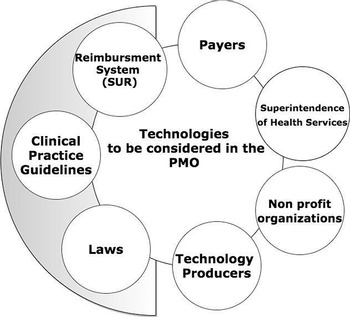
The unit of analysis in this project was the pair comprised by a technology and its indications. We generically called it “technology.” At this stage, we looked for technologies meeting the following criteria: those implying a conflictive situation such as a nonvalid indication for a valid technology; and ambiguous indications leading to a variety of interpretations, which could imply a nonconsensual compulsory coverage of a technology. To identify such technologies, we reviewed seven different sources grouped together as follows (Figure 1): those with a direct influence on social security (their mere mention in these sources forces social security to provide coverage) such as national laws, CPGs issued by the Ministry of Health, and the list of high-cost benefits (SUR) for social security reimbursement. Technologies included in these sources are usually covered by both social security and the private sector despite not being explicitly included in the PMO; therefore, there is a high coverage variability. In order to highlight their importance, technologies from these sources were subsequently consolidated into what we call the “Main Expansion List” for the PMO.
Sources surveyed and stakeholders involved for technologies identification.
Abbreviations: PMO, compulsory medical program (programa médico obligatorio); SUR, single reimbursement system (sistema único de reintegro).

The remaining sources of identification of candidate technologies were a revision of those technologies known for causing claims to be filed with the SSS, and by consultancy with other stakeholders involved, including technology producers, payers, and nonprofit organizations representing the patients’ voice. These groups proposed technologies that they believed could be candidates to be considered for incorporation into the PMO or suggested at least reviewing their current highly conflictive coverage situation through a structured form. After an awareness meeting, a questionnaire was shared for the survey with the vast majority of the main funders of both public and private health in Argentina, through the chambers that group them. Producers were contacted through the chambers that bring them together, and the patient societies that were registered at the time of carrying out this phase. The list of technologies identified from these sources was considered as complementary and was presented under the name “Other Candidates List.”
The set of surveyed sources and stakeholders involved is shown in Figure 1; on the left side of the figure, the three sources with direct influence on the social security system, but with informal coverage, are shown.
Prioritization of Technologies for Rapid HTAs
Considering the complexity and the high number of technologies identified and the need to make decisions in a short period of time, we stratified technologies into categories according to their priority to be evaluated through a rapid HTA, as follows:
High priority: The technology is currently being covered, but it has become necessary to redefine or modify the population, frequency, scope, or coverage conditions; its exclusion is proposed (which must be well founded) or the technology could be effective, but it is not yet being covered, mainly due to its high cost.
Intermediate and low priority: The technology presents good evidence or great consensus supporting its inclusion, exclusion, or modification of the coverage conditions in the applicable beneficiary population.
To perform a prioritization of the technologies included in the “Main Expansion List,” a group of five experts with experience in the clinical, health coverage evaluation, and medical audit and management fields—one from the public sector, one from the social security sector, two from the private system, and one from an HTA agency—was constituted. Consensus was reached when all participants individually selected the same response. Disagreements were resolved by discussing the participant’s different points of view, with the assistance of a “facilitator” from the research team.
The prioritization of technologies included in “Other Candidates List” was addressed by a team of researchers from ISALUD University, using an expert consensus methodology.
Assessment
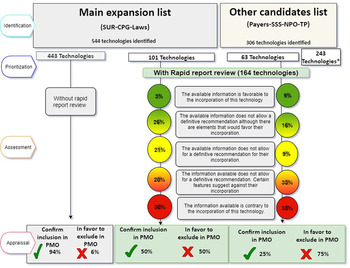
Rapid HTA reports were performed only on high-priority technologies from both lists mentioned in the “Prioritization of Technologies for Rapid HTAs” section. These reports were developed according to IECS methodology for HTA documents in 6–8 weeks (20). Their characteristics include the clinical context, technology description, objectives, methodology, effectiveness results, coverage policies and guidelines, conclusions, and recommendations. A recommendation included three main value dimensions: quality of evidence, magnitude of net benefit (considering both benefits and adverse effects), and economic and organizational aspects (cost-effectiveness or expected budget impact). To categorize the quality of evidence domain, we used the GRADE (Grading of Recommendations, Assessment, Development and Evaluations) methodology. The net benefit was categorized as major, considerable, minor, and marginal/null/uncertain, an adaptation from the German HTA agency (Institute for Quality and Efficiency in Health Care) net benefit assessment. Finally, the cost-effectiveness and budget impact domain were categorized by taking into account the per capita GDP, catastrophic health expenditures, and health budget characteristics in Argentina; and classified as reasonable, uncertain, and unreasonable. The final “traffic-light” color scale had five categories so as to summarize the assessment and facilitate a decision for decision makers: two anchors—green and red—suggesting positive or negative recommendations; and three intermediate categories—different yellows—where it is noted that, although there are factors that would help the decision, additional information would be needed before finally making a coverage decision. The weighting of the different combinations of the three domains to generate the final color of the traffic light scale was previously carried out through a methodology that involved Delphi panels among nine experts in the HTA area (20). A description of the meaning of each color can be seen in Figure 2 (20;21).
Technology identification, prioritization, and assessment.
*These 243 technologies were intermediate and low priority; therefore, their assessment was postponed. Abbreviations: CPGs, clinical practice guidelines; NPO, nonprofit organization; PMO, compulsory medical program (programa médico obligatorio); SSS, Superintendence of Health Services (Superintendencia de Servicios de Salud); SUR, single reimbursement system (sistema unico de reintegro); TP, technology producers.

For the intermediate- and low-priority technologies on the “Main Expansion List,” no HTA documents were developed, and the assessment was mainly based on expert opinions. In some instances, these were complemented by a rapid unsystematic review of information from a variety of sources including scientific evidence and national regulations, without any formal documents being produced. This process was coordinated by ISALUD University, and the consensus panel included clinical experts and healthcare service managers. Intermediate- and low-priority technologies included in the “Other Candidates List” were excluded from this process, and a decision on such technologies, which were deemed to be nonessential, was postponed for a later stage.
Appraisal and Preliminary Recommendation to Decision Makers
As for high-priority technologies on both lists (“Main Expansion List” and “Other Candidates List”), the IECS’s HTA group made recommendations based on the three domains evaluated in the rapid HTA reports as mentioned before. In order to facilitate the interpretation of these results by decision makers, recommendations were presented graphically by means of a traffic-light scale which classified technologies into five categories, ranging from a strong recommendation in favor of, to a strong recommendation against, their inclusion. The final decision for or against considering its inclusion in the benefit package was based both on the HTA rapid report recommendation and the source of the technology. For the “Main Expansion List,” a green to yellow result implied a recommendation in favor of including the technology, whereas a red/yellow or red mark indicated a recommendation against it. In the case of technologies listed under “Other expansion list,” we adopted a more restrictive posture, in that an HTA report with red, yellow/red, and yellow results implied a recommendation against their inclusion in the benefit package, and yellow/green and green results implied a recommendation for inclusion.
Results
The “Results” section is structured in four stages, as described in the “Methods” section. The entire process is shown in Figure 2.
Identification of Health Technologies
An overlap between technologies from different sources was found. After elimination of duplications, 850 pairs (technology-indication) from all the sources surveyed were identified: 544 made up the “Main Expansion List” and 306 the “Other Candidates List” (Figure 2). Those technologies in the “Main Expansion List” from laws and clinical guidelines corresponded to a heterogeneous group ranging from high-cost technologies such as hepatitis C drugs; human immunodeficiency virus drugs; and oncologic treatments, to those for high-impact public health diseases such as diabetes, prenatal control, and obesity for example. Technologies identified from the reimbursement system (SUR) were predominately high-cost drugs such as biologics for rheumatoid diseases or oncologic treatments, and high-cost drugs for orphan diseases. Devices and procedures were also identified in SUR, such as a transcatheter aortic valve implantation and epilepsy neurosurgery; for example, the overlap between technologies from different sources mainly involved high-cost drugs and procedures from mandatory sources.
Prioritization
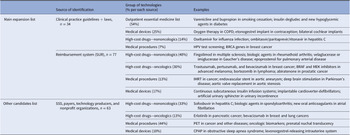
Out of a universe of 850 identified technologies, 164 were classified as high priority for evaluation, 101 out of 544 from the “Main Expansion List,” and 63 out of 306 from the “Other Candidates List” (see Figure 2). Among the 101 technologies prioritized from the “Main Expansion List,” those identified from CPGs and laws were mostly low-cost drugs (outpatient essential medicines list), and those identified from the reimbursement system were mostly both high-cost cancer and noncancer drugs. Technologies included in each category, along with percentages and examples, are shown in Table 1. On the other hand, the sixty-three prioritized technologies from the “Other Candidates List” mostly included therapeutic or diagnostic procedures, medical devices, and low-cost drugs (outpatient essential medicines list).
Technologies by source of identification.

Note: Technologies are grouped according to their frequency from high to less frequency, depending on their source.
Abbreviations: COPD, chronic obstructive pulmonary disease; HPV, human papillomavirus; BRCA, breast cancer 1; IMRT, intensity modulated radiation therapy; ECMO, extracorporeal membrane oxygenation; PET, positron emission tomography; CPAP, continuous positive airway pressure.
Assessment
High-priority technology-indication pairs (n = 164) were grouped according to pathologies or therapeutic groups as appropriate (i.e., PET in oncology, biologic treatment in rheumatoid arthritis) and assessed by seventy-five rapid review reports. The remaining 443 technologies from the “Main Expansion List” categorized as intermediate priority and low priority were nonconflictive technologies; they were assessed by a group of HTA experts based on regulatory aspects, clinical guidelines, HTA reports from other agencies, and coverage policies, and no standardized HTA rapid review report was performed.
The assessment of 243 intermediate- and low-priority technologies from the “Other Expansion List” was postponed for a later stage (Figure 2).
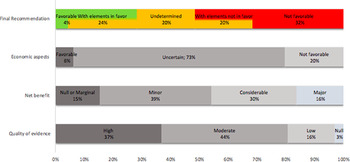
For those technologies assessed through a rapid review report, the evidence was rated, in most cases, as high or moderate quality. In the evaluation of clinical benefits, the net benefit was minor or marginal in almost half of the cases and considerable and/or high in the remaining instances. On the other hand, the economic aspect could seldom be reliably determined due to a lack of local information, although 20 percent of the technologies were considered unfavorable. Due to the aforementioned characteristics, where a benefit was established, such a benefit was subtle and implied a high or unclear cost. Overall, the final recommendation was not favorable in about one third of the cases, and more than 20 percent had some unfavorable factors. About one third of the technologies had favorable recommendations or favorable factors, and 20 percent required other factors to be taken into consideration in order to make the best decision possible. In the “Main Expansion List,” almost one third of the high-cost drugs not intended for oncological treatment and almost half of oncological high-cost drugs called for a recommendation against their inclusion. On the contrary, most of the outpatients’ essential drugs, medical procedures, or devices resulted in a strong recommendation for their inclusion in the benefit package.
Appraisal and Preliminary Recommendation to Decision Makers
Half of the high-priority technologies included in the “Main Expansion List” received a positive recommendation, whereas the other half received a recommendation against their inclusion. This was based on the findings of the rapid reviews where 3 percent of the results were favorable (green), 21 percent had aspects in favor, and 26 percent were undetermined (other criteria have to be considered in order to confirm their inclusion). The remaining HTA reports showed that 20 percent of the technologies had unfavorable features; and 30 percent had a negative result (see Figure 3). The details about the color in the traffic-light obtained in each HTA report can be found in the Supplementary Material. Out of the remaining 443 technologies in the “Main Expansion List” that were not formally assessed, a vast majority (94 percent) received a favorable recommendation, and only a minor portion received a recommendation against their inclusion. Out of the sixty-three technologies assessed in the “Other expansion list,” 25 percent (9 percent of the HTA reports were green, and 16 percent were yellow/green) received a recommendation in favor of their inclusion in the benefit package, and the remaining 65 percent received a recommendation against their inclusion (30 percent ended up with a negative result, 33 percent with unfavorable features, and 9 percent were undetermined).
Distribution of technologies evaluated by domain, and final recommendation.

Discussion
In the present paper, we thoroughly describe a complex, yet time-efficient process designed to guide the long overdue updating of Argentina’s main benefit package, which has not been formally and comprehensively revised. We deemed it necessary to perform a quick assessment in order to pragmatically move toward a UHC. This process was done based on the HTA rapid review methodology which, though not providing the same degree of analysis and synthesis of the evidence as a systematic review or a formal economic evaluation, is actually an optimal tool and offers a certain degree of transparency in the process. This is important when assessing or modifying a benefit package covering such a large population. This fact, in addition to the active involvement of several health system stakeholders such as payers, technology producers, and social security representatives, makes this process stronger, although the selection could be under-representative as we did not include individual patients or the general public, for example. The outcome of this work was designed to serve as an input for the deliberative evidence-informed process that will be performed when a decision-making committee eventually updates the benefit package.
When identifying technologies, we tried to be as comprehensive as possible and recognize not only the formal sources of PMO modification, but also those technologies whose coverage is somewhat conflictive. For this reason, we additionally sought to have some key decision makers involved in the process. We also examined SSS claims. Despite this effort, not all health system stakeholders were represented. This was due to the high fragmentation presented by the Argentinean health system, with more than 300 institutions providing healthcare services. Patients and healthcare professionals voices were represented by their associations; hence, they may have been underrepresented. Furthermore, the general population had no say in the process.
In order to optimize the results of this short but intensive project, it was necessary to identify high-priority technology pairs for evaluation. In the prioritization process, a number of the least conflicting technologies were evaluated with a lower level of detail. This partial analysis can be associated with a risk of an unquantifiable amount of bias or distortion. Therefore, we only performed a formal HTA report on 164/850 technology/indication conflicting pairs.
We developed a preliminary recommendation that could ideally be strengthened or modified by a group of key decision makers with the guidance of a value framework developed for Argentina, in a deliberative and transparent way, with the involvement of as many stakeholders as possible. The fact that there has not been an instance of public consultation in the development of the reports could accentuate the limited participation of stakeholders involved in the nomination process.
The “traffic-light” color scale used for the recommendation was based on the domains usually considered by most agencies around the world: quality of evidence, net health benefit, and economic aspects. In the analysis, we did not formally include other aspects such as equity, accessibility, minority groups, and so on, which could be important from a societal point of view. It would be desirable for the Ministry of Health to incorporate these additional factors into their final decision.
Argentina’s PMO package covers more than half of its population. However, since its inception, it has never been comprehensively reviewed. New technologies have not been formally incorporated, which should be done pursuant to sources such as laws or national CPGs. Ideally, benefit packages should be reviewed on the basis of the best available evidence, to meet the needs of the covered population with the financial resources available. This updating process could be even more beneficial in the case of low- and middle-income countries where a great number of new and expensive technologies face the problem of a scarce budget (Reference Alcaraz, Hernandez-Vasquez and Garcia Marti17). In this scenario, an updating process that identifies technologies for disinvestment might alleviate this problem and provide a fairer resource allocation. Moreover, if the package is not constantly reviewed and updated, there is a risk that it will reflect outdated medical practices, and ignore new and eventually more efficient treatments, which situation would be detrimental to the patients and the health system, as stated by Smith when he mentioned the shortcomings of setting up an explicit health benefit package without a continuous reviewing process (Reference Smith and Chalkidou22). In 2014, Giedion et al. reviewed selected health benefit packages in Latin America (Reference Giedion, Bitrán and Tristao23). Although good practices for designing and implementing benefit packages in Latin America have not been formally defined, it would be desirable for a benefit package to be associated with an established framework which promotes its design and periodic updating. In the region, although the requirement of a periodic review process is mentioned in the regulatory document establishing benefit packages, few explicit criteria (such as a time frame, a manager for the process, a mechanism to perform it, and funding for continued updating procedures) are actually specified. According to Giedion et al., there is no regular and consistent updating of the package in Colombia (POS, by its Spanish acronym Plan Obligatorio de Salud), which they assert, has a detrimental effect on its legitimacy. A Uruguayan package (PIAS, by its Spanish acronym Plan Integral de Atención en Salud, Integral Health Care Plan) was established by law in 2008 and updated in 2018, but without explicitly describing the process. Chile, in contrast, has an explicit list of high-cost benefits (AUGE, by its Spanish acronym Acceso Universal de Garantías Explícitas, Universal Access with Explicit Guarantees) which is updated every 3 years through an established process based on proven efficacy, advantages, and affordability of the technologies to be considered for inclusion, although only a few selected diseases are covered in the package (24). As mentioned above, the law that established the Argentinian PMO, generally, but not specifically, stated that a regular updating of the package contents was to be performed, However, this kind of comprehensive update has never been actually made (Reference Glassman, Giedion, Sakuma and Smith13).
HTA has been recognized as a tool that assists in designing benefit packages, so its use for reviewing technologies that can potentially be included seems to be appropriate (Reference Smith and Chalkidou18;25). It would be advisable that a transparent process for updating the new PMO be established following this report, so as to minimize the potential bias developed in the initial process.
This work provides a tailored pragmatic way to approach the complex, comprehensive benefit package reviewing process. An explicit evidence-based HTA methodology involving different health system stakeholders could support and enhance the decision-making process for a rational use of health resources.
It would be of interest in future research to be able to determine the replicability of this methodology in other settings or health systems that require a review of their health benefit packages.
Funding Statement
This project was carried out through a competitive grant awarded by the Superintendence of Health Services, Ministry of Health, Argentina.
Conflicts of Interest
The authors declare that they have no conflicts of interest.
Supplementary Materials
To view supplementary material for this article, please visit http://doi.org/10.1017/S0266462322000034.