Our political economy model has correctly forecasted the 1998 and 2005 elections. However, in 2002 we predicted a tight race to the benefit of the Christian Democrats(CDU)/Christian Socialists(CSU)-Free Democratic Party (FDP) opposition, so underestimating the narrow defeat of the FDP by the Green Party. In the German political system, proportional representation makes single-party domination almost impossible. On the contrary, the big parties, Social Democratic Party (SPD) or CDU/CSU, are pushed to build a majority coalition. In this competition, the FDP has been the “pivotal party” in German political life, at least until 2002. Since then, the Greens have challenged the FDP, with the Ecologists allowing the SPD to form a red-green coalition in 1998 and in 2002. Similarly, in 2005 the FDP was not associated with the grand coalition driven by Angela Merkel.
The FDP was finally returned to power in 2009. Still, paradoxically, frequent confrontational participation with the CDU tended to seriously weaken its political power. One might even wonder whether it will be able to obtain 5% of the votes cast in September 2013. Therefore, given the uncertainty over the FDP, the rise of the Greens, and the pressure from the Linke-PDS party, we built a new voting model to meet the demands of forecasting the electoral weight of the pivotal parties and to inferring the future coalitions.
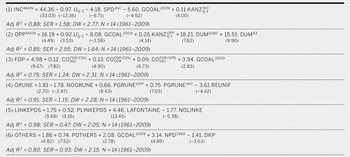
The most appropriate method appears to be a seemingly unrelated regression (SUR) model simultaneously explaining the vote for the CDU/CSU, the SPD, the FDP, the Greens, and the Linke-PDS. In this model, we keep the logic of incumbency for the main coalition party. Therefore, from 1961 to 2009 the INC-MAIN variable includes the vote for the party of the CDU or SPD Chancellor. The OPP-MAIN variable contains the vote for the party in favor of the main opponent of the outgoing Chancellor. Thereafter, specific vote functions for the FDP, the Greens (GRUNE), the Linke-PDS (LINKPDS), and the other parties (OTHER) will be added.
The modeling of the Chancellor party and the opponent party obeys the government responsibility standard. The incumbent vote should be depressed by the prior unemployment level (UQ-2 and UQ-2* measured two quarters before the electionFootnote 1), whereas the vote for the main opponent should be boosted. Similarly, the bigger the preferenceFootnote 2 of the voters for the Chancellor (KANZQ-1INC) or the opponent (KANZQ-1OPP), the bigger the electoral premium. Further, in line with the localization of economic responsibility (Powell and Whitten Reference Powell and Whitten1993), the small parties should be held less responsible for the economic situation compared to the large parties. Therefore, the vote for the FDP should primarily reflect the voters' wish to have it in a future coalition. Such a variable has been measured by German opinion polls for 50 years, and since 1998 and the rise of the Greens it is even more accurate. In this regard, we have distinguished between situations where the FDP was an outgoing party with the CDU (COINCFDP/CDU), or with the SPD (COINCFDP/SPD), or an opponent with the CDU (COOPPFDP/CDU).
Voting for the Greens is assumed to be primarily based on their electoral potential, (PGRUNE) in the polls (IFD Allensbach), distinguishing whether they are opponents or incumbents. Regarding the Linke-PDS, we selected the voting intentions in the polls (PLINKEPDS, IFD Allensbach) and a dummy variable coding the period before and after the Oskar Lafontaine takeover in 2005 (LAFONTAINE). Finally, the vote for the other parties is mainly explained by the vote intentions in the polls for the residual parties (POTHERS, IFD Allensbach). Indeed, several times in German history, small residual parties approached scores between 2% and 5% thereby reducing the scores of the big parties.Footnote 3 In this regard, the new anti-Euro German party (AFD) could play such a role in 2013.
Note that in the specification of the equations we have considered several political-institutional events (from 1961 to 2009) that affect the German elections. Therefore, the grand coalition CDU/SPD (GCOAL2009) has had a negative impact on the CDU and even more on the SPD, but it has had a positive effect on the FDP and on the residual pivotal parties (OTHERS). Similarly, the first elections following German unification (REUNIF) in 1990 broke the Greens electoral progress, which has stayed constant until now. Finally, the DUM6180 variable in equation 2, scored 1 from 1961 to 1980 (zero otherwise) underlines the break in the alliance strategy of the FDP, which definitively becomes a key ally for the CDU on the right, breaking with the SPD in 1983 (DUM83).
After identifying these specifications for each of the vote equations, separately tested, we estimated the following SUR model. Then, from the estimated coefficients, we propose a forecast for vote shares and party seats for 2013.
The SUR model reads as shown in table 1.Footnote 4

NB: The NOLINKE variable is scored 1 from 1961 to 1987 (zero otherwise) and it indicates that the LINKEPDS is not present. The variable NOGRUNE is scored 1 from 1961 to 1976 (zero otherwise) and it indicates that the Greens are not present.
Then, we have plugged in the following values, to make the vote forecast for the partiesFootnote 5:
 $$
{\rm U}_{{\rm Q - 2}} = 7.4;{\rm KANZ}_{{\rm Q - 1}}^{{\rm INC}} = 63\%{\rm (A. Merkel);}
$$
 $$
{\rm KANZ}_{{\rm Q - 1}}^{{\rm OPP}} = 27\% {\rm (P}{\rm . Steinbruck);}
$$
 $$
{\rm CO}_{{\rm INC}}^{{\rm FDP/CDU}} = 13\% {\rm ; PGRUNE}^{{\rm OPP}} = 14\% ;
$$
 $$
{\rm PLINKEPDS} = 6\% {\rm ; POTHERS} = 6.5\% .
$$
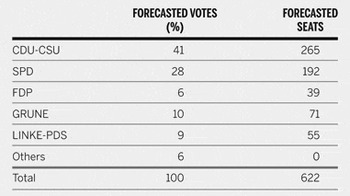
If the elections were held now (in April 2013), Angela Merkel would be assured of remaining the Chancellor, with the SPD and the Greens reaching no higher than 38% of the vote share.Footnote 6 (See table 2.) However, the transfer from the vote share into seats via the swing ratioFootnote 7 makes clear that a CDU/CSU-FDP coalition will fall short, by eight seats, of securing the absolute majority (based on the 2009 seats share).
Political Economy Model (SUR) 2013 German Elections, April 2013

Absolute majority = 312
This is a fragile result because considering the margin error of the FDP vote function (±1.24), it is not certain that the Liberal-Democrats will have elected any candidates. Could the German Chancellor build a “Jamaican coalition,” or a black-green coalition, just as in the Hesse Land? This is unlikely at the national level because the Chancellor would have to agree to dramatic concessions regarding the governance of Europe. Assuming that the pure political parameters stay constant until September 2013, our model shows that a further deterioration in the unemployment rate could require Angela Merkel to rebuild a grand coalition with the SPD. The direct effect would likely be a weakening of the camp favoring budgetary discipline inside the EU.