Introduction
Volumetric-modulated arc therapy (VMAT) can achieve conformal dose distribution, high dose uniformity to the target volume and reduced dose to surrounding organs at risk (OARs) by modulating the dose rate, gantry rotation speed and multileaf collimator positions. Reference Otto1,Reference Palma, Vollans and James2 With its shorter delivery time and fewer monitor units, Reference Yoo, Wu, Lee and Yin3,Reference Zhang, Zhai and Lu4 VMAT is seen as an improvement over intensity-modulated radiation therapy (IMRT). The dose homogeneity within the planning target volume (PTV) of VMAT with 7-field IMRT plans (7F6MV), 9-field IMRT plans (9F6MV) and 7-field IMRT plan (7F10MV) was statistically significantly better compared with IMRT. There was no significant difference when comparing VMAT with a 7-field 10 MV IMRT plan (7F10MV). Reference Vasanthan, Ganesh, Sunil and Raghavendiran5 In radiotherapy, IMRT and VMAT have been commonly employed in cases of head and neck cancer, which involve complex anatomy and multiple OARs, including the brainstem, spinal cord, salivary glands and optic nerves.
In treatment planning, selection of parameters such as single arc, double arc, collimator angle and photon energy can affect dose distribution. Reference Guckenberger, Richter, Krieger, Wilbert, Baier and Flentje6-Reference Agazaryan, Tenn and Chow10 Guckenberger et al. reported that single-arc VMAT was not sufficient for complex-shaped target volumes compared with multiple arc VMAT. Reference Guckenberger, Richter, Krieger, Wilbert, Baier and Flentje6 Tas et al. showed a dependence of dose distribution on collimator angle in VMAT for prostate cancer. Reference Bora, Hatice and Sibel7 Sung et al. showed the effect of photon energy on IMRT plans for prostate cancer and found that a 15 MV IMRT plan was associated with better OAR sparing and fewer integral doses than a 6 MV IMRT plan. Reference Sung, Park, Choi, Ha and Ye8 Hussein et al. reported that a 6 MV IMRT plan for prostate cancer increased the theoretical risk of developing a fatal cancer compared with 15 MV IMRT. Reference Hussein, Aldridge, Guerrero Urbano and Nisbet9 Sakthivel et al. indicated that there was an absolute difference between 6 and 10 MV IMRT plans in impact on what they termed ‘the excess absolute risk’ for in-field organs. Reference Vasanthan, Ganesh, Sunil and Raghavendiran5 In this study, we investigated the effect of different energies on dose distribution in VMAT plans for head and neck cancer. We generated plans for 6 and 10 MV X-ray beams alone, and for dual energy (both 6 and 10 MV X-ray beams). Dosimetric evaluation was based on conformity index (CI), homogeneity index (HI), doses to the PTV and dose to the OARs.
Materials and Methods
Patient data
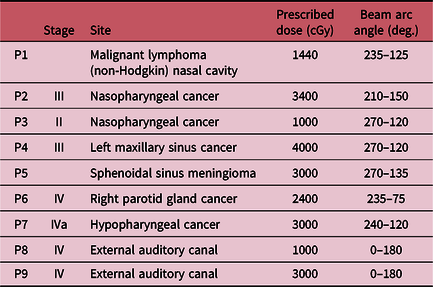
Data from nine cases of different head and neck cancers in different stages (II to IVa) (Table 1) previously treated with VMAT from January 2014 to June 2017 at Department of Radiation Therapy, Kanazawa University Hospital, were chosen for this study. Seven cases had undergone treatment with both 3D conformal radiotherapy and VMAT and two cases had been treated with only VMAT. Computed tomography (CT) (Aquilion LB, Toshiba Medical Systems, Tokyo, Japan) images 2 mm in thickness acquired in the supine position were used for treatment planning.
Patient characteristics

Delineation of target volumes and OARs
Gross tumour volume (GTV), clinical target volume (CTV), PTV and normal tissues were delineated by radiation oncologists in accordance with International Commission of Radiation Units and Measurements reports 50 and 62. 11,12 PTV was defined as a minimum 5-mm margin around the CTV in order to ensure that the prescribed dose is delivered to CTV and to minimise errors from the variabilities of positioning patients in treatment set-up, motion of internal organ, parameters in treatment planning system (TPS). 11,13 The surrounding OARs, including brainstem, spinal cord, optic nerves and parotid glands, were contoured.
Treatment planning
We used the original 6 MV VMAT plans of the nine cases that were previously planned with Monaco Ver. 5.00.03 (Elekta AB, Stockholm, Sweden) by radiation oncologists as standard plans. Planning CTs of these original cases were transferred to a TPS (Pinnacle3 Ver. 9.10, Philips Medical Systems, Fitchburg, WI, USA). Then, we re-planned three VMAT plans with 6 and 10 MV X-ray beams, plus dual energy (both 6 and 10 MV X-ray beams) for each case. The dose distribution was calculated by the collapsed cone algorithm. VMAT plans were developed for Elekta Synergy BM (Elekta AB, Stockholm, Sweden). The prescription doses for all cases were 10–40 Gy in 5–20 fractions with a daily dose of 1·80–2·00 Gy (Table 1). For single-energy treatment plans, a partial-double arc with the first beam progressing in a clockwise direction and the other beam set to start at the end point of the first arc and to move in a counterclockwise direction was used. For the dual-energy VMAT plan, the first progressing beam was 10 MV and the second beam was set for 6 MV. We kept the arc angles of beams intact in the original 6 MV VMAT plan that the radiation oncologists had generated previously. All VMAT plans in this study were normalised by creating a normalisation point as isocentre. Initially, in the treatment planning process, we used optimisation constraints and weights of the original 6 MV VMAT plans for 6 MV, 10 MV and the dual-energy VMAT plans. Then, we modified the constraints and weights during the optimisation process. We prioritised the weights of target dose to GTV, CTV and PTV compared with the weights of normal tissues in all cases; simultaneously, the weights among VMAT plans were kept the same. The objectives of the VMAT plans in this study were based on the objectives of the original VMAT plans, with 100% of the prescribed dose to at least 50% of PTV, and V110% < 20%. Reference Hodapp14
Plan evaluation
Quantitative evaluation of VMAT plans was based on the dose volume histogram (DVH) of each patient. Dose to 2, 50, 95, and 98% of PTV volume (D2, D50, D95, and D98%, respectively) and PTV volume receive 95 and 110% of the prescribed dose (V95 and V110%, respectively), CI and HI were analysed. The CI indicating that the degree of conformity of dose distribution in VMAT plans Reference Hodapp14 was calculated using the following equation:
 $${\rm CI}_{iso} = {{{{\rm{TV}}}}\over{{{\rm{PTV}}}}$$
where the part of tissue volume that is covered by prescribed isodose line is the treated volume.
The ideal case is CI = 1. Reference Hodapp14 HI was used for evaluating homogeneity of dose distribution within the PTV (Equation (2))
 $${\rm HI} = {{{{\rm{D2\% - D98\% }}}}\over{{{\rm{D50\% }}}}$$
The ideal value is HI = 0 with homogeneity decreasing with increasing values of HI. 12,Reference Hodapp14
To evaluate dose to serial-like OARs (brainstem, spinal cord and optic nerve), the dose close to maximum dose such as D1% (dose to 1% of serial-like OAR volume) was used. Reference Hodapp14 The dose limits to the brainstem, spinal cord and optic nerves were less than 54, 45 and 50 Gy, respectively. 15 To evaluate the dose to parallel-like OARs (parotid glands), the mean dose was applied. Reference Hodapp14,15 The mean dose to the parotids should be <26 Gy. 15 For statistical analysis of the VMAT plans, the Statistical Package for Social Science (SPSS version 24, SPSS, Inc. Chicago, IL, USA) was used and the non-parametric Friedman repeated measures ANOVA test was applied with p < 0·05 considered to be statistically significant. The statistical data from all studied cases with the Friedman repeated measures ANOVA test were used to compare among the 6 MV, 10 MV and dual-energy VMAT plans; the Wilcoxon signed-rank test was used as a post hoc test.
Results
Dose to PTV
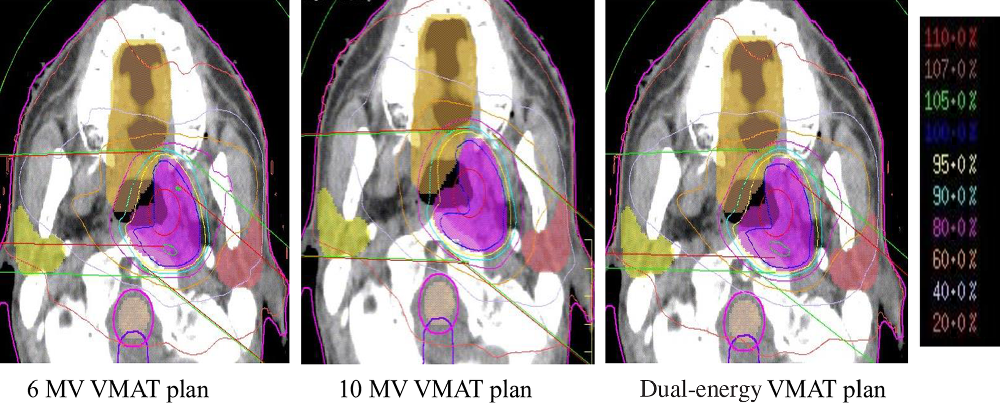
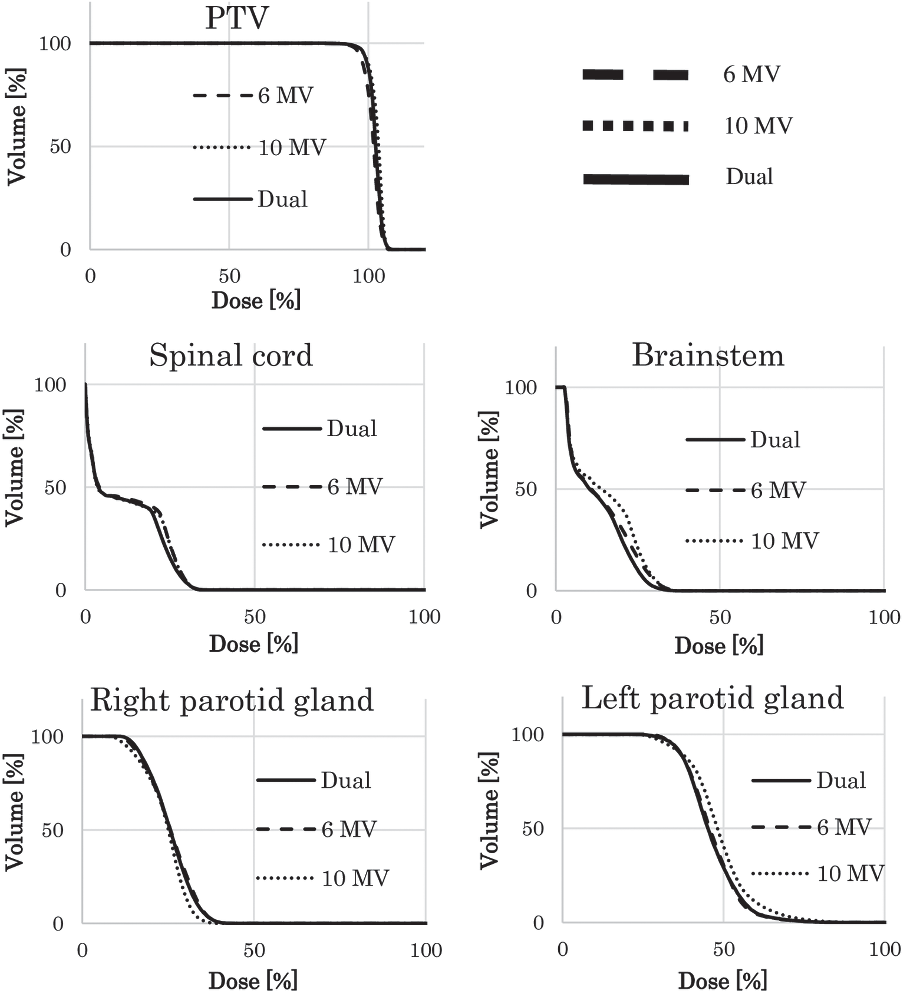
The typical isodose distributions and DVH of 6 MV, 10 MV and dual-energy VMAT plans for a representative head and neck case (case P4) are shown in Figures 1 and 2. Based on dose distributions in Figure 1, the 95% isodose curve of VMAT plans covered the PTV, with no clear difference in dose coverage among the three plans. The DVH in Figure 2 shows that there was no considerable difference in PTV, spinal cord, brainstem or parotid gland dose among the three VMAT plans.
The dose distributions of 6 MV, 10 MV and dual-energy VMAT plans for a representative head and neck case (case P4). PTV (pink), spinal cord (apricot yellow), right parotid gland (yellow), left parotid gland (reddish) and oral cavity (tawny) are outlined.

DVH for 6 MV, 10 MV and dual-energy VMAT plans for a representative head and neck case (case P4).

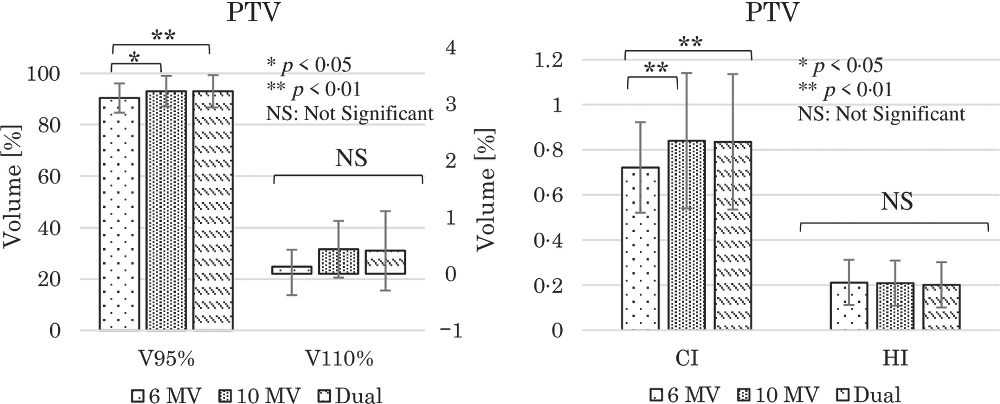
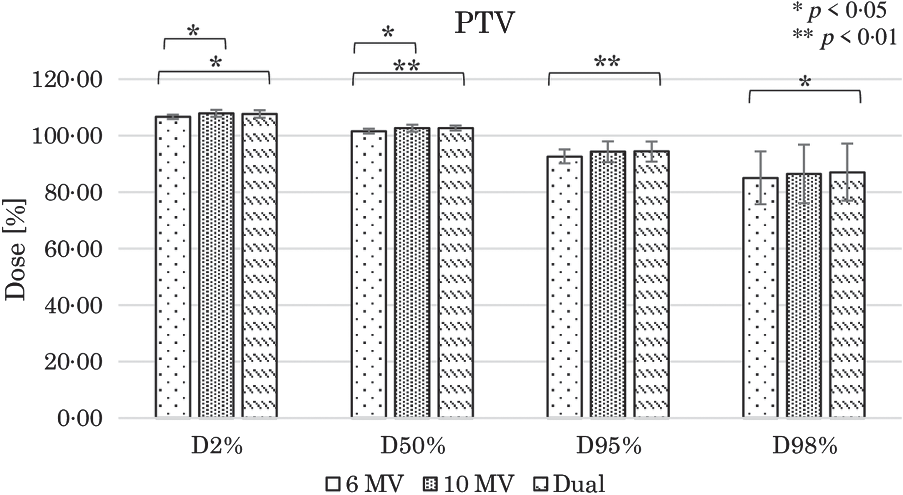
All VMAT plans met the dosimetric limits of 100% of the prescribed dose to at least 50% of PTV, and V110% < 1% (Figures 3 and 4). There were no statistically significant differences in the homogeneity of PTV dose among VMAT plans. The dose CIs for PTV of the 10 MV and dual-energy VMAT plans were significantly higher than that of the 6 MV VMAT plan (0·8 ± 0·3, 0·8 ± 0·3 and 0·7 ± 0·2, respectively; p = 0·001). There were no significant differences in CI of PTV between the 10 MV and dual-energy VMAT plans.
Comparison of V95%, V110%, CI and HI of PTV among 6 MV, 10 MV and dual-energy VMAT plans for all cases.

Comparison of dose to PTV among 6 MV, 10 MV and dual-energy VMAT plans for all cases.

There were significant differences in D2, D50, D95, D98 and V95% of PTV among the 6 MV, 10 MV and dual-energy VMAT plans (Figures 3 and 4). The D2 and D50% to the PTV for the 6 MV VMAT plan were significantly less than those for the 10 MV VMAT plan (D2% 6 MV vs. D2% 10 MV: 106·6 ± 0·7% vs. 107·9 ± 1·2%, p = 0·028 and D50% 6 MV vs. D50% 10 MV: 101·6 ± 0·9% vs. 102·6 ± 1·2%, p = 0·015). The V95% values of the 6 and 10 MV VMAT plans for PTV were 90·3 ± 5·7% vs. 93·0 ± 6·0%, respectively (p = 0·038). There were no significant differences in doses to PTV between the 10 MV and dual-energy VMAT plans. D2, D50, D95, D98 and V95% of the dual-energy VMAT plan were statistically significantly higher than those of 6 MV VMAT plan (p = 0·015, p = 0·008, p = 0·008, p = 0·011, p = 0·008, respectively). The D2% to PTV for 6 MV VMAT plan was significantly lower than that for dual-energy VMAT plan (106·6 ± 0·7% vs. 107·6 ± 1·4%, p = 0·015). The D95% values of 6 MV and dual-energy VMAT plans for PTV were significantly different: 92·7 ± 2·4% vs. 94·4 ± 3·5% (p = 0·008).
Dose to OARs
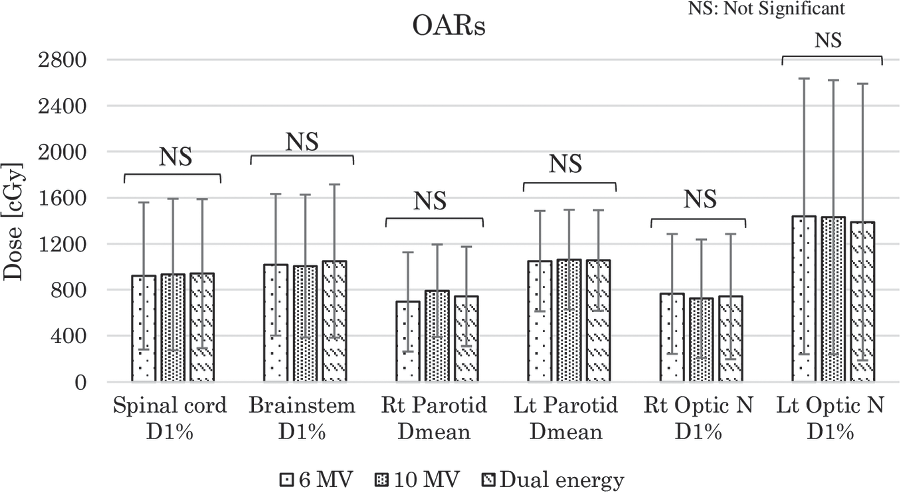
A comparison of OAR doses among the VMAT plans is shown in Figure 5. Constraints for OARs were all within desired limits. The doses to OARs with the 6 MV, 10 MV and dual-energy VMAT plans showed no statistically significant differences. The D1% to the brainstem among 6 MV, 10 MV and dual-energy VMAT plans were 10·2 ± 6·2, 10·1 ± 6·2 and 10·5 ± 6·7 Gy. The mean doses to the right parotid gland among 6 MV, 10 MV and dual-energy VMAT plans were 7·0 ± 4·3, 7·9 ± 4·0 and 7·4 ± 4·3 Gy.
Comparison of dose to OARs among 6 MV, 10 MV and dual-energy VMAT plans for all cases.

Discussion
The purpose of this study was to investigate the effect of beam energy on dose distribution of VMAT plans for head and neck cancer. The factors used to evaluate the quality of treatment planning were isodose curves, DVH, CI and HI for PTV, mean dose to parotid glands, and maximum dose to the brainstem, spinal cord and optic nerves.
In general, there were no clear differences in dose distributions among VMAT plans. However, statistical analysis showed the dual-energy VMAT plan improved PTV coverage significantly as shown by CI, V95, D50, D95 and D98% compared with the 6 MV VMAT plan. These results might be explained by the fact that the dual-energy VMAT plan combines the advantages of both lower-energy (tight dose distributions around the target volume) and higher-energy photons (high penetration) compared with 6 or 10 MV alone. Reference Laughlin, Mohan and Kutcher16 However, this study demonstrated that the 10 MV and dual-energy VMAT plans had a significantly higher D2% to the PTV compared with the 6 MV VMAT plan. Therefore, high-energy photons might be not suitable for minimising hotspots in the PTV for superficial tumours, such as head and neck cancer.
Park JM et al. indicated that an IMRT plan combining both 6 and 15 MV X-ray beams reduced dose to OARs and other normal tissues in prostate cancer therapy. Reference Park, Choi, Ha and Ye17 However, in our study, a VMAT plan combining both 6 and 10 MV X-ray beams showed insignificant improvement in dose to OARs, which may be explained by differences in the process of optimising plans, algorithms, the suitable degree of photon energy for the treatment site and linac delivery. de Boer et al. indicated that the choice of photon energy had no clinical benefit in target coverage and normal tissue sparing in IMRT plans for prostate cancer. Reference de Boer, Kumek, Jaggernauth and Podgorsak18
In this study, in cases of hypopharyngeal and nasopharyngeal cancer, D95 and V95% to the PTV of a 10 MV VMAT plan were higher than those of a 6 MV VMAT plan. However, in one case of non-Hodgkin lymphoma of the nasal cavity, D95 and V95% to the PTV of a 6 MV VMAT plan were higher than those of a 10 MV VMAT plan. As non-Hodgkin lymphoma of the nasal cavity is located near the skin surface, the 10 MV VMAT plan apparently was associated with degraded target coverage compared with the 6 MV VMAT plan. The CI and HI in the PTV in cases of nasopharyngeal cancer in all VMAT plans were better compared with our other cases.
This study presented a comparison of VMAT plans using different energies; however, the total prescription dose for each patient was different and the location of cancer in all cases was not the same (e.g., nasopharynx, pharynx, parotid glands). Future studies should increase the number of patients to reduce uncertainties in analysis and consider dose constraints to improve dose coverage of PTV and reduce OAR dosage. In addition, the quality of dose distribution of VMAT plan depends on the optimisation processes in the TPS. Therefore, the results of dose distribution may be different if a different TPS is used.
As described, there were statistically significant differences in dose conformity and doses to PTV among VMAT plans with three different beam energies. However, there was no statistically significant difference among VMAT plans for OAR doses. We conclude that the photon energy slightly affected the quality of dose distribution within the PTV.
Acknowledgements
The authors thank Libby Cone, MD, MA, from Edanz Group Japan (www.edanzediting.com/ac) for editing drafts of this manuscript.
Financial Support
This research received no specific grant from any funding agency, commercial or not-for-profit sectors.
Conflicts of Interest
None.
Ethical Standards
The authors assert that all procedures contributing to this work comply with the ethical standards (Ethical Guidelines for Medical and Health Research Involving Human Subjects by the Japanese government) of the relevant national guidelines on human experimentation and with the Helsinki Declaration of 1975, as revised in 2008, and have been approved by the Ethics Committee of Kanazawa University (Approval number 767-2).