INTRODUCTION
The reduction or loss of facial expressivity, termed “masked facies” or “hypomimia,” has long been recognized as a reliable symptom of Parkinson's disease (PD; Best & Taylor, Reference Best and Taylor1966). Clinical observations (Monrad-Krohn, Reference Monrad-Krohn1924; Rinn, Reference Rinn1984) and empirical findings (Smith, Smith, & Ellgring, Reference Smith, Smith and Ellgring1996) suggest that hypomimia in PD is more pronounced when facial movements are produced spontaneously (e.g., as a result of an emotional experience or a speaker's intent to emphasize parts of speech) rather than posed on request from a clinician. Research studies using the Facial Action Coding System (FACS; Ekman & Friesen, Reference Ekman and Friesen1978), a manualized method of coding facial movement, have shown that individuals with PD produce facial expressions less frequently (Katsikitis & Pilowsky, Reference Katsikitis and Pilowsky1988, Reference Katsikitis and Pilowsky1991), contract fewer facial muscles when reacting to unpleasant stimuli (Simons, Ellgring, & Pasqualini, Reference Simons, Ellgring and Pasqualini2003), and produce facial movements of lower amplitude (Bowers et al., Reference Bowers, Miller, Bosch, Gokcay, Pedraza, Springer and Okun2006) than do healthy controls (for review, see Bologna et al., Reference Bologna, Fabbrini, Marsili, Defazio, Thompson and Berardelli2012). Also, studies relying on observers’ perceptions instead of FACS have indicated that the spontaneous facial communication of individuals with PD is perceived to be less expressive (Simons, Pasqualini, Reddy, & Wood, Reference Simons, Pasqualini, Reddy and Wood2004) and to convey more negative emotion (Brozgold et al., Reference Brozgold, Borod, Martin, Pick, Alpert and Welkowitz1998) than that of controls.
Aside from affecting the facial expressivity of individuals with PD, hypomimia may color how others perceive these individuals (Monrad-Krohn, Reference Monrad-Krohn1957; Tickle-Degnen, Zebrowitz, & Ma, Reference Tickle-Degnen, Zebrowitz and Ma2011). After viewing the silent videorecordings of PD participants, raters judged them to be more anxious, tense, hostile, suspicious, and unhappy than non-PD participants (Pentland, Pitcairn, Gray, & Riddle, Reference Pentland, Pitcairn, Gray and Riddle1987; Pentland, Gray, Riddle, & Pitcairn, Reference Pentland, Gray, Riddle and Pitcairn1988). In other studies, raters’ negative impressions were associated with the severity of hypomimia (Hemmesch, Tickle-Degnen, & Zebrowitz, Reference Hemmesch, Tickle-Degnen and Zebrowitz2009; Tickle-Degnen & Lyons, Reference Tickle-Degnen and Lyons2004).
Due to the negative consequences of hypomimia, a treatment aimed at alleviating it may improve the quality of life for individuals with PD. Unfortunately, there are no known effective treatments designed to alleviate hypomimia in PD, and only three published studies have examined in detail the effects of treatments designed for other purposes on hypomimia (Elefant, Lotan, Baker, & Skeie, Reference Elefant, Lotan, Baker and Skeie2012; Katsikitis & Pilowsky, Reference Katsikitis and Pilowsky1996; Spielman, Borod, & Ramig, Reference Spielman, Borod and Ramig2003). Elefant et al. found that music therapy enhanced PD participants’ facial expressivity. However, methodological limitations of their study (e.g., lack of a control group) prevent firm conclusions regarding its results. Investigating the effect of orofacial physiotherapy techniques (e.g., brushing facial muscles) on hypomimia, Katsikitis and Pilowsky (1996) obtained a statistically significant effect on only 1 of 12 facial movement measures.
As an alternative to orofacial physiotherapy, a treatment stimulating facial movements in the context of their natural function, communication, may be effective in diminishing hypomimia. Given the overlap between the neural substrates of facial movement and vocalization (Jürgens, Reference Jürgens2002) and the coupling of facial movement dynamics with acoustic speech parameters (Busso & Narayanan, Reference Busso and Narayanan2007; Dromey & Ramig, Reference Dromey and Ramig1998; McClean & Tasko, Reference McClean and Tasko2002), a treatment that alleviates hypokinetic dysarthria (i.e., speech and voice deficits in PD) could also reduce hypomimia. To test this hypothesis, Spielman et al. (2003) examined the effect of the Lee Silverman Voice Treatment (LSVT® LOUD; Ramig, Fox, & Sapir, Reference Ramig, Fox and Sapir2008) on PD participants’ facial movements, which were elicited by asking each participant to talk about any topic for 25–30 s. Study results showed that raters blinded to treatment assignment judged the facial mobility of participants treated with LSVT LOUD (henceforth, “LSVT”), relative to PD participants in the control treatment group, to increase following treatment. Neuroimaging studies (Liotti et al., Reference Liotti, Ramig, Vogel, New, Cook, Ingham and Fox2003; Narayana et al., Reference Narayana, Fox, Zhang, Franklin, Robin, Vogel and Ramig2010) showing that LSVT modulates the activity of brain regions (e.g., ventroanterior thalamus) implicated in the production of facial movements suggest a potential mechanism for results of Spielman et al.
The present study aimed to extend the study by Spielman et al. (Reference Spielman, Borod and Ramig2003) by examining the effect of LSVT on hypomimia under more controlled conditions. Specifically, we addressed the possibility that increased facial expressivity of participants treated with LSVT reflects an elevation of their mood, a potential consequence of treatment-related improvement in their speech, and does not result from the direct effects of LSVT on facial movement. To this end, we requested study participants to rate how happy they felt immediately after completing a monologue. Also, to preclude the effects of mood fluctuations on the choice of monologue topics and consequently facial expressivity, participants produced monologues on a specific topic, an experience that made them extremely happy, which was chosen because happiness, relative to other emotions, tends to elicit a greater number of facial reactions (Smith et al., Reference Smith, Smith and Ellgring1996). Finally, to test whether the results of Spielman et al. (2003) would be supported by a less subjective method, we used FACS rather than observers’ ratings to measure facial movement. We hypothesized that LSVT, relative to articulation treatment (ARTIC; Spielman et al., Reference Spielman, Dumer, Borod, Oster, Rabin, Halpern and Ramig2012), would lead to greater increases of facial expressivity.
METHOD
Participants
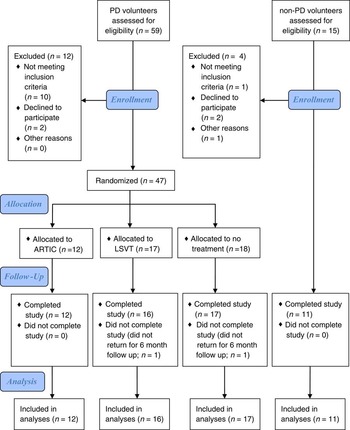
Figure 1 presents the sampling and flow of participants. Individuals diagnosed with idiopathic PD who had signs of hypokinetic dysarthria were recruited from outpatient clinics, support groups, and individual neurologists. Individuals without PD and without speech or voice disorders were recruited through senior centers, advertising, and local area service organizations. All participants were individuals from the Denver, Colorado, area who were told that the research project aimed to compare the effects of LSVT and ARTIC on hypokinetic dysarthria. Mini-Mental State Examination (MMSE; Folstein, Folstein, & McHugh, 1975) scores below 25 (suggestive of moderate cognitive impairment; Crum, Anthony, Bassett, & Folstein, Reference Crum, Anthony, Bassett and Folstein1993), Beck Depression Inventory-II (BDI-II; Beck, Steer, & Brown, 1996) scores above 24 (suggestive of moderate to severe depression; Beck et al., Reference Beck, Steer and Brown1996), neurological conditions other than PD, and medical conditions contraindicating intensive voice therapy (e.g., laryngeal pathology) served as the exclusion criteria. PD participants were stratified on the variables of age, sex, stage of PD (Hoehn & Yahr, Reference Hoehn and Yahr1967) as determined by their neurologist, time since diagnosis, BDI-II performance, MMSE performance, and severity of voice, speech, and swallowing deficits. These stratified participants were randomly assigned to one of three groups: participants treated with LSVT, participants treated with control articulation treatment (ARTIC), and untreated participants (Untreated). One Untreated and one LSVT participant who did not return for a 6-month follow-up assessment, which was conducted as part of a larger research project but not as part of this study, were excluded from the study. The study sample consisted of the remaining 56 individuals from four groups: LSVT (n = 16), ARTIC (n = 12), Untreated (n = 17), and non-PD participants (n = 11).
Participant flow chart following Consolidated Standards of Reporting Trials guidelines.

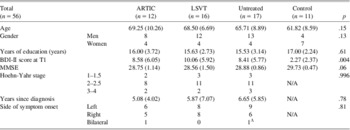
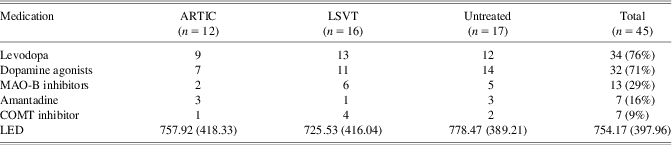
Analyses of variance (ANOVAs) and χ 2 tests showed no significant differences among participant groups on MMSE scores or demographic and health status variables presented in Table 1, all p-values > .05. However, the effect of participant group on BDI-II scores was significant, F(3,52) = 4.93, p = .004, η2 = 0.22, 95% confidence interval (CI) [0.05, 0.34]. Post hoc tests showed that this effect was due to significantly higher BDI-II scores of the PD participants relative to non-PD participants, t(54) = 3.77, p < .001, d = 1.29, 95% CI [0.12, 2.27], reflecting the comorbidity of PD and subclinical depression (Frisina, Borod, Foldi, & Tenenbaum, Reference Frisina, Borod, Foldi and Tenenbaum2008). The BDI-II scores of the three PD participant groups were not significantly different from each other, F(2,42) = 0.37, p = .69. At the time of the first monologue production, PD participants were considered optimally medicated by their neurologists and were taking the types of PD medications shown in Table 2. The mean levodopa equivalent dose (LED) did not differ significantly across the three PD groups, F(2,42) = 0.07, p = .93. Five LSVT participants, one Untreated PD participant, and one non-PD participant reported changes in their medication regimens throughout study duration.
Means (SD) on participant characteristics and screening measures

Note. The p-values were computed by performing ANOVAs and chi-square tests, with participant group as the independent variable and the corresponding variable (e.g., age) as the dependent variable. For gender, Hoehn-Yahr stage, and side of symptom onset, frequencies are shown.
BDI-II = Beck Depression Inventory; MMSE = Mini-Mental State Examination.
ΛThe side of symptom onset was unknown for one participant in the Untreated group.
Number of PD patients taking a given type of PD Medication and the Mean LED

Note. Because 31 PD participants took PD medications of more than one type, the sum of percentages exceeds 100%. In the bottom row, parentheses enclose the SD of the LED for each group. In all other rows, parentheses enclose the percentage of the total sample of 45 PD participants who took medication(s) of a given type.
LED = levodopa equivalent dose; MAO-B = monoamine oxidase B; COMT = Catechol-O-methyl transferase.
Procedure
All data were obtained in compliance with regulations of the City University of New York and the University of Colorado at Boulder. To elicit facial movements, the spontaneous emotional expression task from the New York Emotion Battery (NYEB; Borod, Welkowitz, & Obler, Reference Borod, Welkowitz and Obler1992) was used as described by Borod and colleagues (Borod, Tabert, Santschi, & Strauss, Reference Borod, Tabert, Santschi and Strauss2000; Kazandjian, Borod, & Brickman, Reference Kazandjian, Borod and Brickman2007; Montreys & Borod, Reference Montreys and Borod1998). Specifically, while seated in a chair in a lighted, sound-treated booth in a laboratory at the National Center for Voice and Speech, University of Colorado at Boulder, participants produced a monologue describing an event that had made them extremely happy (“happy monologue”). Each participant was asked to speak for at least 90 s. If a participant stopped speaking after less than 90 s, he or she was prompted by the experimenter to provide additional details about the experience. Each participant produced a happy monologue twice, with participants in the LSVT and ARTIC groups producing a happy monologue before and after treatment. For each participant, the timepoints of the first and second monologue production (“T1” and “T2,” respectively) were 5 weeks apart. In accordance with the experimenter's instructions, each participant described a different emotional event at T1 than at T2. Each monologue was videorecorded with a high-quality video camera (Canon XL1S miniDV) at a distance of approximately 1.8 m. Immediately after producing a monologue, participants rated how happy they felt at that moment on a Likert-type scale that ranged from Not very (1) to Extremely (7).
Treatment
Based on the view that the disturbance of vocal amplitude underlies disordered speech communication in PD, LSVT is an intensive, high-effort regimen that trains individuals with PD to speak in a healthy louder voice and with greater vocal effort than they ordinarily use (Ramig et al., Reference Ramig, Fox and Sapir2008). Additionally, because internal cueing deficits and misperception of one's vocal effort as too loud are implicated in hypokinetic dysarthria (for review, see Sapir, Ramig, & Fox, Reference Sapir, Ramig and Fox2011), LSVT teaches individuals with PD to “recalibrate” their perception of normal loudness and to use adequate vocal effort in everyday life. LSVT, the only speech treatment for PD supported by published Level I efficacy data (Ramig et al., Reference Ramig, Sapir, Countryman, Pawlas, O'Brien, Hoehn and Thompson2001), is administered over a 4-week period, with four individual 60-min treatment sessions per week. Each treatment session consists of daily tasks and a speech hierarchy. Daily tasks increase vocal amplitude through multiple repetitions of sustained vowels (“ah”), high/low-pitch range exercises, and functional phrases. The speech hierarchy improves functional communication by training patients to maintain enhanced vocal amplitude that is achieved in daily tasks for longer periods and in more complex speaking situations (e.g., conversational speech).
To control for treatment effects not specific to LSVT, 12 participants underwent ARTIC, a treatment program of the same frequency and duration as LSVT (sixteen 60-min sessions, with four individual sessions a week; Spielman et al., Reference Spielman, Dumer, Borod, Oster, Rabin, Halpern and Ramig2012). In contrast to the focus of LSVT on vocal intensity, ARTIC trains orofacial-articulatory movement to improve overall articulation. Each ARTIC treatment session consists of daily tasks and a speech hierarchy. Daily ARTIC tasks include repetitions of maximally enunciated single consonant, consonant-vowel, consonant-consonant, and vowel-vowel combinations (e.g., “oo-ee-oo-ee”), and repetitions of 10 self-generated functional phrases using exaggerated enunciation. The ARTIC speech hierarchy trains individuals to carry over effortful enunciation achieved during daily tasks into reading and speaking.
Both ARTIC and LSVT stimulated high effort in repeated exercises during the first half of each session and the carryover of high effort to speech tasks (e.g., reading and speaking) during the second half. The treatment intensiveness, daily homework, daily quantification of treatment variables, and carryover were emphasized equally in both treatment groups. Each participant treated with ARTIC and LSVT was randomly assigned to one of three expert clinicians. Every clinician delivered both ARTIC and LSVT. The clinicians worked closely together to ensure consistency and equivalent high effort and motivation across both treatment programs.
Data Preparation and FACS Scoring
Sixteen of 112 monologues (56 participants × 2 timepoints) contained pauses lasting longer than 5 s. As participants’ comments immediately after some of these pauses demonstrated, the pauses often occurred when participants had difficulties producing the monologue (e.g., could not recall additional details of their experience) and thus may have no longer been engaged in remembering the experience. Thus, pauses lasting longer than 5 s were deemed artifacts. Next, the last artifact-free 60 s of each recording were extracted. This 60-s segment was chosen because the emotional intensity of facial expressions elicited during the NYEB monologue production task tends to increase toward the end of the monologue (Kazandjian et al., Reference Kazandjian, Borod and Brickman2007). The resulting 112 sixty-second video clips were the dataset of this study.
Given that a facial expression is a key unit of communication (for review, see Fridlund, Ekman, & Oster, Reference Fridlund, Ekman and Oster1987), we chose the variability of facial expressions and the frequency with which they were produced as our measures of the severity of hypomimia. To assess the variability and frequency of each participant's facial expressions, a FACS-certified coder (A.D.) used FACS to score facial movements that were observable in 112 video clips. To ascertain adequate intercoder agreement, another FACS-certified coder (D.M.) used FACS to independently score facial movements in 24 of the 112 clips (21%). The proportions of clips from T1 versus T2 and from each participant group in the set of 24 clips were similar to those in the entire dataset. To ensure that the coders were not biased by the monologues’ verbal content, the monologue sound was turned off during scoring. Furthermore, during scoring, the coders were blind to the time of the recording (T1 or T2) and the participants’ group assignment. All facial movements, except blinks and apparent dyskinesias, were coded.
In FACS, an observable activity of a given set of facial muscle(s), termed an “action unit” (AU), is the unit of analysis, and AUs that begin in close temporal proximity to one another form “facial events” (Ekman, Friesen, & Hager, Reference Ekman, Friesen and Hager2002). Facial events unfold in time and roughly correspond to what is usually meant by “facial expressions.” Based on these definitions, we operationalized the frequency and variability of facial expressions as the number of all facial events in a clip (Frequency) and number of different facial events in a clip (Variability; i.e., counting each repeatedly occurring facial event only once) and computed the values of these variables for each clip based on A.D.'s FACS coding.
Intercoder Reliability
Because some AUs can be difficult to distinguish during speech, the following AU combinations were considered the same for purposes of calculating intercoder reliability: AU 17 (chin raiser) versus AU 17 + 24 (chin raiser + lip presser), AU 14 (dimpler) versus AU 14 + 24 (dimpler + lip presser), and AU 18 (lip puckerer) versus AU 18 + 23 (lip puckerer + lip tightener). Because the study hypothesis did not concern the occurrences of specific facial events, ignoring coders’ disagreements regarding these similar AU combinations appeared justified. To compute an intercoder reliability index for each dependent variable, each coder's scores of the 24 clips on that variable were rank-transformed because the scores’ distributions substantially deviated from the normal distribution. Intraclass correlation coefficients between the rank-transformed scores of two coders were .80 for Frequency and .75 for Variability, reliability indices that are considered acceptable for a FACS investigation (Ekman et al., Reference Ekman, Friesen and Hager2002).
Statistical Analyses
To ascertain the presence of hypomimia in our participant sample, the Frequency and Variability of PD participants versus non-PD controls at T1 were compared. To examine the effects of LSVT, a priori comparisons of LSVT versus ARTIC groups (Contrast 1) and LSVT versus Untreated groups (Contrast 2) on the amount of change on facial expressivity measures from T1 to T2 (simple difference scores, Frequency Δ and Variability Δ, computed by subtracting T1 levels from T2 levels) were carried out. Because intergroup comparisons of facial expressivity levels involved two dependent variables, Frequency and Variability (or Frequency Δ and Variability Δ), each comparison began with a multivariate procedure. If significant, the results of a multivariate test were probed with univariate comparisons on each dependent variable. To address the possibility that group differences in the intensity of emotion experienced during monologue production could account for group differences in facial expressivity, the T1 happiness ratings of groups whose Frequency (or Variability) T1 levels were significantly different were statistically compared. Similarly, groups whose Frequency (or Variability) T2 levels were significantly different were contrasted on T2 happiness ratings and, separately, on change in happiness ratings from T1 to T2 (happiness rating Δ).
Because the Frequency, Variability, and happiness ratings’ distributions often violated the normality and homogeneity of variance assumptions, all statistical tests and computations of effect sizes involved nonparametric robust procedures. Specifically, multivariate testing involved multivariate linear model (MLM) analyses with the degrees of freedom adjusted via the Kenward-Roger (Reference Kenward and Roger2009) method. Conceptually equivalent to the multivariate analysis of variance, the MLM analysis is both powerful and robust to the violations of the parametric assumptions (Vallejo & Ato, Reference Vallejo and Ato2012). Univariate procedures for two groups involved t tests with Hall's (Reference Hall1992) transformation and bootstrapping (Keselman, Othman, Wilcox, & Fradette, Reference Keselman, Othman, Wilcox and Fradette2004); for more than two groups, a Welch-James procedure with approximate degrees of freedom and bootstrapping (Keselman, Algina, Lix, Wilcox, & Deering, Reference Keselman, Algina, Lix, Wilcox and Deering2008) was used. To estimate effect sizes,
 $$${{\widehat{{\rm{\delta }}}}_R}$$$
(Keselman et al., Reference Keselman, Algina, Lix, Wilcox and Deering2008)—a robust version of Glass's
 $$$\widehat{{\rm{\delta }}}$$$
statistic (Glass, McGaw, & Smith, Reference Glass, McGaw and Smith1981)—was used.Footnote
1
To compute correlations (see the Exploratory Analyses section), skipped correlations (i.e., Pearson correlations computed with the data that remain after the exclusion of bivariate outliers, as described by Wilcox, Reference Wilcox2012, p. 463) and percentage-bend correlations (i.e., Pearson correlations computed after observations with the greatest [at or above the 80th percentile] deviations from the median are assigned a relatively low weight to reduce their influence on statistical estimates, as described by Wilcox, Reference Wilcox2012, p. 449) were used.
All these procedures were shown to provide excellent control of Type I and Type II errors with normal and nonnormal distributions (Erceg-Hurn & Mirosevich, Reference Erceg-Hurn and Mirosevich2008; Keselman et al., Reference Keselman, Othman, Wilcox and Fradette2004; Keselman, Wilcox, Othman, & Fradette, Reference Keselman, Wilcox, Othman and Fradette2002; Pernet, Wilcox, & Rousselet, Reference Pernet, Wilcox and Rousselet2013). Because the study hypothesis was directional, all potential treatment effects were tested at an alpha level of .05, one-tailed. All other effects were tested at an alpha level of .05, two-tailed.
Results
Facial Expressivity Deficits of PD Participants
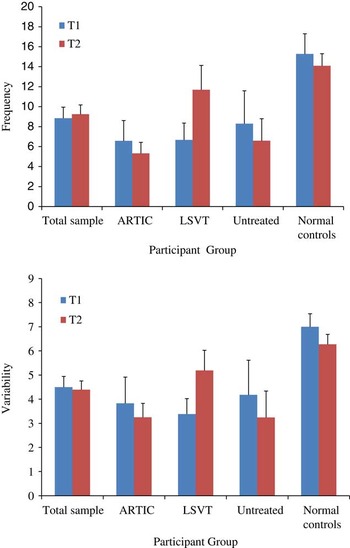
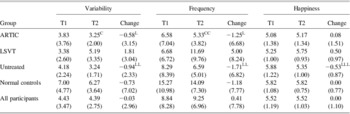
For each participant group, Figure 2 and Table 3 show the mean Frequency, Variability, and happiness rating at T1 and T2 and the mean change from T1 to T2 on these variables. Whereas the facial expressivity levels of the three PD participant groups were not significantly different from each other, FMLM
(2,25.2) = 0.27, p = .76, PD Status (PD participants vs. non-PD controls) had a significant effect on facial expressivity at T1, FMLM
(1,12) = 5.15, p = .04.Footnote
2
The T1 Frequency and Variability levels of non-PD participants were significantly higher than those of PD participants, for Frequency, tyHB(12.28) = 2.60, p = .02,
 $$${{\widehat{{\rm{\delta }}}}_R}$$$
= 0.73, 95% CI [0.25, 1.40], and for Variability, tyHB(11.72) = 2.26, p = .03,
 $$${{\widehat{{\rm{\delta }}}}_R}$$$
= 0.67, 95% CI [0.12,1.43]. The T1 happiness ratings of the three PD participant groups were not significantly different from each other, T*WJ
(2,25.19) = 1.76, p = .21. Also, the T1 happiness ratings of PD participants (M = 5.44; SD = 1.22) were not significantly different from those of non-PD controls (M = 5.82; SD = 1.08), tyHB(16.81) = 0.95, p = .36.
Mean Frequency (+SE) and Variability (+SE) for the total sample and each participant group.

Means (SD) on facial expressivity measures and happiness ratings

Note. L, LL, and LLL denote differences relative to the values of LSVT patients that are significant at the .05, .01, and .001 alpha levels, respectively.
C and CC denote differences relative to the values of controls that are significant at the .05 and .01 alpha levels, respectively. Due to rounding, the amounts in the Change columns may slightly differ from the result of subtracting the amounts in a T1 column from the amounts in a T2 column.
As the BDI-II scores of PD participants were higher than those of controls, one could argue that the hypomimia of PD participants, suggested by these results, is primarily a symptom of subclinical depression rather than PD. To explore this possibility, we examined the Frequency and Variability levels of 18 PD participants (5 ARTIC participants, 6 LSVT participants, and 7 Untreated participants) whose BDI-II scores did not exceed six, the highest BDI-II score in the non-PD group. Whereas the BDI-II scores of these participants (M = 3.53; SD = 1.74) were not significantly different from those of non-PD controls (M = 2.27; SD = 2.37), t(27) = 1.70, p = .10, d = 0.63, 95% CI [−0.40, 2.96], and indicative of few depressive symptoms, the Frequency (M = 4.76; SD = 4.25) and Variability (M = 3.12; SD = 2.67) levels in this PD subsample were significantly lower than those of controls, for Frequency, tyHB(11.79) = 3.66, p = .02,
 $$${{\widehat{{\rm{\delta }}}}_R}$$$
= 0.97, 95% CI [0.56, 1.70], and for Variability, tyHB(13.69) = 2.66, p = .012,
 $$${{\widehat{{\rm{\delta }}}}_R}$$$
= 0.82, 95% CI [0.29, 1.62], suggesting that depressive symptomatology likely did not account for the hypomimia of PD participants.
Effects of LSVT on PD Participants’ Facial Expressivity
LSVT was the only group in which the mean Frequency and Variability scores increased from T1 to T2 (see Table 3). Contrast 1 was significant, FMLM
(1,25.3) = 4.89, p = .02 (one-tailed), indicating that the amount of change on the dependent variables was significantly different for LSVT, relative to ARTIC, participants. The Frequency Δ values of the LSVT group were significantly higher than those of the ARTIC group, tyHB(25.80) = 2.37, p = .010 (one-tailed),
 $$${{\widehat{{\rm{\delta }}}}_R}$$$
= 0.76, 95% CI [0.14, 1.52]. Also, the Variability Δ values of the LSVT group were significantly higher than those of the ARTIC group, tyHB(23.38) = 2.34, p = .02 (one-tailed),
 $$${{\widehat{{\rm{\delta }}}}_R}$$$
= 0.93, 95% CI [0.20, 1.99]. In contrast, the T2 happiness ratings of the LSVT versus ARTIC groups were not significantly different, tyHB(18.65) = 1.30, p = .09 (one-tailed). Also, the happiness rating Δ values of the LSVT versus ARTIC groups were not significantly different, tyHB(17.61) = 0.82, p = .21 (one-tailed). Notably, at T2, the Frequency and Variability of participants treated with LSVT were not significantly different from those of non-PD controls, for Frequency, tyHB(24.75) = 0.71, p = .52, and for Variability, tyHB(20.44) = 0.78, p = .43. In contrast, the Frequency and Variability of the ARTIC group at T2 were significantly lower than those of controls, for Frequency, tyHB(14.81) = 3.31, p = .005,
 $$${{\widehat{{\rm{\delta }}}}_R}$$$
= 1.20, 95% CI [0.57, 2.75], and for Variability, tyHB(15.28) = 2.48, p = .02,
 $$${{\widehat{{\rm{\delta }}}}_R}$$$
= 0.83, 95% CI [0.22, 1.84].
Furthermore, Contrast 2 was significant, FMLM
(1, 28.5) =7.45, p = .005 (one-tailed), showing that the amount of change on the dependent variables was significantly different in the LSVT, relative to Untreated, group. The Frequency Δ and Variability Δ amounts of the LSVT group were significantly higher than those of the Untreated group: for Frequency Δ, tyHB(29.20) = 2.86, p = .007 (one-tailed),
 $$${{\widehat{{\rm{\delta }}}}_R}$$$
= 0.81, 95% CI [0.22, 1.60], and for Variability Δ, tyHB(28.13) = 3.08, p = .003 (one-tailed),
 $$${{\widehat{{\rm{\delta }}}}_R}$$$
= 0.90, 95% CI [0.35, 1.78]. In contrast, the T2 happiness ratings of the LSVT versus Untreated groups were not significantly different, tyHB(31.00) = 1.26, p = .11 (one-tailed). However, the magnitude of happiness rating Δ of the Untreated group was significantly lower than that of the LSVT group, tyHB(30.21) = 3.26, p < .001 (one-tailed),
 $$${{\widehat{{\rm{\delta }}}}_R}$$$
= 1.18, 95% CI [0.43, 2.16], reflecting that, whereas the mean happiness rating decreased from T1 to T2 for the Untreated group, it increased from T1 to T2 for the LSVT group (see Figure 2 and Table 3).
Because, as noted earlier, some participants experienced changes in their medication regimens between T1 and T2, the unknown effects of these changes were confounded with treatment effects in the preceding analyses. To address this issue, we excluded the T2 values and difference scores of these participants from the dataset and repeated all relevant analyses. The pattern of results remained the same: none of the significant comparisons became nonsignificant or vice versa.
Exploratory Analyses
To explore whether the effect of LSVT depended on participants’ medical and demographic characteristics, Pearson correlations and Student's t tests were performed to examine, within the LSVT group, the associations of Frequency Δ and Variability Δ with each of the following variables: participant's age, gender, Hoehn-Yahr stage, time since PD diagnosis, education level, BDI-II score at T1, BDI-II score at T1 dichotomized into “low” (BDI-II score ≤13Footnote 3 ; n = 11) versus “high” (BDI-II score > 13; n = 5) categories, MMSE score, side of symptom onset, and LED. No associations were significant at α levels adjusted for multiple comparisons using the Benjamini-Hochberg (Reference Benjamini and Hochberg1995) correction.
Discussion
This study's results replicate previous findings (Smith et al., Reference Smith, Smith and Ellgring1996) showing that PD participants, relative to non-PD controls with similar demographic characteristics, exhibit a decreased frequency of spontaneous facial expressions. Also, our findings extend the existing research by showing that, besides being less frequent, the facial expressions of individuals with PD are less varied than those of controls. Consistent with previous findings (Katsikitis & Pilowsky, Reference Katsikitis and Pilowsky1991; Simons et al., Reference Simons, Pasqualini, Reddy and Wood2004; Smith et al., Reference Smith, Smith and Ellgring1996), the depressed mood of PD participants in the present sample did not account for their decreased facial expressivity.
Additionally, our results showed that LSVT, relative to ARTIC, increased the frequency and range of spontaneous facial expressions produced by PD participants. Specifically, the increases in the variability and frequency of facial expressions were significantly greater in the LSVT group than changes on those variables in the ARTIC group or the group of untreated PD participants. Moreover, the frequency and variability of facial expressions in the LSVT versus non-PD control group were not significantly different at T2. In contrast, after treatment, participants treated with ARTIC produced facial expressions that were less frequent and varied than those of non-PD controls. These results could not be explained by changes in participants’ medications, as they were replicated in the analyses that included only those participants whose medication regimens stayed the same.
One could argue that the facial expressivity increase of participants treated with LSVT resulted from the increased levels of happiness they felt at T2 versus T1, as evidenced by the ratings of that group. However, the lack of significant differences among the happiness ratings of the LSVT, ARTIC, and Untreated groups at T2 suggests that this explanation is unlikely to entirely account for the present findings. Moreover, changes in the happiness ratings from T1 to T2 were not significantly different in the LSVT versus ARTIC group. Thus, whereas the significant difference between the LSVT and Untreated participants on this variable may account for the differences on facial expressivity between those groups, it is unlikely that the intensification of happy feelings experienced by participants treated with LSVT can fully explain the increase of facial expressivity in the LSVT versus ARTIC groups. Overall, this pattern of results suggests that the expressivity of participants treated with LSVT increased, at least in part, due to treatment and not changes of their emotional experience from T1 to T2. Nevertheless, given that this interpretation is based on negative findings and a small participant sample, it must await confirmation in future investigations with larger numbers of participants.
If replicated, our finding of LSVT-related reduction of hypomimia has important clinical and psychosocial implications for individuals with PD. Due to being a symptom of both PD and depression, hypomimia complicates the diagnosis of depression in PD, potentially leading to both misses and false alarms (Aarsland, Påhlhagen, Ballard, Ehrt, & Svenningsson, Reference Aarsland, Påhlhagen, Ballard, Ehrt and Svenningsson2012). Additionally, by impairing nonverbal communication, hypomimia may contribute to the disruption of psychosocial functioning in PD. Specifically, in one study (Stanley-Hermanns & Engebretson, Reference Stanley-Hermanns and Engebretson2010), individuals with PD reported that their hypomima was misperceived as anger by their families. These reports are consistent with several findings, discussed earlier, showing that hypomimia is associated with negative biases in others’ perceptions of individuals with PD (e.g., Tickle-Degnen et al., Reference Tickle-Degnen, Zebrowitz and Ma2011). Due to such communication difficulties, individuals with PD may feel stigmatized and excluded from conversations by others, which contributes to their withdrawal from social interactions (Miller, Noble, Jones, & Burn, Reference Miller, Noble, Jones and Burn2006), changes in self-concept (Miller, Andrew, Noble, & Walshe, Reference Miller, Andrew, Noble and Walshe2011), and feelings of shame (Nijhof, Reference Nijhof1995).
Given the impact of LSVT on hypomimia and, potentially, on psychosocial functioning in PD, it is intriguing to consider the possible mechanisms underlying this effect. Unlike ARTIC which focuses on improving PD patients’ articulation, LSVT aims to increase the amplitude of patients’ respiratory-laryngeal movements (i.e., increasing their vocal loudness). We hypothesize that this difference between the two treatments accounts for the higher effectiveness of LSVT in reducing participants’ hypomimia in the present study. Specifically, impaired neuronal control of movement amplitude appears to underlie a number of deficits in PD, including hypophonia (soft voice) and hypometria (movements that fall short of the intended goal; Desmurget, Grafton, Vindras, Gréa, & Turner, Reference Desmurget, Grafton, Vindras, Gréa and Turner2004; Ho, Bradshaw, Iansek, & Alfredson, Reference Ho, Bradshaw, Iansek and Alfredson1999). Furthermore, LSVT not only improves patients’ vocal loudness but also articulation and swallowing (El Sharkawi et al., Reference El Sharkawi, Ramig, Logemann, Pauloski, Rademaker, Smith and Werner2002; Sapir, Spielman, Ramig, Story, & Fox, Reference Sapir, Spielman, Ramig, Story and Fox2007). By contrast, another study did not show significant effects of ARTIC on PD patients’ vocal loudness (Spielman et al., Reference Spielman, Dumer, Borod, Oster, Rabin, Halpern and Ramig2012). These findings suggest that in contrast to PD-related articulation deficits, vocal amplitude is a therapeutic target that is well-suited for triggering improvements in a range of motor behaviors not directly addressed by a voice treatment (Ramig et al., Reference Ramig, Fox and Sapir2008).
Although the neural mechanisms of these global effects are poorly understood, one potential mechanism underlying the effect of LSVT on hypomimia is suggested by recent neuroimaging studies (Liotti et al., Reference Liotti, Ramig, Vogel, New, Cook, Ingham and Fox2003; Narayana et al., Reference Narayana, Fox, Zhang, Franklin, Robin, Vogel and Ramig2010) showing LSVT-related changes in the activity of brain regions implicated in the selection and regulation of force amplitude during movement (Vaillancourt, Yu, Mayka, & Corcos, Reference Vaillancourt, Yu, Mayka and Corcos2007), including the supplementary motor area (SMA), putamen, and ventroanterior thalamus. Importantly, clinical and neuroimaging data (Hopf, Muller-Forell, & Hopf, Reference Hopf, Muller-Forell and Hopf1992; Iwase et al., Reference Iwase, Ouchi, Okada, Yokoyama, Nobezawa, Yoshikawa and Watanabe2002; for review, see Wild, Rodden, Grodd, & Ruch, Reference Wild, Rodden, Grodd and Ruch2003) indicate that the SMA and ventroanterior thalamus are also involved in the production of facial movements expressing positive, and possibly other, emotions. Together, these studies suggest that these brain regions may be involved in controlling the amplitude of both vocal and some facial movements and that by focusing on amplitude, LSVT may partly normalize neural processing in these areas. The proposed mechanism suggests that targeting the low amplitude of facial movement in PD (Bowers et al., Reference Bowers, Miller, Bosch, Gokcay, Pedraza, Springer and Okun2006; Smith et al., Reference Smith, Smith and Ellgring1996) may be a promising approach toward treating hypomimia.
Clearly, additional studies are needed to replicate the effect of LSVT on hypomimia in a wide range of PD patients and explore the mechanism underlying this effect. One important question is whether some subsets of individuals with PD require modifications of the treatment protocol to maximize the effect of LSVT on hypomimia. For instance, emerging evidence suggests that relative to other PD patients, PD patients undergoing deep brain stimulation (DBS) may show more variable long-term maintenance of the effects of LSVT on speech (Spielman et al., Reference Spielman, Mahler, Halpern, Gilley, Klepitskaya and Ramig2011) or be resistant to these effects (Tripoliti et al., Reference Tripoliti, Strong, Hickey, Foltynie, Zrinzo, Candelario and Limousin2011). Future research should examine whether administering LSVT presurgically or increasing the number of treatment sessions would help PD patients retain the benefits of LSVT during DBS.
The present findings should be interpreted in light of study limitations. First, the modest size of the participant sample limits the generalizability of our findings. For instance, the Hoehn-Yahr stage of 14 of 16 participants treated with LSVT varied between 2.5 and 3.5, making it unclear whether LSVT could improve the facial expressivity of individuals at more advanced stages of PD. Second, participants’ happiness ratings reflected their emotions immediately after a monologue production without considering the more lasting changes in their emotional state. Thus, an alleviation of depressive symptoms may have contributed to the decreased hypomimia in the LSVT group. This possibility appears unlikely, as participants in both the LSVT and control treatment groups in an earlier study (Ramig, Countryman, Thompson, & Horii, Reference Ramig, Countryman, Thompson and Horii1995) experienced no significant changes from pre- to post-treatment in the levels of depressive symptomatology. However, because we did not assess participants’ depressive symptomatology at T2, we cannot rule out the effects of such changes on hypomimia in the present study. Also, although depressive symptomatology did not affect facial expressivity at T1 in the present sample, studies with larger samples are needed to disentangle the effects of depressive symptoms and PD on facial expression. Finally, although the clinicians worked to ensure consistency across treatment programs, they were not blind to the hypothesis that LSVT, relative to ARTIC, would reduce hypomimia in PD patients. Thus, it is possible that experimenter effects contributed to the observed group differences. Notwithstanding these limitations, the present study suggests that, in addition to alleviating hypokinetic dysarthria, LSVT reduces the hypomimia of PD patients—a deficit that substantially interferes with their social interactions. We hope that our findings will encourage future research aimed at the development of effective interventions for hypomimia in PD.
Acknowledgments
This article is based on the first author's doctoral dissertation, submitted to the Graduate Center of the City University of New York. This work was supported by the National Institutes of Health (J.C.B., R01 DC01150 subcontract to Queens College), a Summer Student Fellowship from the Parkinson's Disease Foundation (A.D.), and a Doctoral Student Grant from The Graduate Center of CUNY (A.D.). The authors gratefully acknowledge the help of Arthur Alimov in conducting this study. Lorraine Ramig receives a lecture honorarium from and has intellectual property rights and ownership interest in LSVT Global Inc., a for-profit organization that conducts training courses and sells products related to LSVT. Dr. Ramig's conflict of interest management plan has been approved by the Office of Conflict of Interest and Commitment at the University of Colorado, Boulder. The authors declare that they have no other conflicts of interest.