

1. Introduction
In the run up to the May 2017 election, the two largest parties laid out their vision for the country in their election manifestos. While there were important differences between them across many policies, there were striking similarities on the approach to the fiscal deficit. Reference CameronThe Conservative Party (2017) emphasised “Sound public finances, built on fiscal credibility and a balanced budget by the middle of the next decade.” Reference CameronThe Labour Party (2017) similarly wrote: “Our manifesto is fully costed, with all current spending paid for out of taxation or redirected revenue streams. Our public services must rest on the foundation of sound finances. Labour will therefore set the target of eliminating the government's deficit on day-to-day spending within five years.”Footnote 1
This agreement on the need for a sound approach to fiscal accounts, and the related link to eliminating the fiscal deficit, may lead one to conclude that this is a conventional wisdom from the study of fiscal policy. This is not the case. A number of relationships, long-since known to economists, suggest that there may not be any need to eliminate a fiscal deficit to reduce a country's debt burden. Or it may be that a surplus is required to prevent debt from rising as a percentage of national income. These macroeconomic ideas appear not to have had the influence on the political narrative that they deserve.
“Sound finance”, captured by policies of balanced budgets together with low taxes and restrictions on the scope of government expenditure, dominated the fiscal strategy of the UK in 1880–95 (Reference OfferOffer, 2002, Reference CampbellCampbell, 2004). Reference LernerLerner (1943) stresses how the idea of “sound finance” has underpinned much of the opposition to fiscal deficits in the US context.
This article is an attempt to gather together some of these key issues and examine what they mean for the UK fiscal situation. Alongside the main economic points that I emphasise, I trace the evolution of recent political narrative on fiscal policy.
The first economic point to make concerns the role that the government plays in the economy. While the government is important, it does not determine the entirety of economic performance. There is no fiscal dashboard on the Chancellor's desk which allows whomever is in power to choose exactly the path for the UK economy to follow. Certainly, decisions on the level of spending and taxation – fiscal policy – will have both direct and indirect impacts on the economy. But there are also other channels of government influence on economic performance such as through policies on regulation.
Beyond a minimum amount of spending for the provision of certain vital public goods and public infrastructure (alongside maintanence spending to go with those), economics does not provide a clear support for either a big government (large amount of public spending) or a small government – and both bigger and smaller government can give rise to government failures. Different people have different preferences with regard to the desirable level and composition of spending and tax. They also have different views about spreading the burden of today's fiscal activity over future generations (running deficits). Political parties are supposed to represent these differences and seek support of the electorate for their plans. In this regard, the recent ‘age of austerity’ was a clear political choice. Moreover, as I shall argue below, this choice was never really hidden.
Discussions of fiscal policy should be about proposals on spending and taxation rather than focusing on the resulting deficit. The level of deficit is important because it determines the amount of today's spending that is transferred to the future and hence will influence the debt burden faced by future generations.
However, austerity and the need for “sound finances”, was also sold on a narrative of a looming debt crisis. This is the idea that, like a household borrowing on a credit card, a government running persistent deficits will quickly succumb to the burden of debt. The focus on deficit reduction as the outcome of importance, as opposed to, for example, specific targets for the level of spending, derives from this sound-finances argument. Narratives are important in policy debates as in other aspects of life (Reference ShillerShiller, 2017). Narratives stick and convey a lot of powerful messages. While aiding the argument for reducing the size of the government, I argue that the narrative that austerity is the only choice masks the deeper political menu of options that voters face and should be debating.
The second economic point follows naturally from this realisation that different political views have different ideas about what is desirably sustainable; sustainability of a fiscal plan depends on what the government means by sustainable. Many different levels of expenditure are sustainable so long as there is the willingness and capacity to raise revenues through taxation to ultimately pay for it. Whether the government has in mind some stable level of the debt or some level of debt-service each period, the level of deficit that can be sustained depends on macroeconomic conditions. The Domar arithmetic is a simple accounting framework that can be used to understand the forces that drive the evolution of the government debt to GDP ratio. This framework, discussed below, highlights that the starting level of debt, economic growth and interest rates on the debt are key determinants. There can be some cases where even running a fiscal surplus will not achieve sustainability. In other cases, a deficit can be sustained in conjunction with a falling ratio of debt to GDP.
Since the natural measure for the scale of debt is the ratio of debt to GDP, and since decisions on fiscal policy can affect GDP, changes in fiscal policy affect the ratio through both the numerator and the denominator. Analysis using basic accounting relationships does not immediately allow for any interactions or feedback between fiscal policies and the macroeconomy. The macroeconomy can also feedback to fiscal outcomes. I modify the Domar accounting framework to allow for these links. The point is not to argue for one austerity plan or another. Rather the point is to emphasise that fiscal and economic outcomes depend on the complex, and uncertain, interactions between the interest rate effect of market concerns about debt sustainability, the endogeneity of macroeconomic conditions and the feedback from the economy to fiscal spending and revenues. The “sound finances” narrative is too simplistic to capture these effects.
To the extent that the political parties are going to aim to balance a budget, it is encouraging that both main parties chose to focus on current deficits which exclude government investment. Government investment, such as much-needed infrastructure investment, could be financed with debt. This decision also highlights that the sound-finances narrative hides important differences; the apparent agreement between parties on the need to achieve balance is actually masking potentially large differences in their views of the total deficit and hence on their differences in the desirable target level of debt to GDP. The narrative has created an opacity in the fiscal debate.
Next, I turn to the role of the deficit in the government's financing needs. As new borrowing, a larger deficit means more need to borrow but it is not the only contributor to financing needs. In fact, even with a balanced budget, a government will need to issue debt securities to rollover existing debt and therefore would still need to convince investors to lend to it rather than another entity. Financing needs, therefore, depend on the maturity structure of the debt. It is only when the government needs to borrow in the primary market and issue new debt that movements in secondary market yields, for example because of changes in monetary policy, affect the interest burden of the government. Further, interaction between fiscal policy and monetary policy as well as regulatory policy are also important considerations for assessing the fiscal financing requirement.
Finally, I briefly consider the important challenges beyond three to five years ahead. In particular, there are important decisions that need to be made regarding how the economy will deal with the challenges from an ageing population. These decisions should be important inputs into fiscal planning long in advance of the ageing challenges becoming current.
I conclude with a discussion of what all of this means for fiscal policy choices in the coming years as in Reference ChadhaChadha (2016). I am neither trying to attack nor defend any particular plan. One of my main recommendations is to ditch the overly simplistic “sound finances” narrative. The focus on fiscal balance disguises important underlying differences. It is these differences that should be the focus and political parties should not be constrained by the need to conform with the potentially misleading logic of the narrative.
2. The role of government in the economy
Regardless of whether you favour a larger or smaller scale of government spending in the economy, the government is responsible for setting the overall framework for the economy. This set of institutions includes creating and maintaining an effective legal system that enforces property rights and contracts, as well as ensuring fair competition by combating monopolistic or other anticompetitive behaviours. This framework underpins the operation of the entire economy.
Fiscal policy is the use of government spending and taxation to affect the economy in terms of the allocation, production and distribution of resources. Textbook functions of fiscal policy include the provision of public goods, income redistribution and social safety nets, and to help to achieve the economic goals such as short-run macroeconomic stability and longer-run growth. More recently, the government has played a crucial role in the bailout and/or backstop of the financial system (which typically involves contingent liabilities which may or may not be realised).
Beyond the need to provide a certain minimum number of public goods as part of the overall framework, the scope of fiscal policy is, ultimately, a decision for society in terms of what it is willing to pay for with taxation. There is no optimal size of government; big government can be great or a disaster, and ditto for small government. Good government will need to match the preferences of the people who will ultimately pay for the activities of the government through taxation.
A first clarification that must be stressed is that fiscal policy plays only a contributory role in most aspects of our economy. Most jobs are not created because of fiscal policy and private industry creates the vast majority of economic growth. This is important to stress as the political system often gives the impression that the Chancellor of the Exchequer's desk has a cockpit-like control panel on it allowing the government to celebrate any good news as their achievement (or to blame the opposition for bad news).
When people think of the government's role in redistribution, most people think of the cross-sectional aspect – redistribution of resources across economic agents in the economy within a given time period. A second clarification is that there is also an important time-series (across time periods) dimension. The government can choose to pay for investments today which yield benefits for future generations at no cost to them, or they can choose to defer payment for items purchased today to future generations. This operates through the system of government debt (the stock of borrowed funds) and the government deficit (the flow counterpart to the government debt).
2.1 The fiscal deficit
In fulfilling its various roles in the economy, the government finances its expenditure using taxation or other revenue sources. Whatever is unfinanced must be borrowed via a deficit. The total nominal deficit (D t) can be split into the primary deficit and interest payments on past debt; the former reflecting the current year's fiscal situation and the latter reflecting the obligations arising from earlier deficits. Let Et be non-interest expenditure made up of government consumption of goods and services, capital expenditure and transfers, and denote tax and other government revenue as Rt. The primary deficit (Pt) can be written as simply Pt = Et – Rt. The interest bill can be written as the product of the effective nominal interest rate on the past debt (īt) multiplied by the total nominal debt stock (Bt −1). The total deficit is therefore Dt = Pt + ī t. Bt −1.
When comparing across time, the basic budget relationships in terms of nominal figures should not be used. However, often they are used to make an economic point in a political debate such as “The UK Government owes more than £1.6 trillion to its creditors … The national debt is now expected to keep growing, according to forecasts compiled by the Office for Budget Responsibility (OBR), to more than £1.7 trillion by the end of the current parliament.” (Reference SpenceSpence 2016). Such use is what Reference LernerLerner (1943) classed as “impressive but irrelevant statistics.”Footnote 2 Since at least Reference HansenHansen (1941), economists have focused on the use of a ratio between national income and government debt even if politicians continue to use nominal amounts to score political points.
Figure 1 shows the level of non-interest expenditure and revenue (both per cent of GDP). This figure shows that expenditure did increase as a share of GDP under the Labour government. Taxation did not increase in line with spending. Therefore, there were primary deficits, despite the relatively strong economic situation (which would tend to boost revenue and push down on spending). But this spending before the financial crisis was a choice, as was the decision not to tax to pay for it but rather to defer the payment to the future.
UK fiscal position: selected indicators 1980–2010

But more important even than the level of spending is the composition of spending. How much is spending on transfers? Are they to the old in the form of state pensions or to the unemployed in the form of income support? Non-interest expenditure can be further decomposed into current non-interest income and capital expenditure. Is the government investing such that future growth will be boosted?
Similarly, the detail of taxation plans matters too. In particular, who bears the burden of the tax bill? Running a deficit is just a choice to tax intergenerationally to pay for today's spending. How do we decide what is best to pay for today and what is best to defer to the future?
Debt determines the cumulative size of the burden that has been transferred to the future and, in future periods, the amount of interest service payments in the total spending. If debt is 80 per cent of GDP, and the effective interest rate on it is 4 per cent, then the government will, in addition to the primary expediture, be spending 3.2 per cent to transfer to bondholders as interest costs. The deficit is important in that it plays a role in the determination of the debt.
It should also be noted that when faced with a deficit, cutting spending is not the only way to close it. That represents one choice. Another choice is to raise taxes sufficiently. A final choice is to leave more of the tax to future generations. Interestingly, right of centre parties who favour lower taxation tend to rely on cutting spending. Such spending is often justified as trimming the fat, cutting out waste or “by delivering more for less” (Reference CameronCameron, 2009). This means that spending can fall but there are really no implications of this. Left of centre parties tend to lean toward raising taxation in order to protect the spending plans as much as possible. The magic source of taxation that does little harm is to target tax avoidance measures used especially by the very wealthy. Each side seeks its own special ways to reduce the deficit in a costless manner.
We should also give some consideration to the concept of the current budget deficit. This is important because both parties' manifesto statements focused on current spending balance. Does this agreement mean that both parties, therefore, agree on the level of debt that is optimal? No. They differ in terms of the level of government investment which they are happy to borrow for, meaning they would maintain different total deficits. They also have different horizons until they reach their target of balance. This means that they will have different debt and hence different interest burden to cover with taxes. Their similarly expressed targets mask important differences in their views about the scope and role of fiscal policy. Do most voters understand these specific details? My guess is that when they are told that, like a household, the government must ‘balance its books’, they extrapolate from the housing analogy to assume that both parties aim to have no debt build-up.
Of course, there is good reason to treat government investment separately. I am not trying to argue against that. If you are paying today for something which will produce large gains but only in the future, then it makes perfect sense to defer most of the burden to future generations. Moreover, it highlights the emphasis on the liabilities side of the government balance without regard to the assets side. If debt is built up acquiring fixed assets which yield benefits in the future then it should be considered differently.Footnote 3
The key differences between the parties are in terms of the paths and composition that make up the revenue and expenditure paths. Even without thinking about the implications of different deficits for fiscal sustainability, the point to stress is that discussions of fiscal policy should be more about the decisions on spending and taxation than about the resulting deficit. The deficit balance narrative which has taken hold in UK politics misses most of this important nuance.
3. UK politics' recent deficit narrative
Reference ShillerShiller (2017) discusses the importance of narratives in all walks of life. Defining them as “human constructs that are mixtures of fact and emotion and human interest and other extraneous detail that form an impression on the human mind”, he stresses that they are at the very core of “human thinking and motivation”. Narratives, which do not need to be entirely truthful, can establish social norms which then influence people in their decision-making.
In this section I examine the origins of the sound-finances narrative in UK politics recently. Mine is a more limited examination of the issue compared with Reference BurtonBurton (2016) and Reference BramallBramall (2013) who examine the wider politics of austerity in more detail including across countries. My interest is specifically on the use of the sound finances narrative that seemed to have become central to both party's ideas on fiscal policy. Clearly the idea of sound finances as a reason to oppose deficit financing is much older, but why was it so suddenly central? Was the warning of a looming debt crisis and the need, therefore, for “sound finances”, merely cover to hide some latent ideological push for a smaller government?
This was, indeed, the suggestion in some of the early critiques of the austerity policy. There was consternation at the suggestion of any possible national debt crisis as the basis for the policy. Accusations were made that there was, instead, an underlying political motivation for cutting government expenditure. An example is Reference StiglitzStiglitz (2013): “… politicians like George Osborne are driven by ideology; the national deficit is an excuse to shrink the state because that is what he wanted anyway”.
The two are, however, not mutually exclusive. In fact, they can be quite consistent. Those with preferences for low taxation would view high spending as unsustainable going forward. That is not to say that the UK was, or is, in the midst of a crisis but, given a reluctance to raise taxes, if left unchecked then debt might begin to spiral. As I show in the next section, debt can have its own momentum.
In fact, this is precisely what was said at the birth of the ‘age of austerity’. Reference OsborneOsborne (2009), speaking before David Cameron's ‘Age of Austerity’ address at the Conservative Spring Forum, is clear that they are motivated by a political philosophy:
“We Conservatives don't need convincing that higher tax rates discourage enterprise and damage economic activity. Like you, I believe in the virtues of lower taxation.”
Notwithstanding this, he does refer to the Labour budget a week earlier and the perception of growing debt problems related to the continued spending expansion of the Labour government:
“What a totally dishonest, disastrous Budget that was. It should have been the day when the Chancellor of the Exchequer was straight at last with the British people about the consequences of the decade of debt. … So they sold our gold at a record low, and then they started to borrow when our economy was on a high. They borrowed and they borrowed, and they never stopped. They should have fixed the roof while the sun was shining. Instead they stored up debts that will take a generation to pay off. And now they have reached a dead end.”
As a prelude to David Cameron's speech, he went on to say (my emphasis):
“The public finances are out of control and that presents a clear and present danger to the prosperity of an entire generation. We must act and act fast. We need a government of thrift in this age of austerity.”
David Cameron then followed his future Chancellor onto the stage and reinforced the message of concern about mounting debt under Labour. Reference CameronCameron (2009):
“Labour's Debt Crisis. The highest borrowing in peacetime history. The deepest recession since the war. Labour are spent. The money has run out. Now some people say: let's get through the recession, let's get through the election we can keep on spending more, keep on borrowing more, and deal with the debt crisis later.
Wrong – seriously wrong. The alternative to dealing with the debt crisis now is mounting debt, higher interest rates and a weaker economy. Unless we deal with this debt crisis, we risk becoming once again the sick man of Europe. Our recovery will be held back, and our children will be weighed down, by a millstone of debt.”
But even he admits it is all about the level of spending (and hence the implicit admission that he does not think that taxes should be raised to pay for it):
“We opposed the £12 billion Labour wasted on the VAT cut. We were against the fiscal stimulus. We said they should reduce their spending plans back in 2008. And now we're saying they should abandon their irresponsible plan to increase spending in 2010.
Controlling public spending and delivering more for less must start right now. Not next year, not after the election – now. We've made it clear that a Conservative government would spend less than Labour. We're not frightened of their idiotic ritual chants about “cuts”.
Everybody knows that Labour's Debt Crisis means public spending cuts. And instead of putting them off, Labour should be making them today.”
The soon-to-be Prime Minister even acknowledged that achieving the smaller government that they sought would be difficult, especially at first:
“Yes if we win the election, we may not see the full fruits of our labours in the lifetime of our government. But if we stick together and tackle this crisis our children and grandchildren will thank us for what we did for them and for our country.”
Not long after forming a coalition government, in June 2010, there was an emergency budget which continued this line of attack on the fiscal developments under the previous government:
“The coalition Government has inherited from its predecessor the largest budget deficit of any economy in Europe with the single exception of Ireland. One pound in every four we spend is being borrowed. What we have not inherited from our predecessor is a credible plan to reduce their record deficit. This at the very moment when fear about the sustainability of sovereign debt is the greatest risks to the recovery of European economies.” (Reference OsborneOsborne, 2010)
The Coalition approach, it appears, was always openly about cutting spending and the reduction of the debt burden going forward. Even their manifesto in advance of the recent election, Reference CameronThe Conservative Party (2017) maintains a similar motivation:
“The greatest impact a government can have on future generations is the amount it chooses to borrow to pay for current spending. Borrowing always means spending money you do not have; but government borrowing differs because the repayment falls to others – those who come later, including people not yet born. Conservatives believe in balancing the books and paying down debts – because it is wrong to pass to future generations a bill you cannot or will not pay yourself.”
Taken altogether, I don't think there is any need for the accusations that the Coalition government was driven by an ideological desire to reduce the level of government spending and taxation. Rather, from the outset, their preference to reduce the size of government spending and their perceived concerns about a mounting debt burden have been quite explicit and relatively consistent.
The sound-finances argument was used as the motivation. This is the idea that, like a household borrowing on a credit card, a government running persistent deficits will quickly succumb to the burden of debt. This was the narrative that stuck and conveyed a powerful message. A positive of this narrative is that it puts an emphasis on costing of proposed plans. However, it also unnecessarily ties parties to ensure that their proposed plans achieve the necessary balance. This powerful narrative that austerity is the only choice masks the deeper political menu of options that voters face and should be debating. Such was the transformative power of the narrative that the Labour party bought into it. So much so that before the 2015 election, The Economist (2015) described Ed Miliband as sounding “like a fiscally hawkish Conservative”.
4. UK fiscal debt dynamics
Did the projected path of UK government debt look at all unsustainable in 2010? Under which conditions, such as the state of the macroeconomy, was some form of deficit balance a solution? In this section I will turn to these questions by first taking a look at UK gross government debt in the period leading up to the start of the age of austerity. I then analyse whether “sound finances” actually achieves sustainable debt?
4.1 UK government debt
Figure 1 sets the scene for the type of fiscal conditions that were facing the UK in 2009 and 2010 as the narrative just described took hold. It shows the general government debt, total non-interest expenditure, and total taxes and revenue all as a per cent of GDP. The difference between the expenditure and revenue lines is the primary deficit.
Of course, the UK sovereign has a much longer history than back to 1980. Data exist going back to 1692 and, especially when compared to levels of debt seen during and after wars, 2009 debt was not high in the historical context. Reference HarrisonHarrison (2011b) offers some reasons why the longer historical context should provide less solace for modern UK governments. In particular, he stresses that historically the UK enjoyed the benefit of being one of, or even the, dominant issuer of government debt in the global economy.
In terms of the recent history of UK government debt, the financial crisis and associated fiscal interventions had led to an increase in debt and spending. In fact, from around 2000 until before the financial crisis, the Blair-Brown Labour government had gradually increased expenditure while keeping revenue about constant. This meant that the debt ratio had begun to increase around 2002. Did the Labour government push their expenditure expansion too far for voters especially given this was a period of high economic growth in which tax revenues are boosted relative to normal? As I argued above, the answer is only yes if society decides that they wish for smaller government or, equivalently, are unwilling to fund the spending through tax revenue and do not wish to defer the burden to future generations via higher debt.
4.2 Fiscal arithmetic
To examine it more formally, I shall turn to an analysis of debt dynamics. Understanding the factors driving the evolution of debt has a long history in economics dating back to Reference DomarDomar (1944). He developed a simple framework which builds upon the intertemporal budget constraint facing the government. One of the advantages of this framework is its simplicity, and using it captures a number of important concepts. I will later explore the implications of some additional, important, considerations in the dynamics of debt. This basic framework has, since 2002, been used by the IMF as part of their debt sustainability analysis (DSA) “as a tool to better detect, prevent, and resolve potential crises” (International Monetary Fund, 2013) and this arithmetic formed the basis for the Maastricht Treaty fiscal criteria which were ultimately embodied in the Stability and Growth Pact. Reference Cronin and McCoyCronin and McCoy (2000) show how these numbers made little sense for fast growing EU states.
In what follows I outline the basic DSA framework. Given that UK debt is almost exclusively sterling denominated, I ignore the exchange rate revaluation channel which is important for many countries in the world. I also constrain the government to finance any deficits by debt, ruling out direct monetary financing (printing money to make government purchases); this is consistent with the current fiscal-monetary framework. Given this, any primary deficits (as defined above) add to the level of debt which also grows because of debt payments.Footnote 4 If we allow for the realisation of one-off contingent liability shocks such as bank bailouts, of cost L pounds, then debt next period will be:

Of course, as discussed already, we shouldn't focus on the nominal amount of debt but rather we prefer to think about debt relative to GDP (per cent of GDP). Dividing this expression by nominal GDP (which is the level of real GDP multiplied by the GDP deflator, or ΠtYt) yields:

where πt is (GDP deflator) inflation, and gt is real GDP growth.
Use lowercase letters to denote the ratio of the uppercase letter to GDP (i.e.  ), and we have the fundamental debt dynamic equation:

This equation captures the key drivers of the evolution of the debt-to-GDP ratio. First, and most obviously, there is a role for the primary deficit; a higher deficit puts upward pressure on the debt to GDP ratio.
Second, and less obviously, the term  is the ratio of the gross effective real interest rate to the gross real GDP growth and is a summary of the two macroeconomic conditions driving the debt dynamics.Footnote 5 The implication of these dynamics is that if growth exceeds the effective interest rate (
 , or ϕt < 1) then the natural momentum of debt is to lower the ratio. In such a situation, if you balance the primary deficit, the debt to GDP ratio falls. Of course, if the interest rate is high relative to GDP growth then even running a balanced budget, or even a small surplus, may not be enough to prevent the natural dynamics from increasing the debt to GDP ratio.
Third, the impact of these natural debt dynamics depends on the starting level of debt. A country with more debt to begin with will benefit (suffer) more from favourable (unfavourable) dynamics. Debt creates its own momentum (Reference HarrisonHarrison, 2011b).
Finally, the realisation of contingent liabilities, such as bank bailouts, acts directly to push up debt to GDP. We tend to think about contingent liabilities as an irregular occurrence rather than something that affects the debt dynamics each year.
The Domar framework also allows us to discuss, for given macroeconomic conditions, a number of descriptive values that can be of use:Footnote 6
1. Debt-stabilising primary balance
Holding fixed macroeconomic conditions at their current values  , what is the level of the primary balance (per cent of GDP), that will keep the debt to GDP ratio constant at its current level b 0?

2. Debt to GDP ratio in T years
Debt to GDP ratio that will result in T years with current macro conditions and primary deficit maintained at current levels  .

3. Primary balance to achieve 40 per cent debt to GDP ratio in T years
Holding fixed economic conditions, what is the level of primary balance, if maintained for T years, that would project the debt to GDP ratio from b 0 to 40 per cent?

Before turning to the specific case of the UK, it is worth examining each of these measures in turn to highlight the role played by the various drivers of the debt to GDP ratio and how they interact. In table 1 I examine the level of primary deficit required to maintain a constant ratio of debt to GDP, for different combinations of macroeconomic conditions summarised in ϕt and starting levels of debt to GDP. When the macroeconomic forces exactly offset (ϕ = 1), a balance of primary budget will stabilise the debt ratio. Otherwise, such as when ϕ = 1.02 and debt starts at 60 per cent of GDP, it may be that a primary surplus is needed just to prevent rising debt to GDP (in this case a surplus of 1.2 per cent). This is because the accumulating costs of the debt service more than offset the (relatively) low economic growth which raises the denominator of the ratio. On the other hand, with favourable macroeconomic conditions, a government can run a primary deficit without exerting upward pressure on the debt to GDP ratio.

It should be clear from this why “sound finance”, or keeping balance in the budget in the way we might encourage a household to, does not in any way keep debt, properly expressed as a percentage of GDP, stable. It may, but whether it does or does not, depends on macroeconomic conditions and starting levels of debt.
While the debt-stabilising primary deficit depends on ϕ, and not on the constituent growth and interest rate figures that make it up, the overall deficit for a given primary deficit does depend on the different elements. For example, if ϕ = 0.98 then a primary deficit of 1.2 per cent of GDP will keep debt at 60 per cent of GDP. But if f = 0.98 because real GDP growth is 2 per cent and real interest rates are essentially 0 per cent, then the total deficit will be lower than the situation when real GDP growth is 5 per cent and real interest rates are essentially 3 per cent. In the latter case, the total deficit will be made larger by higher interest on the existing debt stock, which is offset by the larger growth in the GDP denominator in the debt ratio.
But do we really want to have a stable debt to GDP ratio? As argued already, there is no optimal target for debt to GDP; it depends on the willingness of society to transfer the burden to future generations and, eventually, raise the necessary taxation to make interest and principal payments. Debt is likely to be sustainable where the borrower is expected to be able to continue servicing its debts without an unrealistically large future correction to the balance of income and primary expenditure, given the costs of financing it faces in the market. This definition rules out situations where either the borrower keeps on accumulating debt faster than its capacity to service these debts is growing,Footnote 7 or where debt restructuring is needed. But it leaves open many possible fiscal paths that are sustainable. For example, Reference Blanchard, Chouraqui, Hagemann and SartorBlanchard et al. (1990) discuss sustainability related to the fiscal debt path but allowing for temporary deviations from a long-run trajectory. Reference Portes and Wren-LewisPortes and Wren-Lewis (2015) advocate following a slow convergence to a debt target that would likely be time and economic situation specific.
In all cases, the idea of sustainability is necessarily forward looking. As such, we can carry out the forward looking exercise of calculating what the debt to GDP ratio will be in ten years assuming different combinations of constant primary deficits and macroeconomic conditions. This is calculated assuming a starting debt ratio of 55 per cent using the formula above. The results are shown in table 2. With very favourable economic conditions (ϕ = 0.96), a primary deficit of 1.5 per cent still leads to a declining path of debt over a decade (to 49 per cent). If conditions are less favourable (ϕ = 1), the same deficit leads to an increase in debt to 70 per cent.

While stable debt to GDP is often used as a benchmark, and some countries might feel that they are happy to maintain a stable level of debt to GDP, others, such as those emerging economies with low starting debt and favourable economic conditions but also infrastructure deficiencies to address, may be happy to allow debt to increase somewhat. Some may seek to reduce their debt ratio.
Table 3 shows the primary deficit (per cent of GDP) that is required, for different combinations of starting debt level to achieve (the arbitrarily selected) 40 per cent debt ratio in 10 years. This is  as defined above and could be easily calculated for any other debt target b∗.

In some cases of favourable macroeconomic conditions, running a primary deficit is consistent with reducing the debt ratio from as high 90 per cent to 40 per cent in ten years. In other cases, a surplus is required to prevent debt to GDP from increasing above 40 per cent despite starting at 30 per cent.
Finally in this section, I return to the idea of contingent liabilities, introduced in the debt dynamics equation as lt. Imagine the country currently has 40 per cent debt to GDP which is, for whatever reason, the government's target or desired level. Also assume that macroeconomic conditions are favourable such that ϕ = 0.98 indicating that real growth is larger than real interest rates. According to table 1, the government can run a primary deficit of 0.8 per cent of GDP and keep the debt to GDP ratio at their target. Now imagine that the realisation of contingent liabilities, perhaps due to the need to bailout some banks, adds 20pp to the debt to GDP ratio. Assuming no other changes, if the government wishes to return to 40 per cent debt to GDP in ten years, table 3 tells us that a primary surplus of 1 per cent is required. If growth and interest rates also moved unfavourably such that ϕ = 1, then the required primary surplus doubles. As such, in the presence of risks from contingent liabilities, the probability of a contingent liability shock may influence fiscal choices; encouraging more prudent fiscal plans such as those advised in Reference Hofmans and van de CoeveringHofmans and van de Coevering (2014).
5. Introducing some feedback into the debt dynamics
The exercises in tables 1–3 are just different ways of presenting the same important point; whether a fiscal position looks sustainable, howsoever defined, depends on more than just the primary budget balance. In fact, there is a key role played by macroeconomic conditions. This point is striking in the fiscal arithmetic and the greatest strength of this Domar framework is that it is not a theory but rather an accounting framework.
However, one of the weaknesses of this framework is exactly this strength. Precisely because it is an accounting framework, there is nothing that guides us in terms of how macroeconomic conditions might change in correlated ways. As an extreme example, consider the linkages captured in Brunnermeier et al. (2016). Their “diabolic loop” suggests that if a government realises a large contingent liability as result of a collapse of a systemically-important financial institution, this will not, unlike in the Domar framework, occur in isolation. Instead, expenditures will also increase and revenues will decrease for cyclical reasons as the economy slows; fears over the sovereign sustainability will increase interest rates on the government debt and the credit crunch will further slow economic growth. Such changes, which can occur very quickly, can alter the fiscal dynamics from sustainable and healthy to unsustainable.
Regardless of what definition of sustainability is being considered, taking account of this endogeneity of macroeconomic conditions is important whenever we need to extrapolate from where a country currently finds itself to see, given potential economic conditions together with fiscal plans, where the level of debt will end up. The problem is that the endogeneity of the driving variables must be handled outside the basic Domar framework. For example, a researcher may use a macroeconomic model (such as NIESR's NiGEM model) or a particular crisis model. The downside of doing that is that you lose some of the simplicity and transparency of the framework.
In this section I perform a simple, but relatively transparent, adjustment to the basic framework in order to examine the implications for the analysis of debt dynamics. Others such as Reference SardoniSardoni (2009) have a similar goal. Rather than an alternative to a full modelling exercise, I view this back-of-envelope calculation exercise as complementary, as it will be very easy to show the effect on the path of debt to GDP of the different assumptions about some key links causing this endogeneity. In this section I switch from a general application to considering the specific case of the UK.
5.1 A baseline UK scenario
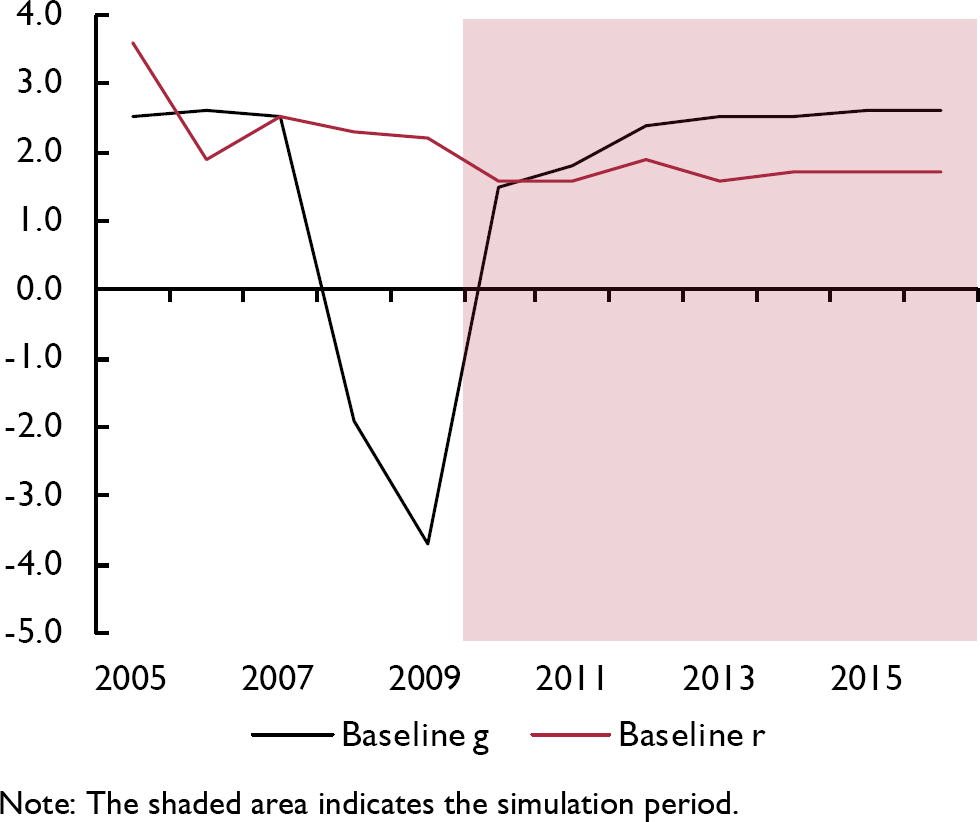
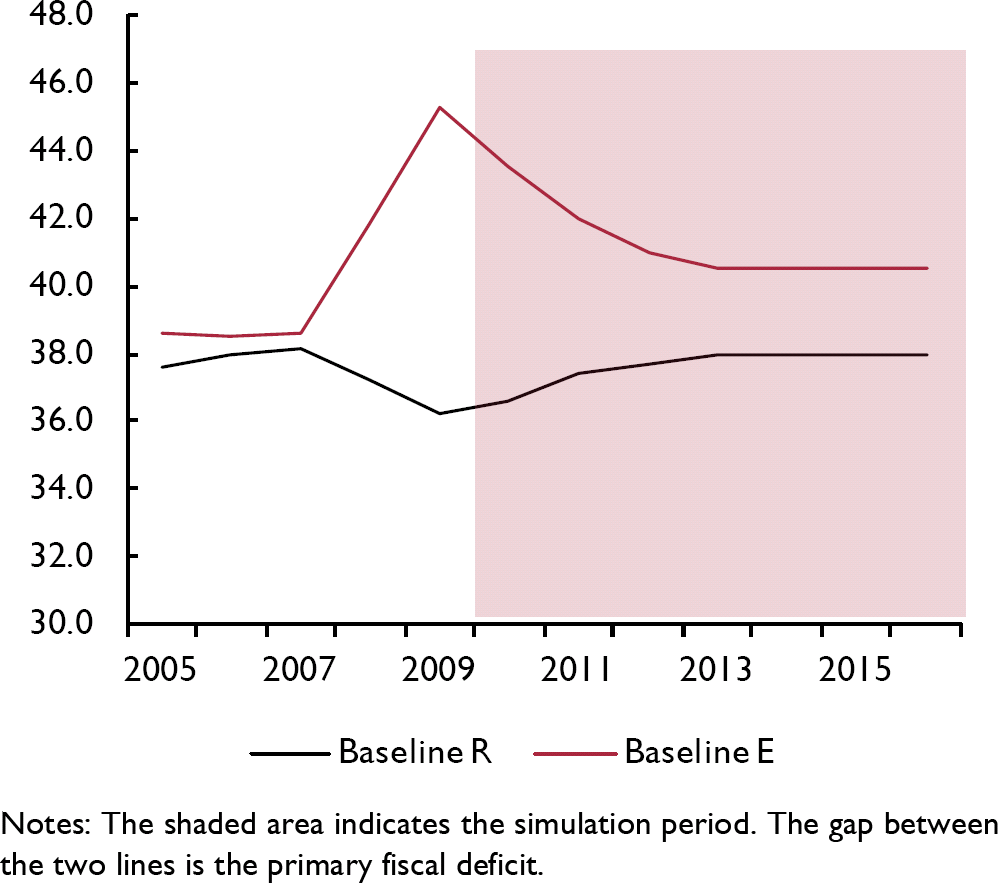
In order to link the analysis more closely to the debate highlighted above, I consider a scenario similar to the one facing the UK in 2010. Figure 2 shows the baseline macroeconomic conditions and fiscal plans. The macroeconomic conditions can be summarised by saying they are unfavourable in the near term (ϕ >1, which will tend to push debt to GDP higher), but they are expected to stabilise quickly and ultimately the debt dynamics are favourable. The fiscal plans will, absent some further adjustment, see the partial reduction of a large primary deficit but a primary deficit of 2.5 per cent will persist. Taken together, the near-term outlook is for rising debt (the primary deficit is a lot higher than the debt-stabilising surplus required with unfavourable ϕ) but this will moderate in time. Under this scenario, debt to GDP will grow to 93 per cent without further adjustment plan.
Baseline macro conditions (per cent)

Baseline fiscal paths (per cent of GDP)

5.2 Interest rate endogeneity
We tend to care about public debt sustainability because of fears about what happens when the debt becomes unsustainable. These include the fear that markets will lose confidence in the ability of the government to service its debt, which in turn causes interest rates on debt to rise (and this may spillover to private sector banks and corporates choking off economic activity). Even if not in a full-blown debt crisis, we may worry that a high level of debt constrains the flexibility of fiscal policy by limiting the ability to engage in countercyclical fiscal policy.
As described earlier, the coalition government used concerns about the unsustainability of debt as justification for the faster implementation of their reduction in the size of the government. Reference OsborneOsborne (2010) referred to the idea of a diabolic loop when presenting his emergency budget in June 2010: “Questions that were asked about the liquidity and solvency of banking systems are now being asked of the liquidity and solvency of some of the governments that stand behind those banks. I do not want those questions ever to be asked of this country. That is why we have set a brisk pace since taking office.”
And fears about UK sovereign were not simply coming from the coalition. The 2009 IMF Article IV staff report wrote that the “projected sizable rise in government borrowing, the considerable contingent liabilities from the banking sector, and the lack of full clarity about the future fiscal consolidation path pose risks to confidence in the public sector's debt sustainability (International Monetary Fund, 2009).” When Moody's downgraded the UK from an AAA rating in 2013, it had little direct economic significance but served to convince those pursuing austerity policies that they should ensure even greater vigilance in sticking to the plan to reduce spending.
The issue is that the questions had not yet been asked. Therefore, it is impossible to rule out with certainty that markets may at some point lose confidence in UK sovereign debt; the assessment must be forward-looking and depends on willingness to raise taxes in the future to pay any deficits built up today. And it is not an easy exercise given the complex relationships determining sovereign risk (as in Reference Brunnermeier, Garicano, Lane, Pagano, Reis, Santos, Thesmar, Van Nieuwerburgh and VayanosBrunnermeier et al., 2016). I therefore model a reduced-form interest-rate premium channel which is forward-looking and asymmetric.
Specifically the interest rate premium on debt is a function of how far, on average over the next five years, the government is from the debt-stabilising primary balance. This is captured by the weighted-average gap between the primary balance and the debt-stabilising primary balance as described above (pgap):

If the primary deficit is greater, on average, than the debt-stabilising level, there is a premium added to the interest rate. This reduced-form relationship depends on two parameters:
1. ζ measures the sensitivity of the interest rate premium to the gap. ζ – 1 means that a 1pp gap gives rise to a 1pp interest-rate premium.
2. The impatience of markets. I calculate the pgap variable as a weighted average of the gap from the debt-stabilising balance over the five-year plan. More impatience means that the premium weighs more heavily in the near term which is implemented by changing the weights to be more front-loaded (impatient). Weighting the later years more heavily captures greater patience.
This interest-rate channel will operate through two channels. First, by making ϕ less favourable (higher interest rates), the natural debt momentum will increase driving up the debt to GDP ratio. Second, I assume that higher interest rates on sovereign debt drive up interest rates faced throughout the economy. That is, I shall model a feedback from the higher interest rates that acts like a persistent contractionary monetary policy shock. This follows from the close correlation between corporate and sovereign debt yields. In terms of the multiplier, in line with Reference Cloyne and HurtgenCloyne and Hurtgen (2016), I assume that a 100bp interest rate increase in time t will lower output by 0.5pp in year t, 1pp in year t + 1 and 0.4pp in year t + 2. Of course, a persistent shock will have effects that accumulate over the years.
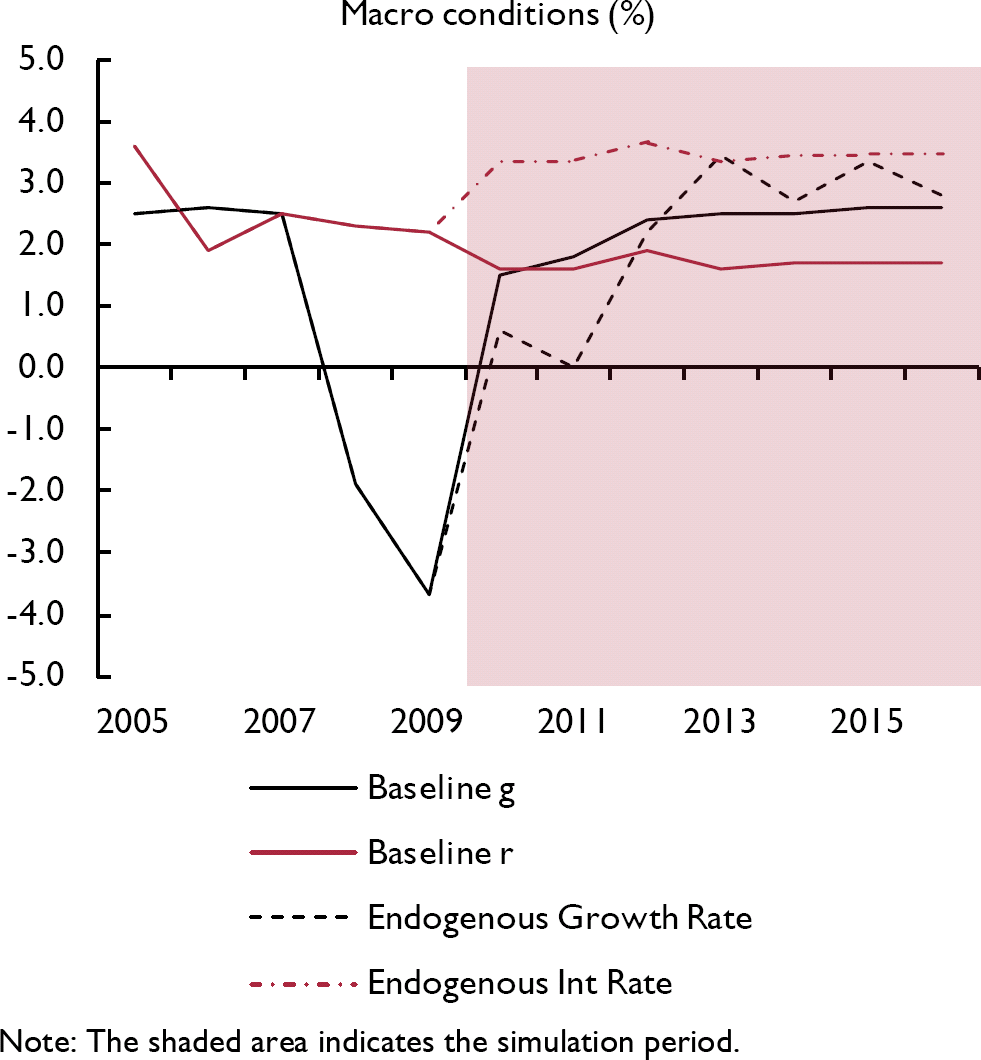
In figure 4 I plot the effect of the endogenous interest rates on macroeconomic conditions. Due to the primary deficit being so far from the debt-stabilising level in the near term, interest rates are subject to a risk premium. The size of the effect depends on the parameters discussed above. In the baseline analysis, I assume that markets are slightly impatient (putting a little larger weight on near-term deviations from the debt-stabilising primary balance) and I assume that ζ = 0.25, which yields an increase in real yields of 180bps when the weighted-average UK primary deficit is 3pp higher than the debt-stabilising primary balance. More impatience by the markets means more weight put on the near-term when the stabilisation gap is larger and so a larger increase in interest rates; less sensitivity would mean that interest rates increase by less. Were concerns about the UK to occur, you might think that the premium would be larger; countries such as Ireland and Greece saw real yields rise by considerably more than 180bps. However, below I address issues of financing and ownership of sovereign bond holdings which mean that such risks are likely much less of an issue for the UK.
The effect of endogenous interest rate

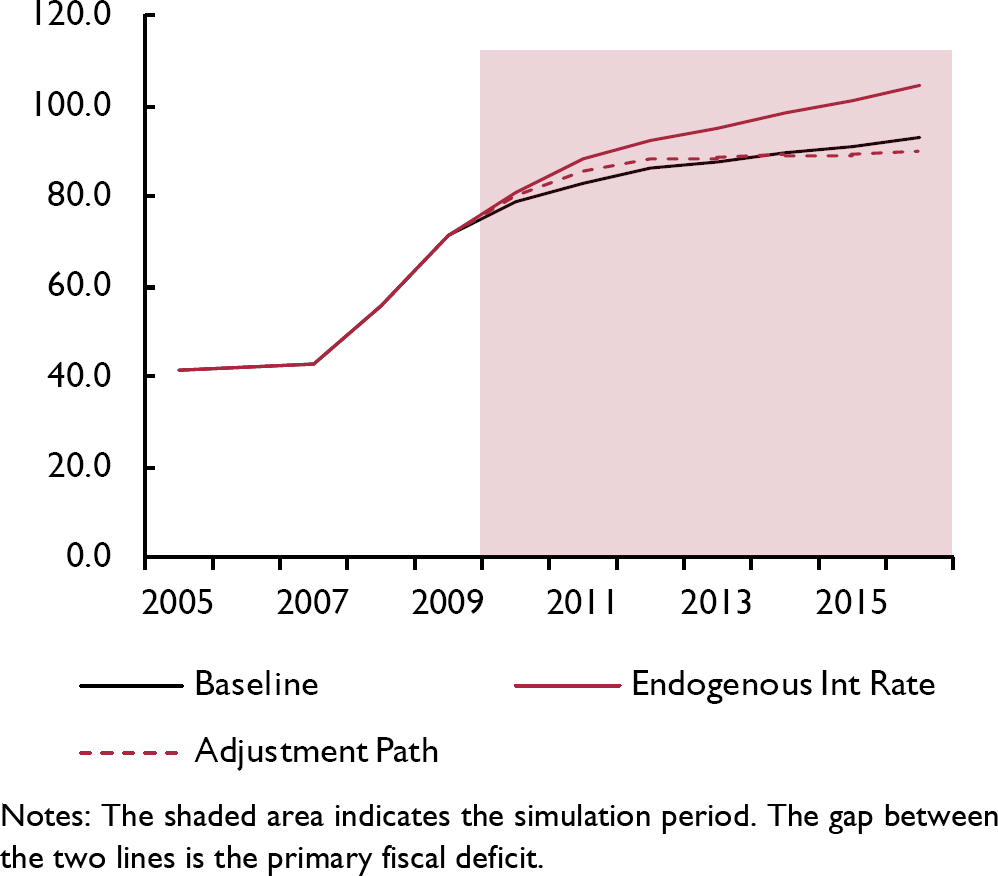
The interest rate shock also weakens growth further in the near term. The combined deterioration in f means that, relative to the baseline scenario described above, the debt to GDP ratio rises faster due to the interest rate reaction. This is shown in figure 5. Under these assumptions (designed to illustrate the channel), debt to GDP increases to 104 per cent of GDP. This suggests, in line with the narrative, that if markets did react, then debt would become more of a burden. Given, as I established above, the stated objective of austerity was to avoid any such issues while reducing the scale of spending, then this would seem to justify some adjustment path (assuming that voters also want such an outcome).
Adjustment plan: debt to GDP paths

5.3 An adjustment path
By assumption, the interest rate premium depends on the deviation of the primary deficit from its (time-varying) debt-stabilising level. Of course, the specific modelling tool in the equation is somewhat arbitrary. Nonetheless it is such that an adjustment of the primary balance can help restore interest rates to their baseline level (but not below). As Reference OsborneOsborne (2010) justifies his emergency budget, he says: “Part of the reason, as we have always argued, is that tighter fiscal policy can enable interest rates to stay lower for longer.” And this position was endorsed at the time by the newly-established Office for Budget Responsibility; following a plan with less fiscal adjustment “would lead to higher interest rates and so lower economic activity” (Office for Budget Responsibility, 2010).
The specific adjustment path that I examine assumes that 80 per cent of the adjustment is completed via spending cuts. This is consistent with the approach laid out in the June 2010 emergency budget. Reference OsborneOsborne (2010): “The coalition Government believes that the bulk of the reduction must come from lower spending rather than higher taxes. The country has overspent; it has not been under-taxed. Our approach is supported by the international evidence, compiled by the Organisation for Economic Cooperation and Development, the International Monetary Fund and others, which found that consolidations delivered through lower spending are more effective at correcting deficits and boosting growth than consolidations delivered through tax increases. This is the origin of our 80:20 rule of thumb – roughly 80 per cent through lower spending and 20 per cent through higher taxes.” In a cumulative sense, 2pp of the additional 2.5pp adjustment in the primary balance is achieved via expenditure cuts. Figure 6 shows the adjustment and the dashed line in figure 5 shows the resulting path of debt to GDP.
Adjustment plan: expenditure and revenue

As a basic adjustment, this achieves a form of “sound finances” in the sense that the primary deficit is brought into balance. However, given economic conditions by the end of the scenario, a balanced primary deficit merely flattens out the debt trajectory. But it is still rising gradually in 2016. In this sense, more adjustment would need to be done as the current plan is not enough to “ensure that debt is falling as a share of GDP by 2015–16 (Reference OsborneOsborne, 2010)” which was the fixed target for debt that was introduced in the June 2010 budget and was supposed to be achieved within the 2010–15 Parliament. This further reinforces the larger point that it is harder to assess the success of fiscal plans which state the objectives in terms of a first intermediate target (deficit balance) to a second intermediate target (lower debt) to an ultimate aim (lower spending and lower future debt repayments).
6. Growth endogeneity and the feedback to fiscal policy
Rather than explore further adjustment in revenue, it is more pertinent to address the issue of growth endogeneity to fiscal policy, and the feedback to fiscal plans. This is a major concern and common objection to the decision to pursue austerity with such speed. As pointed out by Reference HarrisonHarrison (2011a), the idea is quintessentially Keynesian: lowering government spending leads to lower GDP, which reduces tax revenues (and may increase expenditures). Together, these mean that nominal borrowing remains high or falls by less than hoped and the GDP denominator is also lower than without the adjustment. Ultimately, despite the fiscal adjustment plan, public debt will be hard to reduce or could even increase.
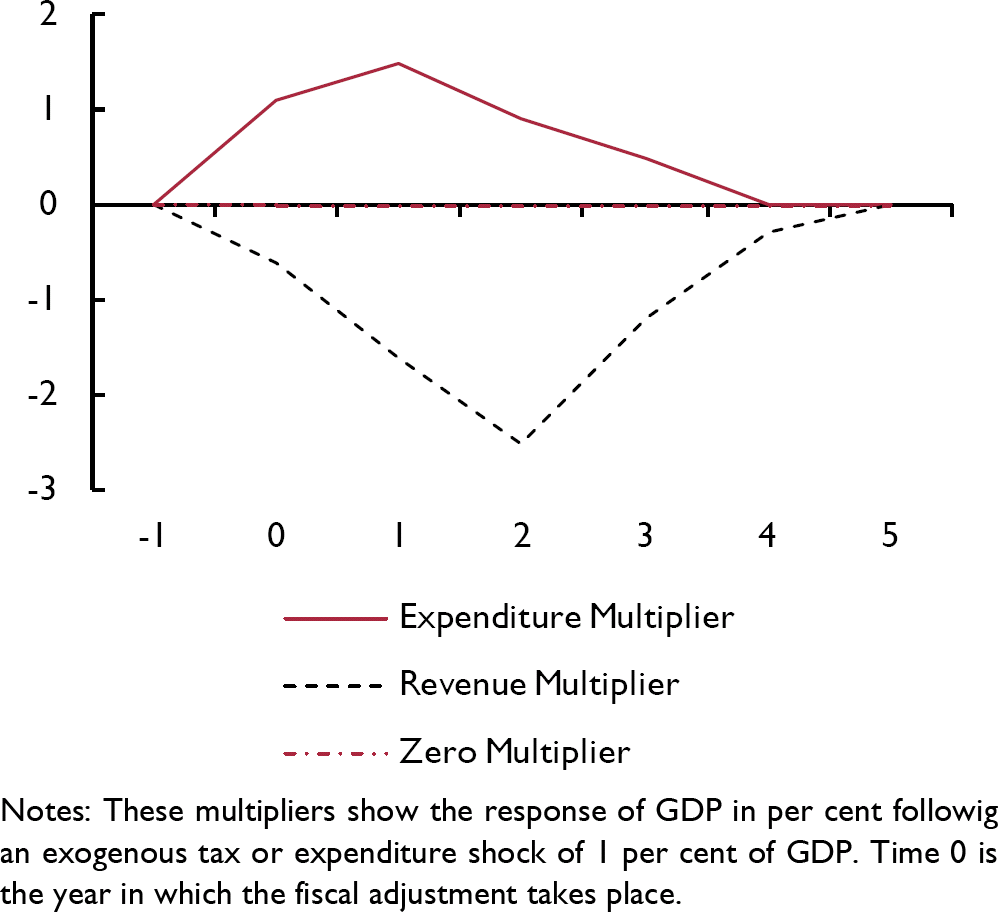
The first step in this is captured by the idea of the fiscal multiplier. That is, the expenditure (tax) multiplier is the change in GDP at time t + i following a change in expenditure (tax revenue) at time t. The use of a fiscal multiplier will address the omission of feedback from fiscal plans to GDP growth in the scenario so far. We need to choose an appropriate pair of multipliers, which is not easy given that there is great disagreement about the size of the fiscal multiplier; Reference Batini, Eyraud, Forni and WeberBatini et al. (2014) discuss the concept and international evdience on fiscal multipliers in detail. Figure 7 plots the multipliers that I consider. So far, I have used a zero multiplier so this is trivially plotted. I now consider a moderate multiplier drawing on UK evidence, such as Reference CloyneCloyne (2013), to inform the shape and size of the multiplier.
Assumed fiscal multipliers

Again, the effects of lags in the multipliers mean that a multi-year adjustment plan accumulates. Consider an adjustment plan starting in 2010 that will adjust tax and spending in each year for three years. The 2012 (year 2) adjustment of lower spending will reduce 2012 GDP by its impact multiplier effect, but at the same time GDP in 2012 is reduced by the t + 1 effect of the 2011 adjustment and the t + 2 effect of the 2010 adjustment.
As before, there are two implications of this approach. The use of the multipliers will give rise to an alternative series for GDP (Ycounter) and an associated alternative path for GDP growth which enters directly into the debt dynamics analysis.
A second effect comes from a feedback loop from weaker GDP back to the fiscal position; I ignored this effect when looking at the interest rate effect earlier. Building on the OECD approach to adjust the fiscal stance for cyclical conditions (Reference Girouard and AndreGirouard and Andre 2005), we can adjust overall taxes (R) and non-interest expenditure (E) at the aggregate level in response to the change in GDP induced by the fiscal adjustment.Footnote 8 Specifically, we use elasticities of revenue (∊R) and expenditure (∊E) to the cycle and generate the counterfactual fiscal series using:

The key coefficients here are the two elasticity terms. In the analysis I shall consider (∊R = 1.2 and ∊E = −0.1. These equate to assuming that revenue is pro-cyclical while expenditure is mildly counter-cyclical. The counterfactual nominal primary balance is Rtcounter – Etcounter
A limitation of my analysis is that I do not further iterate these effects. For example, once there is weaker primary balance because of the endogeneity of fiscal policy to the cycle, I do not further increase the interest rate premium. Such additional impacts would add to the effects identified here.
Figure 8 captures the main implication of the macroeconomic feedback channel. The effect of higher interest rates (section 5.2) was to reduce the output (and raise debt to GDP). This motivated the desire to implement an adjustment plan which effectively reduces the primary balance in the absence of macroeconomic feedback. But once I introduce the effect of fiscal multipliers, the level of GDP is further reduced from the baseline level.
Adjustment with macro feedback: relative GDP

Figure 9 shows how the primary deficit is affected. Rather than being brought to balance, the weaker GDP (in the denominator of the primary deficit ratio) and the additional elasticity of expenditure and revenue to the weaker economic conditions, combine to slow the path of primary deficit reduction. At the end of the simulation horizon (2016), there remains a primary deficit. In fact, in the early years of the adjustment plan the primary deficit is worse than in the baseline case, or the case in which the interest rate is higher but no adjustment is made to fiscal plans. Taken together, figure 10 shows that in this case, where there are fiscal multipliers and feedback effects, debt to GDP is higher in the near term despite the adjustment to apparently “sound finances”.
Adjustment with macro feedback: primary deficit

Adjustment with macro feedback: debt to GDP paths

I do not want to argue my back-of-the-envelope calculations are precise predictions of what happened. Rather, there are forces which could operate to push debt to GDP and other fiscal measures higher and lower. Of course, which of these effects dominates depends on the relative magnitude of each effect. Some will object that I have undersold the scale of the interest rate premium that would follow if bond markets ceased to want to hold UK debt. Others will argue that my multipliers are too low, citing the potential for multipliers to be time-varying and state-dependent; although Reference Owyang, Ramey and ZubairyOwyang, Ramey, and Zubairy (2013) find no evidence that multipliers are greater in times of slack in the US. In particular, when interest rates reach the zero lower bound (ZLB), discussed below, Reference Christiano, Eichenbaum and RebeloChristiano, Eichenbaum, and Rebelo (2011) find that the multipliers are much larger. These findings would argue for delaying adjustment until the multiplier is less high (in more normal times).
The exact size of all of these important considerations is uncertain. The point to stress is that the interlinkages are not simple and so care should be taken using such a simple motivating narrative. A “sound finances” policy may or may not be sound. Any policy that focuses on a particular intermediate target, such as reducing the debt to GDP ratio, needs to take into account the endogenous feedback that comes with linkages in the macroeconomy. As such, policies should be implemented to achieve a better and more desired balance of spending and taxation. These are issues on which people disagree and therefore politicians should transparently sell their proposed plan and its implications.
7. Debt dynamics and potential output
While I have argued that the way to look at fiscal numbers is in terms of their ratio to GDP, this can be misleading when GDP is fluctuating cyclically. In the final simulations, while the expenditure to GDP ratio did not decline much and even increased initially, the amount of expenditure did fall. If the underlying target is to reduce expenditure, then once GDP recovers the numbers will look more in line with the plans. Another option would be to use potential GDP in the denominator.
But what if GDP never recovers? A common feature across many countries is that following a financial crisis there is persistent weakness in economic growth. There is much debate about the reasons for the weakness. Some argue that the cause is deficient aggregate demand (Reference HallHall, 2011; Reference KrugmanKrugman, 2012) with some even suggesting some or all of it is caused by excessive fiscal consolidation (Reference Fatas and SummersFatas and Summers, 2016; Reference Wren-LewisWren-Lewis, 2015). Others point to supply side effects of the financial crisis (Reference BallBall, 2014). Reference Malherbe and McMahonMalherbe and McMahon (2017) examine the role of ex-ante financial incentives in boosting GDP to unsustainable levels before the crisis. Reference Fernald, Hall, Stock and WatsonFernald et al. (2017) argue that actually the main causes of the persistent weakness in the US are factors that were unrelated to the crisis and began in advance of the Great Recession. The truth is that there is probably a contribution from all of these factors to some degree.
Even if the cause is nothing to do with fiscal decisions, the government stands to gain from boosting potential GDP. There are two broad channels of influence. One channel is to encourage an environment that is friendly to private business investment both in machinery and equipment and in productivity enhancements, and an environment and education system that encourages the accumulation of human capital. This is related to the institutional framework described above.
A second channel is through public investment, particularly in infrastructure. One reason for this emphasis is that the UK lags behind other advanced economies in terms of energy, education, health and transport infrastructure; as Reference OfferOffer (2002) says, “The investments required to catch up with European and American standards in transport, health care, and higher education and provide universal access require increases of taxation that might extend beyond the capacity of current politics”. And rising house prices suggest that there is also a deficiency of housing supply, some of which should be social housing. Infrastructure investment is likely to have a larger multiplier effect on GDP growth making debt dynamics more favourable.
Another reason to stress the importance of infrastructure investment is that in periods of expenditure cuts, investment is often amongst the first categories of spending to be cut. When the expenditure and borrowing occur in the near term, perhaps the horizon of benefits (much further into the future) is too far for myopic politicians more concerned about the next election?
Borrowing to fund worthwhile (high social return) infrastructure investments is also less likely to cause alarm to financial markets. A project generating a corresponding government asset generates an income stream to cover debt repayments, which is also likely to boost growth is likely to be much less risky. As such the reason for the borrowing may also be a determinant in whether, or not, financial markets remain willing to fund the government's borrowing.
There is also a more subtle point about the timing of such spending. Reference Wren-LewisWren-Lewis (2013) is correct that the timing of infrastructure spending is “surely something we can all agree on?”. If you are going to have to spend £20bn pounds on an infrastructure project, you may as well spend it when there is deficient demand.
8. Debt dynamics, refinancing and monetary policy
One point that is often overlooked in the context of debt debates is the role of financing. This may seem odd since debt is, itself, a form of financing. It is often assumed that the deficit in a given year represents the financing needs of the government. Of course, those dealing with fiscal issues know this not to be true. The financing need captures the amount of debt the government is trying to convince financial market participants to hold in that year. The government must also look to rollover maturing debt such that even if a government ran an overall balance of spending and revenue, the government would likely still have a financing need.
The overall deficit (surplus) adds to (reduces) the financing need of the government but the total financing need also comes from the need to rollover debt. This latter aspect depends on the amount of debt maturing in that year which itself depends, at least on average, on the maturity structure of the debt.
Figure 11 shows how the maturity structure has evolved recently. The UK has a very long maturity of its sovereign debt. The average maturity in 2016 was 14.7 years which is longer than any other OECD government; OECD governments' typical average maturity ranges between three and eight years (Reference Ellison and ScottEllison and Scott, 2017).
Maturity structure of UK sovereign debt

Holdings of UK sovereign debt(a)

The maturity structure determines how much market interest rate moves affect current financing costs. One impact of the long maturity of UK sovereign debt is that sudden changes in risk premia actually have a smaller effect on average interest rates (which is what matters for the debt dynamics). For example, if you have financed all debt with a 10-year bond last year, and you have no financing need, then secondary market yields will not affect current financing costs. Instead, if all government debt is 1-year maturity, then it must be rolled over at the new higher rates in its entirety meaning interest rate costs will fully reflect the market changes. This suggests that had markets become concerned about UK debt, the simulation increase of 180bps (above) may be too high, rather than too low, at least initially. Only as debt matured would the effective interest rate on the debt gradually increase (assuming the higher interest rates persisted). Notwithstanding the finding in Reference Ellison and ScottEllison and Scott (2017) that the UK makes too much use of long-maturity debt (from an average cost efficiency point of view), in 2009 and 2010 the long-maturity structure likely bought the UK government some breathing space. If fears had built up about fiscal solvency, the government had longer to adjust fiscal plans. And knowing this, forward-looking financial markets would worry less about the UK debt situation.
While an implication of this long maturity structure in the UK was that monetary policy reductions in interest rate take time to filter into the average effective interest rate, this also means that the normalisation of interest rates will be relatively more muted in terms of the implications for UK sovereign debt-servicing costs.
Another important aspect of financing concerns who holds the debt. If too much is held by resident banks, we may worry about a greater effect of the diabolical loop already discussed. Or, non-resident holders of the debt may be less willing to continue to hold the debt as sustainability concerns grow; resident holders are considered less likely to run quickly because they lose (relatively) less from a default to the extent that they lose the asset but will also not have to face a future tax bill to repay it. Updated data from Reference Merler and Pisani-FerryMerler and Pisani-Ferry (2012), plotted in figure 12, suggests that the UK had much lower exposure to either source of concern compared with debt-crisis countries such as Ireland and Greece.
Unlike with these countries, the UK has retained control of monetary policy. This means that, counter to my assumption above, the UK could pay debt off by printing money. Inflation has played a major role controlling debt dynamics in the past (Reference Ellison and ScottEllison and Scott, 2017). However, the current monetary framework means that inflation surprises (which reduce the value of nominal debt) are unlikely to play as large a role in the future; monetary policy has been guided by an inflation target since 1992, and the Bank of England has been operationally independent since 1997. Moreover, about 25 per cent of issued gilts are index-linked, which prevents the government from using inflation to erode the value of debt beyond the difference between RPI inflation and the GDP deflator measure.
Monetary and fiscal policy also interact through the fact that the Bank of England typically uses government securities for its monetary operations. In response to the financial crisis, the expansion of the fiscal deficit meant that there was a large increase in sovereign debt issuance. Ordinarily this would have meant rising yields to induce the private sector to finance the larger amounts of debt. However at the same time, trying to stimulate the economy, the Bank of England Monetary Policy Committee (MPC) reduced interest rates to their ZLB.Footnote 9 At this point, the MPC embarked on its programme of Quantitative Easing (QE) which involved the large-scale outright purchase of large amounts of UK sovereign debt. This is a powerful instrument to influence yields across the maturities; Reference Chadha, Turner and ZampolliChadha, Turner, and Zampolli (2013) show that these purchases significantly influence term premia.
Regulatory requirements that require banks and other financial institutions to hold government debt (as a safe asset) are a form of financial repression. Increased regulation of financial institutions, to the extent that it requires or encourages holding more safe assets could potentially help governments by increasing the private market demand for the debt instrument which it supplies. This further reduces concerns that any increased supply of government bonds will face low demand and require significant increases in yield in order to convince buyers to hold it.
9. Longer-term issues for debt dynamics
In this paper I have focused on shorter horizons, such as a five-year parliamentary cycle, over which to examine fiscal projections. This was because I wanted to make the point that the sound finances logic does not necessarily achieve the government's desired fiscal outcomes at short horizons over which it is advocated. While it is beyond the scope of this article to discuss much longer-term sustainability, it would nonetheless be remiss not to mention the challenges facing fiscal policy going forward.
As is common to many advanced economies, the UK population is ageing. The impact of this slower-moving demographic change is explored in detail in, for example, Reference Amior, Crawford and TetlowAmior, Crawford, and Tetlow (2013) and Office for Budget Responsibility (2017). But the summary impact is that, left unchecked, this ‘greying’ of society is likely to increase public spending on health, social care and pensions. At the same time, a smaller proportion of the population working (and paying income tax) would reduce tax revenues. In the absence of offsetting tax rises or spending cuts, these demographic pressures will widen budget deficits, and contribute to ever growing government debt.
Reference Crawford and EmmersonCrawford and Emmerson (2017) provide some specific estimates of the size of the effect. Their summary advice is that the government “would be wise to consider these long run trends carefully, and to start focusing on finding and implementing a long term solution to these funding pressures now, rather than just announcing further short term funding fixes.” In this sense, the proposal put forward in Reference CameronThe Conservative Party (2017) to deal with the costs of social care should be welcomed in spirit even if the implementation (both economically and politically) could be improved.
These mounting longer-term pressures should be important considerations for political parties in determining their targets for the government debt to GDP ratio and the size of near-term government spending. Knowing that such longer-term challenges will need to be addressed, doing so more gradually would ease the impact of the adjustment on any single generation of voters. Decisions to defer when to deal with these issues are equivalent in ultimate impact, even if not in immediate financing need and debt statistics, to deficits; they defer the burden of paying for today's spending to future generations.
10. Conclusion
The objective in this article was to examine the “sound finances” narrative that seems to have developed in the UK. I am not trying to argue for an austerity plan or against it. I do not want to dismiss potential concerns about debt sustainability and the cost of debt service. I am not trying to argue for a specific size of fiscal multiplier. I think consideration of all of these issues is important, complex and uncertain.
The main point is that following a “sound finances” strategy is not necessarily sound in the sense that achieving fiscal balance of the primary, current or total deficit could, under different conditions, lead to stable, increasing or decreasing debt levels. Using the Domar framework, I highlighted the main drivers of the debt dynamics; the real interest rate, the growth of GDP and primary balance. I then modified the framework to examine the complex and interacting effects of the three channels; the interest rate effect of market concerns about debt sustainability, the endogeneity of macroeconomic conditions and the feedback from the economy to fiscal spending and revenues. I have omitted other channels such as the potential effect of austerity on household debt.
Despite this basic Domar framework being well known to economists for around 80 years, the sound finances narrative has nonetheless persisted and recently has been an influential driver of political choices. It certainly helped the coalition government to convince the public of the need for austerity. One problem with the fiscal arithmetic is that it often appears mystical compared to the more easy-to-relate-to household finances argument. Reference LernerLerner (1943) too recognised that his functional finance ideas, which did away with the need to adhere to balancing the budget, “makes the public suspect it as too slick.” But it is precisely because the correct analysis is received sceptically that we require politicians to engage with it and promote the ideas contained in it.
Of course, if society wants lower spending and a lower tax bill, then that is exactly what democracy is supposed to do. I believe that the Conservative party were quite explicit in stating that this is what they wanted. But because the reality of debt dynamics was not understood, the threat of a Greece-style crisis provided an extreme scenario which resonated with the public in terms of a consequence of not following austerity ideas. “In their failure to see how it all works they are easily frightened by fairy tales of terrible consequences” (Reference LernerLerner 1943). In reality, debt problems were not inevitable, or even that likely, and the UK was not subject to the same concerns as countries like Greece and Ireland.
Moreover, whatever your beliefs in 2009–11, by 2016 the economic landscape had changed and, as shown, this matters a great deal for debt dynamics. The improved economic conditions mean that in their 2016 Article IV assessment, the IMF projected debt to fall despite expected primary deficits in the first two years (International Monetary Fund, 2016). Whatever the concerns about debt financing around the time of the financial and Euro Area debt crisis, now is surely a time to take advantage of low interest rates and invest in much needed infrastructure. Boosting GDP growth will further accelerate the decline in the ratio. Perhaps there is even fiscal space to relax somewhat the constraints on public sector pay especially in the face of above-target inflation.
Higher inflation also signals that it is an important time to shift to more stimulus from fiscal policy. Even though the effects of interest rate cuts are potentially lower in a recession (Reference Tenreyro and ThwaitesTenreyro and Thwaites, 2016), and the fact that the efficacy of QE is highly uncertain, monetary policy has essentially been doing all the policy heavy-lifting to help the economic recovery since 2010. The expansionary stance of monetary policy meant that some of the effects of austerity on the macroeconomy could be counterbalanced. Now, as we face a likelihood of rising interest rates, it is an opportune moment to provide some more fiscal stimulus.
The persistence of the sound finances narrative means UK politicians have unnecessarily focused on fiscal policy paths that are contrained to get some deficit back to zero. Whether this balance achieves their desired outcomes depends on the state of the economy. This apparent agreement on the need to constrain fiscal policy to achieve some balance at some two- to five-year horizon masks substantial and important differences in the menu of fiscal policies offered by different political parties. The focus needs to be on transparency of the plans to allow the electorate to choose more easily between the options and to understand the ultimate goals of the different proposed fiscal plans. The sound finances narrative has proved an extremely pervasive soundbite that has, as Reference van Reenenvan Reenen, (2010) notes, limited the opportunity for a clear discussion of options. We need to accept that deficit financing is not, in and of itself, reckless.