INTRODUCTION
The white-beaked dolphin Lagenorhynchus albirostris Gray, 1846 inhabits the cold-temperate waters of the North Atlantic Ocean including the northern North Sea. It is usually seen in small groups of 5–15 animals, which sometimes form larger associations, occasionally with Atlantic white-sided dolphins Leucopleurus acutus. During the late 20th Century, the species has extended its range into the southern and eastern North Sea, where it has become the most numerous cetacean after the harbour porpoise Phocoena phocoena, both in sightings and strandings. The white-beaked dolphin is now regularly recorded in German, Dutch and Belgian waters and has significantly increased in the strandings records for these countries since the 1960s (Kinze et al., Reference Kinze, Addink, Smeenk, García Hartman, Richards, Sonntag and Benke1997; Reeves et al., Reference Reeves, Smeenk, Kinze, Brownell, Lien, Ridgway and Harrison1999; Reid et al., Reference Reid, Evans and Northridge2003; Camphuysen & Peet, Reference Camphuysen and Peet2006). The population in the North Sea and adjacent Atlantic Ocean was estimated at ~10,000 individuals in 1994 and 2005, respectively (SCANS-I and II surveys: Hammond et al., Reference Hammond, Berggren, Benke, Borchers, Collet, Heide-Jørgensen, Heimlich, Hiby, Leopold and Øien2002; Hammond, Reference Hammond2006).
Because dolphins feed under water, direct observations of feeding are almost impossible. The most commonly used method of diet estimation is the analysis of stomach contents of dead animals (Pierce et al., Reference Pierce, Boyle, Watt, Grisley and Boyd1993; Kinze et al., Reference Kinze, Addink, Smeenk, García Hartman, Richards, Sonntag and Benke1997; Pauly et al., Reference Pauly, Trites, Capuli and Christensen1998; Barros & Clarke, Reference Barros, Clarke, Perrin, Würsig and Thewissen2009). This method is based on the identification of undigested hard prey remains such as otoliths, vertebrae, jaws and squid beaks. Few studies of the diet of white-beaked dolphins in European waters have been published. In a Scottish study by Canning et al. (Reference Canning, Santos, Reid, Evans, Sabin, Bailey and Pierce2008), 22 stomachs were analysed. From other areas, only limited studies based on small sample sizes are available, and some anecdotal reports on single animals exist (Van Bree & Nijssen, Reference Van Bree and Nijssen1964; De Smet et al., Reference De Smet, Asselberg and Duyndam1985; Smeenk & Gaemers, Reference Smeenk and Gaemers1987; Lick, Reference Lick, Bohlken, Benke and Wulf1993; Berrow & Rogan, Reference Berrow, Rogan, Evans and Nice1996; Kinze et al., Reference Kinze, Addink, Smeenk, García Hartman, Richards, Sonntag and Benke1997; Reeves et al., Reference Reeves, Smeenk, Kinze, Brownell, Lien, Ridgway and Harrison1999; De Pierrepont et al., Reference De Pierrepont, Dubois, Desormonts, Santos and Robin2005; Evans & Smeenk, Reference Evans, Smeenk, Harris and Yalden2008).
This study is based on the analysis of stomach contents of 45 white-beaked dolphins stranded on the Dutch coast between 1968 and 2005, giving the most comprehensive description of the species' diet in the south-eastern North Sea to date.
MATERIALS AND METHODS
Sample collection
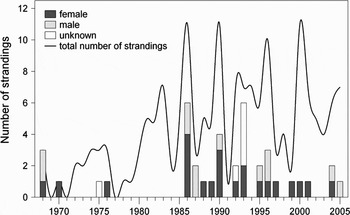
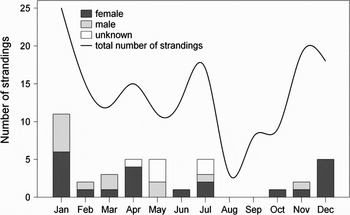
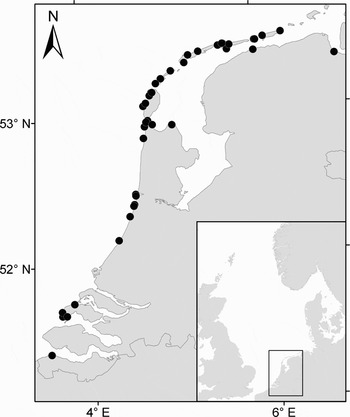
Cetaceans stranded on the Dutch coast are recorded, collected and/or sampled through the Dutch national strandings network, coordinated by the National Museum of Natural History (now NCB Naturalis) in Leiden. The first stranded white-beaked dolphin from the Dutch coast was documented in 1886 (Weber, Reference Weber1887). Over the following 80 years, until 1967, 20 further cases were documented (Van Deinse, Reference Van Deinse1931, Reference Van Deinse1946, Reference Van Deinse1951, Reference Van Deinse1955, Reference Van Deinse1956, Reference Van Deinse1963 and Reference Van Deinse1966). Since then, the stranding frequency has increased as another 175 strandings were recorded from 1968–2009, 45 of which are included in this study (Figures 1 & 2); see for details: Van Utrecht & Husson (Reference Van Utrecht and Husson1968), Husson & Van Bree (Reference Husson and Van Bree1972, Reference Husson and Van Bree1976), Van Bree & Husson (Reference Van Bree and Husson1974), Van Bree & Smeenk (Reference Van Bree and Smeenk1978, Reference Van Bree and Smeenk1982), Smeenk (Reference Smeenk1986, Reference Smeenk1989, Reference Smeenk1992, Reference Smeenk1995, Reference Smeenk2003) and Camphuysen et al. (Reference Camphuysen, Smeenk, Addink, Van Grouw and Jansen2008). When the state of decomposition allowed, animals were retrieved for post-mortem examination and/or sample collection. For most dolphins used in this study, stranding date and locality (N = 40), body length (N = 35) and sex (N = 34) have been reliably recorded. The majority of samples were collected during 1986–2005 (N = 39), and only six are from earlier years (1968–1976). Therefore, this study mainly reflects the period from 1986 onwards (Figure 1). Samples come from the entire Dutch coast, though with a higher abundance in the northern part of the country (Figure 3).
Number of strandings of Lagenorhynchus albirostris per year (N = 40) between 1968 and 2005, separated by sex. Five animals without known stranding dates were excluded. The line shows the total number of strandings recorded from the Dutch coast (data collected by the National Museum of Natural History (now NCB Naturalis), Leiden: www.walvisstrandingen.nl).

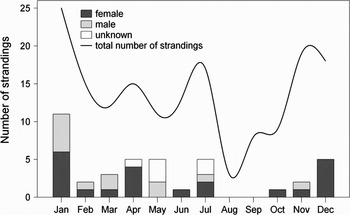
Number of strandings of Lagenorhynchus albirostris per calendar month (N = 40) between 1968 and 2005, separated by sex. Five animals without known stranding dates are excluded. The line shows the total number of strandings per calendar month on the Dutch coast (data collected by the National Museum of Natural History (now NCB Naturalis), Leiden: www.walvisstrandingen.nl).
Map of Lagenorhynchus albirostris stranding localities (N = 40) on the Dutch coast between 1968 and 2005. Five animals without known stranding localities are excluded.

Diet analysis
Stomach contents of white-beaked dolphins were collected during post-mortem examination and have been preserved dry in the collection of Naturalis. Only stomachs with prey remains are included in this study. The five stomachs analysed earlier by Smeenk & Gaemers (Reference Smeenk and Gaemers1987) are included. An animal studied by Van Bree & Nijssen (Reference Van Bree and Nijssen1964) is excluded here, as fish weights could not be calculated from their data. All prey remains were identified to the lowest taxonomic level possible, using a reference collection (IMARES and the Royal Netherlands Institute for Sea Research (NIOZ)) and guides for otoliths and other identifiable hard prey remains (Härkönen, Reference Härkönen1986; Watt et al., Reference Watt, Pierce and Boyle1997; Granadeiro & Silva, Reference Granadeiro and Silva2000; Leopold et al., Reference Leopold, Van Damme, Phillippart and Winter2001). In order to improve prey identification and quantification, skeletal parts other than otoliths, such as vertebrae, jaw bones and lenses were also used (Tollit et al., Reference Tollit, Wong, Winship, Rosen and Trites2003).
For each dolphin, the minimum number of individuals (MNI) per fish species in the samples was estimated by pairing left and right otoliths and other identifiable structures of similar size and wear (Tollit et al., Reference Tollit, Wong, Winship, Rosen and Trites2003). Otolith length and width is proportional to fish length and weight. Therefore, otolith measurements were used to reconstruct the length and weight of individual fish using published regressions of fish species (Härkönen, Reference Härkönen1986; Prime & Hammond, Reference Prime, Hammond, Huntley, Costa, Worthy and Castellini1987; Coull et al., Reference Coull, Jermyn, Newton, Henderson and Hall1989; Leopold et al., Reference Leopold, Van Damme, Phillippart and Winter2001). To account for partial erosion in the stomach, otoliths were assigned to four ‘wear classes’, i.e. pristine, slightly worn, moderately worn and severely worn. Correction factors for wear were derived from large samples, in which all four stages were present for a given fish species, by comparing median sizes (cf. Tollit et al., Reference Tollit, Heaslip, Zeppelin, Joy, Call and Trites2004; Grellier & Hammond, Reference Grellier and Hammond2006). Sizes of non-pristine (worn) otoliths were accordingly corrected before estimating fish length and weight, according to Leopold et al. (Reference Leopold, Van Damme, Phillippart and Winter2001). For cephalopod remains, the MNI was estimated by pairing upper and lower beaks, but these prey were not identified to species. All squid beaks were tiny, with a hood length smaller than 3 mm, and were probably from small sepiolids. We assigned an average prey weight of 2.5 g per individual (the average weight of Sepiola atlantica in our reference collection). The overall diet composition is quantified using three indices: (1) frequency of occurrence (%FO), expressed as the number of stomachs containing a given prey species as a percentage of the total number of stomachs examined; (2) numerical abundance (%N), expressed as the number of individuals of a given prey species as a percentage of the total number of all prey in the stomachs; and (3) reconstructed weight (%W), expressed as the summed weight of a given prey species as a percentage of the total prey weight in all stomachs.
The North Sea stock size of cod, one of the two main prey species of white-beaked dolphins, decreased to an historic minimum in the early 1990s (Hislop, Reference Hislop1996; Pope & Macer, Reference Pope and Macer1996). In order to compare the diet composition of animals before and after the ‘cod collapse’, dolphins were grouped by their stranding date into two groups: (1) pre-1990; and (2) post-1990. Non-metric multi-dimensional scaling (NMDS) was used to compare prey composition between dolphins of different sex and age, between years and months of stranding, and before and after the cod collapse. NMDS based on Bray–Curtis similarities was applied to the MNI per prey species and the total reconstructed weight per prey species, using Primer software (Clarke & Gorley, Reference Clarke and Gorley2006). Data were fourth-root transformed, to limit the influence of dominant prey species on the ordination. Similarity tests (ANOSIM; Clarke, Reference Clarke1993) were performed on the distance matrix to investigate whether a grouping by any of the above mentioned factors was significantly different from random permutation of the distances.
Smaller dolphins have been found to feed on smaller prey (Dong et al., Reference Dong, Lien, Nelson and Curren1996). Newborn white-beaked dolphins are approximately 120 cm in length and sexually mature adults measure 240–310 cm (Kinze, Reference Kinze, Perrin, Würsig and Thewissen2009). Accordingly, animals were grouped based on body length: (1) juveniles: <240 cm; and (2) adults: ≥240 cm. As dolphin lengths were all above 2 m, the group of very young juveniles (120–200 cm) is not represented in this study.
Generalized additive mixed models (GAMMs) were fitted to the cod and whiting data, but Akaike information criterion (AIC) values and likelihood ratio tests indicated that the data were better described by a linear model. Consequently, we fitted a linear mixed model including an interaction between species and dolphin length. Inspection of the residuals indicated heterogeneity and several variance structures were tested (Pinheiro & Bates, Reference Pinheiro and Bates2000; Zuur et al., Reference Zuur, Ieno, Walker, Saveliev and Smith2009). The final model included a different exponential variance structure with dolphin length for each prey species and had the lowest AIC.
We also tested whether the fraction of cod in the diet (based on reconstructed weight) differed between individuals and was related to animal length. For this, a GAM with a so-called quasi-Poisson error distribution and with the total weight of cod and whiting as an offset proved to give the best results. Generalized additive models (GAMs) provide a flexible framework, allowing predictors to be fitted either as parametric or non-parametric smoothing terms (Hastie & Tibshirani, Reference Hastie and Tibshirani1987). The optimal amount of smoothing of GAMs was determined by cross-validation. Model assumptions were assessed visually. All calculations were carried out in the computing environment R (R 2.9.2.; R Development Core Team, 2009). Linear mixed models used the package ‘nlme’ (Pinheiro et al., Reference Pinheiro, Bates, DebRoy and Sarkar2009) and GAMMs were calculated using package ‘mgcv’ (Wood, Reference Wood2006).
RESULTS
Samples
The majority of samples were collected during 1986–2005 (N = 39), against six earlier samples (1968–1976) and mainly reflect the period from 1986 onwards (Figure 1). Both the spatial and temporal patterns in the availability of stomachs correspond with the patterns in strandings on the Dutch coast (Kinze et al., Reference Kinze, Addink, Smeenk, García Hartman, Richards, Sonntag and Benke1997; Camphuysen & Peet, Reference Camphuysen and Peet2006). Most stranded animals were found in the northern part of the country (Figure 3) and numbers of strandings peaked during the winter months (November–January), followed by a smaller surge from April to July (Figure 2). No samples were available from August and September.
Of the 45 white-beaked dolphins, reliable length measurements were available for 35 animals, showing an average of 249.7 cm (SD 23.6 cm, range 209–300 cm). Ten animals were juveniles (<240 cm) and the remaining 25 were adults (≥240 cm). Only 34 dolphins were sexed, 22 females (65%) and 12 males (35%).
Prey species composition
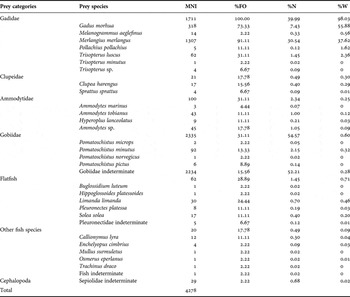
In total, 25 fish species were identified in the stomach contents (Table 1). Remains of small cephalopods were found in one stomach only. Items not considered prey and therefore excluded from further analysis were: remains of crustaceans, echinoderms, shells, worms, algae and foreign objects. Foreign objects found were: fishing line (in six animals), stones (in seven animals) and plastic debris (in one animal). None of these were found in such quantities as to be considered the cause of death.
Diet composition of Lagenorhynchus albirostris stranded on the Dutch coast between 1968 and 2005, identified from stomach contents, expressed by minimum number of individuals (MNI), frequency of occurrence (%FO), percentage number (%N) and percentage weight (%W).

The diet (Table 1) was dominated by Gadidae (40.0%N, 98.0%W), which were found in all stomachs. All other species contributed little to the diet (2%W; all combined). The two most important prey species were whiting Merlangius merlangus (91.1%FO, 30.5%N and 37.6%W) and cod Gadus morhua (73.3%FO, 7.4%N and 55.9%W). In numbers, gobies were most common (54.6%N); however, gobies contributed little to the overall diet by weight (0.6%W).
Three animals had very different prey in their stomachs compared to the others. In the stomach of a juvenile of 210 cm in length, stranded on 8 May 1993 near Den Oever, otoliths of 2250 gobies were found. Besides gobies, this stomach contained remains of 21 sandeels and 52 whitings. The gobies found in this animal's stomach account for 96.4% of all gobies identified in this study. The smallest juvenile in our study, an animal of 209 cm in length, stranded on 28 July 1996 near Bloemendaal was the only animal that had fed on cephalopods. Besides the beaks of 29 small sepiolids, its stomach contained otoliths of 27 whitings, 12 sandeels, 6 cods and one herring.
One sample, labelled ‘L. albirostris’ contained remains of haddock only and accounted for all of the haddock identified in this study. Because the stomach content of this dolphin was so different from all other dolphins, it dominated the NMDS graph, so that the remaining samples fell into one indistinguishable cluster. Without this individual, NMDS graphs showed no meaningful clusters in diet composition for dolphins grouped by either sex, age-class, year and month of stranding or whether they stranded before or after the cod collapse, neither in number nor in total weight per prey species. ANOSIM tests for sex, year and month of stranding, and before and after the cod collapse were not significant.
Prey size and weight
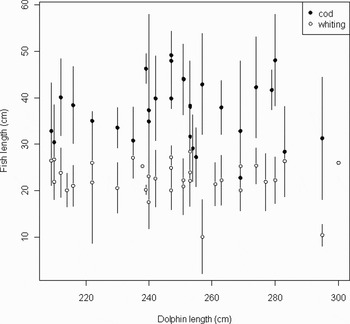
Prey sizes for cod and whiting for each dolphin are shown in Figure 4. The average size of cod is generally larger than that of whiting. For whiting, there is no relation with dolphin length, but dolphins smaller than 240 cm tended to eat relatively small cods. Average cod size in dolphins smaller than 240 cm was approximately 2 cm smaller (means 37.7 cm and 35.7 cm for adult and juvenile dolphins, respectively), however, this difference is not significant (likelihood ratio test: L1 = 0.52, P = 0.47, linear mixed model).
Length (cm) of cod Gadus morhua and whiting Merlangius merlangus (mean and SD) in the diet against body length of Lagenorhynchus albirostris.

The interactions between dolphin length and cod and whiting length were not significantly different from zero (respectively P = 0.14 and P = 0.31). The only difference that remained was the average length of the two prey species (L1 = 243.8, P < 0.0001), which was 35.6 cm (34.1, 37.2, 95% CL) for cod and 22.8 cm (21.7, 23.9) for whiting.
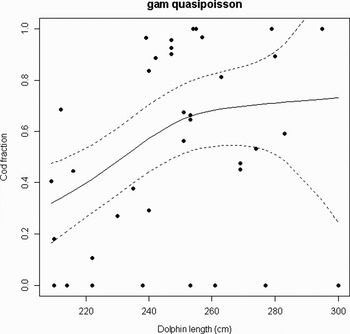
The fraction of cod relative to whiting on a weight basis was investigated to see whether this changed with dolphin size (Figure 5). The model smoother was significant (P = 0.026) and indicates that up to approximately 250 cm the proportion of cod increases from approximately 0.3 to 0.6.
Relationship between the proportion of cod Gadus morhua (weight of cod relative to the total weight of cod and whiting) in the diet and body length of Lagenorhynchus albirostris. The line is the fitted regression line and the dashed lines are the 95% confidence limits.

DISCUSSION
Samples
The number of stomach samples was limited, because not all stranded white-beaked dolphins in The Netherlands have been collected and/or sampled and some stomachs examined were empty. Nevertheless, this study comprises the largest sample size for this species to date, though it is restricted to the south-eastern North Sea. The 45 samples represent 27% of the white-beaked dolphins found stranded in the study period (1968–2005). There is a predominance of females among the samples, with 22 females to 12 males. This corresponds with the female dominance among all documented Dutch strandings of white-beaked dolphins to date (1886–2009, N = 196, 89 females and 47 males) and within the study period (1968–2005, N = 165, 70 females and 40 males) (www.walvisstrandingen.nl). Female predominance among the strandings has also been documented for the Danish (42 females to 20 males; Kinze et al., Reference Kinze, Addink, Smeenk, García Hartman, Richards, Sonntag and Benke1997) and the German coast (12 females to 5 males; U. Siebert, unpublished data), though earlier, Kinze (Reference Kinze1995) reported that all strandings on the German coast were females (N = 9). Kinze et al. (Reference Kinze, Addink, Smeenk, García Hartman, Richards, Sonntag and Benke1997) suggest sexual segregation as a possible cause of this surplus of females. If males would generally stay further off the coast, they are less likely to become stranded or washed up in a fresh condition.
Analysis of stomach contents
The analysis of stomach contents enables us to identify the prey species ingested shortly before the animals died and, generally, not far from the place of stranding. This method has some disadvantages and inherent biases, such as: uncertainties of identification, passage time, retention and degradation and hence recovery rates of different prey, and partial and/or secondary ingestion of species. These problems have been reviewed in great detail elsewhere (Pierce & Boyle, Reference Pierce and Boyle1991; Cottrell et al., Reference Cottrell, Trites and Miller1996; Tollit et al., Reference Tollit, Steward, Thompson, Pierce, Santos and Hughes1997; Wijnsma et al., Reference Wijnsma, Pierce and Santos1999; Bowen, Reference Bowen2000; Arnett & Whelan, Reference Arnett and Whelan2001; Cottrell & Trites, Reference Cottrell and Trites2002; Tollit et al., Reference Tollit, Wong, Winship, Rosen and Trites2003; Grellier & Hammond, Reference Grellier and Hammond2006). Despite these restrictions, the analysis of stomach contents gives the most solid and detailed information on ingested prey species and sizes if compared to other methods. Animals without hard parts will be underestimated, particularly when working on samples from museum collections, in most of which only hard parts are kept dry. However, it seems unlikely that such prey were of any significance for white-beaked dolphins, given the results of other diet studies of fresh stomachs (e.g. Dong et al., Reference Dong, Lien, Nelson and Curren1996; Canning et al., Reference Canning, Santos, Reid, Evans, Sabin, Bailey and Pierce2008).
Diet of white-beaked dolphins from Dutch coastal waters
The results show that the diet of white-beaked dolphins in Dutch waters is dominated by Gadidae, particularly whiting and cod (Table 1). Gobies, being the most numerous prey, contributed little to the diet by weight and most were found in the stomach of only one animal. All prey species other than Gadidae and Gobiidae were only marginally important.
There is diet information for one additional animal. The stomach of an adult female (259 cm), stranded on the isle of Texel on 5 May 1964 was analysed by Van Bree & Nijssen (Reference Van Bree and Nijssen1964) and contained otoliths of at least 4 cods and 30 whitings, along with 3 long rough dabs Hippoglossoides platessoides and 1 plaice Pleuronectes platessa. Although it had to be excluded from the present study, as fish weights could not be estimated from the available data, this animal too, had taken mainly gadids.
The proportion of the weight of a certain prey species in the dolphins' diet is a good indicator of the contribution of that species to total biomass of the stomach contents; obviously, large prey such as gadids contribute more to the diet than small species such as gobies. In this study, gobies were never found as the only prey in the stomachs, but always together with whiting and cod. Gobies are often considered secondary prey, ingested by larger fish, e.g. gadids (Pierce & Boyle, Reference Pierce and Boyle1991). However, the large number of gobies found in one juvenile dolphin show that gobies are in some cases preyed on directly by white-beaked dolphins. Cephalopods (small sepiolids) were only found in one other dolphin, the smallest juvenile included in our study. Both these squids and the gobies found in the other juvenile mentioned, contributed little to the overall diet.
As in most other dolphin species, cooperative feeding of white-beaked dolphins has been observed (Kinze et al., Reference Kinze, Addink, Smeenk, García Hartman, Richards, Sonntag and Benke1997; Evans & Smeenk, Reference Evans, Smeenk, Harris and Yalden2008). In general, dolphin calves, including those of white-beaked dolphins, stay with their mothers for an extended period of time, during which they will learn which prey to take and how to catch them (Boran & Heimlich, Reference Boran, Heimlich, Box and Gibson1999). Dong et al. (Reference Dong, Lien, Nelson and Curren1996) suggested that larger dolphins prey on larger cod. For the two main prey species, whiting and cod, we cannot confirm this, as we did not find a correlation between dolphin length and fish length. However, the fraction of cod in the diet in the combined weight of cod and whiting increased with dolphin length and cods were on average larger than whitings. In addition, the two dolphins that had taken large numbers of small prey, gobies and squid, respectively, were the smallest animals in our study. It may thus well be that young white-beaked dolphins prey on smaller and different prey species. As our smallest animal measured 209 cm, the possibility remains that still smaller individuals would indeed take smaller prey. The remaining animal with a different diet compared to the other dolphins had preyed solely on haddock, another gadid species. No further information is known for this individual, but its specific diet suggests that it may have been by-caught in the central North Sea where haddock is more common (Knijn et al., Reference Knijn, Boon, Heessen and Hislop1993).
Cetaceans are generally considered opportunistic foragers, selecting prey depending on availability (Trites, Reference Trites, Perrin, Würsig and Thewissen2009). The stocks of the main prey species of white-beaked dolphin: whiting and cod, have undergone drastic changes in abundance in the North Sea during the 20th and 21st Centuries (ICES, 2006). Cod has been overexploited in the North Sea since the late 1960s (Cook et al., Reference Cook, Sinclair and Stefánsson1997; Bannister, Reference Bannister, Payne, O'Brien and Rogers2004) and stocks have failed to recover, even after severe catch restrictions. Whiting stocks have also significantly fluctuated over time, with clear peaks and troughs (Hislop, Reference Hislop1996; Pope & Macer, Reference Pope and Macer1996). With cod and whiting accounting for most of the prey weight (93.7%W), being taken very frequently and in large numbers (40.6%FO and 80.4%N), differences in diet of white-beaked dolphins between years would be expected to occur. Such changes, however, are not reflected in the diet of the animals studied here, when arranged according to year (arranged by decade and by pre-1990 versus post-1990). The absence of a reflection of these drastic changes in prey abundance suggests that white-beaked dolphins are still able to exploit remaining concentrations of whiting and cod, staying highly selective in the choice of their prey.
In summary, our data show that the dolphins studied predominantly fed on whiting and cod, irrespective of their age-class, sex, season and year of stranding, before or after the ‘cod collapse’. It appears that white-beaked dolphins in the south-eastern North Sea are specialist feeders, with a strong preference for whiting and cod.
Comparison with other studies
Most relevant to the Dutch situation are studies from elsewhere in the south-eastern North Sea. In agreement with the Dutch strandings, Gadidae predominated in stomachs of four white-beaked dolphins from Germany, particularly whiting, cod and poor cod Trisopterus minutus (Lick, Reference Lick, Bohlken, Benke and Wulf1993). A single specimen from the French coast had Gadidae as the most important prey, including cod, Trisopterus sp. and pollack Pollachius pollachius (De Pierrepont et al., Reference De Pierrepont, Dubois, Desormonts, Santos and Robin2005).
White-beaked dolphins from northern British waters, the core distribution area of the species in the North Sea, were also found to feed mainly on cod and whiting, followed by haddock and hake Merluccius merluccius (Canning et al., Reference Canning, Santos, Reid, Evans, Sabin, Bailey and Pierce2008; Evans & Smeenk, Reference Evans, Smeenk, Harris and Yalden2008). Herring Clupea harengus, mackerel Scomber scombrus, scad Trachurus trachurus, sandeel and long rough dab were occasional prey species. Cephalopods have also been identified in the diet of white-beaked dolphins in British waters, but as in our samples, only one animal had taken cephalopods, which were not identified to species. Additionally, Berrow & Rogan (Reference Berrow, Rogan, Evans and Nice1996) found two Gadidae and six scads in a white-beaked dolphin from Irish waters.
On the other side of the Atlantic Ocean, twenty animals from Newfoundland (Dong et al., Reference Dong, Lien, Nelson and Curren1996) and two from elsewhere in Canadian waters (Sergeant & Fisher, Reference Sergeant and Fisher1957) contained remains of cod only. Despite slight differences in species composition within the Gadidae between regions and studies, gadids clearly account for most of the energetic intake of white-beaked dolphins, throughout their range.
ACKNOWLEDGEMENTS
Samples were collected by staff and volunteers of the Dutch strandings network, coordinated by the National Museum of Natural History (now NCB Naturalis) in Leiden. Thanks go to the staff of Naturalis, in particular to E. Gittenberger for supervision, M.J. Addink for necropsy data, A. Gittenberger for database setup and P.A.M. Gaemers for help on otolith identification. Thanks are also due to the staff of IMARES, in particular to R.S.A. van Bemmelen for creating the strandings locality map and P.J.H. Reijnders for valuable draft revisions. Thanks also to U. Siebert from the Forschungs- und Technologiezentrum Westküste (FTZ, University of Kiel) for contributing the German strandings data. Finally, we thank two anonymous referees for their valuable comments on earlier versions of this paper. This work was supported by Naturalis and Wageningen IMARES, was (co-)funded by the Dutch Ministry of Agriculture, Nature and Food Quality (LNV) and carried out by Wageningen University and Research Centre.