The emergence of antibiotic resistance represents a major public health threat that is driven by antibiotic overuse. 1 Antibiotics are among the most commonly prescribed medications in hospitalized patients yet are frequently prescribed inappropriately.Reference Fridkin, Baggs and Fagan 2 Positive urine cultures are a common trigger for antibiotic use in hospitalized patients,Reference Fridkin, Baggs and Fagan 2 , Reference Gandhi, Flanders, Markovitz, Saint and Kaul 3 though data on overuse of antibiotics for asymptomatic bacteriuria (ASB) are limited. Guidelines recommend avoiding antibiotic therapy for bacteriuria in the absence of symptoms, with a few exceptions, such as during pregnancy.Reference Nicolle, Bradley, Colgan, Rice, Schaeffer and Hooten 4 – Reference Hooten, Bradley and Cardenas 5 Despite these recommendations, antibiotic treatment of ASB is thought to be prevalent and to contribute to increasing antibiotic resistance, costs, and antibiotic-related adverse events, including Clostridium difficile infection.Reference Dull, Friedman, Risoldi, Rice, Starlin and Destache 6 – Reference Shaughnessy, Amundson, Kuskowski, DeCarolis, Johnson and Drekonja 8
Data on antibiotic treatment for ASB are limited to observational data from academic centers or specific inpatient settings. An investigation from an academic Canadian hospital observed inappropriate antibiotics were given to 64% of patients with ASB.Reference Silver, Baillie and Simor 9 Treatment for ASB ranged from 32% to 52% in 2 observational studies in academic centers evaluating catheterized patientsReference Cope, Cevallos and Cadle 10 , Reference Dalen, Zvonar and Jessamine 11 and was observed in 33% of patients with enterococcal ASB.Reference Lin, Bhusal, Horwitz, Shelburne and Trautner 12 A recent study in 2 tertiary teaching hospitals identified antibiotic use in 59% of patients with ASB.Reference Ifran, Brooks, Mithoowani, Celetti, Main and Mertz 13 Importantly, criteria for ASB and exclusion criteria were not consistent across studies.
For these reasons, reducing overtreatment for ASB has been proposed as an area of focus for hospital antibiotic stewardship programs,Reference File, Solomkin and Cosgrove 14 which promote antibiotic use consistent with evidence-based guidelines. Additionally, reducing ASB overtreatment is part of the American Board of Internal Medicine “Choosing Wisely” campaign 15 and has been proposed as a National Performance Measure.Reference Gross and Patel 16 Previous investigations on treatment of ASB have been descriptive in nature with limited analyses of which inpatient populations with ASB are at highest risk for antibiotic treatment. Identification of populations at risk may help identify targets likely to benefit from future intervention to reduce antibiotic treatment of ASB.
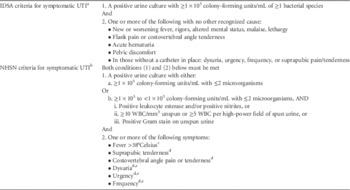
Multiple criteria for symptomatic urinary tract infections (UTI) exist. The 2 major definitions are the clinically oriented criteria from the Infectious Diseases Society of America (IDSA) and criteria from the National Healthcare Safety Network (NHSN), typically used for infection surveillance purposes. Both sets of criteria rely on the presence of symptoms, not bacteriuria or pyuria alone, to diagnose symptomatic UTI and initiate antibiotic treatment per IDSA guidelines. Notable differences exist between these criteria; specifically, IDSA criteria require 1 or more bacterial species, whereas NHSN requires no more than 2 microorganisms (including yeast). Additionally, NHSN criteria consider a fever from any cause as consistent with symptomatic UTI, whereas IDSA criteria require fever without another recognized cause. Although we are unaware of published data examining how these different criteria affect assessment of ASB prevalence and treatment, exploration of this topic may provide insight into strategies for reducing antibiotic overuse. Currently, the IDSA criteria for patient management guides clinician behavior, while hospitals often rely on NHSN criteria for surveillance and reporting.Reference Nicolle, Bradley, Colgan, Rice, Schaeffer and Hooten 4 , Reference Hooten, Bradley and Cardenas 5 , 17
To improve understanding of ASB overtreatment as a potential focus for stewardship programs, we conducted a multicenter study to characterize the burden of antibiotic use for bacteriuria across 3 diverse inpatient hospital settings. We assessed the prevalence of and risk factors for antibiotic treatment for ASB, as well as how these factors vary by different ASB criteria.
METHODS
We performed a multicenter retrospective chart review across 3 diverse hospital settings: a 900-bed tertiary care academic teaching hospital, a 550-bed county hospital, and a 389-bed community hospital. Medical record review was performed for consecutive patients with positive urine cultures from September 1, 2013, through April 30, 2014. Positive urine cultures were identified at each center’s clinical microbiology laboratory. Criteria for inclusion for chart review were: age at least 18 years, an inpatient stay more than1 calendar day, and a urine culture with more than 1×10³ colony-forming units. For patients with multiple positive urine cultures, the first positive culture was evaluated. Patients were excluded if they had an immunocompromising condition (neutropenia, solid organ or stem cell transplant recipient), were pregnant, had a recent or pending urologic procedure expected to cause mucosal bleeding, were discharged within 1 calendar day of urine culture collection, or had a suprapubic catheter, nephrostomy tube, or neobladder. One hundred cultures that fit the above criteria during a predetermined period convenient to the center’s investigative team were obtained from each center. This study was approved by the institutional review board of each participating hospital.
Symptomatic UTI were defined using criteria from the IDSA guidelines (Table 1).Reference Nicolle, Bradley, Colgan, Rice, Schaeffer and Hooten 4 , Reference Hooten, Bradley and Cardenas 5 Patients with bacteriuria without a symptomatic UTI as defined by IDSA criteria were considered to have ASB. We also performed secondary analyses using NHSN definitions of ASB. 17 Within-patient diagnostic concordance between IDSA and NHSN criteria for symptomatic UTI was calculated as the overall percent agreement and Cohen’s kappa value.
Diagnostic Criteria Used to Define Symptomatic Urinary Tract Infection (UTI)

NOTE. IDSA, Infectious Diseases Society of America; NHSN, National Healthcare Safety Network; WBC, white blood cells.
a Urinalysis results do not factor into assessment of a symptomatic UTI.
b NHSN criteria are from 2013; criteria have been subsequently modified to remove urinalysis criteria, among other changes.
c Only applies to patients aged ≤65 years without an indwelling urinary catheter.
d With no other recognized cause.
e Only applies to patients without an indwelling urinary catheter.
Treatment of ASB was defined by medical record documentation of a clinician order for a specific antibiotic treatment for bacteriuria. Patients with a documented reason for antibiotics other than for ASB (eg, pneumonia) were not considered to be treated for ASB. Our primary outcome was antibiotic treatment for ASB (using IDSA criteria) at either day 1 or day 4 (when urine cultures would be finalized) after cultures were taken. Patients on concurrent antibiotic treatment for ASB and non-UTI infection were excluded from bivariate analysis of risk factors for ASB treatment. We also measured the proportion of antibiotic use that was broad-spectrum. On the basis of the consensus of investigators, we defined broad-spectrum antibiotics as beta-lactam/beta-lactamase inhibitor combinations, fluoroquinolones, third- and fourth-generation cephalosporins, fosfomycin, and carbapenems. Multidrug-resistant pathogens were defined as vancomycin-resistant Enterococcus, methicillin-resistant Staphylococcus aureus, and extended-spectrum beta-lactamase–producing and carbapenemase-producing gram-negative bacteria.
Medical record review was conducted by clinicians (physicians at 2 hospitals, pharmacists at 1 hospital) using a standardized data abstraction tool and entered into an electronic database (REDCap, version 5.6.0). Data elements included patient age, sex, urine culture and urinalysis results, presence of urinary catheters, hospital location (intensive care unit [ICU] vs non-ICU), primary service (surgical versus nonsurgical), and involvement of an infectious disease specialist on the day of urine culture collection or the subsequent day. Bacteriuria present on day of admission (hospital day 0) or by hospital day 2 were considered admission-onset; all others were considered hospital-onset. Physician documentation was reviewed to assess for UTI symptoms (Table 1) and concurrent conditions that may contribute to symptoms. Antibiotic treatment both at day 1 and at day 4 after urine culture collection was assessed.
An assessment of interrater reliability was performed at each hospital; 5% of data collected was reviewed by coinvestigators experienced in medical record review, and overall agreement was 96%. Data were analyzed using the χ2 test or Fisher exact test for categorical variables and the t test for continuous variables. Bivariate analysis was conducted to assess factors associated with ASB treatment by calculating odds ratios, 95% confidence intervals, and associated P values. All calculations were performed using SAS statistical software, version 9.3 (SAS Institute).
RESULTS
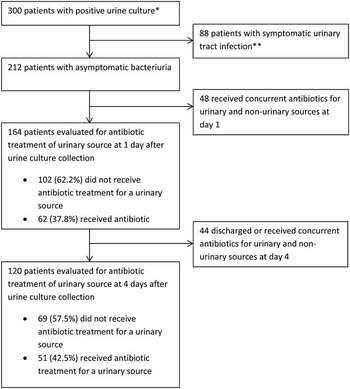
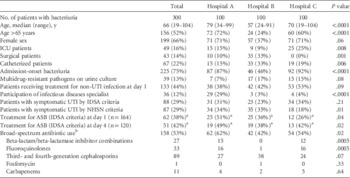
Among the 300 unique inpatients with positive urine cultures from 3 hospitals, the prevalence of ASB using IDSA criteria was 71% (212/300) (Figure 1). Table 2 summarizes the characteristics of all study patients with bacteriuria, regardless of symptoms. The mean age was 67 years; 66% of patients were female. Sixteen percent (49/300) of patients with bacteriuria were in the ICU, and 22% (67/300) were catheterized. Urine cultures were collected within the first 2 hospital days in 75% (225/300). Forty-four percent (133/300) of patients with bacteriuria were on antibiotics for a nonurinary source on day 1 following urine culture collection. Significant differences in patient characteristics between hospitals were seen regarding patient age, ICU status, surgical service, urethral catheterization, admission-onset bacteriuria, presence of infectious disease consultant, and frequency of use of broad-spectrum antibiotics for treatment of bacteriuria.
Patients included in the study analysis. *Patients were adults with an inpatient stay of more than 1 calendar day who were non-immunocompromised and met all inclusion criteria, and no exclusion criteria. These criteria are outlined in the Methods section. **Symptomatic urinary tract infection per Infectious Disease Society of America criteria, as outlined in Table 1.

Descriptive Analysis of All Study Patients With Bacteriuria

NOTE. Data are number (%) of patients unless otherwise indicated. ASB, asymptomatic bacteriuria; ICU, intensive care unit; IDSA, Infectious Disease Society of America; NHSN, National Healthcare Safety Network; UTI, urinary tract infection.
a Percentage represents proportion of ASB patients who received antibiotic therapy, excluding those on concurrent treatment for both UTI and non-UTI indications.
b Broad-spectrum antibiotic use refers to receipt of beta-lactam/beta-lactamase inhibitor combinations, fluoroquinolones, third- and fourth-generation cephalosporins, fosfomycin, or carbapenems, for any indication during the study period.
The most frequent organism isolated from urine culture was Escherichia coli (n=119), followed by Klebsiella pneumoniae (n=36), Enterococcus spp. (n=28), and Proteus mirabilis (n=20). Polymicrobial urine culture results were present in 38% (115/300), and urine cultures with fewer than 1×10⁵ colony-forming units represented 28% (83/300). A urinalysis associated with the urine culture was present in 94% (281/300); leukocyte esterase was detected in 76% (213/281), and nitrites were detected in 27% (77/281). Microscopy identified a leukocyte count of 5 or more cells per high-powered field in 70% (198/281).
Of the 212 patients with ASB, and after excluding 48 patients receiving antibiotics for both UTI and non-UTI indications, the proportion of patients with ASB that received antibiotics for positive urine culture was 38% (62/164) at 1 day after urine culture collection. This proportion increased slightly by day 4 to 43% (51/120, P=.59).
Of patients who received antibiotics for urinary sources at day 1 after urine culture, the prevalence of treatment with broad-spectrum antibiotics was 84% both for those without symptoms (52/62) and for those with symptoms (49/58). For ASB, broad-spectrum antibiotics used were predominantly third- and fourth-generation cephalosporins (n=32), followed by fluoroquinolones (n=13), similar to what was observed in those treated for a symptomatic UTI. Multidrug-resistant pathogens comprised 13% (22/164) of all ASB cultures, also similar to what was observed in patients with symptomatic UTI (13%, 11/88).
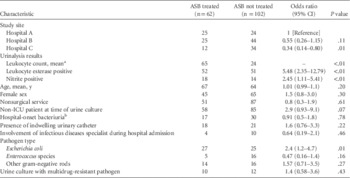
In bivariate analysis, variables associated with ASB treatment were elevated mean urine leukocyte count (65 vs 24 white blood cells per high-powered field, P<.01), hospital identity (hospital C vs A, odds ratio, 0.34 [95% CI, 0.14–0.80], P=.01), presence of leukocyte esterase (5.48 [2.35–12.79], P<.01), positive nitrite (2.45 [1.11–5.41], P=.03), and the presence of E. coli as the primary urine pathogen (2.4 [1.2–4.7], P=.01) (Table 3).
Bivariate Analysis of Patients With Asymptomatic Bacteriuria (ASB) to Evaluate Variables Associated With Treatment at Day 1 Using IDSA Criteria

NOTE. ICU, intensive care unit; IDSA, Infectious Diseases Society of America.
a Measured as white blood cells per high-powered field.
b Hospital-onset was defined as presence of bacteriuria after hospital day 2.
Overall rates of ASB prevalence were no different when IDSA criteria were compared with NHSN surveillance criteria (71% vs 71%). Additionally, overall rates of ASB treatment were also similar when either criterion was applied (38% vs 41%). Within-patient concordance between IDSA and NHSN criteria was 66% (Cohen’s kappa value, 0.52). When bivariate analysis was performed with NHSN, instead of IDSA, criteria, the same factors (hospital identity, elevated urine leukocyte count, presence of leukocyte esterase and nitrite) were associated with ASB treatment.
DISCUSSION
In our study of hospitalized patients with positive urine cultures across 3 different types of hospitals, we observed frequent antibiotic use in patients with positive urine cultures without documented symptoms of UTI. Broad-spectrum antibiotics comprised a high proportion (84%) of treatment, regardless of the presence or absence of UTI symptoms. The proportion of patients treated with antibiotics for ASB did not change from day 1 to day 4 following urine culture, a time by which most urine cultures would have been finalized. Treatment for ASB was not significantly associated with patient characteristics such as age, sex, presence of a urethral catheter, surgical versus nonsurgical service, ICU versus non-ICU setting, or admission-onset bacteriuria but instead primarily was based on results of urine studies. Our findings are comparable with observations from more limited categories of ASB, such as catheterized patientsReference Cope, Cevallos and Cadle 10 , Reference Dalen, Zvonar and Jessamine 11 or patients with enterococcal ASB.Reference Lin, Bhusal, Horwitz, Shelburne and Trautner 12
We found that abnormal urinalysis findings were associated with ASB treatment, a finding consistent with prior observations.Reference Cope, Cevallos and Cadle 10 , Reference Lin, Bhusal, Horwitz, Shelburne and Trautner 12 , Reference Ifran, Brooks, Mithoowani, Celetti, Main and Mertz 13 We hypothesize this finding reflects widespread physician misperception that pyuria with bacteriuria defines infections requiring antibiotic treatment, despite clear guideline recommendations that in the absence of symptoms, pyuria is not an indication for treatment (level A-II evidence).Reference Nicolle, Bradley, Colgan, Rice, Schaeffer and Hooten 4 , Reference Hooten, Bradley and Cardenas 5 Our hypothesis is supported by physician surveys that demonstrate considerable variability in management of bacteriuria,Reference Chant, Dos Santos, Saccucci, Smith, Marshall and Friedrich 18 as well as overall suboptimal knowledge regarding management of catheter-associated bacteriuriaReference Trautner, Petersen, Hysong, Horwitz, Kelly and Naik 19 and the use of urine testing and subsequent treatment.Reference Drekonja, Abbo, Kuskowski, Gnadt, Shukla and Johnson 20
E. coli was the predominant organism isolated from urine culture in our study (40%) and was associated with an increased risk of treatment for ASB. E. coli is the most prevalent agent of uncomplicated cystitis, pyelonephritis, catheter-associated UTI, as well as ASB.Reference Nicolle, Bradley, Colgan, Rice, Schaeffer and Hooten 4 , Reference Hooten, Bradley and Cardenas 5 , Reference Gupta, Hooton and Naber 21 Its known role as the predominant causative pathogen in symptomatic UTI may contribute to a bias towards treatment of asymptomatic patients with E. coli identified in urine culture.
We believe this to be the largest study to specifically address how treatment of ASB contributes to broad-spectrum antibiotic usage. Dalen et alReference Dalen, Zvonar and Jessamine 11 observed ciprofloxacin to be the most common antibiotic used in 15 cases of overtreatment for ASB (33%), and Werner et alReference Werner, Hecker, Sethi and Donskey 22 identified that among all inpatient fluoroquinolone use, 30% was for ASB. Likewise, we observed that broad-spectrum antibiotics comprise a substantial proportion of ASB treatment, thereby potentially contributing to the emergence of multidrug-resistant pathogens and increased rates of C. difficile infection.Reference Shaughnessy, Amundson, Kuskowski, DeCarolis, Johnson and Drekonja 8 The latter is of particular concern, given older age is an established risk factor for C. difficile infection, and our mean patient age was 67 years.Reference Cohen, Gerding and Johnson 23
Multidrug-resistant organisms were identified in 13% (22/164) of patients with ASB, a similar proportion to that observed in patients with symptomatic UTI (13%; 11/88). Overall, the most frequent multidrug-resistant pathogen was extended-spectrum beta-lactamase–producing gram-negative rods (26), followed by vancomycin-resistant Enterococcus (9). We did not observe a significant association between presence of multidrug-resistant urinary pathogens and risk for treatment of ASB, though we were underpowered to test this association. It remains unclear whether ASB with multidrug-resistant bacteriuria represents a risk factor for treatment. A recent investigation of enterococcal ASB found vancomycin resistance did not impact rates of ASB treatment.Reference Khair, VanTassell, Henderson, Warren and Marschall 24
To our knowledge, our investigation is the first to directly compare ASB prevalence using both the IDSA and NHSN criteria. Although ASB prevalence and ASB treatment rates were similar when comparing the IDSA with NHSN criteria, the diagnostic concordance between criteria was only moderate (kappa, 0.52).Reference Viera and Garrett 25 Diagnostic discordance was largely attributed to differences in the number of organisms present on urine cultures. This finding may have implications for antibiotic stewardship programs that utilize NHSN surveillance criteria to identify cases for potential intervention; we postulate clinicians may be more comfortable referencing the clinically oriented IDSA guidelines, rather than NHSN surveillance criteria, when faced with antibiotic stewardship program treatment recommendations.
We did not find an association between an infectious disease physician participation in the patient’s care and reduced frequency of ASB treatment, though our study was underpowered to detect such an association. Educational efforts using infectious disease specialists have been shown to reduce the incidence of inappropriate ASB treatment.Reference Pavese, Saurel and Labarere 26 Our observations suggest that infectious disease specialists are involved in only a small proportion of patients with ASB (9%; 14/164), thus limiting the opportunity to impact overall hospital antibiotic usage. This supports the role for a stewardship program that promotes guideline-concordant antibiotic use targeting all clinicians.
We observed significant differences in baseline patient characteristics across each hospital in our 3-hospital survey. Differences were observed in age, as well as in proportion of patients in the ICU, on a surgical service, with a urethral catheter, and with admission-onset bacteriuria (Table 2). Despite these underlying differences, treatment for ASB remained frequent at each hospital, ranging from 26% to 51%. Additionally, bivariate analysis found that only results of urine studies, and not patient-specific variables such as age or presence of a catheter, were associated with antibiotic treatment for ASB. Together, these findings suggest ample stewardship opportunities exist across a wide variety of inpatient settings.
Strengths of this study include its multicenter design encompassing a diverse inpatient setting and incorporating both catheterized and noncatheterized inpatients. This study represents one of the largest evaluations of appropriate ASB antibiotic treatment in hospitalized patients, and to our knowledge it is the only study to specifically address issues pertinent to antibiotic stewardship programs, including the impact on broad-spectrum antibiotic usage and the way that different criteria might impact interventions. We used standardized criteria to assess for UTI symptoms and utilized a standardized data collection tool that yielded high interrater reliability. Limitations include the retrospective study design and possibility that physicians underdocumented UTI symptoms, contributing to an overestimate of ASB. The diagnosis of nonurinary infections was not standardized and relied on clinical documentation, which may have impacted our assessment of ASB treatment prevalence. This study excluded immunocompromised patients, pregnant women, and those with advanced urologic conditions, limiting the generalizability of our findings to these patient populations. However, the IDSA treatment recommendations also exclude these patient groups, thus enhancing the validity of our analysis. Finally, we excluded patients who were discharged within 1 day of urine culture collection, so our findings do not reflect the burden of antibiotic usage for ASB in the outpatient setting.
This study has important implications for the emerging field of antibiotic stewardship. First, opportunities for improving guideline-concordant antibiotic therapy for bacteriuria exist across a wide spectrum of hospitalized patients. These opportunities appear most abundant in reducing third-/fourth-generation cephalosporin and fluoroquinolone use predominantly in patients aged more than 65 years, which are both established risk factors for C. difficile infection.Reference Cohen, Gerding and Johnson 23 , Reference Slimings and Riley 27 Thus, reducing antibiotic use for ASB aligns well with the primary goal of antibiotic stewardship, which is to optimize antibiotic use and minimize unintended consequences.Reference Dellit, Owens and McGowan 28 Second, educational efforts targeting appropriate interpretation of urinalysis results may be effective, since this appears to be the predominant risk factor associated with ASB treatment. Education for clinicians should reinforce that the diagnosis of a UTI requiring antibiotics is not a laboratory diagnosis based on urinalysis results, but a clinical diagnosis based on symptoms. Third, criteria developed for epidemiologic infection surveillance (such as NHSN criteria) are not always consistent with treatment guidelines developed for clinical management of individual patients (such as IDSA guidelines). Stewardship interventions must be mindful of these discrepancies and not rely only on surveillance criteria for identifying opportunities to reduce antibiotic use.
In conclusion, we observed treatment for ASB to be common across diverse adult inpatient populations and to contribute to the use of broad-spectrum antibiotics. Our analyses reveal that for a substantial group of hospitalized patients, the results of urine studies appear to drive antibiotic treatment regardless of the absence of symptoms. Treatment of bacteriuria with pyuria in the absence of symptoms conflicts with evidence-based clinical guideline recommendations. Although infectious disease specialists can model appropriate care for hospitalized patients with UTI, our data show that infectious disease specialists are involved in only a small minority of hospitalized patients with ASB. Since antibiotic management of bacteriuria involves a diverse set of clinicians, antibiotic stewardship intervention applied to a broad spectrum of clinical specialties has the potential to improve guideline-concordant antibiotic therapy and reduce ASB treatment. Given the high prevalence of treatment among patients with ASB, additional evaluation of programs to reduce ASB treatment may be critical to ongoing efforts to halt unnecessary antibiotic use.
ACKNOWLEDGMENTS
Financial support. UCLA Clinical and Translational Science Institute, National Institutes of Health/National Center for Advancing Translational Science (grant UL1TR000124).
Potential conflicts of interest. All authors report no conflicts of interest relevant to this article.