Since the development of modern survey methods, political scientists have identified gender-based differences in the political behavior of men and women. Early research found women to be less politically engaged than men and to be more likely to vote for right-wing parties (Lipset Reference Lipset1963). Beginning in the 1980s, however, these differences in political participation dissipated, and the gender-based pattern in vote choice was reversed (DeVaus and McAllister Reference De Vaus and McAllister1989; Inglehart and Norris Reference Inglehart and Norris2000). These gender differences in political behavior, and the many others that could be added here, are commonly referred to as “gender gaps.”
While the concept of gender gaps has certainly contributed to our understanding of political behavior, this scholarship tends to focus on women as a collective group in comparison to men. The result is that the differences among women are often not the central focus of analysis (Gidengil Reference Gidengil2007; Lien Reference Lien1998). Yet Gidengil (Reference Gidengil2007, 821) argues that differences among women can affect political behavior, too, and she encourages scholars to examine how race, class, gender, and other cleavages interact to differentiate women.
In this article, we pursue this type of analysis by focusing on Aboriginal peoples. Beyond the basic value of establishing whether Aboriginal gender gaps exist—there is no quantitative evidence for the existence of these gender gaps—examining Aboriginal political behavior necessarily entails an analysis of the intersection of issues of race, class, and gender. It is our contention that those interested in how these cleavages differentiate women and exert an impact on political behavior can learn a great deal by focusing on these populations. Specifically, we examine the political participation and attitudes of Canadian Aboriginal women in comparison to both Aboriginal men and non-Aboriginal women in Canada. The analysis is anchored by two questions: Are there Aboriginal gender gaps in Canadian electoral politics? If so, what is the nature and scope of these gaps? The contemporary literatures on political behavior and Aboriginal politics offer two possible answers to these questions, which we have termed the “inequality hypothesis” and the “colonialism hypothesis.”
The inequality hypothesis suggests that Aboriginal gender gaps exist and that they parallel their non-Aboriginal counterparts. The basis for this set of propositions is the political behavior literature on gender gaps that makes significant connections between gender-based inequalities and political participation and attitudes (e.g., Burns, Schlozman and Verba Reference Burns, Schlozman and Verba2001; Verba, Schlozman, and Brady Reference Verba, Schlozman and Brady1995; Welch Reference Welch1977). Because Aboriginal women face many of the same inequalities as non-Aboriginal women, there is good prima facie evidence for believing that Aboriginal gender gaps exist and that they mirror the ones found in the general population.
In contrast, the colonialism hypothesis puts forward that Aboriginal gender gaps exist but manifest distinctive qualities. The Aboriginal politics literature highlights the central role colonialism plays in the lives of all Aboriginal peoples (Tully Reference Tully2008, 258–65) as well as the fact that colonialism has gendered outcomes (Lawrence Reference Lawrence2003). As a result, this literature advances the expectation that we will find significant gender-based differences in Aboriginal peoples' political participation and attitudes. At the same time, the literature illustrates that, given the centrality of colonialism, we should be cautious in generalizing conclusions drawn from general—and largely non-Aboriginal—population samples to the particular circumstances of Aboriginal peoples. In short, the Aboriginal politics literature lends credence to the idea that Aboriginal gender gaps exist, but it indicates that these gaps should differ from the ones identified in the broader behavior literature.
Our analysis draws on data from three Canadian surveys: the 2004 Canadian Elections Study (CES), the 2001 Equality, Security and Community (ESC) Survey, and an Aboriginal subsample of the 2004 wave of the ESC study (ESC_A). Ultimately, we conclude that Aboriginal gender gaps do indeed exist and that, at least in Canada, vote choice is one of the variables where a gender gap is most prevalent. While the analysis provides some evidence supporting the inequality hypothesis, the magnitude and character of the Aboriginal gender gap in vote choice provides clear support for the colonialism hypothesis.
THE INEQUALITY AND COLONIALISM HYPOTHESES
Explanations for gender gaps can be divided into three main categories: situational, structural, and socialization (Welch Reference Welch1977). Situational and structural accounts are both linked to the social roles traditionally occupied by women. Situational accounts advance that women who are mothers and caregivers have less time for politics and less access to the politicizing experiences of life outside the home (Studlar, McAllistar, and Hayes Reference Studlar, McAllister and Hayes1998; Tedin, Brady, and Vedlitz Reference Tedin, Brady and Vedlitz1977). Structural accounts relatedly emphasize how gender roles translate into aggregate differences in the numbers of women in various politicizing institutions, such as the workforce and higher education (Carroll Reference Carroll and Mueller1988; Everitt Reference Everitt1998; Schlozman, Burns, and Verba Reference Schlozman, Burns and Verba1999). Socialization accounts, by contrast, focus on sociopsychological factors, such as gendered conceptions of morality (Gilligan Reference Gilligan1982), the acceptance of traditional gender roles (Bennett and Bennett Reference Bennett and Bennet1989), or the development of gender-based political consciousnesses (Conover Reference Conover1988; Everitt Reference Everitt1998). In short, all of these theories illustrate how women's lived experiences, whether in the family, in the workforce, or in a patriarchal society more generally, influence their politics. While these explanations vary, a common theme is a recognition that gaps in political participation and attitudes result from gender-based inequalities.
There is reason to believe that such inequalities are present among both non-Aboriginal and Aboriginal women in Canada. In Canada, men and women experience very different economic, social, and political realities. For example, on average, women still earn less income than men (Statistics Canada Reference Canada2006, 133).Footnote 1 Women are overrepresented in short-term contract employment and part-time work, and they are concentrated in particular occupations (Statistics Canada Reference Canada2006, 109–113).Footnote 2 Women are at greater risk than men of experiencing sexual assault and criminal harassment (Statistics Canada Reference Canada2006, 159). And, as political scientists emphasize, women are underrepresented in government at the municipal, provincial, and federal levels (Trimble Reference Trimble and Abu-Laban2008, 79). These examples—and the many others that could be added to this list—reveal the significant inequality of condition experienced by Canadian women.
All of the examples cited above also characterize the position of Aboriginal women in Canada. In fact, Aboriginal women experience these inequalities to a greater degree. They suffer higher rates of poverty (Native Women's Association of Canada 2009, 6–7), more employment insecurity (Native Women's Association of Canada 2009, 6–7), and greater probabilities of being subjected to violence than other women or Aboriginal men (Statistics Canada Reference Canada2006, 163). In effect, Aboriginal women face the same gender inequalities as non-Aboriginal women but fare far worse. The similar inequalities conditioning the lives of both Aboriginal and non-Aboriginal women in Canada provide cause to place some faith in the inequality hypothesis. In combination, the literature on gender gaps and the inequality of condition experienced by Aboriginal and non-Aboriginal Canadian women allows us to speculate that Aboriginal gender gaps probably exist and that they most likely mirror the ones identified in the existing scholarship.
Of course, Aboriginal politics give us good reasons to doubt an explanation founded solely in the inequality hypothesis. This scholarship highlights the central role played by colonialism in the lives of all Aboriginal peoples. While the colonialism hypothesis has clear implications for the socioeconomic resources available to Aboriginal peoples, it forces us to consider the uniqueness of Aboriginal experiences with the state. As a result, it problematizes the utility of generalizing from non-Aboriginal to Aboriginal populations.
For instance, insofar as there has been progress toward sex equality in Canada, it has been the product of the work of feminists and their organizations. Yet Aboriginal women have not always felt at home in these organizations. According to Green (Reference Green1993, 111), until the early 1990s, very few Aboriginal women self-identified as feminists. While the number of Aboriginal feminists may have increased over the years, Udel (Reference Udel2001, 43) contends that many politically active Aboriginal women still “articulate a reluctance to affiliate with white feminist movements.” She argues that Aboriginal women believe that their agenda is quite different from the one pursued by feminist organizations. Importantly, for a number of scholars, the issue dividing Aboriginal women and non-Aboriginal women is not simply one of tactics or organizational politics; rather, it is feminism itself. Feminism, it is said, is a political philosophy made by—and for—white, middle-class women. Mayer (Reference Mayer2007, 23), for example, argues that for many Aboriginal women “feminism [i]s about asserting one's right to be like white men.” Thus, even though all Canadian women experience gender-based inequalities, the primary response of non-Aboriginal women to this situation (that is, equality seeking vis-à-vis feminism and feminist organizations) is rarely the response of Aboriginal women.
Scholars of Aboriginal politics account for the uneasy relationship between feminism and Aboriginal women by advancing that Aboriginal and non-Aboriginal women are actually involved in two different struggles (for example, see St. Denis Reference St. Denis, Hobbs and Rice2013). For these scholars, non-Aboriginal women are struggling to achieve gender equality, while Aboriginal women are struggling to end the colonial relationship between Aboriginal peoples and the state (Jaimes and Halsey Reference Jaimes, Halsey and Jaimes1992).Footnote 3 From this view, equality is not the proper analytical lens for understanding the political behavior of Aboriginal women (or Aboriginal men, for that matter). Instead, colonialism is the correct focus for such an analysis.
Colonialism begins with the involuntary incorporation (historically achieved through force or fraud) of one political community into another and entails the latter community's exercise of dominion over the former community. Thus, domination is a principal characteristic of colonialism. In Canada, many Aboriginal nations never concluded treaties with the Crown, and, even where treaties do exist, many Aboriginal peoples deny that these treaties entailed the surrender of Aboriginal sovereignty (Henderson Reference Henderson1994).Footnote 4 Accordingly, Aboriginal peoples put forward that their ancestors were incorporated into what became the Canadian state without their consent. Furthermore, past and present government policies relating to Aboriginal peoples have facilitated the economic, social, and political domination of Aboriginal peoples. The Indian Act, residential schools, the placement of Aboriginal children in state care, the usurpation of traditional territories (Borrows Reference Borrows, Walken and Bruce2003, 224), and court-defined Aboriginal rights (Panagos Reference Panagos2007) reflect these types of domination. The consensus among scholars of Aboriginal politics is that the relationship between Aboriginal peoples and the Canadian state was, and still is, a colonial one (Green Reference Green2000; Ladner Reference Ladner2005; Panagos Reference Panagos2012; Tully Reference Tully1995). Thus, it is a relationship that entails the domination of Aboriginal peoples by non-Aboriginal peoples and the Canadian state.
Domination is not the only important characteristic of colonialism. There is an emerging recognition in the Aboriginal politics scholarship that colonialism (both in its historic and contemporary forms) is a gendered experience with gendered outcomes. In effect, past and present state policies differentiate between Aboriginal men and women to the detriment of the latter (Lawrence Reference Lawrence2003; McGrath and Stevenson Reference McGrath and Stevenson1996;). In Canada, the case of official recognition as an Aboriginal person (that is, being recognized by the federal government as a “status Indian”) is an illustrative example. When governments in Canada bestowed upon themselves in the nineteenth century the authority to define who is and who is not a status Indian, they not only imposed European norms on this area of life, but they also imposed patriarchal norms. Before legislative changes in 1985, Aboriginal women who “married out”—that is, married nonstatus Aboriginal men—lost Indian status, even if their spouses were Aboriginal. Loss of this status is important because status was/is necessary to reside on reserves and participate in Aboriginal governments, and it is a requirement for certain government programs and benefits. Aboriginal men with this status who married out, on the other hand, did not lose their status and could even pass it on to their spouses (even if their wives were not Aboriginal). For many scholars, these sexist legislative provisions were justified by patriarchal conceptions of the family that held that the legal status of women and children should be determined by their husbands and fathers (Barker Reference Barker2006; Kirk Reference Kirk2002; Lawrence Reference Lawrence2003, Reference Lawrence2004).Footnote 5
The status example is intended to demonstrate that even though colonialism affects all Aboriginal peoples, Aboriginal women and men face different obstacles and challenges as a result of colonialism because the colonial state exercised (and still exercises) its control over Aboriginal peoples in gender-specific ways. In short, many of the experiences and outcomes of colonialism are gendered. It is this last point that underpins Lawrence's (Reference Lawrence2004, 46) position that “[i]t is crucially important, then, to understand the central role that the subordination of Native women has played in the colonization process.” Indeed, Aboriginal women are in many ways the most vulnerable and the most marginal individuals in the country. For scholars such as Jaimes and Halsey (Reference Jaimes, Halsey and Jaimes1992, 331), the gendered dimension of colonialism explains why Aboriginal women put themselves “at the very center of the fray” in Aboriginal struggles to bring an end to these colonial relationships. As with other marginalized communities, then (e.g., Cole and Stewart Reference Cole and Stewart1996; Tate Reference Tate1991), we might expect Aboriginal women to be more engaged than their male counterparts, at least in some forms of politics.
In many ways, the history of Aboriginal-state relations in Canada is a story about Aboriginal resistance to colonialism. Aboriginal peoples have employed a range of strategies—from passive resistance to armed revolt—to challenge the colonial character of these relations (Tully Reference Tully2008, 258–88). In this respect, resistance is a constitutive characteristic of the colonial relationship. In Canada, Aboriginal reserves have been very important to the anticolonial struggle. Reserves provide Aboriginal peoples with key resources for mobilization (e.g., material, ideational, and human resources). In fact, many of the prominent representatives of Aboriginal organizations have deep roots in reserve-based communities. In short, the reserve is a central site for Aboriginal mobilization and anticolonial resistance; it is a place where many Aboriginal peoples confront colonial domination and its gendered repercussions.Footnote 6
If we turn back to the question of Aboriginal gender gaps, the Aboriginal politics literature brings two things to our attention. First, given the way in which this literature characterizes colonialism (in particular, the gender dimensions of this concept), scholars have sufficient cause to think that there may indeed be Aboriginal gender gaps, although the nature and scope of these gaps are unclear. This literature also gives scholars cause to doubt that conclusions drawn from the general—and largely non-Aboriginal—population can be extended to the particular circumstances of Aboriginal men and women. While both the political behavior and Aboriginal politics literatures recognize how the respective patriarchal and colonial systems of domination have consequences for the material resources of women and Aboriginal peoples, they offer very different explanations for the processes that create these inequalities and for the ways in which these processes influence differently situated people.
As a result, the inequality and colonialism hypotheses provide distinct expectations for what types of gaps we should observe and how to understand them. The inequality hypothesis clearly suggests that we should observe a traditional gender gap among Aboriginal peoples, given the particularly precarious socioeconomic and political situation of Aboriginal women. The colonialism hypothesis, however, provides us with an explanation for how to situate differences between this gap and that of non-Aboriginals. Colonialism, not patriarchy, from this perspective, is the cause of fewer socioeconomic resources among both Aboriginal men and women. Beyond this, the colonialism hypothesis also suggests that Aboriginal women (especially those living on reserves) might be particularly mobilized in the struggle against colonial domination while simultaneously raising questions about whether this mobilization will be directed at traditional electoral institutions of the state.
DATA AND METHODS
In order to assess whether there is, in fact, an Aboriginal gender gap in political behavior and the contours of any gap that exists, we rely on three surveys. The first is the 2004 CES, a nationally representative sample of Canadians conducted during the 2004 federal election campaign (N = 4,323). The second is the Equality, Security and Community (ESC) Survey, which includes a general population survey conducted in 2001 (N = 5,152), as well as a unique subsample of Aboriginal Canadians (which we consider our third survey and refer to as the ECS_A). The data come from a 2004 survey in the provinces of Alberta, Saskatchewan, and Manitoba (N = 608).Footnote 7 The Aboriginal subsample is not a nationally representative sample, but it provides an important source of data on Aboriginal peoples' political attitudes and activities. Alberta, Saskatchewan, and Manitoba are key provinces for examining Aboriginal politics because they contain the highest number of Aboriginal people as a proportion of the total provincial populations.Footnote 8 We use the CES for comparisons of turnout and vote choice (as these are related to the 2004 federal election) and the ESC for attitudinal and other participation measures where question wording is identical.Footnote 9
We investigate, in particular, two areas where the literature suggests we should find gender-based differences: (1) political participation (with women having lower levels of involvement in traditional political organizations than men); and (2) vote choice (with women being more likely to vote for parties of the left than men). Where differences do emerge, we use multivariate techniques to determine the extent to which these differences can be accounted for by traditional correlates of the gender gap and what role Aboriginal politics may play in explaining Aboriginal women's political attitudes and practices. With regard to traditional correlates of gender gaps, the analysis focuses on situational (marital status) and structural (education, income, and employment status) variables. With regard to Aboriginal politics, even though only a few quantitative variables are capable of illuminating this facet of the analysis, we focus on whether or not respondents live on a reserve and on their attitudes toward Aboriginal issues.
RESULTS
Electoral and Nonelectoral Participation
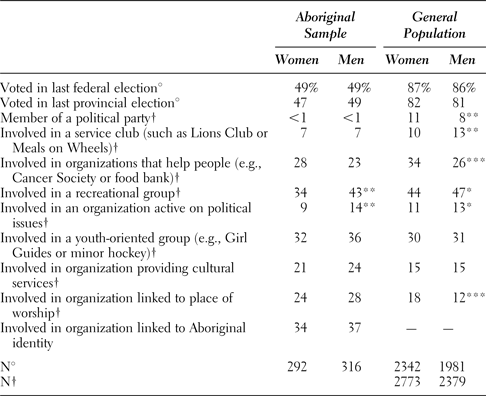
Past research suggests that the gap in participation between men and women has largely disappeared over time. We should find similar levels of turnout between men and women, but outside the ballot box, men should be more involved in political and “stereotypically male” activities, while women should be more involved in religious and service-oriented organizations and groups associated with helping others (Coffé and Bolzendahl Reference Coffé and Bolzendahl2010; Harell Reference Harell2009; Lowndes Reference Lowndes2000). The data presented in Table 1 generally confirmed the expectation in the general population with respect to turnout. There is no difference in turnout rates between men and women. In terms of associational involvement, the patterns largely conform to expectations as well. More men report involvement in recreational groups and political organizations active on a political issue while more women are members of religious organizations and organizations that help people.Footnote 10
Gender gaps in social and political participation

Note: ***p < .01; **p < .05; *p < .10. The general population estimates have been weighted.
Source: The Aboriginal subsample is from the Equality, Security and Community Survey, 2004 Aboriginal sample. For the general population estimates, †indicates Equality, Security and Community 2001 Survey, and °indicates the 2004 Canadian Election Study.
If we consider the Aboriginal sample, we observe some interesting similarities (see Table 1). As with the general population, there is no gender gap in turnout between Aboriginal men and women. Aboriginal women are also less likely than Aboriginal men to be involved in recreational and explicitly political organizations. Both of these findings mirror the patterns observed for the general population and our expectations. None of the other gaps are significant (although this may in part be due to the smaller Aboriginal sample size). Thus, we find some gender gaps in participation consistent with the existing political behavior literature.
More striking than the gender gaps between men and women, in either sample, are the stark differences between Aboriginal peoples and the general population. In terms of turnout in both federal and provincial elections, both Aboriginal men and women are only about half as likely to vote as men and women in the general population (see also Harell, Panagos, and Matthews Reference Harell, Panagos, Matthews, White, Peters, Beavon and Dinsdale2011). In terms of party membership, a much smaller proportion of Aboriginal people (less than 1%) report that they have been a member of a political party in the last twelve months. Formal channels to politics, like the voting booth and party membership, seem to be either less accessible or intentionally avoided by both Aboriginal men and women (see Harell, Panagos, and Matthews Reference Harell, Panagos, Matthews, White, Peters, Beavon and Dinsdale2011). Not surprisingly, given the literature on Aboriginal politics, involvement in Aboriginal organizations is, in contrast, quite high. For men, it is the most common type of organizational involvement (37%). Women participate at almost the same level as men (34%), making it the third most common form of participation for women.
Few differences, then, are observed in the amount of participation between Aboriginal women and men, so we have little support for the inequality hypothesis. The differences that do emerge are consistent with gendered socialization, where men tend toward more “masculine” domains like politics and sports. These gender-based differences, however, are small in comparison to the differences between Aboriginal peoples and the general population. We take this to be consistent with the colonialism hypothesis. Colonialism not only affects all Aboriginal people's access to important socioeconomic resources that facilitate participation, but it also raises questions about the legitimacy of state institutions to represent Aboriginal people's interests. This latter point is particularly relevant if we consider that, as a group, involvement in specifically Aboriginal associations is quite high for both men and women. Furthermore, Aboriginal people appear to be more active in associations linked with culture and community more generally (such as youth-oriented groups, cultural organizations, and religious organizations) than non-Aboriginals. These activities are likely occurring within Aboriginal communities themselves.Footnote 11
Vote Choice
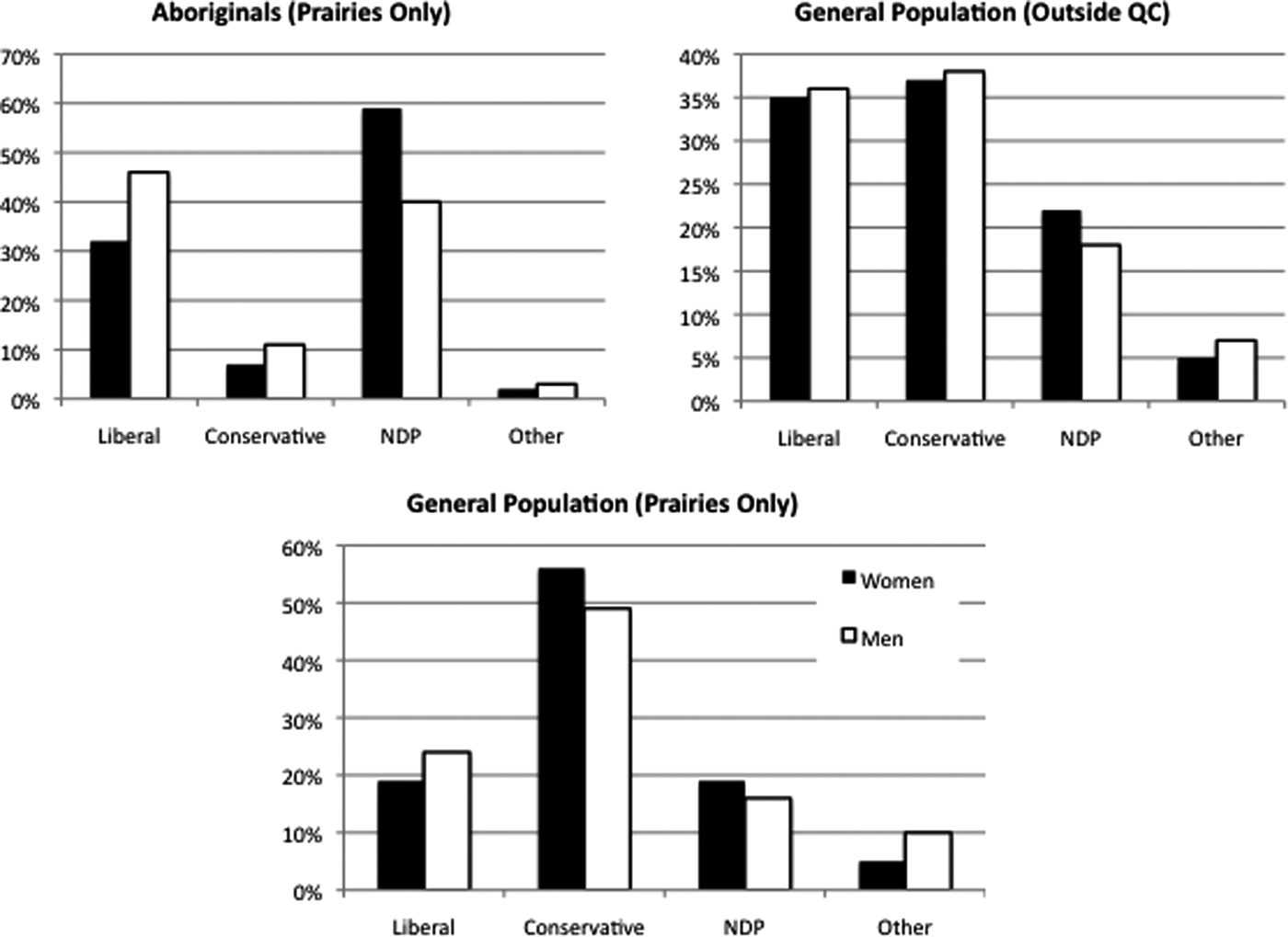
When it comes to vote choice, the scholarship reveals persistent gender gaps. Women in Canada, just like women in other industrialized democracies, are more likely to vote for parties on the left, while men are more likely to vote for parties on the right (Everitt Reference Everitt1998; Gidengil Reference Gidengil1995; Gidengil et al. Reference Gidengil, Blais, Nevitte, Nadeau, Tremblay and Trimble2003, Reference Gidengil, Hennigar, Blais and Nevitte2005; Inglehart and Norris Reference Inglehart and Norris2000). Figure 1 presents vote choice by sex for the CES general sample; the CES data for just Alberta, Saskatchewan, and Manitoba; and the Aboriginal sample.Footnote 12 We single out the three Canadian Prairie provinces because the Aboriginal sample we employ is drawn exclusively from these provinces, and region is an enduring predictor of vote choice in Canada (Blais Reference Blais2005; Gidengil et al. Reference Gidengil, Blais, Nadeau and Nevitte1999).
Gender gaps in vote choice, 2004.
Our analysis of the CES general sample corresponds with the findings on vote choice contained in the literature, with 22% of women and 18% of men supporting Canada's party of the left, the New Democratic Party (NDP). But an examination of vote choice in just the three Prairie provinces yields a more complex picture. The Liberal Party (Canada's party of the center) only garnered 19% of the female vote and 24% of the male vote. Although the differences here in vote choice between men and women are small, they are in the expected direction for the NDP. Interestingly, when compared to men (49%), women (56%) appear more likely to select the Conservative Party (Canada's party of the right). It should be noted, however, that these differences fall short of statistical significance (p = .113). Given the literature on regionalism in Canada, it is not all that surprising that partisan preferences in the Prairie provinces are quite distinct from the overall national picture.
A comparison of these distributions of vote choice with the distribution among Aboriginal people (Figure 1) reveals a remarkable lack of Aboriginal support for the Conservative Party, the party that had overwhelming support among the more general population in these provinces. Among both Aboriginal men (11%) and women (7%), support for the Conservative Party was about five times less than among the general population. What is equally striking is the substantial Aboriginal support for the NDP given its relatively low levels of support in the general population. Of Aboriginal women and men, 59% and 40%, respectively, report voting for the NDP. The Aboriginal vote choice distribution represents a substantial departure from the patterns observed in the three Prairie provinces for the population as a whole. Moreover, the Aboriginal vote choice distribution represents a significant gender gap in Aboriginal support for the NDP—a gender gap that is far larger than the one observed among the general population.Footnote 13 The NDP was clearly the choice of Aboriginal women. Aboriginal men, on the other hand, were slightly more likely to favor the Liberal Party, with 46% voting Liberal.
Why do Aboriginal women demonstrate such a propensity to vote for Canada's party of the left (that is, the NDP)? Can traditional explanations account for the large gender-based difference in Aboriginal vote choice? The NDP is Canada's social democratic party. It does particularly well in the Atlantic provinces of the country, among union members, the unmarried, and those with no religious affiliation (Blais et al. Reference Blais, Gidengil, Nadeau and Nevitte2002). Upon first glance, however, these regional and sociodemographic factors do not seem to explain why Aboriginal women, in particular, would be so inclined to vote NDP.
One possible explanation may be the NDP's policy positions. According to Tremblay and Pelletier (Reference Tremblay and Pelletier2000), an important factor that explains the NDP's success at attracting female voters is its support for social welfare policies. As past research indicates (see, for example, Gidengil et al. Reference Gidengil, Blais, Nevitte, Nadeau, Tremblay and Trimble2003), women tend to be more supportive of the welfare system and public health care than men, and less supportive of the military and “get tough” approaches to crime prevention. Specifically, social welfare policies reflect women's real interest in these domains (because, for example, women are more likely to be primary caregivers or rely on some of the programs affiliated with the welfare state), and women are socialized to prioritize programs that are care-oriented, like social welfare policies. All of this makes the NDP a logical choice for women. If Aboriginal women are more left-leaning than both Aboriginal men and their non-Aboriginal counterparts, then this could account for the relatively large Aboriginal gender gap in vote choice. And, this result would be consistent with the inequality hypothesis.
The colonialism hypothesis, however, suggests that Aboriginal peoples in general, and perhaps Aboriginal women in particular, may be attracted to the NDP for other reasons. From a colonialism perspective, we expect that the NDP's policies on Aboriginal-state relations would be the basis for an alternative explanation. Since the late 1960s, the NDP at the national level has been quite supportive of Aboriginal rights (Tester, McNicoll, and Forsyth Reference Tester, McNicoll and Forsyth1999), including Aboriginal attempts to restructure the relationship between Aboriginal peoples and the Canadian state and Aboriginal nation-building efforts more generally.Footnote 14 The NDP, with its consistent and sympathetic stances on issues such as these that are important to Aboriginal communities, in many ways represents a natural choice for Aboriginal voters.Footnote 15 In a report released prior to the 2006 election, the Assembly of First Nations (AFN) (2006, 4), which is arguably the most influential Aboriginal organization in Canada, went so far as to state that “[t]he NDP continue to represent one of the strongest allies of First Nations in Parliament. Their support on all key issues is very strong.” Tester and colleagues (Reference Tester, McNicoll and Forsyth1999) echo this assessment with their historical analysis of the NDP (and the CCF, which preceded it) from 1926 to 1993, finding that the NDP/CCF played an important role in federal policy related to Aboriginal peoples.
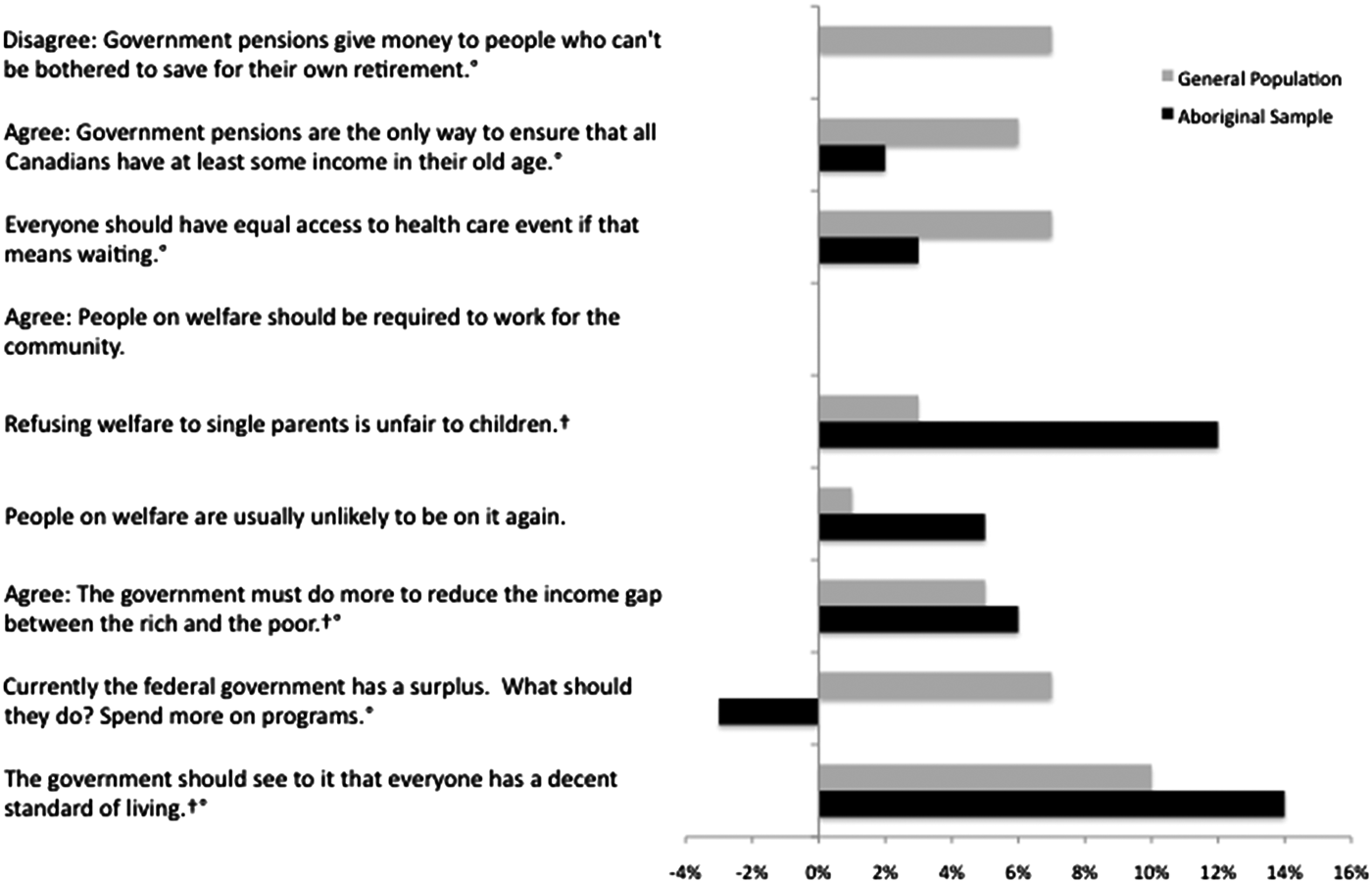
The ESC survey, which focuses on the welfare state, allows us to test these two policy-based accounts in order to establish if (and which set of) the NDP's political positions explain the large Aboriginal gender gap in vote choice. Figure 2 provides the percentage point gap in support for a variety of welfare state policies (e.g., redistribution of wealth, social assistance, health care, and pensions). For both the general population and for the Aboriginal sample, we subtract the percentage of women providing the left-leaning response from the percentage of men agreeing with the left-leaning response.
Gender gaps in public opinion.
Figure 2 clearly demonstrates that gender gaps are present across a variety of welfare state policy areas and that in every case but one, more women provide a left-leaning response than men. For the general population, 6 out of 9 are significant at the <.05 level, and these significant differences range from 5 to 10 percentage points. In the case of Aboriginal women, fewer differences are significant. This finding is perhaps not all that unexpected given the substantially smaller Aboriginal sample size. But in all but one case, the differences are in the expected directions. And in three cases, the differences reach statistical significance.
We have some support, then, that attitudinal gaps exist among Aboriginal women and men that parallel salient gaps in policy support among the general population. Yet while Aboriginal women are particularly likely to vote NDP in the Prairies, both Aboriginal women and men selected the NDP far more often than did their non-Aboriginal counterparts. These gaps cannot explain the fact that more women than in the general population here actually voted for the Conservative party. Nor can these gaps explain the fact that Aboriginal men were more than twice as likely to vote for the NDP than their male counterparts in the general population.
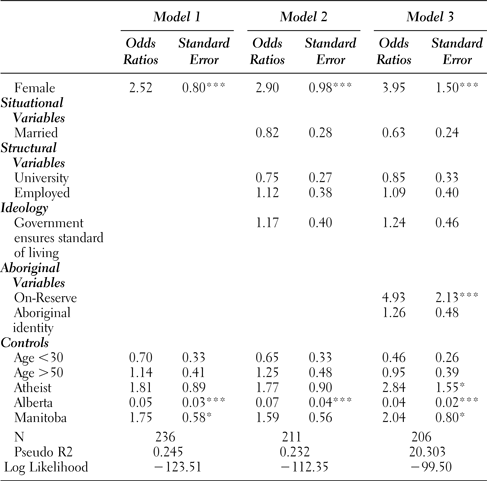
The voting behavior literature suggests that these differences could also result from differences in the socioeconomic situations of these various groups. In order to address this possibility, we modeled the NDP vote for Aboriginal women in three steps (Table 2). First, we examined whether being a woman increases the likelihood of voting NDP, even after controlling for other demographic characteristics (age, religion, and province). Second, we added situational, structural, and ideological factors. Finally, we incorporated variables specifically linked to the Aboriginal experience, namely whether the respondent lives on a reserve and whether the respondent identifies first as Aboriginal (compared to Canadian).Footnote 16 In doing so, we separated the relative impact of the variables linked to the inequality hypothesis and the colonialism hypothesis.
Modeling NDP vote (logistic regression)
Source: Equality, Security and Community Survey, 2004 Aboriginal sample.
In Model 1, we see that the gender variable is indeed significant in the Aboriginal sample, even after controlling for demographic characteristics. In Model 2, we examine three sets of variables linked to the inequality hypothesis: inequalities linked to women's situation, their access to the politicizing institutions of higher education and paid employment, and their ideological orientation. By controlling for these variables, we assess whether this reduces the direct effect of gender on vote choice. The results in Table 2 illustrate two things. First, none of the variables linked to the inequality hypothesis has a significant direct effect on voting for the NDP, and they do not improve the explanatory power of the model. Second, their inclusion does not reduce the size of the gender coefficient. Gender remains a powerful predictor of vote choice among Aboriginal people, and this support does not seem to be based in situational, structural, or ideological differences between Aboriginal men and women.
The colonialism hypothesis raises other possible explanations for the gaps observed in Figure 1. First, it suggests we might find bigger differences between Aboriginal people and non-Aboriginals than between men and women within each group. Second, it suggests that Aboriginal women may be particularly mobilized around issues of Aboriginal rights. Clearly, the first of these expectations is evident in Figure 1.
Yet we might also expect that certain Aboriginal people will be more mobilized than others. On-reserve Aboriginal people are geographically concentrated (making the pay-off for party mobilization efforts in these communities more clear). The reserve itself can be an efficient conduit for the transmission of information about which parties best represent the community's interests given the presence of reserve-based organizations, as well as the fact that living on a reserve may increase the strength of one's identification as Aboriginal.Footnote 17 With this in mind, the NDP's support for Aboriginal rights and Aboriginal nation-building may explain why Aboriginal people who live on-reserve are more likely to support the NDP.
In Table 2, we are able to test the effect of these two variables (reserve status and Aboriginal identity) on NDP voting. Among Aboriginal peoples, reserve status appears to have the largest effect on the odds of voting NDP of any variable in the model. Aboriginal peoples living on-reserve are almost five times more likely to vote NDP than Aboriginal peoples living off-reserve. We find no similar effect for Aboriginal identity.
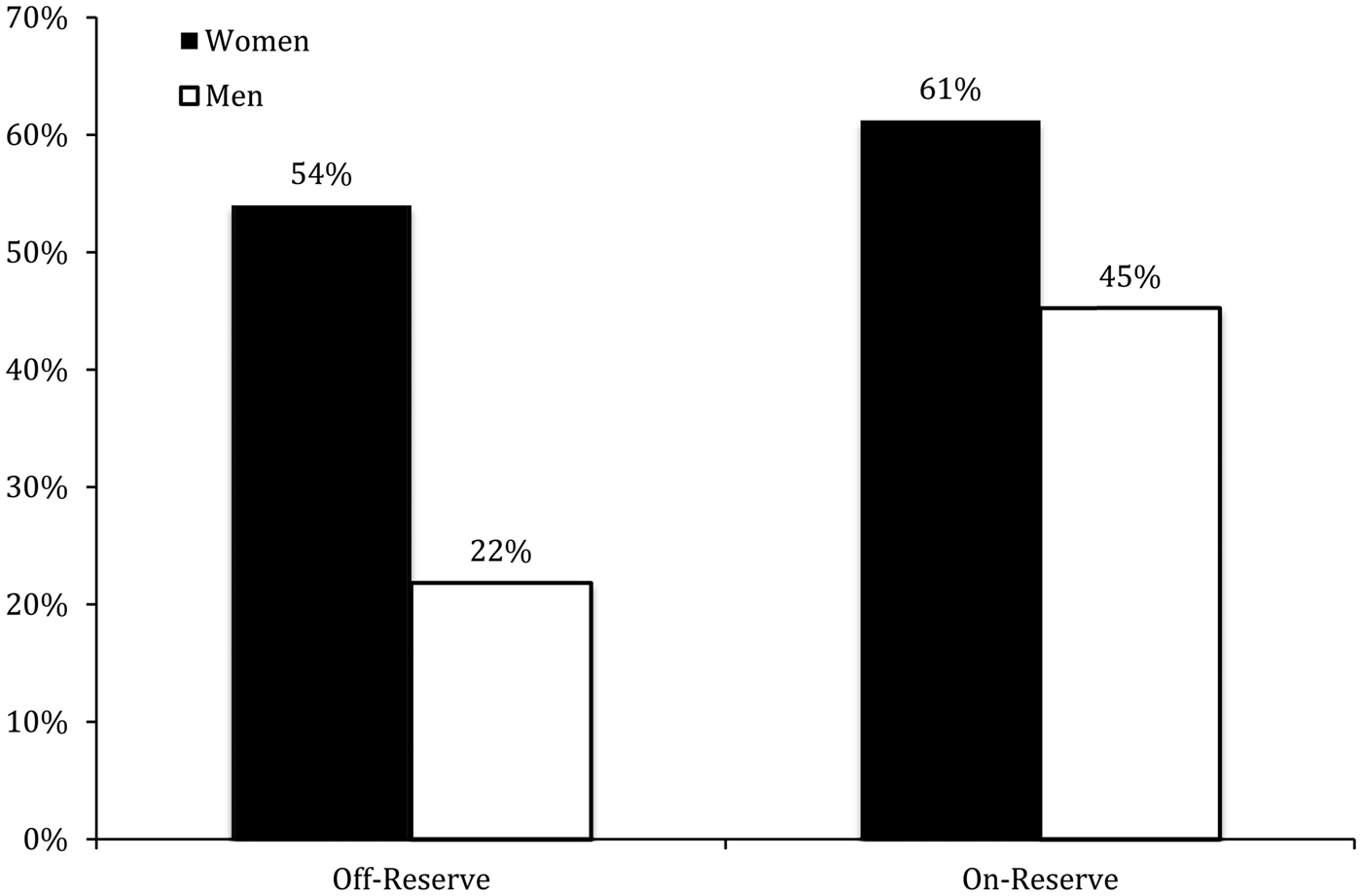
Our model clearly reveals a powerful effect related to reserve status. The question remains whether there is any evidence of the gendered component of the colonialism hypothesis. While an interaction between reserve status and gender is unlikely to reach statistical significance given our limited sample size, the descriptive information here is illustrative (see Figure 3). Women both on- reserve (61%) and off- reserve (54%) tend to vote overwhelmingly NDP. The story among Aboriginal men is different. While Aboriginal men living on-reserve are less likely to vote NDP than Aboriginal women on-reserve, they are significantly more likely to vote NDP than Aboriginal men living off-reserve. The gender gap among Aboriginal peoples living off-reserve (32 percentage points) is more than double the gender gap among Aboriginal peoples living on-reserve (16 percentage points).
Percent voted NDP by gender and reserve status.
A coherent account of these findings emerges if we examine them vis-à-vis the lens of colonialism. From this perspective, the on-reserve/off-reserve difference in Aboriginal support for the NDP represents the differing levels of Aboriginal participation in anticolonial struggles. Assuming that Aboriginal peoples on-reserve are more likely than Aboriginal people living off-reserve to be involved in struggles for Aboriginal liberation, it would make sense that they would be more likely to vote for a party that supports these types of struggles. And as we have shown in the previous section, Aboriginals living on-reserve are more mobilized into associational life linked to their communities. The AFN's characterization of the NDP's policy positions on Aboriginal issues is evidence that at least some Aboriginal people are making this association. We find it quite plausible that the on-reserve/off-reserve difference in support for the NDP may be a product of differing levels of involvement in the struggle for national liberation (where the reserve increases the likelihood of such involvement).
The colonial hypothesis also provides a way of explaining the gender-based distribution of vote choice among Aboriginal peoples. Assuming that colonialism has important gender dimensions that result in Aboriginal women bearing the brunt of colonialism, two things would seem to follow: First, Aboriginal women would be more sensitive than Aboriginal men to the effects of colonialism; and, second, Aboriginal women would be more likely to engage in anticolonial struggles than Aboriginal men. Accordingly, the substantial Aboriginal gender gap in support for the NDP may reflect the differing levels of involvement by Aboriginal men and Aboriginal women in anticolonial struggles.Footnote 18 By way of summary, the colonialism hypothesis has a great deal more explanatory power than its counterpart because it is able to explain both the differences between Aboriginal men and women and between Aboriginal peoples living on-reserve and off-reserve. For its part, the inequality hypothesis can only speak to the former, leaving the latter significant difference unaddressed.
CONCLUSION
The findings and analyses presented in this article reveal that, at least in Canada, Aboriginal gender gaps do indeed exist. They also provide scholars with some direction for locating these gaps. Vote choice is a promising place to look for Aboriginal gender gaps. This article not only found an Aboriginal gender gap in vote choice, but also illustrated that this gap differs from non-Aboriginal gender gaps and its corresponding literature in important ways. In the case of the former, the Aboriginal gender gap in vote choice is far more pronounced than its non-Aboriginal counterpart. The existing literature on gender gaps seems unable to provide an adequate explanation for the substantive difference between Aboriginal women, Aboriginal men, and non-Aboriginal Canadians when it comes to vote choice. One of the main conclusions of our article is that the differences we observed between Aboriginal people and the general Canadian population tend to be far larger than the differences between men and women within each group. Aboriginal peoples' experiences have been fundamentally shaped by colonialism.
Clearly, there are limits to our analysis. While the Aboriginal subsample presents better data than previously available, it remains hard to generalize from this sample to the larger Aboriginal population in the Prairies or across Canada in terms of overall political preferences, or to test whether these differences continue today. Moreover, there may also be complications to generalizing the analysis to other countries with similarly situated Aboriginal populations. Even though the historical experiences of Aboriginal peoples in the United States, Australia, and New Zealand are similar to the Canadian case in foundational ways (for example, they are all characterized by the usurpation of Aboriginal sovereignty, territorial dispossession, official policies of assimilation, etc.), important differences should not be ignored. Given our analysis, one factor to be especially attentive to is the traditional site of Aboriginal mobilization in these countries. In Canada, the reserve is an important location for this type of mobilization. At least since the 1950s in the United States, however, cities have been very important to the anticolonial struggle (Cornell Reference Cornell1988). As a consequence, future research will need to find additional variables for assessing the impact of colonialism on Aboriginal political attitudes and participation in other countries.
Our approach took up Gidengil's call for an intersectional analysis. Specifically, we focused on how gender and colonialism intersect to create unique dynamics among Aboriginal peoples and between Aboriginal peoples and their non-Aboriginal counterparts. While such a view of intersectionality is not without its disadvantages (especially since our methodological approach necessitates the use of simple categories like Aboriginal women/non-Aboriginal women and the like), the research presented here represents one of only a handful of empirical analyses of the political behavior of Aboriginal Canadians and, more significantly, the only study that provides a quantitative case for the existence of Aboriginal gender gaps. By drawing on theoretical contributions from both the political behavior and Aboriginal politics literatures, we provide Aboriginal politics scholars with quantitative data for their scholarship and critique of colonialism. At the same time, this article furnishes political behavior scholars with an important factor for analyzing the political attitudes and participation of Aboriginal peoples, namely the colonial relationship between Aboriginal citizens and the states in which they currently reside. Furthermore, this study points to limits of simple gender analyses that rely exclusively on a gender-lens to understand differences in attitudes and behaviors. While there is a rich theoretical literature on intersectionality, its use in more empirical studies certainly presents challenges for empirically oriented scholars (Dhamoon Reference Dhamoon2011). In our view, however, the payoffs for confronting these challenges are well worth the costs. Locating the presence, size, and nature of existing gender gaps among various communities is an important part of securing a better understanding of women and men's experiences across lines of difference. And this understanding is surely a necessary condition if the goal of such scholarship is to treat people fairly, regardless of difference.