Introduction
Can a painter, with just pigments and brushes, create what he pleases? If the fact of having coloured materials and suitable tools is not enough to realize a painting, the artist is able to complete a creation only with the technical means at his disposal. The handcrafted nature of art has always been omnipresent in aesthetic manifestations and the fact that an artist has never been fully able to control all the properties of the paint has been one of the most important constraints to creativity. Therefore, the introduction of technology as a key element in the birth of a work of art is important to consider: whenever paintings were not just the result of an artist's craft, in the narrow sense of that word, the individualization of artistic productions has led to innovations that modern chemistry can examine and interpret. The understanding of the technical activities in the painter's studio leads us to unfold the creative process, the genesis of an artwork and the invention of specific techniques, which can be linked with the history of arts, sciences and societies.
The best examples of a representation of the artist's workshop are the paintings showing St. Luke painting the Virgin, an image that can be found in medieval manuscripts or in paintings and Flemish tapestries from the 15th century. Luke, the author of the third Gospel, detailed so precisely the events of the birth and childhood of Jesus that it was considered obvious by the Christian tradition that he had met the Virgin personally. He is the author of a series of paintings representing the setting and the iconographic model of her and Jesus in his childhood. The icon Salus Populi Romani is the subject of devotion in the Pauline Chapel inside the Basilica of Santa Maria Maggiore in Rome because it was considered to be painted by St. Luke. As the painter par excellence, the evangelist became the patron saint of painters, in addition to that of physicians. The iconography of the paintings representing St. Luke transposes into the world of the Bible the conditions for making a female portrait. On the other hand, it provides a very representative picture of the activity of the workshop because, in almost all cases, the painters were not projected in antiquity, but are shown as self-portraits in their own time: the artist is sitting at his easel surrounded by brushes and pots of colours. Giorgio Vasari realized one example of these representations. In 1567, he had the idea to appear in Luke's studio, with one palette in hand. We can also see on the ground a palette with brushes of different sizes, and a small glass container –we do not know if this contains a solvent or an oil to dilute paint matter or varnish. In the background, a man is grinding pigments, a fundamental work in the preparation of colours. Grinding pigments to a fine powder and mixing this with binders is necessary to prepare the paint. We enter here into the relationship between art and chemistry, revealed by the chemical analysis of the colours (see Figure 1).
St Luke Painting the Virgin, Giorgio Vasari, Fresco, SS. Annunziata, Florence, around 1565 (from Wikipedia).

Analytical Chemistry and Art
Different techniques for identifying the components of a painting have been developed since the beginning of analytical chemistry. Laboratory studies began at the dawn of the 19th century, when the systematic classification of elements and molecules was developed, together with methods for understanding the nature and the proportion of chemical species. This was the case as of 1795, the date of the first work on the history of metallurgy, by Martin Heinrich Klaproth, a professor at the University of Berlin.Reference Klaproth1 Meanwhile, in Paris, Jean-Antoine Chaptal was interested in dyes and the encaustic technique, while he analysed coloured fragments discovered in a house in Pompeii.Reference Chaptal2 Others chemists followed. For example, after a trip to Egypt during the inauguration of the Suez Canal in November 1869, Marcelin Berthelot began to turn out work on ancient techniques. The cruise he made on the Nile revealed to him the importance of the knowledge of chemistry already developed at the time of the Pharaohs. This observation is at the origin of several of his books, The Origins of Alchemy (1885), Introduction to the Chemistry of Ancients (1889), Chemistry in the Middle Ages (1893), in which he described the invention of chemistry, deciphered from ancient documents in various languages, analysed metal objects from Egypt and Persia, and so on. Later, the discovery of X-rays, from experiments conducted in late 1895 by Wilhelm Conrad Röntgen, had a major impact on the evolution of scientific approaches to art. The German physicist himself understood very quickly that X-rays would be useful to explore archaeological artefacts. Already a few months after his seminal discovery, he and his colleagues did some early experiments on corroded coins and mummies. In 1896, the first X-ray picture was made to investigate the alterations of a paint layer, and then, in 1897, a review published in the British journal The Electric Review highlighted the potential usefulness of this technique to detect counterfeit works.Reference Bridgman3 In 1913, the Weimar radiologist Alexander Faber made a systematic investigation of the absorption characteristics of paints and studied the influence of layer densities on the X-ray image. In 1914 he took out a patent on his new examination procedure, but the war interrupted any further developments.Reference Faber4 In France, Madeleine Hours, the director of the Louvre's laboratory between 1947 and 1980, popularized the scientific exploration of masterpieces in her own television show, The Secrets of Masterpieces, during the 1960s, and in various exhibitions – the most important being La vie mystérieuse des chefs-d'oeuvre at the Grand PalaisReference Hours5 in 1980.
During the 20th century, these scientific approaches have given a tremendous boost to the study of the history of a painting, from the stages of its creation to the damage it has suffered over time. These studies are carried out in the museum research laboratories created around the world to accumulate knowledge on major artists and to help curators when they have to make difficult choices regarding the conservation and restoration of specific works. In the 1980s, Hubert Curien, then Minister of Research in France, proposed to continue further development of this discipline and to introduce techniques from nuclear physics in the Louvre Palace. The small particle accelerator, named AGLAE, was installed in 1988, leading to new approaches based on faster and more sensitive direct analysis of the works of art.Reference Dran, Salomon, Calligaro and Walter6 Thus, during the last 30 years, the methods of investigation have become highly diversified. These developments are due to the dissemination of new analytical technologies but perhaps especially to the growing interest of the scientific community in fields and subjects that transcend traditional disciplinary domains. At the European level, large research programs have been launched, leading to the creation of laboratory networks and the sharing of scientific knowledge. The integrating activity project CHARISMA carried out during the seventh framework program of the European Union (2009–2013) offers an access free of costs to most advanced EU scientific instruments and knowledge, allowing scientists, conservators-restorers and curators to enhance their research7. From the mid-1990s, a new situation has arisen thanks to the miniaturization of technologies, especially those using X-rays and lasers.Reference Alfeld, Janssens, Dik, de Nolf and van der Snickt8–Reference Miliani, Rosi, Brunetti and Sgamellotti11 With these instruments, there is no need to move the works of art. The measurements are non-invasive and can be performed directly on an archaeological site or in the exhibition rooms of a museum. It became possible to list the pigments used by an artist that were available on his palette at some period of his life. The main mobile spectroscopic methods are XRF, LIBS, Raman, FTIR and UV-Vis-NIR. Crystallographic studies have also been made possible thanks to the development of mobile X-ray diffraction (XRD) systems in the framework of NASA programsReference Chiari12, Reference Chiari and Sarrazin13 and in our laboratory.Reference Duran, Castaing and Walter14, Reference Gianoncelli, Castaing, Ortega, Dooryhee, Salomon, Walter, Hodeau and Bordet15 One can also study impurities to identify the sources of raw materials and thus uncover the roads followed by pigments during their trade. The identification of mixtures of binders and pigments provides information on the physical properties of the paint matter and indirectly on the artist's practices. In more detail, the identification of the microstructure of the grains of pigments, that is to say the measurement of their shape and the observation of the defects inside crystals, highlights the preparation methods, such as grinding, synthesis by thermal processes or by soft chemistry, annealing, and so on. All these elements help for a better understanding of the artist's studio. We will now focus the discussion on a specific case, the paintings of Leonardo da Vinci.
The Sfumato of Leonardo da Vinci
Anyone who has looked closely at the Mona Lisa will doubtless remember it is not possible to discern visually brush strokes or the contours and boundaries between the different elements of the face. Colours seem to melt from one to another. The eyes and the nose are thus not drawn with a contour, but they are represented thanks to the shadows that form its surface. These layers were produced by using glazes:Reference Elias and Cotte16 this is not an opaque paint, like the traditional oil paint, but a material almost transparent, tinted with a bit of black pigment dispersed in a lot of organic matter. By superimposing layers of this material, Leonardo da Vinci achieved colours that can become very dark and give an impression of volume that is very different from that afforded by conventional pictorial matter. This achievement is even more exciting from a technical point of view because the glaze is not a material that is easy to use: it cannot be modelled in layers of varying thickness. It is impossible to spread a layer with non-homogeneous thicknesses in one step because the pictorial material is slow to dry, which leaves it time to equalize by flowing naturally. To go from a thin to a thicker layer, the artist has to superimpose thin layers of glaze, paying attention to drying steps. The brothers van Eyck and many Flemish painters knew this type of technique, used for example to paint clothes. But Leonardo had the genius to make repeated use of such glaze to render the face of Mona Lisa more realistic.Reference Zöllner and Nathan17
Leonardo da Vinci has blurred the contours and softened the transitions between colours, making shadows like smoke. This is the term, fumo in Italian, from which now derives the word sfumato associated with his technique. Art historians agree that Leonardo took this practice to its highest level of refinement: ‘Using a technique of almost indescribable delicacy and refinement, he has built up the head from a series of translucent membranes, microtome thin and infinitely subtle in tonal gradation’ wrote Martin KempReference Kemp18, professor at the University of Oxford. In his Treatise on Painting (Manuscript B, 27v) Leonardo explained the hard work it took him to achieve this result by ensuring that the lights and shadows blend without lines, or like smoke. These effects have been obtained thanks to his genius and his skill, but also to the innovations in this period of scientific and artistic agitation of the early 16th century. Discovering some considerations on art and its practices in books written by Greek or Roman authors that, thanks to the invention of printing, had recently gained greater dissemination, many artists sought out new techniques to improve the visual properties of their works of art. The evolution of the arts was then marked by a desire to achieve greater realism, both for the representation of the human body and the control of perspective. Leonardo, like others, did not hesitate to perform autopsies to understand the arrangement of bones, nerves, muscles and tendons lying at the origin of attitudes and gestures of painted or sculpted models. For perspective, he understood that it was necessary to play with lights and shadows to create a perception out of the ordinary and to paint landscapes that appear blue due to atmospheric effects. It is in this intellectual context that Leonardo da Vinci tried to do better than other artists of his time, rethinking the layout of elements in his works and improving the recipes used to prepare paint matters. The ingenuity he developed was truly unique. This practice has led to many comments. Some scholars, however, have managed to get a similar effect by attempting to reproduce it by experimental work. Among these artists-scholars, Jacques Franck, a French consulting expert to the Armand Hammer Centre for Leonardo studies at the University of California, Los Angeles, has proposed introducing a very large number of very thin layers of paint, using a technique he calls micro-divisionism: he marked the darkest areas by fine hatching, then covered them with a translucent layer to fade colours. Gaps were then filled with hatching increasingly smaller and with more or less microscopic dots spaced by interposing translucent material veils between each operation.Reference Franck19
The Pigments Used by Leonardo da Vinci
Different chemical studies have been performed on Leonardo's paintings during the last ten years. We can mention the extensive analysis of the Mona Lisa (Louvre museum, Paris),Reference Mohen, Menu and Mottin B.20 the Madonna of the Carnation (Alte Pinakothek, Munich),Reference Syre, Schmidt and Stege21 the Virgin of the Rocks (National Gallery, London)Reference Keith, Roy, Morrison and Schade22 and The Virgin and the Child with St. Anne (Louvre museum).Reference Eveno, Mottin and Ravaud23 These analyses gave us new insights into the general features of the technique and materials used by the artist. Poplar wood was most commonly used as a support, and undoubtedly it was the most common wood used for panels in Italy during this period. But Leonardo and his circle occasionally used walnut and very occasionally lime. It is interesting to note that he did not mention poplar as a species used for paintings in his Codex A of 1492 but instead lists cypress, walnut, whitebeam and pear wood.Reference Bruzzone and Galassi24 This means that it is sometimes risky to take his own writings as an accurate description of his practice. The wood was first covered with a gesso ground prepared with a glue binder (gesso grosso with anhydrite CaSO4 and gesso sotille with gypsum CaSO4·2H2O), followed by a light oil-based priming (imprimatura) mainly constituted by lead white pigments, sometimes coloured with dark pigments, lead tin yellow or powdered glass. This layer provided not only an overall tonal optical unity in a painting but it was also useful in the initial stages of the work, since it helped the painter to establish value relations from dark to light. The main pigments used by Leonardo da Vinci were azurite, lapis lazuli and indigo for the blue colours, malachite, copper acetates and green earth for the greens, lead tin yellow type I (and type II), ochre, orpiment for the yellows, vermillion, red lake, iron oxides, natural earth such as raw Sienna, realgar and minium for the reds. Black pigments of carbon, umber earth and burnt bones or ivory were also used.
The important use of the very expensive lapis lazuli (or natural ultramarine) is particularly interesting because it was prepared by crushing a semi-precious stone imported from Afghanistan. Its main component is lazurite, 3Na2O·3Al2O3·6SiO2·2Na2S that is difficult to identify by non-invasive ways such as X-ray Fluorescence spectroscopy (XRF) because of its chemical composition which is characterized by many light elements that cannot be easily detected under a varnish layer. Measuring, with a good accuracy, sulphur and sodium to identify it was achieved on the Madonna dei Fusi by ion beam analysis, using Particle Induced Gamma-ray Emission (PIGE) and Particle Induced X-ray Emission (PIXE).Reference Grassi, Migliori, Mando and Calvo del Castillo25 X-ray Diffraction (XRD) was more recently applied to check for the presence of lapis lazuli in different paintings from the Renaissance period.26 In the case of the Mona Lisa, it has been observed by XRF that lapis lazuli was applied on a layer of azurite (Cu3(CO3)2(OH)2), another blue pigment less expensive than lapis lazuli. With a sample from the sky of the Virgin of the Rocks, Keith et al.Reference Keith, Roy, Morrison and Schade22 have also described that Leonardo used to apply a lower thick layer that consists of natural azurite mixed with lead white and a second thin layer containing natural ultramarine with a little quantity of lead white to adjust the hue. The analysis by XRD revealed the situation was different for The Virgin and the Child with St. Anne:Reference Eveno, Mottin and Ravaud23 only lapis lazuli was used, without the azurite layer underneath.
Concerning the lead white pigment, it was noted by XRD on the Sainte-Anne and FTIR on the Virgin of the Rocks that the lead white present in the flesh paint, as elsewhere on the paintings – for example in the pale blue sky – was composed principally of cerussite, the neutral lead carbonate PbCO3. Cerussite is often detected in conjunction with the more common basic lead carbonate hydrocerussite 2PbCO3·Pb(OH)2, but to find it on its own or with very little hydrocerussite present is unusual. It has been suggested that differences in lead white composition may reflect the different grades of lead white production and can be linked to several sources of raw material or different preparation processes.Reference Berrie and Matthew27 Lead white pigments have indeed been synthesized with various recipes for cosmetic and artistic purposes since antiquity. Characterization of lead white pigments used by Matthias Grünewald on the Issenheim altarpiece Reference Welcomme, Walter, Bleuet, Hodeau, Dooryhee, Martinetto and Menu28 revealed variations in terms of composition, graininess and proportion of mineral phases between the priming layer and the coloured layers. We considerer that the mineralogical composition and the shape of the grains can play an important role in the optical properties of the paint layer.Reference Welcomme, Walter, Van Elslande and Tsoucaris29
The Realization of the Mona Lisa Complexion
As sampling of such valuable painting areas is impossible on the character's faces, a non-invasive chemical approach was required to understand the technique used by Leonardo for the realization of the flesh tones. The seven paintings on display in the Louvre museum were analysed by X-ray fluorescence spectroscopy (XRF). This analytical technique allows identifying quantitatively the nature of the pigments with a spatial resolution of about 1 mm in diameter. For the complexion of the Mona Lisa, Leonardo mixed lead white, vermilion and ochre to get the right tone of pink. Her whole face was painted with one unique homogeneous layer. In other portraits, a little amount of vermilion was added to the cheeks to give more life to the face.
The system was built in the laboratory. It is equipped with a silver anode X-ray tube (Moxtek Bullet tube) and a Si(Li) AXAS-V detector from Ketek (SDD) cooled by Peltier effect and reaching an energy resolution (FWHM) of about 136 eV at 5.9 keV at the working temperature. The operating conditions of the tube were 35 kV and 95 μA. The distance from the sample to the detector was 2.5 cm, the beam impact angle 45° and the detection angle 90°. Flowing out of the detector, helium (flow rate 1.5 l min−1) allowed the detection of low energy X-ray radiations, which are very important for the data quantification. The spectra were processed with the dedicated software PyMca (version 4.3.0), using the Fundamental Parameter Method.Reference Solé, Papillon, Cotte, Walter and Susini30 Recent advances in XRF greatly improve the study of works of art. It is now possible to obtain in-depth information by taking into account X-ray absorption through the different paint layersReference Mantler31, Reference de Viguerie, Solé and Walter32 to obtain quantitative access to their composition and to their thickness using appropriate hypotheses on the multilayered material. This approach was applied on the Mona Lisa to examine not only individual spots but also the evolution of spectra along a line running from the corner of the mouth to the left ear, i.e. from the lightest area up to the darker shade. The new procedure we developed is based on the use of differential X-ray attenuation and fluorescence: the low-energy Pb M lines (at about 2.3 keV) are strongly absorbed by the upper organic layers; that is, varnish and glaze layers. For the Pb L lines of high energy (around 10.5 keV), these two layers are thin enough to produce no effect of absorption.
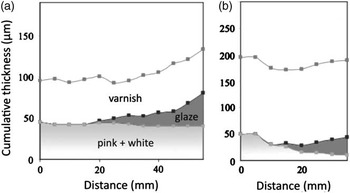
On a line of 4 cm on the left cheek of the face, 17 measurements revealed the evolution of the paint layers and their composition.Reference de Viguerie, Walter, Laval, Mottin and Sole33, Reference de Viguerie, Sole and Walter34 We observed that the thickness of the layers spread on the Mona Lisa wood panel is very small. Leonardo applied first the so-called imprimatura, with a white colour, consisting of white lead and oil. For the face, he then applied a pink layer. For the shadows on the face, he superimposed dark glaze layers. Finally, varnishes were added to protect the painting. This led to the calculation of a virtual section of the painting along the cheek. The structure of the layers is clearly visible in Figure 2(a). The impression layer and the flesh colour have a whole thickness of about 50 μm. From this data, we can estimate that Leonardo used about 800 g of white pigments for the whole panel. And only ten grams of vermilion for flesh tones. The glazes were also extremely thin and reach a thickness into the darkest areas of about 30 μm. Glaze films as thin as 2 μm were measured. These data show Leonardo da Vinci had to multiply the deposits of glaze films to reach the final state of the painting, repeating this gesture many times until the deepest shadows were obtained. These measurements are in agreement with the reconstitutions realized by Jacques Franck, already described above. The method used by Leonardo required extraordinary patience because, before applying a new layer of glaze, he had to sit out the drying time of the previous one, i.e. to wait a few weeks between each step. Analyzing his different paintings preserved in the Louvre, we found the same technique of glaze used in St. John the Baptist (Figure 2(b)), The Virgin and the Child with St. Anne and St. John the Baptist – Bacchus. A sample taken from the leg of the child subsequently confirmed the results.Reference Eveno, Mottin and Ravaud23
Calculation of the thickness of the paint layers superimposed for the realization of the cheek on Mona Lisa (a) and Saint John the Baptist (b). From light (at left) to dark (at right).

Mixture for Glazes
Glazes act like very fine veils and can give relief to the forms. It seems that Antonello da Messina introduced this practice in Italy from 1475 on, probably after having admired the works of Van Eyck in the Castle of the Court of Anjou in Naples.Reference Barbera35 He probably also met Flemish painters during his travels to Northern Europe. To master the use of this technique, Leonardo da Vinci carried out various experiments in order to better understand the effects of chiaroscuro, i.e. the projection of shadows and their intensities. He built up an experimental method in his studio to simulate the effects of bright or cloudy weather at different times of the day. By making these optical studies, the artist understood the value of using glazes that give the impression that the light comes from below the work, and also provides a variety of continuous tones. Leonardo da Vinci was an observer of nature, an experimenter, a mathematician, an optician, which is likely to have fed this knowledge to improve his glazes: he should ideally combine the right components and choose the oil, the resin and the appropriate solvent. Different authorsReference Maroger36, Reference de Viguerie, Ducouret, Lequeux, Moutard-Martin and Walter37 have studied precisely these aspects by examining painting manuals of the Renaissance and the modern periods, and by reconstituting some of the recipes therein. The physical properties of mixtures that were available to Leonardo da Vinci were measured: these rheological properties are indeed crucial to obtain the final rendering of the painting. Leonardo could dissolve a resin, such as mastic, in linseed oil and add turpentine to confer fluidity to the material that allows rapid evaporation of the solvent during the drying of the layer. The modern rheological analysis shows that if the mixture proportions are good, it is possible to spread a 2 μm thick layer without any difficulty, and its molecular organization allows having a viscosity at rest so that the material can form a flat surface after drying. Unfortunately today, without using an invasive method of analysis, we cannot determine the nature of these binders and the organic substances used in them. We just know through his codex that Leonardo was interested in extracting mustard oil, and to make a perfect varnish he advised mixing walnut oil with liquor (resin or oleoresin) exuded from a juniper or cypress that had been freshly cut.Reference Franck19 This ‘perfect varnish’ may have been used to protect the painting as well as to prepare a glaze. This text probably dates from around 1505, when Leonardo was at work on the Mona Lisa in Florence, and may be a description of the organic components used for the glazes.
On other paintings, the glazing technique was not used. The shadows do not have the same translucent appearance on the Portrait of a Lady of the Court of Milan – also called La Belle Ferronnière – which was painted in 1493–1494 in Milan. They were made with an opaque black paint. From the way the model's face and the top of her chest are illuminated, this painting appears to apply ideas that the artist was then testing out on the importance of good lighting to excel in the science of painting. He brought together his ideas in a manuscript, now known as manuscript C of Paris, which he began to write in April 1490, to describe optical phenomena useful in painting and how variations of forms depend on their lighting (Windsor, Royal Library, W. 12604 r). These elements show the intellectual and technical work carried out by the artist. Over the space of ten years, before or after his move from Milan to Florence, Leonardo da Vinci changed his technique to renew the art of the portrait with the Mona Lisa, and thus achieved an exceptional piece of imitation of nature through art. He was able to take the time to experiment with the use of various materials. He not only used purchased pigments and binders but also developed his own essential ingredients for his paintings. In the description of the life of Leonardo, Giorgio Vasari highlights the multiple experiments carried out by the artist, sometimes making him unpopular as he took too much time to deliver on his commissions:
It is said of Leonardo that when the pope commissioned a work from him, he would immediately begin to distil oils and herbs for the varnish; as a result, the pope explained: ‘Alas, this man is never going to do anything, for he starts to think about finishing the work before it is even begun!’Reference Vasari38
Leonardo also left some paintings, such as the Adoration of the Magi and St. Jerome in the Wilderness, unfinished.
Of all the scientific qualities ascribed to Leonardo, we see here those of a chemist, who experimentally seeks, develops and tests new materials and formulations. In the Codex Atlanticus, he draws instruments that should have allowed him to distil natural substances. It includes various kinds of glassware – retorts like alembics – used by the alchemists of the time. Leonardo seemed so interested in these problems that the information came to the ears of the Pope, who expressed surprise. Leonardo also cultivated relationships with other people, sometimes alchemists, who could help him develop new formulations of paint matter. For example, he hosted in his studio Tommaso di Giovanni (who was latter known as an alchemist under the name of Zoroaster Peretola) to help manufacture metal pieces and grind colours. But perhaps in the context of competition between artists’ studios, Leonardo never described in detail his personal recipes. In his Treatise of Painting, he only provided some insights, such as the tricks to produce a green or red pigment of high quality and the best ways of preparing a canvas.
The Nature of the Pigments in the Shadows
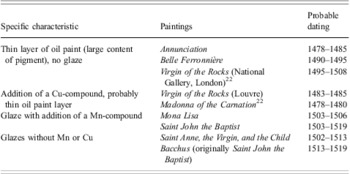
It was thought that carbon black or bone black (made from burnt animal bones) may have provided the right products for darkening the pictorial materials used for the shadows. But the XRF analyses have revealed an unexpected pigment (Table 1). For the Mona Lisa, analyses show that Leonardo used a pigment that is particularly rich in manganese oxides, probably mixed with a coloured earth. Yet this compound was not commonly used in oil painting because it was known to react very badly with the binder, inducing its rapid drying. Its presence in very unusual proportions is an enigma.Reference de Viguerie, Walter, Laval, Mottin and Sole33 Its use has been confirmed in a second painting, St. John-the-Baptiste, but not in others that are conserved in the Louvre museum. In the other paintings, more conventional pigments were used and in two cases only an unusual copper impurity was found. We can actually identify four different ways to darken the shadows on the faces. Leonardo very often changed his pigments and performed many experiments to find a ‘good’ black colour. But how could he use the manganese-based pigment so beautifully?
Technical characteristics of the dark paint used for the face shadows on nine paintings from Leonardo da Vinci

Next to the problem of drying, the use of manganese pigments raises another problem. Leonardo da Vinci deposited glaze layers as thin as 2 μm, which requires very small grains of pigment – much smaller than the thickness of the layer – in order to obtain a perfectly homogeneous material and not a lumpy one producing uneven surfaces, which are unbearable to the gaze. If he had used black smoke or soot, it would have been very easy to disperse them in the binder because these materials are composed of aggregates of carbon atoms with a size of several hundreds of nanometres at most.Reference Winter and West Fitzhugh39 This is what has been used, for example, to make carbon inks since ancient Egypt. If he had used natural dark earth rich in clay minerals, the form and the size of its crystals, like very thin platelets, could also have led to a good dispersion in the glaze. With a mineral rich in manganese, which in nature is generally found in the form of relatively large crystals of oxides, it was necessary to grind it finely, probably more than was possible by hand, and necessary for the other colours used in the mixed oil. The traditional circular motion of the wheel on the stone would not have been sufficient. So Leonardo probably invented sophisticated milling techniques: there is perhaps evidence for these technical developments in the Codex Atlanticus (folio 765), where for 1504 he develops the concept of the transformation of an oil mill into a milling machine for colours with a cone crusher. In this document, the mill of Doccia at Vinci was drawn near a text describing a technique for grinding the colours used in painting (Figure 3). Some art historians have envisaged that he wanted to create a mill to address the problem of producing of painting materials in sufficiently large quantities to make large-format works. This was the case at this time of his life for the Battle of Anghiari, whose format – 4.28 out of 5.77 metres – required a large amount of material. Today, I tend to think that to obtain glazes as thin as he obviously did, Leonardo could not have been satisfied by extended periods of manual grinding by his pupils in the workshop. By placing a few grams of manganese oxide in his mill and leaving it running for a long time, he obtained by mechanical work the very fine powder required. Fine grinding of pigments was certainly another challenge in the creation of Leonardo's glaze. The multiple recipes revealed by chemical analyses may correspond to these experiments. It was not until the late 19th century that mechanical devices appeared in the art materials shops.Reference Richard40
Doccia Mill at Vinci in a drawing by Leonardo da Vinci (folio 776v of the Codex Atlanticus, datable to around 1503); observations on techniques for grinding the colours used in painting (© Museo Galileo – Istituto e Museo di Storia della Scienza).

Chemical analysis also allows us to relate different paintings that appear to have been made with the same techniques. This is the case of the Mona Lisa and St. John the Baptist, the technical realization of the two faces is identical from a chemical point of view. However, even if the historical sources fail to specify the date of the commission, the painting of St. John the Baptist is traditionally considered as a very late work of the Master, and the two paintings have therefore been assumed not to have been realized at the same time. This leads us to consider the chronological value of a technical practice in a workshop. The two paintings are the same size, the faces have the same characteristics, and the materials are similar. These elements can encourage us to consider a new completion date for the St. John the Baptist. The dating of the Mona Lisa portrait is sure because we know that it was ordered in 1503 and the painting needed four years to be realized.Reference Mohen, Menu and Mottin B.20 For the Saint-John the Baptist, some stylistic elements suggest that it may have been made around the same time. Edoardo Villata compared some details of this painting with the altarpiece showing the Incarnation of Christ by Piero di Cosimo,Reference Villata41, Reference Delieuvin42 currently at the Uffizi Gallery in Florence and painted in 1505–1506. These elements might suggest that the work of Leonardo provided a stylistic model and was therefore realized or started before 1505. A leaf of the Codex Atlanticus dating from 1509 also shows a drawing depicting the hand of the Saint in its peculiar pose. We note a similar unusual quantity of manganese was observed in the painting The Virgin and Child (National Galley, London) realized by Marco d'Oggiono.Reference Spring, Mazzotta, Roy, Billinge and Peggie43 A larger study on many paintings by Leonardo and his pupils should now be carried out to try to use the manganese pigment as a key element of the Master's practices. The result of this research should be based on an analysis of hundreds of paintings from this period to understand the transmission of knowledge in the workshops of great artists.
Conclusion
New analytical tools, arising from the world of physics or chemistry, may modify the vision that we have about artists’ studios. These data can provide information on the chronology of works of art and their conservation, and inform us about the raw materials used by artists and craftsmen, and their ability to invent new technologies for the development of new materials. Conversely, some problems with cultural heritage materials invite us to develop new physicochemical methodologies or address scientific issues that have not yet been asked or for which a satisfactory solution has not yet been found. To interpret the analytical data, it is indeed important to understand how molecules, molecular assemblies and crystals are formed or transformed over long periods, taking into account many parameters and complex chemical transformations.
Philippe Walter is director of the laboratory of molecular and structural archaeology (CNRS-UPMC). He is developing new analytical tools adapted to the study of ancient materials, with the ion bean analysis facility AGLAE, synchrotron radiation and homemade portable instruments using X-rays. His main research interests focus on the use of analytical chemistry to understand the development of chemistry for health and beauty during Antiquity or the elaboration of new painting materials, for instance during the Renaissance. He received an MS degree in physics at the Ecole Normale supérieure de Saint-Cloud – Lyon and a PhD degree in geochemistry from Paul Sabatier University, Toulouse, France in 1993. In 2008 he was awarded the CNRS silver medal and in 2010 the Franklin-Lavoisier Prize in Philadelphia (USA).