


Introduction
Like good conquered people what we want is to recuperate what they took from us … and this has to do with the recuperation of memory. If memory isn't recuperated, it is impossible to be able to retrieve, or be conscious of what they have taken from us.Footnote 1
In the above quote, Mapuche musician Domingo Nahuelcura of the Comunidad Fernando Carilao noted that the formation of the band Los Guitarreros Caminantes (The Travelling Guitarists, LGC) in the mid-1980s allowed him and fellow bandmates to reclaim their Mapuche cultural and historical identity. The cultural histories LGC invoked in many of their songs challenged the insistence of the Augusto Pinochet dictatorship (1973–90) that the economic stability of southern Chile required Mapuche communities to overcome their presumed weak and destructive cultural practices and assimilate into the market economy through private property management. LGC, however, did not perform this music as clandestine activists. Rather, the group formed and performed under the junta's first pilot project for Mapuche integration known as Plan Perquenco (1980–8). The Ministry of Agriculture and an Italian consultant from the United Nations Food and Agriculture Organisation (FAO), Cristóbal Unterrichter, designed Plan Perquenco to follow the Chilean state's new administrative model, known as regionalisation. Military officials claimed that under regionalisation, municipalities like Perquenco, without strong oversight, had to take a leading role in depoliticised community-development initiatives that empowered citizens to take active roles in the advancement of the Chilean nation and market economy. In Perquenco, however, this system ultimately created administrative contradictions that permitted LGC to work through Plan Perquenco to challenge not only the Ministry of Agriculture's reform efforts, but also the very justification for those programmes.
Regionalisation and Plan Perquenco provide a means to rethink the quotidian indigenous policies of the military regime, their administrative structure, and how Mapuche communities worked through state-led programmes for their own ends. The bulk of the literature on the dictatorship's indigenous policies has focused on Decree Law 2568 (DL 2568) and Mapuche responses to this law. Passed in 1979, DL 2568 provided the legal means to permanently divide and privatise Mapuche communal lands and thus dissolve what various officials considered the last major roadblock to free market expansion in southern Chile. To justify these measures, the Ministry of Agriculture continually denied that ancestral lands were related to Mapuche culture, despite the fact that many Mapuche communities and organisations had fought for the restitution of their ancestral lands as the cornerstone of their identity since Chilean statehood.Footnote 2 By the late 1970s, a well-defined Mapuche cultural movement supported by the Catholic Church and led by organisations such as the Centros Culturales Mapuche (Mapuche Cultural Centres, CCM) and later the Asociación Gremial de Pequeños Agricultores y Artesanos (Association for Artisans and Small Farmers, Ad-Mapu) had mobilised in opposition to the land division law. Historians, anthropologists and sociologists have all provided excellent insight into this movement's development at a local and international level, its representation amongst a diverse political spectrum, and its ability to force a new, albeit limited restructuring of Chile's indigenous policies following the 1990 return to democracy.Footnote 3
The focus on micro-histories such as Plan Perquenco does not seek to challenge the importance of the Mapuche cultural movement in the 1980s, but rather, as scholars have recently argued, to underscore the complex ways in which Mapuche communities engaged with the Pinochet dictatorship. Historians and anthropologists such as José Bengoa, Florencia Mallon and Mapuche scholar Sergio Caniuqueo have demonstrated the myriad of reasons that led some Mapuche to support land division and even work with the regime.Footnote 4 The diverse responses to the dictatorship should come as no surprise given the variety of political alliances Mapuche formed throughout the nineteenth and twentieth centuries. In looking at this diverse political participation, Caniuqueo has argued that one cannot view Mapuche political motives through a simple left–right political binary, as Mapuche have often utilised various political coalitions for their own ends since the formation of the Chilean Republic.Footnote 5 The micro-history of Plan Perquenco builds on these studies to further develop the complex and multifaceted motives that defined Mapuche–state relations in the latter part of the twentieth century.
My research methodology also necessitated that I move away from dominant narratives of Mapuche experiences under military rule. Utilising the collaborative methodology of ethnographic research, I conducted 25 interviews with Mapuche in Perquenco and four with the agricultural technicians who worked with these communities in the 1980s.Footnote 6 Throughout 2012, I worked primarily in the Comunidad Higidio Pinchulao in Perquenco. I also conducted interviews with nearly every member of LGC in the Comunidad Fernando Carilao. Initial interviews demonstrated that my reliance on institutional narratives had created a historical chronology that did not represent community members’ own sense of history and identity. I followed the standard chronology that viewed 1973 as a point of rupture that culminated in the passage of DL 2568 in 1979. These temporal reference points, however, often meant little to the people I interviewed, and I was frequently questioned as to which land division law I was referring to. Many communities had divided their communal lands before military rule, and thus DL 2568 did not signify a point of rupture. For many of the musicians I interviewed, being Mapuche existed within a context of a shared history of exploitation among Perquenco's rural inhabitants that culminated in Plan Perquenco. By blending my institutional analysis of Plan Perquenco with ethnographic research, I was able to examine the different ways Mapuche communities engaged with the military regime and how this affected state formation.
To highlight this point, this article develops two arguments. First, an ethnically defined crisis that did not exist elsewhere in Chile was the rhetorical justification for regionalisation, and thus state building in southern Chile, during military rule. A central goal of regionalisation in southern Chile was to liberate Mapuche families from what officials called the ineffectual state paternalism of the two previous administrations, understood as a central state controlling all aspects of private life and the economy. Officials claimed that state paternalism had not only provoked violence, but had also produced weak Mapuche communities that threatened the stability of southern Chile.Footnote 7 It was in the context of this crisis that the Ministry of Agriculture and FAO consultant Cristóbal Unterrichter designed Plan Perquenco, claiming that by reforming families and introducing ‘rational’ agricultural practices their plan would create self-sufficient farmers who individually produced and marketed their goods without state oversight or assistance.
Second, it was the very structure of regionalisation that permitted groups like LGC to undermine the goals of and justification for Plan Perquenco. While some scholars have emphasised the importance of the regionalisation model in Chilean history, they have generally focused on Santiago-based narratives that reinforce the idea that the model was highly authoritarian. Scholars like Kent Eaton and David Slater have argued that through the formation of a complex bureaucratic structure, regime officials were able to replicate state authority at all levels of society as a means to limit regional autonomy and ensure market stability.Footnote 8 Other scholars have provided a more nuanced view of regionalisation. Verónica Valdivia, Rolando Álvarez and Karen Donoso have all demonstrated that popular resistance to the dictatorship, as well as ineffective mayors, at times limited the success of regionalisation and efforts to present Pinochet as the champion of the poor. These authors nonetheless conclude that regionalisation did succeed in forever transforming Chile's political structure.Footnote 9
A move away from Santiago-based narratives of regionalisation demonstrates that in southern Chile the model led to a segmentation of authority, whereby the system did not replicate Pinochet's authority, but rather produced disjointed parcels of governance that permitted more autonomy in local development initiatives than regime officials had intended. The little studied case of Plan Perquenco therefore builds on works that break down notions of state homogeneity during military rule.Footnote 10 With regard to the Mapuche, Sergio Caniuqueo and Chilean scholar Christian Martínez show that the regime-supported Consejos Regionales Mapuche (Mapuche Regional Councils, CRM) permitted Mapuche to work through government agencies for ends that contradicted the stated goals of the Ministry of Agriculture's indigenous reform efforts.Footnote 11 These analyses support Joanna Crow's assertion that Mapuche strategies for cultural survival under military rule did always not exist on the extremes of collaboration or resistance, but often incorporated elements of both.Footnote 12 Plan Perquenco further demonstrates that while studies of contested state formation are not new, regionalisation provides a critical historical lens through which to analyse the internal complexities and contradictions of the dictatorship.
In developing these points, this article examines the relationship between Mapuche communities and the state technicians who worked in Perquenco. At a micro level, the Ministry of Agriculture charged Unterrichter with hiring the six agricultural technicians who oversaw the day-to-day management of Plan Perquenco. Much to the chagrin of the ministry, however, the agricultural technicians whom Unterrichter hired were not military officials, but rather civilians who had at times minimal support for the dictatorship. Without motor vehicles, maintained roads, or reliable communication, the six technicians were disconnected, largely autonomous representatives of the military regime. While I interviewed four of the six technicians who worked under Plan Perquenco, this article focuses on María Molina as she was the music instructor for LGC, and her story most fully represents the complex internal dynamics of regionalisation that affected local communities. As LGC's primary music teacher, Molina drew from Plan Perquenco's emphasis on the importance of folklore programmes to encourage the youths she worked with to advocate for their cultural history. Molina's relationship with LGC supports historians’ argument that the junta's promotion of folklore programmes provided a variety of spaces not only for Mapuche individuals and organisations, but also for state officials, to denounce and challenge the goals of military rule.Footnote 13
If a goal of regionalisation was to depoliticise local development, LGC fully politicised it through their music. As in the case of immigrant communities, Andean indigenous populations and marginalised ethnic groups in the United States, LGC's musical performances challenged the dominant political culture through the promulgation of alternative notions of history and community identity.Footnote 14 These alternative identity constructs and community responses to them nonetheless demonstrate the complex ways the band's existence undermined the regime's argument that programmes like Plan Perquenco were necessary to empower Mapuche communities. Oral interviews reveal that many community members felt that the youths’ participation in music distorted proper masculine and feminine values.Footnote 15 The gender roles that community members invoked in their critiques of the band at times converged with those of the dictatorship, and thus the Ministry of Agriculture's insistence that Mapuche families were broken and needed Plan Perquenco to create healthy men and women was unfounded.Footnote 16 Songs like El Mingako, however, did resonate with a historical memory among Mapuche in Perquenco of independent communal organisation and solidarity that negated the regime's insistence that Mapuche communities were weak and thus stifled the economic advancement of southern Chile. Oral interviews ultimately show that there was a long history of community organisation in Perquenco that the policies of the dictatorship, rather than the assumed retrograde cultural practices of the Mapuche, had shattered. The cultural identities and histories that LGC invoked in their music thus exposed the central justification for the regime's indigenous policies as a historical falsehood designed to force Mapuche assimilation into the market economy.
State Paternalism, Agrarian Crisis and the Origins of Regionalisation
Beginning in the late 1970s military officials engaged in a ‘social war’ to combat the extreme poverty that they suggested bred marginality, subversion, delinquency and, worst of all, the influence of Marxism. Verónica Valdivia notes that officials argued this ‘social war’ demanded a comprehensive programme to re-socialise Chile's popular class, and thus empower local communities through the eradication of centralised state politics, as well as the clientelism of political parties.Footnote 17 To help empower marginalised groups, eradicate poverty and eliminate what officials considered the predatory nature of political parties, state personnel contended that reform had to occur at the most local level within Chile's municipalities.
In framing the argument for regionalisation and re-socialisation in southern Chile, regime officials lambasted what they saw as the debilitating effects of the Chilean Agrarian Reform (1962–73). In the 1960s and early ’70s the agrarian reform initiatives of the administrations of Eduardo Frei Montalva (1964–70) and Salvador Allende Gossens (1970–3) blamed the paternalism of the patrón, or large estate owner, for stunted familial and economic development in rural areas. In turn, officials from the Ministry of Agriculture under military rule claimed it was the state paternalism of the Chilean Agrarian Reform itself that had limited economic productivity in the countryside.Footnote 18 The ministry pointed to two pieces of legislation passed during the presidencies of Frei and Allende to demonstrate the negative impact state paternalism had had on Mapuche communities. In 1967, Frei's Partido Demócrata Cristiano (Christian Democrats, PDC) enacted the Ley de Sindicalización Campesina (Countryside Unionisation Law), which permitted huge advances in labour organisation in the Chilean countryside. Most importantly for the dictatorship, the law established a means for political parties and state institutions to finance unions. In 1967, the Corporación de Reforma Agraria (Agrarian Reform Corporation, CORA) and Instituto de Desarrollo Agropecuario (Institute for Agricultural and Livestock Development, INDAP) grouped the unions they sponsored into the Triunfo Campesino confederation, which received explicit support from the PDC.Footnote 19 Through their work with rural unions, political parties and national institutions at times supported the use of direct action, like land takeovers, or tomas. The use of tomas was a common tactic in the 1960s and early ’70s that allowed workers to protest against labour agreements and the slow pace of the Agrarian Reform. In some cases, INDAP, CORA and political parties actively sponsored tomas as a means to expedite the process of land expropriation.Footnote 20
Mapuche communities in southern Chile built on this climate of heightened political mobilisation to protest against the slow pace of the Chilean Agrarian Reform to restitute their ancestral lands. With the aid of the new unionisation law, Mapuche communities throughout the Malleco and Cautín provinces specifically allied with unions connected to communist and socialist parties. Their principal allied organisation in Cautín was the offshoot of the Movimiento de Izquierda Revolucionaria (Revolutionary Leftist Movement, MIR), the Movimiento Campesino Revolucionario (Revolutionary Peasant Movement, MCR). As a result of this mobilisation, land occupations for the restitution of ancestral Mapuche lands jumped from 27 in 1968 to 148 in 1969.Footnote 21 In late 1969, Mapuche communities working with the MCR also began fence running, the process by which Mapuche communities reconstructed fences on large estates to recuperate lands usurped throughout the twentieth century. It was under this climate of intense Mapuche political mobilisation that Allende's Unidad Popular (Popular Unity, UP) government came to power in 1970. Upon Allende's election, Mapuche, with the aid of the MCR, initiated a series of land occupations and fence runnings in the municipalities of Lautaro, Loncoche, Carahue and Nueva Imperial. These land occupations and fence runnings prompted Allende to initiate a mass expropriation of land in favour of Mapuche communities known as the Cautinazo, which totalled 13,416 hectares.Footnote 22
In reaction to heightened Mapuche mobilisation and land expropriation after 1970, large estate owners and influential businessmen began to form comités de retomas (retaking committees) that violently removed Mapuche from occupied lands. In an emblematic case, a landowner shot MCR member Moisés Huentulaf in the head.Footnote 23 In mid-1972, the UP nearly declared the province of Cautín an emergency zone as a result of the increased violent confrontations on large estates. A year later, the province of Cautín became militarised to prevent further mobilisation on the part of Mapuche communities. Beginning in August 1973, the increasingly autonomous Chilean armed forces, led by the air force, began to raid Mapuche communities to uncover ‘terrorist’ cells of Marxists who had allegedly stockpiled weapons to foment revolution. Before the 11 September 1973 coup, members of the armed forces detained and tortured Mapuche community members for their connections to revolutionary groups. To support these actions, newspapers printed images of confiscated weapons, which often amounted to little more than shotguns, Molotov cocktails and poorly designed homemade explosives.Footnote 24 After the coup, the military regime capitalised on these images to accuse Allende of openly supporting an international Marxist takeover of Chile.
In 1978, the Intendant – a military-appointed governor who served as a region's highest ranking official – of the Ninth Region argued that the Chilean Agrarian Reform under Allende was therefore the product of ‘totally political objectives, [and] extremist elements that unleashed the most intense series of abuses to private property known in the history of Chile’.Footnote 25 The Intendant continued by suggesting that the productive farmers of the Ninth Region continually ‘saw anarchy in the development of their fields’.Footnote 26 Despite the variety of opinions surrounding the efficacy of land seizures in the early 1970s, the Intendancy of the Ninth Region presented land occupations as acts coordinated by a highly centralised state.
While military officials argued that state paternalism had created a mass of violent Mapuche communities, the Ministry of Agriculture also contended that the Allende administration had created a system of ethnic segregation in Chile that limited Mapuche productivity. In 1972, Allende's UP government passed Decree Law 17.729 (DL 17.729), which created constitutional safeguards against the division and sale of Mapuche ancestral lands while also establishing mechanisms for the restitution of usurped lands. The law also had clauses that protected indigenous groups’ rights to determine education, economic and resource development policies within their communities.Footnote 27
The Ministry of Agriculture under military rule argued that rather than help Chile's indigenous groups, the law had actually ‘excluded indigenous groups from national scholarship programmes, leaving available [to indigenous communities] what little quantity [of aid] the Institute of Indigenous Development had. In general this increases the detachment of reservation occupants from the rest of the nation and from programmes for economic and social development.’Footnote 28 At the time of the dictatorship, Mapuche communities were relegated to a reservation-type system that had placed Mapuche on 2,318 reducciones (reservations) between 1883 and 1929. Allende's belief in Chilean ethnic diversity, argued the Ministry of Agriculture, had therefore placed the Mapuche in a unique situation among campesinos in that their subjugation derived from constitutional law. DL 17.729 specifically prevented the division and sale of Mapuche communal lands, which the ministry considered as one of the greatest obstacles to free market reforms in the Ninth Region. Cristóbal Unterrichter concluded that inadequate acreage and the inability to sell communal land did not provide initiatives to produce, and thus Mapuche lands remained underdeveloped. Unterrichter wrote, ‘By not having individual titles, secure tenancy is reduced. Nobody makes improvements in the field or in the home.’Footnote 29
The Ministry of Agriculture blamed communal lands and Allende's segregationist policies for Mapuche ‘food, health, housing, education, infrastructure, low business level, insufficient technological development in the management of their lands and cultural and mental difficulties’.Footnote 30 In 1978, the Intendancy of the Ninth Region reported there was an infant mortality rate of 52 per 1,000 births in Mapuche communities, which amounted to 16 more deaths per 1,000 than the national average. Furthermore, close to 10 per cent of the population remained malnourished and 15.3 per cent were illiterate.Footnote 31 All of these measures were several percentage points higher than the national average. In 1978, the Director of the Division of Social Communication stated that, like other sectors of Chilean society, Mapuche communities had become weak through 40 years of state building that placed government officials rather than fathers in charge of familial education, health, economics and moral wellbeing.Footnote 32 Reports from state functionaries, therefore, claimed that state paternalism had created a culturally backward Mapuche population that lacked the capacity to support the rural economy.
With the aid of Cold War alliances that dated from the 1960s, the Ministry of Agriculture designed indigenous reform programmes to empower what officials argued were debilitated Mapuche families. Italian-born Unterrichter was one of the primary FAO agents who worked with the Ministry of Agriculture in the late 1970s and ’80s. Born in 1918, Unterrichter spent his early life in south-eastern Europe. His first agrarian job was from 1938 to 1942, when he worked as the administrator of a potato-farm cooperative in Tachov District (in Czechoslovakia; from 1938 Nazi-occupied Sudetenland). He served under Nazi Germany from 1942 to 1947 as an infantry lieutenant and company leader, later being taken prisoner of war in British Egypt. Unterrichter first came to Latin America in 1953 to work for the International Catholic Migration Mission, where he helped 3,000 people displaced after World War II to settle in Chile. He later became the representative for the German Association for Settlement Abroad, working in La Serena, northern Chile. Up until 1965, he worked in the FAO's agricultural settlement programmes in Chile before the Organization of American States’ Inter-American Institute of Agricultural Sciences (IICA) employed him in Ecuador as a manager of settlement and agrarian reform programmes. In 1976, he returned to Chile to work as one of the primary advisors to the Ministry of Agriculture.Footnote 33
The Ministry of Agriculture and Unterrichter argued that proper rural productivity rested upon men's ability to be independent, sober and disciplined workers who knew how to plan agricultural development, keep track of expenses and successfully market their products.Footnote 34 An article in the Ministry of Agriculture's official magazine Nuestra Tierra stated that many small property owners did not see the economic value of their land. Nuestra Tierra combated this sentiment by arguing: ‘Any land, of any size, and located in any part of the country is a factory. And, as such, it must produce not only products but also profit. What the campesino is lacking, therefore, is his conversion into a businessman.’Footnote 35 The article went on to detail the need for men to take out loans, learn simple accounting and use ‘rational’ planting techniques as a means to build a better life for their families. The idea of independence suggested men had to break free from the paternalism that formerly stunted their progress. The Ministry of Agriculture reminded the rural man that ‘nobody controls him’.Footnote 36
While Mapuche men had to be independent and market-oriented farmers, Mapuche women had to adhere to what various functionaries considered proper rural femininity based on domesticity and obedience to male authority. Centros de Madres (Mothers’ Centres, CEMAs) worked with Mapuche women to instil these values. During the Chilean Agrarian Reform, the Christian Democrats and independent political organisations created CEMAs to empower women to solve familial and community problems while giving women ‘collective representation in community activities’.Footnote 37 As the Chilean Agrarian Reform proceeded, CEMA membership increased and the goals of the organisation changed. Particularly under the UP, CEMAs advocated revolutionary gender roles that argued for women's active participation in community mobilisation.Footnote 38
During the military dictatorship, Pinochet's wife, Lucía Hiriart de Pinochet, as CEMA's new leader, made concrete efforts to promote gender roles based on female domesticity. CEMA's official magazine Amiga stated that after 1973 ‘CEMA-Chile stopped being a political entity. Now it is an organisation where women learn, are trained and help both their families and communities.’Footnote 39 The goal of CEMA under the dictatorship was to restore the domestic, non-productive and complementary nature of women's and mothers’ work. The idea of apolitical domesticity was a fundamental aspect of the regime's promotion of women's maternal nationalism. The middle-class women who directed CEMAs in the 1970s and ’80s therefore ‘praised maternal self-abnegation and elaborated a patriotic mysticism that defined women as the apolitical soul of the nation’.Footnote 40
To enact the change that would help Chile overcome state paternalism, regime officials completely overhauled Chile's administrative structure. Unlike the two preceding administrations, military officials argued that the private sector rather than the state should be the primary engine for social change. In 1974, the Pinochet regime founded the Corporación Nacional de Reforma Administrativa (National Corporation for Administrative Reform, CONARA) to enact a policy of regionalisation and dismantle the pre-1973 centralist political structure. While regionalisation permitted state institutions to control policy formation, the private sector would be in charge of implementing state policy at the local level. Officials from CONARA argued that regionalisation therefore eliminated ‘organisms, functions and attributions of an interventionist character that [formerly] strangled private initiative and halted national development’.Footnote 41
Decree Laws 573 and 575 that the military regime passed in 1974 created 12 regions in Chile, and a 13th known as the Metropolitan Region based around the national capital, Santiago. Within regions, the next largest administrative unit was the province. In 1974, the Ninth Region comprised two provinces, Malleco and Cautín. The provincial governor oversaw the distribution of funds from the Fondo Nacional de Desarrollo Regional (National Fund for Regional Development, FNDR) to various public service initiatives in municipalities, like road construction and the formation of health clinics. Within provinces, mayors directed municipalities based around urban centres. In the 1970s, the Ninth Region had 30 municipalities, 11 in Malleco and 19 in Cautín. The 1980 National Social Plan for Chile noted, ‘Municipalities can and must establish local diagnostic mechanisms, take planning initiatives and promote structures, services, projects, programmes, etc. … as a contribution that stimulates and facilitates the channelling of state investments for the benefit of harmonious regional development.’Footnote 42
To fulfil this goal, mayors worked with a number of different public and private organisations. The mayor and the Comités de Desarrollo Comunal (Communal Development Councils, CODECO) distributed funds to community organisations like CEMAs, neighbourhood associations and youth organisations. These various institutions and organisations in turn established the administrative systems, social service programmes, credits, subsidies and networks of communication that allowed for an adequate integration of the rural economy into national and international markets.Footnote 43 Municipal programmes for social, cultural and economic reform were therefore the most locally-based initiatives that military officials enacted and tried to control as a means to curb what they perceived as the abuses committed by state intervention. It was under this format of regionalisation that officials from the Ministry of Agriculture and the FAO designed and implemented Plan Perquenco.
Plan Perquenco and the Paradoxes of Regionalisation
To accomplish the goals of regionalisation in southern Chile, Unterrichter called for a pilot project for Mapuche integration to take place in the Ninth Region's Perquenco municipality. Unterrichter suggested that Perquenco was an ideal location for a pilot project as it was the Ninth Region's smallest municipality in 1979 with about 35,000 hectares and 4,995 inhabitants.Footnote 44 The municipality also had close access to larger cities like Lautaro and Victoria. In political terms, Perquenco had been a latecomer to the Chilean Agrarian Reform and did not exhibit the strong history of political mobilisation or unionisation that was apparent in surrounding municipalities. More importantly, Mapuche farmers comprised 75 per cent of Perquenco's population.Footnote 45 The location, size, political history and high percentage of Mapuche farmers, therefore, made Perquenco a manageable laboratory to enact the social and cultural changes that fulfilled the goals of the Ministry of Agriculture's indigenous reform programmes.
Reports from Unterrichter, the Ministry of Agriculture and INDAP also suggest Perquenco was an ideal location for a pilot project because the municipality had fallen victim to all the shortcomings of state paternalism. One report concluded that Perquenco's lack of infrastructure, economic development and community organisation, and its dependency on nearby cities, left the municipality ‘with a lack of community identity’.Footnote 46 All of Perquenco's inadequacies ultimately created a ‘poor population, without the creativity that the actions that permit [them] to overcome [their] difficulties require’.Footnote 47 The idea that Perquenco lacked identity and creativity created an image of a rural mass incapable of supporting the economic and cultural growth of the Chilean nation.
In August 1980, the Chilean Ministry of Agriculture and Unterrichter developed the pilot project Desarrollo y Organización del Sector Indígena y de Pequeños Agricultores (Development and Organisation of the Indigenous and Small-scale Farming Sector), or Plan Perquenco. The first phase of the programme lasted from 1980 to 1983, but came to a close amid allegations of mismanagement of funds by the third-party agency hired to oversee the programme, Agroservicio. The FAO and Unterrichter officially assumed management of the programme in 1984. To effect the changes needed to create healthy citizens and families in Perquenco's Mapuche population, Unterrichter developed a three-tier plan based on home economy, agricultural growth and community development. He argued that home development needed to comprise projects that trained rural women to incorporate ‘modern’ practices of family nutrition, hygiene, home improvement and the use of public services into their day-to-day lives. Unterrichter noted that his ideals of modernity were based on European norms of hygiene, temperance, exercise and familial organisation. He specifically suggested that Mapuche families needed to imitate the cultural practices of German-Chilean communities in southern Chile as a means to overcome their cultural inferiority.Footnote 48 These ideals supported a common perception of ‘racial uplift’ that had defined Chilean state formation throughout the twentieth century, and which probably influenced the level of autonomy granted to Unterrichter by the ministry not only as an expert, but as a European expert.Footnote 49 The agricultural development project focused on the introduction of new planting techniques and the enhancement of livestock reproduction. Beyond the technical aspects of farming and livestock care, the agricultural development programme also trained men to administer and market their produce. The cultural programmes of Plan Perquenco sought to create a homogenous national identity in Mapuche communities through music, religious and sports activities.
Unterrichter devised an entirely new system for rural development in Perquenco to enact these changes. To more effectively manage the Mapuche communities within Perquenco, he divided the municipality into three sub-regions. He suggested that two agricultural technicians, preferably a married couple, administer each sub-region, and work with roughly 150 Mapuche families.Footnote 50 The técnica (the wife) would administer training programmes for family gardens, hygiene, nutrition, small animal husbandry and home repair. The técnico (the husband) would administer programmes that focused on increased agricultural production and livestock care. Through their coordinated effort in communities, the married agricultural technicians would be an ‘example and local “leader”, and by extension, advisor and coordinator of sports, cultural and economic associations in place of the vanished ancient leaders’.Footnote 51 For Unterrichter, the married couples served as the paragon of proper European familial relations, and thus the model for the self-sufficient and culturally mature rural family.
Unterrichter had the responsibility of hiring the six agricultural technicians to work in the three sub-areas of Perquenco. The process of hiring these technicians, and the consequences of Unterrichter's decisions, reflected the contradictions embodied in the process of regionalisation. Unterrichter ultimately hired María Molina, who had direct links to the Chilean Agrarian Reform. During the presidency of Frei, Molina had worked with Mapuche musician Gabriel Calfiqueo to compose songs that CORA used to teach reading and writing skills to the rural population in Malleco and Cautín provinces. While Molina argued her music was not political, it did reflect social realities in Chile that the military regime saw as potentially threatening. ‘What happened is during the military regime there was no distinction between what was protest and what was a social reality.’Footnote 52 After the 1973 coup, Molina and her husband became exonerados (‘exonerated’). In the Chilean context, this meant that the military regime had pardoned Molina for any political crimes, fired her, and told her she would never work for the Chilean government again. Molina noted that ‘They were hard times, very hard, because we were unable to find work because we were exonerados políticos, nobody gave us work.’Footnote 53
Officials from INDAP nonetheless ignored the exonerated status of Molina and approached her and her husband to interview for Plan Perquenco. Despite their status, Molina and her husband received the position. The fact that the Ministry of Agriculture permitted the presence of professionals like Molina in Plan Perquenco requires further analysis. In the early 1980s, the only people who had experience as agricultural technicians and knowledge of the Ninth Region's communities were those who had worked under the Chilean Agrarian Reform. Unterrichter thus had a limited pool from which to hire technicians. Furthermore, those whom the military junta considered dangerous Unterrichter may have seen as potentially good workers with experience, and thus the autonomy granted to him permitted him to make such contradictory hires.
As the principal music teacher in Perquenco's western sector of Pitraco, Molina gave music lessons to a group of Mapuche teenagers from the Comunidad Fernando Carilao beginning in 1984. All the agricultural technicians who worked under Plan Perquenco shared a house in the Comunidad José Santos López. It was at the technicians’ house that Molina held the music classes twice a week, at night, and outside of Plan Perquenco's official programmes. Molina's decision to hold the classes at night was the result of several factors. Most of the teenagers who participated in Molina's classes had to work during the day, and thus could only go out at night. These meetings, however, were also slightly illegal and clandestine. Molina noted, ‘Meetings were prohibited, so there wasn't a lot of freedom to go, meet, get together, and for this reason they [the teenagers] had to go at night. On the one hand because they worked during the day, because they studied during the day, and on the other hand because there wasn't permission to hold meetings like this so easily.’Footnote 54 Because they walked nearly five miles, often in the dark, cold, rain and mud, the teenagers called their band ‘Los Guitarreros Caminantes’.
Regionalisation and geographic isolation supported the quasi-clandestine formation of LGC in a number of ways. Under Plan Perquenco, Molina and the other technicians were the highest level of authority in the countryside. These meetings, while in part illegal, gained their legitimacy from the very technicians that the military regime invested with the power to run rural development programmes and ‘reform’ Mapuche communities. The technicians who worked in Plan Perquenco noted that for the most part outside military officials paid little attention to the plan. Lead technician Luis Muñoz described the situation as ‘total autonomy’.Footnote 55 Muñoz commented that the autonomy derived from the fact that the Ministry of Agriculture trusted Unterrichter to independently manage the programme, probably as a result of his status as a European expert. Muñoz also noted that autonomy derived from what could be described as Unterrichter's ignorance of Perquenco's communities. Muñoz stated, ‘He [Unterrichter] was a person who in technical aspects didn't help much because it was obvious that he didn't know the local reality. The technical aspects he didn't control, but from the outside, he gave us a lot of autonomy.’Footnote 56 Furthermore, geography limited military intervention. In the 1980s, and even today, one can only reach the interior of Pitraco through poorly maintained roads that wash out and become impassable in winter months. Regionalisation, geography and a general lack of knowledge about the project and how to fulfil its goals held military intervention at bay to some extent in Perquenco.
While some of the other technicians who lived in the house were staunch supporters of the dictatorship, Molina's classes do not seem to have raised much suspicion. In part this may have resulted from folklore being an essential part of Plan Perquenco's community development programme. Initial proposals for Plan Perquenco supported the formation of folklore festivals and theatre groups because ‘the practice of popular arts that belong to a specific place and that recognise free expression are necessary to respect everyone's creative impulses’.Footnote 57 The format of rural education under Plan Perquenco also provided an opportunity to utilise state-coordinated programmes for subversive ends. In the 1980s, the Regional Secretariat for the Minister of Education, Gastón Sepúlveda, expressed concern over Plan Perquenco's ability to re-educate Mapuche families at the annual conference held in Perquenco to discuss the programme. Minister Sepúlveda argued that urban teachers often brought a cultural bias to the countryside that viewed rural inhabitants as backward ‘others’ who were an obstacle to progress. Rural education, argued the Minister, was nothing more than an ‘extension of the general social attitude towards the campesino’.Footnote 58
To enact efficient rural education programmes in Perquenco, Minister Sepúlveda suggested that technicians had to develop a curriculum that incorporated the needs, interests and expectations of rural and principally Mapuche communities. Sepúlveda placed particular emphasis on the creation of a ‘bi-cultural’ education system that was sensitive to Mapuche ethnic identity.Footnote 59 Since 1976, the Ministry of Education had worked to create educational programmes that promoted the use of Mapuche culture, language and religion as part of the educational process in rural communities throughout the Ninth Region. In 1984 the Ministry of Education released a manual for teachers working in Mapuche communities from which Sepúlveda no doubt drew in his presentation in Perquenco.Footnote 60 Folklore and cultural programmes were therefore an essential part of Plan Perquenco, and thus Molina's use of them fell squarely within the programme's guidelines.
Furthermore, the songs that Molina initially taught LGC were not political. Molina and the young musicians formed LGC near the end of 1984. The proximity of Christmas meant that the first round of songs that Molina taught the youths were Christmas carols. The members of LGC remembered these early tours of Perquenco's communities as a formative experience. Band member Eliana Nahuelcura noted that the purpose of the Christmas carol circuit was
To rescue some of the Chilean tradition that was lost at the time. So, Señora María Molina was like a bridge for us, which took us to the communities. First, we learned two or three carols, nothing more, our hands were stiff [unused to playing], but we went … we met with people that in this era couldn't get together, but we had a space where we could talk, the ladies drank maté, the men talked, and we sang to them. It was a way to cheer up very solitary people, abandoned, let's say, without a space to express themselves.Footnote 61
These early meetings made a huge impact on the group, who at the time had a profound sense of cultural loss. Band member Eliazar Navarrete Hualquil noted, ‘Nobody could express themselves in any way because of the regime [under which] we lived, so communities lived in silence despite the necessity that there were a lot things [to discuss], [but] there was no expression.’Footnote 62 Domingo Nahuelcura said, ‘The Mapuche community didn't exist. I am talking about Fernando Carilao. We, being Mapuche, didn't consider ourselves very Mapuche, and they [military officials] also made us believe that we weren't Mapuche.’Footnote 63 These early experiences created what Steve Stern calls human meeting grounds, and which formed networks of solidarity for people who suffered under the dictatorship.Footnote 64
Compounding these formative experiences was that Molina encouraged the youths she worked with to promote their cultural identity. Molina stated,
I always told them, ‘Kids’, I'd tell them, ‘This is a wingka Footnote 65 guitar, this is a wingka song, but you have your own, you have your songs, your dances, your musical instruments, your community, you are a community. We are brothers and sisters’, I'd tell them, ‘but you have your rich culture, never stop talking about your culture, never stop talking about your identity’.Footnote 66
It was through Molina's classes therefore that the band found an outlet to express their cultural identity in contradiction to the stated goals of Plan Perquenco.
Travelling Guitarists and the Recuperation of Communal Memory
In developing their community identity, LGC drew specifically from the Nueva Canción movement that had openly supported the Allende administration. The Nueva Canción movement was a specific revolt against American cultural imperialism, expansion of consumer-based society and the formation of economic monopolies that create adverse living conditions for Chile's urban and rural poor. Allende's UP particularly drew on the themes of class and cultural alliances present in Nueva Canción between 1970 and 1973. The UP's promotion of this music led to a fundamental change in the themes presented in the movement. While previously lyrics had addressed the plight of workers, in the 1970s they valorised the Chilean worker as the centre of national identity. By 1973, therefore, the Nueva Canción movement had emerged as a central voice that challenged the economic, cultural and imperialist dictates of the United States and Chile's ruling class.Footnote 67
At the time, the dictatorship labelled much of the Nueva Canción music subversive, and thus it was prohibited. To gain access to the music, bandleader Domingo Nahuelcura listened to cassette tapes that others smuggled into Perquenco. The rise in popularity and availability of bootleg cassettes in the 1980s led to what Nancy Morris describes as an informal music exchange among Chileans.Footnote 68 This informal music exchange ultimately kept Nueva Canción and the social themes it embodied alive during the dictatorship. Through these cassettes and the access to underground Chilean radio stations like Radio Moscú and Radio Ñielol, LGC slowly began to identify with the ideas of social justice that Nueva Canción artists sang about. Domingo Nahuelcura argued,
After 1973, when everything was prohibited, we began to rediscover our [national] authors. We began to listen to Violeta, I remember, with a lot of energy, we began to listen to Quilapayún, we began to listen to Víctor Jara … we had lived what Violeta lived, what Héctor Pávez sang about, we had lived it. We knew what it was to be cold, we knew what it was to be tired, we knew the joy of celebrating with the community … life began to make sense, it began to have content for us. In this way we linked ourselves to the theme of [this] music.Footnote 69
LGC also incorporated traditional Mapuche instruments as a means to recuperate their cultural identity. ‘We got close to the kultrún as a basic instrument, symbolic of the Mapuche world, playing it, interpreting it.’Footnote 70 This musical format ultimately led LGC to write music that challenged the cultural, economic and gendered ideals of the military dictatorship, as well as of their own community.
In terms of gender, the very existence of a mixed-sex band that travelled independently throughout Perquenco was a threat to community perceptions of proper interaction between young men and women. Domingo Nahuelcura argued, ‘It wasn't common to see a group of young people together. There was always a division between men and women. It wasn't common that a group of young women got together with a group of young boys.’Footnote 71 Eliana Nahuelcura noted, ‘It was really difficult because my parents, my mum, didn't want to give me permission [to participate], because at this time kids weren't like they are today. Nowadays kids date openly, but not in that era.’Footnote 72 Her mother's fear of female promiscuity reaffirmed what Heidi Tinsman argues was the threat of female independence and the notion that young women's bodies were objects of male desire that necessitated adult supervision and control.Footnote 73 Eliana Nahuelcura's ability to travel throughout Perquenco without father or husband to supposedly care for her was a challenge to community perceptions of women's roles within the family and society based on domesticity and obedience.
Oral interviews reveal that many of these domesticity- and obedience-based ideals of femininity that Plan Perquenco sought to instil in women already existed, and thus officials’ idea that the programme was a radical reformulation of rural living was naïve at best. Adela Lagos Gómez from the Comunidad José Santos López worked with Molina under Plan Perquenco. Lagos Gómez recalled that, in matters of the family garden, Molina sometimes lacked the knowledge to successfully carry out the programme. ‘Like my mum did, I kept a garden, all the time, so I knew how to make a garden … Señora María said to me, “OK, you're going to teach because I don't know how to make a garden”, like that, Señora María put us to work making the garden.’Footnote 74 While Molina had worked in rural reform projects since the 1960s, she had always done so as a musician. Molina lacked many of the technical skills that Plan Perquenco suggested true femininity embodied, and thus her experiences reflected a disconnect between theory and practice. Furthermore, Lagos Gómez's familiarity with family gardens suggested that many of the aspects of ‘modern’ rural living already existed in Perquenco, and thus the programme was not a massive reorganisation of rural life that empowered Mapuche women.
While LGC in ways challenged community and regime perceptions of labours appropriate for women, they also contested notions of rural masculinity. LGC's emphasis on music and cultural production as their primary objective in life principally contended with the idea that men should engage in intensive agricultural production to ensure familial and national security. Domingo Nahuelcura recalled that lead technician Muñoz often had trouble delivering the message of productive rationality to LGC. ‘He [Luis Muñoz] saw in us the possibility of, that we could take up this economic theme, and [he] urged us to go to meetings, to talk about these things, concerning productive development, but we were basically musicians. We began to like this, we began to create this dynamic around music and art.’Footnote 75 The lack of interest among the members of LGC in participating in the economic and familial reform programmes created an alternative vision for what Plan Perquenco meant for community members. In the case of Los Guitarreros Caminantes, music and cultural production rather than rational agricultural development was the principal vehicle for personal and community advancement.
Many families in Perquenco, however, felt that participation in LGC did not encourage proper behaviour for young men. Band member Federico Lagos Rosales noted, ‘There were a lot of people who didn't understand during this time … they said to me, “Do you go along starving because you are playing the guitar?” One doesn't play the guitar so he can eat but because he likes to play guitar, because he is passionate.’Footnote 76 Domingo Nahuelcura remembered,
Our parents, or the majority of the parents of the kids, thought that it [music] was a waste of time … what was most important for our family was to eat, so one had to work to eat, and playing guitar was, I don't know, was ridiculous, it didn't suit the fundamental objective [of living] … the truth is that I was hungry, we never said this, but we lived it.Footnote 77
These quotes suggest that through music, members of LGC diverged from notions of production that both the Ministry of Agriculture and local families considered the hallmarks of masculine responsibility.
The thematic content of Los Guitarreros Caminantes’ songs, nonetheless, reinforced alternative notions of community development that resonated with Mapuche communities in Perquenco. The song El Mingako specifically highlighted a communal memory that reified traditional modes of Mapuche community organisation challenging the Ministry of Agriculture's insistence that Mapuche communities were weak, unproductive, and lacked identity. The mingako was and is a form of communal field work that, beyond labour efficiency, is central to the renewal of community bonds and identity. While the mingako is not solely a Mapuche practice, for LGC the act was a central part of their community's historical identity. In their reference to the trilla (the practice of threshing) and to tortilla, soup and pig, the song's lyrics emphasise a desire for communal development and a sense of sharing, and draw from a historical memory common to many throughout Perquenco:
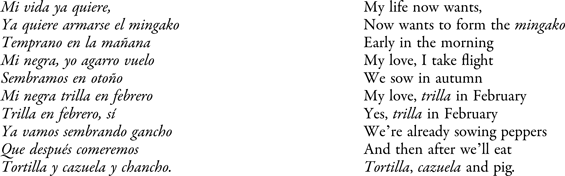
Domingo Guevilao of the Comunidad Higidio Pinchulao stated, in regard to the mingako, ‘There was a lot of unity before, because, shoot, even I sowed up to 10 hectares, that is, 10 quadrants it was, I killed a pig, we went along with a drink of wine, I invited my people. I invited up to 15 teams of oxen, we were really united.’Footnote 78 For Guevilao, therefore, the mingako signified a time to come together and share food, wine and companionship as a means to advance community agricultural development. Colihuinca Huaiquilao, too, stated that, ‘Yes, the mingako was the same, we helped one another. At least if I was going to do a mingako, I invited all my neighbours who came to help me, but we got together 30, 25 teams of oxen, [that's how] the mingako was done. To share, to advance one's work, to get more out of the work one was going to do.’Footnote 79
The mingako, for Domingo Nahuelcura, was the greatest embodiment of the cooperative form of living that challenged the ideals put forth in Plan Perquenco. Nahuelcura stated with regard to the song El Mingako:
Here we resisted, at least our grandparents [did]. And when this life was created, it began to generate communitarian living, which is the only way human beings can survive … Neighbours got together to help a neighbour who was in the worst conditions. And there were these celebrations like the mingako, like the trilla, the community celebrations were born. Everything was done as a community … we are children of the trilla, we are children of the mingako, we are children of community celebrations … Many of us had this cooperative mentality, to go to work with a neighbour with the sole desire to help him, and the neighbour gave payment in food. There was no motivation to earn money, that didn't exist. So, in that way [cooperative living] was constructed … the base of Plan Perquenco said ‘an individual businessman’. That has never been. We, the poor, organised ourselves. We have always had to organise ourselves to be able to survive.Footnote 80
Nahuelcura tied the memory of collectivism specifically to the UP and Allende. He was ten when the UP came to power in 1970, and recalled that for his family the era signified cooperative living. Nahuelcura recalled that in these formative years
For the first time campesinos ate meat in abundance, for the first time campesinos could eat bread without having to measure it out, for the first time campesinos worked healthy hours, they didn't have to get up at night and return at night to their house. They worked during the day. They had the right to rest, they had the right to a salary, and they had the right to decent houses.Footnote 81
Rather than being the source of societal malfunction and chaos, as the dictatorship claimed, the UP era for Nahuelcura and other band members had provided community empowerment. Oral interviews further demonstrate that there were no ‘vanished ancient leaders’, as suggested by Unterrichter; rather, the disorganisation that the dictatorship attributed to a cultural backwardness brought on by former state paternalism was actually the result of its own policies. In reference to the repression and abolition of community organisations by the regime, Segundo Ambrosio Tremolao of the Comunidad Juan Savaria noted
There was a fear for us, a huge fear, because it was a war, let's say, a war without rifles, one didn't have anything to defend oneself with, and they [the military] placed all the arms above [the people and communities]. It's that, this was another injustice. And they also took all the land, the Pinochet government did everything at this time, what he commanded, one did, because he was a soldier. We couldn't say, ‘This is bad’, no. One had to say ‘It's good’, nothing more to be able to live. If we said that we were unhappy, here's the rifle.Footnote 82
Domingo Nahuelcura recalled,
The military dictatorship destroyed the social fabric, what they destroyed was the community, understand? So, that was serious, because certainly they [military officials], those that exercised power, continued getting together in the communities, but they didn't allow us [to get together] any more.Footnote 83
Juana Lemonao of the Comunidad Coliman/Cayumil noted,
We couldn't have meetings, we couldn't talk with a neighbour, everything was really strict. During that government things were done that should not have been. People and neighbours were lost and you never saw them again … I saw carabineros [policemen] on TV. [Women] said, ‘My husband has disappeared.’ ‘No, if you had a husband he would be sent home’, like that, and the people had to agree.Footnote 84
José Hullipan Tramalao of the Comunidad Juan Savaria recalled that the military regime did nothing for the Mapuche:
When General Pinochet took office, everything changed here, everything was different. There was nothing because everything was lost, you couldn't have meetings, you couldn't do anything. We couldn't have technicians who visited us, because they were ‘political’. And here came the military, they attacked, so, everything was dead in the era of General Pinochet.Footnote 85
Tramalao concluded, ‘They [the military regime] didn't consider the Mapuche at all.’Footnote 86
It was through songs like El Mingako that LGC sought to recuperate memories of cultural practices that the dictatorship attempted to erase. Band member Rosales noted, with regard to the song, ‘To remember is a good thing, and well, now to show the youth that in those times the mingako existed and to try and explain to them what the mingako is.’Footnote 87 Hualquil also felt that the song represented a memory of collectivity that provided the community with an alternative ideal of labour organisation and cooperative work.
I believe the concept of the mingako is also extremely important because the song, the theme speaks of the mingako, of what it was before, the communion of working the land … mingako is to be in solidarity with the person by your side, the one in need.Footnote 88
With regard to the importance of music, Domingo Nahuelcura noted,
I believe that through music, returning to art, I believe the mission of art is to communicate to communities, to communicate among ourselves, and to be able to understand in some way that we share the same things, and that the truth is relative to who is looking … our truth is subversive, because it deals with oppression, because it deals with maltreatment, because it deals with violence.Footnote 89
El Mingako and LGC's performances therefore served as a form of collective memory for the band based on the recuperation of community solidarity and identity.
Current sources do not give concrete evidence as to the extent to which the message and influence of LGC affected community identity in Perquenco. They did perform frequently in public spaces and annual festivals throughout Perquenco. From oral interviews it seems that the group had an impact on other youths in Perquenco. Eliana Nahuelcura noted,
As kids and having done that [performed music] we were like, I don't know if it's too much to say, like a model, like a referent for the other kids. Because many of them were more screwed than we were because they had less, they had fewer possibilities to learn. But they saw us, and they began to join us … A lot of people went through the group, girls, boys, they joined for a time, six months, a year, they sang with us, they learned to play a little guitar, there were a lot of them. They also identified with us, they felt content with us.Footnote 90
While her quote certainly places a lot of emphasis on the importance of the group for other kids, it does support the reality of the group. Hualquil recalled that Domingo Nahuelcura wrote a play. To perform the play required some 19 kids as actors and for stage management. Mapuche theatre groups were a common phenomenon under military rule, and served as important sites of community solidarity and collective art endeavours. While it is hard to tell the exact impact the group had on other kids, the collective nature of Nahuelcura's theatre group and LGC fits other patterns of community solidarity and rejuvenation that occurred under military rule.
Conclusion
An analysis of regionalisation in southern Chile brings to the foreground several important aspects of the Pinochet regime's indigenous reform programmes, and the ability to administer those projects. While regionalisation was ubiquitous, the rationale for the structure was unique in southern Chile in that it relied on an ethnically defined crisis for its justification. Officials from the Ministry of Agriculture stated that the paternalism of the Frei and specifically Allende administrations had not only created violent Mapuche communities, but also communities that lacked the ability to sustain a modern agricultural economy. Officials argued that municipal-based reforms under regionalisation were the best means to correct these ills. While regionalisation defined official policies, it also limited the applicability of the regime's indigenous reform programmes. The unintended segmentation of state authority that regionalisation created provides new insight into the inconsistencies of state building under military rule. Plan Perquenco reveals that rather than a coherent chain of command from Pinochet to the municipality, regionalisation created far more autonomy in the quotidian management of indigenous reform programmes than military officials had intended. The administrative format in part allowed people less than sympathetic to the regime, such as Molina, to manage programmes like Plan Perquenco and ultimately distort the project's goals. It was these subtleties of regionalisation that eventually permitted LGC to reaffirm a Mapuche identity that challenged Plan Perquenco and the economic, ethnic and gender dictates the programme embodied. Plan Perquenco, however, was not unique, but rather emblematic of the hundreds of other municipal-based reform programmes that the regime enacted throughout Chile. It is to be hoped that future research will confirm that Plan Perquenco's administrative inconsistencies were a reality of regionalisation that affected the entirety of the Chilean nation.
Community responses to the LGC furthermore reveal a complex relationship with music, whereby community members both supported and contested the ideals put forth by the band. On the one hand, community members viewed participation in the band as antithetical to proper gender roles. The convergence between some community members’ gender ideologies and those of the regime underscores that officials’ notions – that they were reforming broken Mapuche families – were misguided, and showed a lack of understanding of Mapuche communities. The band's invocation of a historical memory of communal solidarity in songs like El Mingako indeed draws attention to communal memories of high levels of effective organisation that the regime denied existed in Perquenco. The music of LGC therefore highlighted a community memory of solidarity and cultural identity that undermined the regime's rhetorical justification for Plan Perquenco based on the assumption that Mapuche communities were weak and incapable of supporting market production.
My examination of the effects of Plan Perquenco therefore offers another vantage point for understanding indigenous–state relations under military rule. Like other histories, the story of Los Guitarreros Caminantes and regionalisation reveals that by the early 1980s avenues were available for Mapuche to challenge the regime's indigenous policies that did not always exist within the context of the larger Mapuche cultural movement.


