


Background
Depression represents a leading global cause of disability and premature mortality, imposing personal suffering and societal costs (Covid-19 Mental Disorders Collaborators, 2021). It frequently progresses undetected in its early stages, and the majority of affected individuals, particularly in resource-limited settings, lack access to evidence-based care (GBD 2021 Diseases and Injuries Collaborators, 2024). The pervasive treatment gap underscores the critical need for effective preventive strategies focused on modifiable risk factors.
Psychosocial status refers to an integrated condition encompassing individual-level mental, emotional and social well-being. It includes a range of factors such as recent stressful life events, current psychiatric symptoms, patterns of social interaction and individual socio-economic status (SES) (Lund et al., Reference Lund, Brooke-Sumner, Baingana, Baron, Breuer, Chandra, Haushofer, Herrman, Jordans, Kieling, Medina-Mora, Morgan, Omigbodun, Tol, Patel and Saxena2018). These factors reflect individual psychological and social experiences, providing a multidimensional characterization of the psychosocial context relevant to health outcomes including depression (Wilkinson and Michael, Reference Wilkinson and Michael2003; Lund et al., Reference Lund, Brooke-Sumner, Baingana, Baron, Breuer, Chandra, Haushofer, Herrman, Jordans, Kieling, Medina-Mora, Morgan, Omigbodun, Tol, Patel and Saxena2018). Yet such psychosocial needs have often been overlooked in modern health systems. Social prescribing has been proposed as a person-centred approach to address these needs through tailored, non-medical interventions, with the aim of bridging social well-being and mental health. Nevertheless, robust evidence regarding its potential efficacy remains scarce (The Lancet, 2025). Extensive evidence has linked individual adverse psychosocial factors, such as chronic stress, low SES and social isolation, to elevated depression risk (Gilman, Reference Gilman2003; Lemoult et al., Reference Lemoult, Humphreys, Tracy, Hoffmeister, Ip and Gotlib2020; Wickramaratne et al., Reference Wickramaratne, Yangchen, Lepow, Patra, Glicksburg, Talati, Adekkanattu, Ryu, Biernacka, Charney, Mann, Pathak, Olfson and Weissman2022). However, these unfavourable factors seldom occur in isolation; they frequently cluster and may interact synergistically, suggesting their combined effect could substantially exceed the sum of individual risks. While pioneering work, such as the multi-cohort analysis by Wang et al. (Reference Wang, Liu, Yang, Chen, Wang and Liu2024b) reporting a 145% increased depression risk with unfavourable psychosocial profiles, methodological limitations persist. They often relied on restricted SES indicators and categorical (e.g., binary: yes/no, low/high) rather than continuous or nuanced operationalizations of psychosocial constructs. This may mask important heterogeneity within factors, failing to capture the complex interplay and relative contributions of distinct psychosocial domains to depression aetiology.
To address existing knowledge gaps, we leveraged the population-based UK Biobank cohort, which contains comprehensive records on multiple psychosocial factors, to investigate the associations between psychosocial status and the risk of depression and to quantify the potential for prevention. Furthermore, we constructed a weighted composite psychosocial score incorporating all identified factors and examined potential effect modifications by socio-demographic and lifestyle factors.
Methods
Study population
The UK Biobank is a population-based prospective cohort that includes more than 500,000 adults aged 37–73 years from assessment centres across the United Kingdom between 2006 and 2010. During the baseline assessment, participants attended 1 of 22 dedicated centres located throughout England, Scotland and Wales. They were asked to complete touchscreen questionnaires and physical measurements, and provide biological samples for collection. All participants provided written informed consent for longitudinal linkage to national electronic health registries (Fry et al., Reference Fry, Littlejohns, Sudlow, Doherty, Adamska, Sprosen, Collins and Allen2017). Ethical oversight was ensured by the NHS National Research Ethics Service (11/NW/0382). Participants were excluded if they had a history of depression at baseline (n = 42,095), with missing data on covariates (n = 5,306), or lacked data on psychosocial factors (n = 118,041). A total of 336,922 participants were included in the final analyses (Supplementary Figure 1).
Ascertainment of psychosocial factors and psychosocial status
Based on previous studies (Wilkinson and Michael, Reference Wilkinson and Michael2003; Lund et al., Reference Lund, Brooke-Sumner, Baingana, Baron, Breuer, Chandra, Haushofer, Herrman, Jordans, Kieling, Medina-Mora, Morgan, Omigbodun, Tol, Patel and Saxena2018; Wang et al., Reference Wang, Wang, Zeng, Yang, Chen, Shen and Song2024a), the psychosocial status in our study encompassed four dimensions, including recent stressful life events, current psychiatric symptoms, social contact and individual SES (Supplementary Table 1). Information on psychosocial status were ascertained from baseline questionnaires. Participants were asked about the occurrence of recent stressful life events in the past 2 years, including ‘traumatic event occurred to themselves’, ‘traumatic event occurred to a close relative’, ‘death of a close relative’, ‘death of a spouse/partner’, ‘marital separation’ and ‘financial difficulties’. It was assigned a value of 1 if participants indicated that any event had occurred during the specified period. Current psychiatric symptoms were assessed by frequency of depression, unenthusiasm, tenseness and tiredness during the past 2 weeks. It was assigned with 1 if participants answered ‘nearly every day’, ‘more than half the day’ or ‘several days’. Social contact was coded as 1 to ‘living alone’, ‘low frequency of friends/family visit’, ‘low frequency of leisure/social activities’, ‘loneliness’ and ‘not able to confide’. SES was measured using education years (<10 years, 10–13 years, 13–15 years, 15–20 years, ≥20 years), household income (low [<£18,000], low–moderate [£18,000–30,999], moderate [£31,000–51,999], moderate–high [£52,000–100,000] and high [>£100,000]) and employment state (unemployed and employed) (Wang et al., Reference Wang, Wang, Zeng, Yang, Chen, Shen and Song2024a).
A weighted psychosocial score was developed to capture the combined contribution of multiple psychosocial factors associated with depression. All psychosocial factors were represented as binary indicators (coded as 0 or 1), and factors with more than two categories were converted into dummy variables, thus a total of 24 binary indicator terms were included in the score construction. Specifically, a separate multivariable-adjusted Cox regression model was fitted for each psychosocial factor, and the resulting regression coefficient (β) was used as the weight for that factor (Supplementary Table 2). All models were adjusted for age, sex, ethnicity, Townsend deprivation index (TDI), dietary score, drinking status and smoking status. For each individual, a raw weighted score was calculated as the weighted sum of the 24 binary psychosocial factors, divided by the sum of the coefficients and multiplied by 24, as shown in Equation 1. To enhance interpretability, the raw score was further transformed to a 0–10 scale using Min–Max Normalization (Equation 2), with a higher score indicating a lower level of psychosocial status. Participants were subsequently classified into three distinct risk categories based on tertiles of the score, representing low, medium and high psychosocial status, respectively.
 \begin{equation}Raw\,score\, = \,\left( {\frac{{\sum\nolimits_{i = 1}^{24} {{\beta _i}{X_i}} }}{{\sum\nolimits_{i = 1}^{24} {{\beta _i}} }}} \right)\,*\,24\end{equation}
 \begin{align}& Composite\;psychosocial\;score\;\nonumber \\
& =\;10\,\ast\,\frac{\lbrack raw\,score\,-\,min(raw\,score)\rbrack}{\lbrack max(raw\,score)\,-\,min(raw\,score)\rbrack}\end{align}
In Equation 1, Xi denotes the binary value (0/1) of factor i, and βi denotes the corresponding regression coefficient. In our study, the minimum and maximum raw scores were 0 and 17.92, respectively.
Covariates
Covariates in this study included age at baseline (in years), sex (female or male), ethnicity (White or non-White), TDI, dietary score, smoking status (never, former or current smoker) and drinking status (never, former or current drinker). Information on age, sex, ethnicity, smoking status and drinking status were obtained from touchscreen questionnaires or verbal interviews. TDI is a composite indicator of unemployment, car ownership, house ownership and household overcrowding, with higher values indicating higher deprivation (Morris and Carstairs, Reference Morris and Carstairs1991). The dietary score was developed to reflect the dietary pattern based on the frequency of consumption of fruits, vegetables, fish, processed meat, unprocessed red meat, whole grains and refined grains, with higher scores indicating a healthier dietary pattern (Morris et al., Reference Morris, Tangney, Wang, Sacks, Bennett and Aggarwal2015; Mozaffarian, Reference Mozaffarian2016).
Ascertainment of depression
The primary outcome of this study was depression. Information on the date of depression was obtained from linked hospital inpatient records (International Classification of Diseases [ICD] codes: F32 and F33). Participants were followed from the date of baseline assessment (2006–2010) until their first depression diagnosis, death, loss to follow-up or the end of follow-up, whichever occurred first. The duration of follow-up was contingent upon the availability of linked health data, with a defined end date of 31 October 2022 for participants enrolled in England, 31 August 2022 for those enrolled in Scotland and 31 May 2022 for those enrolled in Wales.
Statistical analysis
Baseline characteristics of the participants were described as means and standard deviations (SDs) for continuous variables, or as numbers and percentages for categorical variables. Multivariable Cox proportional hazards models were performed to estimate the hazard ratios (HRs) and 95% confidence intervals (CIs) for the associations between individual psychosocial factors, as well as psychosocial score and depression risk. Furthermore, restricted cubic spline was used to examine the dose-response relationship between the composite psychosocial score and depression. Since the distribution of the composite psychosocial score was highly skewed, knots of the restricted cubic splines were placed at percentiles corresponding to regions with a higher data density (5th, 35th, 65th and 95th percentiles). To control for multiple comparisons in the multivariable analyses, false discovery rate (FDR) corrected P values were reported. Two incremental models were constructed to account for potential confounding effects. Model 1 was adjusted for age and sex. Model 2 was further adjusted for ethnicity, TDI, dietary score, drinking status and smoking status. The population attributable fractions (PAFs) were estimated to quantify the theoretical proportion of depression cases that could be prevented through the complete elimination of specific psychosocial factors under the assumption of causal associations (Mansournia and Altman, Reference Mansournia and Altman2018).
Stratified analyses were conducted according to age (≤60 and >60 years), sex (female and male), ethnicity (White and non-White), dietary score (≤4 and >4), drinking status (never, former and current) and smoking status (never, former and current). Likelihood ratio tests were used to evaluate the significance of interaction terms. A series of sensitivity analyses was also performed to test the robustness of our results. First, we excluded participants who developed depression within the first 2 years to further account for potential reverse causality. Second, we performed competing risk analyses by treating mortality from other causes as a competing event. Third, given the potential impact of missing data in covariates, we used multiple imputation with the mice package in R to impute missing data for covariates.
All analyses were conducted using STATA 18 (Stata Corp LLP, College Station, TX) and R software (version 4.2.2). The statistical significance was set at P < 0.05 (two-sided test).
Results
Baseline characteristics of participants
Baseline characteristics of participants categorized by composite psychosocial score are presented in Table 1. The mean age was 56.21 years (SD: 8.09 years), and 51.3% of the participants were female. Among the general population, the most prevalent psychosocial factors were recent psychological tiredness (49.9%) and the absence of leisure or social activities (29.2%). Adverse psychiatric symptoms were more frequently observed in individuals with higher scores.
Baseline characteristics of participants categorized by weighted psychosocial score

Table 1 Long description
Participant characteristics are presented for the total sample and across weighted psychosocial score groups categorized as low (0.00–1.63), medium (1.64–2.91), and high (2.92–10.00). The total sample included 336,922 participants, of whom 111,449 were in the low-score group, 114,334 in the medium-score group, and 111,139 in the high-score group. Mean age was 56.21 years overall and was similar across groups. Participants with higher psychosocial scores were more likely to be female and had higher mean TDI values, indicating greater socioeconomic deprivation. Current smoking was more common in the high-score group (14.17%) than in the low-score group (6.33%), whereas current drinking was slightly less common (91.53% vs 95.77%). Adverse psychosocial factors were generally more prevalent among participants with higher scores. Recent depressive symptoms were reported by 57.29% of participants in the high-score group compared with 0.18% in the low-score group, while recent tiredness was reported by 84.06% and 11.70%, respectively. Loneliness was also substantially more common in the high-score group (39.94%) than in the low-score group (0.38%). Financial difficulties increased from 1.24% in the low-score group to 24.82% in the high-score group, and low income increased from 0.20% to 32.68%. Social indicators showed similar patterns, including living alone (27.45% vs 7.71%), no leisure or social activities (35.84% vs 21.72%), and inability to confide in others (35.67% vs 13.82%). Overall, participants with higher weighted psychosocial scores tended to have a greater prevalence of adverse psychiatric, social, and socioeconomic characteristics.
SD, standard deviation; TDI, Townsend deprivation index.
Individual psychosocial factors and depression
During a mediam follow-up of 13.6 years, 14,806 participants were diagnosed with depression. Significant associations were observed between each psychosocial factor and the risk of depression (FDR-corrected P < 0.05 Table 2). Low household income demonstrated the most pronounced association with incident depression among all factors after adjusting for potential covariates (HR: 3.82, 95% CIs: 3.43–4.26). Baseline depressive symptoms and a lack of enthusiasm are ranked as the second and third, with HRs of 3.09 (95% CIs: 2.99–3.19) and 2.77 (95% CIs: 2.68–2.87), respectively. Recent stressful life events were associated with an elevated risk of depression, with HRs ranging from 1.11 (95% CIs: 1.07–1.15) for the death of a close relative to 1.96 (95% CIs: 1.88–2.04) for financial difficulties. Among various aspects of social contact, loneliness has emerged as the factor most strongly associated with an increased risk of depression (HR: 2.46; 95% CIs: 2.37–2.54).
Associations between 18 psychosocial factors and the risk of depression

Table 2 Long description
The table presents associations between 18 psychosocial factors and the risk of depression using hazard ratios (HRs) with 95% confidence intervals (CIs), FDR-corrected P values, and population attributable fractions (PAFs). Among recent stressful life events, financial difficulties showed the strongest association with depression, with an HR of 1.96 (95% CI 1.88–2.04) and a PAF of 9.80%, followed by traumatic events occurring to oneself, with an HR of 1.81 (1.73–1.89) and a PAF of 6.65%. Current psychiatric symptoms showed stronger associations: depressive symptons had an HR of 3.09 (2.99–3.19) and a PAF of 29.88%, unenthusiasm an HR of 2.77 (2.68–2.87) and a PAF of 24.51%, tenseness an HR of 2.50 (2.42–2.58) and a PAF of 26.29%, and tiredness an HR of 2.24 (2.16–2.32) and a PAF of 38.16%. Among social contact factors, loneliness showed the strongest association, with an HR of 2.46 (2.37–2.54) and a PAF of 18.37%. For socioeconomic factors, lower educational attainment was generally associated with higher depression risk compared with 20 or more years of education. Household income showed a clear gradient, with HRs of 1.68, 2.12, 2.63, and 3.82 for moderate-high, moderate, low-moderate, and low income, respectively, compared with high income. Low household income had a PAF of 13.17%. Unemployment was associated with an HR of 1.96 (1.86–2.07) and a PAF of 4.86%.
HR, hazard ratio; CI, confidence interval; FDR, false discovery rate; PAFs, population attributable fractions.
HRs and 95% CIs were calculated in Cox proportional hazard models after adjusting for age (years), sex (female or male), ethnicity (White or non-White), TDI, dietary score (0–7), drinking status (never, former or current) and smoking status (never, former or current).
PAFs were adjusted for age (years), sex (female or male), ethnicity (White or non-White), TDI, dietary score (0–7), drinking status (never, former or current) and smoking status (never, former or current).
Associations between psychosocial score and risk of depression

Table 3 Long description
The figure shows the association between psychosocial score and the risk of depression using a restricted cubic spline, together with the distribution of psychosocial scores. The association was statistically significant overall and nonlinear (P for overall < 0.001; P for nonlinearity < 0.001). The hazard ratio for depression increased progressively with increasing psychosocial score, with the risk increasing progressively as the psychosocial score increased and becoming steeper at higher scores. The shaded area represents the 95% confidence interval. The histogram shows the distribution of psychosocial scores, with most participants concentrated at lower score levels and fewer participants at higher scores. The horizontal dashed line indicates the reference HR of 1.
HRs, hazard ratios; CIs, confidence intervals; FDR, false discovery rate.
Model 1 was adjusted for age (years) and sex (female or male).
Model 2 was adjusted for age (years), sex (female or male), dietary score (0–7), ethnicity (White or non-White), TDI, drinking status (never, former or current) and smoking status (never, former or current).
Assuming a causal relationship, experiencing tiredness exhibited the highest PAF among the psychosocial factors, indicating that 38.2% of depression cases in the study population could potentially be prevented by addressing this factor. Furthermore, financial difficulties (9.8%), loneliness (18.4%) and low household income (13.2%) were the primary contributors to preventable cases within the domains of recent stressful life events, social contact and individual SES, respectively.
Composite psychosocial score and depression
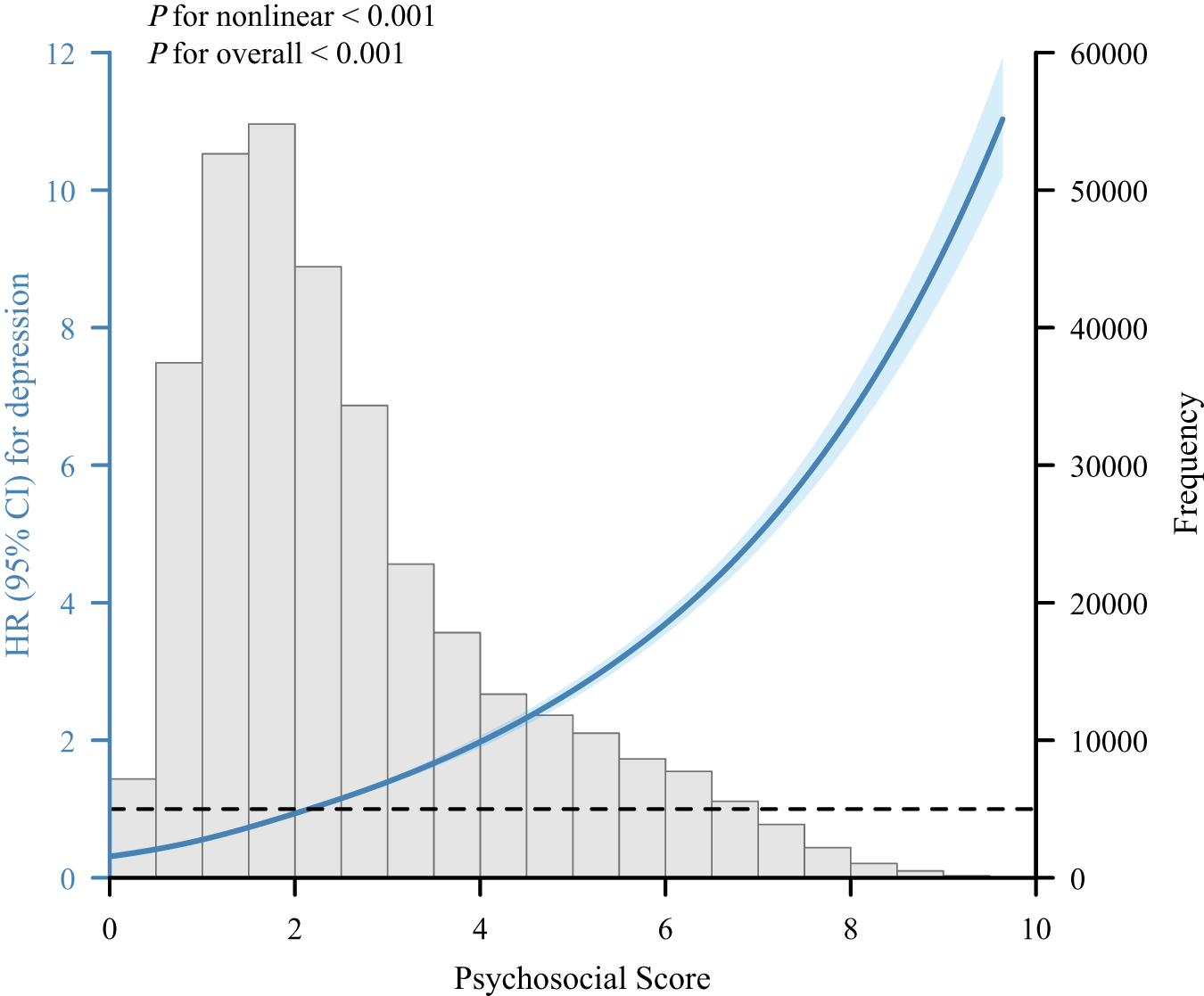
An increased risk of depression was associated with higher psychosocial scores (P for non-linearity < 0.001), with a steeper increase in risk observed at around 5–6 points, as presented in Table 3 and Fig. 1. We observed that each 1-point increase in the composite psychosocial score corresponded to a 42% (95% CIs: 41–45%) higher risk of depression. The association remained significant when the psychosocial score was analyzed as a categorical variable. After controlling for lifestyle factors, the association was somewhat weakened but still statistically significant, with adjusted HRs for depression of 1.71 (95% CI: 1.62–1.81) for individuals with medium-level psychosocial status and 4.36 (95% CI: 4.15–4.58) for those with low-level psychosocial status.
The dose–response associations between psychosocial scores and incident depression.

Figure 1 Long description
Associations between the psychosocial score and risk of depression are presented according to low, medium, and high score groups, as well as per 1-point increment in the score. The low-score group (≤1.62) included 1,940 depression events among 111,449 participants and served as the reference group. The medium-score group (1.63–2.91) included 3,620 events among 114,334 participants and was associated with a higher risk of depression, with an HR of 1.79 (95% CI: 1.69–1.89) in Model 1 and 1.71 (95% CI: 1.62–1.81) in Model 2. The high-score group (≥2.92) included 9,246 events among 111,139 participants and showed the strongest association, with an HR of 4.82 (95% CI: 4.59–5.06) in Model 1 and 4.36 (95% CI: 4.15–4.58) in Model 2. For the psychosocial score analyzed continuously, 14,806 depression events occurred among 336,922 participants, and each 1-point increment was associated with an HR of 1.44 (95% CI: 1.43–1.46) in Model 1 and 1.42 (95% CI: 1.41–1.45) in Model 2. FDR-corrected P values were less than 0.01 for the medium- and high-score groups and for each 1-point increment. Overall, higher psychosocial scores were associated with progressively greater risks of depression.
Stratified and sensitivity analyses
A statistically significant interaction was observed between psychosocial score and sex (Table 4). The positive association between psychosocial score and depression appeared to be slightly stronger in males than in females (HR: 1.43 for males vs. HR: 1.41 for females), suggesting that males may be more susceptible to adverse effects from equivalent levels of psychosocial score (P for interaction < 0.05). Stronger associations were observed among non-smokers (45% vs. 40% vs. 36%) compared to the counterparts. No significant interaction effects were found between psychosocial score and other stratified variables such as age, ethnicity, dietary score or drinking status.
Psychosocial scores and incident depression, subgroup analyses

Table 4 Long description
Subgroup analyses examined the associations between psychosocial score and incident depression according to age, sex, ethnicity, dietary score, drinking status, and smoking status. Higher psychosocial scores were consistently associated with an increased risk of depression across all subgroups. For each 1-point increment in psychosocial score, HRs ranged from 1.36 to 1.45 across subgroup categories. Significant interactions were observed for sex and smoking status in the continuous-score analyses (P for interaction < 0.01 for both). The association was slightly stronger in males than in females, with HRs of 1.43 (95% CI: 1.42–1.45) and 1.41 (95% CI: 1.39–1.42), respectively. For smoking status, the HRs per 1-point increment were 1.45 (95% CI: 1.43–1.46) among never smokers, 1.40 (95% CI: 1.38–1.42) among former smokers, and 1.36 (95% CI: 1.34–1.39) among current smokers. No significant interactions were observed for age, ethnicity, or drinking status. Similar positive associations were observed when the psychosocial score was analyzed categorically, with participants in the high-score group consistently showing substantially higher risks of depression than those in the low-score reference group.
All adjusted for age (years), sex (female or male), ethnicity (White or non-White), dietary score (0–7), drinking status (never, former or current), smoking status (never, former or current) and TDI. Stratified factors were not adjusted for in the models.
The results were largely consistent with the main analyses under various sensitivity analyses, including the exclusion of participants diagnosed with depression within the first 2 years of follow-up (Supplementary Table 3), treating mortality from other causes as a competing event (Supplementary Table 4) and imputing missing values for covariates (Supplementary Tables 5 and 6).
Discussion
In this large prospective cohort study involving 336,922 participants, we proposed that a novel composite measure of psychosocial status, integrating 18 factors across stress, psychiatric symptoms, social contact and socio-economic domains, is a robust predictor of depression incidence. We observed a strong gradient effect: individuals with low psychosocial status faced over fourfold higher depression risk compared to those with high status, even after adjusting for lifestyle factors. These findings confirm that psychosocial factors collectively represent modifiable targets for prevention, with interventions addressing the combined status of these domains likely offering greater impact than focusing on isolated factors.
Psychosocial status and depression
Numerous previous studies have consistently demonstrated a strong association between psychosocial factors and depression (Bruce, Reference Bruce2002; Hammen, Reference Hammen2005, Reference Hammen2018). Notably, emotional distress and low household income emerged as the most prominent risk factors for depression (Markkula et al., Reference Markkula, Marola, Nieminen, Koskinen, Saarni, Härkänen and Suvisaari2017). As a core dimension of psychosocial status, lower SES may heighten psychological stress, restrict healthcare access and promote unhealthy behaviors, all of which contribute to an increased risk of depression (Ridley et al., Reference Ridley, Rao, Schilbach and Patel2020). Reduced social contact is a prevalent and modifiable psychosocial burden that negatively impacts mental health (Bruss et al., Reference Bruss, Seth and Zhao2024). A 12-year population-based study estimated that 11–18% of depression cases could potentially be prevented if loneliness were eliminated (Lee et al., Reference Lee, Pearce, Ajnakina, Johnson, Lewis, Mann, Pitman, Solmi, Sommerlad, Steptoe, Tymoszuk and Lewis2021). Stressful life events are well-established risk factors for mental disorders (Beards et al., Reference Beards, Gayer-Anderson, Borges, Dewey, Fisher and Morgan2013), with events such as the death of a loved one, divorce or financial difficulties being linked to a heightened risk of depression (Musliner et al., Reference Musliner, Andersen, Agerbo, Albiñana, Vilhjalmsson, Rajagopal, Bybjerg-Grauholm, Bækved-Hansen, Pedersen, Pedersen, Munk-Olsen, Benros, Als, Grove, Werge, Børglum, Hougaard, Mors, Nordentoft, Mortensen and Suppli2023). Among all evaluated psychosocial factors, tiredness and current depressive symptoms exhibited the highest PAF values, highlighting their significant contributions to the overall burden of depression. These epidemiological associations were further supported by evidence from Mendelian randomization and mechanistic studies (Kendler et al., Reference Kendler, Karkowski and Prescott1999; Andreu-Bernabeu et al., Reference Andreu-Bernabeu, González-Peñas, Arango and Díaz-Caneja2023; Sbarra et al., Reference Sbarra, Ramadan, Choi, Treur, Levey, Wootton, Stein, Gelernter and Klimentidis2023), reinforcing their importance as universal targets for preventive strategies.
Psychosocial factors frequently co-occur and may interact synergistically, suggesting their collective impact could exceed the sum of individual risks. However, these previous studies focused exclusively on a single dimension of psychosocial status and have typically treated all contributing factors as equally important (Kinner and Borschmann, Reference Kinner and Borschmann2020; Shi et al., Reference Shi, Han, Liao, Zhao, Fan, Zhang, Teopiz, Song, Li, Guo, Lu and Mcintyre2023). This approach may compromise the accuracy of assessments, as factors with stronger associations may exert greater influence. To address this limitation, we constructed a weighted psychosocial score to reflect a multidimensional and richer psychosocial status and explore its association with depression. We observed a dose–response association between psychosocial score and the risk of depression, with low psychosocial status facing over four-fold higher depression risk, and medium psychosocial status with nearly double the risk, compared to those with high status. Notably, the combined effect exceeded those reported for several established modifiable risk factors for depression, such as SES and social disconnection (Lund et al., Reference Lund, Brooke-Sumner, Baingana, Baron, Breuer, Chandra, Haushofer, Herrman, Jordans, Kieling, Medina-Mora, Morgan, Omigbodun, Tol, Patel and Saxena2018; The Lancet Public Health, 2025). Thus, our findings emphasized that a comprehensive approach targeting multidimensional psychosocial risk factors may be more effective in preventing depression, rather than focusing on any single domain alone. To operationalize this approach, incorporating a composite psychosocial score into routine health assessments may help identify disadvantaged populations and target modifiable interventions.
We observed that the association between the psychosocial score and depression was slightly stronger in men than in women. This modest difference may be partly explained by socio-behavioral mechanisms. Traditional masculine norms may discourage men from expressing psychological distress and seeking support under psychosocial stress (Seidler et al., Reference Seidler, Dawes, Rice, Oliffe and Dhillon2016), while inadequate social support may exert a stronger adverse effect on depression risk in men (Li et al., Reference Li, Li, Lam, Tang, Seedat, Barbui, Papola, Panter-Brick, Waerden, Bryant, Mittendorfer-Rutz, Gémes, Purba, Setyowibowo, Pinucci, Palantza, Acarturk, Kurt, Tarsitani, Morina, Burchert, Patanè, Quero, Campos, Huizink, Fuhr, Spiller, Sijbrandij and Hall2023). Our findings further suggested that the observed associations were largely independent of most lifestyle factors, and the association was more pronounced among participants who had never smoked. Among current or former smokers, depressive symptoms may additionally be influenced by nicotine dependence, withdrawal-related affective changes, and other smoking-related behavioral or health burdens (Taylor et al., Reference Taylor, Mcneill, Girling, Farley, Lindson-Hawley and Aveyard2014; Mathew et al., Reference Mathew, Hogarth, Leventhal, Cook and Hitsman2017), thereby attenuating the relative contribution of the psychosocial score to depression in these groups. By contrast, among never smokers, the psychosocial score may more directly capture psychosocial adversity, resulting in a clearer association with depression. These findings underscore the need for future public health surveillance and prevention strategies to extend beyond unhealthy lifestyles to include adverse psychosocial status.
Potential mechanisms between psychosocial status and depression
The underlying mechanisms linking psychosocial status to depression risk are intricate and multifaceted, involving genetic, behavioral and neurobiological aspects (Malhi and Mann, Reference Malhi and Mann2018). According to the social causation hypothesis, poverty elevates the risk of depression by increasing stressful events, exacerbating trauma and fostering social exclusion (Lund et al., Reference Lund, De Silva, Plagerson, Cooper, Chisholm, Das, Knapp and Patel2011). Numerous studies have suggested that depression often follows traumatic or stressful life events, which can induce structural and functional changes in neurons (Cui et al., Reference Cui, Li, Wang, Wu, Liu, Yu, Wang, Tang, Xia and Li2024). Exposure to traumatic or stressful life events may impair social functioning across the life course (Lord et al., Reference Lord, Suvak, Holmes, Shields, Lane, Sijercic, Wagner, Stirman and Monson2020), including diminished social networks and persistent loneliness. These disruptions can destabilize mental equilibrium and increase vulnerability to depressive disorders. Moreover, social isolation and loneliness activate the hypothalamic–pituitary–adrenocortical axis (Hodgson et al., Reference Hodgson, Watts, Fraser, Roderick and Dambha-Miller2020), thereby increasing susceptibility to depression and accelerating its progression. Given that psychosocial risk factors frequently co-occur and interact, interventions targeting these mechanisms offer a promising approach to mitigate their cumulative impact on depression.
Global and national efforts towards depression prevention
Depression can be prevented through the intervention or reduction of individual or multiple psychosocial factors. For example, a meta-analysis demonstrated the potential of psychological interventions in preventing the onset of major depression among individuals not currently experiencing depressive symptoms (Buntrock et al., Reference Buntrock, Harrer, Sprenger, Illing, Sakata, Furukawa, Ebert and Cuijpers2024). As an approach targeting the social determinants of health, social prescribing has been regarded as a holistic, person-centred intervention to reduce the disparity between social well-being and mental health (The Lancet, 2025). In response to the increasing burden of depression, international organizations and national governments have implemented strategic plans. The World Health Organization (WHO) launched the Comprehensive Mental Health Action Plan 2013-2030, which is based on six cross-cutting principles and aims for 80% of countries to develop or update their mental health policies by 2030 (World Health Organization, 2021). The Lancet–World Psychiatric Association Commission highlights that depression arises from a unique combination of factors, including psychosocial status, and emphasizes the need for social and economic interventions across society to address early-life adversities and inequities throughout the life course (Herrman et al., Reference Herrman, Patel, Kieling, Berk, Buchweitz, Cuijpers, Furukawa, Kessler, Kohrt, Maj, Mcgorry, Reynolds, Weissman, Chibanda, Dowrick, Howard, Hoven, Knapp, Mayberg, Penninx, Xiao, Trivedi, Uher, Vijayakumar and Wolpert2022). Given the complex influence of psychosocial factors on the onset of depression, it is crucial to assess the psychosocial status of populations and implement comprehensive, integrated interventions.
Strengths and limitations
This study represents the first large-scale, longitudinal investigation with extended follow-up and a nationally representative sample to explore the combined association of multiple psychosocial factors with depression. Moreover, it included a large sample size and a relatively long-term follow-up, which enabled us to perform detailed subgroup and sensitivity, and enhance the validity of the results.
However, several important limitations should be noted. First, while our study observed strong associations, these findings do not necessarily imply causation due to the inherent limitations of observational research designs. To address potential reverse causality, we excluded participants who developed depression within the first 2 years of follow-up and found similar results. Second, the majority of participants were White and tended to be healthier than the general population, limiting the generalizability of our findings. Third, psychosocial data were collected at recruitment from self-report questionnaires, which are prone to recall bias and might not accurately reflect actual association. In addition, the time window captured by these questionnaires may not accurately reflect participants’ actual psychosocial status, potentially leading to misclassification. However, existing studies have suggested the stability and reproducibility of retrospective self-reported psychosocial information (Gigantesco and Morosini, Reference Gigantesco and Morosini2008; Hosang et al., Reference Hosang, Manoli, Shakoor, Fisher and Parker2023). Fourth, unmeasured pre-exposure confounders may lead to residual bias, although we attempted to adjust for potential confounding factors as comprehensively as possible. Fifth, although modification by lifestyle factors had been examined, a more comprehensive set of lifestyle factors and a detailed classification were not considered. Sixth, the psychosocial factors included in our study may not fully capture the complexity of psychosocial status, as our final set was designed as a parsimonious and interpretable individual-level measure. Future research with comprehensive consideration is warranted to expand our exploration of various dimensional factors to mitigate the adverse effects of psychosocial status on depression.
Conclusion
Our study demonstrated that individuals with low psychosocial status experienced over four-fold higher depression risk compared to those with high status, highlighting that psychosocial factors collectively represent modifiable targets for prevention. Additionally, the joint effects of stress, psychiatric symptoms, social contact and socio-economic domains emphasize the benefits of simultaneous and integrated interventions to reduce the burden of depression.
Supplementary material
The supplementary material for this article can be found at https://doi.org/10.1017/S2045796026101012.
Availability of data and materials
The data that support the findings of this study are available from the UK Biobank project site, subject to registration and application process. Further details can be found at https://www.ukbiobank.ac.uk.
Acknowledgements
This study was conducted using the UK Biobank resource (Application No. 79095). We want to express our sincere thanks to the participants of the UK Biobank and the members of the survey, development and management teams of this project.
Author contributions
C.X. and X.W. conceived and designed the project. X.Z. and Y.S. conducted the data analysis, interpreted the results, and wrote the first draft of the manuscript. M.Q., Z.C., X.W. and C.X. have made critical revisions to the manuscript for important intellectual content. C.X. is the guarantor of this work. All authors read and approved the final manuscript. X.Z. and Y.S. are co-first authors. Xiaohe Wang can also be contacted for correspondence, email xhewang@163.com.
Financial support
This study was supported by the National Natural Science Foundation of China (No. 72274051, No. 72204071) and Hangzhou Normal University Fund (No. 4035C52726101100).
Competing interests
The authors declare no competing interests.
Ethical standards
The studies involving human participants were reviewed and approved by NHS National Research Ethics Service (NW/0382). Patients/participants provided their written informed consent to participate in this study.




 Open access

