Throughout the early 2000s, Clostridioides difficile infection (CDI) rates increased dramatically, which coincided with the rise of the “epidemic” C. difficile strain recognized as BI/NAP1/027. Reference McDonald, Killgore and Thompson1,Reference Burnham and Carroll2 Testing strategies for CDI also evolved over this period. Reference Johnson3–Reference McDonald, Gerding and Johnson5 In 2009, polymerase chain reaction (PCR) testing primarily targeting the gene for toxin B (tcdB) was approved for commercial use in the detection of C. difficile. Reference Burnham and Carroll6 Utilization of PCR provided clinicians with a rapid and highly sensitive test for C. difficile Reference Burnham and Carroll6 but also led to increased CDI rates reported for many institutions. Reference Guh, Mu and Winston7,Reference Guh, Hatfield and Winston8 However, this increase in CDI rates was potentially confounded because PCR does not distinguish between active infection and colonization. Reference Guh, Mu and Winston7,Reference Guh, Hatfield and Winston8 Thus, the best testing strategy for CDI remains an open question with no universal agreement among healthcare systems. Reference Burnham and Carroll2
The 2017 Infectious Diseases Society of America (IDSA) CDI guidelines changed to reflect the complexity of CDI testing and diagnosis. Reference McDonald, Gerding and Johnson5 The guidelines recommend implementing a 2-step algorithm approach that includes a more sensitive initial step, such as PCR or a glutamate dehydrogenase (GDH) assay, followed by a more specific step, such as toxin A/B EIA. Reference McDonald, Gerding and Johnson5 The guidelines further suggest that if a single test is used, a highly sensitive test such as PCR should be utilized and that pre-agreed institutional criteria for stool submission are in place to avoid testing patients on laxatives or those with insignificant diarrhea symptoms. Reference McDonald, Gerding and Johnson5 Recent data suggest that reliance on PCR alone for the detection of C. difficile results in overdiagnosis of CDI. Reference Guh, Mu and Winston7,Reference Polage, Gyorke and Kennedy9 In response, many institutions have readopted a 2-step testing algorithm utilizing either GDH plus a toxin EIA or PCR plus a toxin EIA. Reference Skinner, Yu, Cheknis, Pacheco, Gerding and Johnson4 Additionally, recent data suggest that the presence of C. difficile toxin by EIA is associated with increased severity and risk of recurrence but not other CDI-related complications or mortality. Reference Guh, Hatfield and Winston8
In September 2019, our hospital changed the testing algorithm for C. difficile from PCR alone to PCR followed by toxin A/B EIA. We conducted a retrospective study for patients diagnosed with C. difficile by PCR from October 2019 through October 2020 to compare the outcomes between those who were toxin A/B negative and those who were toxin A/B positive as well as their associated molecular epidemiologies.
Methods
Prior to September 2019, microbiologic detection of C. difficile was performed via PCR detection of tcdB (PCR, GeneXpert, Cepheid, Sunnyvale, CA). Starting in September 2019, a multistep testing strategy was adopted. Stool samples that were positive for C. difficile PCR underwent reflex toxin testing (Cdiff quick check complete, Alere/TechLab, Waltham, MA). Within the electronic medical record (EMR), PCR-positive, toxin A/B–negative tests (PCR+/Tox−) were reported as “C. diff detected by PCR, toxin negative by EIA. Possible disease or colonization. Interpretation requires clinical judgement.” And PCR-positive, toxin A/B–positive tests (PCR+/Tox+) were reported as “Toxigenic C. difficile detected. Repeat testing should not be performed.”
Data collection
We conducted a retrospective study using both case–control and cohort methods for patients who tested for positive for C. difficile by PCR at the Edward Hines Jr Veterans’ Affairs Hospital from October 1, 2019, through October 31, 2020, after changing to a testing algorithm that included toxin EIA in addition to PCR. According to hospital policy, repeated CD testing was prohibited for 7 days after the last positive PCR test. A case was defined as a person who was PCR positive and toxin A/B positive, and controls were defined as patients who were PCR positive and toxin A/B negative. During the study period, 130 nonduplicate positive PCR tests were obtained. Of these PCR positive tests, 50 were PCR+/Tox+ and 80 were PCR+/Tox−. The EMR was reviewed for all patients with PCR-positive tests to collect the following baseline characteristics and demographics: symptoms, initial laboratory data, relevant healthcare and medication exposures, immunocompromised status, CDI severity as defined by a Zar score ≥2, Reference Zar, Bakkanagari, Moorthi and Davis10 community-onset CDI (CO-CDI) and hospital-onset CDI (HO-CDI) as defined by the 2017 IDSA C. difficile guidelines, Reference McDonald, Gerding and Johnson5 C. difficile treatments, and details relayed to any subsequent recurrence up to 90 days after the index event. Immunocompromised status was defined as a history of a hematologic malignancy, active chemotherapy, active solid-organ malignancy, immunomodulating medications (ie, prednisone or adalimumab), or HIV/AIDS with a CD4 <200.
Moreover, 19 patients had repeated positive C. difficile tests at least a week apart, and 4 patients tested positive a total of 3 times and represented different clinical episodes. Therefore, we referred to these separate patient events as ‘encounters.’ The median interval between positive tests in these 19 patients was 62 days, and no patients were tested while on C. difficile treatment.
Stool culture and REA typing
Stool samples that tested positive for C. difficile in the clinical laboratory were frozen for subsequent testing. Among the 130 positive tests, 95 stool specimens were available for culture. Samples were subsequently thawed, inoculated anaerobically on taurocholate-cefoxitin-cycloserine-fructose agar plates (TCCFA), and C. difficile isolates identified as previously described. Reference Clabots, Johnson and Bettin11 C. difficile was recovered from 77 (80%) of the 95 available stool specimens and were frozen at −80°C prior to subsequent analysis.
Restriction endonuclease analysis (REA) typing was performed on the recovered C. difficile isolates from the stool culture as previously described by Clabots et al. Reference Clabots, Johnson and Bettin11 Briefly, HindIII digestion of total cellular DNA was performed, and DNA fragments were separated by electrophoresis on 0.7% agarose gel. The resulting HindIII restriction patterns were compared with patterns from previously characterized strains. Patterns showing a 90% similarity index were placed in the same REA group suing letter designations (ie, REA group BI, REA group Y). REA group designations correlate well with particular PCR ribotypes (RTs), the other major typing system for C. difficile. Reference Kociolek, Perdue, Fawley, Wilcox, Gerding and Johnson12,Reference Manzo, Merrigan and Johnson13 The predominant RTs associated with each REA group have been included in parentheses in the tables and text for reference.
Statistical analysis
The χ2 test and the Fisher exact test were used to compare categorical variables for associations between PCR+/Tox− and PCR+/Tox+ and REA typing. Normality of continuous variables was determined using the Kolmogorov-Smirnov method. The Student t test was used to compare parametric variables and the Wilcoxon signed-rank test was used to compare nonparametric variables.
Crude odds ratios (cORs) in relationship to the toxin status (PCR+/Tox− vs PCR+/Tox+) were calculated for the a priori variables that had previously been defined as a risk factor for CDI recurrence. Reference Guh, Mu and Winston7,Reference Gerding, Kelly and Rahav14 These risk factors include age ≥65 years, history of CDI within the past 6 months, epidemiologic classification defined as hospital-onset CDI (HO-CDI), severe CDI (defined as a Zar score ≥2), and concomitant antibiotic exposure defined as systemic antibiotics received while on CDI therapy and up to 90 days after completing CDI therapy. Additionally, to account for potential C. difficile colonization, a univariate risk ratio (RR) was calculated for the decision to treat for CDI, which was included in the final multivariable model.
A series of multivariable logistic regression models were constructed to evaluate the relationship of between toxin positivity status and CDI recurrence at 30 days (primary outcome), CDI recurrence at 90 days, death at 30 days, and death at 90 days. A secondary set of models was constructed in which toxin positivity status was exchanged for PCR cycle threshold (PCR-Ct) as a continuous variable. Moreover, 9 encounters were removed from the model because they either died during hospitalization or were enrolled in hospice. Results were reported as adjusted odds ratios (aORs) and 95% confidence intervals (CIs). Statistical analyses were conducted using SAS version 9.4 statistical software (SAS Institute, Cary, NC).
The study was approved by the Edward Hines Jr. VA Hospital Institutional Review Board (IRB no. 1588822-2)
Results
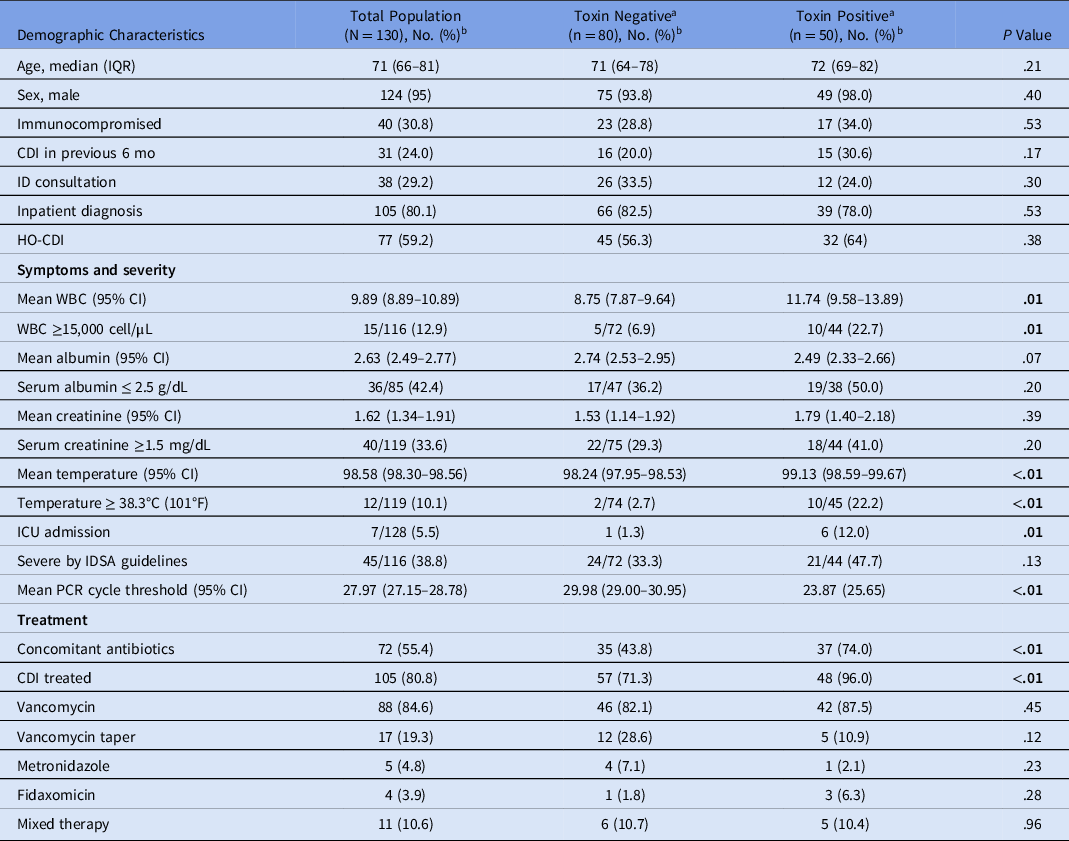
For the 130 patient encounters with C. difficile PCR positive stools, 95% were male and the median age was 71. CDI within the past 6 months was identified in 24% of the encounters, and 30.8% were classified as immunocompromised. The majority were classified as HO-CDI (59.2%), and the clinical infectious diseases service was consulted on 29.2% of cases (Table 1).
Demographic Characteristics for all Encounters

Note. CI, confidence interval; IQR, interquartile range; ID, infectious diseases; HO, hospital onset; CDI, Clostridioides difficile infection; WBC, white blood cell count; PCR, polymerase chain reaction; IDSA, Infectious Diseases Society of America. Bold indicates statistical significance.
a All tests were PCR positive.
b Units unless otherwise specified.
Encounters that were PCR+/Tox+ were more likely to have a higher temperature when compared to PCR+/Tox− encounters: 37.29°C (99.13°F) versus 36.8°C (98.24°F; P < .01). The mean white blood cell counts (WBCs) were 11.74 cell/μL in encounters with a PCR+/Tox+ test and 8.75 cell/μL in encounters with a PCR+/Tox− test (P = .01). There was no statistically significant difference in the mean albumin level (2.49 g/dL vs 2.73 g/dL; P = .07) or the mean serum creatinine level (1.79 mg/dL vs 1.53 mg/dL) for these groups. The mean C. difficile PCR-Ct was 23.87 among stools that were PCR+/Tox+ and 29.98 in PCR+/Tox− stools (P < .01). ICU encounters were more common among PCR+/Tox+ encounters because 12.5% were admitted to the ICU specifically for a CDI, whereas only 1.3% of PCR+/Tox− encounters were admitted to the ICU for a CDI (P = .01) (Table 1).
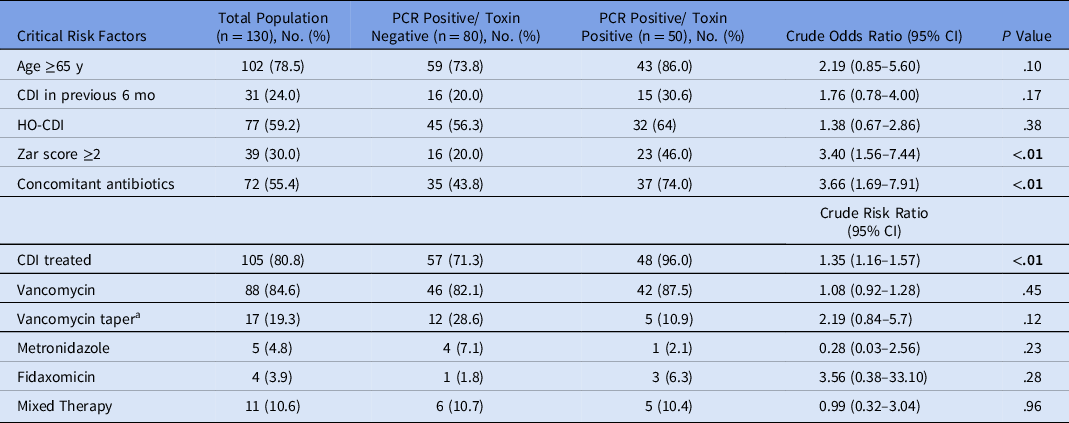
Among the a priori risk factors for recurrence, age ≥65 years was more common among PCR+/Tox+ encounters but not significantly so (cOR, 2.19; 95% CI, 0.85–5.60). Additionally, there was no significant difference between PCR+/Tox+ and PCR+/Tox− encounters who had had a CDI episode within the past 6 months (cOR, 1.76; 95% CI, 0.78–4.0) or those who had been diagnosed with HO-CDI (cOR, 1.38; 95% CI, 0.67–2.86). A Zar score ≥2 was more common among PCR+/Tox+ (46.0%) compared to PCR+/Tox− encounters (20.0%; cOR, 3.40; 95% CI, 1.56–7.44). Concomitant antibiotics were received by 55.4% of all of encounters; however, concomitant antibiotics were more common among the PCR+/Tox+ encounters compared to the PCR+/Tox− encounters (74% vs 43%; P < .01). Although 80.8% of encounters were treated for CDI, the PCR+/Tox+ group was more likely to be treated for CDI (RR, 1.3; 95% CI, 1.16–1.57). Among those who were treated, there was no difference in the choice of CDI therapy between the PCR+/Tox+ and PCR+/Tox− encounters (Table 2).
Univariate Analysis of Critical CDI Recurrence Risk Factors

Note. PCR, polymerase chain reaction; PCR, polymerase chain reaction; CDI, Clostridioides difficile infection. Bold indicates statistical significance.
a Subset of patient encounters receiving vancomycin.
Outcomes based on stool toxin results
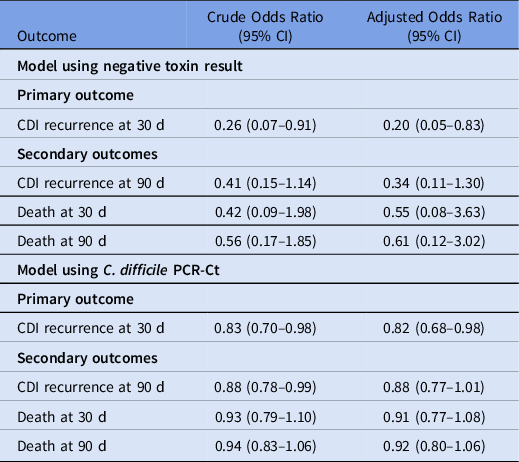
The odds of CDI recurrence at 30 days was lower among encounters with stools that were toxin negative with a cOR of 0.26 (95% CI, 0.07–0.91). Though not significant, the odds of CDI recurrence at 90 days for encounters with toxin negative stools was lower than for those with toxin-positive stools (cOR, 0.41; 95% CI, 0.15–1.14). The odds of death at 30 and 90 days in toxin-negative encounters were 0.42 times (95% CI, 0.09–1.98) and 0.56 times (95% CI, 0.17–1.85) that of toxin positive encounters, respectively. After adjusting for the a priori variables, the aORs for CDI recurrence at 30 and 90 days in encounters with toxin-negative stools were 0.20 (95% CI, 0.05–0.83) and 0.34 (95% CI, 0.11–1.30), respectively. The aORs for death at 30 and 90 days in encounters with toxin-negative stools were 0.55 (95% CI, 0.08–3.63) and 0.61 (95% CI, 0.12–3.02), respectively (Table 3).
Outcomes

Note. CI, confidence interval; CDI, Clostridioides difficile infection; Ct, cycle threshold.
Outcomes based on PCR cycle thresholds
The cOR of CDI recurrence at 30 days was also significant for PCR-Ct (0.83; 95% CI, 0.70–0.98), and the cOR at 90 days was 0.88 (95% CI, 0.78–0.99) (Table 3). Thus, for each 1.0 increase in the PCR-Ct, the odds of developing a CDI recurrence at 30 and 90 days decreased by 17% and 12%, respectively. The cORs of death at 30 and 90 days were not significantly different: 0.93 (95% CI, 0.79–1.10) and 0.94 (95% CI, 0.83–1.06). The aORs for CDI recurrence at 30 and 90 days utilizing PCR-Ct were 0.83 (95% CI, 0.82 – 0.98) and 0.88 (95% CI, 0.77–1.01), respectively. The aORs for death at 30 and 90 days utilizing PCR-Ct were 0.91 (95% CI, 0.77–1.08) and 0.92 (95% CI, 0.80–1.06) (Table 3).
Molecular epidemiology results
REA group Y was the most common group strain present accounting for 23.4% of all isolates, followed by REA group BI (14.3%) and REA group DH (10.4%) (Fig. 1). REA group Y was more commonly associated with PCR+/Tox− tests. Among the PCR+/Tox− group, REA group Y made up 32.5% of these isolates whereas REA group Y only made up 13.5% of PCR+/Tox+ isolates (P = .05) (Fig. 1 and Table 4). Additionally, REA group Y–related CDIs resulted in treatment for 72% of the encounters. In contrast to REA group Y, REA group BI–associated encounters were predominantly found to be PCR+/Tox+. REA group BI accounted for 24.3% of encounters with toxin-positive stools and 5.0% of those with toxin-negative stools (P = .02). Among encounters with patients infected with REA group BI, 100% were treated for a CDI. Among those infected with the other REA group groups, there was no significant difference between toxin positivity status (Table 4).
Frequency and distribution of C. difficile REA group strains from encounters that occurred between October 1, 2019, and October 31, 2020.

Molecular Epidemiology

Note. REA, restriction endonuclease analysis; PCR, polymerase chain reaction.
a REA groups closely align with the following PCR ribotypes (RT): REA group Y, RT 014/020; REA group BI, RT 027; REA group DH, RT 106.
Of the 19 patients with a subsequent CDI, 11 had typing data available for multiple encounters. Among these patients, 8 had the same the same REA type isolate recovered at each encounter.
Discussion
In 2019, our hospital clinical laboratory testing strategy changed from PCR to PCR plus a toxin A/B EIA. These changes were made in response to data that PCR alone was overly sensitive and falsely inflated the overall burden of C. difficile within the healthcare setting. Reference Guh, Mu and Winston7,Reference Polage, Gyorke and Kennedy9 Upon changing to a 2-step algorithm, we noted that encounters that were toxin positive were more likely to be treated compared with their toxin-negative counterparts. However, despite a decrease in treatment within the PCR+/Tox− group, the 30-day recurrence rate was lower among PCR+/Tox− encounters, potentially indicating that there was a higher degree of colonization that did not require treatment within the PCR+/Tox− group. This inference was supported by a reduced odds of recurrence at 30 days after multivariable adjustment revealing that encounters that were PCR+/Tox− had an aOR of 0.20 (95% CI, 0.05–0.83) of recurrence. Additionally, among our a priori variables for adjustment, we noted that PCR+/Tox+ encounters were more likely to have more severe CDI, with a higher proportion of PCR+/Tox+ encounters having a Zar score of ≥2. These data support previous findings that the detection of toxin by EIA is an indicator for severity and the risk of recurrence. Reference Guh, Hatfield and Winston8,Reference Origüen, Corbella and Orellana15
In addition to recurrence and severity, the PCR-Ct correlated closely with toxin EIA positivity. Previous data have revealed that the PCR-Ct can be used to predict the toxin status. Reference Senchyna, Gaur, Gombar, Truong, Schroeder and Banaei16,Reference Choi, Wong and Dunn17 Although these previous data were able to establish potential threshold cutoff values, they were unable to determine an association with CDI severity or recurrence. Reference Senchyna, Gaur, Gombar, Truong, Schroeder and Banaei16,Reference Choi, Wong and Dunn17 Our data indicate that as the PCR-Ct increases, the odds of recurrence at 30 days decreased (Table 3). A lower PCR-Ct could indicate a higher bacterial burden and thus could correlate to a higher amount of toxin production that would be detected by the toxin assay. Reference Senchyna, Gaur, Gombar, Truong, Schroeder and Banaei16 PCR-Ct data could also potentially be used to estimate the risk of recurrence. As others have shown, our data indicate that C. difficile toxin as identified by the toxin A/B EIA is associated with CDI recurrence. Reference Guh, Hatfield and Winston8,Reference Origüen, Corbella and Orellana15 Our PCR-Ct data in contrast to other studies also suggest a predictive value for recurrence. Reference Choi, Wong and Dunn17,Reference Origüen, Orellana and Fernández-Ruiz18 A larger prospective study could help determine whether PCR-Ct is truly an effect modifier that is affecting the course of CDI or if it is, instead, a confounder that must be controlled for in multivariable models.
Lastly, during the change in the testing algorithm, we noted key associations within the C. difficile molecular epidemiology within our hospital. We previously documented in the same hospital that REA group BI (RT027) was the most prevalent strain in the early 2000s, accounting for nearly 70% of all isolates. Reference Wieczorkiewicz, Lopansri and Cheknis19 REA group BI (RT027) has demonstrated an increased capacity for toxin production in the past. Reference O’Connor, Johnson and Gerding20 Our data further illustrate that infection with REA group BI is more commonly associated with positive stool-toxin results (Fig. 1 and Table 4). Conversely, our data show that, currently, the most common group strain within our hospital, REA group Y, is more frequently found in encounters with toxin-negative stools. Previous studies have indicated the REA group Y more commonly results in less severe infections. Reference Walk21 However, the REA group Y has been prevalent over multiple decades, and recent data from the Center for Disease Control (CDC) Emerging Infection Program (EIP) indicate that PCR ribotype 014/020 (the most common RT associated with REA Group Y) has become the most common group strain in the United States. Reference Olson, Shanholtzer, Lee and Gerding22,23 Because a greater number of REA group Y isolates are toxin negative, these encounters on the whole received different treatment than encounters who tested positive for REA group BI. Notably, all encounters with REA group BI were treated as if they had a CDI, whereas 72% of those with REA group Y stools were treated as if they had CDI. Because stool culture and strain typing were performed long after the patient encounters, the decision to treat was made without knowledge of the infecting strain, again supporting these associations.
This study had several limitations. Confounding may have occurred due to the effects of COVID-19. As we conducted this review of encounters in 2020, overall hospitalizations at our institute decreased significantly, as did elective procedures. These changes likely resulted in some decreased risk for C. difficile exposure with fewer healthcare and antimicrobial exposures. For those who did develop a CDI during the early stages of the COVID-19 pandemic, there could have been unmeasured selection bias because encounters that were hospitalized in the early stages of COVID-19 pandemic could have been at a higher risk for more severe CDI or recurrent CDI despite not having a positive COVID-19 diagnosis. Additionally, as a retrospective study, we were limited in our capacity to control for all variables which may have introduced bias or unaccounted confounding. Lastly, the generalizability of our results may be limited given that 95% of this VA population were male.
In conclusion, adopting a PCR plus toxin EIA is a reasonable strategy for diagnosis of CDI. The addition of toxin EIA testing provides clinicians with critical data on the severity of infection. Treatment was initiated 25.6% less frequently for toxin-negative encounters compared to toxin positive encounters, with no significant changes in recurrence. Further data are required to determine whether PCR-Ct can be used as a risk factor for CDI recurrence or if it is a confounding element that must be controlled for in future clinical epidemiologic CDI evaluations.
Acknowledgements
The authors thank Stacey Spadoni and Edith Siemianowski for collection PCR cycle threshold data.
Financial support
S.J. and A.M.S. received funding from the US Department of Veteran’s Affairs. This report reflects their viewpoint and does not represent that of the US Department of Veterans’ Affairs.
Competing interests
None of the authors report a conflict of interest.