The Lacaune sheep originated in France and produces the milk used to prepare Roquefort cheese. Over the last 40 years, the Lacaune breed was selected from a dual-purpose animal with low dairy yields, to select for an animal with increased milk production. The selection programme incorporated artificial insemination, milk recording (yields, composition, type traits, somatic cell count and udder score; Barillet et al. Reference Barillet, Marie, Jacquin, Lagriffoul and Astruc2001) and progeny testing of sires.
The Lacaune breed, owing to selection and export programmes, is currently one of the world's high-yielding milk ovine breeds, with an average daily milk yield of 1·59 l and a total milk yield of 270 l over a 165-d lactation period. Since 1992, 17 countries have officially imported dairy Lacaune from France. In Spain, for example, the Lacaune breed produces 1·43 l of standard milk daily, compared with Manchega production of 0·75 l/d (Such & Caja, Reference Such and Caja1995). In Canada, the productivity of the Lacaune is 330 l in the first lactation (lactation period of 220 d) and 392 l in the second and subsequent lactations (lactation period of 241 d) (Regli, Reference Regli1999).
Production of Roquefort cheese is strictly regulated (AGRP0001838D); legislation protecting Designation of Origin prohibits intensive milk production and insists on traditional management of the flocks. The hoggets are bred starting at an average age of 7–9 months. Therefore, there is only one lambing/year for adult ewes, which occurs from October to January (out-of-season mating). After a 30-d suckling period, ewes are milked to be dried off in July or August, when dairy factories stop or reduce their activities. In addition, sheep are maintained using extensive management practices. Feeding must be based on grass, forage and grain for at least 9 months and grazing must occur daily, when weather conditions and grass availability are adequate.
For producers outside the Roquefort Designation of Origin and unable to command the high prices of such cheese, traditional production conditions are not cost-effective and intensive management is the only way of fully exploiting animal potential and achieving profitable and sustainable farms. In contrast to the abundant research on traditional management, information about performance of Lacaune sheep under intensive management is scarce.
The productive life of a sheep, like that of other domestic animals, is strongly determined by the age at first lambing (AFL) and the lambing interval. AFL is crucial not only because it determines the precocity of productive life, but also because it affects lifetime productive yields. In dairy cattle, a large body of information exists on the effects of age at first calving (AFC) on individual productive and physiological records, as well as on collective profitability of the herd (Hare et al. Reference Hare, Norman and Wright2006). Optimal AFC has been the objective of numerous studies evaluating effect of genotype, environment and management both in beef cattle (Donaldson, Reference Donaldson1968; Pinney et al. Reference Pinney, Stephens and Pope1972; Chapman & Young, 1978) and dairy cattle (Gill & Allaire, Reference Gill and Allaire1976; Lin et al. Reference Lin, Mcallister, Batra, Lee, Roy, Vesely, Wauthy and Winter1988; Van Dam et al. Reference Van Dam, Bartlett, Kirk and Mather1988; Moore et al. Reference Moore, Kennedy, Schaeffer and Moxley1991; Simerl et al. Reference Simerl, Wilcox, Thatcher and Martin1991; Ettema & Santos, Reference Ettema and Santos2004; Haworth et al. Reference Haworth, Tranter, Chuck, Cheng and Wathes2008).
Conversely, information on optimal AFL in dairy sheep is limited, mainly because most of the ovine production systems include grazing without intensive breeding management and allow long suckling periods for the first milking interval (Gabiña et al. Reference Gabiña, Arrese, Arranz and Beltran de Heredia1993, Fuertes et al. Reference Fuertes, Gonzalo, Carriedo and San Primitivo1998; Barillet et al. Reference Barillet, Marie, Jacquin, Lagriffoul and Astruc2001; Morrissey et al. Reference Morrissey, Cameron and Tilbrook2008; Ramón et al. Reference Ramón, Legarra, Ugarte, Garde and Pérez-Guzmán2010). Only some information exists about the influence of AFL on successive performance of the Israeli breeds, Awassi and Assaf, maintained under intensive management (Gootwine & Pollott, Reference Gootwine and Pollott2000; Pollott & Gootwine, Reference Pollott and Gootwine2004). These studies confirm, analogously to studies in cattle, the key influence of AFL on the performance of the ewes and, hence, on the profitability and viability of the farms. As in cattle, optimal AFL in sheep is likely to depend on the breed and production system.
The present study aimed to investigate optimal AFL in dairy Lacaune ewes under intensive management by evaluating the effect of AFL on reproductive and productive performance.
Material and Methods
Animals and management
This study includes data on reproduction and milk production after first lambing for 3088 maiden Lacaune sheep from a single farm; the data cover the period 2005–2010. Ewes belonged to the flock of 3500 sheep located at the Cerromonte Farm (Avila, Spain; continental climate, latitude of 40·90 N, altitude of 900 m). The original flock had been imported from the French Lacaune Association (Upra Lacaune Region of Aveiron) between 2005 and 2006. On the Cerromonte Farm, animals are housed indoors, but exposed to natural conditions of photoperiod and thermoperiod, and monitored for adequate health status and specific pathogens. Food, rationed according to the sheep's production level, is based on corn, soybean and dried beet pulp, alfalfa, rye silage and wet brewers’ grains. Reproductive management includes 5 mating-periods per year (spaced at intervals of approximately 75 d) in which the ewes remain with males for 25 d to allow natural mating.
Maiden sheep were treated for oestrus synchronization with the insertion of intravaginal progestagen-impregnated sponges (40 mg fluorogestone acetate, FGA, Chronogest®, Intervet Schering Plough AH, Boxmeer, Netherlands) for 14 d plus 400 i.u. of eCG (Folligon®, Intervet Schering Plough AH, Boxmeer, Netherlands) administered on the day of sponge removal. Starting 36 h later, females were exposed to rams and natural mating was allowed for 25 d, with the exception of 350 maidens and 700 ewes and maiden sheep, which were artificially inseminated with frozen semen of purebred Lacaune rams in 2009 and 2010, respectively. Pregnancy diagnosis was performed by transabdominal ultrasonography in all sheep between 35 and 60 d post mating.
Ewes were mated again approximately 100–140 d after lambing. From the day after lambing, ewes were milked twice a day until milk production dropped below 0·5 l/d or until 30 d before the next lambing, when they were dried off. Lambs were weaned at a liveweight of 10 kg approximately 30 d after birth, after which they received concentrates and hay; the objective was to achieve 75% of the adult liveweight in approximately 6–7 months. Some of the maiden sheep considered for this study (n=404) were born between March and August and reached puberty at 150–210 d (5–7 months). They were the youngest ones in the next reproductive season (September–January). The remaining hoggets (n=2684) were older than 240 d (8 months) at their first reproduction season; on average, the maiden sheep were 270 d (9 months) old at first insemination or mating. A total of 2197 of these 3088 ewes had their first lambing during the natural lambing season (December–May) and 891 sheep lambed out of season (June–November).
Experimental groups and endpoints
Four experimental groups of ewes were identified on the basis of AFL: group E (‘early-maiden ewes’, n=926): sheep that were mated before 240 d of age and that therefore lambed before 390 d; group M (‘middle-maiden ewes’, n=1127): sheep that were mated between 241 and 300 d and that therefore lambed between 391 and 450 d; group L (‘late-maiden ewes’, n=664): sheep that were mated between 301 and 360 d and that therefore lambed between 451 and 510 d; group A (‘aged-maiden ewes’, n=278): sheep that were mated after 361 d and thus lambed after 511 d.
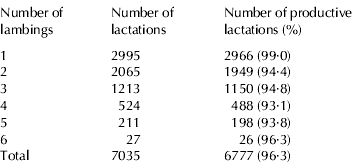
The study evaluated productive and reproductive parameters and longevity of the sheep in the different groups. Performance records were collected, stored and validated using the on-farm Software of Alpro Windows Application (DeLaval, Tumba, Sweden). For the last lactations of each ewe, only lactations longer than 120 d were considered in order to avoid lactational data with abnormally low production due to causes other than production capacity. In total, data from 7399 lambings and 7035 lactations from 3088 sheep were included. Of these 7035 lactations, 2995 (42·6%) were the first, 2065 (29·3%) the second, 1213 (17·2%) the third, 524 (7·5%) the fourth, 211 (3%) the fifth and 27 (0·4%) the sixth. The following information was recorded for each lambing/lactation: date of birth of the ewe, date of her first lambing, date of successive lambing, date of dry-off, number of lactations of the ewe, total milk production per lactation, days in milk (DIM) and date of culling. ‘Productive lactation’ was differentiated from ‘lactation’ and was defined as lactations lasting more than 120 d (DIM; Table 1). Productive parameters over time were calculated per day or year of life, or per day or year of ‘productive life’ (the life of the animal from its first lambing).
Total and productive lactations (lactation with ⩾120 DIM) included in the study, for each lambing

Productive parameters (expressed in litres of milk) were determined on the basis of: lambings/sheep (Lam); number of productive lactations/sheep in life time (PLa); number of lactations/sheep per year of life (LaL); number of lactations/sheep per year of productive life (LaPL); total milk yield/sheep over lifetime (TM); milk yield/lactation (MLa) and milk yield/day in milk (MDM) in each lactation and in the productive life time of each ewe.
Reproductive parameters (expressed in d) were determined on the basis of: mean lambing–conception interval (LCI), mean lambing interval/sheep in life (LI) and lambing interval in each lactation (LI1–2; LI2–3; LI3–4, and so on).
Longevity was determined based on data about the sheep's whole productive life (culled or death animals; n=1334). Data were collected on age at culling (expressed in d), number of productive lactations/sheep (PLa), and number of lactations/sheep per year of productive life (LaPL).
Statistics
All data collected were summarized for determination of the effects of AFL on productive and reproductive parameters and longevity of the sheep. The program used was SPSS® 15.0 (IBM Corporation, New York NY, USA). Statistical differences in continuous parameters for more than two groups were estimated by analysis of variance (ANOVA) and either a Student-Newman-Keuls or a Duncan post hoc test were performed to contrast the differences within groups. For comparisons between two groups (productive data of the ewes classified by the age at puberty and by the season at their first lambing), Student's t test was used. Analyses of repeated measures (comparisons among successive lactations or successive lambing intervals of the same ewes) were estimated by ANOVA for repeated measures assuming sphericity. For the variables with non-spherical variance, we used the Greenhouse significance level. Relationship between the different parameters and AFL considered as continuous variables was assessed by Pearson correlation analysis and linear regression procedures.
Results
Global flock performance parameters
Interval from birth to conception (BCI) was 287·9±78·8 d (9·6 months), with the mean age at first lambing being 432·9±78·8 d (14·4 months).
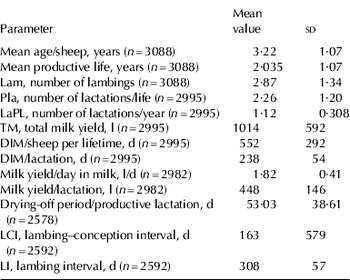
Main data on productive performance of the flock during the study period are summarized in Table 2. Both milk yield/lactation and yield/DIM decreased with number of lactation (P<0·0001, Fig. 1A) such that milk yield decreased between the first and second lactations (P<0·01) and third and fourth lactations (P<0·0001) for both parameters. However, only milk yield/lactation declined between the second and third lactations (P<0·01). Reproductive parameters were also affected by the age of the sheep (P<0·0001; Fig. 1B), with lambing interval decreasing with age.
Changes in the mean values (± sem) of milk yield/day in milk (DIM) and milk yield/lactation of the flock over time (A) and lambing intervals of the flock over time (B).

Average performance data† of the flock between 2005 and 2010

† DIM= Days in milk; productive life=life since the first lambing; productive lactation=lactation with >120DIM; Lam=lambings/sheep; La=number of lactations/sheep in lifetime; PLa=number of productive lactations/sheep per lifetime; LaPL=number of lactations/sheep per year of productive life; TM=total milk yield/sheep in lifetime; LI=lambing interval/sheep in life
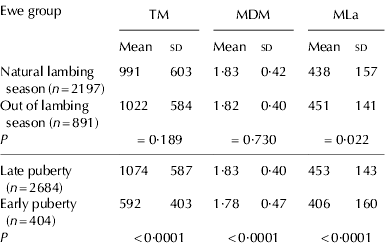
Productive performance was affected by age at puberty, such that ewes which reached puberty late had greater (P<0·0001) productive performance than ewes that reached puberty early (Table 3). No differences for total milk yield/sheep in lifetime or milk yield/DIM were observed between ewes that had their first lambing in the natural season or out of season. However, ewes that lambed out of season had greater (P<0·05) milk yield/lactation than ewes that lambed in season.
Milk production† (l) of ewes, classified by age at puberty (late or early) and by season at first lambing (natural or out of lambing season)

† TM=Total milk yield/sheep in lifetime (l); MDM=milk yield/Day in Milk (l/d); MLa= milk yield /lactation (l)
Effect of the AFL on productive and reproductive performance of Lacaune sheep under intensive management
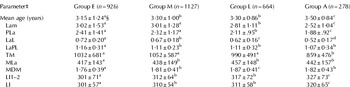
Table 4 summarizes productive and reproductive parameters of sheep with different AFL during the period of study. Ewes from groups E and M lambed 0·2 times more and had 0·25 more productive lactations than the ewes from group L; groups E and M lambed 0·5 times more often and had 0·49 more productive lactations than ewes from group A (P<0·0001).
Productive and reproductive parameters of the sheep classified by age at first lambing (AFL)†expressed as mean±sd

† Group E= ewes with AFL ⩽390 d; group M= ewes with AFL 391–450 d; group L= ewes with AFL 451–510 d; group A= ewes with AFL ⩾511 d
‡ Lam= number of lambings /sheep; PLa= number of productive lactations /sheep in lifetime; LaL= number of lactations/sheep per year of life; LaPL= number of lactations/sheep per year of productive life; TM=total milk yield/sheep per lifetime (l); MLa= milk yield /lactation (l); MDM = milk yield/ Day in Milk (l/d); LI1–2= Lambing interval between first and second lambing (d); LI= lambing interval/sheep in life (d)
§ Values within each row with different superscripts are significantly different (P<0·05)
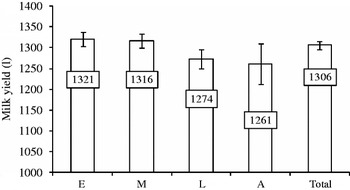
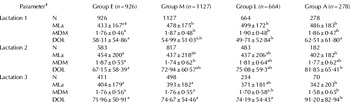
Group A also showed significantly lower total milk yield per sheep in lifetime (TM) during the period of study than did the other groups (P<0·0001); on the other hand, group M tended to produce more milk (around 1051 l) than the other groups (989 l and 859 l for groups L and A, respectively). Table 5 shows the milk yield of the first three lactations. Dairy production by lactation was affected by AFL for the first three lactations (P<0·05); this production was significantly lower in group A in the second and third lactations (P<0·05) compared with groups E and M. On the other hand, ewes in group E produced significantly less milk in the first lactation than the other groups (P<0·0001); however, their yields during the second and third lactations were the highest of all the groups. In the end, group E showed the numerically highest milk yield for the total milk yield of the first three lactations (Fig. 2).
Total milk yield, in litres, of the first three lactations in ewe groups classified by their AFL. No statistical difference was observed between groups (P>0·05).

Productive parameters of the first three lactations of the sheep classified by age at first lambing (AFL)† expressed as mean±sd

† Group E= ewes with AFL ⩽390 d; group M= ewes with AFL 390–450 d; group L= ewes with AFL 451–510 d; group A= ewes with AFL ⩾510 d
‡ MLa=milk yield/sheep per lactation (l); MDM=milk yield/Day in Milk per sheep (l/d); DOL=dry-off length (d)
§ Values within each row without a common superscript are significantly different (P<0·05)
Similarly, the effect of AFL on the length of the dry period was observed until the third lactation, similarly to the production data. In the first lactation, the group with the shortest dry period was group L. On the other hand, the dry-off period of group A was significantly longer than that of group E at the second lactation (P<0·05) and significantly longer than that of all the other groups in the third lactation (P<0·05).
Reproductive parameters were also affected by AFL. Group E showed a significantly shorter lambing interval (LI) between first and second lactations than the other groups (P<0·0001). Additionally, groups M and L also had shorter LI than group A (P<0·0001). Differences for LI in subsequent lactations were not found, either between experimental groups or between different lactations (data not shown). However, the mean lambing interval (LI) per sheep during the period of study was affected by AFL, being the shortest in group E compared with the other groups (P<0·0001). Groups M and L also had significantly shorter LI than group A (P<0·0001).
Effect of AFL on the longevity of Lacaune sheep under intensive management
In the 1334 sheep for which the entire productive life was recorded, AFL was negatively correlated with the number of lactations in life (r = −0·26; P<0·0001), with the number of productive lactations/sheep per year of life (r = −0·40; P<0·0001) and with the total milk yield per sheep in lifetime (r = −209; P<0·0001). Hence, sheep lambing the earliest (group E) remained alive longer than groups M and L (P<0·001) and produced more than groups M, L and A.
Longevity parameters of sheep that died or were culled, classified by age at first lambing (AFL)†

† Group E= ewes with AFL ⩽390 d; group M= ewes with AFL 391–450 d; group L= ewes with AFL 451–510 d; group A= ewes with AFL ⩾511 d
‡ Age= mean age/sheep at culling in years; PLa=number of Productive lactations/sheep; LaPL= number of lactations/sheep per year of productive life; TM=total milk yield/sheep per lifetime (l)
§ Values within each column without a common superscript are significantly different (P<0·001)
Discussion
Optimizing management procedures to improve the productive and reproductive potential of a selective dairy breed like Elite Lacaune under intensive conditions may be extremely important for milk producers over the world. The present study offers, for the first time, information on the influence of AFL on productive and reproductive parameters in Lacaune sheep maintained under intensive practices. Results indicate that ewes with AFL >510 d showed shorter productive life, produced less milk and lambed fewer times throughout their productive life than females with earlier AFL.
The animals’ first lambing month did not seem to influence milk production. In contrast, this factor has been found to strongly affect productive and reproductive performance of other dairy breeds (Assaf, Awassi or Churra sheep), both under intensive management (Gootwine & Pollott, Reference Gootwine and Pollott2000; Pollott & Gootwine, Reference Pollott and Gootwine2004) and non-intensive management (El-Saied et al. Reference El-Saied, de la Fuente and Primitivo2006). Influence of month-of-the-year of birth and month-of-the-year of first lambing are mostly explained by the influence of the photoperiod on maternal milk yield and hence on prepubertal growth and peripubertal breeding activity (Gootwine & Pollott, Reference Gootwine and Pollott2000; Pollott & Gootwine, Reference Pollott and Gootwine2004; El-Saied et al. Reference El-Saied, de la Fuente and Primitivo2006).
Our work suggests a weaker effect of photoperiod and thermoperiod on productive and reproductive yields of Lacaune sheep reared under intensive management. Such difference with other dairy breeds may be a genotype effect, since previous authors indicated that Lacaune sheep are less sensitive to photoperiod than other dairy breeds like Assaf (Ramírez-Andrade et al. Reference Ramírez-Andrade, Salama, Caja, Castillo, Albanell and Such2008) and Manchega (Palacín et al. Reference Palacín, Abecia, Forcada, Casao, Cebrián, Muiño, Palacios and Pontes2008). At the same time, this feature may indicate that management practices can mitigate influences from the environment. Sheep under intensive conditions (not grazing) are not affected by seasonal variations of food availability and seasonal variations of thermoperiod influencing the performance of the animals (Finocchiaro et al. Reference Finocchiaro, van Kaam, Portolano and Misztal2005) are partially mitigated by technological solutions and management practices, as reported for dairy cattle (West, Reference West2003; Flamenbaum & Gallon, Reference Flamenbaum and Galon2010).
Overall, the analysis of our results on the effects of AFL on milk yields indicates that average lambings/sheep and productive lactation/sheep over a lifetime were maximal in ewes lambing earlier than 410 d of life. These females had 0·2-fold more lambings and 0·25-fold more productive lactations than ewes with AFL between 451 and 510 d, and 0·5-fold more lambings and productive lactations than ewes with AFL greater than 510 d. However, we need to keep in mind that ewes with an extremely early AFL (born between March and August) were less productive in terms of total milk yield/sheep, milk yield/DIM of productive lactations and milk yield/productive lactation. This is probably due to their less developed bodies at first lambing.
In all the ewes, the mean milk yields, both per lactation and per day in milk, declined with the age of the sheep; this is due to a decreased maximum secretion potential during the lactation, both in quantity and length (Pollot & Gootwine, Reference Pollott and Gootwine2004). Females with AFL >390 d reached their maximal milk productivity at their first lactation and the total amount of milk at this first lactation was higher than that obtained from younger ewes. These results are similar to those previously reported for different breeds (Lacaune, Barillet et al. Reference Barillet, Boichard, Barbat, Astruc and Bonaiti1992; Latxa, Gabina et al. Reference Gabiña, Arrese, Arranz and Beltran de Heredia1993; Awassi, Gootwine & Pollott, Reference Gootwine and Pollott2000) and also in dairy cattle (Moore et al. Reference Moore, Kennedy, Schaeffer and Moxley1991, Pirlo et al. Reference Pirlo, Miglior and Speroni2000; Haworth et al. Reference Haworth, Tranter, Chuck, Cheng and Wathes2008). Our results show that sheep with an AFL between 390 and 450 d produced approximately 45 l more at the first lactation than did females with an AFL earlier than 390 d. Moreover, these latter ewes did not reach maximal yield until their second lactation, probably because of insufficient udder development at first lactation (Pollot & Gootwine, 2004). Therefore, the total lifetime production was also affected. Pollott & Gootwine (Reference Pollott and Gootwine2004) described similar results in Assaf ewes with an average age at first lambing of 438 d (14·6 months).
On the other hand, a later AFL correlates with shorter productive life in sheep. From the second lactation onwards, ewes lambing at ages older than 510 d had lower milk yields than the other sheep; indeed, their total lifetime milk yield was the lowest of all the groups.
Our study also found effects of AFL on reproductive yields, mainly on lambing interval between the first and second lactations and on the mean LI during lifetime (LI). AFL showed a critical effect on LI; the maiden sheep that lambed at the earliest age (AFL<390 d) showed LI around 10–20 d shorter than the other ewes. This finding is opposite to that described in other reports (Pollott & Gootwine, Reference Pollott and Gootwine2004) which found no such carry-over effect from AFL. Thus, our current findings may be an indirect effect of lower milk production as ewes with lower milk production will be bred earlier than ewes with higher milk production. This effect of AFL may be important to consider under conditions of intensive milk production. Similarly to the parameters of milk production, the lambing intervals of the flock decreased slightly with lactation number after the first lactation. In this case, our results concur with previous studies (Gootwine & Pollott, Reference Gootwine and Pollott2000; Pollott & Gootwine, Reference Pollott and Gootwine2004) and may again reflect the fact that, in the breeding systems analysed, sheep with lower milk yield are bred earlier.
The present results add to our knowledge of the effects of AFL, which is scarce for this species in spite of its importance. In contrast, corresponding information about AFC is abundant in dairy cattle (Gill & Allaire, Reference Gill and Allaire1976; Lin et al. Reference Lin, Mcallister, Batra, Lee, Roy, Vesely, Wauthy and Winter1988; Ettema & Santos, Reference Ettema and Santos2004; Nilforooshan & Edriss, Reference Nilforooshan and Edriss2004; Haworth et al. Reference Haworth, Tranter, Chuck, Cheng and Wathes2008). Several studies in different countries have shown, similarly to our current results, that an earlier AFC (between 22 and 26 months) is beneficial for both milk yield and productive life of the cow; these results argue for avoiding too many early calvings that harm these parameters (<22 months). Thus, in conclusion, what is evident is that the AFL or AFC has a key effect on the productive life and performance of dairy animals.
Optimizing AFL is cost-effective not only because it increases productive life but also because it reduces into inputs – mainly the cost of feeding non-productive maiden animals. For example, on the farm in our study the estimated daily cost of feeding maiden sheep is 0·19 €/sheep (±10% depending on the year and leaving other costs aside). Therefore delaying AFL by a month will cost 5·70 €/sheep. Thus, on a farm with 700 first lambings a year, the annual cost would be 3999 € if the first lambing was delayed by a month.
Conclusion
These results indicate that the optimal AFL for Lacaune breed under an intensive dairy system ranges between 390 and 450 d. Ewes with AFL earlier than 390 d or later than 450 d are likely to have a lower lifetime milk production and shorter productive life.
The authors thank Raquel de Paz y Santiago Fuentes for assistance with data collection; the farm workers who managed the flock for their collaboration and Pedro Cuesta (Department of Research Support, Complutense University of Madrid) for the statistical analyses.