1. Introduction
In the political science and economics literature, the term legislative shirking is commonly defined as failure by legislators to act in the interests of their constituents (Bender and Lott, Reference Bender and Lott1994: 68). Since the 1980s, numerous studies have examined the existence of legislative shirking and its substantive implications (Kalt and Zupan, Reference Kalt and Zupan1984; Peltzman, Reference Peltzman1984; Lott and Bronas, Reference Lott and Bronas1993; Poole and Romer, Reference Poole and Romer1993; Rothenberg and Sanders, Reference Rothenberg and Sanders2000a, Reference Rothenberg and Sanders2000b, Reference Rothenberg and Sanders2004; Carson et al., Reference Carson, Crespin, Jenkins and Vander Wielen2004; Wright, Reference Wright2007; Jenkins and Nokken, Reference Jenkins and Nokken2008a, Reference Jenkins and Nokken2008b; Parker and Dabros, Reference Parker and Dabros2012; Nokken, Reference Nokken2013, Reference Nokken2014; Clark and Williams, Reference Clark and Williams2014). The main line of this inquiry has paid attention to the last period problem.
The logic of the last period problem is simple. Legislators’ opportunistic behavior is being constrained by the threat of facing re-election. However, once legislators decide or are forced to retire, thereby being in the last period, they are likely to abandon their obligations to the constituents (or the political party) and pursue their own personal interests instead. The questions of whether and how legislators shirk have been investigated in terms of voting participation and voting decisions. The hypothesis about shirking in voting participation states that representatives are more likely to abstain from floor votes, once unconstrained by voters. In the same vein, the hypothesis about shirking in voting decisions predicts that representatives unshackled by election will be more likely to pursue their own interests when they cast their votes on the floor.
Testing these two shirking hypotheses has frequently been conducted in the situations such as the legislative term-limit (Elling, Reference Elling1982; Carey et al., Reference Carey, Niemi, Powell and Moncrief2006; Wright, Reference Wright2007; Clark and Williams, Reference Clark and Williams2014) or lame-duck Congress (Rothenberg and Sanders, Reference Rothenberg and Sanders2000a, Reference Rothenberg and Sanders2000b, Reference Rothenberg and Sanders2004; Goodman and Nokken, Reference Goodman and Nokken2004; Jenkins and Nokken, Reference Jenkins and Nokken2008a, Reference Jenkins and Nokken2008b; Nokken, Reference Nokken2013, Reference Nokken2014), where staying and departing legislators coexist in the same legislature. For example, a lame-duck Congress consists of two kinds of legislators: those who are re-elected to the next Congress and those who are about to leave the Congress. Whether or not legislative shirking exists has been tested by examining the differences in legislative behavior between those returning to the Congress and those not returning.
In order to empirically examine whether legislative shirking exists in a new democracy, South Korea, we also utilize the lame-duck sessions of the Korean National Assembly (hereafter the KNA). With respect to shirking in voting participation, there exist two apparently conflicting theories about motivations of legislators in the last period: that to secure more leisure time vs that to utilize the last, valuable voting opportunity. We argue that these two theories are not working at cross-purposes, and we present a synthetic hypothesis, tested by two-part hurdle models. Two-part hurdle models assume two different motivations of legislators in floor vote participation. On the other hand, the existing shirking literature has entertained the idea that freedom from constituents as well as political parties among legislators in the last period may result in the changes of their voting decisions. We attempt to find evidence of shirking in voting decisions in the KNA by focusing on the bills that are supposedly related to the interests of constituents or political parties.
We use lame-duck sessions of the KNA as a testing bed to examine shirking hypotheses in a comparative setting. Shirking hypotheses are rarely tested beyond the confines of the American Congress. Thus, our attempt to employ the lame-duck sessions of the KNA and test the shirking hypotheses in an entirely different context will appeal to a wider audience in the comparative legislative studies.
Employing the lame-duck sessions of the KNA has additional benefits in that it allows us to gauge the impact of the lame-duck status on legislative behavior in a more precise manner. First of all, since the lame-duck sessions of the KNA are held strictly during the period between the end of the legislative election and the beginning of the next Assembly, we can clearly identify who are and who are not in the last period. This is an apparent advantage over the American case, where identifying pre- and post-shirking periods is a rather complicated matter (see Rothenberg and Sanders, Reference Rothenberg and Sanders2000a). Besides, a sufficiently large number of bills are tabled during the lame-duck sessions of the KNA, which allows for rigorous statistical analyses.Footnote 1
Furthermore, unlike the lame-duck sessions of the U.S. Congress, in which a large portion of the bills on the table are related to appropriations, thereby making testing shirking behaviors rather difficult (Jenkins and Nokken, Reference Jenkins and Nokken2008b), the lame-duck sessions of the KNA mostly deal with substantive policy bills or bills about procedural rules. Overall, the lame-duck sessions of the KNA provide one of the better empirical settings to test the shirking hypotheses.
2. Two types of legislative shirking
The prevailing literature regarding shirking in voting participation consistently finds a predictable relationship between being in the last period and a lower rate of voting participation in the post-election chamber. Once their electoral connections with voters are severed due to either retirement or election defeat, many legislators value securing more leisure time over finishing remaining business on the floor. Therefore, departing legislators are less eager to fulfill their duty in terms of floor voting than those returning to the next Congress. Though not all, many find empirical evidence for this participatory shirking argument (Lott, Reference Lott1990; Rothenberg and Sanders, Reference Rothenberg and Sanders2000a, Reference Rothenberg and Sanders2000b; Clark and Williams, Reference Clark and Williams2014).
However, for some, the last period problem in voting participation may not be a ‘problem’. The negative correlation between being in the last period and level of voting enthusiasm in the floor, so prevalent in the shirking literature, has been called into question. Parker and Dabros (Reference Parker and Dabros2012) argued that legislators who are in their last period are as eager to vote as those who have been re-elected. Departing legislators find the remaining opportunity of voting more valuable and take it more seriously. What is more, legislators in the last period find it relatively easy to place their own preferences over their constituents’ will and party leaders’ directions. They can cast votes for whatever entices their personal interests. If this reasoning is correct, the often-plagued last-period problem should be a poor predictor of legislator voting participation in their last term. Parker and Dabros (Reference Parker and Dabros2012) calculate the vote participation rates of departing and re-elected members in the U.S. House of Representatives over 40 years and find a negligible difference in floor participation between these two groups.
To date, however, most research on shirking in voting participation is unable to embrace these two different aspects of voting motivations in the last period. We argue that these seemingly mutually contradictory positions upon voting participation are not incompatible and that it is quite possible to understand them in a stepwise framework. Even if departing members do not run for re-election (and subsequently remove their re-election goals from mindsets), does it suddenly turn them into single-minded leisure seekers? For departing members, both the motivation to secure more leisure time and the motivation to utilize the last, valuable voting opportunity without the voters’ and party's pressures could co-exist.
Consider a situation where both departing and returning members in a lame-duck session are about to vote on a series of substantial (or procedural) bills in a short period of time. A departing legislator has to decide whether to attend the floor meeting. This can be regarded as a hurdle for the member. Departing members who put more weight on more leisure time are more likely to fall at the hurdle and not attend the floor voting. Therefore, for those legislators, securing more leisure time is the dominant motivation inducing them to forgo the floor voting. For the departing members who do decide to attend the floor voting, thereby successfully leaping the hurdle, their dominant motivation is clear: vote according to their own preferences. They want to thrive on a rare opportunity to vote for what they want over other concerns. It is more rewarding to them than having extra leisure time. We find no convincing reason to assume that departing members with this motivation are less enthusiastic than returning members in terms of voting intentions.
On the other hand, the current research over shirking in voting decisions has pursued two major themes: shirking from constituents and from the political party. First, the question of whether shirking from constituents does really exist is still under hot debate. Lott (Reference Lott1987), for example, finds that departing legislators do not shirk their constituents’ interests even in the last period (see also Peltzman, Reference Peltzman1984; Vanbeek, Reference Vanbeek1991; Lott and Bronas, Reference Lott and Bronas1993; Poole and Romer, Reference Poole and Romer1993; Poole and Rosenthal, Reference Poole and Rosenthal1997). Lott and Reed (Reference Lott and Reed1989) find a rationale for the absence of the last period problem in the sorting process of the political market: constituents usually succeed in weeding out representatives with unrepresentative policy preferences through elections and keep representatives whose preferences are similar to their own; hence, departing members do not need to change their voting pattern.
Contrary to this line of argument, some have found supporting evidence for shirking from constituents. Rothenberg and Sanders (Reference Rothenberg and Sanders2000a, Reference Rothenberg and Sanders2000b) find that departing members are likely to engage in ideological shirking when they cast their votes (see also Kalt and Zupan, Reference Kalt and Zupan1984; Parker and Choi, Reference Parker and Choi2006). Put differently, re-elected incumbents are likely to weigh district preferences far more heavily than those departing. Controversies over ideological shirking have been stirred in the field of legislative shirking. After replication of Rothenberg and Sanders’ empirical analysis, some challenge their findings. Once a set of controls is added (Carson et al., Reference Carson, Crespin, Jenkins and Vander Wielen2004), or different model specifications are applied (Lawrence, Reference Lawrence2007), the statistical significance of ideological deviation effect upon legislative voting vanishes.Footnote 2 Therefore, the question of whether shirking occurs in voting decisions has been far from conclusive.
Meanwhile, some scholars take the lame-duck Congress as an alternative bed for testing the hypothesis about shirking from the political party (Jenkins et al., Reference Jenkins, Crespin and Carson2005; Jenkins and Nokken, Reference Jenkins and Nokken2008a, Reference Jenkins and Nokken2008b; Nokken, Reference Nokken2013, Reference Nokken2014). This perspective assumes that departing members are able to vote freely from both voters and political party leaders, while returning members are relatively free from local voters, at least during the lame-duck session, and are under strong party discipline. Since a considerable amount of time remains until the next election, returning members are free from the constituents (see also Fukumoto and Matsuo, Reference Fukumoto and Matsuo2015). However, political party leaders in the U.S. House of Representatives can command great loyalty from fellow party members in roll call votes during the lame-duck session. The next Congress will be newly convened right after the lame-duck sessions. Since political party leaders can exercise power over the committee assignment and the structure of the legislature, returning members need to adapt to their party leaders’ tastes when necessary.
Thus, the different voting patterns by lame-duck status are mostly caused by the degree of party influence, not by that of local voters’ controls. From this perspective, Jenkins and Nokken (Reference Jenkins and Nokken2008b) analyze the influence of political parties over legislative voting in the lame-duck sessions of the U.S. Congress during the period between 1877 and 2006. They find that departing members tend to deviate from party leaders more frequently than returning members over the period of the pre-1933 lame-duck Congresses.
However, it is difficult to assume that party pressure upon its members should be applied over all bills regardless of type. Party pressure upon its members is particularly strong for certain types. The bills about rules and procedures of a legislature are modal example (Jenkins et al., Reference Jenkins, Crespin and Carson2005). Procedural acts in a legislature are often considered significant and substantial to political parties because political parties strengthen their influence and maximize partisan interests in the legislature either throughout existing rules or by adopting revised legislative rules. Enacting these bills has no influence on local voters’ living, and most voters find little interest in these bills. Thus, a legislator's vote on procedural bills is more susceptible to party leaders’ demands. Party leaders generally exert huge pressure on their members to follow party instructions when a procedural bill is tabled on the floor. When a significant procedural bill is tabled and voted on in the floor during the lame-duck session, it could be a useful testing bed to check if absence of party influence induces departing members to vote differently from their counterparts remaining under party influence.
3. The lame-duck sessions of the KNA
3.1 A brief introduction to the KNA and its lame-duck sessions
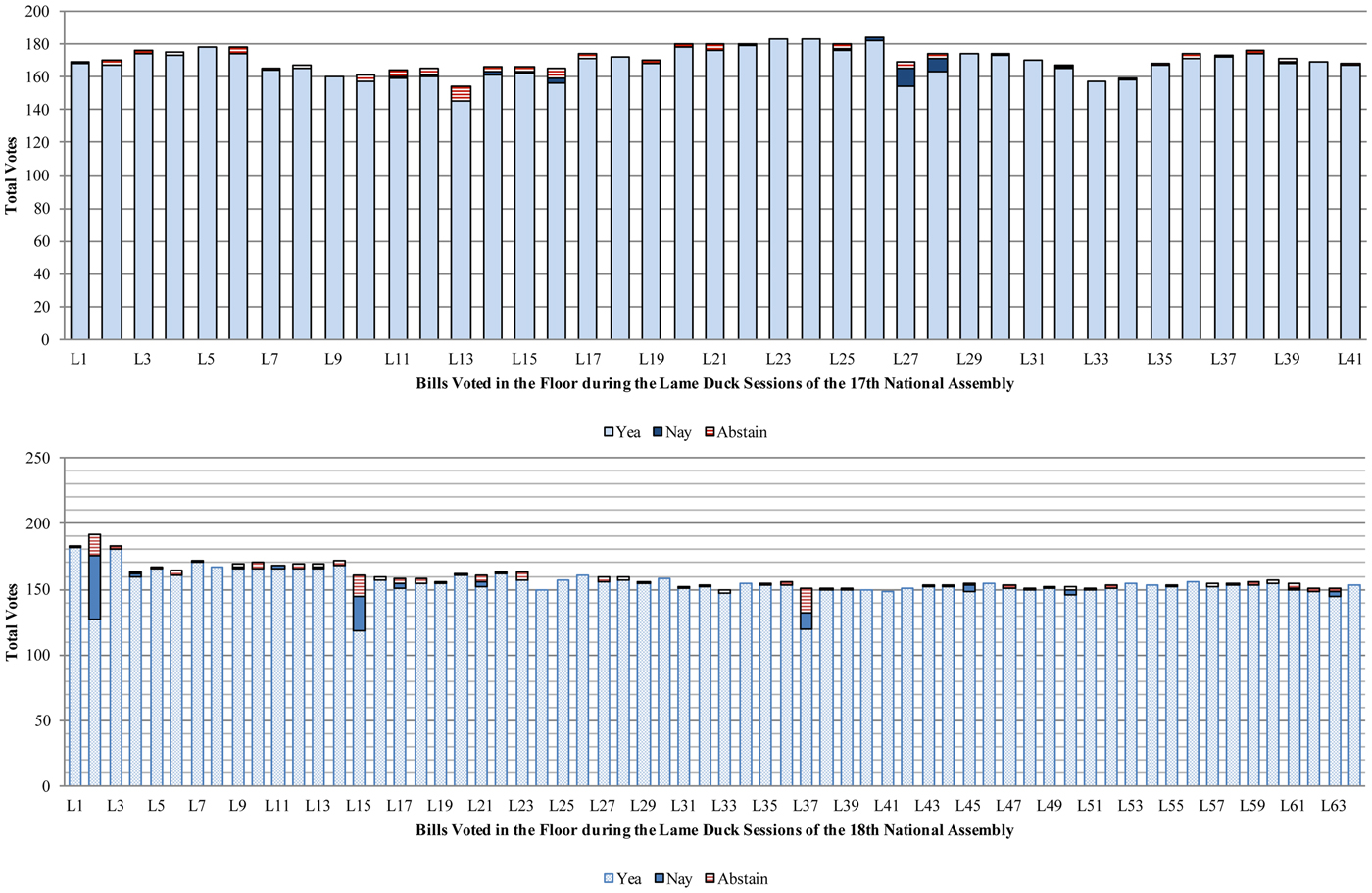
Since the democratization of 1987, the KNA has been institutionalized over the last three decades. There are five distinct characteristics of the KNA to be mentioned upfront. Firstly, political parties maintain very strong discipline over their members in terms of legislative behavior, including voting (Hix and Jun, Reference Hix and Jun2009; Jeon, Reference Jeon2010; Jun and Hix, Reference Jun and Hix2010; Lee and Lee, Reference Lee and Lee2011; Rich, Reference Rich2013; Shin, Reference Shin2013; Shin and Lee, Reference Shin and Lee2017). Second, because of the mixed-member electoral systems, there are two tiers of legislators in the KNA: district legislators and closed-party list legislators. There are ongoing debates about whether the mode of election leads members to behave differently in the KNA in terms of deviation from party discipline. Some find that members elected by proportional representation (PR members) are more likely to defect from the party line than those in the single-member districts (Hix and Jun, Reference Hix and Jun2009; Jun and Hix, Reference Jun and Hix2010), while others find no apparent difference between the two tiers of members (Rich, Reference Rich2013; Shin and Lee, Reference Shin and Lee2017). Third, how the legislative institutions are structured and operated depends on bipartisan consensus by major political parties rather than the majority party alone. Unlike the U.S. House of Representatives, where the majority party monopolizes key legislative positions including speaker and committee chairs, the important positions in the KNA, such as committee chairs, are shared and distributed to parliamentary negotiating parties that pass the threshold of 20 seats according to the proportions of seats. Fourth, with a few notable exceptions that brought political parties to in-house brawls, bringing in bills under bipartisan agreement has been one of the implicit principles of bill processing in the KNA. Voting in the standing committees is rarely held. Bills have often been preceded by unanimous consent both at the committee level and on the floor.Footnote 3 Lastly, taking the above characteristics together, bills that are tabled on the floor connote approval. That is, they have a pro-yea tendency (Hix and Jun, Reference Hix and Jun2009: 676). Almost all bills on the floor are tabled through cross-party negotiation. The proportion of nay-voters in the floor is very small. Considering that the lame-duck sessions are used for clearing up the remaining business, Figure 1 shows that pro-yea voting tendency among legislators is even more prevalent in the lame-duck sessions of the 17th and 18th KNA.
Pro-yea tendency in roll-call votes, lame-duck sessions of the 17th and 18th KNA.

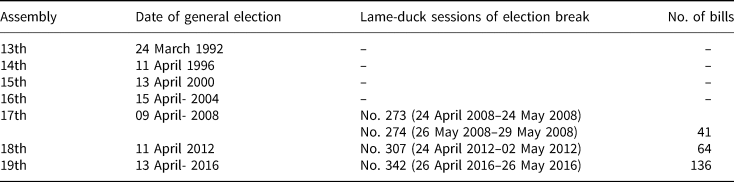
Table 1 shows the historical summary of lame-duck sessions in the KNA during the period between 1989 and 2016. In total, three lame-duck sessions were held. None occurred from 1988 to 2007. There were two after the 2008 election break in the 17th KNA. Session 273 lasted about a month and the following session, 274, was held for only 4 days. In the 18th KNA, one lame-duck session was held and lasted for 9 days.
Lame-duck sessions of Korean National Assembly (13th–19th)

The numbers of registered members are the same across the lame-duck sessions of 17th and 18th Assemblies: 292. More than a half of these members did not carry on membership in the next assembly. In the 17th KNA, one hundred fifty three members departed from the KNA (52.4%). In the 18th KNA, the proportion of departing members is 61% of the total memberships. What if shirking occurs in the KNA, where over a half of its members are not returning to the next assembly and still exercise their voting choices over influential bills during the lame-duck sessions? This could have serious consequences for democratic policy making in South Korea. The low turnover rate of U.S. Congress is the reason why some scholars conclude that legislative shirking would not have a big impact in lawmaking, despite their evidence of shirking (Jenkins and Nokken, Reference Jenkins and Nokken2008b; Nokken, Reference Nokken2013, Reference Nokken2014). In the case of the U.S. Congress, about 80% of incumbent legislators generally return to the next Congress. Considering that quite a few of those are non-attendees, those departing could not form an influential voting bloc in congressional policy making.Footnote 4 The verification of whether and how legislative shirking occurs poses a much more significant meaning in new democracies like South Korea than in advanced democratic countries from the perspectives of democratic decision-making.
3.2 Building hypotheses
Even after their re-election goals are removed by either not seeking another term or by election defeat, legislators still hold a set of often-conflicting goals regarding the floor vote participation: the motivation to pursue leisure and the motivation to enjoy the opportunity to vote freely. Legislators experience inner conflict when making decisions on whether to attend the floor meeting and (if they do) how many votes to cast. Studies of participatory shirking have narrowly taken these two competing motivations as a matter of choice, often treating them as incompatible in terms of hypothesis testing. This assumption is rather unrealistic. Believing that legislators behave differently depending on which motivation acts more strongly on decision stages, we consider these competing motivations by constructing a hypothesis and its sub-hypothesis:
Hypothesis 1:
Departing members of the Assembly are less inclined to participate in the floor meeting than the ones who are re-elected and continue their legislative career to the next Assembly, holding others constant.
Hypothesis 1a:
Once they decide to participate in the floor meeting, no difference between re-elected and departing members is expected in terms of vote frequency.
We also test the hypothesis regarding shirking in voting decision and gauge the effects of the lame-duck status on how members vote in the floor. Following Parker and Dabros (Reference Parker and Dabros2012), we expect that being in the last period yields a significant difference in members’ vote choices. A departing member, whose connection to the electoral district has been severed, is more inclined to vote against bipartisan bills than those re-elected, regardless of the types and contents of legislation.
In the case of the KNA, party leaders exert strong influence on members so that legislators who vote against their party leaders expect to bear a huge burden in general. Individuals rebelling against their party leaders in the floor seldom succeed in enacting the bill at their pleasure and just stand as a symbolic gesture to their audience. More importantly, almost all bills are brought to the floor by bipartisan agreement in the KNA. Since party discipline is exerted on most votes on the floor, there is not much room for individual legislators’ autonomy. Therefore, regardless of the types of legislative sessions, the proportions of yea voters in the floor voting are extremely high. Considering that the main task of a lame-duck congress is to settle the remaining business (Jenkins and Nokken, Reference Jenkins and Nokken2008b; Nokken, Reference Nokken2013, Reference Nokken2014), we expect to observe an even higher tendency of yea voting shown in the lame-duck sessions of the KNA.Footnote 5 We expect that there is a strong covariation between nay voters in the lame-duck session and their lame-duck status. More specifically, departing members whose interests are no longer linked to specific local interests or partisan leaderships are more likely to cast nay votes on bills tabled on the floor. Hence, we suggest the following hypothesis:
Hypothesis 2:
Departing members of the Assembly are less restrained from external pressures than the ones who are re-elected, and are freer to vote against a bipartisan bill regardless of its type and contents.
Furthermore, the cause of members departing from the KNA can lead to different motivations of voting behavior. We divide these departing members into three groups: voluntary retirees who did not either run for nomination or in the general election, enforced retirees who did not win their party nomination and were forced to retire, and defeated candidates who won their nomination and lost the general election.
We believe that voluntary retirees are freer to put their own preferences over the party discipline and are likely to deviate from bipartisan bills. Members who won the party nomination and were defeated in the general election, maintain loyalty with consideration for the next election (or the chance of other political posts) and follow the partyline policies. Members who failed to win the party nomination may hold grievances against their party leaders. Thus, they are more likely to deviate from the party positions in the lame-duck session even if their nay votes are purely symbolic.
Hypothesis 2 is a general hypothesis that is assumed to apply to all bills submitted to the floor regardless of their nature and characteristics. The bills dealt with in modern legislatures cover a broad range of issues and encompass complex contents. The more realistic view is that legislators consider target groups and the extent to which the targets are to be affected when they cast a floor vote. Thus, the voting motivations vary across the nature of bills tabled. Unless the pending bill causes conflicts among related groups, even departing members who are free from electoral and party pressure may swim with the tide. Regardless of the lame-duck status, legislators are likely to vote yea if a non-contentious bill is subject to a vote on the floor.
In contrast, when a legislation including earmarks and pork-barrel spending favorable to specific regions/interests or a procedural bill potentially affecting the balance between parties is tabled in the floor, some legislators find themselves having stronger motivations to vote nay than others. Their motivations to vote according to their own preferences are constrained by electoral constraints or strong party discipline during the regular sessions. However, departing members who are constrained by neither electoral nor party pressure in the lame-duck sessions may vote differently from returning members.
Voters’ preferences may impede legislators from voting freely. When voting on the legislation directly related to the interests of the constituents during the lame-duck sessions, departing members are expected to show the following behavior:
Hypothesis 3-1:
When a legislative earmark bill beneficial to specific constituents is on the table, departing members of the Assembly are more likely to deviate from their constituents’ preferences.
A strong party discipline also imposes restrictions on how legislators vote in the floor. We view a procedural bill as one in which party leaders will strive to control members; thus, a procedural bill in the lame-duck session can be taken as a testing bed to confirm the hypothesis about deviation from party influence. We derive a hypothesis about behavioral differences in voting a procedural bill between departing and returning members as follows:
Hypothesis 3-2:
When a procedural bill is on the table, departing members of the Assembly, free from party constraints, are more likely to vote against a bill that their political parties support.
4. Research design and models
4.1 Testing shirking in voting participation: two-part hurdle models
We use two-part hurdle models to analyze both whether a member participates in the floor meeting and how many votes she casts if she participates. In Part 1 (the hurdle equation), the dependent variable is whether or not a legislator participates in the lame-duck session. In Part 2 (the votes participation equation), the dependent variable is the number of bills voted by a member in a given lame-duck session, which is greater than zero. By using two-part hurdle models, we can consider the possibility that key explanatory variables can be differently associated with the participation itself and the intensity of participation (Farbmacher, Reference Farbmacher2011).
The two-part hurdle model is similar to Heckman's sample selection model in that both use two equations to separately model whether the outcome is positive and how count outcomes vary. However, the two models are different in some aspects. First, the sample selection model posits an underlying bivariate normal error. It estimates an unconditional equation that describes the level that subjects would have if they all had outcomes. In contrast, the two-part model estimates a conditional equation that describes only the level of outcomes for those that are truly positive (Min and Agresti, Reference Min and Agresti2002: 14). Second, the second stage equation in two-part models is more flexible than that in Heckman's selection model. In particular, the hurdle model proposed by Mullay (Reference Mullay1986) allows the same variables to be included in both stage of the equations, and the signs of the regression coefficients can be inconsistent. For instance, while a key explanatory variable, such as the lame-duck status, is negatively associated with whether to participate in the session, it is positively associated with how many bills they vote on. We expect that departing members who have decided to retire or failed to be re-elected have a weaker motivation for participation in comparison to members who return to the next assembly. However, departing members who decided to participate in the session will not necessarily vote on fewer bills. In the regression context, we expect that the coefficient for the lame-duck status will be negative in Part 1 (zero hurdle model) but that it will be positive in Part 2 (count model).
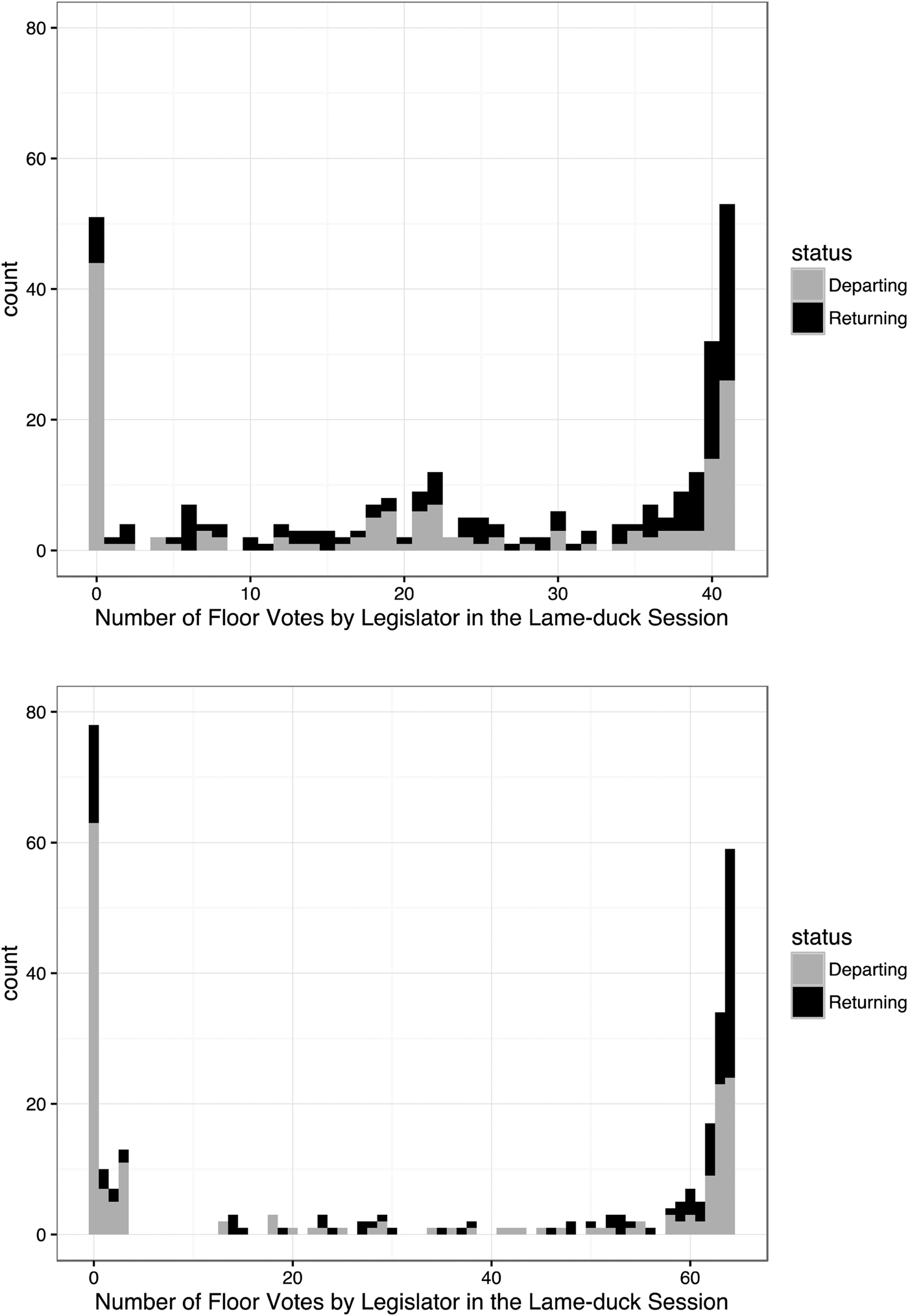
Characteristics of our data also justify our methodological approach. First, if we use zero-inflated models, it implicitly means that legislators who never vote is either those who do not attend or those who attend but not vote. However, the latter case is odd, which theoretically justifies employing two-part hurdle models. Second, compared with zero-inflated negative binomial models, two-part hurdle models are more flexibly applicable to cases in which the data do not include an extremely large number of zero counts (Hilbe, Reference Hilbe2011: 355). Figure 2 displays the distributions of the number of votes casted by departing members during the lame-duck session. Observing that the number of votes casted is densely distributed at zero and widely dispersed, we consider a two-step statistical approach to explain the truncated at zero first, and then intensity of participation rather than simple generalized linear regression models (e.g., normal, Poisson, or negative binomial regression). Basically, the two-part hurdle model is a parametric generation of the Tobit model in which the decision to participate in the floor meeting and the intensity of votes participation (the number of votes cast) are determined by two separate stochastic processes (Martínez-Espineira, Reference Martínez-Espineira2006).
The distribution of number of floor votes participation during the lame-duck sessions of the 17th and 18th KNA.

In Part 2 we select the truncated negative binomial model as the main count model because we are concerned about the overdispersion issue. In particular, the distribution of the dependent variable looks clearly overdisposed as illustrated in Figure 2.
For the hurdle equation (Part 1, zero hurdle model), we hypothesize that a member's attendance decision is mainly a function of the lame-duck status and other controls particular to that member. The key variable of interest is the variable Departing Member. It is operationally defined as 1 if a legislator does not return to the next Assembly and 0 otherwise. We also control for member's seniority, measured by the terms of legislative service at the lame-duck session of each Assembly. Although theoretically ambiguous in directions,Footnote 6 we believe that a member's seniority positively weighs on the decision to attend the floor meeting. As for relevant legislators’ personal characteristics and earnest attitudes, there are two obvious explanatory variables that influence member's attendance decision: member's age and the number of motions sponsored. The variable Age is expected to be positively associated with the probability of attendance decision. Elderly legislators are less inclined to miss the regularly scheduled floor voting procedures than young members (Rothenberg and Sanders, Reference Rothenberg and Sanders1999, Reference Rothenberg and Sanders2000a; Parker and Dabros, Reference Parker and Dabros2012). We include the number of motions sponsored by a member in the regular session in each KNA as a proxy for how sincere a legislator is to her duties in a given assembly (Yakovlev, Reference Yakovlev2007). Those who introduced more bills into the assembly during their tenures are less likely to miss the floor meeting than those with fewer bills. We also include the dummy variable for PR members as a control variable and try to gauge the extent to which the type of seats makes members act differently.
For the votes participation equation (Part 2, count model), we adopt the abovementioned four variables along with a legislator's ideological deviation from the floor median and its interaction variable with the lame-duck status. We do so for two reasons; first, we test how sustainable our main finding of the lame-duck effects upon a member's participation decisions is with different model specifications; second, we examine whether a legislator's ideology, in particular a departing member's ideological variation, is associated with the number of votes cast. A member's ideological deviation from the floor median is a variable to measure how far a member is ideologically located from the median. To calibrate it, we estimate the first dimension W-NOMINATE score in each KNA, as suggested by Poole and Rosenthal (Reference Poole and Rosenthal1997). In particular, a departing member's ideological deviation expressed as an interaction term (Departing Member × Ideological Deviation) is used as a key explanatory variable.
4.2 Testing shirking in voting decision: logistic regression models
We analyze all the bills (N = 105) tabled during the lame-duck sessions in order to test if there exists a statistically significant difference in the chance of voting nay between departing and returning participants who have already cleared the first hurdle. We use simple logistic regression models, setting the dichotomous outcomes (0 for nay, 1 for yea) as the dependent variable. Each regression includes Departing Member (1 for not returning to the next Assembly, 0 otherwise), W-NOMINATE score, and Seniority as explanatory variables. In the analysis of the 18th KNA, we also use a different explanatory variable of the lame-duck status in that the cause of the lame-duck status can generate different motivations. We call it Retiree, which takes a value of 1 for those voluntarily or enforcedly leaving after the lame-duck sessions and a value of 0 for those who won the nomination but lost the election.
However, we need to consider the possibility that shirking in voting decisions is differentiated by type and content of bill tabled. It is nonsensical to assume that departing members will vote nay regardless of the contents of bills during the lame-duck sessions. For more rigorous testing, out of the 105 bills, we select the two bills in which, we believe, constituents’ interests are strongly reflected and one bill that political parties attempted to constrain, and then test them in detail. To test the hypothesis about deviation from constituents’ preferences (Hypothesis 3-1), we choose the DGIST Support Act (Bill No. 178193) and the GIST Support Act (Bill No. 170702), which aim to extend the exclusive benefits provided for the existing local research institute to institutes located in other regions. For testing the hypothesis about deviation from party influence (Hypothesis 3-2), we select a procedural act: the National Assembly Rule Amendment (Bill No. 1814739). Compared with other acts, these three bills share relatively higher ratios of nay votes.Footnote 7
For further understanding, we provide brief information about these three bills. The 17th National Assembly passed a series of legislative earmarks such as the DGIST (Daegu-Gyeongbuk Institute of Science and Technology) and GIST (Gwangju Institute of Science and Technology) Support Acts. The DGIST and GIST bills fit the typical profile of congressional earmarks, elevating the government-funded local research institutes to the status of 4-year degree-granting colleges in science and technology. These bills are generally considered pork-barrel and earmark spending for particular local areas. However, some, especially local, voters in the Daejeon-Chungnam area, shared their concerns about the potential harms of these two bills on KAIST, which once had a unique status as a government funded science and technology institute.
We believe that perhaps the most significant issue negotiated during the entire lame-duck sessions was the enactment of the National Assembly Rule Amendment. The bill was passed along with other 63 legislations on 2 May 2012, in the last floor session of the 18th National Assembly. Following a series of embarrassing brawls in the Assembly, the ruling and opposition parties amended the Assembly rule. The act aims to engineer the need for compromise into the legislative process. The revision installed the three-fifths requirements instead of the majority rule to enact the legislation. It significantly reduces cases in which the Assembly speaker can use his power to discharge a bill for a floor vote directly without first going through the standing committees. In consequence, it restricts the majority party's ability to handle bills fast through the Assembly.
The dependent variable is a member's voting choice on the final passage of these selected bills. Votes in favor are coded 1; votes opposed and did not vote while present are coded 0. Logistic regression models are separately implemented. Two primary explanatory variables of interests are included; one is Departing Member, which takes a value of 1 for those leaving after the lame-duck sessions and a value of 0 for returning members. Furthermore, since the cause of lame-duck status can generate different motivations, we also use Retiree (1 for those voluntarily or enforcedly leaving after the lame-duck sessions, 0 otherwise).
The other explanatory variable of interest is the proximity of a member's ideology from the floor median. The existing studies of the U.S. Congress mainly employ distance from the party median (Jenkins and Nokken, Reference Jenkins and Nokken2008b; Nokken, Reference Nokken2013, Reference Nokken2014). Instead, we use ideological distance from the floor median because most of the bills tabled during the lame-duck sessions had already reached a bipartisan consensus. We calculate the absolute differences in the W-NOMINATE scores between each member and the floor median value during the non-lame-duck sessions. Higher values indicate how far a member's ideological disposition deviates from the floor median. We hypothesize that those who are ideologically far from the floor median are less likely to cast yea ballots than those close to it.
As controls for more common exogenous effects for legislators’ voting decisions, we include Seniority as well. We use different model specifications to test the remaining hypotheses. For testing the hypothesis about deviation from the constituents’ preference (Hypothesis 3-1), we include the regional dummies for DGIST and GIST. For these two earmark bills, whether or not legislators represented the electoral district in Daejeon-Chungnam (in which the KAIST is located) becomes an important variable, Affected Region. The logistic regression model to test the hypothesis about deviation from the party influence (Hypothesis 3-2) includes members’ party affiliation with the majority party in that the members of the majority party would be more likely to resist the bill, supposedly reducing its power, even though their leaders made a deal with the minority parties.Footnote 8
Finally, to test the hypothesis about deviation from the party influence (Hypothesis 3-2), we include the interaction variable between the lame-duck status variable and the ideological deviation from the median (Departing Member × Ideological Deviation or Retiree × Ideological Deviation) as a key explanatory variable. When testing the hypothesis about deviation from the constituents’ preferences (Hypothesis 3-1), the statistical model contains the interaction term between the lame-duck status variable and the bill-specific region (Departing Member × Affected Region) instead.
5. Results
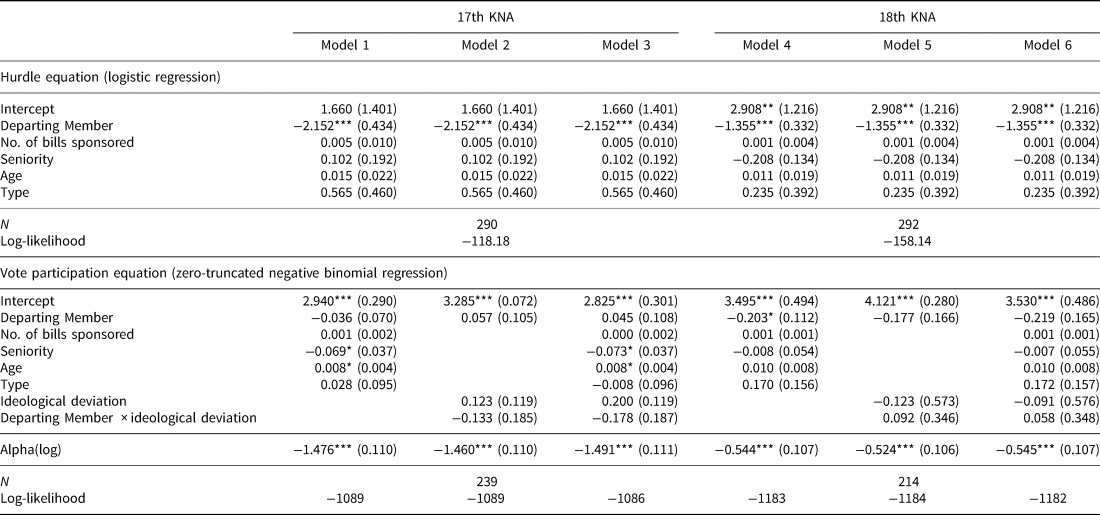
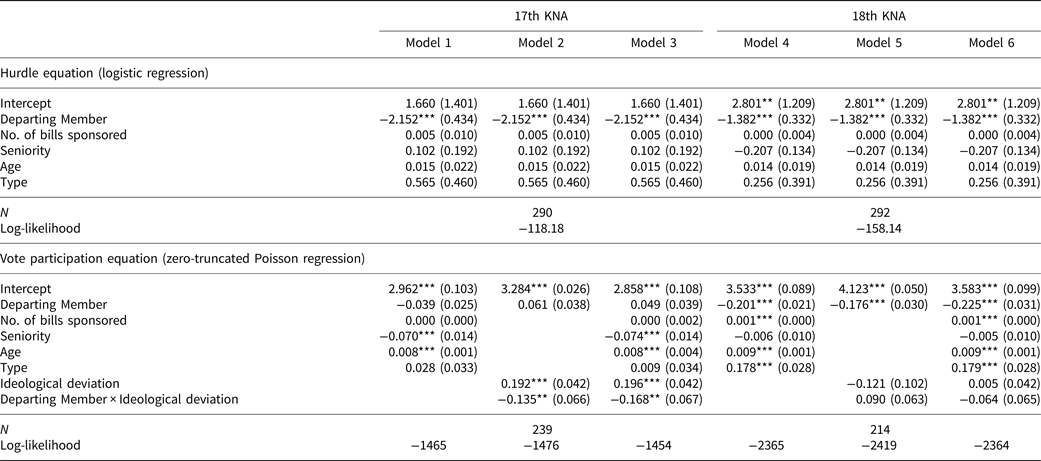
The results of the two-part hurdle models on the 17th and 18th lame-duck sessions are presented in Table 2. In the hurdle equation (Part 1), the variable Departing Member is negative and statistically significant at the significance level of 0.01. This result is robust regardless of model specifications in Table 2. When legislators do not return to the next assembly, they are less likely to participate in the floor meeting during the lame-duck sessions. Whether or not a member departs the assembly clearly influences his or her motivation to participate during the lame-duck sessions. Other things being equal, the coefficients for the variable tell us that the chance that departing legislators participate in the floor meeting is 74–86% lower than that of their returning counterparts. This is consistent with most empirical findings about the participatory shirking hypothesis. However, in the votes participation equation (Part 2), the variable Departing Member is not statistically significant, with inconsistent signs across different model specifications. In sum, legislators who were absent from the floor meeting can be regarded as those who did not surmount hurdle 1 (due to a stronger motivation to enjoy their leisure). Once the hurdle is passed, however, departing members do not behave differently from their returning counterparts, which strongly supports Hypothesis 1.Footnote 9 We found no statistical evidence for a legislator's ideological deviation from the floor median.
Two-part hurdle model estimates for floor vote participation in the 17th and 18th National Assemblies

***P < 0.01; **P < 0.05; *P < 0.1, two-tailed; standard errors in parentheses.
We mentioned that the bills tend to be passed virtually unanimously during the lame-duck as well as the regular sessions in the KNA. No statistical model can be applied to such bills because of lack of variation in values of the dependent variable. Instead we analyze the bills with some variation in each roll call vote (i.e., a sufficient number of nay votes) with logistic regression models. We find only three out of 41 bills (=7.3%) and 13 out of 64 bills (=20.3%) that satisfy the minimum criteria in the lame-duck sessions of the 17th and 18th assemblies, respectively.Footnote 10 This tells us that roll call votes in the latter were more heterogeneous than those in the former.
Table 3 displays the number of statistically significant coefficients at the significance level of 0.05 by sign among the 16 bills to which the logistic regression model including three explanatory variables (Departing Member, first dimension W-NOMINATE, and Seniority) is applied. We cannot find any bill supporting the expectation that departing members are more likely to vote against bipartisan bills in the 17th National Assembly than returning members. In contrast, Hypothesis 2 is partially supported in the 18th National Assembly. While the statistically significant negative coefficients for the variable Departing Member are detected in three bills (Legislations 2, 15, and 23), the significant positive coefficient for the variable is not found. Confining our attention to these three bills, the hypothesis claiming that departing members are more likely to vote nay seems to be supported. However, based on overall results, it is difficult to argue that Hypothesis 2 is supported.
The number of statistically significant coefficients for explanatory variables by sign

However, lame-duck status is differently associated with the types of departing members. This is demonstrated when we use the variable Retirees in the 18th KNA instead of the variable Departing Member. It is evident that voluntary retirees tend to vote against some bipartisan bills in the lame-duck session. Of course, departing members who were nominated but lost the election (i.e., defeated candidates) are more likely to vote against a bill (Legislation 17), but those bills are significantly different from the bills (Legislation 2, 15, and 23) that (voluntary or enforced) retirees are more likely to vote against. Confining our attention to these three bills, the hypothesis claiming that departing members are more likely to vote nay seems to be supported. However, based on overall results, it is difficult to argue that Hypothesis 2 is supported.
We also found statistically significant associations between yea votes and W-NOMINATE scores in 16 bills. Positive signs are recognized in most of them.Footnote 11 This positive association indicates that the more conservative a legislator is, the more likely to vote yea she is in the lame-duck sessions. Considering that only bills that passed the standing committees by a bipartisan consensus can be tabled on the floor, and legislators who belonged to the conservative party that held the legislative majority in the 18th National Assembly, such a positive relationship is comprehensible. In contrast, we infer that legislators who belonged to extremely liberal minority parties were more likely to vote against the same bills in the assembly.
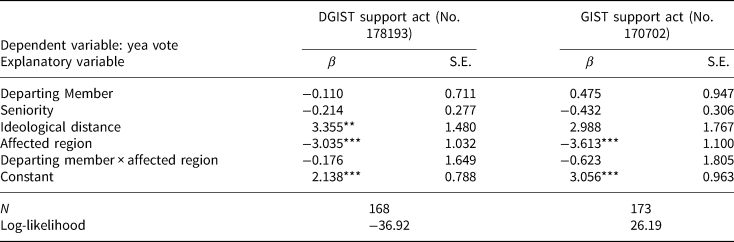
We turn to a discussion of the results that allow us to test the hypothesis about deviation from constituents’ preferences (Hypothesis 3-1). According to the results of the DGIST support act and the GIST support act, the chance that legislators representing the region negatively affected by the bills would vote yea is very low (see Table 4). The negative and significant coefficients of the variable Affected Region dummy show that for making of pork-barreling legislations, legislators represent their local constituents’ interests in the lame-duck settings.
Logit analysis of legislators roll-call voting decisions during lame-duck sessions (Hypothesis 3-1)

***P < 0.01; **P < 0.05; *P < 0.1, two-tailed.
Departing members whose electoral districts reside in the affected region do not cast their votes differently from their returning counterparts. Regardless of their lame-duck status, legislators are faithfully serving their local districts’ interests. The coefficients for the interaction term between lame-duck status and the dummy variable for the affected region (Departing Member × Affected Region) have negative signs in both bills, but there is little substantive difference between the two groups. In sum, the hypothesis about deviation from constituents’ preference cannot be empirically supported.
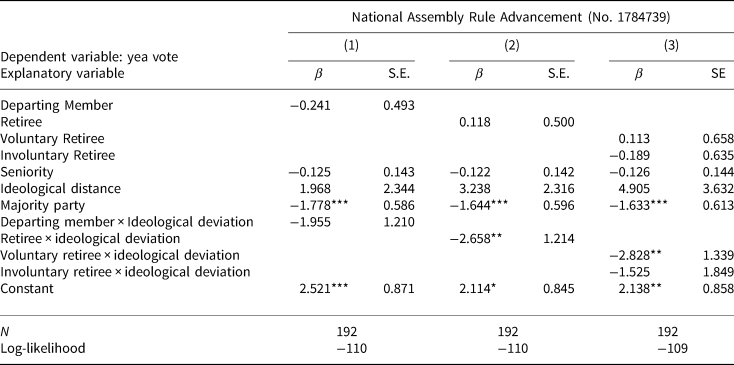
Now, we move to the issue regarding the procedural bill, which allows us to test the hypothesis about deviation from party influence (Hypothesis 3-2) in that such a procedural bill can decisively influence the balance of power among the parties in the legislature. To test the more nuanced hypothesis, we apply two model specifications to the National Assembly Rule Amendment Act. We expected that the likelihood of a bill approval falls as the proximity of a member's ideology from the floor median is growing further. That is, lawmakers who are ideologically distant from the floor median are less likely to vote for partisan procedural bills. However, what is inferred from the results of model (1) in Table 5 is that legislators’ ideological deviation itself is not directly associated with yea voting. Instead, the coefficient for the majority party is negative and statistically significant. It is consistent with the fact that the majority party members have a strong aversion to the bill, which induces them to turn against their party that holds a majority in the next assembly. Our statistical results also show an insignificant behavioral difference between departing and returning members in terms of vote decisions. The interaction variable (Departing Member × Ideological Deviation), which allows us to test the hypothesis that ideologically deviant lame-duck members are more likely to deviate from party constraints, does not pass the statistical criterion, either.
Logit analysis of legislators roll-call voting decisions during lame-duck sessions (Hypothesis 3-2)

***P < 0,01; **P < 0.05; *P < 0.1, two-tailed.
Model (2) in Table 5 focuses on retirees. The coefficient for the majority party is negative and statistically significant in this model specification. Inconsistent with our theoretical expectations, the coefficient for the variable Retiree is positive and statistically insignificant in this model specification. However, the interaction term (Retiree × Ideological Deviation) is negative and statistically significant while the composite terms themselves are not statistically significant.
Model (3) in Table 5 divides the variable Retiree into the two subtypes: Voluntary Retiree and Involuntary Retiree. We find the interaction term (Voluntary Retiree × Ideological Deviation) is negative and statistically significant, which clearly shows the high chance of ideological shirking by members voluntarily leaving after the lame-duck session.
We need a more sophisticated approach to this outcome. Indeed, departing legislators who are not seriously deviated from the median ideology do not necessarily vote against the bipartisan bill. Ideological shirking can be true only for departing members who are located at the ideological extremes. For this reason, we should see the distribution of ideological deviation from the floor median and the chance that the association between lame-duck status and nay votes is mediated by the degree of ideological deviation (Brambor et al., Reference Brambor, Clark and Golder2006; Clark et al., Reference Clark, Gilligan and Golder2006; Berry et al., Reference Berry, Golder and Milton2012).
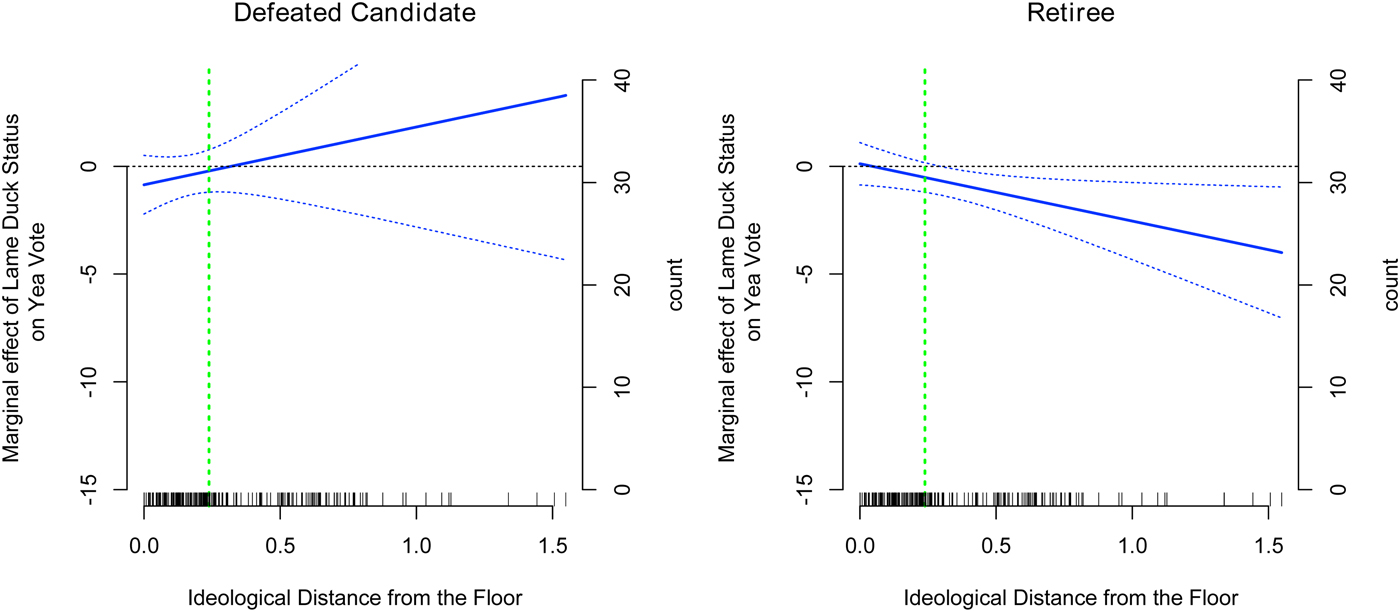
Figure 3 displays the association between the lame-duck status and yea votes in Table 5. Setting a member's ideological distance from the floor median as a moderator, we visualize the relationship between two types of lame-duck status and yea vote. This figure illustrates the marginal effects of the interaction term when using (1) the variable Defeated Candidate (the left panel), and (2) the variable Retiree (right panel). Regardless of the values of ideological deviation from the floor median (the vertical dotted line) the 95% confidence interval contains zero in the case of defeated candidates.
Marginal effect of departing the 18th National Assembly on the likelihood of yea vote (National Assembly Rule Amendment).

In contrast, we found the negative association between lame-duck status and yea votes in the case of retirees. The values of ideological deviation from the floor median are less than the median (the vertical dotted line), the 95% confidence interval contains zero. However, when they are greater than the median, the confidence interval is clearly below zero. For members who belonged to the centrist region of the ideological distribution (i.e., whose ideological deviation is less than the median), the lame-duck status itself does not make a difference in voting for the procedural bill. However, for members in the extremist cluster (i.e., whose ideological deviation is greater than the median) the chances of voting yea is differentiated by lame-duck status.
From this result, we infer that retirees are more likely to vote against the bill by being free from the party influence, as their ideology is located far from the floor median. This result supports the hypothesis about deviation from party influence (Hypothesis 3-2). However, this is not applicable to defeated candidates who won nomination but lost the election, which implies that like returning members, this type of departing members is still under party influence.
6. Conclusion
We summarize the results as follows. There exists a difference in participation in floor meetings between departing and returning members during the lame-duck sessions in Korea. However, among participants there is no significant distinction in the number of bills voted on between the two groups. This implies that legislators’ motivation for participation is not necessarily identical as is viewed in the existing literature dealing with the last period problem. Besides the trade-off between labor and leisure, some legislators deem the lame-duck sessions opportunities to express their own preferences without any constraints. They are willing to attend the sessions to enjoy these opportunities.
We had expected some differences in voting behavior between departing and returning participants, but found partial evidence for it. First, when ignoring what each bill substantially deals with, we could hardly find significant associations between voting nay and the lame-duck status. Second, when analyzing the two pork barrel bills to test the hypothesis about deviation from the constituents’ preference, we fail to find evidence that departing members are actively engaged in shirking behavior. Third, it is detected that departing members (in particular, retirees) who were ideologically deviated from the floor were able to vote against the will of their party leaders in a bipartisan bill, the National Assembly Rule Amendment. In sum, the results tell us that Korean departing members would not deviate from their constituents’ preferences, but would from their party influence.
The results about Hypothesis 3-1, no difference in voting patterns between the two experiment groups, can be discussed further. Jenkins and Nokken (Reference Jenkins and Nokken2008a) provide one possibility for it. Since there are 4 years left for returning members until the next election, they do not need to seriously consider their constituents’ preference, which results in no difference between returning and departing members. However, it could also occur because only legislators deeply attached to constituents’ preference had been chosen by the electorates, as Lott and Reed (Reference Lott and Reed1989) claim. Considering the negative coefficient, which means that legislators who represent the region to which the pork barrel legislation may cause harm were more likely to vote against the bill, the latter claim seems to be more appropriate in our case.
What do the empirical results imply for the lame-duck situations in the legislatures in new democracies? We pointed out that high rates of turnover are commonly observed in new democracies such as South Korea. In theory, if departing members shirk often during the lame-duck sessions, then their shirking can cause problems in the democratic decision-making process. Contrary to the theoretical concerns about the possibility, shirking by departing members did not damage Korean representative democracy in practice. We provide two points regarding this issue.
First, departing legislators’ shirking in voting participation was clearly observed, but it did not create a huge problem in policy making. It may raise an ethical issue of neglecting their duty. However, most bills tabled during the lame-duck sessions had been tabled by a bipartisan agreement. This implies that even if departing members do not attend the meeting, it would not affect the passage of the bills.
Second, we found partial evidence for shirking in voting decision, but did not find a clue to the hypothesis about deviation from the constituents’ preference. That is, political accountability, sincerely reflecting the constituents’ preference, was not damaged. Deviation from the party preference was observed in the bipartisan procedural bill. However, such shirking in voting decision was found mainly in the cluster of ideologically extremes, who were a relatively minority. In particular, considering the right-skewed distribution of ideological (absolute) deviation, ideological deviants are not expected to decisively influence the passage of bills.
Nevertheless, this does not mean that the shirking-proof condition will be sustained in Korea. If legislators become ideologically more polarized, then the distribution of absolute values of ideological deviation from the floor median may increase. Such a widening ideological divide can open the chance of voting outcomes decisively affected by departing members’ shirking. Many Korean pundits and scholars alike argue that ideological polarization in the legislature has been deepened recently, especially in the 19th National Assembly. If this trend continues, thereby increasing the number of ideologically extreme legislators, our findings predict that departing members’ shirking will be a menace to the democratic policy making process in the KNA.
Bon Sang Koo is a research fellow at the Institute for North Korean Studies, Yonsei University, Korea. His research interests include comparative studies of modern authoritarian regimes including North Korea, legislative politics, and quantitative methods. His recent articles have appeared in Korean Political Science Review, Pacific Focus, North Korean Review, and Korea Observer.
Junseok Kim is a professor at the Department of Political Science, Dongguk University (Seoul), Korea. His research interests include legislative politics, bureaucratic politics, and analytical methods. His works have published in the Policy Studies Journal, Korea Observer, and Pacific Focus.
Jun Young Choi is a professor at the Department of Political Science, Inha University, Incheon, Korea. His main research interests are electoral and legislative politics in South Korea and the United States. His works have appeared in various journals, such as Public Choice, Party Politics, Electoral Studies, International Political Science Review, and Pacific Focus.
Appendix
Two-part hurdle model estimates for floor vote participation in the 17th and 18th National Assemblies