Introduction
CO2 methanation to CH4 using renewable H2 is a pathway to transform CO2 into value-added carbon feedstock (Aziz et al. Reference Aziz, Jalil, Triwahyono and Ahmad2015). The reaction requires high temperatures (200–450°C) and the presence of active Ni nanoparticles (Fukuhara et al. Reference Fukuhara, Hayakawa, Suzuki, Kawasaki and Watanabe2017). Hydrogenation of CO2 to methane is thermodynamically feasible at ambient pressure (Ewald et al. Reference Ewald, Kolbeck, Kratky, Wolf and Hinrichsen2019) in contrast with CO2 hydrogenation to methanol, which requires a high-pressure system (Bahruji et al. Reference Bahruji, Bowker, Hutchings, Dimitratos, Wells and Gibson2016). The critical aspect in the design of a robust catalyst is that it must have high catalytic activity and stability over a wide temperature range in order to prevent catalyst deactivation. Zeolite Y, ZSM-5, USY, zeolite 5A, and BEA have been investigated as supports for CO2 hydrogenation to methane with Ni metal nanoparticles added to increase the conversion and selectivity toward methane (Graça et al. Reference Graça, González, Bacariza, Fernandes, Henriques, Lopes and Ribeiro2014; Westermann et al. Reference Westermann, Azambre, Bacariza, Graça, Ribeiro, Lopes and Henriques2015; Quindimil et al. Reference Quindimil, De-La-Torre, Pereda-Ayo, González-Marcos and González-Velasco2018). As a weakly acidic gas, the adsorption of CO2 is improved by increasing the basicity and the surface area of the zeolite (Walton et al. Reference Walton, Abney and Douglas LeVan2006). Replacing the compensating cation in zeolite with an alkali metal cation alters the charge and the density of framework oxygen in the zeolite lattice and contributes to an increase in zeolite basicity (Quindimil et al. Reference Quindimil, De-La-Torre, Pereda-Ayo, González-Marcos and González-Velasco2018; Bacariza et al. Reference Bacariza, Graça, Lopes and Henriques2019). Reducing the amount of Al in the framework consequently decreases the zeolite basicity and weakens the C–O bond for high CO2 conversion (Bacariza et al. Reference Bacariza, Graça, Lopes and Henriques2019).
Faujasite (FAU)-type zeolite with a Si/Al ratio of 1.5 is also known as zeolite NaY and has been investigated widely as an adsorbent in gas storage (Dong et al. Reference Dong, Wang, Xu, Zhao and Li2007), as a catalyst for hydrocracking reactions (Mu et al. Reference Mu, Feng, Zhang, Hu and Cui2019), and as support for metal or metal oxide nanoparticles in various catalytic reactions such as CO2 hydrogenation, biodiesel production, and glucose isomerization to fructose (Du et al. Reference Du, Ding, Li, Lv, Lu and Ding2018; Graça et al. Reference Graça, Bacariza, Fernandes and Chadwick2018; Bacariza et al. Reference Bacariza, Graça, Lopes and Henriques2019). Hydrothermal synthesis of zeolite from clay minerals produces a zeolite with a uniform crystal structure. Dry-gel and steam-assisted methods, however, provide a facile and scalable pathway for the green synthesis of zeolite (Weitkamp and Hunger Reference Weitkamp and Hunger2005; Asghari et al. Reference Asghari, Khorrami and Kazemi2019; Chen et al. Reference Chen, Qian, Yang, Xu, Zhu, Zhong, He, Chen and Zhang2020). Naturally occurring materials such as clay minerals, stone, and fly ash have also been investigated as alternative sources of silica and alumina (Doyle et al. Reference Doyle, Alismaeel, Albayati and Abbas2017). The conversion of natural pyrophyllite as a new clay source via facile alkaline treatment produces hydroxysodalite zeolite with enhanced surface area and porosity (Gaidoumi et al. Reference Gaidoumi, Benabdallah, Bali and Kherbeche2018). Kaolin is a clay material consisting largely of kaolinite (Al2O3•2SiO2·2H2O) and has been investigated as a precursor for zeolite synthesis (Li et al. Reference Li, Li, Liu, Yue and Bao2017; Wang et al. Reference Wang, Zha, Yao and Chang2018). Kaolin obtained from Bangka Belitung, Indonesia, was previously converted to Zeolite HX and sodalite, which showed potential as an acid catalyst and adsorbent for the removal of heavy-metal pollutants from water (Iftitahiyah et al. Reference Iftitahiyah, Prasetyoko, Hartati, Ni'Mah, Bahruji and Nur2019; Wahyuni et al. Reference Wahyuni, Prasetyoko, Suprapto, Qoniah, Bahruji, Dawam, Triwahyono and Jalil2019). The thermal treatment of kaolin between 550 and 950°C produced active amorphous metakaolin (Kovo et al. Reference Kovo, Hernandez and Holmes2009; Sperinck et al. Reference Sperinck, Raiteri, Marks and Wright2011; Qoniah et al. Reference Qoniah, Prasetyoko, Bahruji, Triwahyono, Jalil, Suprapto and Purbaningtias2015). Metakaolin can be further dealuminated with an inorganic acid such as HCl, H2SO4, or HNO3 to reduce the concentration of aluminum in the resulting zeolite (Colina and Llorens Reference Colina and Llorens2007; Alaba et al. Reference Alaba, Sani, Mohammed, Abakr and Wan Daud2017; Sri Rahayu et al. Reference Sri Rahayu, Subiyanto, Imanuddin, Wiranto, Ristiani, Suhermina and Yuniarti2018). A large concentration of sulfuric acid enhances the dissolution of aluminum in kaolin; but, the remaining sulfur in kaolin also affects the structural properties of the zeolite that is synthesized (Alaba et al. Reference Alaba, Sani, Mohammed, Abakr and Wan Daud2017; Sri Rahayu et al. Reference Sri Rahayu, Subiyanto, Imanuddin, Wiranto, Ristiani, Suhermina and Yuniarti2018).
In the present study, the aim was to establish the promotional effect of dealuminated metakaolin for the production of NaY with a large surface area in order to enhance stability and catalytic activity for CO2 methanation, and to correlate CO2 conversion and CH4 selectivity with the surface area, the crystallite structure, and the Si/Al ratio of NaY in order to demonstrate the advantages of dealumination and complete removal of sulfur from metakaolin for the synthesis of NaY.
EXPERIMENTAL
Materials
Materials used in the experiments were kaolin, consisting primarily of kaolinite (Al4(Si4O10)(OH)8, obtained from Bangka Belitung Island, Indonesia, 57% SiO2 and 22% Al2O3), Ludox® HS-40 colloidal silica (30% SiO2; 70% H2O, Sigma Aldrich, Darmstadt, Germany), sodium hydroxide (≥99% NaOH, Merck KGaA, Darmstadt, Germany), deionized water (UD Sumber Ilmiah Persada, Surabaya, Indonesia), sulfuric acid (98% H2SO4, Smart-Lab, Tangerang, Indonesia), hydrofluoric acid (48% HF, Sigma Aldrich, Darmstadt, Germany), nitric acid (65% HNO3, Merck KGaA, Darmstadt, Germany), and NiNO3.6H2O (Sigma Aldrich, Darmstadt, Germany).
Preparation of Metakaolin and Dealuminated Metakaolin
Kaolin was transformed to metakaolin by calcination at 720°C for 4 h (Li et al. Reference Li, Zhang, Cao, Gao and Cui2010) and labeled as M (metakaolin). Dealumination of metakaolin was carried out by adding 1 g of metakaolin powder to 1 mL of 6 M sulfuric acid solution. The mixture was stirred at 90°C for 2 h to form an homogeneous mixture. The mixture was dried at 110°C for 12 h and calcined at 550°C for 2 h in a muffle furnace, and labeled as SM (sulfuric acid-soaked metakaolin). The SM was washed with deionized water at 80°C to reduce the concentration of sulfur, and labeled as DM (dealuminated metakaolin). After 2 h, the solution was cooled and filtered and then the residue was dried in an oven at 105°C for 6 h. The M, SM, and DM were used as precursors for the synthesis of NaY.
Synthesis of Zeolite NaY
Zeolite NaY was synthesized using a hydrothermal method in an autoclave with a Teflon liner; the starting materials were: M, SM, and DM with molar composition of 6 Na2O:10 SiO2:1 Al2O3:180 H2O (Ginter et al. Reference Ginter, Bell and Radke1992). 3.2 g of NaOH was stirred into 22.3 mL of deionized water in a propylene bottle for 15 min or until dissolved. Then 2.83 g of metakaolin was added to this NaOH solution and stirred gently for 30 min. 14.37 g of LUDOX was added and the mixture stirred for 30 min. The resulting mixture was left to age for 24 h at room temperature followed by hydrothermal processing at 100°C for 24 h. The gel was filtered and washed with deionized water until the pH reached 7 in order to remove the remaining NaOH. The powder was dried in air in an oven at 105°C for 5 h and labeled as NaY-M. The procedures were repeated to synthesize NaY from SM and DM and were labelled as NaY-SM and NaY-DM, respectively.
Preparation of Ni/NaY Catalyst
A 5 wt.% loading of Ni nanoparticles was deposited on the as-synthesized NaY via the wetness impregnation technique. 0.260 g of NiNO3.6H2O was added to 10 mL of water to form a Ni solution which was added dropwise to 1 g of NaY. The mixture was mixed and dried at 110°C for 16 h followed by calcination at 550°C for 3 h.
Characterization
Elemental compositions of M, SM, and DM were determined by X-ray fluorescence (XRF) analysis using a PANalytical MiniPal 4 Sulfur (PANalytical B.V., Almelo, The Netherlands) instrument operating at a maximum voltage of 30 kV and a maximum current of 1 mA. The samples were pressed into pellets and inserted into the instrument sample holder and held there for 10 min. Organic functional groups were identified in KBr pellets (1:9 sample:KBr) of the samples using FTIR spectroscopy (Shimadzu FTIR-8400S, Tokyo, Japan) in the range 4000–400 cm–1. The crystalline phases of the materials were determined from X-ray powder diffraction (XRD) patterns (CuKα, 40 kV, 30 mA) over the range from 5 to 50°2θ at a scan speed of 0.04°2θ/s using a Philips-Binary X’Pert X-ray diffractometer (PANalytical B.V., Almelo, The Netherlands). The morphology of the samples was determined using scanning electron microscopy (SEM). The sample was placed on a carbon tape base and coated with Au for 15 min at a pressure of 6×10⁻² mBar and analyzed using a SEM (ZEISS EVO MA 10, Carl Zeiss Microscopy GmbH, Jena, Germany). Energy dispersive X-ray spectroscopy (EDX) using a BRUKER 129 EV spectrometer (Bruker Nano GmbH, Berlin, Germany) was used to determine the element compositions. Surface area and pore-size distribution of the catalyst were calculated from nitrogen adsorption-desorption isotherms obtained using a Beckman Coulter SA 310 instrument (Beckman Coulter Inc., Fullerton, California, USA). The sample was degassed for 3 h at 150°C prior to analysis. To provide detailed morphological and compositional information at micro- and nano-scales, high-resolution field emission transmission electron microscopy (HRTEM) at 200 kV was used (Tecnai G 2 F20 S-TWIN, FEI Company, Hillsboro, Oregon, USA). For TEM analysis, the material was ground and mixed with water; then 2 mL of the resulting suspension was placed on the TEM grid and dried. The instrument was equipped with a high-resolution digital camera providing a maximum resolution of 0.2 Å which enabled detailed observation of the crystal lattice, diffraction patterns, and lattice d spacing with the help of the Digital Micrograph software. The actual concentration of Ni on Ni/NaY catalysts was determined using atomic absorption spectroscopy (AAS) (ThermoFisher Scientific iCE 3000 Series AAS, Thermo Electron Manufacturing Ltd, Cambridge, UK). 0.2 g of the catalyst was dissolved in 2 mL of HF under stirring and heating at 80oC to dissolve the catalysts. 10 mL of HNO3 was then added to the solution and evaporated to reduce the volume of the solution. The solution was further diluted with deionized water to a fixed volume of 50 mL and analyzed.
Catalytic Testing
Catalytic activities of Ni/NaY catalysts were determined for CO2 methanation using a laboratory-assembled packed-bed-continuous flow reactor at 200–500°C. 0.2 g of catalyst was placed in a stainless steel tube and annealed under air flow at 500°C for 1 h followed by a H2 stream at 500°C for 3 h. CO2 and H2 were flowed in stoichiometric ratios of 1:4 at 25 mL/min. The gas composition was analyzed using an online 7820A Agilent gas chromatograph (GC) (Agilent Technologies Inc., Shanghai, China), equipped with a thermal conductivity detector (TCD). The conversion and the selectivity of the products were calculated using the following equations:


where
 is the conversion of carbon dioxide,
 is the selectivity for methane,
 is the yield of methane, and M is the number of moles of the respective gases.
RESULTS AND DISCUSSION
Elemental Analysis of Kaolin Using XRF
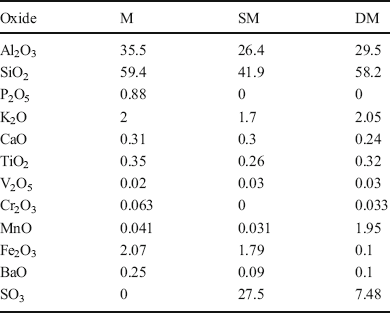
The elemental compositions of M, SM, and DM were determined using XRF (Table 1). Metakaolin consisted of 59.4% SiO2 and 35.5% Al2O3 with trace amounts of P2O5, K2O, CaO, TiO2, V2O5, Cr2O3, MnO, Fe2O3, and BaO. Treatment with sulfuric acid caused the disappearance of P2O5 and Cr2O and the reduction of all the metal-oxide impurities. The sulfur content was analyzed at 27.5% following dealumination treatment and the concentrations of Al2O3 and SiO2 were reduced to 25.6% and 41.9%, respectively. Washing the SM sample with water reduced significantly the concentration of sulfur to 7.8% and increased the SiO2 and Al2O3 concentrations to 29.5% and 58.2%, respectively. The SiO2/Al2O3 ratio of DM sample increased to 1.97 compared to M at 1.67.
Elemental analysis (wt.%) by XRF of metakaolin (M), sulfuric acid-soaked metakaolin (SM), and dealuminated metakaolin (DM)

Infrared Analysis
Kaolin, M, SM, and DM were analyzed by FTIR to provide evidence for structural changes in the kaolinite following calcination and dealumination (Fig. 1). Results revealed an adsorption band at ~536 cm–1, indicating the Al–O bond vibration in Al[O(OH)]6. The absorption band that appeared at ~1115–1008 cm–1 was associated with the vibration of Si–O–Si bonds (Qoniah et al. Reference Qoniah, Prasetyoko, Bahruji, Triwahyono, Jalil, Suprapto and Purbaningtias2015). The vibration peaks of Al–OH appeared at ~795 and 697 cm–1 and the vibration peaks of Si–O bonds were observed at 469 and 430 cm–1 (Alkan et al. Reference Alkan, Hopa, Yilmaz and Güler2005). Following calcination at 500°C, the transformation of kaolin to metakaolin was observed by the disappearance of the features assigned to Al–O and Si–O–Si bonds in the kaolin framework. The metakaolin showed a broad absorption peak centered at 1095 cm–1, which corresponded to the vibration of the Si–OT symmetric group (T is Si or Al). The absorption band at 810 cm–1 corresponded to Si–OT bond vibration and the band that appeared at 472 cm–1 was assigned to the Si–O vibrational bond (Ptáček et al. Reference Ptácek, Šoukal, Opravil, Nosková, Havlica and Brandštetr2011). The broad hydroxyl –OH peak observed in M at 3600 cm–1 showed significant reduction in intensity due to dehydroxylation and the removal of adsorbed water during annealing treatment. Dehydroxylation occurred based on the following reaction:

IR analysis of: a kaolin, b metakaolin (M), c sulfuric acid-soaked metakaolin (SM), and d dealuminated metakaolin (DM), and zeolite NaY synthesized from e M, f SM, and g DM

During calcination of kaolin at high temperatures, 1.5 moles of H2O was removed for every mole of kaolin that was converted into metakaolin via the process described as dehydroxylation (Bessa et al. Reference Bessa, Costa, Oliveira, Bohn, do Nascimento, Sasaki and Loiola2017).
Metakaolin treated with sulfuric acid showed an absorption band at 3396 cm–1, corresponding to adsorbed water (Rasouli et al. Reference Rasouli, Golestani-fard, Mirhabibi, Nasab, Mackenzie and Shahraki2015). The analysis also revealed the Si–O peak shifted toward a higher wavenumber at ~1170 cm–1 due to the asymmetric-symmetric stretching vibration of sulfate (SO4 2–). The Si–OT vibration observed at 810 cm–1 in metakaolin also disappeared after sulfuric acid treatment, implying that the interaction between Si and sulfur followed the dealumination process. The disappearance of the Si–OT peak was also accompanied by the formation of an adsorption band at ~613 cm–1, corresponding to the symmetric vibration of sulfate anions (Kloprogge et al. Reference Kloprogge, Ruan and Frost2001). The dealuminated metakaolin showed the reappearance of the Si–OT peak at 810 cm–1 together with the reduced intensity of the sulfate peak at 613 cm–1, suggesting the removal of sulfur following washing of SM.
Infrared analysis of the NaY synthesized from M, SM, and DM (Fig. 1) revealed that all the adsorption peaks associated with the kaolin at ~541, 913, and 1107 cm–1 disappeared. The peak observed at 453 cm–1 indicated the vibration band of TO4 (T = Si, Al), and the peak which appeared at 500–600 cm–1 indicated the external vibration of the double four-membered ring (D4R) and double six- membered ring (D6R). The symmetrical internal and external vibrations of the O–T–O bonds were observed at 650–820 cm–1 and the asymmetric stretching vibrations of the T–O–T bonds were observed at 950–1250 cm–1. These results were consistent with the previous studies which showed that the adsorption bands of zeolite Y appeared at 460, 565, 685, 780, and 1010 cm–1 (Holmberg et al. Reference Holmberg, Wang, Norbeck and Yan2003).
XRD Analysis
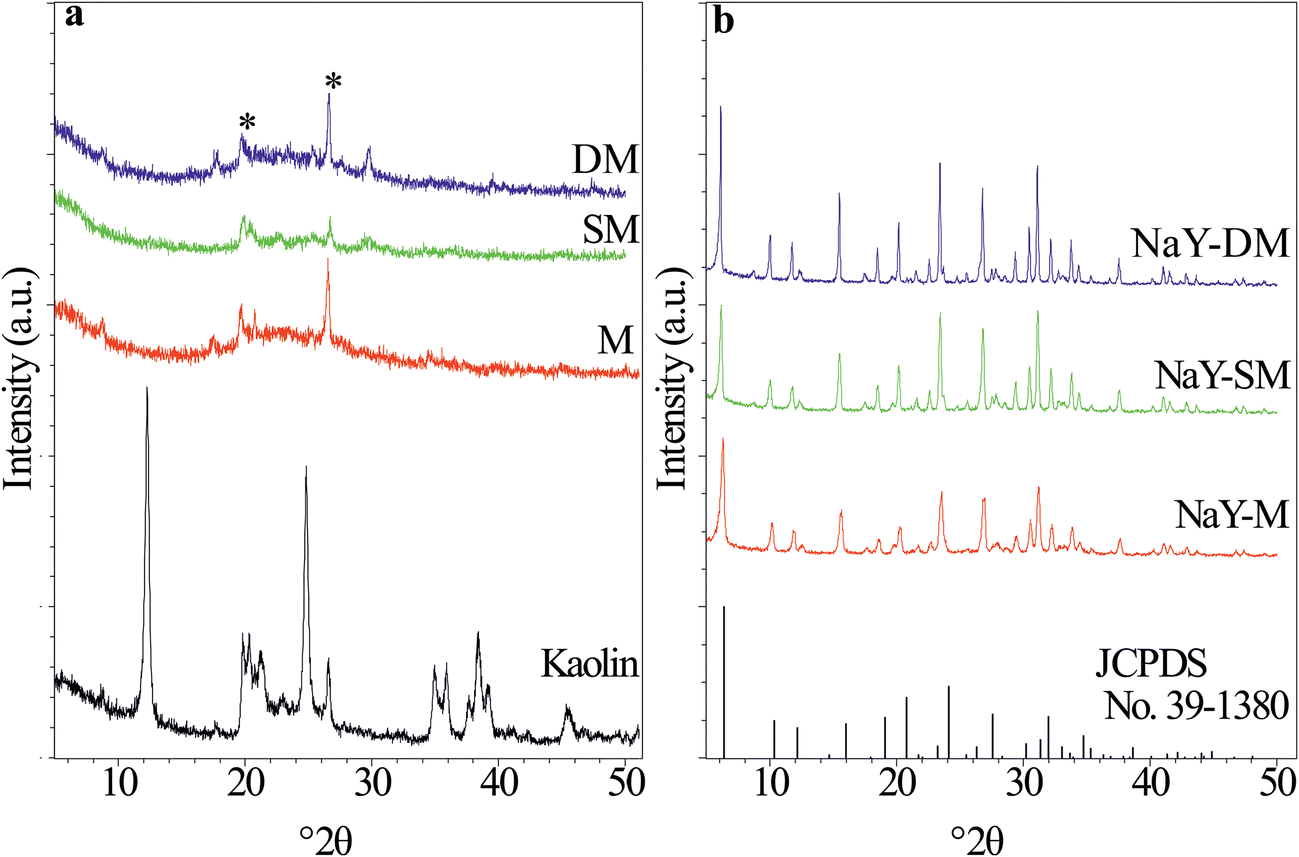
The crystalline phase of kaolin was identified using XRD (Fig. 2a) with diffraction peaks appearing at 12.6, 20.43, 24.94, 38.46, and 45.54°2θ. Annealing of kaolin at 720°C showed the disappearance of the kaolin diffraction peaks due to the transformation of the kaolin crystalline structure into amorphous aluminosilicate. The annealing treatment also showed the formation of typical quartz peaks at ~19.6 and 26.64°2θ (Kahraman et al. Reference Kahraman, Önal, Sarkaya and Bozdoğan2005) as the result of structural changes during the dehydroxylation process. No significant differences were found in the diffraction pattern of metakaolin following treatment with sulfuric acid.
XRD patterns of a kaolin, metakaolin (M), sulfuric acid-soaked metakaolin (SM), and dealuminated metakaolin (DM); b zeolite NaY synthesized from metakaolin, NaY-M; sulfuric acid-soaked metakaolin, NaY-SM; and dealuminated metakaolin, NaY-DM. *quartz SiO2

The formation of NaY from M, SM, and DM was also analyzed using XRD (Fig. 2b). The diffraction patterns were in accordance with the JCPDS No. 39-1380 of NaY with the main peaks appearing at 6.31, 10.31, 12.31, 15.92, 19.01, 20.71, 24.06, 27.52, and 31.95°2θ (CuKα). Sodalite was produced commonly during the synthesis of NaY with the characteristic peaks at ~14.20, 24.43, 31.79, 34.85, and 43.01°2θ (Luo et al. Reference Luo, Zhang and Yang2016). However, no peaks associated with sodalite were observed in the XRD patterns of the zeolites synthesized here, indicating the formation of high-purity NaY from kaolin. The crystallite size of NaY (Table 2) was calculated using the Scherer equation based on the FWHM of the (111) peak at 6.31°2θ. The crystallite size of NaY-DM produced from dealuminated metakaolin was ~81 nm, which was significantly larger than NaY-SM at ~40 nm and NaY-M at ~21 nm.
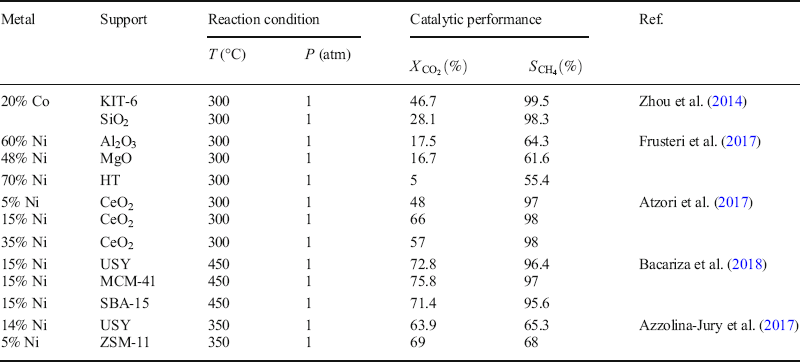
Summary of the catalytic performances of Ni catalysts for CO2 methanation reactions

N 2 Adsorption-desorption Analysis
The textural properties of NaY were determined using the N2 adsorption-desorption method. The adsorption-desorption isotherms of all NaY produced from M, SM, and DM (Fig. 3) were of type I, as indicated by the sharp increase in the isotherm at low P/P 0 before reaching steady state. The type I isotherm is a typical adsorption for NaY and it implies that the adsorption of nitrogen occurs within the micropores of the framework (Feng et al. Reference Feng, Yu, Mi, Cao, Yu and Song2019). The surface area and the pore volume of NaY synthesized from M (Table 3) were 376 m2/g and 0.015 cm3/g, respectively. The surface area of NaY synthesized from SM was reduced significantly to ~260 m2/g, suggesting that the high concentration of sulfur in SM was detrimental to the formation of NaY. Reducing sulfur concentration in the sulfuric acid-soaked metakaolin with water at 80°C prior to the synthesis of NaY, however, significantly improved the surface area of NaY to 505 m2/g and the pore volume to 0.304 cm3/g (sample NaY-DM, Table 2).
N2 adsorption-desorption isotherms of zeolite a NaY-M, b NaY-SM, and c NaY-DM

Textural properties of NaY synthesized from M, SM, and DM

aDetermined using EDX analysis; bdetermined using XRD
Morphology Analysis of Ni/NaY
Surface morphologies of zeolites NaY-M, NaY-SM, and NaY-DM were characterized using SEM analysis. The SEM image of NaY-M (Fig. 4a) synthesized from M revealed the formation of zeolite with non-uniform shape consisting of spherical and randomly shaped crystallites. Following dealumination with sulfuric acid, the NaY crystallites were transformed into octahedral structures with variation in the aggregate size. The dealuminated metakaolin as the NaY precursor revealed more uniform and well-defined octahedral structures. The aggregates of NaY-DM also appeared larger than NaY-SM and NaY-M as shown by the crystallite sizes (Table 3) calculated from the XRD analysis.
SEM images of zeolite NaY from a metakaolin, NaY-M, b sulfuric acid-soaked metakaolin, NaY-SM, and c dealuminated metakaolin, NaY-DM. Scale bars: 1 μm

Images from TEM-EDX analysis of NaY-M and NaY-DM following impregnation with 5 wt.% Ni (Fig. 5a,c) revealed the homogeneous dispersion of Ni nanoparticles on NaY. HRTEM analysis of 5 wt.% Ni/NaY (Fig. 5b) also revealed well dispersed Ni nanoparticles with an average diameter of 2.6 nm and an interplanar distance of 0.242 nm, which corresponded to the NiO(111) crystal plane (Rakshit et al. Reference Rakshit, Ghosh, Chall, Mati, Moulik and Bhattacharya2013). No significant differences between the sizes of Ni nanoparticles were observed when NaY-M and NaY-DM were used as supports.
a TEM analysis of Ni/NaY-DM, b HRTEM analysis of Ni/NaY-DM with its corresponding Ni particle-size distribution and Ni lattice spacing, c TEM analysis of Ni/NaY-M, and d HRTEM analysis of Ni/NaY-M with its corresponding Ni particle-size distribution and Ni lattice spacing

Catalytic Activity
Detailed characterization of synthetic NaY-DM showed increased surface area and pore volume and the formation of well-defined crystal structures. The catalytic activity of NaY was also investigated following impregnation with Ni nanoparticles for CO2 methanation. Ni nanoparticles were also impregnated into NaY-M to provide evidence for the promotional effect of dealuminated metakaolin as a precursor to NaY catalytic activity. All the catalysts were pre-reduced at 500°C for 3 h prior to the reaction in order to reduce NiO to Ni. The catalytic activity of Ni/NaY-M and Ni/NaY-DM at 400°C (Table 3), with CH4 and CO being the only products analyzed from the reaction, revealed a 67% conversion of CO2 on Ni/NaY-DM compared to just 47% for Ni/NaY-M. Ni/NaY-DM also showed high selectivity for conversion to CH4 at 94% while only 77% of methane selectivity was observed for Ni/NaY-M. Note that the control reactions were also carried out using a blank reactor and a bare Ni catalyst without any support and which showed negligible activity towards CO2 methanation. The results exhibited the important role of the NaY support to enhance the activity of Ni by increasing the dispersion of Ni nanoparticles. The presence of Ni was crucial in providing the active sites for CO2 dissociation, with the particle size and the amount of Ni loading affecting CO2 conversion and product selectivity (Zhang et al. Reference Zhang, Tian, Zhang, Hu, Xiang and Wang2019). Impregnation of supporting material with a large loading of Ni produced large nanoparticles due to the sintering process that occurred during high-temperature calcination (Atzori et al. Reference Atzori, Cutrufello, Meloni, Monaci, Cannas, Gazzoli, Sini, Delana and Rombi2017). A review of previous investigations into Ni catalysts for CO2 methanation (Table 4) indicated that high Ni loading (>50 wt.%) showed only ~5–17% of CO2 conversion (Frusteri et al. Reference Frusteri, Frusteri, Costa, Mezzapica, Cannilla and Bonura2017); reducing the Ni loading to only 5 wt.%, meanwhile, and increased significantly the CO2 conversion to ~70% (Atzori et al. Reference Atzori, Cutrufello, Meloni, Monaci, Cannas, Gazzoli, Sini, Delana and Rombi2017; Azzolina-Jury et al. Reference Azzolina-Jury, Bento, Henriques and Thibault-Starzyk2017). The actual amounts of Ni on the catalysts were determined using AAS (Table 4) and the results were ~6.3 wt.% in Ni/NaY-DM and ~4.6 wt.% in Ni/NaY-M. The values were slightly different when the initial loading of impregnated Ni was 5% wt. (due to experimental error during the AAS analysis), though the result showed the efficiency of the impregnation method for the deposition of Ni on NaY support.
Catalytic data from CO2 methanation reaction at 400°C using Ni/NaY catalysts synthesized from dealuminated metakaolin (DM) and metakaolin (M)

aDetermined using AAS; b determined using HRTEM; S = selectivity; Y = yield
Catalytic activity of Ni/NaY-M and Ni/NaY-DM catalysts were also investigated at different reaction temperatures in the range 200–500°C (Fig. 6). The catalysts showed negligible activity for the methanation reaction at 200°C. Increasing the temperature to 250°C enhanced the CO2 conversion of Ni/NaY-DM catalyst to 13%, though Ni/NaY-M showed only ~3% of CO2 conversion. CO2 conversion was improved significantly when the temperatures were increased to 400°C; Ni/NaY-DM exhibited much greater conversion and CH4 selectivity than NaY synthesized from a metakaolin precursor. Ni/NaY-M and Ni/NaY-DM catalysts exhibited 100% selectivity toward CH4 for the reactions up to 350°C. When the temperature was increased to 400°C, CO from the water-gas shift reaction was produced which consequently reduced the selectivity toward CH4 to 94% on Ni/NaY-SM. The detrimental effect of a high reaction temperature was more significant for the Ni/NaY-M catalyst. Reaction at 550°C reduced the conversion of CO2 to 30% and also the CH4 selectivity to only 30%. Significant reduction in the productivity of CH4 at temperatures of between 400 and 550°C for the Ni/NaY-M catalyst suggested that the catalysts have poor stability at high temperatures. For Ni/NaY-DM, the conversion of CO2 to methane showed only slight reduction at 500°C, which suggested that the NaY produced from dealuminated metakaolin provided a more stable support for Ni nanoparticles. The catalytic activity of Ni/NaY-DM was also compared with the activity of Ni nanoparticles supported on metal oxides SiO2, Al2O3, MgO, on mesoporous silica SBA-15, on MCM-41, and on zeolites USY and ZSM-11 (Table 2). At a similar 5 wt.% loading of Ni, the CO2 conversion of Ni/NaY-DM appeared lower than the conversion observed for Ni/ZSM-11, though Ni/NaY-DM showed 100% selectivity toward CH4 at 350°C and only slightly reduced to 94% at 400°C.
Catalytic performance of 5 wt.% Ni-NaY-M synthesized from metakaolin and 5 wt.% Ni-NaY-DM from dealuminated metakaolin at various temperatures from 200 to 500°C. a Conversion of CO2, b selectivity (S) of CH4, and c yield (Y) of CH4

Ni nanoparticles provided active sites for CO2 dissociation during CO2 hydrogenation reactions (Zhao et al. Reference Zhao, Li and Bian2016; Fukuhara et al. Reference Fukuhara, Hayakawa, Suzuki, Kawasaki and Watanabe2017; Quindimil et al. Reference Quindimil, De-La-Torre, Pereda-Ayo, González-Marcos and González-Velasco2018; Ewald et al. Reference Ewald, Kolbeck, Kratky, Wolf and Hinrichsen2019). In the presence of H2 as reducing agent, the dissociated CO2 was further reduced to form methane (Bacariza et al. Reference Bacariza, Graça, Lopes and Henriques2019). As no significant differences were observed between the sizes of Ni nanoparticles analyzed using HRTEM for Ni/NaY-DM and Ni/NaY-M, the enhanced catalytic performance of NaY-DM was suggested to be due to the increased surface area and pore volume of NaY, and the reduction of the Si/Al ratio of NaY. In general, the adsorption of CO2 on NaY was increased on any zeolite with large surface basicity (Walton et al. Reference Walton, Abney and Douglas LeVan2006). Reducing the concentration of Al increased the basicity of zeolite and enhanced the interaction of CO2 with the basic oxygen framework (Bacariza et al. Reference Bacariza, Graça, Lopes and Henriques2019). Synthesis of NaY from dealuminated metakaolin produced an aluminosilicate precursor containing little aluminum. Analysis by EDX (Table 2) revealed that the Si/Al ratios of NaY increased from 1.21 in NaY-M to 1.32 in NaY-DM, which implied a decrease in the Al content in the zeolite. Zeolite NaY produced from dealuminated metakaolin also exhibited a large surface area with well-defined octahedral structures. The rate-limiting step of the CO2 methanation reaction involved the dissociation of the CO2 bond followed by hydrogen insertion (Westermann et al. Reference Westermann, Azambre, Bacariza, Graça, Ribeiro, Lopes and Henriques2015). Adsorbed CO2 reacted with the dissociated H2 to form a monodentate formate intermediate on Ni0 which further hydrogenated to produce CH4. The formate intermediate can also decompose on Ni0 via C–O bond dissociation, however, to form CO (Westermann et al. Reference Westermann, Azambre, Bacariza, Graça, Ribeiro, Lopes and Henriques2015). Catalytic activity of Ni/NaY-DM for CO2 methanation showed high selectivity for CH4 in comparison to Ni/NaY-M. The combination of a large surface area, well-defined structure, and low Si/Al ratios of NaY-DM is suggested to provide active support for stabilization of formate intermediates which allowed further hydrogenation to CH4.
Conclusions
The structural properties and the catalytic activity of NaY synthesized from metakaolin (M) and dealuminated metakaolin (DM) were investigated as Ni supports for CO2 methanation. Kaolin was transformed into metakaolin and subsequently treated with sulfuric acid to reduce the aluminum content of the metakaolin, yielding a sulfuric-acid soaked metakaolin (SM), then washed to remove excess sulfur to obtain the DM product. NaY synthesized from M produced non-uniform crystallite structures with 376 m2/g of surface area. Synthesis of NaY from DM significantly enhanced the surface area of NaY to ~500 m2/g with a well-defined octahedral structure. The presence of a large concentration of sulfur in the SM product produced NaY with a small surface area of ~260 m2/g. Ni/NaY catalysts produced from DM showed 67% of CO2 conversion with 94% selectivity for methane as the product, both values of which were much greater than for the Ni/NaY catalysts synthesized from M. The enhanced catalytic activity was due to the large surface area, low sulfur content, well-defined crystallite structures, and low concentration of Al which facilitated CO2 dissociation and stabilization of a formate intermediate for methane production, particularly for the reaction at high temperatures.
ACKNOWLEDGMENTS
The authors acknowledge the Ministries of Research, Technology, and Higher Education, Republic of Indonesia, for funding under PMDSU research fund number 5/EI/KP.PTNBH/2019 and PBK research fund number 841/PKS/ITS/2019 to D. Prasetyoko. The authors also acknowledge Universiti Brunei Darussalam Research Grant UBD/RSCH/URC/RG(b)/2019/012 for funding to H. Bahruji and UTM Transdisplinary research grant (Grant no. 06G53) for funding to A. A. Jalil.
Funding
Funding sources are as stated in the acknowledgment.
Compliance with Ethical Statements
Conflict of Interest
The authors declare that they have no conflict of interest.