Introduction
Salmonella is a worldwide public health hazard and, despite extensive research and scientific knowledge, the bacterium continues to cause significant human illness and mortality. Increasing levels of bacterial antimicrobial resistance with direct impact on food safety has become a serious problem (Boyle et al., Reference BOYLE, BISHOP, GRASSL and FINLAY2007). Salmonellosis is caused by consuming contaminated poultry products, either eggs or chicken meat. The disease in humans is associated with major concerns relating to public health and the economy, at both a local and a global scale.
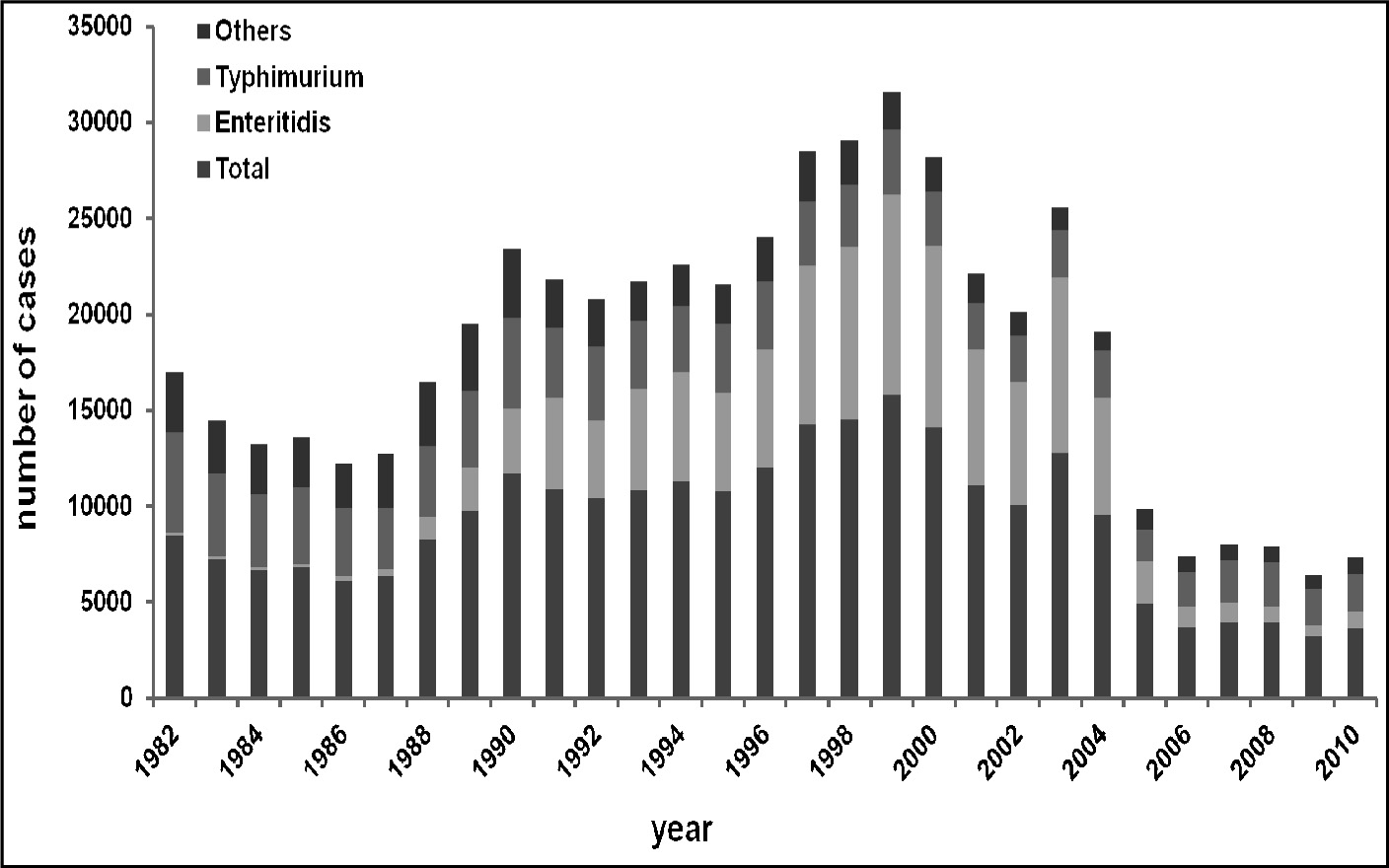
Up to 168,000 cases of human salmonellosis are reported each year in the European Union, and up to 1.4 million cases annually in the United States (WHO, 2005; EFSA, 2008; 2010; 2011 (Figure 1).
Human salmonella infections history (EFSA, 2011).

Furthermore, with approximately 550 deaths annually, salmonella-induced enter colitis is the single most common cause of death from food-borne illnesses in the United States (Anonymous, 2009). The majority of the cases are caused by Salmonella enterica serovar enteritidis or Salmonella enterica serovar typhimurium and are often associated with the consumption of infected poultry meat or eggs (Rajashekara et al., Reference RAJASHEKARA, HAVERLY, HALVORSON, FERRIS, LAUER and NAGARAJA2000; Thorns, Reference THORNS2000; Foley et al., Reference FOLEY, NAYAK, HANNING, JOHNSON, HAN and RICKE2011). Both serovars are capable of inducing a systemic disease in newly hatched chicks but colonise the gastrointestinal tracts of chickens older than three days without clinical signs (Barrow et al., Reference BARROW, HUGGINS, LOVELL and SIMPSON1987; Humphrey et al., Reference HUMPHREY, BASKERVILLE, CHART and ROWE1989; Humphrey, Reference HUMPHREY1999). Colonisation may lead to long-term presence in the gut, with consequences on faecal shedding and horizontal transmission within the flock. Colonisation causes contamination of the meat, principally through faecal contamination at slaughter (Gast et al., Reference GAST, GUARD-BOULDIN and HOLT2005; Reference GAST, GURAYA, GUARD-BOULDIN, HOLT and MOORE2007; Smith et al., Reference SMITH, CASON and BERRANG2005). Similarly, egg shells or freshly laid eggs may be contaminated as they pass through the cloaca if this is colonised by salmonella (Gantois et al., Reference GANTOIS, DUCATELLE, PASMANS, HAESEBROUCK, GAST, HUMPHREY and VAN IMMERSEEL2009). Egg can be also contaminated with salmonella by vertical transmission (from infected reproductive tissues to eggs prior to shell formation) (Foley et al., Reference FOLEY, NAYAK, HANNING, JOHNSON, HAN and RICKE2011). Furthermore, it was shown that salmonella affects the gut integrity and open the tight junction gate for the invasion of pathogens (Awad et al., Reference AWAD, ASCHENBACH, KHAYAL, HESS and HESS2012), therefore, it is important to find different strategies to manage these risks.
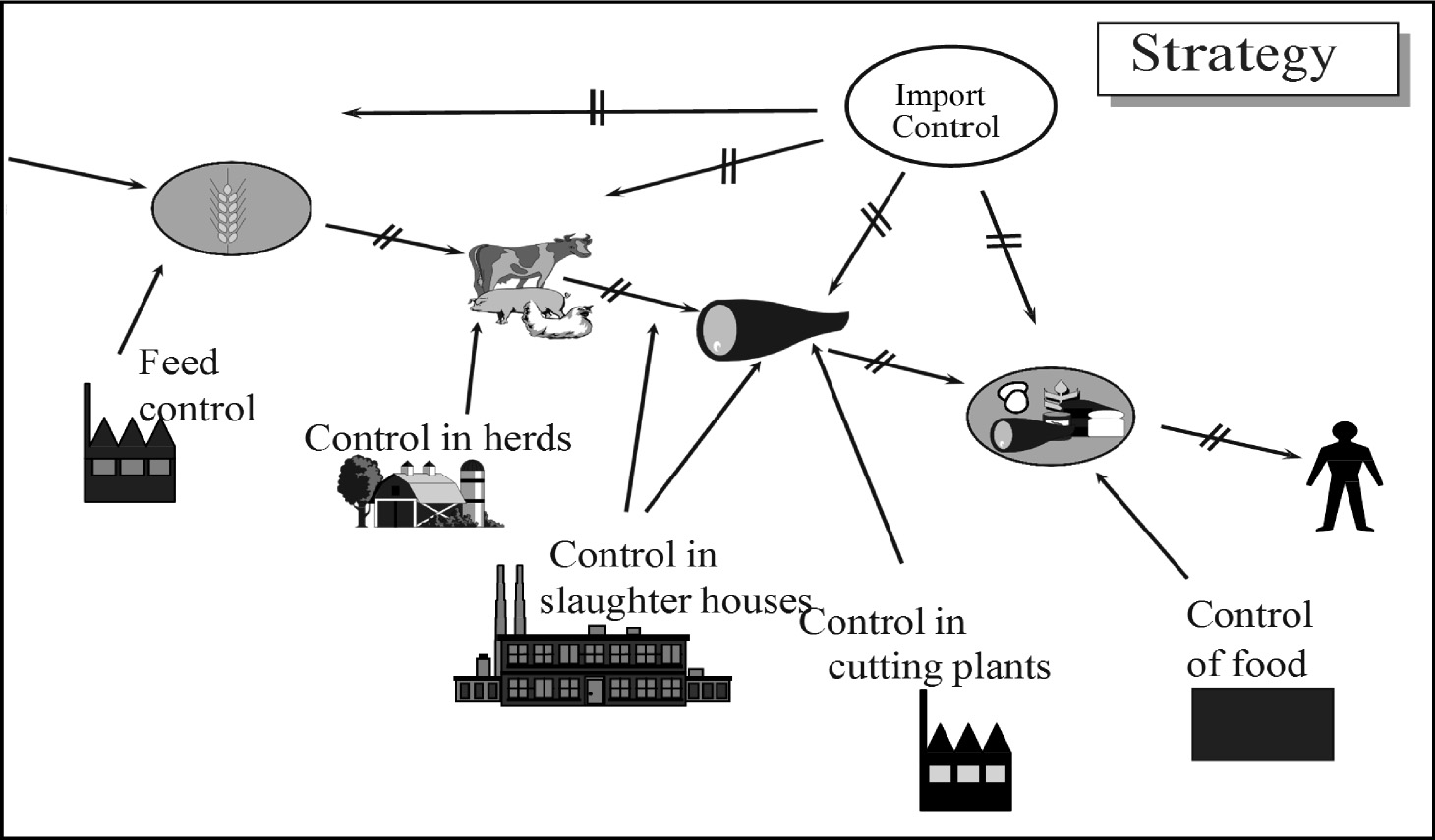
Post-harvest measures, such as hygienic slaughtering, processing and storage routines, can minimise the risks of salmonella to consumers but they have not yet resulted in a sufficient reduction in human salmonellosis cases. Therefore, good internal and external biosecurity measures are key components of salmonella control programmes to avoid the introduction of salmonella onto the farm or to reduce infection pressure when salmonella is present (Figure 2). Feed plays a significant role in the control of salmonella on two levels. Firstly, feed may potentially be an important vector to introduce salmonella onto the farm. Proper control programmes must, therefore, be in place at any feed manufacturing site, as well as on the farm to avoid ingestion of salmonella by the animals. Secondly, when animals are exposed to salmonella through feed and other sources, feed composition, texture and supplements can be used to additionally minimise the risk of colonisation and shedding of salmonella. Therefore, the purpose of this review is not to provide an extensive and all-inclusive list of publications on the subject but to supply overall nutritional-related strategies that can be considered in a salmonella control programme.
Overview for the points of salmonella control (Haeggblom, Reference HAEGGBLOM2009).
Host-pathogen interactions in chickens
Salmonella enterica is one of the major causes of human food-borne gastroenteritis worldwide. Poultry are the most important source of S. enterica in humans. The different outcome of interaction between salmonella and its host is dependent upon multiple factors. Lamont et al. (Reference LAMONT, KAISER and LIU2002) found differences between chicken lines in the level of colonisation of the gastrointestinal tract. It was shown that salmonellosis in young chickens is characterised by severe clinical signs of systemic disease associated with diarrhoea, dehydration and high mortality rates, however, in adult chickens can produce a sharp decrease in egg production, without clinical signs in birds infected with S. enteritidis.
Several factors can affect the susceptibility of poultry to salmonella colonisation (Bailey, Reference BAILEY1988) such as: 1) age of birds; 2) salmonella serotype and initial challenge dose level; 3) stress, including environmental, transport, and overt or subclinical disease; 4) presence of feed additives, such as antimicrobials and anticoccidials; 5) survival through low pH of the stomach; 6) competition with gut microflora; 7) presence of a compatible colonisation site, and 8) host genetic background.
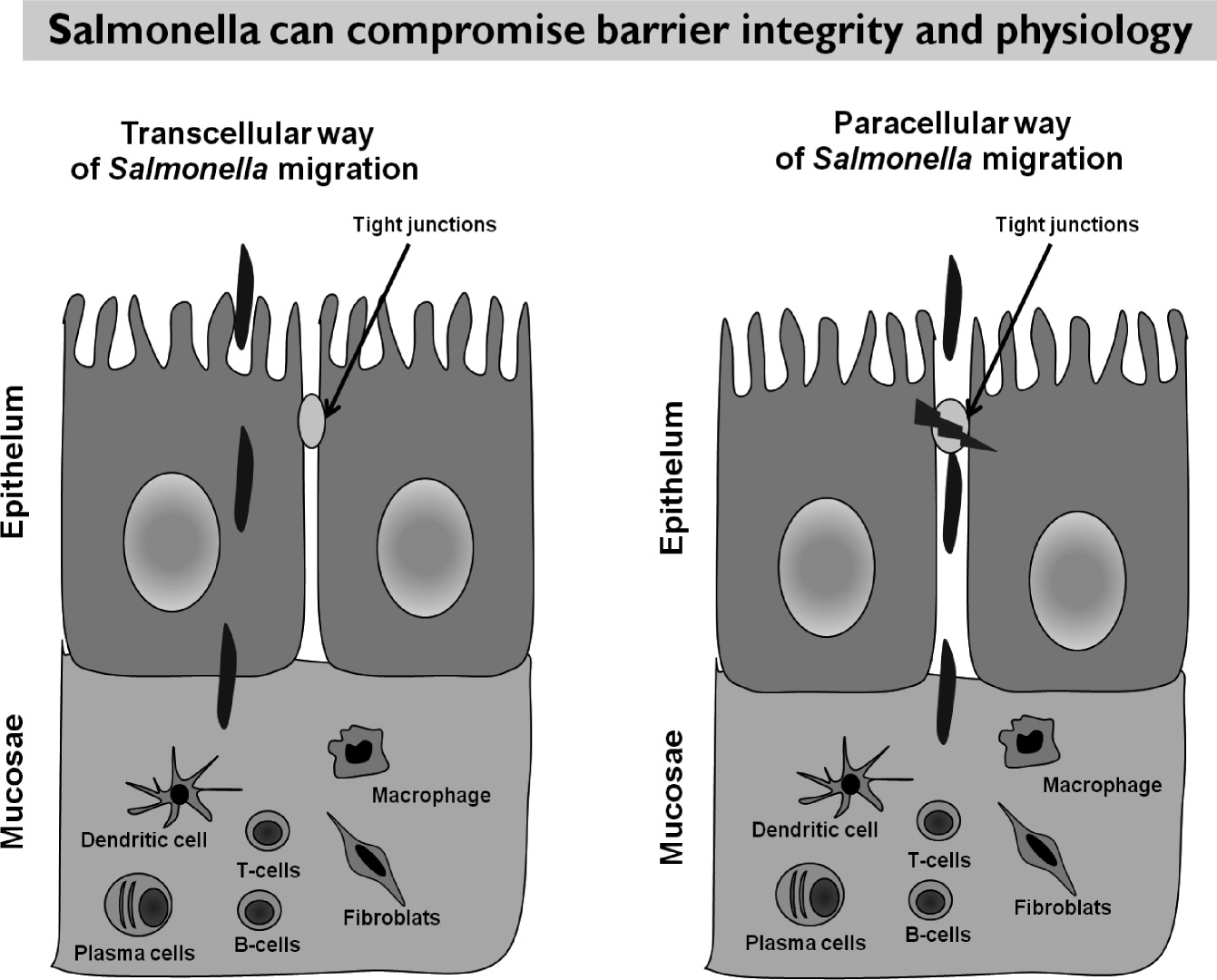
Intestinal epithelial cells acts as an efficient barrier that prevents mucosal penetration by most enteric bacteria. However, some pathogenic enteric bacteria can overcome the protective barrier and invade the epithelium and gain access to the underlying mucosa. In response to mucosal invasion of pathogens, epithelial cells and macrophages express pro-inflammatory cytokines. Some studies demonstrated the ability of salmonella to disrupt barrier integrity by modulating epithelial permeability as indicated by a reduction in Trans-Epithelial Electric Resistance (TEER) and alteration of tight junction expression and/or distribution (Jepson et al., Reference JEPSON, SCHLECHT and COLLARES-BUZATO2000; Bertelsen et al., Reference BERTELSEN, PAESOLD, MARCUS, FINLAY, ECKMANN and BARRETT2004; Otte and Podolsky, Reference OTTE and PODOLSKY2004; Kohler et al., Reference KOHLER, SAKAGUCHI, HURLEY, KASE and MCCORMICK2007 (Figure 3).
The intestine represents an efficient barrier against enteric pathogens; however, the pathogen can attach to and invade intestinal epithelial cells and generate toxins that kill host cells and impair host functions and has consequences for animal health.
The intestinal mucosal barrier composes of epithelial cell membranes and a mucus layer covering the epithelium (Turner, Reference TURNER2009). Mucus provides a physical barrier to protect the underlying epithelium from direct contact with commensal microbes and pathogenic microbes (Kim and Ho, Reference KIM and HO2010). Zarepour et al. (Reference ZAREPOUR, BHULLAR, MONTERO, MA, HUANG, VELCICH, XIA and VALLANCE2013) indicated that the lack of the entire intestinal mucus layer caused increased epithelial barrier dysfunction as well as higher salmonella colonisation.
The role of local intestinal immune homeostasis is very important to provide effective defence against harmful pathogens. Gut-associated lymphoid tissues (GALT) of the intestine are part of the mucosal immune system of commercial poultry and are fundamental for induction of local inflammatory responses. Even though, salmonella can colonise the avian intestine and, although no pathology is associated with chicken colonisation, an intestinal immune response to infection has been illustrated with increased cytokine expression and toll-like receptor (TLR) activation (Cheeseman et al., Reference CHEESEMAN, KAISER, CIRACI, KAISER and LAMONT2007).
In the present review, some intervention measures to reduce Salmonella in feed were mentioned. However, we focus mainly on the on-farm intervention measures to reduce salmonella colonisation in poultry. Three general strategies have been proposed to control salmonella on the poultry farm: (1) reduction of environmental exposure (biosecurity measures), (2) an increase in poultry's host resistance to reduce salmonella carriage in the gut (e.g., competitive exclusion, vaccination, and host genetics selection), and (3) the use of antimicrobial alternatives to reduce and even eliminate salmonella from colonized chickens (e.g., bacteriocin treatment).
Salmonella control strategy (pre-harvest)
The shedding of salmonella within the poultry environment enhances the opportunity for transmission (Davies and Wray, Reference DAVIES and WRAY1996). However, management variation can influence the rate of infection. It has been shown that caged systems had a lower prevalence of S. enteritidis compared to free-range systems (1.7% and 50%, respectively) (Kinde et al., Reference KINDE, READ, CHIN, BICKFORD, WALKER, ARDANS, BREITMEYER, WILLOUGHBY, LITTLE, KERR and GARDNER1996). Furthermore, Davies and Wray (Reference DAVIES and WRAY1996) indicated that S. enteritidis can survive for at least one year in naturally infected housing, but will decline rapidly in deep litter. Subsequently the cross-contamination between the environment and domestic animals increases through transportation and slaughtering (Murray, Reference MURRAY2003).
Wild birds including pigeons and sparrows as well as rodents, cats, dogs and insects may be contaminated by contact or ingestion of spilled meat meal, feather meal and other animal by-products at slaughtering plants and poultry houses. These may lead to contamination of effluents, surface waters, creeks, lakes, rivers, pastures, and soils which increases subsequent colonisation in wild birds, cattle, pigs, sheep, and horses as well as to contamination of animal feeds, or direct re-colonisation of farm animals (Kirkwood et al., Reference KIRKWOOD, CUNNINGHAM, MACGREGOR, THORNTON and DUFF1994). It is very difficult to control salmonella transmission because of the continuous faecal-oral infection and birds can excrete bacteria via their faeces for several months without showing any clinical signs. salmonella strains are capable of surviving for six or more years in the environment and biosecurity is consequently a major factor towards reducing the risk of salmonella in poultry farms. Buildings, surfaces, fans, cooling pads and equipments should be cleaned and disinfected properly. Further measures such as foot baths, wheel baths, hand hygiene and minimising the movement between different barns and housing need to be carried out properly. Establishment of a clear zone around building to discourage rodent and insect traffic in the building is important. Additionally, the overall management plan, cleaning and disinfection after each production cycle must be routinely performed. Consequently, hygienic measures should be part of the overall management plan of poultry producers. These measures are of utmost importance to control infections and all other measures lose their efficacy when the overall hygienic plan is not functioning. However, biosecurity measures alone will not be sufficient to solve the problem. Furthermore, salmonella is transmitted vertically, thus the starting point for any control strategy is to ensure poultry breeding flocks are kept salmonella-free.
Byrd et al. (Reference BYRD, ANDERSON, CALLAWAY, MOORE, KNAPE, KUBENA, ZIPRIN and NISBET2003) reported that providing mineral and organic acids in the drinking water greatly reduces post-harvest crop contamination with salmonella. Furthermore, feed and ingredients are a critical part in the salmonella control strategy. Feedstuffs can easily become contaminated at several stages for example primary production, mixing and processing at the feed mill, during storage, during feeding of the animals via contact with insects and wild animals. Berends et al. (Reference BERENDS, URLINGS, SNIJDERS and VAN KNAPEN1996) estimated that about 15-30% of all infections in the finishing period may be attributed to (re)contaminated feed.
There is no single strategy for salmonella control or eradication on the farm. The most successful programs will be those that utilise as many of the intervention programs as is economically possible.
Control of salmonella in feed
salmonella control in animal feed is important in order to protect animal and public health. Contaminated feed is a source for salmonella infections and a potential route of disease transmission to animal and human populations. Heat treatment, usually by heat conditioning, pelleting or extrusion has been shown to be an effective way of reducing microbial loads in feed; however, absolute ‘feed sterility’ cannot be achieved. Organic acids are one of the control measures used for treatment of salmonella contaminated feed or feed ingredients. Using acidifiers in feed and water minimises salmonella infection and promotes gut health, thereby enhancing poultry performance. The use of acidifiers can be seen as a management tool that effectively controls salmonella in feed (Lückstädt and Theobald, Reference LÜCKSTÄDT and THEOBALD2009; Koyuncu et al., Reference KOYUNCU, ANDERSSON, CHARLOTTA L., GOUNADAKI, ZENTEK and HÄGGBLOM2013). Therefore, it is important to improve feed hygiene by reducing the contamination of feedstuffs and avoiding the dissemination of contaminated feed for animals and preventing feed from recontamination.
Vaccination of chickens against salmonella
Vaccination of chickens may be the most practical measure to control the disease in humans. Van Immerseel et al. (Reference VAN IMMERSEEL, DE BUCK, DE SMET, MAST, HAESEBROUCK and DUCATELLE2002) reported that the administration of live salmonella orally to newly hatched chicks resulted in a strong adaptive immunity leading to rapid protective effects within 24 hours, indicating that the presence of a large number of live salmonella in the intestine can induce infiltration of polymorphonuclear cells into intestinal walls and increase the intestinal resistance to invasion and systemic spread by virulent salmonella strains.
Salmonella spreads primarily through a flock via faecal contamination, vaccines would be effective if they increased specific antibody levels in the digestive tract and reduced the amounts of salmonella shed in faeces while preventing egg contamination and overall disease transmission by limiting invasion of the bird's internal organs such as the ovaries where eggs are infected internally. While killed vaccines only stimulate humoral immunity, live salmonella vaccines have the capacity to stimulate both cell-mediated and humoral immunities. Many studies reported that live attenuated or killed salmonella vaccines give different degrees of protection in chickens (Cooper et al., Reference COOPER, VENABLES, WOODWARD and HORMAECHE1994; Reference COOPER, VENABLES and LEVER1996; Feberwee et al., Reference FEBERWEE, DE VRIES, HARTMAN, DE WIT, ELBERS and DE JONG2001; Liu et al., Reference LIU, YANG, CHUNG and KWANG2001; Gantois et al., Reference GANTOIS, DUCATELLE, PASMANS, HAESEBROUCK, GAST, HUMPHREY and VAN IMMERSEEL2009.
Many studies have been shown that vaccines do not prevent initial colonisation of the mucosal surfaces, particularly in the young birds (Gast et al., Reference GAST, STONE, HOLT and BEARD1992; Chatfield et al., Reference CHATFIELD, ROBERTS, LONDONO, CROPLEY, DOUCE and DOUGAN1993; Cooper et al., Reference COOPER, VENABLES, WOODWARD and HORMAECHE1994; Barrow, Reference BARROW1996; Woodward et al., Reference WOODWARD, GETTINBY, CORKISH and HOUGHTON2002). Because chicks are immunologically immature until around four weeks of age (Jeurissen et al., Reference JEURISSEN, JANSE, KOCH and DE BOER1989), it has been suggested that the avian immune system may be compromised by early vaccination at day old (Holt et al., Reference HOLT, GAST, PORTER and STONE1999).
However, it was shown that the vaccines currently available have limited efficacy, accordingly, the development of stable, efficacious, and safe vaccines against salmonella is still a major challenge (Barrow, Reference BARROW2007). Consequently, vaccinations do not always provide a complete guarantee that a disease would be prevented. Therefore, workers on breeder farms should be trained on cleaning and disinfection, the use of drag swabs to monitor salmonella contamination before re-stocking poultry houses and hatcheries, regular cleaning of ventilation inlets and fans, occupational health inspections and cool storage to limit growth of salmonella in eggs, and observance of environmental hygiene and prompt vaccination. Furthermore, analysis of feeds, especially those of animal origin, and testing to identify positive flocks should be conducted regularly. In addition, vaccine development and environmental management around poultry houses can lead to significant reductions in transmission and overall infections.
Competitive exclusion against salmonella
Competitive exclusion (CE) is used in poultry as a means for controlling salmonella colonisation (Revolledo et al., Reference REVOLLEDO, FERREIRA and MEAD2006). Spencer et al. (Reference SPENCER, CHAMBERS and MODLER1998) found that the most effective exclusion agents for poultry were derived from chicken intestines and many of them being commercially available (Collins and Gibson, Reference COLLINS and GIBSON1999). Furthermore the CE approaches is beneficially used in reducing the pathogens colonisation during early life of birds.
Competitive exclusion agents are considered to exert their effect by the creation of a restrictive physiological environment, competition for bacterial receptor sites and elaboration of antibiotic like substances and/or depletion of essential substrates (Schneitz and Mead, Reference SCHNEITZ and MEAD2000). Roberto et al. (Reference ROBERTO, RAGIONE and WOODWARD2003) showed that Bacillus subtilis was an effective competitive exclusion agent to be used in poultry for controlling Salmonella enteritidis. However, the effectiveness of CE for decreasing level of Salmonella spp. colonisation is varied, whereas, the efficacy of competitive exclusion depends on cultivation methods and storage of the microbiota. It was reported that the efficacy of using competitive exclusion microflora decreased with storage of the cultures (Stern, Reference STERN1994). Therefore, hatchery sanitation, litter treatments, and use of CE cultures may eventually be incorporated into a multifaceted intervention program that could limit colonisation by Salmonella spp. during production (Stern et al., Reference STERN, COX, BAILEY, BERRANG and MUSGROVE2001).
Probiotics and prebiotics for salmonella control in poultry
Probiotics (direct-fed microbials) are live, non-pathogenic bacteria that have a beneficial effect on the gut environment. Probiotics are used in animal feed as alternatives to antibiotic growth-promoters and for the control of specific enteric pathogens (Vila et al., Reference VILA, FONTGIBELL, BADIOLA, ESTEVE-GARCIA, JIMENEZ, CASTILLO and BRUFAU2009; Williams et al., Reference WILLIAMS, BURDOCK, JIMENEZ and CASTILLO2009). A prebiotic is defined as a non-digestible food ingredient that beneficially affects the host by selectively stimulating the growth and/or activity of one or a limited number of bacteria (Gibson and Roberfroid, Reference GIBSON and ROBERFROID1995). Prebiotics can change gut microbiota by supplying the nutrients for beneficial bacteria or by leading pathogenic bacteria to attachment sites in oligosaccharides instead of intestinal mucosa sites, subsequently reducing undesired intestinal colonisation, which in turn decreases the incidence of infections and improves the integrity of the mucosal surface of the gut wall (Iji and Tivey, Reference IJI and TIVEY1998; Awad et al., Reference AWAD, GHAREEB and BÖHM2011; Reference AWAD, GHAREEB, PAßLACK and ZENTEK2013).Many studies have reported that certain probiotics that can reduce salmonella colonisation in chickens (Vicente et al., Reference VICENTE, TORRES-RODRIGUEZ, HIGGINS, PIXLEY, TELLEZ, DONOGHUE and HARGIS2008; Higgins et al., Reference HIGGINS, HIGGINS, WOLFENDEN, HENDERSON, TORRES-RODRIGUEZ, VICENTE and TELLEZ2010). Tellez et al. (Reference TELLEZ, PIXLEY, WOLFENDEN, LAYTON and HARGIS2012) reported that a lactic acid bacteria based probiotic (FloraMax-B11®) was successful as a salmonella control strategy used in the drinking water for reducing colonisation in poultry industry.
Recently, it was shown that the use of probiotics can help to improve the natural defence of animals against pathogenic bacteria and considered as an effective approach for livestock to reduce bacterial contamination (Ghareeb et al., Reference GHAREEB, AWAD, MOHNL, PORTA, BIARNÉS, BÖHM and SCHATZMAYR2012; Reference GHAREEB, AWAD, MOHNL, BÖHM and SCHATZMAYR2013). Probiotic application is used to produce significant changes in gut physiology and increase performance parameters in poultry (Awad et al., Reference AWAD, BÖHM, RAZZAZI-FAZELI, GHAREEB and ZENTEK2006; Reference AWAD, GHAREEB, ABDEL-RAHEEM and BÖHM2009; Reference AWAD, GHAREEB and BÖHM2010). Furlan (Reference FURLAN2005) reported that the mode of action of probiotics is related to the competition for attachment sites, or competitive exclusion. The bacteria present in the probiotic attach to the intestinal mucosa, thus forming a physical barrier that blocks the attachment of pathogenic bacteria.
Ribeiro et al. (Reference RIBEIRO, VOGT, CANAL, CARDOSO, LABRES, STRECK and BESSA2007) found that prebiotic and probiotic can diminish the salmonella colonisation in broiler chickens. Furthermore, Caramori (Reference CARAMORI2001) indicated that the use of a product containing probiotics and prebiotics in contaminated flocks challenged with Salmonella enteritidis significantly reduced carcass contamination with Salmonella spp.
Probiotic preparations are important in poultry production to improve the health status of animals. Probiotics as dietary supplements affect higher performance and are ideal in stressful situations, as well as during periodic decrease in immune response of individuals. In addition, there is a possibility for using probiotics as a vehicle for providing digestive enzymes and other bioactive substances. Another advantage of probiotics is the fact that is natural supplements. Therefore, the use of probiotics are important in economic aspects as well as for gut health.
Salmonella control during transport and slaughtering (harvest and post-harvest)
Feed should be withdrawn from the birds between 8-12 hours before slaughter to reduce the amount of defecation and contamination of the carcass. Transportation of a salmonella positive flock leads to contamination of the containers (Slader et al., Reference SLADER, DOMINGUE, JØRGENSEN, MCALPINE, OWEN, BOLTON and HUMPHREY2002; Berrang et al., Reference BERRANG, NORTHCUTT, FLETCHER and COX2003). Therefore, each time, after unloading the flock; containers and vehicles must be thoroughly cleaned and disinfected.
Defeathering and evisceration are critical control points at processing stages where cross contamination may occur. Therefore, a control measure to reduce or eliminate cross-contamination is necessary during slaughter; in other words, salmonella negative flocks should be slaughtered before infected flocks.
Conclusions
Chickens are an important source of human infection with salmonella because they can carry a high load of bacteria without showing any clinical signs. Salmonella may modulate gut health by a number of complex interactions with the gut epithelium, mucus and microflora. Resolving the selective modulation of intestinal immunity and physiology as a result of subclinical infection represents a valid basis for the assessment of the effectiveness of prevention strategies. Gut health plays a critical role in poultry productivity and maintaining healthy gut is the primary step towards efficient production. Thereby more research on the pathophysiological reaction of the gut against subclinical pathogenic infections in birds, dramatically expanding our understanding of bacterial pathogenesis, could contribute to more effective control strategies to eradicate this pathogen. Therefore, the improvement of gut health by certain natural feed additives plays a crucial rule in the prevention or amelioration of salmonella infection. Hence, effective salmonella control is based on preventing its introduction on farm and preventing its spread. Strategies to control salmonella transmission needs to focus on the whole production chain of poultry from farm to fork.