


Simple, erect, severe, austere, sublime –
Shrine of all saints and temple of all gods,
… – sanctuary and home
Of art and piety – Pantheon! – Pride of Rome!
Lord Byron, Childe Harold’s Pilgrimage, Canto 4.cxlvi
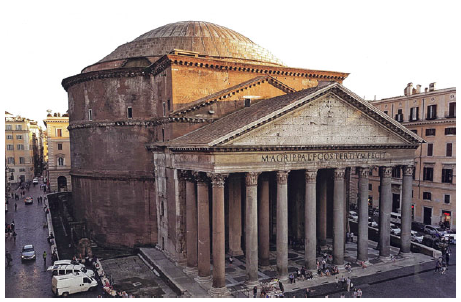
The conversion of the Pantheon into a Christian church occurred during the pontificate of Pope Boniface IV (608–15), who is credited with dedicating an extraordinary pagan temple to ‘blessed Mary ever virgin and all the martyrs’ (‘fecit ecclesiam beatae Mariae semper virginis et omnium martyrum’).Footnote 1 The church later became known as Sancta Maria ad martyres, the ‘ad martyres’ epithet, appearing for the first time in the Liber pontificalis biography of Pope Vitalian (657–72). Later still (and more popularly), it became known as Santa Maria Rotonda, an allusion to its unique circular design (Figure 1).
Rome, Pantheon (exterior)
(photo: Barbara Smith, Sacred Architecture, 40 (2021), p. 24)

The Pantheon was constructed by the Emperor Hadrian (AD 117–38) to replace an earlier temple from the time of Marcus Vipsanius Agrippa (c. 62–12 BC), destroyed by fire. Hadrian did not, however, place his own name on the façade but that of Agrippa. The design of the building, a rotunda preceded by an impressive portico, was a daring experiment. As one of the few monuments from antiquity that remains intact, it has been intensely studied since the Renaissance, especially with regard to its symmetrical proportions and treatment of statics.Footnote 2 Though now surrounded by modern buildings, in antiquity the Pantheon was part of a complex of public structures and temples.Footnote 3 The Pantheon faces north towards the Via Recta, parallel to the (now vanished) porticoed Saepta Julia immediately to the west and the adjoining Temple of Isis and Serapis beyond. A powerful reminder of the grandeur of imperial Rome, the Pantheon is reputedly the most visited historical site in all of Italy today and the oldest building still in use, presently as the ‘Basilica of Sancta Maria ad martyres’ with a staff of twelve priest-canons. Were it not for Pope Boniface, the building would have most probably become a ruin.
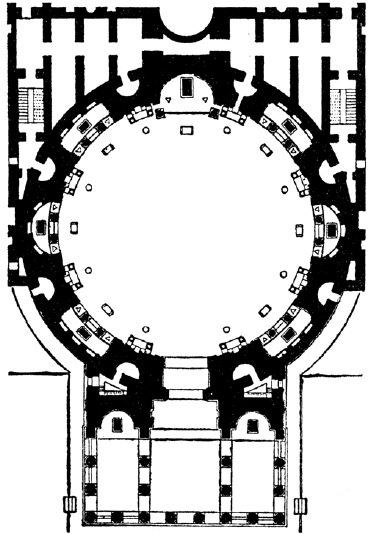
The question of the original function of the Pantheon (as rebuilt by Hadrian c. AD 126), forgotten even a century after its completion, has not been satisfactorily solved. Was it dedicated to the seven planetary deities, whose statues would have been placed in the seven niches along the circumference of the walls (Figure 2)? The seven rings of the dome (five coffered rows surmounted by an unadorned ring and crowned by the oculus, a circle at the top thirty feet across and open to the air), can be construed as supporting that opinion.
Rome, Pantheon (ground plan)
(from Buchowiecki, Handbuch der Kirchen Roms, ii, p. 660)

As early as the late second century its identification was in doubt. The Roman historian Dio Cassius (c. 165–c. 235) surmised it was called (ὠνομασμένον) ‘the Pantheon’ because it housed ‘the statues of many gods’, of which he mentions Mars and Venus, as well as statues of Augustus and Julius Caesar (in niches in the portico?). Nevertheless, he thought that the round vaulted roof ‘resembles the heavens’.Footnote 4 There are references to Hadrian’s use of the space as a judicial tribunal, but this does not of itself undermine its probable primary function as a temple.Footnote 5 Ammianus Marcellinus (c. 330–c. 391/400) reported that, when the Emperor Constantius II (337–61) visited Rome in 357 he admired especially ‘the Pantheon with its arched rounded sphere, its beautiful height, and the lofty niches rising one above another like shells’, a reference to the coffering of the interior of the dome.Footnote 6 Macrobius (c. 431) had no doubts about its sacred character: ‘in templo quod Pantheum dicitur’ (in the temple that is called the Pantheon).Footnote 7 By the time of its conversion into a Christian church in the early seventh century the building’s identification as a former pagan temple was not in doubt.
Since the Pantheon was imperial property, the Emperor Phocas II (602–10) had to be petitioned to allow its conversion into a church, the first transformation of this kind in Rome. Such reuses were uncommon, since most pagan temples were relatively small and were not very well suited to the needs of Christian worship in the cities.Footnote 8 In rural and mission areas with smaller populations their adaptation was sanctioned on an ad hoc basis, as will be explained below.
That Phocas readily granted permission for the conversion of the Pantheon is not surprising, given his good rapport with the papacy dating back to the days of Gregory the Great (590–604). In a letter written to Phocas in May 603 Gregory welcomed his accession as emperor (actually a usurpation) in effusive terms – so effusive that his sincerity has been questioned. Gregory told Phocas how much he ‘rejoice[d] that the kindness of your Piety has come to the imperial throne’, and he expressed a hope that ‘your Piety [will] make you kind to your subjects’.Footnote 9 In fact, Phocas was a ruthless tyrant, who had his predecessor, Maurice, and his immediate family put to death.Footnote 10 Also in May 603, portraits of the new emperor and empress were carried solemnly in procession to the oratory of St Caesarius on the Palatine. Gregory may have participated in this event.
Two months after his first letter, Gregory wrote to Phocas about sending the deacon Boniface to Constantinople as his personal representative (apocrisarius).Footnote 11 The identity of this Boniface is not entirely clear. It could have been either the future Pope Boniface III (February–November 607) or his successor, Boniface IV. Both were on good terms with Phocas. A case has been made for the former, based on the theory of his father’s possible Antiochene background, which would have made him familiar to some extent with the East and presumably conversant with Greek.Footnote 12 During his short papacy Boniface III persuaded the emperor to designate Rome ‘the head of all the churches’ (‘caput omnium ecclesiarum’), thereby spiting Constantinople, where Phocas was roundly disliked.
The future Boniface IV is just as likely to have been Gregory’s apocrisarius in the eastern capital. The first line of his epitaph, ‘Gregorio quartus iacet hic Bonifacius almus’ (Here lies Boniface IV, [who was] dear to Gregory), may suggest a close personal relationship between the two popes.Footnote 13 During Boniface IV’s pontificate the Byzantine exarch in Italy, Smaragdus, dedicated to Phocas a tall (22.2m including the base) marble commemorative column crowned by a gilded bronze statue of the honouree.Footnote 14 The column, aligned with seven earlier memorial columns facing the Basilica Julia, still rises on the Forum today (sans statue).
The import of the new name attached to the Pantheon by the Liber pontificalis, ‘ecclesia beatae Mariae et omnium martyrum’ (the church of the blessed Mary and all the martyrs), is not immediately evident. Public veneration of the Virgin Mary was not as prominent at the beginning of the seventh century as it was later to become. Only two churches in her honour predate the Pantheon’s rededication: Santa Maria Maggiore (early 430s) and Santa Maria Antiqua (built under Byzantine auspices in the mid sixth century).Footnote 15 They did not initiate a wave of Marian church dedications or feasts. The church later known as Santa Maria in Trastevere did not have a Marian dedication at the time;Footnote 16 its Marian title appears first in the biography of Gregory IV (827–44), though the present church dates only from the time of Pope Innocent II (1130–43).
The Pantheon probably did not originally have a uniquely Marian dedication. Boniface’s epitaph praised him for driving demons from the building and dedicating it to all the saints.Footnote 17 Mary is not mentioned. The original dedication may have been to ‘all the saints’, pointedly replacing ‘all the gods’. The Marian part of the title may be connected with a famous Byzantine icon of Mary, mentioned for the first time in the Liber pontificalis biography of Pope Stephen III (768–72).Footnote 18 Legend has it that it was donated by the Emperor Phocas at the time of the church’s dedication. Though there had been disagreement in the past about dating the image, the last scientific examination of the icon (1961) established it as a work of the early seventh century, leading the noted art historian Hans Belting to conclude that ‘its origin at the dedication of the church [is] hardly any longer to be doubted’.Footnote 19 The icon’s presence, especially as an imperial donation, might go some distance in explaining the Marian designation attached to the rededicated Pantheon.
The gilded bronze roof tiles were still in place at the time of dedication, but they were removed by the Emperor Constans when he visited Rome in 663. Arab pirates foiled his attempt to transport them to Constantinople through Sicily, but a storm sent their own ship and its precious cargo to the bottom of the Mediterranean.Footnote 20 The bronze cladding of the beams of the portico fell victim to the desire of Pope Urban VIII (1623–44) to supply cannons for Castel Sant’Angelo. This act of papal vandalism gave rise to the sarcastic ‘quod non fecerunt barbari, fecerunt Barberini’ (what the barbarians didn’t do, the Barberini did). Apparently, the alloy from the Pantheon turned out to be not suitable for the manufacture of cannons.
The Dedication of the Pantheon as a Christian Church
The Liber pontificalis biography of Pope Boniface IV gives no hint of what happened on the day when the church was dedicated, but the dedication Mass was probably preceded by a procession to the church with ‘relics’ of martyrs.Footnote 21 The report of the dedication of the Pantheon in the Liber pontificalis does not mention that any relics were deposited in the new church, though by the beginning of the seventh century a deposition of relics was considered a normal part of the dedication of a new church, a fact confirmed by relevant petitions and responses in the Liber diurnus, a collection of stock letters used by the papal scrinium (chancery). Twenty-two of the letters (x–xxxi) concern permissions for the dedication of a church and the deposition of relics.Footnote 22 The first ‘Petitio dedicationis oratorii’ (x) requests that ‘reliquiae supramemoratorum sanctorum’ (relics of the saints listed above) be provided for the consecration of a new church. The affirmative responsum (xi) concludes with an instruction to the bishop-consecrator that ‘sanctuaria vero suscepta sui cum reverentia collocabis’ (you will place with reverence the relics received).Footnote 23 With one exception (letter xxvi), whenever ‘relics’ are mentioned, contact relics, ‘brandea’ or (as here) ‘sanctuaria’ – cloths that had been placed on martyrs’ tombs – are to be assumed, not corporeal remains.Footnote 24 Especially in the area subject to the jurisdiction of the bishop of Rome (Italia suburbicaria), moving the bodies of the deceased, saintly or not, was strictly prohibited in conformity with ancient Roman tradition.
Gregory the Great, who died only a few years before the dedication of the Pantheon, was inflexibly opposed to disturbing the bodies of the saints buried in the catacombs around Rome. His disciple, Boniface, would never have deviated from Gregory’s resolve on this matter. The notion that twenty-eight cartloads of bones were transported from the catacombs to Santa Maria ad martyres for the dedication is a sixteenth-century fabrication.Footnote 25 The procession with relics to a former Roman temple would not have imitated the festive papal cortège of Easter Sunday described in Ordo Romanus 1 (it probably resembled the relic translation of the Roman ‘dedication’ ordines, 42 and 43).Footnote 26 Nor would the papal Mass of the early seventh century have incorporated all of the ceremonial trappings of the Mass described in Ordo Romanus 1, which developed over the course of the seventh century. John F. Romano regards this as a ‘court liturgy’, but not one heavily indebted to Byzantine influence, as often assumed.Footnote 27
The interior of the Pantheon, a space in which pagan gods had been worshipped, would have first been thoroughly sprinkled with holy water, a form of apotropaic lustration dating back at least to the sixth century. In a letter of 13 July 601 to Abbot Mellitus, a future archbishop of Canterbury, Gregory the Great recommended that any pagan temple converted to Christian use be sprinkled with blessed water. Once the idols had been removed from the shrine and destroyed, the buildings ‘should be changed from the cult of demons to the worship of the true God’.Footnote 28 Local populations might well have appreciated the fact that the old temples, part of their heritage, were not being torn down – something that Gregory had recommended to King Ethelbert only a month before!Footnote 29 Even after the statues of pagan gods had been removed from the building, the Pantheon must have required more than a perfunctory besprinkling.Footnote 30 The Venerable Bede’s account of the Pantheon’s rededication may allude to such a sprinkling: ‘all filthiness having been eliminated, … so that, when the multitude of devils had been driven out, [the Pantheon] might serve as a memorial for a multitude of saints’.Footnote 31
When Gregory the Great reclaimed the Arian church of Sant’Agata dei Goti, which he regarded as ‘a cave of heretical depravity’,Footnote 32 to the orthodox faith, a demon who had taken the form of a pig was driven from the building. Though invisible to those assisting at the dedication Mass, it scurried to and fro in the nave before exiting. Gregory interpreted this as a divine sign that ‘the unclean spirit had departed from the building’.Footnote 33 Nevertheless, it was celebration of Mass that constituted the single essential act required for the dedication of a church.
The Dedication Mass
The Liber pontificalis reveals nothing about the Mass for the dedication of the Pantheon as a Christian church. Still, it may be possible to reconstruct the complete Mass formulary (prayers, readings, chants) for this very special, indeed unique, occasion. In particular, good arguments can be made that the entire chant formulary that begins with the introit Terribilis est locus iste was created specifically for the dedication of the Pantheon as a Christian church. This formulary, if composed in 609, carries significant implications for the genesis of the entire repertoire of Proper chants for the Mass, a topic that will be addressed later in this essay. The other sources for the dedication Mass (sacramentaries and lectionaries), though not as unified, supplement the musical evidence.
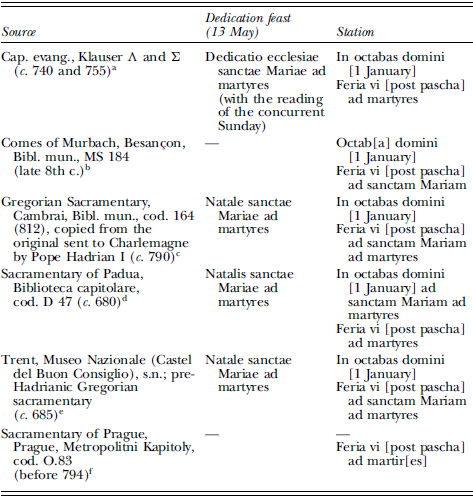
Table 1 lists selected sources of the dedication Mass in lectionaries and sacramentaries. Column 1 identifies the sources (with approximate datings); column 2 indicates how the dedication formulary is titled in each book; column 3 indicates how Sancta Maria ad martyres is rubricated in the sources as a stational church – for 1 January and Friday in Easter Week.
Sancta Maria ad martyres: Dedication and Stations Lectionaries and Sacramentaries

a T. Klauser, Das römische Capitulare evangeliorum, Liturgiegeschichtliche Quellen und Forschungen, 28 (Münster in Westfalen, 1935), pp. 73 [Λ] (no. 132), 114 [σ] (no. 128); W. H. Frere, Studies in Early Roman Liturgy, ii: The Roman Gospel Lectionary, Alcuin Club Collections, 30 (Oxford, 1934), p. 42 (no. 129).
b A. Wilmart, ‘Le comes de Murbach’, Revue bénédictine, 30 (1913), pp. 25–69, at pp. 36, 44; Vogel, Medieval Liturgy, p. 347.
c H. Lietzmann, ed., Das Sacramentarium Gregorianum nach dem Aachener Urexemplar, Liturgiegeschichtliche Quellen und Forschungen, 3 (Münster in Westfalen, 1921), p. 67 (no. 107); J. Deshusses, Le sacramentaire grégorien: Ses principales formes d’après les plus anciens manuscrits, i, Spicilegium Friburgense, 16, 3rd edn (Fribourg, 1992), p. 219 (no. 107). The collect refers merely to an ‘annual solemnity’; the generic super oblata is borrowed from the feast of St Agnes (ibid, p. 123 (no. 121)), the ad completa from Sexagesima Sunday (ibid., p. 130 (no. 149)). All of the prayers use the rhythmic cursus (tardus and planus).
d Liber sacramentorum Paduensis: Padova, Biblioteca capitolare, cod. D 47, ed. A. Catella etal., Monumenta Italiae liturgica, 3, Bibliotheca ‘Ephemerides liturgica’, Subsidia, 131 (Rome, 2005), p. 273 (no. 99).
e Monumenta liturgica Ecclesiae Tridentinae saeculo XIII antiquiora, ed. F. dell’Oro, 2 vols. (Trent, 1983–5), ii, pp. 198–9 (13 May), 109 (1 Jan.), 183–4 (fer. vi).
f Das Prager Sakramentar: Cod. O.83 (fol. 1–120) der Bibliothek des Metropolitankapitels, ed. A. Dold with L. Eizenhofer, 2 vols., Texte und Arbeiten, 1. Abt., 38-42 (Beuron, 1944–9), ii, p. 66*.
Epistle and Gospel Readings
One of the arguments against an early dating of the dedication Mass is the absence of the 13 May feast in the earliest Roman lectionary tradition. The earliest lists of epistle readings, the comes of Würzburg (c. 645), the epistolary of Corbie (772/780) and the comes of Alcuin (based on an original of c. 626), lack a commemoration of the Pantheon’s dedication.Footnote 34 Sancta Maria ad martyres does, however, appear as the stational church for Friday in Easter week in all three: Würzburg (‘ad sancta Maria martyra’),Footnote 35 Corbie (‘ad s. Mariam’),Footnote 36 and Alcuin (‘ad sanctam Mariam ad martyres’).Footnote 37 Given the ultimate Roman pedigree of these books, the omission of the 13 May feast is curious. Perhaps the rededication of a pagan temple, however significant, was seen as a local urban observance. At the very least, since Sancta Maria ad martyres serves as a stational church during Easter week, the lectionaries cannot be earlier than the date of its dedication (609).
There is no entry for 13 May in the Würzburg capitulare evangeliorum, the earliest source (c. 645) of Klauser’s Π family of lists of gospel readings. Manuscripts of the Π tradition were later brought up to date with the addition of the ‘dedicatio’ title, followed by a gospel pericope (John 15:26–16:4) in which Jesus predicts that his followers would be persecuted, a singularly appropriate message to a martyrial commemoration.Footnote 38 A reading for this day is, however, supplied in later sources of this tradition, which Klauser classified into two families: Λ (c. 740) and σ (c. 755). In both of these the observance is titled ‘Die XIII mensis supra scripti [May] dedicatio ecclesiae sanctae Mariae ad martyres’, but no gospel pericope is prescribed. Instead, a rubric following the title directs that ‘the reading that is read is that of the concurrent week, inasmuch as this solemnity is always celebrated on a Sunday’ (Table 1).Footnote 39 Since the reading would have varied from year to year, lack of a specific pericope can be easily explained. If the Sunday were to be observed as a dedication festival, the Proper chants and prayers of the dedication anniversary must have replaced the appointed Sunday chant formulary. Whether a curious coincidence or not, a Greek martyrology preserved in a Syriac manuscript lists a commemoration of all the martyrs on the Friday in Easter Week, a day when Sancta Maria ad martyres is the stational church.Footnote 40
Sacramentaries
Neither the Leonine (Verona)Footnote 41 or Old GelasianFootnote 42 sacramentaries, both based on Roman materials, have a Mass to commemorate the dedication of Sancta Maria ad martyres, though the Gelasian has prayers ‘in dedicacione basilicae novae’ (for the dedication of a new basilica).Footnote 43 Its absence from the former may be easily explained. The Verona sacramentary is an anthology of Mass formulae for various occasions, which seems to have been the work of a private collector, judging from the presence of multiple formularies for the same feast: five for the feast of St John Baptist (24 June), eight for the feast of Saints John and Paul (26 June), and fourteen full or partial Masses for the feast of the Roman martyr, Lawrence (10 August). An ‘in dedicatione’ Mass formulary in the Verona sacramentary is inserted in April, but it is for a church dedicated to St Peter.Footnote 44 There follow nine ‘item alia’ Masses, mainly seeking the intercession of the martyrs; one (no. 38, ‘Vere dignum’) has the phrase ‘in tua aecclesia’, but it is not for the anniversary of a dedication. The chief authority on the Gelasian sacramentary, Antoine Chavasse, regarded it as a presbyteral book, which was based on authentic Roman material and used as the sacramentary of one of the tituli.Footnote 45 If such were the case, one just might expect to find an anniversary commemoration of a local dedication that had taken place not too many decades earlier. An alternative to Chavasse’s theory holds that the Gelasian sacramentary is more likely to have been the creation of Frankish ‘moines/clercs romanisants’ (Romanising monks/clerics).Footnote 46 In this case, the compiler(s) may not have considered inclusion of a local church dedication of much interest or practical import outside of Rome. Neither source records the locations of stational churches.
Jean Deshusses has spoken of a ‘tronc commun’ (common trunk) from which all the surviving versions of the Gregorian sacramentary tradition split off at different times. This ‘first edition’ dates from the pontificate of Pope Honorius I (628–38) and hence about two decades after the 609 dedication. The Cambrai manuscript (Table 1, col. 1) is a copy of the sacramentary sent to Charlemagne by Pope Hadrian. It does have a formulary for the 13 May dedication feast, but with a significant change in title, which has been altered to ‘Natale sanctae Mariae ad martyres’.Footnote 47 The Sacramentary of Trent, written c. 825 for Bishop Arn of Salzburg, represents an earlier stage of the Gregorian tradition.Footnote 48 Here and in the late-seventh-century Paduense, a papal sacramentary modified for a presbyteral liturgy (thought to be that of St Peter’s) the ‘Natale’ nomenclature is replicated.Footnote 49 This indicates that the dedication feast remained part of the papal liturgy, albeit with a revised title that obscures the original function of the commemoration.
The Gregorian prayer formulary (oratio, super oblata, ad completa) is not unique to this feast. The oratio commemorates several (unnamed) martyrs with a plea that those on earth who celebrate their ‘annua solemnitas’ might attain the eternal joys (‘gaudia aeterna’) already enjoyed by the martyrs.Footnote 50 The super oblata is borrowed from the ‘Natale sanctae Agne secundo’ (the second feast of St Agnes, 28 January); the ad completa, from Sexagesima Sunday – both observances in place before the Sancta Maria ad martyres dedication. A source earlier than the Hadrianum, the palimpsest sacramentary of Monte Cassino (Biblioteca dell’Abbazia, cod. 271; c. 700), from Ravenna or central Italy, inserts the dedication feast (‘S[an]c[t]ae Mariae ad Martyres’) immediately before ‘pascha annotina’, the anniversary of the previous year’s Easter.Footnote 51 Since the latest day on which Easter can fall is 25 April, the 13 May commemoration is misplaced.
The lectionary and sacramentary traditions thus produce a basket of mixed results: (1) an annual commemoration of a dedication anniversary denominated as ‘natale’, (2) a celebration held not on the anniversary day itself (13 May) but on the closest Sunday, (3) readings for that Sunday at Mass, (4) a prayer formulary focused on martyrs rather than on a church dedication, and (5) no emphasis on the Virgin Mary.
Early Chant Sources of the Dedication Mass
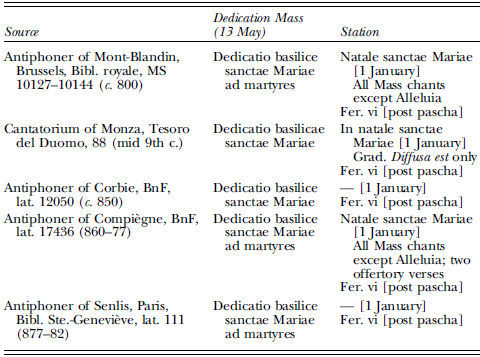
The musical repertoire for the dedication Mass is less ambivalent than the lectionary and sacramentary traditions, and it holds the key not only to the history of the dedication feast but also to the early history of the Roman chant repertoire. The first evidence of a chant formulary (introit, gradual, alleluia, offertory, communion) for the rededication of the Pantheon as a Christian church occurs in five of the six Mass antiphoners edited by Dom René-Jean Hesbert as Antiphonale Missarum sextuplex (Table 2).Footnote 52 These comparatively late witnesses to the chant repertoire have no pre-history. The manuscripts on which his edition is based are spread across the ninth century. None has musical notation, and such was never intended, since they are written in scriptio continua or with word clumping (‘aerated’ script), neither of which readily allows for the insertion of neumes.Footnote 53 The Sextuplex sources are not entirely uniform in content, but the Mass formulary for the annual commemoration in all of them is titled ‘Dedicatio s. Mariae ad martyres’, not ‘Natale’ or as a generic ‘in dedicatione ecclesiae’.Footnote 54 This ‘Dedicatio’ title is absent from the epistolary and early sacramentary traditions.Footnote 55 The uniform title, relevant to a Roman church dedication, could hardly have arisen in Francia. Was it a memory kept alive by the papal singers, organised as a ‘schola’ in the seventh century? Did they serve not only as custodians of a vast musical repertoire but also of one of their city’s traditions?
Early Chant Sources of the Mass Terribilis est

The Sextuplex antiphoners preserve the 13 May dedication feast of S. Maria ad martyres, but they were apparently confused about the station on the first of January, the octave day of Christmas.Footnote 56 Mont-Blandin, Monza and Compiègne list it simply as ‘(In) natale sanctae Mariae’. Curiously, Mont-Blandin repeats the station (‘ad sanctam Mariam’) for the Sunday after Christmas. Senlis, which does not record a Mass on 1 January, also indicates for this Sunday ‘statio ad sanctam Mariam’.
Frankish ecclesiastics turned 1 January into a Marian feast, unknown at Rome, apparently mistaking the Marian station for the day as a Marian feast, in this case the birth (natale) of the Virgin.Footnote 57 Mary is mentioned in the opening prayer of the Mass. Part of their confusion may have to do with the fact that at Rome the first day of the year was not only the octave of Christmas but also the feast of St Martina, which in the North must have been read as an error for ‘Maria’. A variant of Walter Howard Frere’s ‘standard series’ of gospel readings, which he called the ‘Martina Gospels’ because of the presence of this saint’s feast on 1 January, circulated widely in eighth-century Francia.Footnote 58 Cantors compiled an appropriate Marian formulary (Intr. Vultum tuum, Grad. Diffusa est, Off. Offerentur regi virgines, Com. Simile est regnum) adapted from chants for the feasts of virgins. This invented Marian feast eventually disappeared, but in 1974 it was reintroduced into the Roman Catholic calendar under the mistaken belief that it was an ‘ancient custom of the liturgy of Rome’ (Paul VI, Marialis cultus). Raised to the rank of ‘solemnity of Mary, Mother of God’, it replaced the more ancient octave day of Christmas.
The melodies sung with these books were what we know as ‘Gregorian’ (alternatively ‘Romano-Frankish’) chant. These melodies are not recorded (in staffless neumes) until the ninth (Laon, Bibliothèque municipale, 239), early tenth (St. Gallen, Stiftsbibliothek, 359, c. 900), and later tenth (Einsiedeln, Stiftsbibliothek, 121, 960–70) centuries.Footnote 59 The Old Roman melodies for the dedication Mass are not recorded until the twelfth and thirteenth centuries, but with pitch-specific notation in two Roman graduals (Vatican City, Biblioteca Apostolica Vaticana (hereafter BAV), Vat. lat. 5319, and BAV, Arch. cap. S. Pietro F 22).Footnote 60 An earlier Roman chant source, the graduale of Santa Cecilia in Trastevere (Cologny-Genève, Bibliotheca Bodmeriana, C 74; dated 1071), does not have chants for this Mass.
With the exception of the Alleluia. Adorabo, all of the chants are unique to this observance. Adorabo was sung in one or another of the Sextuplex manuscripts on 2 February (Hypapante or Purification) and the nineteenth (Senlis) or twentieth (Rheinau) Sunday after Pentecost. It also served as a ‘de circulo anni’ chant (throughout the year), a kind of re-employment that was not uncommon in the Alleluia repertoire.
Since the focus in the present essay is on Rome and the dedication of a Roman church, I will have recourse to the musical evidence of the Old Roman chant manuscripts, two of which have the Terribilis est Mass formulary. In both cases it is placed under the rubric ‘in dedicatione ecclesiae’ (Vat. lat. 5319, fol. 136r; S. Pietro F 22, fol. 100v), that is, as the Commune formulary for the anniversary of the dedication of a church, as was generally the assignment by that time.Footnote 61 Two of the Old Roman graduals have music for the dedication of the Lateran (9 November), a more important church than Sancta Maria ad martyres, but inserted under a simple ‘eodem die’ rubric (on the same day) after the formulary for the primary feast of that day, St Theodore.Footnote 62 All of the chants for this Lateran anniversary are borrowed from the second Sunday after Epiphany, evidence that this dedication observance was a later development of lesser importance.
The texts of all the Mass chants correspond with perfection to the dedication theme.Footnote 63 The first four are derived from passages in the Old Testament (following the biblical order). The communion sets the words of Jesus. The dedication Mass formulary is as follows (finals of the Old Roman chants are placed in square brackets):
Introit. Terribilis est locus iste (Gen 28:17, 22) [d]
Gradual. Locus iste a deo factus est (4 Esdras 8:21) [f]
Vs. Deus cui astant angelorum chori (4 Esdras 8:21, 24 / Ps 83:9)
Alleluia. Adorabo ad templum sanctum tuum (Ps 137:2) [a]
Offertory. Domine deus in simplicitate (1 Chr/Par 29:17–18) [cć]
Vs. 1. Fecit Salomon (2 Chr/Par 7:8, 10–11)
Vs. 2. Magestas domini (2 Chr/Par 7:2b–3)
Communion. Domus mea domus orationis (Mt 21:13, 7:8; cf. Mk 11:17, 24, Lk 19:46, 11:10) [d]
The words of the introit, ‘Terribilis est locus iste; hic domus dei est et porta caeli et vocabitur aula dei’ (Awesome is this place; this is the house of God and the gate of heaven, and it will be called the great hall of God), are uniquely suited to the overwhelming grandeur of the Pantheon’s interior.Footnote 64 Does this text not evoke the reaction of a visitor who, having passed through the towering granite columns of the portico and the massive doors at the entrance to the rotunda, gazes upwards to the coffered dome high above, to the oculus at its summit, and to the open sky above?Footnote 65
For the introit Jacob’s reaction to his dream of angels ascending to and descending from heaven was adapted for a musical setting by paring away superfluous words to create a straightforward declaration that a former pagan temple had become (1) the house of God, (2) the gate of heaven, and (3) the great hall (aula) of God. The Vulgate text, ‘vocabitur domus dei’, is altered to ‘vocabitur aula dei’, fittingly so, because the Pantheon is far more exalted than a mere ‘house’ (domus).Footnote 66 While not literally true that the Pantheon was made by God, this expression can be interpreted to signify that God had now transformed an imposing edifice, formerly the house of false gods, into his own special dwelling. Such divine intervention could not be claimed for newer churches or oratories built under lay or papal sponsorship, a topic to be taken up below.
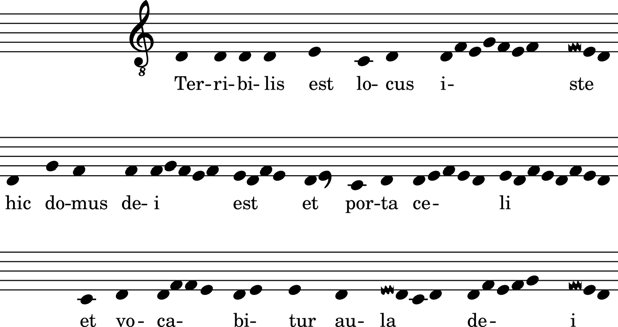
The melody of the introit, a typical example of the Old Roman ‘oscillating’ style, occupies a narrow range (c–g), the upper note heard only four times (Example 1). The melody moves mostly within the interval of a minor third (d–f). The Gregorian version, on the other hand, covers the span of a seventh (A–g).Footnote 67 In Example 1 the cadences of the three phrases (fed) have been aligned to display similarities. The musical setting may have been designed to suggest a parallel between ‘locus’ and ‘porta’ (lines 1 and 2).
Terribilis est locus iste (BAV, Vat. lat. 5319, fol. 136r)

The text of the gradual, Locus iste, continues the theme announced in the introit. The gradual was long thought to have been the work of an unknown author, but Dom Louis Brou pointed to its probable derivation from a biblical source: two verses from the apocryphal fourth book of Esdras (Ezra).Footnote 68 Brou maintained that the Roman liturgy did not adapt the text directly from its biblical source, but through the intermediary of an antiphon in the Antiphoner of LeÓn (Biblioteca Capitolar de la Santa Iglesia Catedral de LeÓn, MS 8, fol. 264r) that begins with the same words and is annotated ‘in Esdra’ in the right margin, thus facilitating his identification. It forms part of a large group of chants entered under the rubric ‘Officium de secratione baselice’ (office for the consecration of a basilica; fols. 258v–265r).Footnote 69 The Spanish antiphoner has been dated by Elsa De Luca to the very beginning of the tenth century (900–5), but the antiphon itself, according to Brou, ‘n’a pas de date connue’ (has no known date).Footnote 70
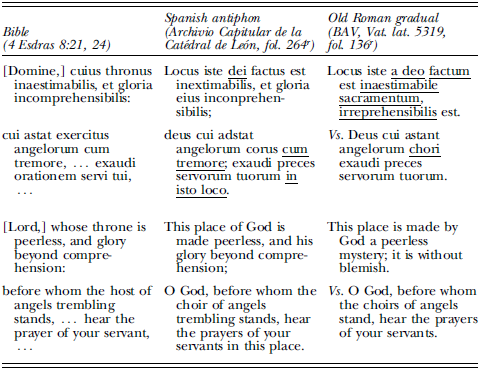
The Roman chant gradual splits the continuous text of the Spanish antiphon into respond and verse to adapt it to its new function – a division suggested by the Spanish antiphon.Footnote 71 Table 3 compares the texts of the Spanish antiphon and the Roman gradual as well as the Bible. I have underlined differences between the chant texts, both of which depart from the Vulgate text. Brou’s discussion of the way in which the chant text adapts the biblical original is illuminating.
Locus iste: Bible, Spanish antiphon and Roman gradual

The replacement of the Spanish genitive ‘dei’ (of God) with the ablative ‘a deo’ (by God) of the Roman gradual (line 1) reinforces the idea of a divine intervention that claimed a former temple for the worship of the one true God.Footnote 72 The Pantheon was in its origins scarcely a locus dei, a ‘place of God’. Freed from the grasp of pagan gods by lustration with holy water and the offering of Mass, it had been transformed into ‘a peerless mystery (sacramentum)’. Thus modified, the text accommodates the circumstances surrounding the rededication of the Pantheon and produces a better textual continuity.
The Roman chant sources and two of the Sextuplex antiphoners (Corbie and Senlis) have the plural: ‘a[d]stant angelorum chori’ – perhaps an alteration to acknowledge the ‘nine choirs of angels’.Footnote 73 Compiègne and Mont-Blandin agree with the singular reading (chorus) retained by the Missale Romanum and the modern chant books.Footnote 74 Substitution of ‘chorus’ for ‘exercitus’ (host) in a text intended to be sung may be self-explanatory. The Roman version deletes the Spanish ‘cum tremore’ and ‘in isto loco’, the latter possibly because it was considered redundant in light of the words of the first half of the respond.
Augustin Hollaardt suggested that the punctuation of this gradual in the Missale Romanum and Graduale Romanum, both of which insert a comma after ‘factus est’ (see Example 2b), is misleading and distorts the intended meaning.Footnote 75 He proposed that the first eight words (up to ‘sacramentum’) should properly be read as a continuity and thus without the comma. Absent the comma, the text declares that a pagan ‘place’ has been transformed by God himself into a ‘mystery of inestimable worth’, a house of Christian worship which is ‘without blemish’. Merely human intervention could not have accomplished this transformation.
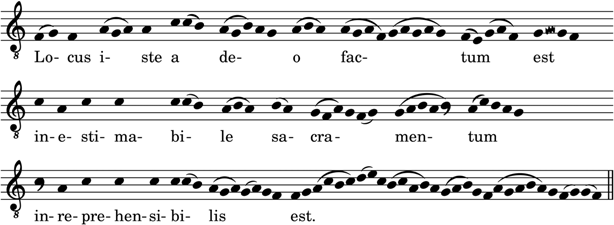
Locus iste (BAV, Vat. lat. 5319, fol. 136r)

In the Old Roman gradual Vat. lat. 5319 (fol. 136r) both ‘factum’ and ‘inestimabile’ agree with the neuter ‘sacramentum’. The Old Roman gradual of St Peter’s (S. Pietro F 22, fol. 101r) and the Gregorian version correct ‘factum’ to ‘factus’, properly linking the past participle with the masculine ‘locus’ (‘locus iste a deo factus est’). The Vat. lat. 5319 adapter of this text, perhaps anxious to emphasise the continuity of ‘factum inestimabile sacramentum’ (Hollaardt’s proposal), chose a grammatically incorrect reading. As the lectio difficilior, the Old Roman version with ‘factum’ might have some claim to priority, if it is not simply an error.
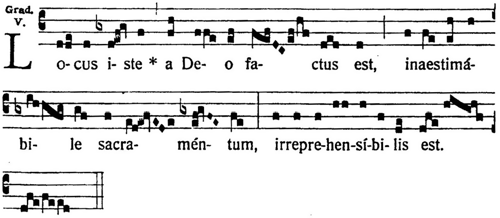
The musical settings, Roman and Gregorian, seem to treat this passage differently.Footnote 76 The Gregorian version (Example 2b) makes a decisive melodic break at ‘factus est’ with a standard torculus + punctum cadence (fgf f). The Roman version (Example 2a) picks up the next word (‘inestimabile’) a fifth higher – a dramatic leap for the generally stepwise Roman melos – but the cadence at ‘est’ (end of line 1) is less forceful than the Gregorian equivalent. Of course, this is a matter of performance as much as notation.Footnote 77 From a melodic standpoint both versions are equally florid.
Locus iste (Graduale Sacrosanctae Romanae Ecclesiae (Rome, 1908), p. [64])

Dom Brou observed that the second half of the verse of Locus iste is borrowed (text and music) from the second half of the verse of the gradual Protector noster, replacing the original text, ‘exaudi orationem meam’ (Ps 83:9), with ‘exaudi preces servorum tuorum’ (cf. 4 Esdras 8:24).Footnote 78 Brou’s point of reference was the Gregorian setting, but the same correspondence is true of the Old Roman version as well.Footnote 79 Protector noster is the gradual for Monday in the first week of Lent, the fifth and twelfth Sundays after Pentecost, and Saturday of the Lenten and September Ember Days, the latter in only two of the Sextuplex sources: Mont-Blandin and Rheinau (Zurich, Zentralbibliothek, Rheinau 30). These multiple Temporale assignments indicate that Protector noster must antedate the dedication Mass. While this is an unusual kind of borrowing – an extract instead of an entire verse – it might not be unexpected in an oral environment.Footnote 80 The Gregorian adapter made exactly the same choice, lifting music and text from the Protector verse rather than transforming the Old Roman melody.
The presence of a respond + verse form between the readings of the dedication Mass has additional implications. It suggests that by the beginning of the seventh century the responsorial psalmody of Augustine’s time (solo verses with short choral refrain) had been supplanted (at least at Rome) by a musical genre with an entirely different formal schema: the responsum gradale, as it is called in certain manuscripts.Footnote 81 The text of Locus iste is, moreover, not drawn from the Psalms or even one of the quasi-psalmic poetic books of the Old Testament, which invite a responsorial mode of performance, but from one of the nominally historical books of the Bible, which shares some of the rhythmic and periodic characteristics of Old Testament prophetic books. The choice of a text from Esdras demonstrates that a chant at this point in the Mass need no longer have a psalmic text, but could be a setting of any short biblical passage.
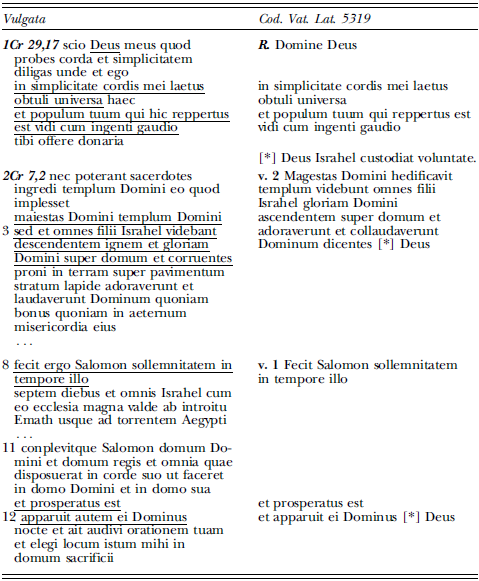
The (also non-psalmic) offertory of the dedication Mass, Domine deus in simplicitate cordis, might at first glance appear to deviate from the dedication theme, but this is only apparent. The text of the respond is David’s declaration of joy (‘laetus obtuli universa’, I have joyfully offered all these things) in offering gold and silver to the future Temple (1 Chr 29:17–18). In the full form of the offertory the respond is followed by two verses that focus more specifically on the theme of dedication: ‘Fecit Salomon sollemnitatem’ and ‘Magestas domini aedificavit templum’ (2 Chr 7:8–12 and 7:1–3). Both revolve around the theme of building a Temple worthy of the Lord. Domine deus in simplicitate is a genuine cento, inasmuch as it draws its text from two different, albeit related, books of the Bible. The text editor skilfully wove together passages from the biblical narrative to craft a coherent text for musical setting, an indication that the Old Roman offertory respond and verses were conceived as an integral whole, as is undoubtedly true of most chants in the genre.Footnote 82 The offertory is compared with the Vulgata text in Table 4, where points of correspondence have been underlined. Of the Sextuplex manuscripts only Compiègne has the complete text of both verses. Mont-Blandin and Senlis have only incipits. In the Gregorian tradition the order of the verses is sometimes reversed, probably to respect the biblical sequence.
The Text of the Offertory Domine deus in simplicitate compared with the Vulgate (reset from Veľbacký, Alle sorgenti dell’Offertorium, p. 157, omitting footnote indices)

There is a significant textual variant in verse 2 (‘Magestas’). The Compiègne Antiphoner (BnF, lat. 17436) replaced the ‘ascendentem’ of the Roman source (Table 4) with the Vulgate reading, ‘descendentem’ (LXX: καταβαῖνον).Footnote 83 This small point has wider implications for the relationship between the Old Roman and Gregorian chant traditions. The lectio difficilior, ‘ascendentem’, must be the original Roman reading, since it is difficult to imagine that, if the Vulgate ‘descendentem’ reading were transmitted to the Franks, why Roman singers would later revert to an incorrect one, quite apart from the peculiar directionality of the glory of the Lord ascending upon the house rather than descending upon it.Footnote 84 It is only logical to assume that the Romans kept singing ‘ascendentem’, but the Franks, noticing the textual anomaly, introduced the correction. This textual adjustment was merely a single aspect of the comprehensive musical process in the North that transformed the eighth-century Roman melodies into ‘Gregorian’ chant.
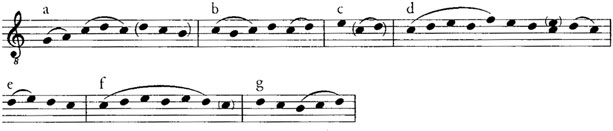
The Old Roman melody of Domine deus in simplicitate is thoroughly integrated into the corpus of that tradition’s offertories through its prolific use of ‘Formula B’, one of two formulae that pervade the Old Roman offertory repertoire.Footnote 85 The basic shape of the formula is shown in Example 3.
Old Roman ‘Formula B’

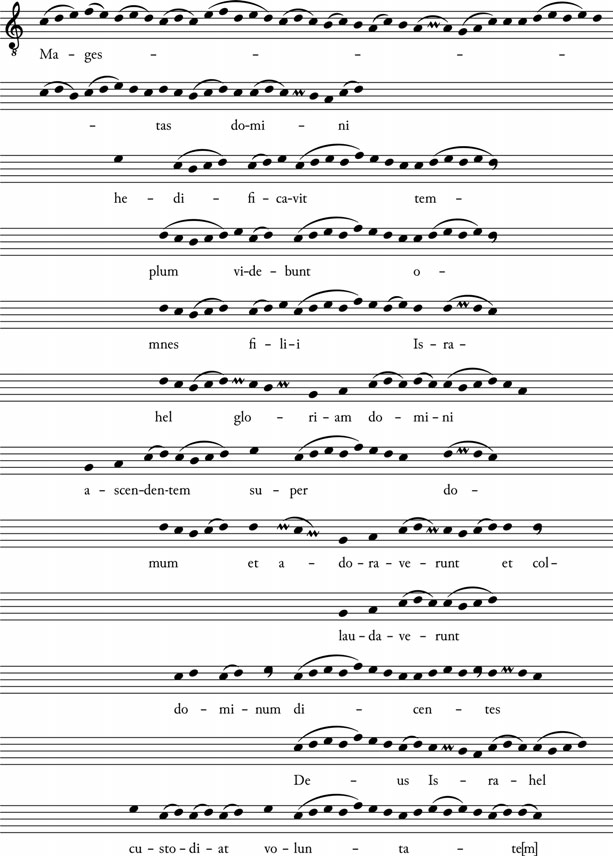
‘Formula B’ appears five times in the refrain, twice in verse 1, and seven times in verse 2 (Example 4), slightly varied each time. Repetitions of the formula are connected by various melodic bits, as illustrated by the layout of ‘Magestas domini’, the second verse of the offertory. Gregorian versions of the offertories invariably eliminate such formulaic repetitions by supplying continuous ‘new’ music. The Old Roman verse is introduced by a grand melodic flourish on ‘Magestas’, and it concludes with a return of the closing phrase of the respond, ‘deus Israhel custodiat voluntate[m]’, leading to a final cadence on (low) c (not shown). An examination of this piece in many Gregorian sources led Rebecca Maloy to conclude that the cadence on c, as in Aquitanian sources, is the more authentic reading.Footnote 86 Adaptations cadencing on f, endeavouring to bring the melody within the norms of the eight-mode system, adopt different solutions. Old Roman chant, lacking a systematically elaborated theoretical system, has no concern about that.
‘Magestas domini’, verse 2 of the Old Roman offertory Domine deus in simplicitate (BAV, Vat. lat. 5319, fols. 136v–137r)

The Gregorian version of the verse ‘Fecit Salomon’ introduces a textual and musical repetition of the first phrase.Footnote 87 This feature, not uncommon in the offertory genre, is not present in the preserved Old Roman version of this offertory. Did it drop out of use at Rome? It is unlikely that the Franks would have added this unusual feature.
For the communion, Domus mea, whose text is drawn from the Gospel of Matthew (the ‘cleansing of the Temple’), the editor of the chant text had to proceed judiciously. The Lord’s reassuring declaration ‘domus mea domus orationis’ (my house is the house of prayer) ends in the Gospel with a bitter rebuke: ‘but you have made it a den of thieves’ – hardly a sentiment appropriate to a church dedication.Footnote 88 The phrase was replaced by a passage that occurs earlier in the same Gospel, where Jesus reminds his listeners of the efficacy of prayer: ‘everyone who asks receives, and he who seeks finds, and to him who knocks it will be opened’ (omnis enim qui petit accipit, qui querit invenit, et pulsanti aperietur).Footnote 89 Dom Guilmard discovered that this second half of Domus mea is not newly composed but taken over from the communion Petite et accipietis for the Mass that follows the procession of the Major Litanies (25 April).Footnote 90 In Domus mea the two passages are linked by the inserted phrase ‘dicit dominus; in ea omnis’, omitting the superfluous ‘enim’ after ‘omnis’, thus producing a seamless ‘lyric’ for musical setting. The final cadence of Domus mea is adjusted to compensate for the omission of the triple ‘alleluia’ of Petite.
The Terribilis est Mass and the ‘Advent Project’
Was the conceptually unified Mass formulary just described composed by papal singers specifically for the dedication of Sancta Maria ad martyres in 609? If so, does it represent a working paradigm for the fashioning of other Mass Propers or was it merely a ‘one off’, created for an unprecedented event in the city’s history? James McKinnon argued that the entire Terribilis est Mass formulary was added to the chant repertoire towards the end of the seventh century. As such, it represented the capstone of an ambitious program undertaken by the papal schola cantorum to shape the entire repertoire of chants for the Mass, a process he called the ‘Advent Project’. The book in which he elaborated his theories about the genesis of the chant repertoire for the Mass was published posthumously, the year after his death in 1999.Footnote 91 He sought to elucidate how the chant repertoire for the Mass was created – not by a process of gradual evolution, as often hitherto assumed, but as the result of a decisive intervention by members of the papal schola cantorum over the span of a few years in the late seventh century.Footnote 92 Two levels of activity were proposed: the first concerned the development of chants according to individual genres (introits, communions, etc.); the second, the organisation of these chants into unique Mass formularies covering the entire liturgical year, Temporale and Sanctorale.
Concerning the first, McKinnon proposed that ‘the chants of the Mass Proper developed to a greater extent genre by genre rather than festival by festival’.Footnote 93 Pieces of the same genre were assembled in booklets (libelli) – introits in one, communions in another – within which there might be an organisation according to topic. This concept was inspired by what modern scholars have proposed about the genesis of certain liturgical books. Bishops and priests had at their disposal small collections of texts (prayers, Scripture readings, chant texts, rubrics) that covered a single rite, a few related rites, or a portion of the liturgical year.Footnote 94 Such booklets contained a mix of items. McKinnon interpreted the libellus typology in an unconventional way, hypothesising the existence of books containing only a single genre. No chant libelli of this type have ever been found, either complete or in fragmentary form.
The second aspect of the ‘Advent Project’ theory, which supposed a comprehensive reorganisation of the entire repertoire of Mass chants for the liturgical year, is germane to the present topic. According to this theory singers of the schola cantorum undertook an ambitious program of organisation, supplying whatever music was needed to create an annalis cantus – a cycle of Mass chant formularies sufficient for the entire liturgical year.Footnote 95 The ultimate goal of this massive project was properisation, which aimed to create ‘a uniquely assigned chant [formulary] for each feast in the calendar year and a text appropriate to the liturgical season’.Footnote 96 The schola supposedly focussed first on the organisation of the Advent and Christmas seasons, which then served as a model for the rest of the liturgical year; hence the term ‘Advent Project’.Footnote 97 There were admittedly many shortcomings, but were these genuinely ‘shortcomings’ or just evidence that there was no such ‘project’?
The Terribilis est Mass formulary fulfils in brilliant fashion all of the properisation requirements of the ‘Advent Project’. If it could be dated to the early seventh century and shown to have been created for a specific event, this would undermine the Project’s scenario. McKinnon denied the possibility of an early-seventh-century origin for the Terribilis est Mass, claiming that ‘the [dedication] Mass may indeed represent the end of the creative phase of Roman chant production, but it cannot have originated at the time that Boniface IV (d. 615) dedicated the Pantheon to Mary and all the martyrs’. Though aware of the problem that the Terribilis Mass presented for his theory, he could only propose that the dedication Mass ‘was composed when it was no longer necessary to honour Mary with a 13 May festival at the end of the seventh century, because the four great Marian festivals were already in place’.Footnote 98 This hardly seems convincing, since the rededication of the Pantheon was not primarily a Marian celebration in the first place.
The early dating which I have proposed implies that papal singers were quite capable of inventing a textually unified Mass that anticipated all of the desiderata of an ‘Advent Project’ seventy years before. From this perspective ‘properisation’ appears not as a novel late-seventh-century concept but a familiar, if not invariably exercised, methodology employed by Roman singers as need arose. In the Sextuplex manuscripts the Terribilis est chant formulary is, moreover, linked consistently with the rededication of the Pantheon, a uniformity that must represent a solid Roman tradition transmitted to the Franks in the late eighth century. They may not have understood the assignation, but it is highly unlikely that they would have spontaneously attached this Mass to the anniversary of a Roman church of which they must have known little or nothing.
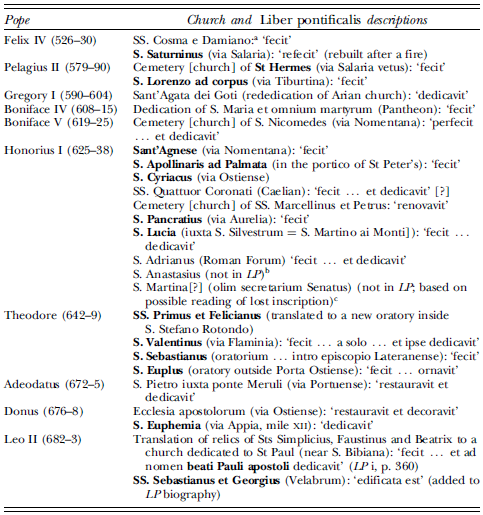
Were the Terribilis formulary not composed for the 609 dedication, which I have argued it was, what other Roman church dedication might have prompted the creation of so grand and coherent an ensemble of chants? An origin as a contribution to the Commune repertoire hardly seems a satisfactory explanation. The Appendix to this article assembles information about papal church building campaigns from the early sixth to the late seventh century, the latter being the period of the supposed ‘Advent Project’.Footnote 99 Pope Sergius I (687–701) has not been included, since his activity was restricted to supplying churches with textiles and decorative elements in precious metals. In a few cases the extent of the work carried out under papal sponsorship is uncertain – whether a new building or major repairs. The Liber pontificalis favours the words ‘fecit’ along with ‘dedicavit’, but neither term is very precise. Singly or in combination the words can mean new construction or restoration. I have indicated the former by boldface in the Appendix.Footnote 100 Since the tituli established in the fourth and fifth centuries sufficed for Rome’s diminished population, only a few new urban churches were built after that.
Pope Pelagius II (579–90) erected a completely new church (‘fecit’) directly over the tomb of St Lawrence (the area of the raised presbyterium of today’s church), but ‘fecit’ is also used to describe Felix IV’s renovation (c. 530) of an audience hall on the Forum as the church of SS. Cosma e Damiano. Boniface IV’s rededication of the Pantheon is described with the same ‘fecit’, but Gregory the Great is said to have ‘dedicated’ the formerly Arian church of Sant’Agata dei Goti, as described above. Pope Honorius I (625–38) was far and away the most active builder-pope of the seventh century. Sant’Agnese (via Nomentana), where he is pictured in the apse mosaic, was his most important church.Footnote 101 He converted the Senate House on the Forum into the church of Sant’Adriano and possibly the secretarium senatus into the oratory of St Martina. The translation of the bodies of the martyrs Primus and Felician from a distant cemetery by Pope Theodore (642–9) required only the insertion of a small oratory into the church of S. Stefano Rotondo.Footnote 102 The most striking aspect of this enumeration is the preponderance of papal interventions at cemeterial churches along the consular roads outside the Aurelian Wall – either those completely underground (hypogean) or partially underground (semi-hypogean). None of these projects could be compared to the spectacular conversion of a masterpiece of pagan Roman architecture to Christian service.
The Later History of Sancta Maria ad martyres and the Dedication Feast
At Rome interest in this iconic building and the liturgical observance of the anniversary of its dedication faded over time before being revived in the Renaissance. An eighth-century list of churches appended to the mid-seventh-century ‘guidebook’ De locis sanctis martyrum notes a ‘basilica quae appellatur Sancta Maria Rotunda’, early evidence for a Marian association.Footnote 103 The Einsiedeln Itinerary from the first half of the ninth century mentions the structure twice, not as a church but simply as ‘Rotunda’. The Mirabilia urbis Romae (mid twelfth century) transmits legends about the building (e.g. its supposed original dedication to Cybele, mother of the gods), and it records its rededication by Boniface IV.Footnote 104 According to the Mirabilia, since Mary is ‘mother of the saints’, the dedication of Santa Maria Rotonda to the Virgin (Theotokos) was quite fitting. In later travel reports the church receives more prominence. The Stacions of Rome (1370) devotes forty-one lines to ‘seinte Marie þe Rounde’, relaying pagan legends and the story of its rededication by Boniface IV.Footnote 105 John Capgrave (1393–1464) visited the church during his tour of the stations of Rome and was dumbstruck by the ‘wondir’ of the dome. In The Solace of Pilgrims (3.1) he wrote that Pope Boniface’s decision to reclaim the Pantheon was attributable to the fact that ‘þis church stant in þe best part of Rome where most puple dwellith’.Footnote 106 In an earlier part of his narration (1.15) he mingled ancient history (misunderstood, since he believed that Agrippa was responsible for the building) and legend.Footnote 107 The image of the Pantheon appears on a few seals, most famously the golden bull of the Emperor Ludwig IV (1328), and (along with the Coliseum) on medieval maps as an image emblematic of the city.
The diminished liturgical importance of Sancta Maria ad martyres may be attributed to several causes, a smaller medieval population in the area being one of them. Situated in the Campus Martius, the Pantheon was subject to periodic flooding whenever the Tiber overflowed its banks and drainage systems were overwhelmed. As the street level began to rise due to the accumulation of silt and rubble, the problem became only worse. The opening in the oculus allowed wind and rain unimpeded access to the building in all seasons. Records of visitations to the church mention how uncomfortable were the circumstances of its location during the most inclement parts of the year.Footnote 108 Priests were even permitted to wear a head covering during Mass (except during the Canon) ‘propter aeris gravitatem’ (on account of the unwholesomeness of the air). It is fair to conjecture that an appointment to Sancta Maria ad martyres was not considered a ‘plum’ by Roman clerics.
Over time, even at Rome, liturgical commemoration of the anniversary of the rededication of ‘St Mary and all the martyrs’ waned in importance. It is, nevertheless, listed in several medieval Roman liturgical manuscripts, among them a ninth-century capitulare evangeliorum (BAV, Vat. lat. 5465) from the church of San Matteo (via Merulana), not far distant from the Lateran.Footnote 109 In this source there is an entry on 13 May entitled ‘Dedicatio basilice sanctae Mariae ad martyres’. A century later, another Roman capitulare evangeliorum (BAV, Barb. lat. 637) commemorated the observance under the title ‘Natale S. Mariae ad martyres’, a nomenclature that reflects the Gregorian sacramentary tradition.Footnote 110 There is a switch back to ‘Dedicatio’ in two eleventh-century Roman sources (Rome, Biblioteca Vallicelliana, E 15, sacramentary of San Lorenzo in Damaso; BAV, Arch. cap. S. Pietro F 12, evangeliary-sacramentary of St Peter’s).Footnote 111 The ‘Dedicatio’ feast on 13 May is still present in three Roman sources of the twelfth century.Footnote 112 The Old Roman chant books do not, as we have seen, assign the dedication Mass to the dedication of Sancta Maria ad martyres, though one might have expected that a local feast would have been remembered.Footnote 113 Given the poor survival rate of Roman liturgical manuscripts, many sources with (or without) the anniversary observance must have perished, thus making a comprehensive assessment of its city-wide importance (or lack thereof) impossible.
Sancta Maria ad martyres did, however, maintain its position as the stational church for 1 January and for Friday in Easter week (col. 3 in Tables 1 and 2). In the mid twelfth century (and certainly for an indeterminate earlier period) there was also a station at Sancta Maria ad martyres on the Sunday between Ascension and Pentecost, when the pope celebrated Mass there. To exemplify the subject of his sermon, the coming of the Holy Spirit, rose petals were dropped though the oculus (‘de altitudine templi mittuntur rose in figura eiusdem Spiritus Sancti’).Footnote 114 For this reason the day became known as ‘Dominica de Rosa’. The tradition continues today, but on the feast of Pentecost itself.
I have argued that the chant formulary Terribilis iste was created for the conversion of the Pantheon from a pagan temple into a Christian church, whose conversion was (in the words of the gradual) ‘a deo factus’. The chant formulary epitomises perfectly the principle of ‘properisation’ elucidated by James McKinnon, but this was not an entirely new concept, for the same principle had guided the creation of prayer formularies and Scripture readings for the great feasts and seasons of the liturgical year.Footnote 115 Music just followed suit. One of the unique features of the ‘Pantheon project’ was not just ‘properisation’ but a turn away from psalmic texts.Footnote 116 The creation of the Roman chant repertoire and a fortiori a Proper for the dedication of the Pantheon was not really a ‘project’, but part of a gradual process. It does not stand outside that process as a novelty for its time, but participates fully in it.
University of Massachusetts, Boston
APPENDIX
Roman Churches: Construction and Renovation in the Sixth and Seventh Centuries