

1. Introduction
Consider the following Finnish construction involving a string of two nouns, one of which is the ideophone kanttura:Footnote 1
-
(1)
-
a. Puu-n kanttura
tree-gen idph.nom
‘a tree bent (by wind, weight of snow, etc.)’
-
b. Uko-n kanttura c. Aka-n kanttura
(older.)man-gen idph.nom (older.)woman-gen idph.nom
‘a decrepit (older) man’ ‘a decrepit (older) woman’
-
d. Lehmä-n kanttura e. Hirve-n kanttura
cow-gen idph.nom moose-gen idph.nom
‘a large, bony cow’ ‘a large, bony moose’
-
In Finnish linguistics, this structure, and its verbal parallel, are usually labelled as “colorative” (Rytkönen Reference Rytkönen1937; see also Luttinen Reference Luttinen2000, Jarva and Kytölä Reference Jarva and Kytölä2007, Leinonen Reference Leinonen2010, among others). The sequence involves two nouns: the first, N1, is a semantically neutral noun in genitive case; the second, N2, is an ideophone (such as kanttura) inflected in accordance with its syntactic position. The earliest works that mention these types of constructions are descriptive and pre-theoretical (e.g., von Becker Reference von Becker1824, Tunkelo Reference Tunkelo1919–1920, Rytkönen Reference Rytkönen1937).Footnote 2 In more recent work, a limited number of research questions related to the colorative constructions, mostly focusing on the verbal variant, have attracted investigation: the origin and development of such structures in Finnish and related Balto-Finnic languages and the crosslinguistic relationships among them (e.g., Jarva Reference Jarva2008a, Leinonen Reference Leinonen2010); their variation and frequency of use in Finnish dialects, and among different age groups (e.g., Ikola et al. Reference Ikola, Palomäki and Koitto1989, Leskinen Reference Leskinen1991, Luttinen Reference Luttinen2000); the occurrence and semantics of the structures in the works of individual Finnish authors (e.g., Iisa Reference Iisa1965, Havo Reference Havo1966, Korhonen Reference Korhonen1967); and the translation of these constructions in literary works into other languages (e.g., Mäki-Välkkilä Reference Mäki-Välkkilä1997, Lehikoinen Reference Lehikoinen2000). Research into the internal structure of the construction is more limited. The sound and morphological patterns, as well as the lexical semantics of the ideophones that appear in the colorative constructions have attracted some examination (e.g., Mikone Reference Mikone, Erhard Voeltz and Kilian-Hatz2001, Reference Mikone2002; Jarva Reference Jarva, Erhard Voeltz and Kilian-Hatz2001, Reference Jarva2003, Reference Jarva2008b; Kim Reference Kim2013), but only the expressivity and pragmatic function of the full verbal structure have thus far been considered (e.g., Jarva and Kytölä Reference Jarva and Kytölä2007, Hamunen Reference Hamunen2007, Reference Hamunen, Herlin and Kotilainen2012). The only published work with a specific focus on the noun–noun structure is Leinonen (Reference Leinonen2010).
In the present study, we argue that noun–noun structures such as those in (1) are serial noun constructions that contain an ideophone (henceforth SNC). To date, the possibility of SNCs—in contrast with serial verb constructions—has been left almost entirely unaddressed (the two exceptions are Déchaine Reference Déchaine1993 and Yuka Reference Yuka2014). We are puzzled as to why this is the case. We doubt that the omission is due to complete lack of data; as linguists who happen to be native speakers of Lithuanian and Finnish, we have had no trouble generating examples in both languages of intriguingly comparable data across the nominal and verbal domains. While this by no means entails that nominal serialization is readily available in all languages, it does suggest that it is not as vanishingly rare as a literature search would lead one to believe.
Moreover, the dearth of discussion of nominal serialization cannot be explained by a failure of structures to meet strict criteria for serialization. The literature on verbal serialization is rife with variability when it comes to definitions, diagnostics, and theoretical accounts, and suffers from a clear lack of consensus on these issues (see section 3 for a more detailed discussion), but this has not hampered the investigation of serial verb structures.
Finally, one would expect a vigorous discussion of noun serialization to have already been initiated, given that verb-noun domain parallels have been the subject of intense research for decades. With respect to syntactic structure, for example, researchers have drawn parallels showing that nominal structures are akin to verbal phrases or clauses (Abney Reference Abney1987, Szabolcsi Reference Szabolcsi and Kenesei1987, Lecarme Reference Lecarme, Lecarme, Lowenstamm and Shlonsky1996, Hoekstra Reference Hoekstra, Adger, Pintzuk, Plunkett and Tsoulas1999, Bernstein Reference Bernstein, Baltin and Collins2001, among many others). The same is true in semantics, where linguists have argued for similarities across verbal and nominal aspectual domains (Filip Reference Fillip2001, Rijkhoff Reference Rijkhoff, Söhrman and Josephson2008, among many others).
Our analysis of colorative constructions, therefore, has consequences that extend beyond its immediate contribution to Finnish linguistics, where these nominal constructions have not been addressed in the detail that they deserve, particularly when one considers their abundance and systematicity. Our goal is to trigger a broader discussion of nominal serialization across languages and of its implications for linguistic theory.
The structure of the paper is as follows. We first describe the database from which we have drawn numerous examples of colorative constructions and demonstrate that these nominal constructions are used productively and are found in abundance across various registers in Finnish (section 2). In section 3, we outline the theoretical assumptions of our analysis. We then describe the properties of the construction (section 4), and argue that these colorative constructions are in fact serial nouns that contain ideophones (section 5). In section 6, we weigh in on two potentially plausible alternative accounts. We summarize our conclusions and outline questions for further study in section 7.
2. The database
Existing published work on the colorative construction has typically relied on very limited data. For example, several authors have examined these constructions in the works of a single author (Heikkinen and Voutilainen Reference Heikkinen, Voutilainen and Heikkinen2009, Leinonen Reference Leinonen2010, among many others), or in a particular dialect (Luttinen Reference Luttinen2000), or have focused on a specific sound pattern or root (Jarva Reference Jarva2003, Kim Reference Kim2013, among others). As a result, analyses typically rely on a small number of tokens; for instance, Luttinen's M.A. thesis (2000) analyzes only 128 examples, and Jarva (Reference Jarva2003) examines material based on just four word stems.
An important goal of our research was to establish whether the colorative construction is a productive one in contemporary Finnish usage, and whether it appears across a range of linguistic contexts and registers. To achieve this goal, we examined a diverse body of print and online material, representing a broad range spanning both literary and informal sources. We drew data from the following published sources: from two dictionaries of Standard Finnish – Sadeniemi's (Reference Sadeniemi1996) Nykysuomen sanakirja, [Dictionary of Modern/Standard Finnish] Volumes 2 and 3Footnote 3 , which was published in print form, and Grönros’ (Reference Grönros2008) Kielitoimiston sanakirja [The Dictionary of the (Finnish) Language Office], which was released on CD-ROM; from classical and modern works of fiction and poetry; works of non-fiction; and articles from print magazines and newspapers. Online sources include dictionaries (Urbaani Sanakirja [Urban Dictionary], Suomi Sanakirja [Finnish Dictionary]); articles from newspapers, journals, and magazines; entries in discussion forums; and posts on blogs and on social media such as Facebook, YouTube, Instagram, and Geocaching. A small number of examples (20) from spoken language were recorded by one of the authors.
The data that serve as the basis of the present study consist of approximately 500 noun–noun tokens collected from the above sources. The focus of the data collection was on gathering a sizeable and diverse sample of distinct tokens of noun–noun pairs, rather than on establishing the frequency of the occurrence of any given pair. Hence, each specific noun–noun combination was recorded only once.
Collecting examples of the colorative construction of either the verbal or nominal variety proved to be challenging.Footnote 4 The difficulties were especially acute for the nominal constructions; it is not feasible to simply search through an existing database for either of the two nouns that may appear in such a construction. Any neutral N1 that may appear in a colorative construction can also appear on its own or in other constructions, and therefore is not unique to the structure in question. It is also impossible to predict a priori the combinations in which the two nouns – non-ideophonic and ideophonic – might occur. The same ideophonic noun may co-occur with any of a number of neutral nouns. For instance, in our database, kanttura appears with eight different nouns, and känttyrä with 20. Moreover, the ideophonic noun may be unique and thereby unknown to researchers as a searchable item; this may be because (i) a speaker or an author has created it or (ii) its form is not phonologically and/or orthographically stable, and, hence, difficult to search for (see further discussion of this issue in section 3.1).Footnote 5
Given the difficulties inherent in devising a viable method of automated data screening, the database was painstakingly built one token at a time, as follows. One of the authors (PK), a native speaker of Finnish, systematically read through Volumes 2 and 3 of the Nykysuomen sanakirja (Sadeniemi Reference Sadeniemi1996), one page at a time and in alphabetical order, searching for instances of nouns identified as onomatopoeic or descriptive. She also searched this print dictionary for ideophones that she had encountered elsewhere, and for their definitions and occurrences within SNCs. In addition, she searched the electronic dictionary (Grönros Reference Grönros2008) for ideophones that she had encountered elsewhere, as well as for definitions and SNC occurrences pertaining to these. (Since the electronic dictionary does not categorize nouns as ideophonic, descriptive, expressive, or onomatopoeic, such information was not available in this source.) Subsequently, for all ideophones that appeared in either of the dictionaries, the author used Google's search engine to look for co-occurrences of these with other nouns, combing through hundreds of pages of potential hits and at times relying on educated guesses regarding potential co-occurrences.
All examples from print sources other than the dictionary, that is, from fiction, poetry, songs, newspapers and magazines, as well as from online sources such as web forums, blogs, Facebook, YouTube, Instagram, and Geocaching are ones that the native Finnish-speaking author came across incidentally. As with examples present in the dictionaries, once an ideophonic noun had been identified, the author searched online for further occurrences of this noun within an SNC. However, this method has its limitations, as searching for NN combinations relies on the inventiveness of the researcher, and no doubt some unusual examples remain unearthed.
Although our database is not large, it shows, (i) most importantly, that the construction is productively used in modern Finnish, and (ii) that it can be found in formal, semi-formal and informal registers alike (cf. also Leinonen Reference Leinonen2010: 200–203). It is also worth noting that younger speakers use this construction in innovative ways, as is evident from examples in social media, web discussions and blog posts. We regret the scarcity of examples from spoken language, but note that, particularly in web forum discussions, typed expressions may resemble a spoken style of Finnish more than a written one; many such examples are devoid of punctuation or capitalization, and omit the inflectional morphology that is typically missing in spoken Finnish, but present in text (e.g., possessive suffixes, the ma-infinitive, etc.). In this sense, although the observed medium is written, it closely mirrors spoken language. Similarly, in fiction, the SNC occurs most frequently in dialogue, which hints at its prevalence in spoken Finnish.
An overview of the kinds of examples obtained is given in (2).
-
(2) Examples of SNCs from the database:
-
a. Web forums/blogs (274 tokens)
… pää-lle-ni hyppäs-i koira-n nulikka
top-all-1sg.poss jump-pst.3sg dog-gen idph.nom
… an ill-mannered dog jumped on me
(flirttistoori role-play forum)
-
b. Dictionaries (print, CD-ROM) (163 tokens)
laiha lehmä-n kanttura
skinny cow-gen idph.nom
‘a skinny, dried-up, bony cow’
(Kielitoimiston sanakirja)
-
c. Fiction, poetry (67 tokens)
… keskeytt-i tytö-n hepsakka hän-en luku-nsa
interrupt-pst.3sg girl-gen idph.nom 3sg-gen reading-3.poss
‘… the flighty girl interrupted his reading’
(Jane Austen, Ylpeys ja ennakkoluulo [Pride and Prejudice])
-
d. News, journals, magazines (17 tokens)
80 vuot-ta lähentele-vä… vanhukse-n rähjäke aloitta-a…
80 year-par near-prs.ptcp senior-gen idph.nom begin-prs.3sg
‘[when] a … worn-out senior nearing 80 years begins to…’
(Kauppalehti)
-
e. Social media (YouTube, Facebook, Instagram, etc.) (12 tokens)
… kaupa-s joku papa-n känttyrä tul-i taas…
store-ine some grampa-gen idph.nom come-pst.3sg again
‘At the store some dried-up geezer came again …’
(FFins Foorumi discussion forum)
-
f. Song lyrics (8 tokens)
… Jeesus ol-i … onne-n hylkää-mä, hipi-n reuhake
Jesus be-pst.3sg luck-gen abandon-inf hippie-gen idph
‘Jesus was … abandoned by luck, a scraggly, worn hippie’
(lyrics by the punk-rock band Vandaalit)
-
g. Recipes (2 tokens)
n. 0,5 kg lohe-n känttyrä
ab. 0.5 kg salmon-gen idph.nom
‘one roughly half-kilo chunk of salmon’
(recipe on the blog Lemon Gay)
-
h. Spontaneous conversations (20 tokens)
Tua-lla se fasaani-n venkale nyv vaani-i.
there-ine that pheasant-gen idph.nom now lurk-prs.3sg
‘There's that ill-mannered rascal of a pheasant lurking now.’
-
3. Theoretical assumptions
In section 4, we argue that Finnish colorative nominal constructions (i) involve ideophones, and (ii) represent a case of serialization of nominals. However, before laying out the analysis, we spell out our theoretical assumptions in this section.
3.1 On ideophones
The linguistic phenomenon of sound symbolism can be carved up into two distinct varieties of iconic expression: onomatopoetic and ideophonic. In English, smash, crash or bash are examples of onomatopoeia, in which sounds contained in the word directly imitate certain auditory properties of the external world (Crystal Reference Crystal2008: 443). In ideophonic expressions, speakers unconsciously endow particular sounds or sound combinations with specific sensory meanings, without directly imitating properties of the external world (Crystal Reference Crystal2008: 443; Dingemanse Reference Dingemanse2012: 654; Jurafsky Reference Jurafsky2014: 158–170). Examples of ideophonic sound strings in English include the consonant cluster gl- in words associated with the visual perception of light, as in glimmer, glitter, glare, or the occurrence of front vowels in words associated with small, thin, or light things versus back vowels in words associated with big, fat, or heavy things (Jurafsky Reference Jurafsky2014: 162–164). The appropriate strategies for identifying ideophones are subject to ongoing debate (see, e.g., Dingemanse Reference Dingemanse2012 for an overview of issues pertaining to our current research agenda on ideophones), but at least a few characteristics of ideophones, listed in (3), can be discerned as having withstood the test of time.
-
(3) Characteristics of ideophones:
-
a. ideophonic strings are phonologically marked
-
b. ideophones are morphosyntactically restricted
-
c. ideophones depict sensory imagery
-
d. ideophones elude translation
-
e. ideophones are part of the expressive and/or evaluative domain
-
While all of the above properties are found across languages rich in ideophonesFootnote 6 (see Voeltz and Kilian-Hatz Reference Voeltz and Kilian-Hatz2001 for a sample of languages and ideophone patterns of these languages), specific instantiations of the first three properties are language-specific. Phonological markedness may manifest as, for instance, reduplication patterns that are specific to ideophones, as in Turkish (Jandraschek Reference Jandraschek2001), or in terms of constraints on syllabicity, as in Shona (Déchaine Reference Déchaine2015). Similarly, while morphosyntactic peculiarities are broadly recognized as characteristic of ideophones, the morphosyntactic restrictions that apply to them are not crosslinguistically uniform. For example, in some languages ideophones can occur as free-standing roots (Beck and Mel’čuk Reference Beck and Mel’čuk2011) that combine with non-ideophonic entries, while in others they are integrated into the adverbial domain (Jandraschek Reference Jandraschek2001). Finally, while all ideophones uncontroversially depict sensory imagery, there is great variation with respect to the kinds of senses that are expressed within and across languages (Dingemanse Reference Dingemanse2012). These last two properties universally come up in speakers’ comments and authors’ footnotes; when pressed for translations, speakers and authors resort to (usually lengthy) periphrastic elaborations and emphasize the expressive rhetorical value of these expressions as well as the importance of speaker perspective in their use.
3.2 On serialization
Cross-linguistic discussions of serialization have taken place almost exclusively in relation to verbs (Yuka Reference Yuka2014 being the sole exception, to the best of our knowledge). Below, we first provide key points relating to the larger debate on serial verbal constructions (henceforth, SVCs), and subsequently turn to the possibility of serial nominals.Footnote 7
Regardless of their typological or theoretical affiliation, researchers now acknowledge considerable variation in both the empirical descriptions and theoretical analyses of serialization (for detailed overviews of general descriptive and theoretical issues, see Newmeyer Reference Newmeyer2004, Aikhenvald and Dixon Reference Aikhenvald and Dixon2006, Muysken and Veenstra Reference Muysken, Veenstra, Everaert and van Riemsdijk2006, and Enfield Reference Enfield2009). To avoid unnecessary redundancy, and because space precludes the possibility of doing justice to these in-depth studies, we do not attempt to restate the content of the aforementioned overviews. Rather, we briefly identify where consensus has been attained, and where the most important remaining disagreements lie, particularly where these are relevant to the claims we make in section 5.
There are two main reasons for the disparity in views on serial verb constructions: vagueness of the definition of what constitutes a serial verb, and the cross-linguistic diversity apparent in the data. As Aikhenvald and Dixon (Reference Aikhenvald and Dixon2006: 2) aptly put it, “serial verb constructions are a grammatical technique covering a wide variety of meanings and functions.” A “grammatical technique” is a term so vague and all-encompassing that it may include any means. Thus, it has been easy to assume that “serial verbs are so called because they, or at least the primary examples of them, involve verbs in series” (Zwicky Reference Zwicky1990: 2). As Zwicky (Reference Zwicky1990) is quick to point out, however, a broad range of data falls under such a definition, and in fact, is reflected in research on this topic. Over the years, distinct types of SVCs have been analyzed within numerous languages, using narrow, language-specific definitions that may or may not be applicable to cross-linguistic data. Studies of SVCs currently cover a vast body of crosslinguistic data, ranging from Niger Kongo Kwa languages to Caribbean creoles (Sebba Reference Sebba1987, Awóyalé Reference Awóyalé1988, among many others). Moreover, the types of data included in these studies vary; there is no one universally attested SVC, and such constructions are found in domains ranging from the functional (e.g., they may change the aspectual or event type of a verb) to the lexical (e.g., they may add a descriptive quality). Thus, diversity in the data has led to a diversity in perspectives regarding what constitutes a SVC. Currently, the field has reached the consensus that disagreement should be tolerated, acknowledging that the interpretation of what counts as evidence of SVCs, and consequently their analyses, appropriately depend on the particular descriptive or theoretical criteria chosen by the researcher. Summarizing a number of pre-theoretical, typologically driven studies, Aikhenvald and Dixon posit a multidimensional continuum, with several types of SVCs (2006: 56–58). Newmeyer (Reference Newmeyer2004: 15) sums up the status quo in the more theoretically driven camp, stating that “there is no one serialization parameter that everyone agrees upon”, even within the same school of thought. We view this collective decision to disagree as a temporary truce. We interpret the truce as an implicit working hypothesis that SVCs do not form a homogeneous class; however, a principled overarching account of what the possible sub-classes are, and, more importantly, how these sub-classes emerge, has yet to be proposed. We also assume that the accepted heterogeneity of serial constructions allows for the possibility of nominal serialization (see Yuka Reference Yuka2014).
In the context of this agreement to disagree, we sought out testable criteria rooted in the behaviour of SVCs that we could apply to our study of Finnish verbs (Armoskaite and Koskinen Reference Armoskaite and Koskinen2014). We took the stance that a SVC is present in a given language as long as the SVC can be identified by properties that have been determined to be particular to that construction. We assumed the diagnostic criteria for SVCs as outlined in Muysken and Veenstra (Reference Muysken, Veenstra, Arends, Muysken and Smith1995, Reference Muysken, Veenstra, Everaert and van Riemsdijk2006), which, to our knowledge, have not been contested elsewhere. Moreover, these criteria have been usefully applied to cross-linguistic data and have even been used to identify SVCs in sign languages (Benedicto et al. Reference Benedicto, Cvejanov, Quer and Quer2008). Thus, we assume that a “series of verbs” comprise a SVC if they have the properties listed in (4).
-
(4) Properties of serial-verb constructions:
-
a. only one expressed subject
-
b. at most one expressed direct object
-
c. one specification for tense/aspect
-
d. only one possible negator
-
e. no intervening coordinating conjunction
-
f. no intervening subordinating conjunction
-
g. no possible intervening pause
-
Based on these criteria, one can test sets of “verbs in series” and establish whether they behave like SVC units in terms of their argument structure, functional projections, and prosody. The two verbs must share their arguments, whether the arguments are in subject or object position. Only one functional projection of tense/aspect and negation is allotted per SVC. The prohibitions on coordination and subordination rule out the interpretation of the SVC as two independent phrases. Finally, the lack of a possible pause between the two verbs within an SVC establishes that the verbs behave as a single prosodic constituent.
Adapting the criteria for verbal serialization to the nominal domain, we stipulate that, in order to be considered an SNC, a series of nouns must have the properties in (5).
-
(5) Properties of serial-noun constructions:
-
a. only one expressed predicate
-
b. only shared modifiers and/or quantifiers
-
c. only one active inflection for case
-
d. only one possible negator
-
e. no intervening coordinating conjunction
-
f. no intervening subordinating conjunction
-
g. no possible intervening pause
-
Based on these criteria, two nouns behave as a syntactic atom in that they share a single predicate, cannot be modified separately, have only one active inflection for case and share the negator. They can be neither coordinated nor subordinated, and a pause between them is not permitted. In section 4, we show that the Finnish colorative construction meets these criteria, and hence, forms an SNC. To make this argument, we also need to assume a particular view of possessive constructions.
3.3. On possessive constructions
As is widely noted in the literature, grammatical possession is a semantically heterogeneous phenomenon (Postma Reference Postma1997, Francis Reference Francis2000, among others). It may cover a range of possible meanings, some of which are listed in (6).
-
(6) Possible meanings expressed by possessive constructions:
-
a. property (my colour)
-
b. property/possession/authorship (my book)
-
c. kinship (my father)
-
d. part-whole relationship (my leg)
-
e. temporal relationship (my train)
-
f. emotional state (Jo has a lot of anger)
-
g. knowledge state (Jo has the answer)
-
h. absence of ownership (Jo has nothing)
-
For our purposes, it is important that a Genitive-Nominative structure may be viewed as an instance of modification, as noted by Massam (Reference Massam1993). Massam further observes that the noun–noun relation in a possessive construction is qualitatively different from adjective–noun modification. In the case of adjectival modification (e.g., a white wall), the variable provided by the modifier to the nominal fixes a relevant property such as color, size, etc. In the case of a nominal modifier (e.g., Hilary's wall), the parameters of the variable are not semantically determined. Crucially, for the purposes of this study, “…the interpretation of modification is undefined and is open to any number of possible relations which will be fixed in an extra-grammatical component.” (Massam Reference Massam1993: 123).Footnote 8 A specific context or a specific perspective of the speaker can serve as such an extra-grammatical component, representing a plausible locus of interaction with pragmatics in Finnish SNCs, given that there have been independent arguments for pragmatic features entering syntax via, for example, an Evaluative Mood Phrase (Cinque Reference Cinque1999, Speas Reference Speas2004, among others).
4. Properties of the NN string
In this section, we examine the grammatical properties of the SNC. In 4.1 we discuss the phonological peculiarities of the structure, in 4.2 its morphosyntactic characteristics, and in 4.3 we address its semantic nuances.
4.1 Phonological properties
In this section, we explore the phonological characteristics of the SNC. We argue that the second noun is phonologically marked. In fact, it is specifically the sound properties of this noun that allow us to determine its ideophonic status.
As has been discussed in previous studies of Finnish ideophones (e.g., Mikone Reference Mikone, Erhard Voeltz and Kilian-Hatz2001, Reference Mikone2002; Jarva Reference Jarva, Erhard Voeltz and Kilian-Hatz2001, Reference Jarva2003, Reference Jarva2008b), there is no absolute division between ideophones and non-ideophones in Finnish, given that both types of lexical entries use the same inventory of sounds. However, ideophonic entries can be discerned based on how their sounds behave and cluster. Here we discuss some particularly strong tendencies that have been observed.
As noted in Mikone Reference Mikone, Erhard Voeltz and Kilian-Hatz2001 (and also Sadeniemi Reference Sadeniemi1962, Kiviniemi Reference Kiviniemi1971, Sivula Reference Sivula1989, and Leskinen Reference Leskinen1991, among others), the front vowel phonemes /ø/, /y/, and /æ/ are prevalent in ideophones. Citing research on ideophones in the Kihtelysvaara dialect of Finnish, Leskinen observes that the vowel phoneme /ø/ appears unusually frequently; more than 80% of the Kihtelysvaara dictionary words beginning with /ø/ or /Cø/ are ideophones (Leskinen Reference Leskinen1991: 103, 105). However, the vowel /ø/ is not unique to ideophones, as non-ideophonic words such as öljy [øljy] ‘oil’, höyhen [høyhen] ‘feather’ and pöllö [pøllø] ‘owl’ all start with either /ø/ or /Cø/. Nevertheless, the common occurrence of this sound in ideophones is striking. The ideophonic nouns in (7) illustrate the presence of /ø/, /y/, or /æ/.Footnote 9
-
(7)
-
a. hömppä ‘a silly entity’
-
b. jötikkä, mötikkä, pötikkä ‘a large, heavy being or object’
-
c. käppänä ‘a small, shrunken entity’
-
d. köriläs ‘a large, strong, clumsy entity’
-
e. löllykkä ‘a large, fat, slow entity’
-
f. mössö ‘indeterminate mass’
-
g. nysä ‘a short-stemmed object’
-
h. pötkäle ‘a rod-like piece of relatively solid mass’
-
i. rötiskä, rötiskö ‘a broken entity’
-
j. rähjäke ‘a decrepit, worn-out, broken entity’
-
k. rötkäle ‘a large, flabby entity’
-
l. sählä, söhlö ‘a person always in a hurry, but not finishing things’
-
m. tynkerö ‘a short entity’
-
n. vätys ‘a slow, inefficient person’
-
In contrast with these front vowels, Kiviniemi (Reference Kiviniemi1971: 29) and Mikone (Reference Mikone2002: 81) note the rarity of the phoneme /e/ in ideophones.
Karlsson (Reference Karlsson1983), Leskinen (Reference Leskinen1991), and Mikone (Reference Mikone, Erhard Voeltz and Kilian-Hatz2001), among others, also point out differences in the occurrence of initial consonant clusters in ideophonic versus non-ideophonic words. Such clusters are relatively common in ideophones, whereas older Indo-European loan words have reduced initial clusters to a single consonant. However, ideophones permit only four initial consonant clusters: [kl-], [kr-], [pl-], [pr-]. This stands in contrast with recent Indo-European loan words, which permit twelve: [fl-], [fr-], [kl-], [kn-], [kr-], [pl-], [pr-], [sl-], [sm-], [sn-], [sp-], [sr-], [st-], [sv-]. Some examples are given in (8).
-
(8)
-
a. poja-n kloppi c. kahvi-n plörö-t
boy-gen idph.nom coffee-gen idph-pl.nom
‘an impish, troublesome boy’ ‘coffee with alcohol mixed in’
-
b. paperi-n krymppy d. mopo-n prutku
paper-gen idph.nom scooter-gen idph.nom
‘a rumpled-up piece of paper’ ‘a putt-putting scooter’
-
Finally, ideophonic entries occasionally undergo phonemic alterations that result in no hint of a meaning shift (Ruoppila Reference Ruoppila1934, Reference Ruoppila1935; Rytkönen Reference Rytkönen1935, Reference Rytkönen1937, Reference Rytkönen1940; Kiviniemi Reference Kiviniemi1971: 23–33; and Leskinen Reference Leskinen1991, among others). Such phonemic neutralization is not normally permitted in Finnish, and replacing one phoneme with another typically results in a different word (for example, mökkiä ‘hut’ and mykkiä ‘(the) dumb (ones)’; kuva ‘picture’ vs. kova ‘hard’, and so on). This contrast between phonotactic strategies is readily observed when comparing the ideophonic entries with non-ideophonic entries. The ideophonic entries exhibit a continuum of possible forms, as shown in (9), whereas the non-ideophonic entries maintain a sharp phonemic contrast, as in (10):
-
(9)
-
a. talo-n rotisko / rötiskö / rötiskä Footnote 10
house-gen idph.nom
‘a decrepit, falling-apart house’
-
b. männy-n känttyrä / kanttura
pinetree-gen idph.nom
‘a shortish, dried-up, bent pine tree’
-
c. haue-n jöllikkä / möllikkä
pike-gen idph. nom
‘an unusually large chunk of pike’
-
-
(10)
-
a. kyntöä ‘of a plowing’ vs. kyntää ‘plows’
-
b. käsi ‘a hand’ vs. kasi ‘(number) eight’
-
c. jono ‘a line-up’ vs. mono ‘a ski boot’
-
Our examination of the phonological properties of Finnish ideophones, which appear in the second position of an SNC string, leads us to conclude that the SNC exhibits unusual sound properties associated exclusively with the second noun. Therefore, phonological markedness is present in Finnish SNCs, as in serial constructions in other languages. However, it remains to be determined why these properties are specific to Finnish ideophones, and hence, to Finnish SNCs.
We now turn to the prosodic properties of the SNC string. We posit that the two nouns within the SNC form a prosodic unit because no pause (//) can be inserted between them, as shown in (11).
-
(11)
-
a. * lehmä-n //kanttura b. * puuro-n // mössö
cow-gen idph.nomporridge-gen idph.nom
‘a large, bony, old // cow’ ‘the mushy // porridge’
-
In contrast, a pause may be inserted between two adjacent noun phrases, as in the morphologically parallel possessive constructions in (12).
-
(12)
-
a. lehmä-n // kello b. puuro-n // kattila
cow-gen bell.nom porridge-gen pot.nom
‘the cow's bell’ ‘the pot of the porridge’
-
4.2 Morphosyntactic properties
In this section, we examine the identifying characteristics of the SNC at the level of morphosyntax. We argue that for all relevant grammatical purposes, the SNC behaves as a single noun, that is, as a syntactic atom.
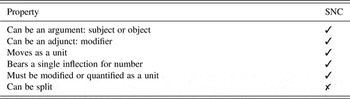
First, the SNC may function as a subject (13a), an object (13b), or a modifier (13c).
-
(13)
-
a. [Hatu-n reuhka] roikku-u naula-ssa. subject
hat-gen idph.nom hang-prs.3sg hook-ine
‘The floppy, worn-out hat is hanging on a hook.’
-
b. Minä tykkä-än [siitä hatu-n reuhka-sta]. object
I.nom like-prs.1sg that.ela hat-gen idph-ela
‘I like that floppy, worn-out hat.’
-
c. [Hatu-n reuhka-n] reuna repes-i. modifier
hat-gen idph-gen edge.nom rip-pst.3sg
‘The edge of the floppy, worn-out hat ripped.’
-
A-movement patterns confirm that the SNC behaves as a syntactic atom: neither of the nouns can be moved on its own. Attempts to front only N1 (14b) or only N2 (14c) result in ungrammaticality.
-
(14)
-
a. [Siitä hatu-n reuhka-sta] minä tykkä-än
that.ela hat-gen idph-ela I.nom like-prs.1sg
‘It is that floppy, worn-out hat that I like.’
-
b. *Siitä hatu-n j minä tykkä-än [ t j reuhka-sta]
that.ela hat-gen I.nom ike-prs.1sg idph- ela
Intended: ‘It is that hat that I like the floppy, worn-out.’
-
c. *Reuhka-sta j minä tykkä-än [siitä hatu-n t j ]
idph-ela I.nom like-prs.1sg that.ela hat-gen
Intended: ‘It is the floppy, worn-out that I like that hat.’
-
When the SNC inflects for number, only one suffix is allowed, obligatorily on N2, as shown in (15a). The presence of two suffixes (15b), or a suffix on N1 only (15c), results in ungrammaticality.
-
(15)
-
a. hatu-n reuhka-t
hat-gen idph- pl .nom
‘floppy, worn-out hats’
-
b. *hattu-je-n reuhka-t c.*hattu-je-n reuhka
hat- pl -gen idph- pl .nom hat- pl -gen idph.nom
-
The entire SNC string can be modified, but not the individual nouns within it. The modifier precedes N1, but agrees with N2 in number and/or case (here nominative singular, which is zero-marked), as in (16).
-
(16)
-
a. punainen hatu-n reuhka
large. nom hat-gen idph. nom
‘a red, floppy, worn-out hat’
-
b. *punaise-n hatu-n reuhka
red- gen hat- gen idph.nom
Intended: ‘a red, floppy, really worn-out hat’
-
If a quantifier is used, it precedes the entire SNC, yet it agrees in case with N2, as in (17a). If it agrees with N1, the result is ungrammatical, as in (17b).
-
(17)
-
a. kaik-i-lle hatu-n reuhko-i-lle
all-pl- all hat-gen idph-pl- all
‘to all the floppy, worn-out hats’
-
b. *kaik-i-n hatu-n reuhko-i-lle
all-pl- gen hat- gen idph-pl-all
-
Native speakers prefer that derivational suffixes, such as the diminutive -nen in (18a), appear on N2 rather than on N1, although it is not impossible for such suffixes to surface on N1, as in (18b). Alternatively, these suffixes may attach to both nouns, albeit with a resulting stylistic overkill (18c).
-
(18)
-
a. hatu-n reuhka-nen
hat-gen idph- dim .nom
‘a small floppy, worn-out hat’
-
b. hattu-se-n reuhka
hat- dim -gen idph.nom
‘a small floppy, worn-out hat’
-
c. ??hattu-se-n reuhka-nen
hat- dim -gen idph- dim .nom
‘a really small, floppy, worn-out hat’
-
Various suffixes can be used to derive nouns from ideophonic roots, such as -isko (rotisko ‘a large, undesirable entity), -kka (jöllikkä ‘a large, heavy entity), -ke (reuhake ‘something poor, raggedy’), -le (ketale ‘a useless, lazy, good-for-nothing person’), and -na (käppänä ‘a small shrunken entity’) (VISK Reference Hakulinen, Vilkuna, Korhonen, Koivisto, Heinonen and Alho2008: §206).Footnote 11 These suffixes may also be added to non-ideophonic roots, with the exception of -na, which appears only on ideophones. The verbal suffix -ise behaves in the same way as -na. However, since not all ideophonic nouns appear with -na, we cannot use suffixation to determine ideophonic status.
The properties of Finnish SNCs are summarized in Table 1.Footnote 12
Morphosyntactic properties of Finnish SNCs

4.3 Semantic properties
In this section, we examine the semantic properties of the SNC. We argue that the use of the SNC is evaluative, offering the speaker's perspective pertaining to the entity at hand (Jespersen Reference Jespersen1922, Amanuma Reference Amanuma1974, and Hinton et al. Reference Hinton, Nichols, Ohala, Hinton, Nichols and Ohala1994, among others). This evaluative effect is composed stepwise, with each of the following elements playing a role: the individual nouns within the SNC, the speaker's attitude, the speaker's world knowledge, and/or the particular discourse context within which the utterance is used. Below, we walk the reader through data that illustrate the step-by-step construction of the layered evaluative meaning of the SNC.
The N2, that is, the ideophone, introduces a relevant property of N1. Deviation from a standard is an inherent, necessary characteristic of the lexical entry cast as N2. Consider, for example, an entry such as pullero which means ‘rather round, big’. On its own, it means that whatever the entity to be described, it will be somehow bigger than the standard size. One can use it, for example, to refer to an N1 such as vauva ‘a baby’, thereby forming an SNC:
-
(19) vauva-n pullero
baby-gen idph.nom
By itself, the deviation from a standard size is neither positive nor negative. However, once the N1 is considered, a particular default evaluation is typically assumed by the speaker. Out of the blue, without any context, vauvan pullero means something along the lines ‘bonny/plump/healthy-looking baby’. Given our general world knowledge, when people talk about the remarkable size of a baby, it is usually to draw attention to the baby's healthy physique. (20) is an example of this particular SNC (marked in bold) used in a garden-variety example illustrating positive evaluation.
-
(20) Minun sisko-ni vauva-n pullero sitten lopulta synty-i.
my sister-1sg.poss baby-gen idph.nom then finally be.born-pst.3sg
‘My sister finally had a healthy, plump baby.’
The preferred evaluative value—in this case, positive—is due to our world knowledge about N1 in relation to size. However, the positive value is not fixed. It can be overridden by manipulating the speaker's attitude and/or the discourse context. Consider (21).
-
(21) Minun narkkarinaapuri-ni vauva-n pullero sitten
my druggie.neighbour-1sg.poss baby-gen idph.nom then
lopulta synty-i.
finally be.born-pst.3sg
-
a. ‘My drug-addict neighbour finally had a healthy, plump baby.’
Speaker: a kind, positive parish priest who knows the troubled neighbour and is ever-hopeful that things will work out for the best
-
b. ‘My drug-addict neighbour finally had a fat baby.’
Speaker: a harsh, judgmental conservative who would sterilize all drug addicts if it were possible
-
The two examples are identical in form. The only change is in the speaker's attitude. As the speaker's attitude changes, so does the interpretation of the SNC.
Next, we look at an example of how a particular context forces either a positive or a negative interpretation. The entry pojan roikale refers, without any context, to ‘a hulky young man’. By itself it simply describes a young man who is bigger than average. However, if the context is manipulated, the SNC can be interpreted as either positive (Context A) or negative (Context B).
-
(22) Katso noita poja-n roikale-i-ta !
look.imp that.pl.par boy-gen idph-pl-par
‘Look at these hulky young men!’
Context A: Athlete recruitment event on university campus
Context B: Leaving the bar late at night, in a shady neighbourhood
Thus, we conclude that while the SNC refers to an entity that in some way deviates from a standard, it is not inherently either pejorative or laudatory. A particular interpretation arises as a result of a specific context or the specific attitude of a speaker. Furthermore, the nuances of N1 have noteworthy effects. The role of the non-ideophonic N1 is to encode the entity, but the specific noun that is used also reflects stylistic register. Since N2 is already marked as deviating from a standard in some way, it conditions, to some degree, the kind of entity that may appear in the N1 slot. A formal or even a neutral N1 tends to be viewed by native speakers as unnatural, with acceptability declining in direct relation to the degree of formality of the N1 (see also Leinonen Reference Leinonen2010: 208). For example, the ideophone käppänä refers to a small, light, shrivelled entity. When this N2 ideophone is used with an N1 that clashes with it in terms of stylistic markedness, acceptability is degraded. In this case, the level of acceptability correlates with the degree of formality of the N1, as illustrated graphically in (23):
-
(23) least formal neutral most formal
←————————————————————————————→
‘old fart, bloke’ > ‘cop’ > ‘man, police officer’ > ‘grandpa/granny’ > ‘Mrs’ > ‘Mr’
Consider the continuum illustrated in example (23) and its relation to acceptability judgements in (24)–(29).
-
(24) Best
-
a. äijä-n/ämmä-n käppänä
(old) man/woman-gen idph.nom ‘a small, shrunken (old) fart/bag’
-
b. jätkä-n käppänä
bloke-gen idph.nom ‘a small, shrunken bloke (of a man)’
-
-
(25) Good
-
a. vaari-n / mummo-n käppänä
grandpa / granny-gen idph.nom ‘a small, shrunken grandpa’
-
b. kytä-n käppänä
cop-gen idph.nom ‘a small, shrunken cop’
-
-
(26) Less good
-
a. miehe-n/naise-n käppänä
man/woman-gen idph.nom ‘a small, shrunken man/woman’
-
b. eno-n/sedä-n käppänä
uncle-gen idph.nom ‘a small, shrunken uncle’
-
-
(27) Passable
poja-n/tytö-n käppänä
boy/girl-gen idph.nom ‘a small, shrunken young man/woman’
-
(28) Barely acceptable
-
a. tädi-n käppänä
aunt-gen idph.nom ‘a small, shrunken aunt’
-
b. isoisä-n / isoäidi-n käppänä
grandfather/mother-gen idph.nom
‘a small, shrunken grandfather/grandmother’
-
c. rouva-n käppänä ‘a small, shrunken married woman,
Mrs-gen idph.nom or simply any adult woman’
-
d. poliisi-n käppänä
police-gen idph.nom ‘a small, shrunken police officer’
-
-
(29) Not acceptable
-
a. ??ihmise-n käppänä
human-gen idph.nom‘a small, shrunken human being’
-
b. ??herra-n/neidi-n käppänä
Mr/Miss-gen idph.nom‘a small, shrunken Mr/Miss’
-
The position of each term on the continuum reflects the speaker's relationship to the entity at hand; the more formal the register of the N1, the less likely the use of the ideophone (though it should be noted that the use of an ideophone with a formal N1, while unlikely, is not outright ungrammatical). However, while N1 may contribute to the overall interpretation of the SNC, it does not determine it. Whether ‘old fart’ is pejorative or laudatory depends on the speaker's perspective. The acceptability of the more neutral and formal nouns in (24–28) depends on the attitude of the speaker towards N1, and on the particular context, as discussed near the beginning of this section. However, the two entries in (29) – ‘human’, ‘mister’, and ‘Miss’ are perceived as so much more formal than käppänä that we could not come up with a plausible context for usage, hence the rating of “not acceptable”.
The examples discussed above refer exclusively to humans. The same generalizations hold with respect to inanimate entities. For example, hatun reuhka ‘worn-out hat’ in (30) can refer to (31b) but not to (31a).
-
(30) hatu-n reuhka
hat-gen idph.nom
‘a floppy, worn-out hat’
-
(31)


While N2 obligatorily introduces some sort of deviation from a standard of wear and tear, the perceived attitude of the speaker toward that worn-out hat can swing from a default pejorative interpretation to a laudatory one. The default pejorative interpretation is dictated by our world knowledge; in the age of conspicuous consumption, old, worn-out hats do not hold much value. However, a laudatory interpretation is not ruled out and may occur when, for example, the beauty standards prevalent within a particular speech community are at odds with the beauty standards held by the speaker or addressee. Moreover, a hat may derive its value from emotional attachment, as illustrated in the examples in (32)–(33).
-
(32) Minä rakasta-n tä-tä hatu-n reuhka-a
I.nom love-prs.1sg this-par hat-gen idph-par
en-kä ikinä hei-tä sitä pois.
neg.1sg.and never throw-infit.par away
‘I love this floppy, worn-out hat and I'll never throw it away.’
-
(33) Sinu-lla on taas tuo rakas vanha hatu-n reuhka
you-ade be.prs.3sg again that dear old hat-gen idph.nom
pää-ssä-si.|
head-ine-1sg.poss
‘You have that dear, old, floppy, worn-out hat on your head again’
5. Proposal: NN strings are serial noun constructions
Based on the criteria spelled out in section 3, repeated in (34), and upon consideration of the data presented in section 4, we argue that Finnish colorative constructions are best analysed as serial nouns (see also Yuka Reference Yuka2014).
-
(34) Properties of serial-noun constructions:
-
a. only one expressed predicate
-
b. only shared modifiers and/or quantifiers
-
c. only one active inflection for case
-
d. only one possible negator
-
e. no intervening coordinating conjunction
-
f. no intervening subordinating conjunction
-
g. no possible intervening pause
-
In addition, we argue that the serial noun construction contains an ideophonic element as N2. Our assumptions about ideophones, laid out in section 3, readily apply to the colorative constructions considered in section 4. Ideophonic elements in these constructions have the five properties listed in (35).
-
(35)
-
a. Ideophonic strings are phonologically marked.
-
b. Ideophones are morphosyntactically restricted.
-
c. Ideophones depict sensory imagery.
-
d. Ideophones elude translation.
-
e. Ideophones are part of the expressive and/or evaluative domain.
-
We posit that the SNC is best analyzed as an evaluative formed at the phonology-syntax-semantics interface. In the discussion below, we address each of our claims in detail.
By treating the colorative construction as an instantiation of the possessive structure, we can capture the grammatical characteristics of this SNC string, namely the fact that the first noun always bears fixed genitive case, and the second noun inflects for case as needed. Most importantly, the possessive structure allows for a loosely defined entity–property relationship between the possessor and the possessee, as discussed in section 4. We assume the standard syntactic structure for the possessive and apply it to the SNC, as represented schematically in (36).
-
(36)
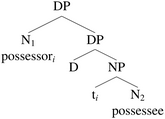
Phonotactic properties specific to Finnish ideophones (discussed in section 3.1) mark the construction as salient. A phonologically unremarkable non-ideophonic N1 is thus combined with a phonologically marked N2:
-
(37)

The content of ‘Possessor’ is a type of entity. The content of ‘Possessee’ is a property that signals deviation from a (usually visual) standard.Footnote 13
-
(38)

Higher in the structure, we find an Evaluative Mood node (EMP). The content of the Evaluative Mood phrase is not fixed, but rather is context- or speaker-dependent.Footnote 14 If this content is positive, then the SNC is interpreted as laudatory. However, if this content is negative, the SNC is interpreted as pejorative.
-
(39)

6. Alternative analyses
Two other analyses of the SNC structure are conceivable: (i) the SNC is a compound; or (ii) the SNC falls under the category of ‘N of an N’ constructions such as ‘the jewel of a secretary’ (Matushansky Reference Matushansky, Mikkelsen and Potts2002). In this section, we examine these alternatives, rejecting each in turn.
6.1 The compound analysis
Given that the SNC behaves as an atomic unit, it would be tempting to analyze it as an instance of a compound. In fact, this possibility is bolstered by the fact that Finnish speakers are very inconsistent with the written form of the SNC—for instance, both puunkänttyrä and puun känttyrä are attested as translations of ‘a dried-up, bent tree’. However, we reject this approach for both empirical and theoretical reasons.
The available literature on compounding in Finnish provides little guidance with regard to such an analysis; some authors do not provide any criteria at all on how to classify compounds (e.g., Karlsson Reference Karlsson2008: 342–345). Elsewhere, the criteria for compounding are highly fluid and divergent from those observed in Indo-European languages (Niemi Reference Niemi2009: 239–242). Moreover, scholars disagree on the appropriate criteria. For instance, Karlsson (Reference Karlsson1983: 150) proposes that Finnish compound words are identifiable based on word stress, arguing that the main stress in compounds falls on the first syllable, and secondary stress falls on the third or fourth syllable and then on every second syllable until the last, which is unstressed. However, Nieminen and Lantee (Reference Nieminen, Lantee, Werner and Kinnunen2011) have shown that in practice, the identification of compound meanings based on secondary stress is unreliable. These shortcomings notwithstanding, in comparing SNCs to typical compound nouns drawn from the literature, we are confronted with several ways that the former diverge from the latter with respect to phonology, morphosyntax and semantics.
Phonologically, a compound is an atom, which means that contrastive stress cannot apply to the second element of the complex word. Or rather, contrastive stress may apply, but with the consequence that the non-compositional meaning of the noun–noun combination becomes unavailable, as in (40b), suggesting that it no longer has the status of a complex word:
-
(40)
-
a. compound: b. non-compound:
talo-n-poika talo-n poika
house-gen-boy.nom house-gen boy.nom
‘peasant’ ‘the son of the (typically farm) house’
-
c. Sieltä tule-e tálo-n-pòika. [regular stress]
there.abl come-prs.3sg house-gen-boy.nom
‘Here comes the peasant.’
-
d. Sieltä tule-e tálo-n POIka. [contrastive stress]
there.abl come-prs.3sg house-gen boy.nom
*‘Here comes the peasant.’
‘Here comes the son of the house.’
-
In contrast, it is possible to have contrastive stress on the second element of the SNC, without any resulting change in meaning, as in (41).
-
(41)
-
a. Sieltä tule-e púuro-n mössö [regular stress]
there.abl come-prs.3sg cereal-gen idph.nom
‘Here comes the cereal mush.’
-
b. Sieltä tule-e púuro-n MÖSsö. [contrastive stress]
there.abl come-prs.3sg cereal-gen idph.nom
‘Here comes the cereal mush.’
-
Morphosyntactically, one might argue that the SNC resembles a typical Finnish compound that does not contain an ideophone but that is also construed as possessive. However, the two structures—those containing an ideophone and those lacking one—do not pattern in the same way syntactically. For example, one can see that non-ideophonic compounds like merenranta ‘sea shore’ (cited in Karlsson Reference Karlsson2008: 342) are truly possessive in that they can, under favourable contextual conditions, be separated in a question~answer exchange, as in (42).
-
(42) Q: Minkä ranta tämä on? A: Mere-n.
what.gen shore.nom this be.prs.3sgsea-gen
‘What kind of shore is it?’‘The sea's.’
Lit.: ‘What's shore is this?’
This contrasts with the SNC, where, as we argued in section 4, the possessive construction is used to host a very loosely defined modifier–modified relation. For the SNC, such a question–answer exchange is not possible, as shown in (43).
-
(43) Q: * Minkä mössö tämä on? A: *Puuro-n.
what.gen idph.nom this be.prs.3sg porridge-gen
‘What kind of mush is this?’ ‘Porridge's.’
Lit.: ‘What's mush is this?’
In an overview of Finnish compound types, Niemi (Reference Niemi2009) points out that morphosyntactically, Finnish compounds are unlike their Indo-European counterparts in that they allow internal agreement and inflection. In this sense, Finnish compounds also differ from Finnish SNCs; unlike the inflectionally active elements of the garden-variety compounds that Niemi (Reference Niemi2009) describes, the genitive case of N1 in the SNC is inert and fixed. One could perhaps argue that what we call the SNC construction should be viewed as an instance of Niemi's fossilized NGen–N compounding (Niemi Reference Niemi2009: 241). However, we have shown that SNCs are not fossilized, but on the contrary, are often produced by native speakers on the fly—in fact, such spontaneous formations are directly responsible for the particular challenges we encountered in harvesting SNC data from a variety of sources, as the SNC tokens are often unique. If SNC constructions were fossilized, searching for them would not pose any difficulty.
Lastly, from a semantic perspective, non-ideophonic compounds do not arise as evaluatives, to the best of our knowledge, whereas an evaluative function is a defining feature of the SNC.
6.2 The ‘N of an N’ analysis
Given our translations of Finnish SNCs into English, it may seem natural to propose that what we call the SNC should be viewed as an ‘N of an N’ construction. However, we have strong grounds for arguing that the ‘N of an N’ analysis does not apply in this case, as SNCs pattern quite differently from ‘N of an N’ constructions. In this section, we review several properties that differentiate the two constructions.
Whereas the ‘N of an N’ construction can be iterated indefinitely (44a), or for as long as is pragmatically viable (Matushansky Reference Matushansky, Mikkelsen and Potts2002), the SNC construction cannot be iterated at all (44b–c):
-
(44)
-
a. this asshole of an idiot of a bastard of a musketeer (Matushansky Reference Matushansky, Mikkelsen and Potts2002: 265)
-
b. * hatu-n reuhka-n rähjäkke-en krympsy
hat-gen idph-gen idph-gen idph.nom
‘the crumpled-up mess of a worn-out derelict of a floppy hat’
-
c. * miehe-n jäyhäkke-en jörrikä-n järkäle
man-gen idph-gen idph-gen idph.nom
‘the stiff lump of a curmudgeon of a mountain of a man’
-
Another property of ‘N of an N’, as noted by Matushansky (Reference Matushansky, Mikkelsen and Potts2002), is that N1 must be scalar in some way. Since not all nouns are inherently scalar, not all can be N1. For example, in (45a), ‘idiot’ is scalar while ‘sorceress’ is not, hence the questionable grammaticality of the latter. While the SNC also places constraints on the content of N1, the choice is not based on gradability, but on register and other considerations. As the ungrammaticality of (45b) shows, gradability is not the relevant criterion for SNC constructions as it is for ‘N of an N’; if it were, this example would be acceptable.
-
(45)
-
a. Miranda is even more of an idiot/?of a sorceress than I thought.
(Matushansky Reference Matushansky, Mikkelsen and Potts2002: 267)
-
b. * Hattu on reuhka-mpi kuin usko-i-n.
hat.nom be.prs.3sg idph-comparative than believe-pst-1sg
‘The hat is even floppier than I believed.’
-
c. * Hatu-n reuhka-mpi kuin usko-i-n
hat-gen idph-comparative than believe-pst-1sg
‘The hat is even floppier than I believed.’
-
The emotive nature of N1 is yet another prominent property of the ‘N of an N’ construction. According to Matushansky (Reference Matushansky, Mikkelsen and Potts2002: 268), N1 is there to express the general mood of the speaker rather than to pass judgment, and plays a role that is similar to adjectives such as bloody or stupid, as in (38):
-
(46) Why are you always talking to some idiot of a guy whenever I see you?
In contrast, as we have shown in section 3.3 for SNC's, N1 is not inherently judgmental but rather signals deviation from a standard. Moreover, the SNC construction as a whole is used precisely to pass judgment, namely, to provide an evaluation of the entity at hand.
Finally, the N2 of the SNC construction must be an ideophone, whereas no such requirement is imposed on the N2 for the ‘N of an N’ construction. One can easily construct a Finnish version of the ‘N of an N’ construction that does not contain an ideophone:
-
(47)
-
a. sankari miehe-ksi b. nero kielitieteilijä-ksi
hero.nom man-trn genius.nom linguist-trn
‘a hero of a man’ ‘a genius of a linguist’
-
7. Conclusions and further questions
This study has explored aspects of sound, form, and meaning that are particular to Finnish nominal colorative constructions. We have argued that a specific set of properties sets these constructions apart, and have proposed a serial-noun analysis to account for their characteristics. Empirically, the study contributes to a better understanding of Finnish ideophony in the nominal domain. Analytically, it opens up a discussion of serial nominalization, whose existence, to the best of our knowledge, was first predicted by Déchaine (Reference Déchaine1993), but which has thus far been explored in only one other publication (Yuka Reference Yuka2014). From a theoretical perspective, there is considerable value in exploring how possessive constructions may be used for evaluative purposes as a way of encoding speaker perspective, and in investigating the role of ideophony in such a process.
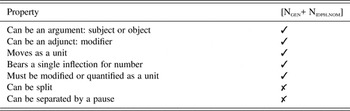
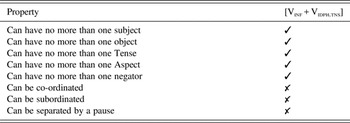
Our investigation here is but one toward answering much larger questions. For example, one issue to be resolved is the role of ideophony across categorial domains. We have argued elsewhere for a serial verb construction in Finnish that involves ideophony (Armoskaite and Koskinen Reference Armoskaite and Koskinen2014). Table 1, repeated and expanded as Table 2, summarizes the properties of serial nouns, while Table 3 does the same for properties of serial verbs (for further details, see Armoskaite and Koskinen Reference Armoskaite and Koskinen2014).
Properties of Finnish [N gen Nidph.case ]

Properties of Finnish [V inf Vidph.tns ]

Even a quick comparison of the properties listed in the two tables raises questions about the nature of the parallels between them, such as the parallel between finiteness and case that is readily apparent across the nominal and verbal domains, as schematized in Table 4.
Parallel restrictions across domains

What would an overarching account of ideophony and serialization across the verbal and nominal domains look like? The noun-verb parallels could be framed along the lines of the discussion on the relationship between case and tense. Tense has been argued to be expressed as Nominative case on nouns (Pesetsky and Torrego Reference Pesetsky, Torrego, Guéron and Jacqueline Lecarme2004). Pesetsky (Reference Pesetsky2013) has further argued that all nouns are born Genitive. Let us suppose for the moment that Pesetsky (Reference Pesetsky2013) is correct. If we were to continue along these lines, pursuing the parallels between nominal and verbal domains, we could further suggest that Genitive case may be viewed as an expression of Infinitive on a noun, in line with Tense-as-Nominative theorizing. From the point of view of serialization in Finnish, as schematized in Table 4 below, this would result in a welcome parallelism. It would also, however, raise further questions, such as: Where might one find independent evidence that Genitive is equivalent to Infinitive? What would this equivalence tell us about the parallelism of functional heads across nominal and verbal domains?
Puzzles remain within the nominal domain as well. For example, what is the relation between a simplex N and a serial noun [N gen N idph.nom ]? To the second author of this study, reuhka without N1 means ‘hat’, but based on our data from web forums, blogs and other hangouts for youth on the internet, to the average 17-year-old this word now means ‘messy hair’. How does a linguistic community arrive at such a specific, agreed-upon meaning?
Turning to the domain of pragmatics, further questions arise. How can one predict the relation that holds between the SNC and a particular context or some specific intention of the speaker? Even age may play a role in determining these. The example in (48) is representative.
-
(48) tytö-n typykkä
girl-gen idph.nom
Based on the native-speaker judgment of the second author, who is middle-aged, (48) is a mild term of endearment for a little girl. Apparently, this is not true for the younger generation. A Google Images search related to the term brings up scantily clad young women, and Wiktionary offers the English translation of ‘babe’. For our middle-aged female speaker, the connotation of the term is mildly positive, but we are not sure how it would be judged by a younger speaker. Could it be interpreted as pejorative from the point of view of young women who do not want to be viewed as sex objects? What judgment would be implied by a young male who desires the woman in question and tends to view women as sex objects? We hope to address these and other issues in follow-up studies.
The Finnish facts also bear on a larger looming question: What is the place of iconicity in formal accounts of grammar? These data indicate the robustness of sound symbolism in Finnish, showing that specific sounds are closely associated with certain meanings. As such, ideophones pose a problem, given that the arbitrariness of sound~meaning correspondence has long been one of the fundamental assumptions of mainstream linguistics, at least since the seminal work of de Saussure (1916; reprinted Reference de Saussure1983). Arbitrariness is most commonly viewed, as Panagiotidis (Reference Panagiotidis, Kosta, Franks, Radeva-Bork and Schürcks2014: 209) aptly put it, as “an indispensable property of language because the underlying faculty is designed to leave open the limits of interpretation.” The opposite of arbitrariness is iconicity, where meaning is represented directly in grammatical expression (Crystal Reference Crystal2008: 234), such that the meaning is present in the signal itself (Déchaine, Reference Déchaine2015). Due to the fact that iconicity is limited in Indo-European languages, it has typically been treated as an anomaly and set aside or relegated to the lexicon, the repository of all idiosyncratic entries (Di Sciullo and Williams Reference Di Sciullo and Williams1987, Chomsky Reference Chomsky1995, among many others). The hitherto-marginal existence of this phenomenon has not in any way affected our conception of the nature of grammar. However, if we are to accommodate a growing and now-critical mass of cross-linguistic data that points to the robustness of iconic manifestations (see Dingemanse Reference Dingemanse2012 and references therein, among many others), our current views of grammar may need to change.
Appendix A: Behavior of non-ideophonic possessive noun–noun constructions
Here is an example of a non-ideophonic possessive noun–noun construction:
-
(49) Liisa-n hattu
Lisa-gen hat
‘Lisa's hat’
Like the ideophonic SNC, the possessive SNC may function as a subject (50a), an object (50b), or a modifier (50c):
-
(50)
-
a. [Liisan-n hattu] roikku-u naula-ssa. subject
Lisa-gen hat.nom hang-prs.3sg hook-ine
Lisa's hat is hanging on a hook.’
-
b. Minä tykkä-än siitä Liisa-n hatu-sta]. object
I.nom ike-prs.1sg that.ela Lisa-gen hat-ela
‘I like that hat of Lisa's.’
-
c. [Liisa-n hatu-n] reuna repes-i. modifier
Lisa-gen hat-gen edge.nom rip-pst.3sg
‘The edge of Lisa's hat ripped.’
-
Movement tests confirm that the possessive noun–noun behaves as a syntactic atom with the result that neither of the nouns can be moved on its own. Attempts to front only N1 (51b) or only N2 (51c) result in ungrammaticality:
-
(51)
-
a. [Siitä Liisa-n hatu-sta] minä tykkä-än
that.ela Lisa-gen hat-ela I.nom like-prs.1sg
‘It is that hat of Lisa's that I like.’
-
b. * Siitä Liisa-n j minä tykkä-än [ t j hatu-sta]
that.ela Lisa-gen I.nom like-prs.1sg hat-ela
Intended: ’It is that Lisa's that I like the hat.’
-
c. * Hatu-sta j minä tykkä-än [siitä Liisa-n t j ]
hat-ela I.nom like-prs.1sg that.ela Lisa-gen
Intended: ’It is hat that I like that Lisa's.’
-
When the non-ideophonic possessive inflects for number, either noun may be pluralized (in contrast with ideophonic constructions):
-
(52)
-
a. Liisa-n hatu-t
Lisa-gen hat- pl .nom
‘Lisa's hats’ (i.e. one Lisa, several hats)
-
b. Liiso-je-n hatu-t
Lisa- pl -gen hat- pl .nom
‘Lisas’ hats’ (i.e. several Lisas, several hats)
-
c. Liiso-je-n hattu
Lisa- pl -gen hat.nom
‘Lisas’ hat’ (i.e. several Lisas, one hat)
-
Moreover, unlike the ideophonic noun–noun constructions, one can modify either noun in the regular possessive construction. The modifier precedes the noun that it modifies, and agrees with it in number and/or case:
-
(53)
-
a. Liisa-n punainen hattu b. nuore-n Liisa-n hattu
Lisa-gen red. nom hat. nom young- gen Lisa- gen hat.nom
‘Lisa's red hat’ ‘young Lisa's hat’
-
If a quantifier is used, its agreement determines which N it modifies; again, this is unlike ideophonic constructions. If a quantifier modifies N1, it must precede the regular non-ideophonic possessive SNC, and it agrees in case and/or number with N1. If it modifies N2, it may precede N1 or N2, but must agree in case and/or number with N2.
-
(54)
-
a. kaikk-ie-n Liiso-je-n hatu-i-lle
all-pl- gen Lisa- gen hat-pl-all
‘to the hats of all the Lisas’
-
b. kaik-i-lle Liiso-je-n hatu-i-lle
all-pl- all Lisa-gen hat-pl- all
‘to all the hats of the Lisas’
-
c. Liiso-je-n kaik-i-lle hatu-i-lle
Lisa-gen all-pl- all hat-pl- all
‘to all the Lisas’ hats’
-
While it is possible to use N1 as a predicate in possessive constructions (55a) this is not possible in either ideophonic (55b) or compound nouns (55c):
-
(55)
-
a. Tuo hattu on Lisa-n.
that hat.nom be.pres.3sg Lisa-gen
‘That hat is Liisa's’
-
b. * Tuo reuhka on hatu-n.
that idph.nom be.pres.3sg hat-gen
?? Intended: ‘That hat is floppy, worn out’
-
c. * Tuo hattu on uko-n.
that hat.nom be.pres.3sg man-gen
?? Intended: ‘That bane is Wolf's’
-
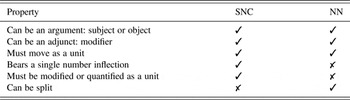
Table 5 summarizes the properties of the Finnish colorative (SNC) and possessive (NN) constructions.
Morphosyntactic properties of Finnish ideophonic vs. non-ideophonic noun strings