Pseudomonas aeruginosa is one of the most important nosocomial pathogens, especially in immunocompromised and intensive care unit (ICU) patients, and it is associated with high morbidity and mortality rates.Reference del Barrio-Tofiño, López-Causapé and Oliver1,Reference Fernández-Cuenca, López-Cerero and Cabot2 P. aeruginosa has become a major worldwide public health concern due to its ability to develop resistance to almost every available antimicrobial agent and to the nosocomial spread of high-risk clones and multidrug-resistant (MDR) and extremely drug-resistant (XDR) isolates.Reference del Barrio-Tofiño, López-Causapé and Oliver1 The emergence of transferable resistance determinants, particularly metallo-β-lactamases (MBLs) such as verona-integron–encoded metallo-β-lactamase (VIM) and IMP-type metallo-β-lactamase (IMP), severely limits the therapeutic options.Reference del Barrio-Tofiño, López-Causapé and Cabot3
A recent nationwide survey conducted in Spain showed that the prevalence of acquired β-lactamases (ESBL or carbapenemases) in P. aeruginosa isolates was 3.1%, similar to that observed in other western European countries.Reference del Barrio-Tofi, Zamorano and Cortes-Lara4 In this study, the most frequent carbapenemases were those of the VIM group (1.9%), mainly in isolates belonging to ST175 clone, followed by those of the Guiana extended-spectrum β-lactamase (GES) group (0.6%).Reference del Barrio-Tofi, Zamorano and Cortes-Lara4 In contrast, the prevalence of IMP-producing P. aeruginosa was very rare in Spain (0.3%).Reference del Barrio-Tofi, Zamorano and Cortes-Lara4 Even so, there was a wide variation in the epidemiology of ESBL- or carbapenemase-producing P. aeruginosa between different regions and hospitals in Spain.Reference del Barrio-Tofi, Zamorano and Cortes-Lara4
This survey was conducted before coronavirus disease 2019 (COVID-19) pandemic, which brought important changes in hospital settings, with a greater number of critically ill patients, associated to long hospital stays and mechanical ventilation, which are considered classic risk factors for MDR bacterial infection.Reference Baiou, Elbuzidi and Bakdach5,Reference Aliberti, Cilloniz and Chalmers6 Additionally, these patients are prone to secondary bacterial nosocomial infections.Reference Baiou, Elbuzidi and Bakdach5,Reference Ansari, Hays and Kemp7
We have described the investigation and interventions carried out due to an increase on IMP-producing P. aeruginosa (IMP-PA) detection in Galdakao University Hospital (GUH) in 2021.
Methods
Setting, case definition, and bacterial isolates
Galdakao University Hospital is a 383-bed tertiary-care hospital that belongs to a health area that provides health care to 313,000 inhabitants in the Basque Country (northern Spain).
During 2021, an increase of IMP-PA isolates was detected, first at the respiratory ward followed by the ICU. Patients with infection or colonization by IMP-PA during their stay in GUH in 2021 were classified as cases. Colonization was defined when IMP-PA was isolated only from surveillance samples, whereas the infection was defined not only from the isolation of IMP-PA from clinical samples but also the consideration as such by the clinician in charge of the patient. This study included at least 1 isolate from each of the IMP-PA–infected or –colonized patients detected in GUH in 2021.
Environmental surveillance
Environmental sampling was performed in the respiratory ward and the ICU.
High-touch surfaces, both those related to the patient (ie, side tables, remote controls, telephones, caller buttons, and disinfectant dispensers) and those of work areas (ie, computers, mouses, keyboards, and tables), and air grids were sampled using eSwab (Copan, Italy). Disinfectants were sampled in sterile Falcon flasks (Sarstedt, Germany). Wet area samples were taken by eSwab (Copan) or by urinary catheter and included showers, drains, siphons, washbasins, bidet, bathroom floor, washer-machine water, and faucets. Samples were inoculated in thioglycolate broth (Oxoid, UK) and were incubated aerobically up to 7 days at 35°C. Subcultures in blood agar, MacConkey agar and MacConkey agar with a meropenem disc (Oxoid) were carried out when growth was observed in enrichment cultures. These cultures were incubated aerobically for 24–48 hours at 35°C.
Bacterial identification and antimicrobial susceptibility testing
Isolates were identified by matrix-assisted laser desorption–ionization time-of-flight mass spectrometry (MALDI-TOF MS, Bruker Daltonics, Madrid, Spain).
Antimicrobial susceptibility testing was performed by broth microdilution with the Microscan Neg Multidrug Resistant MIC 1 Panel (Beckman Coulter, Madrid, Spain). Minimum inhibitory concentration (MIC) results were interpreted according to the EUCAST clinical breakpoints for bacteria, version 11.0.8
Carbapenemase production was confirmed by immunochromatographic techniques (NG-Test Carba 5, NG-Biotech, Guipry, Francia).
Molecular typing
Clonal relatedness among isolates was evaluated by pulsed-field gel electrophoresis (PFGE). For this purpose, bacterial DNA embedded in agarose plugs prepared as described previously was digested with the restriction enzyme SpeI.Reference Kaufmann9 DNA separation was then performed in a contour-clamped, homogeneous electric field (CHEF) Mapper XA apparatus (Bio-Rad, La Jolla, CA) under the following conditions: 6 V/cmReference Fernández-Cuenca, López-Cerero and Cabot2 for 26 hours with pulse times of 5–40 seconds. Finally, obtained DNA macrorestriction patterns were interpreted following the criteria established by Tenover et al.Reference Tenover, Arbeit and Goering10
Whole-genome sequencing: MLST and resistome analysis
Genomic DNA was obtained by using a commercially available extraction kit (High Pure PCR template preparation kit; Roche Diagnostics) and indexed paired-end libraries were then prepared with the Nextera XT DNA library preparation kit (Illumina) and finally sequenced on an Illumina MiSeq benchtop sequencer with the MiSeq reagent kit v3 (Illumina), resulting in 300-bp paired-end reads.
Obtained paired-end reads were de novo assembled using SPAdes version 3.13.1 software (http://cab.spbu.ru/files/release3.13.1/) with default parameters. Sequence type was determined using the web tool MLST 2.0 (https://cge.cbs.dtu.dk/services/MLST/) and the presence of horizontally acquired antimicrobial resistance determinants was investigated using the web tool ResFinder (https://cge.cbs.dtu.dk/services/ResFinder/).
To study the mutational resistome, a variant calling analysis was performed using previously defined and validated protocols with slight modifications.Reference López-Causapé, Mette Sommer and Cabot11 Briefly, trimmed reads were mapped to the P. aeruginosa PAO1 reference genome (NC_002516.2) with Bowtie 2 version 2.2.4, and pileup and raw files were obtained by using SAMtools version 0.1.16 and PicardTools version 1.140. We used the Genome Analysis Toolkit (GATK) version 3.4-46 for realignment around indels. From the raw files, SNPs were extracted if they met the following criteria: a quality score (Phred-scaled probability of the samples reads being homozygous reference) of at least 50, a root-mean-square (RMS) mapping quality of at least 25, and a coverage depth of at least 3 reads, excluding all ambiguous variants. Microindels were extracted from the total pileup files when meeting the following criteria: a quality score of at least 500, a RMS mapping quality of at least 25, and support from at least one-fifth of the covering reads. Filtered files were converted to vcf files, and SNPs and indels were annotated with SnpEff version 4.2 software. Gene absence was also investigated using SeqMonk (https://www.bioinformatics.babraham.ac.uk/projects/seqmonk/). SNPs and microindels were investigated in a set of 40 chromosomal genes known to be involved in P. aeruginosa antibiotic resistance. OprD structural integrity was investigated using an appropriate reference sequence (PAO1, LESB58, UCBP-PA14, MTB-1, FRD1, or F23197). Finally, known polymorphisms within the studied set of genes were eliminated.Reference Cortes-Lara, Barrio-Tofiño and López-Causapé12
Data availabity
Sequence files have been deposited in the European Nucleotide Archive (study no. PRJEB5362).
Results
Case characteristics
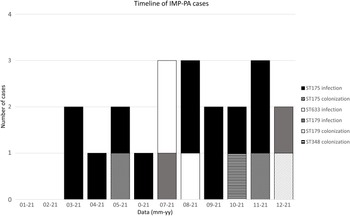
Between March and December 2021, 21 cases of IMP-PA were detected in GUH. Of these, 18 were considered infection cases, and only 3 were classified as colonization cases (Table 1). Among the infection cases, 6 were isolated from patients who had been admitted to the ICU or reanimation ward, the only 2 wards in which a weekly active surveillance of carriers is performed. Only 1 of these patients (case 12) had a positive MDR screening result prior to the clinical samples.
Demographic and Clinical Relevant Features of Patients Infected/Colonized by IMP-PA.

Note. M, male; F, female; *, during previous admission, yes. R, respiratory ward; IRCU, intermediate respiratory care unit; IM, internal medicine; H, hematology; ICU, intensive care unit; UR, urology; OV, outpatient visit; HH, home hospitalization; REA, Reanimation unit.;
S: Sputum, U, urine, B, blood; BAL, bronchoalveolar lavage, A: abscess, BAS, bronchoalveolar aspirate; RE, rectal exudate; FE, pharyngeal exudate; C, catheter; BB, bronchial brush; UL, ulcer.
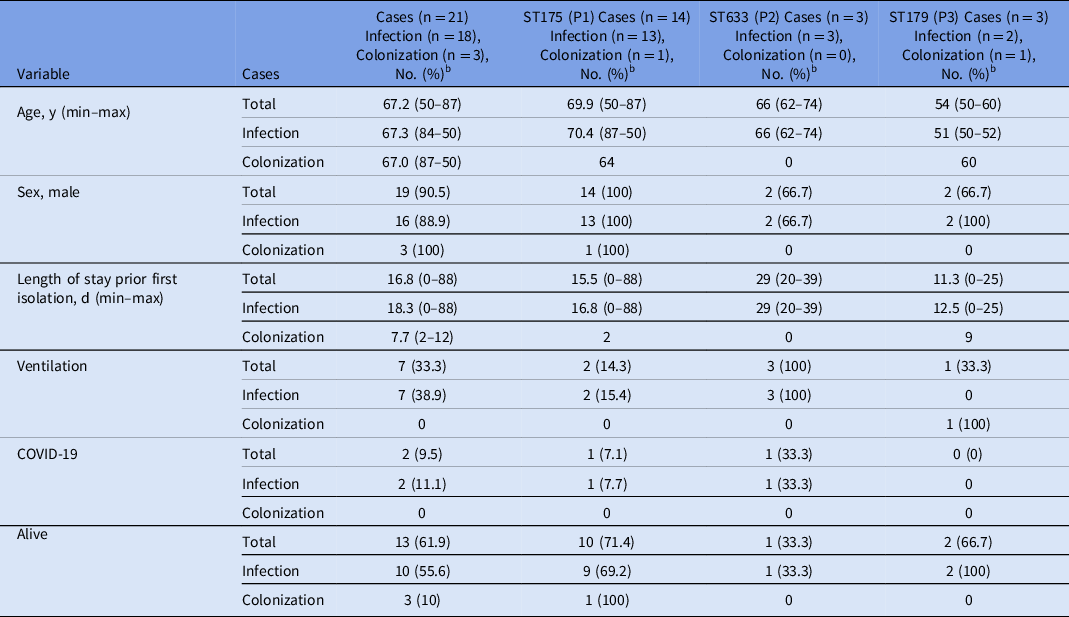
The demographic and main clinical features of patients colonized or infected by IMP-PA are shown in Tables 1 and 2. The main characteristics of the 21 IMP-PA isolates are shown in Tables 3 and 4, and the timeline of IMP-PA isolates detection is shown in Figure 1.
Demographic and Main Clinical Features of Patients Infected or Colonized by IMP-PA and by Main Pulsotypesa

a There was only 1 P4 isolate, and it was not included in this table.
b Units unless otherwise specified.
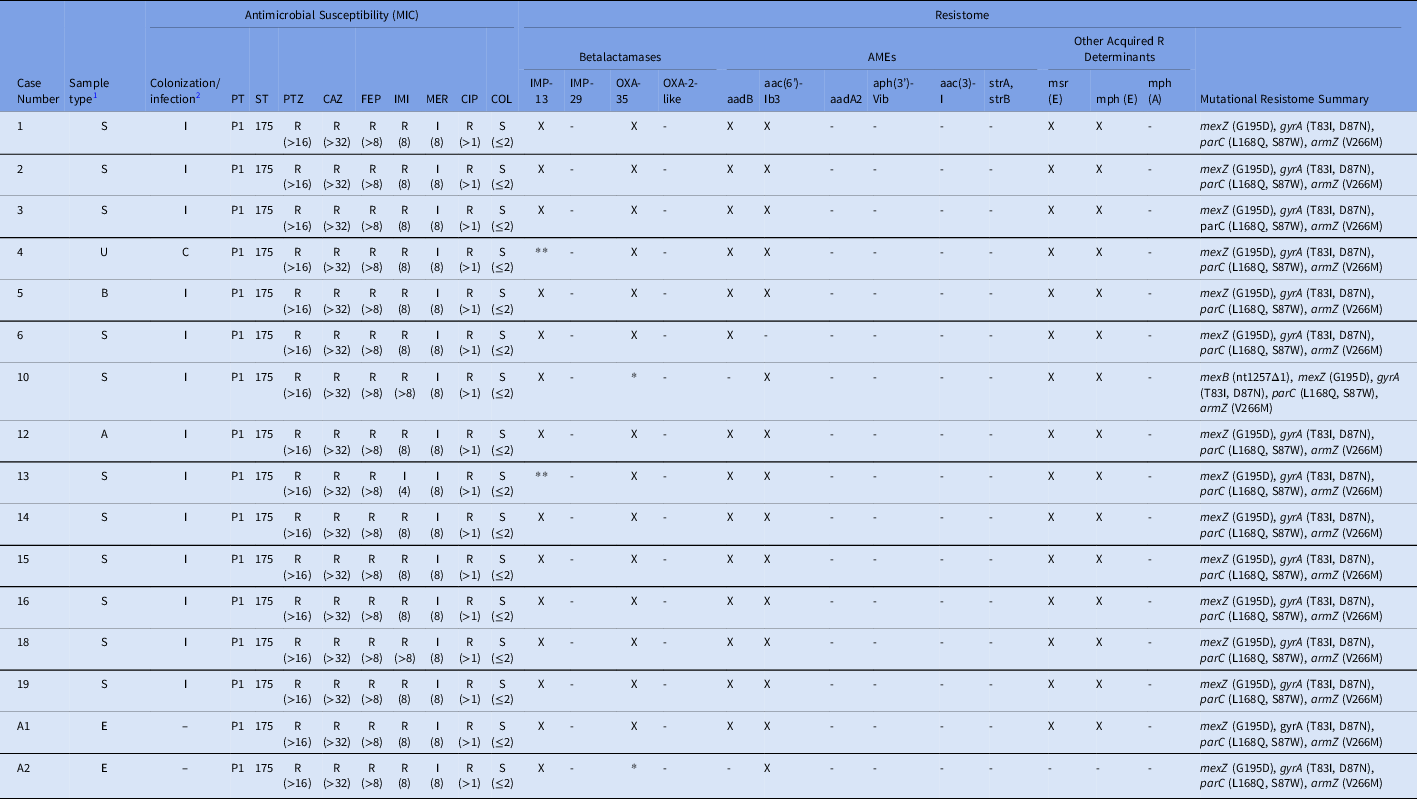
Antimicrobial Susceptibility and Resistome of the 14 IMP-PA Colonization and Clinical Isolates and 2 IMP-PA Environmental Isolates Belonging to the ST175 Clone and the P1 Pulsotype

Note. A, abscess; B, blood; BAL, bronchoalveolar lavage; BAS, bronchoalveolar aspirate; E, environmental; S, sputum; U, urine; C, colonization; I, infection;
PT, pulsotype; ST, sequence type; PTZ, piperacillin-tazobactam; CAZ, ceftazidime; FEP, cefepime; IMI, imipenem; MER, meropenem; CIP, ciprofloxacin; COL, colistin; AME, aminoglycoside-modifying enzymes; R, resistant; I, susceptible, increased exposure; S, susceptible, standard dosing regimen. X, indicate that the corresponding antimicrobial resistance gene has been described for the corresponding clone; -, indicate that the corresponding antimicrobial resistance gene has not been described for the corresponding clone. *: P1 isolate without OXA-35. ** IMP detected by ICT but not by WGS, it was probably lost during the process.
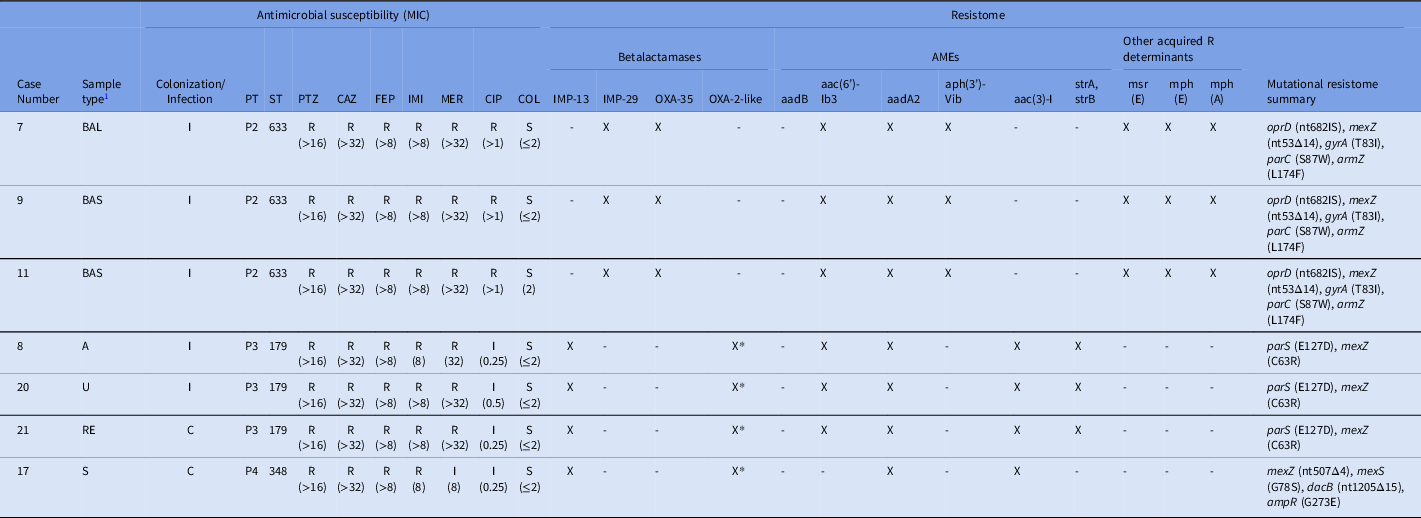
Antimicrobial Susceptibility and Resistome of the 7 IMP-PA Clinical Isolates Belonging to the ST633 (P2), ST179 (P3) and ST348 (P4) clones

Note. A, abscess; BAL, bronchoalveolar lavage; BAS, bronchoalveolar aspirate; RE, rectal exudate; S, sputum; U, urine; C, colonization; I, infection; PT, pulsotype; ST, sequence type; PTZ, piperacillin-tazobactam; CAZ, ceftazidime; FEP, cefepime; IMI, imipenem; MER, meropenem; CIP, ciprofloxacin; COL, colistin; AME, aminoglycoside-modifying enzymes; R, resistant; I, susceptible, increased exposure; S, susceptible, standard dosing regimen. X, indicate that the corresponding antimicrobial resistance gene has been described for the corresponding clone; -, indicate that the corresponding antimicrobial resistance gene has not been described for the corresponding clone. (*): OXA-2-like gene with N60D and A255V changes.
Imipenemase-producing Pseudomonas aeruginosa (IPM-PA) isolate detection timeline.

Overall, 5 patients did not receive treatment because IMP-PA isolation was considered a colonization (3 patients) or due to the patient’s poor prognosis (2 patients). Moreover, 14 patients were treated accordingly to susceptibility testing results: 3 patients received ceftazidime/avibactam + aztreonam + colistin, 7 colistin, 2 ciprofloxacin and 2 cefiderocol, whereas 2 patients received an inadequate treatment (ceftazidime-avibactam).
In total, 4 different pulsotypes were detected (P1, P2, P3 and P4): 14 isolates belonged to P1 (ST175), 3 isolates belonged to P2 (ST633), 3 isolates belonged to P3 (ST179), and another isolate belonged to P4 (ST348) (Tables 2–4).
All isolates belonging to ST175 clone were classified as P1 pulsotype. Furthermore, 13 cases were considered infection cases whereas 1 was a colonization case. In 11 isolates IMP-13 and OXA-35 were simultaneously detected, whereas in the other 3 isolates only 1 of these determinants was detected by whole-genome sequencing (WGS). The resistomes of all clinical isolates belonging to the ST175 clone were very similar, with the exception of the isolate from patient 10, in which neither OXA-35 nor acc(6’)-Ib3 was detected and an additional mutation was detected (mexB (nt1257Δ1)) (Table 3). All patients in whom an ST175 clone was detected had been admitted to the respiratory ward or had had a previous stay in that ward during the last 6 months (except patient 5) (Table 1).
All isolates belonging to ST633 clone were classified as a P2 pulsotype. In all of them, the IMP-29 and OXA-35 β-lactamases were simultaneously detected, and they presented the same mutational resistome summary (Table 4). All cases were considered infection cases. All patients in whom an isolate belonging to the ST633 clone was detected had been admitted to the ICU (Table 1).
The isolates belonging to the ST179 and ST348 clones were classified as P3 and P4 pulsotypes respectively, and IMP-13 and OXA-2-like β-lactamases with N60D and A255V mutations were detected in all of them. The resistome of isolates belonging to the ST179 and ST348 clones differed in aminoglycoside-modifying enzymes (AME) and the mutational resistome (Table 4). Isolates belonging to the ST179 clone were detected in different wards throughout the second half of 2021; 2 were considered infection cases and 1 was a colonization case. The isolate belonging to the ST348 clone was considered a colonization case.
Environmental investigation
In the respiratory ward, IMP-PA were isolated from 2 of the sampled siphons, 1 from an infected patient’s bathroom (A1) and 1 from a sink used by professionals to clean and disinfect material used by patients (A2). Both isolates belonged to the ST175 clone and P1 pulsotype; IMP-13 was detected and isolates presented the same mutational resistome summary. Unlike most clinical isolates belonging to the ST175 clone and the P1 pulsotype, the resistance determinants OXA-35, aadB, msr(E), and mph(E) were not detected in isolate A2 (Table 3). Additionally, VIM-producing Pseudomonas spp were isolated in the drains of the communal showers that were used by patients.
In the ICU, IMP-PA were not detected on environmental samples, but VIM-producing P. aeruginosa isolates were detected in 2 sink drains.
Outbreak management
When the presence of an outbreak was suspected, an exhaustive cleaning and surface disinfection was carried out in the respiratory ward. After this intervention, a meeting with the cleaning company was held in which it was revealed that newly hired workers did not know how to perform a proper disinfection of certain areas. These employees received a course given by specialists focused on surface disinfection and deep cleaning. An excessive workload could have also played a role in the suboptimal cleaning. Following environmental sampling results, siphons of the sinks in which IMP-PA had been detected were replaced; the drains of the communal showers in which MBL-producing P. aeruginosa were cleaned thoroughly; and all high-flow respiratory devices were cleaned, disinfected, and sterilized.
In the ICU, all high-flow respiratory devices were cleaned, disinfected, and sterilized. Hand hygiene was not being correctly performed, so a course was held by specialists to update ICU professionals’ knowledge in this specific area. In addition, siphons of the sinks in which MBL-producing P. aeruginosa isolates had been detected were replaced. New screenings were performed afterward, and no MBL-producing P. aeruginosa isolates were found.
The screening of health personnel was dismissed because, after applying the measures, no more cases of infection or colonization were detected.
To evaluate the measures taken due to the outbreak, all high-flow respiratory devices and patients admitted to the ICU and reanimation ward were monitored by routine active surveillance, resulting in no more IMP-PA isolations until the end of the study. Additionally, periodic meetings were held with the affected wards, and environmental critical points continued to be screened during the next 6 months following the same protocol, and no carbapenemase-producing microorganisms were detected.
Discussion
We report 2 concurrent IMP-PA outbreaks in 1 year that affected different units in a tertiary-care hospital. The nosocomial spread of carbapenemase-producing microorganisms is a worldwide health concern because it represents a therapeutic challenge, especially in critically ill patients and immunocompromised hosts. Early detection of patients colonized or infected with carbapenemase-producing microorganisms is essential to avoid the spread of these highly resistant pathogens in the hospital setting and to prevent outbreaks.Reference Tacconelli, Cataldo and Dancer13
The presence of P. aeruginosa in water environments, especially those contaminated by human activity, is common because it is a microorganism that proliferates in humid environments.Reference Rossi, La Rosa and Bartell14 In addition, healthcare water environment has also been described as a potential reservoir of multidrug-resistant pathogens that could cause outbreaks.Reference Kanamori, Weber and Rutala15,Reference Kizny Gordon, Mathers and Cheong16 In the case of carbapenemase-producing P. aeruginosa, the most common environmental reservoirs are contaminated sinks.Reference Kanamori, Weber and Rutala15,Reference Kizny Gordon, Mathers and Cheong16 However, routine environmental sampling in the hospital environment is not recommended, although it may be useful in the event of an outbreak to decide which interventions should be carried out and to assess them later.Reference Tacconelli, Cataldo and Dancer13
In our hospital, the first IMP-PA isolates were detected in March 2021, and new isolates continued to appear until December of the same year, causing 18 infection cases and 3 colonization cases. The presence of a prolonged outbreak over time that continues despite the interventions carried out, suggested the possible presence of an environmental reservoir, so an environmental sampling was carried out.Reference Kanamori, Weber and Rutala15,Reference Kizny Gordon, Mathers and Cheong16 The findings from the sampling carried out at the respiratory ward led to the replacement of siphons in the 2 units where outbreaks had occurred. Molecular and genomic epidemiology revealed that respiratory ward environmental isolates (A1 and A2) were closely related to clinical isolates from patients admitted to that ward. After this intervention, no more cases were detected, although it was not possible to assess the impact of this measure alone because multiple interventions were carried out simultaneously. Additionally, although routine environmental screening was not indicated, drains, and sinks in which VIM-producing P. aeruginosa were detected were thoroughly cleaned to prevent its spread.
Long-term nosocomial outbreaks, such as ours, can be difficult to detect and trace, especially when different hospital settings are involved. An outbreak could affect different units due to the transfer of patients between them, a frequent circumstance during the SARS-CoV-2 pandemic. Nevertheless, pulsed-field gel electrophoresis and WGS revealed that, in this case, 2 different outbreaks were overlapping at the same time and that, in addition, 4 isolates were unrelated to the outbreaks. It is important to have tools in clinical microbiology laboratories, such as WGS, to obtain this information as soon as possible, to be able to assess the current epidemiology and take the measures needed to stop the outbreaks.
In our hospital, the respiratory ward outbreak was caused by ST175, a P. aeruginosa major high-risk clone, prevalent in Europe and the most prevalent in Spain.Reference del Barrio-Tofiño, López-Causapé and Oliver1 The ICU outbreak, on the other hand, was caused by ST633 clone. Mortality in this group was higher than in the respiratory ward outbreak patients, which could have been because the patients were more seriously ill and/or because they all needed mechanical ventilation.
The lack of molecular typing techniques in our laboratory prevented us from determining the epidemiological relationship between the isolates belonging to ST179 clone (P3 pulse type) because the findings were obtained months after last clinical isolation. Even so, the results allowed us to carry out a retrospective study to rule out the existence of new infections related to this clone, although we did not have any data regarding possible colonization.
In conclusion, the use of typing methods made it possible to describe 2 independent outbreaks of what were initially considered a single long-lasting nosocomial outbreak. The epidemiological and microbiological study allowed the performance of multiple interventions that contributed to controlling these outbreaks. Tools, such as WGS, are essential (1) to allow the characterization of outbreaks caused by MDR isolates, especially those producing carbapenemases, (2) for epidemiological surveillance to avoid the spread of these microorganisms in areas where they are not endemic and (3) for optimal outbreak control.
Acknowledgments
Financial support
No financial support was provided relevant to this article.
Competing interest
All authors report no competing interest relevant to this article.