Condoms are one of the most effective methods for preventing the transmission of STIs and unplanned pregnancies (Centers for Disease Control and Prevention, 2003). It is estimated that between 74% and 86% of sexually active teenagers in Spain used a condom during their last sexual intercourse (Moreno et al., Reference Moreno, Ramos, Rivera, Sánchez-Queija, Jiménez-Iglesias, García-Moya and Fuchs2013). Compared to other European countries (Lazarus et al., Reference Lazarus, Moghaddassi, Godeau, Ross, Vignes, Östergren and Liljestrand2009; Ramiro et al., Reference Ramiro, Windlin, Reis, Gabhainn, Jovic, Matos and Godeau2015) and the United States (Frieden, Jaffe, Cono, Richards, & Iademarco, Reference Frieden, Jaffe, Cono, Richards and Iademarco2014), this rate is high. However, when adolescents inform about regular condom use in their sexual relationships, less than 50% of adolescents report using condoms consistently (Escribano, Espada, Morales, & Orgilés, Reference Escribano, Espada, Morales and Orgilés2015; Espada, Morales, Orgilés, Jemmott, & Jemmott, Reference Espada, Morales, Orgilés, Jemmott and Jemmott2015). The high condom inconsistency among adolescents may suggest the existence of factors that interfere with the consistent use of condoms as a method of prevention, increasing the risk for STIs and unplanned pregnancies. In Spain, the latest data show a growth trend for all STIs (Center for Epidemiology, 2015), according to worldwide data (Organización Mundial de la Salud, 2016). With respect to pregnancies, the Youth Institute survey (Moreno & Rodríguez, Reference Moreno and Rodríguez2013) reflects that most of the adolescents who gave birth, their pregnancies were not planned.
The perceived barriers to condom use-evaluated and defined as beliefs about condoms (Lameiras, Rodríguez, Calado, & González, Reference Lameiras, Rodríguez, Calado and González2003)-are included directly or indirectly in most explanatory models of health behaviors, recognizing their influence on the ultimate behavior. The Theory of Planned Behavior (TPB), (Ajzen, Reference Ajzen1991) argues that the ultimate behavior is predicted by the intention of carrying out such behavior. Likewise, intention can be predicted by several factors, including attitudes. Attitudes are defined as a set of beliefs about the value of behavior and its consequences, and they are formed from opinions and available information (Ajzen, Reference Ajzen1991). From this perspective, perceived barriers to condom use would be related to the development of attitudes towards their use. Hence, it is important to know what perceived barriers interfere with the use of condoms in order to address them with preventive programs, and thereby improve the attitudes towards their use. In a recent study on the mediation effects of an intervention to promote sexual health, Escribano et al. (Reference Escribano, Espada, Morales and Orgilés2015) concluded that adolescents who had a more favorable attitude towards using condoms when there are obstacles reported greater intention to use them when having sex and were more likely to use them. Several recent studies have found a strong association between positive attitudes towards condom use and the percentage that they are used (Doyle, Calsyn, & Ball, Reference Doyle, Calsyn and Ball2008; Stulhofer et al., Reference Ŝtulhofer, Graham, Boziĉević, Kufrin and Ajdukovic2007; Teva, Bermúdez, & Ramiro, Reference Teva, Bermúdez and Ramiro2014).
Barriers that Spanish teenagers perceive for not using condoms are diverse and heterogeneous. As major barriers, several studies have highlighted the choice of other contraceptive methods and the idea of trust in the partner (Moreno & Rodriguez, Reference Moreno and Rodríguez2013), decreased pleasure or sensitivity, lack of availability, interference with the sexual intercourse, their high cost (Ruiz, Giménez, Ballester, Roig, & Calvo, Reference Ruiz, Giménez, Ballester, Roig and Calvo2012), and disagreement with the partner (Romero-Estudillo, González-Jiménez, Mesa-Franco, & García-García, Reference Romero-Estudillo, González-Jiménez, Mesa-Franco and García-García2014). These barriers, identified as reasons for hindering condom use, have also been studied in adolescents in the international area (O’Brien, 2013). Furthermore, studies also highlight the presence of gender differences regarding perceived barriers to using condoms or not (Guiella & Madise, Reference Guiella and Madise2007).
Despite the relevance of the “barriers to condom use” construct for promoting healthy sexual behaviors in adolescents, we have not found valid and reliable instruments in Spain to assess perceived barriers in adolescents to using condoms. Therefore, the objectives of this study were to: a) analyze the psychometric properties and factor structure of a new scale for assessing the barriers to condom use among adolescents; b) describe the perceived barriers to condom use in a sample of Spanish adolescents; and c) examine potential gender differences in perceived barriers to condom use. Based on the scientific literature, the following hypotheses were set up to be tested: construct validity will be proven through indirect and significant correlations between the new scale to evaluate condom use and the attitudes towards their use (a subscale of the HIV-AS) and self-reported percentages of condom use. Many studies relate or predict the influence of barriers to condom use on their actual use (Muñoz-Silva, Sánchez-García, Martins, & Nunes, Reference Muñoz-Silva, Sánchez-García, Martins and Nunes2009; Muñoz-Silva, Sánchez-García, Nunes, & Martins, Reference Muñoz-Silva, Sánchez-García, Nunes and Martins2007). Based on gender differences in the barriers to condom use found in previous studies (Guiella & Madise, Reference Guiella and Madise2007), we hypothesize that boys will perceive more barriers related to the interruption of pleasure and the negative aspects of condoms, such as money or security issues, and these barriers will be related to their self-reported use. However, girls will perceive more barriers associated to perceived feelings factors and condom use negotiation skills, and these barriers will be related to their self-reported use. Studies conducted in Spain concur that boys attribute greater importance to pleasure in sexual relations (Lameiras et al., Reference Lameiras, Rodríguez, Calado and González2003; Teva, et al., Reference Teva, Bermúdez and Ramiro2014), and feeling safe when using condoms is a predictor of the ultimate behavior (Lameiras et al., Reference Lameiras, Rodríguez, Calado and González2003). However, girls focus more on aspects related to emotions and/or romanticism (Sánchez, Phelan, Moss-Racusin, & Good, Reference Sánchez, Phelan, Moss-Racusin and Good2012; Teva et al., Reference Teva, Bermúdez and Ramiro2014), which is one of the best predictors for not using condoms (Lameiras et al., Reference Lameiras, Rodríguez, Calado and González2003). For example, Tschann, Flores, de Groat, Deardorff, and Wibbelsman (Reference Tschann, Flores, de Groat, Deardorff and Wibbelsman2010) concluded that girls had fewer strategies of condom use negotiation than boys.
Methods
Participants
The participants included 629 adolescents aged between 13 and 18 years (M = 15.17, SD = 1.09), with 51.51% males (n = 324). All were enrolled in four public schools within the province of Alicante in Spain, studying in either the 3rd (41.02%) or 4th (39.11%) year of obligatory secondary education (ESO) or equivalent curricular adaptation programs (10.65% in 3rd year adaptation and 9.22% in 4th). Among the participants, 71.66% reported having parents married or living together, 19.90% had parents who were separated, 1.27% were in single-parent families, and 3.50% had been orphaned by either one or both parents. As for their country of origin, 89.03% (n = 560) were from Spain, 8.90% from Latin America, 1.59% from Eastern Europe, and less than 1% were from Asia. Socioeconomic status was assessed according to income levels: 30.45% belonged to a low socioeconomic level; 62.23%, medium; and 7.32%, high. A little more than one-third of the participants (34.34%) had had sex (vaginal, oral, and/or anal). For 89.12% of the adolescents, condoms were reported as the primary method used in vaginal and/or anal intercourse, and 38.95% said they used them consistently in their sexual relationships.
Measures
Condom Use Barriers Scale for Adolescents (CUBS-A). An initial questionnaire consisting of 19 items with a three-response option scale was developed (disagree = 1; neither agree nor disagree = 2; agree = 3), with higher scores meaning higher barriers to condom use. The item selection was the first stage in developing the scale. Four experts in human sexuality proposed potential items/barriers to condom use. This task was supported by the scientific literature (Sarkar, Reference Sarkar2008), national surveys that describe perceived barriers in adolescents (Moreno & Rodriguez, Reference Moreno and Rodríguez2013; Ruiz, Giménez, & Ballester, Reference Ruiz, Giménez, Ballester and Universitat Jaume2008; Ruiz et al., Reference Ruiz, Giménez, Ballester, Roig and Calvo2012; Sierra et al., Reference Sierra, Espinosa, Roldán, Martínez, García, Antanaityte and Kizina2010), and validated international questionnaires for adults (St. Lawrence, Reference Lawrence, Chapdelaine, Devieux, O´Bannon, Brasfield and Eldridge1999). The second stage consisted of a pilot study with a small sample (n = 10). This stage allowed evaluating item comprehensibility and estimating the time for administering it. The third stage consisted in the analysis of the psychometric properties. The items refer to the safety and perceived efficacy of condom use, their ease of purchase, the ability to put them on, cost, negotiation skills with the partner, concern about what others might think about having and using them, beliefs about romance, and pleasure.
HIV Attitudes Scale for Adolescents (HIV-AS, Espada et al., Reference Espada, Ballester, Huedo-Medina, Secades-Villa, Orgilés and Martínez-Lorca2013). This questionnaire assesses attitudes about HIV/AIDS in four dimensions: attitude towards protective behaviors when there are obstacles, attitude about testing for HIV, attitude towards using condoms, and attitudes towards people with HIV/AIDS. The instrument explained 65% of the variance and has an internal consistency of .77. The attitude towards condom use subscale, with an internal consistency of .70, was used to measure concurrent validity. This dimension evaluates the predisposition to defend, use, or have condoms ready for use with four items. Examples of items include “I would be willing to carry condoms for my use” and “I would be willing to say that I agree with using condoms in front of my friends.” The total Likert-type score ranges from 4–16 (Strongly disagree to Strongly agree).
Sexual behavior. Three questions were formulated to evaluate sexual practices: a) Have you ever engaged in … fondling, petting, vaginal intercourse, anal, or oral sex? (with a dichotomous response for each); b) Do you use any of these contraceptive methods during intercourse? (with a multiple response): condoms, contraceptive pill, no method, and others (which?); and c) What percentage of intercourse do you use condoms? (continuous scale from 0 to 100). Variable c was used to measure concurrent validity, and responses to this item were categorized as either 1 (consistent condom use, consisting of those who indicated condom use 100% of the times they have sex) or 0 (inconsistent use, the rest of the times).
Procedure
Prior to administering the questionnaires, authorization by the ethics committee at the institution responsible for the study and the collaborating schools was obtained and informed parental consent was sought. Participants completed the questionnaires collectively and anonymously during school hours. During the administration, a researcher was available for resolving doubts. Thirty-two schools were invited to participate, and 4 accepted, with a high response rate (98%).
Data Analysis
SPSS version 20.0 was used to analyze the psychometric properties of the Condom Use Barriers Scale for Adolescents, EQS (Bentler, Reference Bentler1989) version 6.1 was used for confirmatory factor analysis (CFA), and the R program was used for internal reliability. The median of nearby points was used as an imputation technique for replacing missing data (< 10%). Compared to the mean, the median is considered a more robust statistic of central tendency (Gmel, Reference Gmel2001). The sample was divided randomly into two in order to estimate both factor analyses; exploratory factor analysis (EFA) was performed with 335 participants (53.26%) and CFA was so with 294 (46.74%). To determine the factors underlying the items, EFA was used, calculated by the principal axis factorization method of extraction after checking that the normality assumption of the items with the Kolmogorov-Smirnov statistic was not met. Oblimin rotation was performed because the factors were shown to be theoretically related, as reflected in other English-language barrier scales (e.g., Doyle et al., Reference Doyle, Calsyn and Ball2008). The evaluation of the adequacy of EFA analysis was conducted by the Kaiser-Meyer-Olkin (KMO) measure (Kaiser, Reference Kaiser1970) and Bartlett’s sphericity test (Bartlett, Reference Bartlett1950). Item selection was conducted based on the following criteria: a) Eigenvalue ≥ 1; b) saturation ≥ .30; c) communality ≥ 30. Internal reliability was calculated by the ordinal alpha value. Concurrent validity was evaluated with the percentage of condom use and attitudes towards their use variables by Pearson’s correlation coefficient (r). In order to confirm the EFA, CFA was carried out using the EQS ML robust method (maximum likelihood corrected for distributions in which the multivariate normal cannot be assumed). Three indices were considered to analyze the goodness of fit of the model: the non-standard adjustment index (NNFI) (Bentler & Bonnett, Reference Bentler and Bonett1980), comparative fit index (CFI) (Bentler, Reference Bentler1990), and the incremental fit index (IFI) (Bollen, Reference Bollen1989). For these indices, indicators with values greater than 0.90 were considered a good fit (Bentler, Reference Bentler1989; Hu & Bentler, Reference Hu and Bentler1999). Furthermore, the root mean square error of approximation (RMSEA) is considered a proper adjustment for considering the model when values are lower than .06 (strict criterion) (Bentler, Reference Bentler1989; Hu & Bentler, Reference Hu and Bentler1999).
A descriptive analysis of the sociodemographic variables, the sexual behavior, and barriers to condom use was made in the total sample and by gender. Gender differences were evaluated by the Student’s t-test statistic in quantitative dependent variables, chi-square (χ2) for categorical variables, and Cramer’s V phi with dichotomous variables.
Results
Gender differences in sociodemographic variables
No statistically significant gender differences were found in sociodemographic characteristics except for the participants’ grade levels. There was a higher proportion of boys in both curricular adaptation courses than girls, while there were more girls than boys in 3rd and 4th ESO. No gender differences in the use of contraceptive methods (p =.12) were found.
Exploratory Factor Analysis
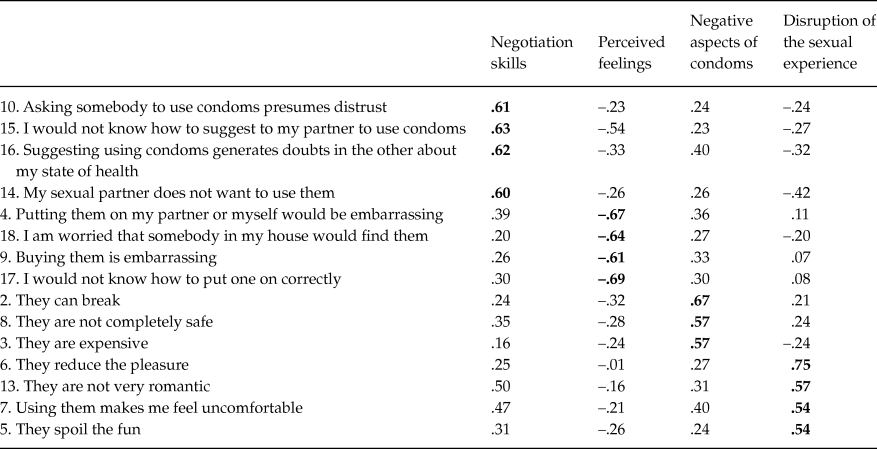
The results of the structural matrix are presented in Table 1. A KMO value of .85 was obtained, and Bartlett’s sphericity test, χ2(171) = 1272.12; p < .001, confirmed a structure suitable with five dimensions and an explained variance of 40.25%. However, it does not show a final factorial solution after a maximum of 25 iterations. The items 1, 11, 12, and 19 were removed due to their low communality (.24, .18, .23, and .19, respectively). After that, a new factor analysis was conducted with the new set of items (15), obtaining a four-factor structure: KMO = .84 and χ2 = 1071.93; p < .001. All items obtained moderate saturation in the extracted factors, varying between .60 and .63 (factor 1), –.61 and –.69 (factor 2), .57 and .67 (factor 3), and .54 and .75 (factor 4). We also found that some items saturated in more than one factor; however, we chose the higher value. The communality values of all items were higher than .30. The percentage of total variance explained by these four factors was 41.89%.
Exploratory Factor Loadings

Note: Bold type indicates items with loadings > .30.
Confirmatory Factor Analysis
The CFA results with ML estimation revealed a robust structure with four factors with a good fit, as indicated in the different adjustment indexes analyzed: NNFI = .93; CFI = .95; IFI = .95; and RMSEA = .04.
Reliability
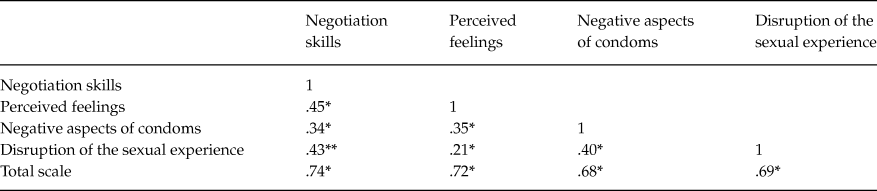
The ordinal alpha for the total scale was .86. Factor 1 had moderate to low internal reliability (α = .73) with four items related to negotiation skills. Factor 2 contained three items related to perceived feelings, such as worry and feelings of shame, and obtained an ordinal alpha of .81. Factor 3 included four items that refer to negatively perceived aspects of condoms (security, management, and cost), showing an ordinal alpha of .63. Factor 4 consisted of four items related to the disruption of the sexual experience and showed moderate internal reliability (α = .78). It is noteworthy that the alpha obtained for the total scale did not improve by removing any item according to the factorial solution extracted in the exploratory analysis except for a slight improvement in factor 1 of .02 if item 10 was deleted. Table 2 shows the interrelationships between the CUBS-A subscales.
Correlations among CUBS-A subscales

Note: * p < .01.
Concurrent Validity
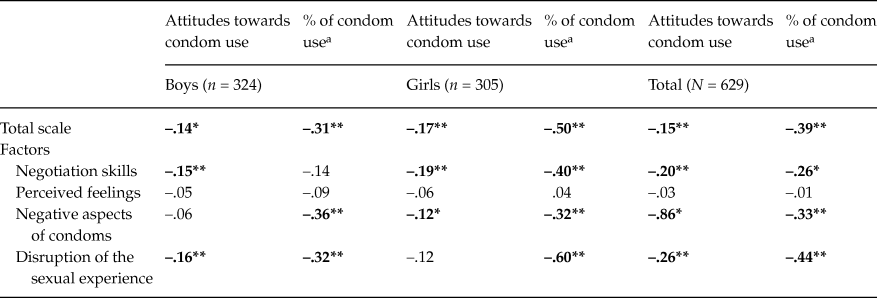
Concurrent validity was evaluated with the percentage of condom use and attitudes towards condom use variables in the total sample and by gender (Table 3).
Concurrent criterial validity

Note: a Among those who use condoms (n = 172); * p < .05; ** p < .01; Bold type indicates statistically significant differences.
Barriers to Condom Use
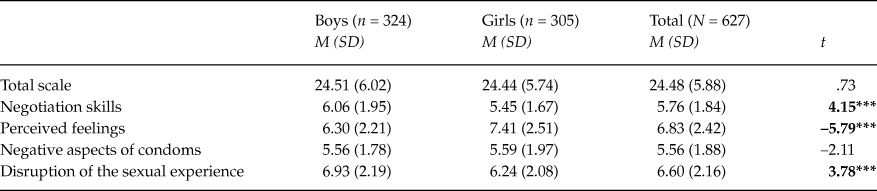
Table 4 shows the mean scores and the extracted factors. Gender differences were found in three of the four dimensions of the CUBS-A. Boys perceive more barriers in the dimensions of communication skills and interruption of the sexual experience (p < .001), while girls receive a higher score on the perceived feelings factor subscale (p < .001). No gender differences were found in the negative aspects of the condom dimension.
Barriers towards condom use in the total sample and by gender

Note: *** p ≤ .001; Bold type indicates statistically significant contrasts.
Discussion
The main objective of this study was to analyze the psychometric properties and factorial structure of a new scale aimed at evaluating the barriers that interfere with condom use in an adolescent population due to the absence of validated tools in the Spanish context. A valid and reliable tool to evaluate condom use barriers is needed in order to identify those barriers directly related to the use of condoms in this population.
The results reflect the instrument’s good properties. Exploratory factor analysis provides a structure of four factors that explain a moderate percentage of variance. Confirmatory factor analysis provides good fit indices of the model for the structure of four underlying factors of the exploratory analysis. The instrument showed high internal consistency, and this value did not increase by removing any item. Suitable values of internal consistency for each factor, except for factor 3. This can be explained by the low number of items that make up the factor. Loewenthal (Reference Loewenthal1996) considers acceptable values from .60 on scales with less than 10 items. It would be interesting to check if these items function the same way in other adolescent samples.
The attitude towards condom use is related to the percentage of condom use in accordance with the Theory of Planned Behavior (Ajzen, Reference Ajzen1991) and is consistent with the sample results. On the other hand, the TPB demonstrates the influence of beliefs on the establishment of attitudes, understanding the barriers as ideas or negative beliefs that subjects perceive about condoms. However, the data showed higher correlations with the percentage criteria of condom use for both sets of items as factors. Therefore, it can be concluded that the scale shows greater ability to accurately measure perceived barriers in samples which are sexually active. Muñoz-Silva et al. (Reference Muñoz-Silva, Sánchez-García, Nunes and Martins2007) conclude that barriers to condom use is the second most important variable for predicting the frequency of condom use among young Spaniards. One of the possible causes for finding lower correlations between the perceived barriers and attitudes towards condom use is that non-sexually active adolescents form their beliefs about using condoms roughly by information received from their peers, professionals, mentors, parents, the Internet, etc., and the correlations can vary when they encounter difficulty in using condoms during sex.
Data from this study indicate that there are clear gender differences in perceived barriers to condom use. Compared to girls, boys perceive greater disruption of the sexual experience, such as decreased pleasure and negotiation skills, as barriers to using condoms. Various studies concur that boys place more importance upon issues relative to sexual pleasure and satisfaction (Lameiras et al., Reference Lameiras, Rodríguez, Calado and González2003), while girls focus more on aspects relative to romanticism and feeling connected with their partner during sexual activity (Sanchez et al., Reference Sánchez, Phelan, Moss-Racusin and Good2012). Compared to boys, girls are more concerned on emotional levels, like the feelings of shame that arise when putting them on their partner or buying them. Although these barriers were not related to the attitude towards condom use or the percentage of use in girls, they are important to keep in mind when designing prevention programs, as they reflect the prevailing beliefs in gender roles in matters of sexuality.
It is noteworthy that boys and girls show a lower percentage of condom use when they perceive barriers that interfere with pleasure and identify negative aspects connected to condoms. Carrying out efforts directed at demystifying false beliefs, reducing negative perceptions, and highlighting the positive aspects of condoms, such as pleasure and their use (Crosby, Charnigo, & Shrier, Reference Crosby, Charnigo and Shrier2014), are recommended. Furthermore, girls relate lower condom use with poor communication and negotiation skills. Tschann et al. (Reference Tschann, Flores, de Groat, Deardorff and Wibbelsman2010) indicated that girls have fewer strategies for verbal and nonverbal communication to negotiate condom use.
The limitations of this study should be taken into account when interpreting its results. First, the sample was incidentally recruited and came from the same geographical area. Second, in order to analyze the correlation between the barriers to condom use and actual condom use in order to analyze the criterial validity, adolescents who reported being sexually active and using condoms as a preventive method were selected. This sub-sample was small (representing 27.34% of the total sample), so it would be interesting to utilize a larger sample of sexually active adolescents to increase the representativeness and generalizability of the results. Third, future research would need to assess the predictive ability of the CUBS-A. Finally, the adolescents and youngsters evaluated were in school, so generalizing these results to adolescents in other contexts was not possible.
The results of this study have important implications for the promotion of sexual health in adolescents since it can reveal the barriers our youngsters perceive before they initiate sex and risk behaviors occur; therefore, it is capable of influencing the difficulties by increasing the percentage of condom use at first sexual intercourse. It is desirable that preventive programs include contents that provide adolescents with the knowledge and skills necessary to overcome the identified barriers. It is also important to address the gender differences in the perception of these barriers, with the ultimate aim of increasing the proportion of teens using condoms consistently.