INTRODUCTION
Hookworm infection is one of the most important parasitic infections in humans, possibly outranked only by malaria as a cause of misery and suffering. Because they injure their human hosts directly by causing intestinal blood loss leading to iron deficiency and protein malnutrition, some investigators consider hookworms as the most important helminthic cause of global disease burden. About 1·2 billion people are infected by hookworm in rural areas of poverty in the tropics and subtropics. Epidemiological data collected in China, Southeast Asia and Brazil indicate that unlike other soil-transmitted helminth infections, the highest hookworm burden typically occurs in the adult population, including the elderly (Hotez et al. Reference Hotez, Zhan, Bethony, Loukas, Williamson, Goud, Hawdon, Dobardzic, Dobardzic, Ghosh, Bottazzi, Mendez, Zook, Wang, Liu, Essiet-Gibson, Chung-Debose, Xiao, Knox, Meagher, Inan, Correa-Oliveira, Vilk, Shepherd, Brandt and Russell2003).
Latest findings indicate that hookworms may induce a state of host immunological hyporesponsiveness and promote susceptibility to intercurrent viral, bacterial or protozoan infections such as measles, HIV-AIDS (Wolday et al. Reference Wolday, Mayaan, Mariam, Berhe, Seboxa, Britton, Galai, Landay and Bentwich2002) and tuberculosis (Borkow et al. Reference Borkow, Weisman, Leng, Stein, Kalinkovich, Wolday and Bentwich2001), which are of tremendous importance in areas where these diseases coexist. High rates of hookworm infections are known to occur in sub-Saharan Africa (Stoltzfus et al. Reference Stoltzfus, Kvalsvig, Chwaya, Montresor, Albonico, Tielsch, Savioli and Pollit2001), South China (Bethony et al. Reference Bethony, Chen, Lin, Xiao, Zhan, Li, Xue, Xing, Humphries, Yan, Chen, Foster, Hawdon and Hotez2002), Southeast Asia (Humphries et al. Reference Humphries, Stephenson, Pearce, The, Dan and Khanh1997), India and Nepal (Dreyfuss et al. Reference Dreyfuss, Stoltzfus, Shrestha, Pradhan, LeClerq, Khatry, Shrestha, Katz, Albonico and West2000), and Americas (Labiano-Abello et al. Reference Labiano-Abello, Canese, Velazquez, Hawdon, Wilson and Hotez1999).
The purpose of this study was to investigate the effects of consecutive selective chemotherapy, mass chemotherapy as well as target chemotherapy on hookworm-infected villagers in tested villages, so as to explore the strategy of hookworm disease control in hypo-endemic areas. Selective chemotherapy means that sensitive and differential detective methods are carried out on a collection of people, the infected individuals are identified, and the medication is administered. This is also called an all-pervading survey. Mass chemotherapy means that all of the village inhabitants are given the chemotherapy without any inspection or diagnosis in the high endemic area where parasite infection is extremely common. This is also called all-civil chemotherapy. Target chemotherapy means that the chemotherapy is only given to individuals with high risk, which is also called key-crowd chemotherapy.
MATERIALS AND METHODS
Observational parameters
The studies were conducted respectively in Jiangdu city and Gaoyou city of north Jiangsu Province, China. The selective chemotherapy was used to treat the egg-positive individuals in the tested villages in Jiangdu city. The total population was 1400 in the selective chemotherapy villages. The comparative study was conducted between the target chemotherapy and mass chemotherapy in endemic areas of low hookworm infection, i.e. Gaoyou City. Mass chemotherapy means treating all of the population over 2 years except in the case of contraindication with mebendazole. The population for target chemotherapy, mass chemotherapy and the control villages is 1000 per one. In this study we did not intend to compare efficacy of the selective chemotherapy in a high transmission area with that of the target and mass chemotherapy in a low transmission area.
Stool examination
The method of improved Kato's thick smear was used. Briefly, the hole of the quantitative board was filled with stool, and then placed on the slice. The stool was covered with hydrophilic cellophane dipped in glycerin and malachite green solutions (glycerin 98 ml, water 100 ml and 3% malachite green 2 ml). The stool was pressed thinly, and examined after 1 h at 25 °C (Katz, Reference Katz, Coelho and Pellegrino1970; Yang et al. Reference Yang, Shen, Shao, Zhang, Liu, Zhang, Cai and Hong2002).
Chemotherapeutic schemes
Selective chemotherapy was applied to treat the egg-positive cases with albendazole 300 mg and co-mebendazole 375 mg in combination for 1·5 days. Before the chemotherapy was carried out, the examination was performed on all the villagers' feces for hookworm eggs in the locale. Target chemotherapy was applied to treat those individuals susceptible to hookworm infection with mebendazole. Before the chemotherapy was carried out, villagers' feces were sampled for hookworm eggs in the locale. The target of chemotherapy included the egg-positive cases in the sampling, children aged between 2 and 12 in kindergarten and elementary school, individuals who had physical signs and symptoms of hookworm disease, peasants who touched the soil frequently, and the individuals who came from an epidemic area of hookworm disease. The target chemotherapy was applied to treat 140 cases, except those individuals who had contraindication of mebendazole (allergic to mebendazole, functional disorder of kidney or liver etc.). Mass chemotherapy was applied to treat all individuals except those with contraindication of mebendazole. Before the chemotherapy was carried out, the feces of the villagers in the locale had not examined. In total, 600 mg of mebendazol was taken by each adult, 3 times in 1·5 days and a total of 400 mg of mebendazol was taken by each child (2 to 12 years old), twice in 1 day in the mass and target chemotherapy schemes. NaHCO3 was used as a placebo in the control village and its dosage was the same as that used by the adults and children in the mass and target chemotherapy schemes. Improved Kato's thick smear method was used for examining hookworm eggs to evaluate the efficacy of chemotherapeutic schemes 12 to 16 months after the treatment.
Data analysis
The negative binomial distribution was used to fit the selective chemotherapy data by using the statistic software R2.2.1. Re-infection can cause the accumulation of the eggs in the excrement of infected people, and the analysis of the sample data also indicates that the variance is larger than the mean, therefore we used the negative binomial distribution including 2 parameters (μ and k) to fit the infectiosity (EPG) data. The replacement of μ is the sample, which means that  and k are obtained by the following formula:

obtaining and s 2 for the data from each examined infectious (EPG) sample, and calculating k through the above formula. Then the Monte-Carlo method was used to calculate the 95% confidence interval (CI) of the infectious data (simulate 10 000 data which have the negative binomial distribution with parameters and k, in which the 2·5% and 97·5% quantile numbers were respectively the upper and lower boundary of the 95% confidence interval) (Torgerson et al. Reference Torgerson, Schnyder and Hertzberg2005). The Monte-Carlo method is a computational algorithm which relies on repeated random sampling to compute its results. It is a useful method to calculate the confidence interval.
RESULTS
Effect of selective chemotherapy on hookworm infections in human
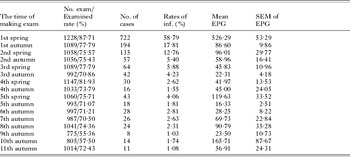
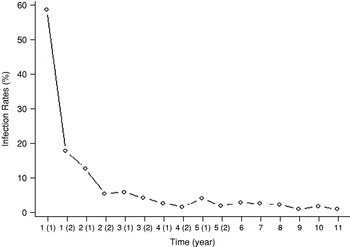
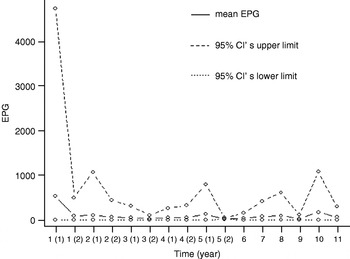
Selective chemotherapy is conducted twice in autumn and spring in the first 5 years, and once in autumn in the next 5 years. The infection rate decreased from 58·79% to 1·08% and the mean EPG changed from 526·29 to 56·91. The profile of hookworm infection rates appears as an ‘L’ shape (Table 1, Fig. 1). The infection rate and the mean EPG fluctuate at low level after the first three chemotherapies (Fig. 2).
The consecutive changes in infection rate and intensity (EPG) of hookworm infection following chemotherapy

Profile of hookworm infection rates. The vertical axis represents the infection rates (%). The horizontal axis represents the time of making the examination. For example: 1 (1) means the spring of the first year; 1 (2) means the autumn of the first year.

The 95% CI and intensity (mean EPG) of hookworm infection. The vertical axis represents the EPG. The horizontal axis represents the time of making the examination. For example: 1 (1) means the spring of the first year; 1 (2) means the autumn of the first year.

Control effects of the mass and target chemotherapy schemes on hookworm infection in hypo-endemic area
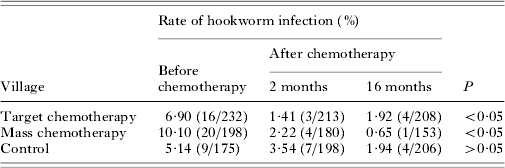
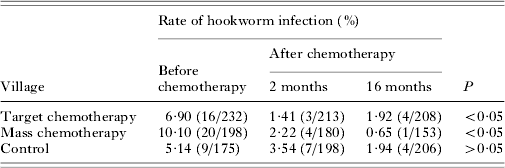
The hookworm infection rates droped from 6·90% before the treatment to 1·41% during the second month after treatment and to 1·92% during the 16th month after treatment. The mean EPG decreased from 418·50 to 72·00 in the target chemotherapy village. Similarly, the hookworm infection rates droped from 10·10% to 2·22% and 0·65%, and the mean EPG decreased from 396·60 to 168·00 in the mass chemotherapy village. However, the infection rates in the control village were 5·14%, 3·54% and 1·94% (Table 2).
Changes in the rate of hookworm infection after chemotherapy
Changes in constituent ratio of hookworm infection after and before the mass and target chemotherapy
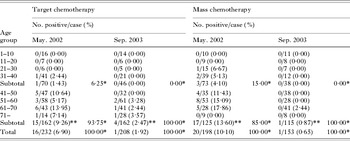
Table 3 shows the hookworm infection percentage and the constituent ratio of hookworm-infected persons in the different age groups. Before target chemotherapy, the infection percentages were 1·43% and 9·26% respectively, the constituent ratio was 6·25% and 93·75% in the 1 to 40-year-old and the >41-year-old age groups, respectively. After the target chemotherapy, infection percentages were 0 and 2·47% respectively, and the constituent ratio was 0 and 100·00% in the two groups respectively. After target chemotherapy, the hookworm infection percentage dropped significantly in various age groups. Simultaneously, the individuals above 41 years old comprised the majority of the hookworm-infected inhabitants. Before the mass chemotherapy, the infection percentages were 4·10% and 13·60% respectively, and the constituent ratios were 15·00% and 85·00% respectively in the 1 to 40-year-old and the >41-year-old groups. After mass chemotherapy, infection percentages were 0 and 0·87% respectively, and the constituent ratios were 0 and 100·00% respectively in the 2 groups. After mass chemotherapy, the hookworm infection percentage dropped significantly in various age groups. Individuals above 41 years old also comprised the majority of the hookworm-infected inhabitants (Table 3).
Changes in the constituent ratio of hookworm infection after and before chemotherapy

* Constituent ratio (%), ** P<0·01.
DISCUSSION
At present, the community chemotherapy schemes used in China for parasitic disease control include selective chemotherapy, mass chemotherapy and target chemotherapy.
Selective chemotherapy is applied early in the prevention and control of parasitic diseases, and its merit lies in helping the infected individuals to implement the chemotherapy, so as to rapidly reduce the infection rate. However, the effort involved in carrying out an all-pervading survey is so large that the selective chemotherapy has certain limitations in large-scale implementation. This study indicates that, the continual selective chemotherapy rapidly decreases both the infection rate and the mean EPG of hookworm-infected individuals, and keeps them fluctuating at a lower level. While applying the statistical software R2.2.1, we used the negative binomial model to fit the data. Statistical analysis revealed that both curves for the infection rate and the mean EPG declined in an ‘L’ shape. After the third chemotherapy, the infection rate and the mean EPG fluctuated and was maintained at a low level for a long period of time, but total inhibition of hookworm disease prevalence was not achieved, perhaps due to re-infection and latent drug resistance etc.
Mass chemotherapy means that all of the inhabitants (except children aged below 2 and medicine exclusions) are given the chemotherapy, without any inspection or diagnosis, in the high endemic area where parasite infection is extremely common. The target chemotherapy is one kind of new plan to control intestinal nematodiasis and has been developed in recent years. Target chemotherapy means that the chemotherapy is only given to individuals with high risk.
Nematodiasis control has been implemented for many years. Mass chemotherapy and selective chemotherapy have their own advantages and disadvantages. When the hookworm infection rate drops to 10% or below, mass chemotherapy can lead to an increase in the consumption of medicines and in the workload of delivering the medicine. Therefore, we adopt one kind of frugal, effective new control measure, namely, target chemotherapy. We compared and observed the effect on hookworm disease control between the mass chemotherapy and the target chemotherapy in the lower endemic area. The result shows that, the curative effect is similar between the mass chemotherapy and the target chemotherapy. The target chemotherapy can decrease the hookworm infection rate significantly in a short period of time (2 months after the chemotherapy), and the infection rate did not rise significantly during the 16 months following chemotherapy. Moreover, comparing target chemotherapy with mass chemotherapy, we found that target chemotherapy may not only save on the massive use of medicines and reduce the workload, but also reduce both the side-effects of the medicine and the drug resistance of parasite. WHO (World Health Organization) emphasizes that when applying the anti-worm medicine, attention should be paid to the development of drug resistance. It is a very good restrictive strategy to reduce the speed of restrictions on the ‘high-risk’ population tested with the chemotherapy (WHO, 1998).
Because of the lack of currently available vaccine, the non-chemotherapy method cannot eliminate the parasite. For a long time, expelling worms with chemical medicine has become the main method of preventing and controlling parasitic disease. In recent years, the drug resistance of digestive tract wireworm has become a serious problem in human and livestock nematodiasis control, especially nematodiasis in cattle and sheep all over the world. In the late 1970s, many reports were drawn up on the resistance of the wireworm to the benzimidazole class of drugs. Simultaneously, multi-drug resistance to benzimidazole in parasites has been discovered (i.e. the cross-drug resistance in many kinds of benzimidazole-class medicines). A new medicine (e.g. ivermectin) was also produced to solve the problem of resistance, or the signs of resistance. The most likely outcome of this is a bacterium multi-drug resistance (Wang and Shen, Reference Wang and Shen1997; Jones and George, Reference Jones and George2005). In recent years, a great number of studies have reported on ‘discovery technology’ for drug resistance of parasitic nematodes, and investigations of the mechanisms to prevent resistance are carried out in the veterinarian field worldwide. WAAVP (World Association for the Advancement of Veterinary Parasitology) has drawn up the criteria for appraisal of helminths and the testing methods for examining effective antibiotics in vivo or in vitro. WAAVP has also drawn up the IPM (Integrated Pest Management) report on parasitic drug resistance (Waller, Reference Waller1999). Although we have not conducted such experiments concerning the detection of drug resistance as performed in the IPM research, the result from the current study indicates that hookworms may have become resistant to benzimidazole. The co-existence of drug resistance and re-infection is assumed to be the primary cause of major epidemic hookworm disease. At present, the primary measures of preventing and controlling hookworm disease are (i) prompt and thorough chemotherapy of infected persons, (ii) appropriate fecal disposal, and (iii) personal protection after entering known endemic areas, such as covering bare feet. Such proper sanitation measures target interruption of the hookworm life cycle. Certainly, the development and application of a hookworm vaccine is one of the most promising ways of preventing human hookworm disease.
The study was supported by the Scientific and Technological Program of Jiangsu Province (No. BS2004534). We gratefully acknowledge the efforts of Professor Z. H. Zhang, Nanjing Medical University, Nanjing, China, for carefully reading and revising the manuscript.