For nearly four decades, researchers have documented significant emotional distress for caregivers of persons with traumatic brain injury (TBI). Distress has been evidenced by self-reported symptoms of depression and anxiety, beginning as early as the first year following injury and persisting for at least 5–7 years (Brooks, Campsie, Symington, Beattie, & McKinlay, Reference Brooks, Campsie, Symington, Beattie and McKinlay1986, Reference Brooks, Campsie, Symington, Beattie and McKinlay1987; Gillen, Tennen, Affleck, & Steinpreis, Reference Gillen, Tennen, Affleck and Steinpreis1998; Kreutzer, Gervasio, & Camplair, Reference Kreutzer, Gervasio and Camplair1994; Kreutzer et al., Reference Kreutzer, Rapport, Marwitz, Harrison-Felix, Hart, Glenn and Hammond2009; Livingston, Brooks, & Bond, Reference Livingston, Brooks and Bond1985; Marsh, Kersel, Havill, & Sleigh, Reference Marsh, Kersel, Havill and Sleigh1998a, Reference Marsh, Kersel, Havill and Sleigh1998b; Ponsford, Olver, Ponsford, & Nelms, Reference Ponsford, Olver, Ponsford and Nelms2003). In spite of this distress, there has been minimal research evaluating interventions to reduce caregiver distress (Sander, Reference Sander, High, Sander, Struchen and Hart2005, Reference Sander, Zasler, Katz and Zafonte2007). This may be partly due to lack of well-designed prognostic studies identifying risk factors for emotional distress in caregivers. Prognostic studies serve as a foundation for development of interventions that can then be evaluated.
The extant literature on predictors of emotional distress in caregivers of persons with TBI reveals a plethora of studies. Many studies have investigated the predictive ability of injury severity, neurobehavioural impairments in the person with injury, or activity and participation levels in the person with injury. Other studies have focused on characteristics of the caregivers themselves, including demographics (e.g., age, gender, relationship to the person with injury), perceptions of the caregiving role and coping styles. Still others have investigated the prognostic value of environmental conditions, such as social support and access to care. Unfortunately, the conclusions of these studies are often limited by methodological challenges. Thus, it is difficult to derive treatment recommendations and to determine the most productive avenue for future research. While there have been several reviews of emotional distress in caregivers, (Florian, Katz, & Lahan, Reference Florian, Katz and Lahav1989; Kreutzer et al., Reference Kreutzer, Marwitz and Kepler1992; Perlesz, Kinsella, & Crowe, Reference Perlesz, Kinsella and Crowe1999) none have focused on predictors of distress.
The purpose of the current paper is to provide a systematic review of the evidence for prognosis of emotional distress in caregivers of adults with TBI and to provide evidence-based classification for prognostic variables to guide future research and clinical practice. This review was focused solely on the outcome of emotional distress and not on other caregiver outcomes, such as family functioning and life satisfaction. The concept of ‘burden’ has often been used to describe the impact of TBI on caregivers (Brooks et al., Reference Brooks, Campsie, Symington, Beattie and McKinlay1986, Reference Brooks, Campsie, Symington, Beattie and McKinlay1987; Marsh et al., Reference Marsh, Kersel, Havill and Sleigh1998a, Reference Marsh, Kersel, Havill and Sleigh1998b; McKinlay, Brooks, Bond, Martinage, & Marshall, Reference McKinlay, Brooks, Bond, Martinage and Marshall1981); however, the construct of ‘burden’ is often not clearly defined and has been viewed alternately as objective/concrete changes (Brooks, Reference Brooks1991), perceived stress (Chwalisz, Reference Chwalisz1992) and caregiver appraisals (Struchen, Atchison, Roebuck, Caroselli, & Sander, Reference Struchen, Atchison, Roebuck, Caroselli and Sander2002). Due to inconsistency in the conceptualisation of the term ‘burden’, the current review did not include studies that aimed only at predicting ‘burden’, except when it was used synonymously with emotional distress.
Method
Literature Search and Initial Inclusion/Exclusion Criteria
Peer-reviewed articles published through October 2012 that addressed emotional distress in caregivers of adults with TBI were considered for review. The specific criteria for inclusion were as follows:
(1) The article was written in English.
(2) The sample involved caregivers of adults with TBI; or the sample involved caregivers of persons with mixed aetiology (e.g., stroke, dementia), but the subsample of caregivers of adults with TBI was analysed separately.
(3) The primary or secondary outcome was an aspect of caregiver emotional distress. (Studies that focused only on caregiver burden, caregiver life satisfaction or family systems functioning as outcomes were excluded.)
(4) Included a prediction model that examined simultaneously the relationship between two or more predictor variables (of any type) and outcome. (Studies with simple correlations only or group comparisons were excluded.)
Review articles, non-peer-reviewed articles, dissertations, conference abstracts and book chapters were excluded. We also excluded studies that focused on caregivers of paediatric patients.
We identified articles though electronic searches of PubMed, CINAHL and PsycINFO, using the following MeSH terms, subject headings and keywords: caregivers, traumatic brain injury, craniocerebral trauma, brain injuries, head injuries, well-being, emotional states, anxiety, distress, emotional responses, depression, emotional distress, emotions, psychological stress, emotional, burden, caregiver burden, caregiver emotional health, caregiver lifestyle disruption, caregivers/psychology. We also reviewed reference lists of included articles to locate additional studies not identified through database searches.
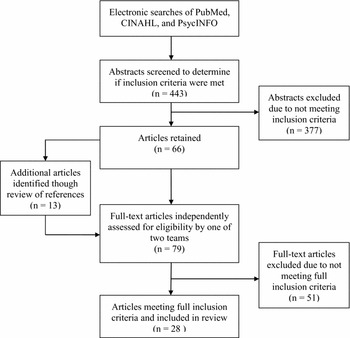
A flowchart illustrating the selection of studies for the literature review is shown in Figure 1. Electronic searches of databases yielded 443 references. The abstracts were reviewed by the first author (A.S.) to determine whether full inclusion criteria were met. If eligibility was not able to be determined from the abstract, the full paper was reviewed. At this stage, 66 articles were retained and independently reviewed by one of two teams, each comprised of two study authors (A.S./W.H. or K.M./A.C.). Review of references of included articles identified an additional 13 articles, which were also reviewed by one of the teams. Following detailed review, it was determined that an additional 51 articles did not meet inclusion criteria. A total of 28 articles met full inclusion criteria and were evaluated for this review.
Selection of studies for the literature review.

Review and Rating of Articles
Each article was reviewed by one of two teams (A.S./W.H. or K.M./A.C.). The teams consisted of three neuropsychologist investigators and one senior-level graduate student. The articles were evenly divided between the two teams, and articles that included Dr Sander as an author were reviewed by the other team (K.M./A.C.). Within each team, an article was reviewed and the data were abstracted on a form, developed by the first author, based on a prior systematic review done at our centre. Each team member independently rated each article. The two members then met to resolve any discrepancy in ratings.
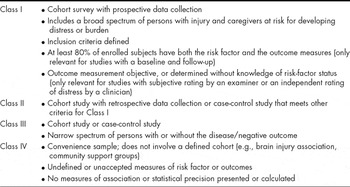
Reviews were conducted in accordance with the 2011 edition of the American Academy of Neurology (AAN) Guidelines for classifying evidence for prognostic studies (American Academy of Neurology, 2011). Because these guidelines were developed for classifying studies predicting medical outcomes (objective presence or absence of disease), modifications were required when applying these criteria to subjective outcomes of emotional distress. Table 1 shows the criteria that were used for determining the level of evidence in the current review.
Criteria for Rating Level of Evidence

Specific modifications to the AAN Guidelines warrant further comment. First, the criteria of having an objective outcome and objective predictors were eliminated for the current review. This was done because the very nature of the outcome being investigated in caregiver adjustment studies is subjective and is typically assessed by self-report measures. While it is possible to have an objective measure of emotional distress, such as occurrence of psychiatric/psychological treatment or diagnostic criteria, the absence of such criteria do not negate the presence of distress in caregivers. For this reason, self-report of emotional and behavioural symptoms is considered to be a gold standard for diagnosis, and is even used when completing structured diagnostic questionnaires, such as the Structured Clinical Interview for DSM-IV Diagnosis (First, Spitzer, Gibbon, & Williams, Reference First, Spitzer, Gibbon and Williams2002). Similarly, while many risk factors for distress may be objective (e.g., severity of impairments in the person with injury, gender), there are many risk factors that are subjective by their nature (e.g., coping styles, appraisals of stress). These potential subjective predictors may have important treatment recommendations, and we decided not to devalue their weight with regard to predicting caregiver distress and burden.
Due to the subjective nature of many of the predictors and outcomes in this area of research, masking of outcomes assessment is not possible. Self-report measures are often used as both predictors and outcomes. This negates the need for a ‘blinded’ rater. This criterion was not rated unless the study employed a rating by an examiner (such as a rating of patient impairment by a clinician or an independent rating of caregiver depressive symptoms by a clinician). Therefore, studies were not rated down if masked outcomes assessment was not possible due to the self-report nature of the variables, provided that all other criteria were met for a particular class of study.
Many of the studies on predictors of caregiver distress involve predictors that are collected at the same time as the outcome measures (e.g., self-report of social support used to predict self-report of emotional distress). In such cases, the criterion of 80% of persons having the risk factor (baseline) and outcome (follow-up) assessment does not apply, and such studies were not rated down if the other criteria for a particular class of evidence were met. This 80% criterion was used for determining class of evidence for studies in which there were baseline risk factors used to predict later outcome.
While not clearly part of the AAN Guidelines, the quality of statistical analysis was also used as a means of determining evidence class for the current review. Studies that employed exploratory or data-driven methods to select predictors, such as selecting variables for inclusion based on bivariate/correlational analyses, were rated down a level.
After review and rating of articles, the following evidence-based classification system was applied for different prognostic variables: Level A – the predictor is a highly probable risk factor for emotional distress, as supported by two or more Class I studies; Level B – the predictor is a probable risk factor for emotional distress, as supported by at least one Class I study or two or more Class II studies; Level C – the predictor is a possible risk factor for emotional distress, as supported by one Class II study or two or more Class III studies.
Results
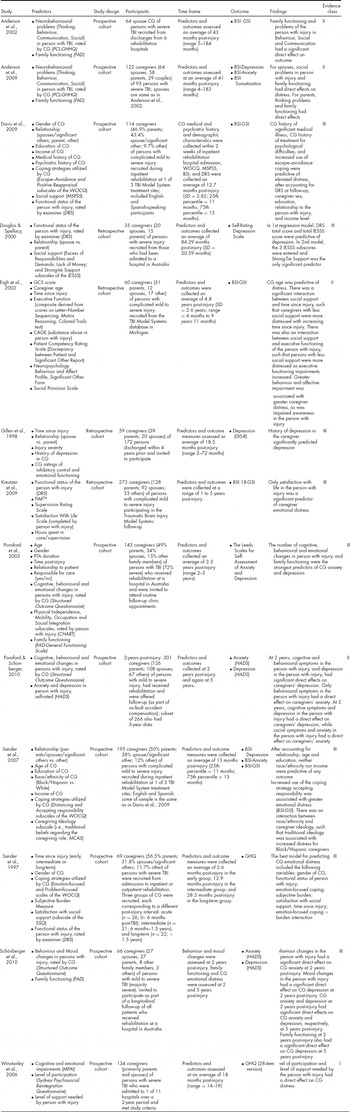
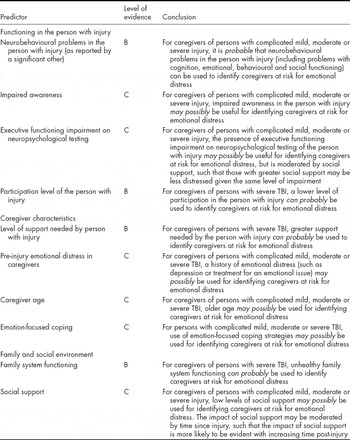
This review includes one Class I study (Winstanley, Simpson, Tate, & Myles, Reference Winstanley, Simpson, Tate and Myles2006), four Class II studies (Anderson, Parmenter, & Mok, Reference Anderson, Parmenter and Mok2002; Anderson et al., Reference Anderson, Simpson, Morey, Mok, Gosling and Gillett2009; Ergh, Rapport, Coleman, & Hanks, Reference Ergh, Rapport, Coleman and Hanks2002; Ponsford & Schonberger, Reference Ponsford and Schonberger2010), eight Class III studies (Davis et al., Reference Davis, Sander, Struchen, Sherer, Nakase-Richardson and Malec2009; Douglas & Spellacy, Reference Douglas and Spellacy2000; Gillen, et al., Reference Gillen, Tennen, Affleck and Steinpreis1998; Kreutzer, et al., Reference Kreutzer, Rapport, Marwitz, Harrison-Felix, Hart, Glenn and Hammond2009; Ponsford, et al., Reference Ponsford, Olver, Ponsford and Nelms2003; Sander, High, Hannay, & Sherer, Reference Sander, High, Hannay and Sherer1997; Sander et al., Reference Sander, Davis, Struchen, Atchison, Sherer, Malec and Nakase-Richardson2007; Schonberger, Ponsford, Olver, & Ponsford, Reference Schonberger, Ponsford, Olver and Ponsford2010) and 15 Class IV studies. The 15 Class IV studies were determined to have a high risk of bias due to: (a) the use of convenience samples (i.e., brain injury associations or non-consecutive clinic samples) in 10 studies (Blankfeld & Holahan, Reference Blankfeld and Holahan1999; Calvete & de Arroyabe, Reference Calvete and de Arroyabe2012; Degeneffe & Lynch, Reference Degeneffe and Lynch2006; Groom, Shaw, O'Connor, Howard, & Pickens, Reference Groom, Shaw, O'Connor, Howard and Pickens1998; Knight, Devereux, & Godfrey, Reference Knight, Devereux and Godfrey1998; Kreutzer, et al., Reference Kreutzer, Gervasio and Camplair1994; Riley, Reference Riley2007; Rivera, Elliott, Berry, Grant, & Oswald, Reference Rivera, Elliott, Berry, Grant and Oswald2007; Stebbins & Pakenham, Reference Stebbins and Pakenham2001; Wells, Dywan, & Dumas, Reference Wells, Dywan and Dumas2005); (b) the use of undefined/unclear measures as predictors in three studies (Marsh, Kersel, Havill, & Sleigh, Reference Marsh, Kersel, Havill and Sleigh2002; Marsh et al., Reference Marsh, Kersel, Havill and Sleigh1998a, Reference Marsh, Kersel, Havill and Sleigh1998b); and (c) failure to provide data on the statistical values supporting stated results in two studies (Livingston, Reference Livingston1987; Livingston, et al., Reference Livingston1985). The prognostic evidence for the Class I–III studies will be reviewed by broad category of predictor. Design characteristics and outcomes for Class I, II and III studies are summarised in Table 2. A summary of the evidence-based classification for different prognostic variables by broad category of predictor is shown in Table 3. The timing of assessment of predictors and outcomes in the studies reviewed ranged from 4 months to over 9 years, with the average of most studies being greater than 1 year after injury.
Design Characteristics and Outcomes for Class I, II and III Studies

CG, caregiver; TBI, traumatic brain injury; PCL-GHHQ, Problem Checklist of the General Health and History Questionnaire; BSI, Brief Symptom Inventory; BSI-GSI, Global Severity Index of the Brief Symptom Inventory; FAD, Family Assessment Device; WOCQ, Ways of Coping Questionnaire; DRS, Disability Rating Scale; MSPSS, Multidimensional Scale of Perceived Social Support; IESSS, Instrumental-Expressive Social Support Scale; DIS-R, Diagnostic Interview Schedule- Revised; HADS, Hospital Anxiety and Depression Scale; CHART, The Craig Handicap Assessment and Reporting Technique; MCAS, Modified Caregiver Appraisal Scale; GHQ, General Health Questionnaire; SSQ, Social Support Questionnaire; MPAI, Mayo–Portland Adaptability Inventory.
Evidence-based Classification for Prognostic Variables by Broad Category of Predictor

Functioning in the Person with Injury
Six studies, which included four Class II (Anderson, et al., Reference Anderson, Parmenter and Mok2002, Reference Anderson, Simpson, Morey, Mok, Gosling and Gillett2009; Ergh, et al., Reference Ergh, Rapport, Coleman and Hanks2002; Ponsford & Schonberger, Reference Ponsford and Schonberger2010) and two Class III studies (Ponsford, et al., Reference Ponsford, Olver, Ponsford and Nelms2003; Schonberger, et al., Reference Schonberger, Ponsford, Olver and Ponsford2010), supported the contribution of neurobehavioural problems (e.g., problems with thinking and behavioural or emotional control) to caregiver emotional distress. All of these studies used caregiver ratings of neurobehavioural functioning as the predictor. A relationship between impaired awareness in the person with injury, as assessed by the discrepancy between self and significant other report on the Patient Competency Rating Scale, and caregiver distress was demonstrated in a Class II study (Ergh et al., Reference Ergh, Rapport, Coleman and Hanks2002). This study also investigated the relationship of executive functioning impairment (measured by neuropsychological test performance) to caregiver distress and found that executive functioning interacted with caregivers’ social support. Caregivers with less social support were more distressed when the person that they cared for showed greater impairment in executive functioning.
The relationship between caregiver distress and functional status, activities and/or participation in the person with injury was supported by a few studies. One study provided Class III evidence of increased distress in caregivers associated with lower functional status in the person with injury, as assessed by examiner-rated Disability Rating Scale (DRS) (Douglas & Spellacy, Reference Douglas and Spellacy2000). A single Class I study reported that greater participation in the person with injury, as assessed by the Sydney Psychosocial Reintegration Questionnaire, was predictive of less caregiver distress on the 28-item General Health Questionnaire (Winstanley et al., Reference Winstanley, Simpson, Tate and Myles2006). This study also showed a direct effect of level of support needed by the person with injury on caregiver distress. Kreutzer and colleagues (Reference Kreutzer, Rapport, Marwitz, Harrison-Felix, Hart, Glenn and Hammond2009) provided Class III evidence that greater satisfaction with life in the person with injury was predictive of less caregiver distress.
There was insufficient evidence to support the prediction of caregiver distress from injury severity alone or from time since injury. These predictors were often not investigated individually, but used as covariates for other predictors.
Conclusions
There is Level B evidence for the prognostic ability of neurobehavioural impairments in the person with injury, as reported by the significant other. For caregivers of persons with complicated mild, moderate or severe injury, it is probable that neurobehavioural problems in the person with injury (including problems with cognition, emotional, behavioural and social functioning) can be used to identify caregivers at risk for emotional distress. There is also Level B evidence for the prediction of caregiver emotional distress from the participation level of the person with injury and the level of support needed by the person with injury, for caregivers of persons with severe injury. These two predictors can probably be used to identify caregivers at risk for emotional distress following severe TBI. Level C evidence exists for the prognostic ability of impaired awareness and impaired executive functioning in the person with injury. For caregivers of persons with complicated mild, moderate or severe injury, impaired awareness or impaired executive functioning in the person with injury may possibly be useful for identifying caregivers at risk for emotional distress; however, the impact of executive functioning appears to be moderated by social support, such that those with greater social support may be less distressed given the same level of impairment.
Caregiver Characteristics
The prognostic ability of caregiver demographic characteristics (e.g., age, gender, relationship to the person with injury) has been investigated in several studies. Caregivers’ pre-injury history of emotional difficulties has been shown to be predictive of their post-injury distress in two Class III studies (Davis et al., Reference Davis, Sander, Struchen, Sherer, Nakase-Richardson and Malec2009; Gillen et al., Reference Gillen, Tennen, Affleck and Steinpreis1998). The Davis et al. (Reference Davis, Sander, Struchen, Sherer, Nakase-Richardson and Malec2009) study also found that caregivers’ pre-injury history of medical illness was predictive of their post-injury emotional distress. Another Class III study showed that caregivers’ emotional distress (anxiety and depression) at 2 years after injury was predictive of their distress at 5 years post-injury (Schonberger et al., Reference Schonberger, Ponsford, Olver and Ponsford2010). Older caregiver age was associated with greater emotional distress in one Class II study (Ergh et al., Reference Ergh, Rapport, Coleman and Hanks2002). One Class III study found that race/ethnicity of caregivers interacted with caregiver ideology to impact emotional distress (Sander et al., Reference Sander, Davis, Struchen, Atchison, Sherer, Malec and Nakase-Richardson2007). Specifically, Black and Hispanic caregivers who held traditional ideologies about caregiving (e.g., caregiving as an obligation) showed greater emotional distress.
Caregivers’ coping styles have been the topic of a few prognostic studies. Use of emotion-focused coping strategies has been found to be predictive of emotional distress in two Class III studies (Davis et al., Reference Davis, Sander, Struchen, Sherer, Nakase-Richardson and Malec2009; Sander et al., Reference Sander, Davis, Struchen, Atchison, Sherer, Malec and Nakase-Richardson2007) and was one variable in an overall significant predictive model in another Class III study (Sander et al., Reference Sander, High, Hannay and Sherer1997). Specific emotion-focused strategies that were predictive of greater emotional distress included use of escape–avoidance (Davis et al., Reference Davis, Sander, Struchen, Sherer, Nakase-Richardson and Malec2009) and accepting responsibility (Sander et al., Reference Sander, Davis, Struchen, Atchison, Sherer, Malec and Nakase-Richardson2007).
Conclusions
In caregivers of persons with complicated mild, moderate or severe TBI, there is Level C evidence for the prognostic ability of caregivers’ pre-injury emotional distress, age and use of emotion-focused coping. Caregivers who are older, have a history of emotional distress or make use of emotion-focused coping may possibly be at risk for emotional distress.
Family and Social Environment
Family systems functioning showed a significant impact on concurrent caregiver distress in two Class II studies (Anderson et al., Reference Anderson, Parmenter and Mok2002, Reference Anderson, Simpson, Morey, Mok, Gosling and Gillett2009) and one Class III study (Ponsford et al., Reference Ponsford, Olver, Ponsford and Nelms2003). In a further Class III study, family functioning at 2 years post-injury was predictive of caregiver distress at 5 years post-injury (Schonberger et al., Reference Schonberger, Ponsford, Olver and Ponsford2010). The prognostic ability of caregivers’ social support has been investigated in several studies. One Class III study showed that low social support was predictive of depression (Douglas & Spellacy, Reference Douglas and Spellacy2000). In a Class II study, Ergh and colleagues (Reference Ergh, Rapport, Coleman and Hanks2002) reported that social support interacted with time since injury, such that caregivers with less social support were more distressed with increasing time post-injury. In a Class III study, caregivers’ satisfaction with social support was one variable in a model that significantly predicted emotional distress (Sander et al., Reference Sander, High, Hannay and Sherer1997).
Conclusions
There is Level B evidence for the prognostic ability of family systems functioning in caregivers of persons with severe TBI. Unhealthy family system functioning can probably be used to identify caregivers at risk for emotional distress. Level C evidence exists for the predictive ability of social support. For caregivers of persons with complicated mild, moderate or severe TBI, low levels of social support may possibly be used for identifying caregivers at risk for emotional distress. The impact of social support may be moderated by time since injury, such that the impact of social support is more likely to be evident with increasing time post-injury.
Discussion
The strongest evidence is for the predictive ability of significant other report of neurobehavioural impairments, participation level of the person with injury, level of support needed by the person with injury and family system functioning. For all of these predictors, there is evidence sufficient to identify them as probable prognosticators of caregiver emotional distress (Level B evidence). There is weaker evidence for the prognostic utility of impaired awareness in the person with injury, executive functioning impairment in the person with injury, pre-injury emotional distress in caregivers, caregiver age, caregivers’ use of emotion-focused coping and social support (Level C evidence).
Limitations and Implications for Future Research
It is noteworthy that there was only one Class I study reviewed. While there have been numerous studies investigating predictors of caregiver emotional distress, this area of research is clearly still in its infancy. The conclusions of the articles, and of this review, are limited by frequent lack of a theory-based or systematic selection of predictors to include in models. There is great variety in the type and number of demographic and injury characteristic predictors that have been controlled for. Future prediction studies should choose variables systematically, based on the findings to date. Choosing predictors based on bivariate correlations with emotional distress weakens the strength of evidence and should be avoided. Many of the studies were rated at lower evidence levels because they did not sufficiently describe the derivation of the sample. In many cases, it was difficult to determine whether the design of the study was prospective or retrospective, or whether the selection of participants was convenience-based. Future studies should describe the design and sample selection in sufficient detail to allow for conclusions regarding generalisability of results.
It should be noted that all potential variables that may impact caregivers’ emotional distress have not been fully evaluated in the extant literature. For example, relationship of the caregiver to the person with injury (e.g., parent or spouse) has been shown to be related to distress in some simple correlational and group comparison studies, but such studies were not included in the current review because they did not utilise prediction models. Five of the studies that were included in the current review investigated relationship of the caregiver to the person with injury; however, this variable was not significant in any of the models. The results should not be taken to indicate that relationship of the caregiver is not important and should not be considered in future studies, as the results may be highly dependent upon the combination of predictors used in each model. Indeed, there may be a multitude of other factors, not yet investigated, that may be important for predicting caregiver distress. Therefore, exploratory studies may still be warranted in this area to uncover unexplored variables that may contribute to caregivers’ distress. Toward this end, exploration of the literature on caregivers of persons with other diseases (e.g., dementia, chronic disability) may be beneficial.
The current review included studies that employed a variety of statistical techniques to describe the utility of different variables for predicting caregiver distress. While there is no accepted system of grading the statistical techniques used, different techniques likely result in different confidence levels regarding strength of prediction and generalisability to other samples. For example, path analytic and structural equation modelling techniques are typically based on an a priori model concerning the relationships between variables. Some would consider these models to be exploratory rather than prognostic. While we included evidence based on these types of models in the current review, their generalisability to other samples is not clear.
Likewise, the findings of studies using regression models may not be generalisable to studies including different combinations of predictors. Replication of studies using an empirical basis for choosing predictor variables, and conducted in larger multi-site samples, would strengthen the existing evidence base. The current review may be helpful as a foundation for selecting variables when designing studies, although inclusion of previously unexplored predictors can also help to strengthen the literature.
The current review used an adapted version of the AAN criteria for rating evidence. Studies were not rated down if the predictor variables were collected in parallel with the outcome variable; however, the evidence this type of design provides is not as strong as that of a true prognostic study, where identified risk factors can be assessed prior to measurement of outcomes in an effort to prevent the onset of poor outcomes. Even the Class I study identified in the current review (Winstanley et al., Reference Winstanley, Simpson, Tate and Myles2006) would not have been rated as highly if the criteria mandated that predictors be collected prior to outcomes. Thus, the results and implications of this review are largely limited to predictors at the time of outcomes assessment. Further research should be conducted to identify true prognostic indicators, as defined by risk factors that can be assessed at an early time point to predict later caregiver distress.
Emotional distress is an inherently subjective outcome, and many of the predictors and outcome measures used in the literature are subjective. For this reason, the traditional AAN requirement of objective measurement of predictors and outcomes was waived for the current review. The limitations of this approach must be acknowledged. It is possible that caregivers’ ratings of neurobehavioural impairments in the person with injury, as well as their ratings of family functioning and social support, may be impacted by their distress. A few of the reviewed studies included more objective predictors, such as neuropsychological test performance (Ergh et al., Reference Ergh, Rapport, Coleman and Hanks2002) or a clinician-rated measure of functioning in the person with injury (Davis et al., Reference Davis, Sander, Struchen, Sherer, Nakase-Richardson and Malec2009; Douglas & Spellacy, Reference Douglas and Spellacy2000; Kreutzer et al., Reference Kreutzer, Rapport, Marwitz, Harrison-Felix, Hart, Glenn and Hammond2009). Use of such objective measures would certainly improve confidence in their prognostic ability. Future studies should include objective measures to the extent possible. In spite of this limitation, there is some value to knowing that caregivers’ reports of problems with the person with injury, family functioning and social support can be used to identify those with distress who may need services.
Implications for Assessment and Treatment
The existing literature indicates the need for holistic assessment of family caregivers. At the very least, assessment should include caregivers’ perceptions of the types of problems (cognitive, emotional, behavioural and social) experienced by the person with injury, as well as the level of support needed by the person with injury and their level of participation. An assessment of family systems functioning is also recommended. While there was weaker evidence for the predictive ability of caregivers’ pre-injury emotional functioning, coping style and social support, the assessment of these areas, when feasible, may possibly add to the ability of clinicians to identify caregivers who are at risk for emotional distress.
The timing of assessment is an important issue that is not adequately addressed in the existing literature. Most studies included a wide range of injury. Some studies investigated the contribution of time since injury to caregivers’ distress, but most found no effect once other variables were accounted for. Thus, the best timing for assessment remains a gap in the evidence base. Most studies included samples that were an average of more than 1 year post-injury. This chronic period, when many family caregivers are still experiencing distress, is often a time when they are no longer receiving rehabilitation services and have less support. Therefore, distress is less likely to be identified by service providers during this chronic period. Ideally, family caregivers would receive follow-along case-management services over time. Unfortunately, funding for such services is not a realistic possibility in most healthcare environments. In lieu of follow-along services, the best solution may be to conduct comprehensive family assessment at the time of rehabilitation or at the first point of entry into the health service system. Family caregivers who screen as at risk for developing emotional distress may then be provided with brief education and stress management designed to prevent deterioration of emotional functioning. Unfortunately, some family members may not screen positive on risk factors initially, but may develop some risk factors (e.g., increased awareness of neurobehavioural problems in the person with injury, disrupted family systems functioning, increased social isolation) and associated emotional distress at a later point in time. When feasible, it may be best to provide all family caregivers with brief education and stress management training when they have access to care, so that they may use the information later as needed. Toward this end, provision of information in written form is recommended. Educational materials written in lay language can be referred to by family members over time, as the need arises. At least one study has shown that caregivers made use of written educational materials in the long term (an average of 18 months after receiving them; Sander, Clark, Atchison, & Rueda, Reference Sander, Clark, Atchison and Rueda2009).
The existing research also has implications for the types of interventions that may be effective in reducing family caregiver distress. Family members need tools to help them manage neurobehavioural problems in the person for whom they provide care. This training should be specific to the types of problems that they are experiencing. For example, training in specific strategies to manage such problems as impaired attention, impaired memory, decreased initiation, irritability and depression in the person with injury could help family members to feel more efficacious in managing their everyday lives. Caregiver satisfaction with this type of training has been demonstrated (Kreutzer, Stejskal, Godwin, Powell, & Arango-Lasprilla, Reference Kreutzer, Stejskal, Godwin, Powell and Arango-Lasprilla2010; Sander, Reference Sander, Zasler, Katz and Zafonte2007; Sander, et al., Reference Sander, Clark, Atchison and Rueda2009). Study findings also suggest that caregivers need help in managing family systems or relationship changes after injury. Referrals for family therapy may be beneficial for many, in order to help with addressing the variety of changes in roles, communication and general relationship issues that often arise after TBI. For those who do not have resources for family therapy, education in the types of changes that families often experience after TBI, as well as tips to manage those changes, may be helpful. For example, tips to reduce role strain and to improve communication among family members may help caregivers to begin to cope with the changes. Such information can be provided as part of written educational materials (Sander, Reference Sander2002). The Winstanley et al. (Reference Winstanley, Simpson, Tate and Myles2006) study also raises the possibility that intervening directly with the person with injury to compensate for impairments and improve participation may have an indirect impact on reducing caregiver distress.
Training in stress-management techniques may also be effective for reducing family caregivers’ emotional distress after injury. Stress-management training includes development of effective coping strategies and maximising social support, which are possible predictors of emotional functioning in caregivers. Helping caregivers learn to manage their own emotions and to reduce stress in their daily life can be equally as important as training them to manage problems in the person with injury. While there have been no clinical trials investigating the effectiveness of stress-management training for reducing distress in caregivers of persons with TBI, there has been evidence of caregivers’ satisfaction with such training in pre-post studies (Kreutzer et al., Reference Kreutzer, Stejskal, Godwin, Powell and Arango-Lasprilla2010; Sander, Reference Sander, Zasler, Katz and Zafonte2007). Stress-management training has been shown to be successful for reducing emotional distress in a variety of populations and there is every reason to believe that it would prove effective with caregivers. Future clinical trials in this area are recommended.
Finally, increasing social support for caregivers may have beneficial effects. Positive effects have been shown for peer mentor programmes (Hanks, Rapport, Wertheimer, & Koviak, Reference Hanks, Rapport, Wertheimer and Koviak2012; Hibbard et al., Reference Hibbard, Cantor, Charatz, Rosenthal, Ashman, Gundersen and Gartner2002) and multiple family group interventions (Charles, Butera-Prinzi, & Perlesz, Reference Charles, Butera-Prinzi and Perlesz2007). Inclusion of social support as a component of comprehensive family caregiver interventions may be beneficial.
Acknowledgements
This work was supported in part by grant numbers H133B090023, H133A070043 and H133A120020 from the National Institute on Disability and Rehabilitation Research, US Department of Education.