Introduction
The co-occurrence of substance use disorders (SUD) and other mental illnesses, known as dual disorder, poses a major challenge in the field of mental health. The Substance Abuse and Mental Health Services Administration (2023) indicates that 35% of adults aged 18 and over in the United States with a mental disorder also have a SUD. Particularly concerning is the high prevalence of dual disorders observed in adolescents with SUD, which reaches 59.6% according to a recent study (Jandac & Stastna, Reference Jandac and Stastna2024). This finding not only highlights the vulnerability of this population, but also suggests a potential increase in the prevalence of dual disorders in the future. In Europe, the European Monitoring Center for Drugs and Drug Addiction (EMCDDA, 2015), now called EU Drugs Agency (EUDA), estimates that 50% of patients with either a SUD or a severe mental illness experience both conditions concurrently. The heterogeneity of studies and the difficulty in establishing causal relationships between the disorders complicates the assessment of epidemiological data (Torrens et al. Reference Torrens, Mestre-Pintó, Montanari, Vicente and Domingo-Salvany2017) and, as stated by the Council of the European Union (2023), makes it necessary to continue and expand the study of this matter.
In the context of dual disorders some specific high-risk groups deserve special attention. Individuals with schizophrenia (SZ) are particularly vulnerable to SUDs, with a co-occurrence prevalence rate of 47%, compared to 16% in the general population (Khokhar et al. Reference Khokhar, Dwiel, Henricks, Doucette and Green2018). Moreover, SZ is the most prevalent severe mental illness among those seeking treatment for a primary SUD (Urits et al. Reference Urits, Gress, Charipova, Li, Berge, Cornett, Hasoon, Kassem, Kaye and Viswanath2020). The relationship between SZ and SUD is bidirectional, with each condition significantly increasing the risk of developing the other (Masroor et al. Reference Masroor, Khorochkov, Prieto, Singh, Nnadozie, Abdal, Shrestha, Abe and Mohammed2021). This complex interplay, possibly driven by shared etiological factors, increases the clinical diagnostic difficulties, particularly considering the worldwide prevalence of SZ. It is estimated that 0.32%, or approximately 24 million individuals, suffer from SZ according with the World Health Organization (2023), and an increasing trend has been observed in recent studies (Solmi et al. Reference Solmi, Cortese, Vita, De Prisco, Radua and Dragioti2023). The co-occurrence of SZ and SUD (SZ+) not only complicates diagnostic procedures but also leads to a poorer prognosis compared to the presence of a single disorder (Ruppelt et al. Reference Ruppelt, Rohenkohl, Kraft, Schöttle, Schröter, Gaianigo, Werkle, Daubmann, Karow and Lambert2020).
While considerable heterogeneity exists among individuals diagnosed with SZ+, certain characteristics tend to be prevalent. These include a preponderance of males, earlier age of onset for the psychiatric disorder, greater severity of symptoms, especially in the positive and affective domains, more intense craving and lower levels of premorbid functioning (Prat et al. Reference Prat, Marquez-Arrico, Río-Martínez, Navarro and Adan2021). This often leads to a cascade of specific negative consequences, including poor treatment adherence (Semahegn et al. Reference Semahegn, Torpey, Manu, Assefa, Tesfaye and Ankomah2020), higher dropout rates (Bouchard et al. Reference Bouchard, Lecomte, Cloutier, Herrera-Roberge and Potvin2022), poorer physical health, and limited social support (Adan et al. Reference Adan, Marquez-Arrico and Gilchrist2017b). Additionally, research indicates a disruption in circadian rhythms and poorer wakefulness quality (Adan et al. Reference Adan, Marquez-Arrico, Río-Martínez, Navarro and Martinez-Nicolas2024) as well as increased risks for infections such as HIV and hepatitis (Hughes et al. Reference Hughes, Bassi, Gilbody, Bland and Martin2016). SZ+ patients also show elevated rates of hospitalization, relapses, and mortality (Correl et al. Reference Correll, Solmi, Croatto, Schneider, Rohani-Montez, Fairley, Smith, Bitter, Gorwood, Taipale and Tiihonen2022). Despite all of this, high-quality evidence on SZ+ individuals is not available, as they are often excluded from clinical trials or studied and treated as SZ only within “one-size-fits-all” approach (Neyra et al. Reference Neyra, Parro-Torres, Ros-Cucurull, Carrera, Echarri and Torrens2024).
The cognitive impairments inherent to both SZ and in SUD are a factor that complicates the evolution of these disorders. It is well-known that individuals with SZ exhibit deficits in various cognitive domains which are not observed in other psychotic disorders and are considered a premorbid marker of the disease (Gebreegziabhere et al. Reference Gebreegziabhere, Habatmu, Mihretu, Cella and Alem2022; Schaefer et al. Reference Schaefer, Giangrande, Weinberger and Dickinson2013). Memory has been established as one of the major cognitive domains impaired in SZ (Guo et al. Reference Guo, Ragland and Carter2019). These deficits are not limited to a single aspect of memory, but can affect different aspects of memory; episodic memory (Kwow et al. Reference Kwow, Xu, Duan, Wang, Tang, Allé and Berna2021), autobiographical memory (Herold et al. Reference Herold, Lässer and Schröder2023), relational memory, or the ability to form flexible, contextual relationships between individual characteristics (Raucher-Chéné et al. Reference Raucher-Chéné, Lavigne and Lepage2023) or negative priming, understood as an implicit memory effect in which prior exposure to a stimulus unfavorably influences the response to the same stimulus (Wang et al. Reference Wang, Sun, Wong and So2023). Furthermore, these cognitive deficits are associated with an earlier age of illness onset and longer duration of the disease (Rannikko et al. Reference Rannikko, Paavola, Haapea, Huhtaniska, Miettunen, Veijola, Murray, Barnes, Wahlberg, Isohanni and Jääskeläinen2012).
Memory impairment, which may begin a decade or more before the onset of psychosis, is a valuable early indicator of the disease, even before the appearance of SZ (Kahn, Reference Kahn2020). Furthermore, cognitive deficits can be considered endophenotypes, defined as measurable biomarkers associated with a disease and reflecting shared genetic underpinnings (Gottesman & Gould, Reference Gottesman and Gould2003). In disorders such as SZ and SUD, biomarkers are observed at elevated rates in unaffected relatives compared to the general population. Verbal and working memory disturbances are a well-known endophenotype in individuals with SZ and their unaffected relatives (Abhishek et al. Reference Abhishek, Nizamie, Jahan, Kumar, Goyal, Pachori and Katshu2020; Donati et al. Reference Donati, DAgostino and Ferrarelli2020; Mark and Toulopoulou Reference Mark and Toulopoulou2016). Some studies even suggest that memory processes impairments may serve as an endophenotype for SZ (Rodríguez-Martínez et al. Reference Raucher-Chéné, Lavigne and Lepage2021), and potentially this could make a difference in SZ+. In the case of SUD, endophenotypes are more related to personality traits than to cognitive deficits, with a strong influence of impulsivity, sensation-seeking, and reward sensitivity as the most prominent (Everitt and Robbins Reference Everitt and Robbins2016). While cognitive deficits, including executive functions and decision-making, may be observed in individuals with SUD, these appear to be due to the consequences of chronic substance use rather than vulnerability markers (Benaiges et al. Reference Benaiges, Serra-Grabulosa, Prat and Adan2013; Marceau et al. Reference Marceau, Berry and Grenyer2021).
The impact of memory impairments on patients SZ + remains poorly investigated and existing studies provide heterogeneous results. Thus, some have observed greater impairment in individuals with SZ + compared to SZ alone (Adan et al. Reference Adan, Arredondo, Capella, Prat, Forero and Navarro2017a; Faye et al. Reference Faye, Tadke, Gawande, Bhave, Kirpekar, Chatterjee, Nathani and Singh2022; Scheffler et al. Reference Scheffler, Phahladira, Hendrikse, du Plessis, Asmal, Luckhoff, Smit, Olivier and Emsley2022), other have obtained no differences (Benaiges et al. Reference Benaiges, Serra-Grabulosa, Prat and Adan2013; Pope et al. Reference Pope, Manseau, Kelley and Compton2021; Sánchez-Torres et al. Reference Sánchez-Torres, Basterra, Rosa, Fañanás, Zarzuela, Ibáñez, Peralta and Cuesta2013), and some even showed better performance (Hájková et al. Reference Hájková, Knížková, Siroňová, Keřková, Jonáš, Šustová, Dorazilová and Rodriguez2021; Schnakenberg et al. Reference Schnakenberg Martin, Bonfils, Davis, Smith, Schuder and Lysaker2016). This highlights the complexity of SZ+ and underscores the need for further investigation into the specific memory processes (i.e., encoding, storage, and retrieval) rather than general memory assessments. Moreover, when recognizing the clinical reality of prevalent polysubstance use, the overreliance on cannabis-focused studies requires a broader approach.
The present study assessed and compared the encoding, storage, and retrieval memory processes in patients with SZ, SZ+, and SUD under treatment. We hypothesize that SZ+ individuals will exhibit more severe memory impairments in all processes than either SZ or SUD groups. We will evaluate whether the different memory profiles may serve as endophenotypes for SZ+, reflecting a specific pattern of memory functioning related to vulnerability and consequences of substance use in comparison with the single diagnostic conditions of SZ and SUD.
Methods
Participants
The study included a total sample of 294 male patients under treatment, all of them recruited in Catalonia. Participants were categorized into three groups based on their clinical diagnoses: SZ (n = 72), SZ+ (n = 72), and SUD (n = 150). The following inclusion criteria were applied: (1) male sex, given the higher prevalence for the three diagnoses in treatment settings; (2) age between 18 and 55 years; (3) a diagnosis of SZ and/or SUD, confirmed using DSM-5 criteria; (4) being under treatment and stabilized for SZ; (5) SUD in early remission, defined as a minimum of 3 months and a maximum of 12 months of abstinence according to the DSM-5 criteria. Exclusion criteria were: (1) substance-induced or medical illness-related disorders according to the DSM-5 criteria; (2) meeting DSM-5 criteria for any other mental disorder; and (3) the presence of any physical or mental condition that could potentially interfere with task completion. Assessments were individually administered by a trained psychologist. Patients received no financial compensation for their participation; however, they were provided with feedback regarding their performance. Signed informed consent was obtained from all subjects involved in the study.
Procedure
An ad hoc structured interview was designed for collected sociodemographic and clinical data, including age, marital status, educational level, age of onset for SUD and psychiatric diagnoses, SUD relapse history, and current psychopharmacological treatment. When applied, SUD severity was assessed using the Spanish version of the Drug Abuse Screening Test (DAST-20) Spanish version (Pérez et al. Reference Pérez Gálvez, García Fernández, de Vicente Manzanaro, Oliveras Valenzuela and Lahoz Lafuente2010). Psychiatric symptoms for SZ were evaluated using the Spanish version of the Positive and Negative Syndrome Scale (PANSS; Peralta & Cuesta, Reference Peralta Martín and Cuesta Zorita1994). The PANSS is composed of subscales assessing positive symptoms, negative symptoms, and general psychopathology.
Verbal memory was assessed using the Rey Auditory Verbal Learning Test (RAVLT; Rey Reference Rey1941), a widely recognized and frequently used neuropsychological instrument for evaluating verbal learning and memory (Kushwaha et al. Reference Kushwaha, Basera, Kumari, Sutar, Singh, Das and Agrawal2024; Rabin et al. Reference Rabin, Paolillo and Barr2016). The RAVLT involves the presentation of a 15-word list (List A) across five consecutive learning trials (Trials A1–A5). Following these trials, an interference list (List B) of 15 new words is presented, followed immediately by a free recall trial of List A (Trial A6). After a 20-minute delay, delayed recall (Trial A7) and a 50-word recognition task (RecogA), which includes the original 15 words from List A, are administered. Raw scores were converted to Z-scores based on normative data provided by Van der Elst et al. (Reference Van der Elst, van Boxtel, van Breukelen and Jolles2005) to facilitate comparisons with the general population. A Z-score of -1.5 or below was considered indicative of a clinically significant or deficient performance. This threshold is a widely used convention in clinical neuropsychology, consistent with the established psychometric criterion for defining mild cognitive impairment (Petersen et al. Reference Petersen, Smith, Waring, Ivnik, Tangalos and Kokmen1999) and with recent practices for defining domain-specific cognitive impairment in large-scale population studies (Grande et al. Reference Grande, Rizzuto, Vetrano, Marseglia, Vanacore, Laukka, Welmer and Fratiglioni2020; Liew Reference Liew2025).
To examine specific memory processes, we operationalized encoding, storage, and retrieval using measures derived from the RAVLT, based on available normative data. Encoding is the fundamental stage of memory, where information is initially registered and processed in a way that allows it to be stored and reflects the ability to initially acquire and register new verbal information. This process was defined as the learning curve of the 5 trials and the performance on the recognition task (RecogA). Storage or information encoding must be preserved over time, ranging from short-term to long-term storage. Storage was quantified as the total number of words recalled across all five learning trials (Trials A1 to A5). This measure reflects short-term retention and could be influenced by encoding processes. Retrieval involves accessing and recalling stored information when necessary. Retrieval was calculated as the difference between the number of words recalled on Trial A5 and Trial A7 (A5–A7), representing the ability to access information after a delay and an interference task, adjusted for the initial learning performance at the end of the fifth trial. To facilitate comparisons across measures, direct measure scores were transformed into z-scores according to published normative data. The retrieval measure, however, was excluded from this standardization procedure due to the lack of established norms. Values with a z-score of ≤ −1.5 were classified as altered.
To account for the potential confounding influence of premorbid intellectual functioning on cognitive performance, and consistent with previous research (Capella et al. Reference Capella, Benaiges and Adan2015; Marquez-Arrico et al. Reference Marquez-Arrico, Gonzalez-Sanchez, Navarro, Penadés and Adan2022), we estimated premorbid IQ using the Vocabulary subtest from the Wechsler Adult Intelligence Scale-Third Edition (WAIS-III; Wechsler, Reference Wechsler1997). Direct punctuations were also transformed into z-scores according to norms.
Statistical analysis
Descriptive statistics were calculated for demographic and clinical variables of the three groups. Means and standard deviations were computed for continuous variables, while frequencies and percentages were calculated for categorical variables. Group differences in neuropsychological performance were analyzed using analysis of covariance (ANCOVA) or multivariate analysis of covariance (MANCOVA), depending on the specific measure. Repeated measures MANCOVA analysis were also used for assessing the learning curve of the memory test. Scores of the Vocabulary subtest of WAIS-III were included as a covariate in all analyses. Post hoc comparisons between groups were adjusted for multiple comparisons using the Bonferroni correction. Statistical analyses were conducted using IBM SPSS Statistics for Windows, Version 29.0 (IBM Corp., Armonk, NY). A two-tailed alpha level of 0.05 was used to determine statistical significance for all tests.
Results
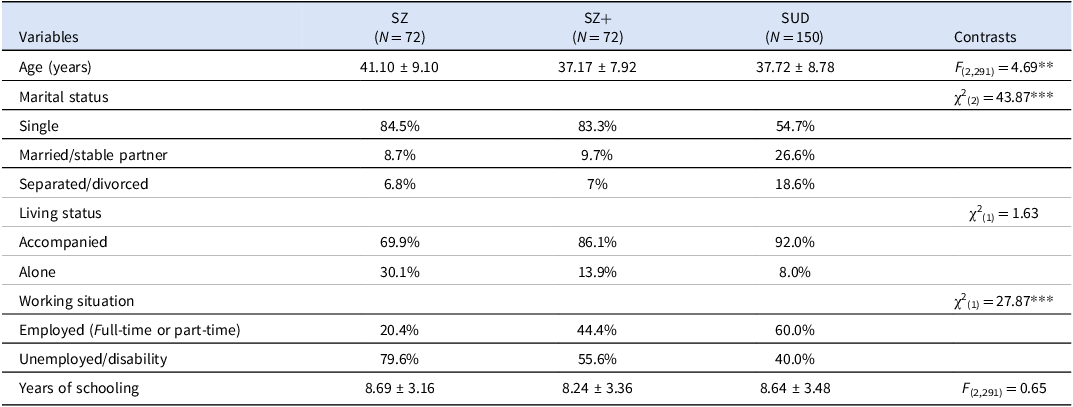
The analysis of sociodemographic variables (Table 1) showed significant differences of the age among groups (p = 0.01), with the SZ group being significantly older than the SUD (p = 0.021) and the SZ + groups (p = 0.022). Significant differences were also observed in marital status (p < 0.001), with most patients in SZ + and SZ groups being single compared with SUD (p < 0.001). However, no significant differences were found between group and living arrangements (p = 0.803), with most participants in the three groups living accompanied. The groups also differed in relation to employment status (p < 0.001) with the SUD group having the highest proportion of employees, SZ the lower rates and in an intermediate position the SZ + group. No significant differences were found in years of schooling, with a mean duration in all cases comparable to primary studies.
Socio-demographic and clinical data for the three groups of patients regarding psychiatric diagnosis. Means, standard deviation, percentages, and contrasts (ANOVA or chi-square test)

SZ = schizophrenia; SZ+ = schizophrenia with comorbid substance use disorder; SUD = substance use disorder. ** p < 0.01; *** p < 0.001.
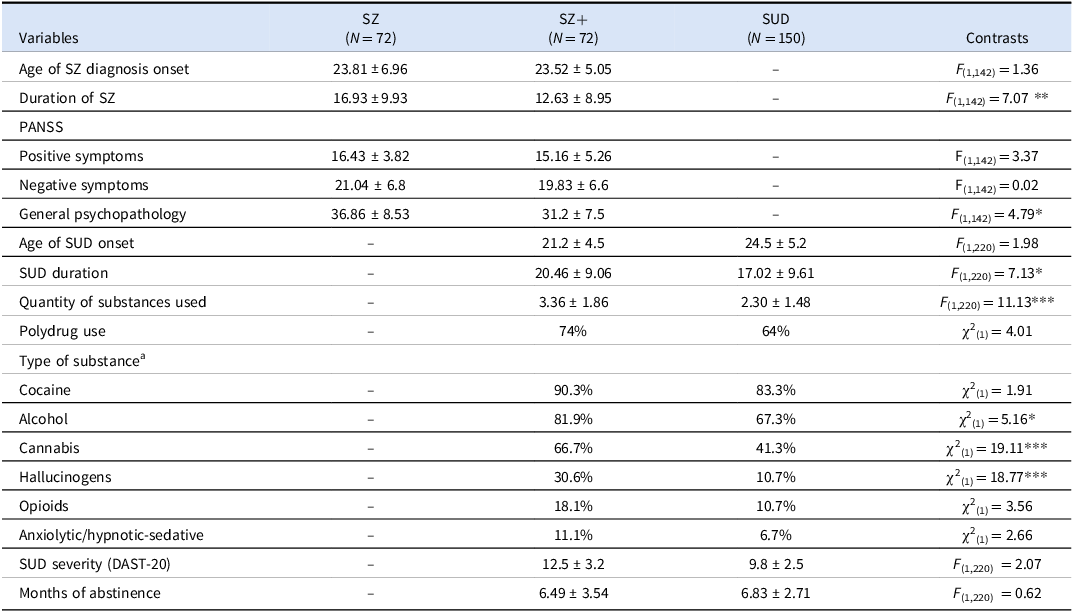
As seen in Table 2, clinical variables showed no significant differences between SZ and SZ + groups in the age of SZ onset (p = 0.226), as well as between SZ + and SUD groups in age of SUD onset (p = 0.140). However, the SZ + group had a longer duration of the SUD (p = 0.008) compared to the SUD group, and a shorter duration of SZ compared to the SZ group (p = 0.008). Considering the PANSS, the score of general symptoms subscale was higher in the SZ group compared to the SZ + group (p = 0.031), while no significant differences were found between groups for negative symptoms nor positive symptoms. Polysubstance use was the more frequent pattern in both the SZ + and SUD groups. However, the SZ + group used a significantly greater number of different types of psychoactive substances (p < 0.001), including alcohol (p = 0.023), cannabis (p < 0.001), and hallucinogens (p < 0.001).
Clinical data for the three groups of patients regarding psychiatric diagnosis. Means, standard deviation, percentages, and contrasts (ANOVA or chi-square test)

SZ = schizophrenia; SZ+ = schizophrenia with comorbid substance use disorder; SUD = substance use disorder. DAST = drug abuse screening test; PANSS = positive and negative syndrome scale. aPercentages will not equal 100 as each patient may have taken more than one substance. *p < 0.05; **p < 0.01; ***p < 0.001.
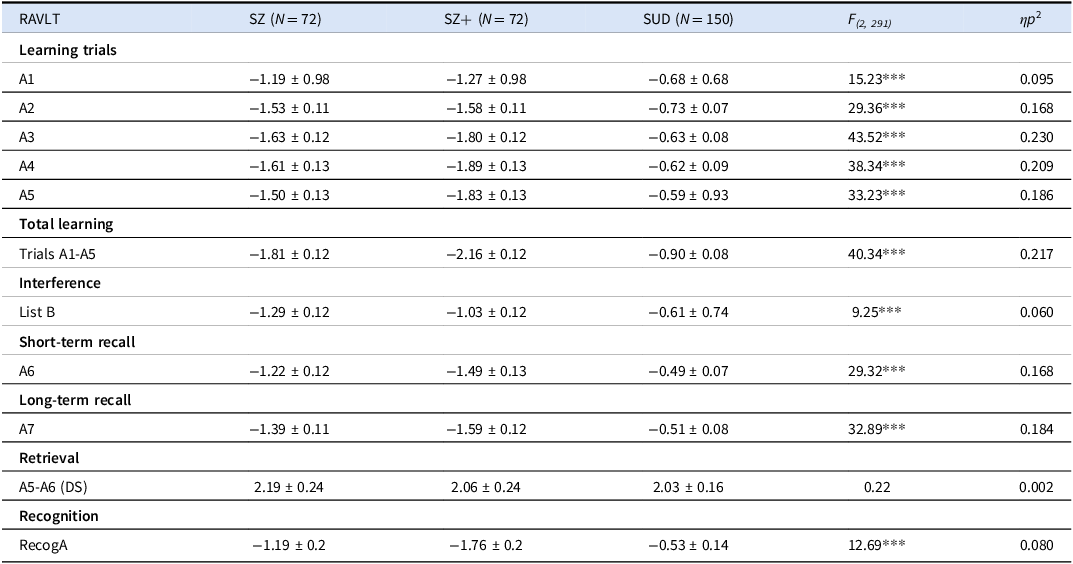
In relation to performance in the memory task, the three groups obtained negative z-scores across all trials of the test. Table 3 shows z-scores for the RAVLT measurements, except for retrieval with direct scores. The ANOVAs for each RAVLT trial, with premorbid IQ as a covariate, revealed significant group differences in all cases, with SUD group having better performance compared to SZ and SZ + groups (p < 0.001). In all trials, the SZ + and SZ groups exhibited a marked deficit. Specifically, across trials A2 through A5, both groups consistently scored more than −1.5 standard deviations below normative data which is considered pathological performance. This also contributes to the fact that in both groups an altered score was observed for total learning. In the case of the interference task, short-term recall, long-term recall and recognition, a worse performance is also observed in the SZ and SZ + groups compared to SUD (p < 0.001, in all cases). Although no significant differences were found between the SZ and SZ + groups, it is worth noting that the scores in long-term recall and recognition provided values considered pathological/deficient (greater than −1.5 Z) in the SZ + group. Likewise, in the case of short-term recall, the Z value of 1.49 is very close to the same consideration. It should be emphasized that in no measurement the SUD group presented scores below −1Z. The retrieval, the measure that could not be converted into z-scores, showed no differences among groups.
Z-scores for the three groups of patients in RAVLT (Rey Auditory Verbal Learning Test), except for retrieval in direct score (DS). Means, standard deviation and statistical contrasts of the ANCOVA (Analysis of covariance) or MANCOVA (Multiple analysis of covariance)

SZ = schizophrenia; SZ+ = schizophrenia with comorbid substance use disorder; SUD = substance use disorder. ***p < 0.001. DS = Direct Score.
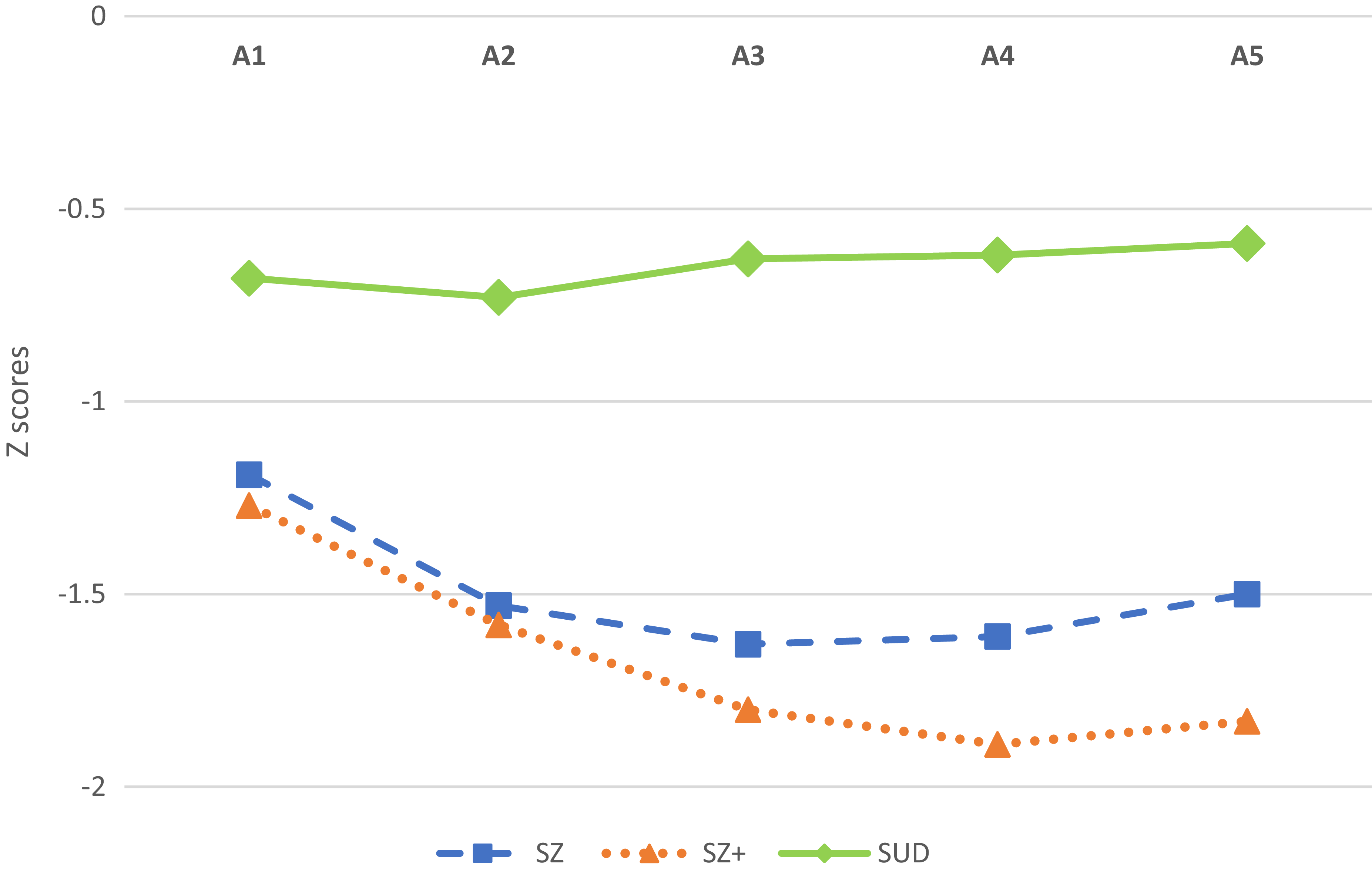
The repeated measures ANOVA with the premorbid IQ as covariate (Figure 1) revealed a significant linear effect of group on RAVLT performance across the five trials (F (2,291) = 9.418, p < 0.001, ηp2 = 0.061). The performance of the SUD group was not only superior in all trials, but also with a slight tendency to improve in the last 3 trials. In contrast, the SZ and SZ + groups worsened their recall between the first and fourth trials with a very slight improvement in the fifth or last trial. This evolution was more marked in the SZ + group.
Learning curve in Z-scores for the Rey Auditory Verbal Learning Test (RAVLT) trials by groups. SZ: schizophrenia; SZ+: schizophrenia with comorbid substance use disorder; SUD: substance use disorder.

Discussion
Consistent with our initial hypothesis, our study found that patients with SZ + exhibited marked impairments in verbal memory. The pervasiveness of these verbal memory deficits, with the majority of scores falling below a clinically significant threshold of −1.5 z-scores, underscores the substantial cognitive load inherent in SZ + patients and is consistent with the established notion that this group represents a complex and challenging clinical entity (Faye et al. Reference Faye, Tadke, Gawande, Bhave, Kirpekar, Chatterjee, Nathani and Singh2022; Scheffler et al. Reference Scheffler, Phahladira, Hendrikse, du Plessis, Asmal, Luckhoff, Smit, Olivier and Emsley2022). However, our key finding was that this level of impairment was not statistically different from that observed in the SZ group. Both SZ and SZ + groups were, in turn, significantly more impaired than the SUD group. This strongly suggests that severe verbal memory impairment is a core feature of SZ itself, which is not substantially exacerbated by the presence of a comorbid SUD. This pronounced impairment is in concordance with findings from previous research examining chronic SZ + samples characterized by prolonged substance use despite a minimum abstinence period of three months (Benaiges et al. Reference Benaiges, Serra-Grabulosa, Prat and Adan2013; Marquez-Arrico et al. Reference Marquez-Arrico, Gonzalez-Sanchez, Navarro, Penadés and Adan2022).
However, it should be acknowledged that some studies have reported divergent performance patterns, with SZ + groups performing differently compared to SZ groups alone. These seemingly contradictory findings highlight the inherent complexity of the SZ + population and warrant careful consideration. Several factors may account for these discrepancies. For instance, in studies reporting better or worse performance in SZ + compared to SZ (Hájková et al. Reference Hájková, Knížková, Siroňová, Keřková, Jonáš, Šustová, Dorazilová and Rodriguez2021; Scheffler et al. Reference Scheffler, Phahladira, Hendrikse, du Plessis, Asmal, Luckhoff, Smit, Olivier and Emsley2022), current substance use status at the time of cognitive testing could be a critical mediating factor. Furthermore, methodological differences, such as unbalanced or small sample sizes as seen in Schnakenberg et al. (Reference Schnakenberg Martin, Bonfils, Davis, Smith, Schuder and Lysaker2016), may also contribute to such discrepancies. Finally, the specific substance of abuse under investigation is also relevant; for example, Faye et al. (Reference Faye, Tadke, Gawande, Bhave, Kirpekar, Chatterjee, Nathani and Singh2022) have focused on alcohol dependence only, which limits the generalizability of their findings to the broader, more clinically representative SZ + poly-consuming population. Therefore, the interpreting of cognitive findings in SZ + populations requires careful consideration of factors such as current substance use status, sample characteristics, and the specific substances of abuse involved.
When comparing the level of impairment in SZ + group relative to SZ or SUD, we observed that SUD patients showed relatively preserved initial learning mechanisms compared to the marked impairments seen in SZ and SZ + groups, across all memory stages. These results emphasize the relevance of neurocognitive memory deficits in these patients. Cognitive deficits in the SZ population are considered core features and potential endophenotypes (Rodríguez-Martínez et al. Reference Rodríguez-Martínez, Monroy-Jaramillo, Rodríguez-Agudelo and Solís-Vivanco2021), whereas in SUD they are often viewed as consequences of chronic substance use (Marceau et al. Reference Marceau, Berry and Grenyer2021). This profile, which is absent in the SUD group, would support the distinction in the verbal memory domain for SZ + patients.
Regarding the level of impairment in the SZ + group relative to the SZ, our results indicated a similar profile. Thus, we found no statistically significant differences in the performance of these two groups. This finding is in agreement with the results described by Benaiges et al. (Reference Benaiges, Serra-Grabulosa, Prat and Adan2013), Pope et al. (Reference Pope, Manseau, Kelley and Compton2021) and Sánchez-Torres et al. (Reference Sánchez-Torres, Basterra, Rosa, Fañanás, Zarzuela, Ibáñez, Peralta and Cuesta2013), who have reported similar cognitive profiles between the SZ and SZ + groups. However, the observation of high impairment (considering z-scores) in encoding, as seen in the later learning trials and the RecogA in the RAVLT, and in storage (as observed in the total learning), highlights a particular vulnerability in these key stages of verbal memory processing for SZ + individuals. These findings strongly suggest that the capacity for effective verbal learning and retention over time is significantly compromised in SZ and, although in a more subtle way, in SZ+.
Clinically, while onset ages of SZ and SUD were similar between groups, the SZ group presented a higher mean age, with a longer mean duration of illness relative to the SZ + group. Given that cognitive scores were age-normalized, this difference should not confound our memory findings. Moreover, despite the longer illness duration and a trend towards earlier SZ onset – factors associated with greater cognitive impairment (Rannikko et al. Reference Rannikko, Paavola, Haapea, Huhtaniska, Miettunen, Veijola, Murray, Barnes, Wahlberg, Isohanni and Jääskeläinen2012; Kahn, Reference Kahn2020) – there is no greater detriment in memory performance in the SZ group compared to SZ+. The sociodemographic profiles of the examined groups also provide an important context for understanding these memory findings. SZ + and SZ groups showed significantly poorer social and occupational functioning compared to the SUD group, in line with the outcome of the SZ population (Adan et al. Reference Adan, Marquez-Arrico and Gilchrist2017b, Prat et al. Reference Prat, Marquez-Arrico, Río-Martínez, Navarro and Adan2021). The higher employment rate of the SUD group may reflect the lower impact of SUD without comorbid mental illness. The three groups do not differ in living arrangements or years of schooling, suggesting some level of shared background or access to basic support, although the SZ group is characterized for being single and unemployed/disability condition.
In relation to the learning curve, a similar impairment was found in both SZ and SZ + groups relative to SUD. While direct statistical comparisons between SZ and SZ + for specific memory processes were not significant, if we take into consideration the magnitude of deviation of the z-scores we can make some nuances to the performance between groups. Both the SZ and SZ + groups performed verbal memory tasks with values clinically considered deficient in the total learning and in all the trials except the first one (Trial A1). In the case of the SZ + group, poor performance in long-term memory and recognition must be added. All this suggests an exacerbation of memory deficits in SZ + beyond initial encoding, potentially influencing later memory stages (such as storage) to a degree that could be clinically noteworthy. This could be related to shared vulnerabilities such as vigilance levels (Adan et al. Reference Adan, Marquez-Arrico, Río-Martínez, Navarro and Martinez-Nicolas2024), which might impact on sustained memory processes beyond initial encoding and storage in SZ + individuals.
Several limitations of this study should be considered. Firstly, future research should incorporate a wider range of neuropsychological tests to examine other memory domains, such as episodic, autobiographical, and relational memory, which have also been affected in several studies in SZ patients (Herold et al. Reference Herold, Lässer and Schröder2023; Kwow et al. Reference Kwow, Xu, Duan, Wang, Tang, Allé and Berna2021; Raucher-Chéné et al. Reference Raucher-Chéné, Lavigne and Lepage2023; Wang et al. Reference Wang, Sun, Wong and So2023) and how they modulate memory processes. Secondly, the cross-sectional design limits to infer causal relationships or to track the longitudinal trajectory of memory impairments in SZ+. Longitudinal studies are crucial to disentangle the temporal relationship between substance use, SZ onset, and cognitive decline, especially given that memory impairment may predict psychosis onset a decade or more earlier (Kahn, Reference Kahn2020). Thirdly, while premorbid IQ was considered and performance was normalized, there are other potential confounding variables not considered such as the type of substances of dependence, due to the high number of polydrug users, which could have influenced the results of the SUD groups. Furthermore, future studies should consider this issue for the SZ + group, going beyond the overdependence of current studies focusing on cannabis (Hájková M et al. Reference Hájková, Knížková, Siroňová, Keřková, Jonáš, Šustová, Dorazilová and Rodriguez2021; Pope et al. Reference Pope, Manseau, Kelley and Compton2021; Schnakenberg et al. Reference Schnakenberg Martin, Bonfils, Davis, Smith, Schuder and Lysaker2016).
In conclusion, this study provides valuable insights into the verbal memory functioning of SZ and SUD, and their comorbidity. Although the presence of SUD in patients with SZ + under treatment and in early remission phase, does not appear to exacerbate the overall memory deficits associated with SZ, there may be a subtle impairment in encoding and consolidation processes that warrants further investigation.
Acknowledgements
We thank Projecte Home Catalunya, ATRA Association, Mental Health of Althaia Foundation, and Dianova International Association for providing the sample of the study, and Dr Julia E. Marquez-Arrico for support in the collection of patients´data.
Funding statement
This research was funded by the Spanish Ministry of Science and Innovation (MCIN/AEI/10.13039/501100011033; grant PID2020-117767GB-I00), the Generalitat de Catalunya (2021SGR801), and the Instituto de Salud Carlos III (ISCIII) and co-funded by the European Union (RD24/0003/0001).
Competing interests
The authors declare none.
Ethical standards
The authors assert that all procedures contributing to this work comply with the ethical standards of the relevant national and institutional committee on human experimentation and with the Helsinki Declaration of 1975, as revised in 2008. This study was approved by the Research Committee of the University of Barcelona (protocol code IRB00003099).