Introduction
From 2000 to 2013, Ghana’s rapid economic growth outpaced both the United States and the European Union, earning it the nickname “Africa’s rising star” (see Brunts Reference Brunts2008). However, these gains have been concentrated in the urban centres of the nation’s South, while the country’s North has seen an increase in poverty over this same period.Footnote 1 As a result of chronic unemployment and decreased agricultural production in recent years, an increasing number of men throughout the Dagbamba community of northern Ghana are experiencing a “crisis of masculinity,” owing to their inability to consistently meet the financial and moral expectations traditionally associated with social manhood. This crisis of masculinity has resulted in the disruption of patriarchal power structures and a realignment of traditional kinship obligations in Dagbamba communities. Driven by anxieties over these changes, Dagbamba “tradition” has emerged as a site for the restoration of idealised versions of masculinity.Footnote 2
The twenty-first century has seen a resurgence of participation and interest in Dagbamba tradition, beginning in earnest with the 2006 burial of the Dagbamba paramount chief, the late Yaa Naa Yakubu Andani II, and reaching new heights upon the installation of his successor, Yaa Naa Abukari Mahama II in January 2019.Footnote 3 This interest is most visible in increased attendance at traditional performances, such as funerals, and in increased numbers of young men seeking to learn drumming and other aspects of performance.
This article explores an aspect of this resurgence of ancestral practices, focusing especially on the mobilisation of traditional music and ritual for the production of social manhood. The community I focus on are the sapashinima (sing. sapashini), hereditary warriors within the traditional Dagbamba socio-political structure.Footnote 4 Sapashini drummers perform a repertoire collectively referred to as Sapashin-waa, the most common instantiation of which is the Gun Gon. Footnote 5 A ritual re-enactment of battle involving music, dance, and gunfire, the Gun Gon is typically performed at funeral observances of deceased warriors, chiefs, and other VIPs. In this article, I argue that the musical ritual of the Dagbamba warriors has taken on increased importance and urgency in recent decades by providing an occasion for men across differing social categories to perform the socially important work of making masculinities. This ritual temporarily neutralises the crisis of masculinity and alleviates anxieties of both the sapashinima and Dagbamba society by facilitating the successful demonstration of various idealised masculinities within the temporal and spatial frame of ritual.
The data for this study was gathered over a total of twelve months of fieldwork among the Dagbamba community in and around the city of Tamale, a sprawling city of nearly 400,000 people (District Analytical Report 2014:20).Footnote 6 Between the years 2006 and 2019, I conducted participant-observation fieldwork in six separate site visits, consisting largely of studying and performing with a renowned group of warriors and musicians in the Kakpagyili quarter of Tamale. Additionally, I conducted dozens of interviews with traditional warriors, drummers, and chiefs; “opinion leaders” such as radio personalities, pop singers, and schoolteachers; and a variety of other Dagbamba people, male and female, young and old.
Most of my time in Tamale, however, was spent in the company of young men. In 2006 I first met my two primary research assistants, Fatawu and Saeed, sons of chiefs who were in their early twenties at the time. We maintain a close friendship and have worked together on subsequent trips on this and other related research projects. I watched them struggle to finish schooling, to find steady work, maintain farmlands, and eventually marry and start families. I spoke with them many times about their life situations and those of their peers, and listened to their opinions and commentary on life in the Northern Region. Much of what I know about how contemporary Dagbamba youth navigate the traditional sphere is thanks to their input.
The overwhelming majority of the men I knew and worked with in Tamale, from elders like my drumming teacher Mba Buaru, to his younger drumming apprentices Sualey, Abukari, and Abdul-Hanan, to my assistants Fatawu and Saeed, struggled to live up to the material and economic expectations of “being a man.” The young men I mention here were each in and out of work in both the formal and informal sectors in the years I knew them. In countless casual conversations and formal interviews, they recounted problems of losing work or the difficulties of feeding their families. I hasten to add that not all Dagbamba men are un- or under-employed, and many are doing quite well for themselves and their families. However, it has been my observation that a disproportionate number of men in the traditional music scene in Tamale are in one way or another attempting to cope with financial insecurity. What I am arguing here is that participation in Gun Gon performances places titled elders and young adepts alike outside of a broken and disordered world in which unemployment and poverty prevent them from being the men they and others wish them to be while accruing social and cultural capital.Footnote 7
By reiterating performances of masculine identities during the Gun Gon, the sapashinima create a subjunctive space, an “as if” world that is presented as it could or should be, as opposed to the “as is” world of everyday life. What is at stake for the musicians I worked with in Tamale is their ability to be men. In this context, I approach masculinity here not as an element of a patriarchal social structure, but, rather, a dynamic locus of social change to be grappled with. Many problems associated with masculinity—including violence, domestic abuse, drug and alcohol abuse, and other dangerous and risky behaviours—are as pressing in Ghana as anywhere else. The present work focuses, instead, on one means through which the socially gendered aspects of poverty and precarity are being navigated by Dagbamba men amid the “juxtaposition of expanding potential and declining opportunities” (Weiss Reference Weiss2009:115–116) at a moment in history that so many had believed would be ripe with possibilities presented by a liberalised economy and increased access to education (see Piot Reference Piot2010; Ferguson Reference Ferguson2006).
Framing Ritual
My framework for analysing the Gun Gon is based on the ritual theories of Jonathan Z. Smith (Reference Smith1982), and of Adam Seligman and Robert Weller (Reference Seligman2008, Reference Seligman and Weller2012), who argue that the efficacy of any ritual lies in its ability to bring order to an otherwise disordered world “through the construction of a performative, subjunctive world. Each ritual rebuilds the world ‘as if’ it were so, as one of many possible worlds” (Seligman et al. Reference Seligman2008:11; see also Seligman and Weller Reference Seligman and Weller2012).Footnote 8 In the Gun Gon, sapashini men leave the profane world in which their masculinity is challenged by their inability to provide adequately for their families, and produce a ritual time and space in which they collectively produce masculine identities in line with traditional ideals of powerful warriors and authoritative patriarchs.
This ritual framework holds that, regardless of what its practitioners may believe, and beyond any ostensible meanings encoded within it, the importance of a ritual lies in what is accomplished for the community in which it is practised. Such an approach eschews an interpretation of what the various actions and utterances within the performance may or may not mean to either the participants or the community, focusing instead on what the Gun Gon does. This orientation runs counter to prevailing methodologies that seek to “clarify the meanings of rituals, to show the ways in which their symbols encode and evoke systems of cultural discourse” (Seligman et al. Reference Seligman2008:4). The problem of such a methodology is that approaching ritual as a collective exercise in meaning making, as prescribed by Clifford Geertz (Reference Geertz1973), relies on both cultural congruity and a singular viewpoint (Seligman et al. Reference Seligman2008:19–20).Footnote 9 Meaning, however, is neither universal nor constant. As in many forms of African expressive culture, there are many possible explanations and meanings encoded in the Gun Gon, both above and below the surface. My goal here, then, is not to offer an interpretation of the ritual by decoding its component parts, but to posit a theory of the work that various actions within these performances do for those who take part in them.
The centrepiece of my analysis is a single performance of the sapashini Gun Gon ritual that took place on 17 April 2014 in the village of Yemoo, about 25 km north of Tamale. I argue that the Gun Gon creates a subjunctive, “as if” space for elder and youth masculinities to be enacted as they “should be,” temporarily unencumbered by the “as is” world in which financial struggles make “being a man” so difficult. The Gun Gon “represents the creation of a controlled environment where the variables (i.e., the accidents) of ordinary life may be displaced precisely because they are felt so overwhelmingly present and powerful” (Smith Reference Smith1982:63; italics in original). As recapitulations of ancestral practices and generators of clearly defined social hierarchies, these performances produce idealised male subjects and restore order to the Dagbamba social world.
I focus specifically on the various ways idealised forms of masculinity are constructed and negotiated through music, dance, and drama by viewing these performances as gendered social interactions. In adopting a performance-based approach that treats the event as an integrated whole of musical and non-musical sounds, bodies, objects, and identities in time and space, I aim to illustrate the various means and mediums through which the Gun Gon’s significance and efficacy are generated.Footnote 10
Ritual Beginnings
In the hour or so since giving my teacher, Mba Buaru Alhassan Tia, a ride on my motorcycle from his house to the palace of the chief warrior of Kakpagyili, the sapashinima have been gathering for the coming Gun Gon performance this afternoon.Footnote 11 Men of multiple ranks and life-stages are preparing for the afternoon’s festivities, each performing a masculine identity consistent with their respective life-stages. Young men and teenage boys—the sapashini youth—take turns filling plastic bottles with their allotted rations of homemade gunpowder. They are exuberant, joking and playfully rough-housing among themselves. One wears a locally made smock, another a worn-out Bob Marley T-shirt.
About half a dozen sub-chiefs and elders have already arrived and sit chatting under the sampahi, the chief’s shaded sitting area. An elder with a white goatee wears the white tunic, hat, and red-and-white checked scarf of a man whose pilgrimage to Mecca has earned him the distinguished honorific of Alhaji; the Nachin-naa (chief of the youth) is dressed in the typical Dagbamba ensemble of a cotton smock, traditional hat,Footnote 12 pressed cotton trousers, and sandals. Another old man is combining markers of Islamic piety with his sapashini heritage by wearing an embroidered silk baba riga Footnote 13 over a visibly frayed smock. The sapashini chief, called the Kambon-naa, sits authoritatively upon his kugiziniga, a locally made reclining chair associated with elders. A veteran of the 1994 Guinea Fowl War,Footnote 14 he is the only senior warrior wearing clothing associated with warfare: a war tunic (gbaɣno) and hat covered in leather-sewn amulets.
Eventually, the signal for the group to begin moving comes when lead drummer Buaru takes up his drum and begins praising the Kambon-naa (:11). In contemporary Dagbamba practice, the praising of an individual is done through the musical recitation of the great deeds of his or her ancestors (Locke Reference Locke1990, Reference Locken.d.; Chernoff Reference Chernoff and Sullivan1997). The varying tones of the drum are modelled on language; the drum recites praise-names of chiefs and ancestors, praises their heroic feats, and validates contemporary chieftaincy claims by providing a substantiating genealogy.
Over the course of the next few hours, the sapashinima will participate in a funeral ritual in which multiple forms of Dagbamba masculinity will be enacted. Within this ritual frame, these men will publicly display their identification with and relation to the idealised masculinities associated with elders and youth, big men and small boys, constructed across a network of participants. They will show their community and themselves that they are worthy of respect while demonstrating their worth as men. They will do this through the embodiment of traditional masculine archetypes—chiefs, soldiers and musicians of varying hierarchical status—and by adhering to a traditional ethics that dictates how each type of man should behave relative to the other types.
Framing Masculinities
The field of men’s studies was pioneered through the work of sociologists Michael Kimmel (Reference Kimmel2012; Kimmel, Hearn, and Connell Reference Kimmel, Hearn and Connell2005) and R. W. Connell (Reference Connell2000, Reference Connell2005), who were the first to develop models specifically for the study of men as gendered subjects. These early studies, however, have been primarily focused on men and masculinities in the industrialised West, as have a great many of the works that have followed. The crisis of masculinity in the Global South has received more attention in the last two decades or so, predominantly from the social sciences, with much excellent work addressing the impacts of male disempowerment in the era of “development” (Cleaver Reference Cleaver and Frances2002; Boyle Reference Boyle and Cleaver2002; Gutmann Reference Gutmann1996). The research on men and masculinities in sub-Saharan Africa, in particular, highlights the unique political and economic situations of men navigating a world in which deeply entrenched ideas about gender roles are being altered by forces seemingly beyond their control, drawing attention to the relationship between men’s abilities to be breadwinners and and their identities as men (Arku and Arku Reference Arku and Arku2009; Bolt Reference Bolt2010; Cornwall Reference Cornwall2003; Luning Reference Luning and Jones2006; Morrell and Ouzgane Reference Morrell and Ouzgane2005; Ouzgane and Morrell Reference Ouzgane and Morrell2005; Overa Reference Overa2007; Silberschmidt Reference Silberschmidt, Ouzgane and Morrell2005; Smith Reference Smith2017). Scholars such as Matlon (Reference Matlon2011) and Weiss (Reference Weiss2009) have demonstrated how this predicament is especially challenging for African male youth.
Though relatively few in number, studies of masculinity and music have increased in recent years, ranging from the ethnographic (Hutchinson and Ostashewski Reference Hutchinson and Ostashewski2014; Spiller Reference Spiller2010), to the historical (Biddle and Gibson Reference Biddle and Gibson2009; Biddle Reference Biddle2011), to sociological analyses of popular music in the United States and Europe (De Boise Reference De Boise2015; Jarman-Ivens Reference Jarman-Ivens2007; Palmer Reference Palmer and Whiteley1997; White Reference White2011). Much of this work has focused on the role of music and movement in various problematic and often restrictive social categories into which men are pressured to fit, or against which they may resist. I depart from this orientation towards problematising masculinities, focusing instead on the limits on and possibilities for agency afforded by music and dance for economically disempowered men while foregrounding the importance of masculinity-affirming practices for men and their communities (see Cornwall et al. Reference Cornwall, Edström and Greig2011; Meintjes Reference Meintjes2004; Silberschmidt Reference Silberschmidt, Ouzgane and Morrell2005).
My commitment here is to the exploration of the utility, and indeed, the relevance of traditional music and ritual, as well as their capacity to respond to the social and economic conditions of the twenty-first century. What seems most urgent to me is to better understand how men in one community are coping with what, to many, seems like a permanent state of precarity as conceptions of the material, economic, and moral aspects of social manhood continue to evolve in contemporary Africa. To be sure, this is a decidedly local practice, but the conditions to which it is responding—the absence of meaningful work, low social status, impediments to achieving social manhood—are hardly unique to Africa. The sapashini ritual of the Gun Gon has become part of a local repertoire for responding to changes taking place all over the world.
Dagbamba Masculinities
Since the publication of R. W. Connell’s Masculinities (Reference Chernoff and Sullivan1995), it has become a truism in critical men’s studies that there is no single way of “being a man,” although some ways carry more social cachet than others. Connell’s theory of masculinities focuses, in part, on two categories of masculinities: “hegemonic,” representing the dominant form of masculinity prevalent in any one society at a given time; and “subordinate” masculinities, which generally carry less privilege.Footnote 15 Historians Stephan Miescher and Lisa Lindsay have challenged Connell’s influential concepts through African case studies, pointing out that it “fails to acknowledge situations in which different hegemonic forms might coexist” (Reference Lindsay and Miescher2003:2). Drawing from his research on Akan masculinities in Ghana, Miescher articulates a model in which multiple masculinities are considered “ideal,” noting that the masculinities available to any one man change with time, experience, and across divergent social spaces (Reference Miescher2005:2–11).Footnote 16
My approach to Dagbamba masculinities is predicated upon the notion that masculinity is not a monolithic conceptualisation but exists in multiple forms. I employ Miescher’s model of Akan masculinities, whereby multiple forms of masculinity may be held in high regard at once without any one form being convincingly “hegemonic.” In this article I use the Dagbamba categories of “youth,” including those between the ages of about 15 and 45 years old, and “elder,” which includes those with status, such as chiefs, who have aged out of the youth category.
According to my interlocutors, and evidenced by my own observations in Tamale and surrounding communties, all contemporary Dagbamba men, regardless of masculinity types, are expected to attend to the same basic responsibilities: the primary obligation of a man is to provide for his family in the form of food, shelter, education, healthcare, clothing, and physical security; as father and husband, he is expected to be the sole breadwinner for his household;Footnote 17 and he is expected to contribute to communal labour. A well-respected man is a community leader. He is educated, whether through schooling, a trade, or in agriculture. He is knowledgeable about Dagbamba history, and is respectful of elders and freely supportive of those junior to him. It is the failure of many—though by no means all—Dagbamba men to achieve these aspirational ideals that is the root of the crisis of masculinity I describe. Indeed, it was a common topic of both casual conversations and formal interviews. All Ghanaian adults know the phrase “to be a man is not easy,” or its common variant “to be a man is not a one-day job.”Footnote 18 I heard them both often.
The responsibilities of men that I have listed above are considered gender specific: biological men are expected to do these things, and women are not, although they often must in order to make up for household shortfalls. The qualities and actions expected of Dagbamba men are not in and of themselves “masculine.” However, regarding those various qualities and life-stages not exclusively associated with men or masculinity, like, say, strength, knowledge, or seniority, they become masculine insofar as they are as part of masculine identities, such as when a sapashini chief exercises his social power in assembling dozens of warriors and musicians to accompany him in a Gun Gon performance. In other words, these qualities are situationally gendered, rather than essentially.Footnote 19 Significantly, my goal in analysing these multiple masculinities is not to focus on differentiating between masculinity and femininity, but rather to outline differences between types of masculinities and the men who seek to bear them.
Background: “As Is”
Whichever type of masculinity a man may wish to achieve, his ability to do so rests largely in his capacity to meet the responsibilities of providing his dependents with access to basic needs including food, shelter, education, and healthcare. Providing these needs, however, has become more and more difficult over the past two or three decades. The increase in economic pressure on male breadwinners stems from several potential factors. Farmland in and around Tamale has become especially scarce as a result of the privatisation of land (which had historically been readily provided by chiefs for a small share of the yield) and increases in population. Agricultural subsidies were removed as part of the institution of Structural Adjustment Programs, beginning in 1983 (Kraev Reference Kraev2004), which proved economically disastrous for northern farmers and agricultural labourers (see Konadu-Agyemang Reference Konadu-Agyemang2001).
Additionally, unemployment remains high, certainly well above the 5.8% projected by the World Bank (World Bank 2017). All of these factors have led to a convergence of decreasing incomes and increasing living costs, many of which are new since the early 1990s. Indeed, while most Dagbamba have not benefitted from the economic gains of the early twenty-first century (Dessus et al. Reference Dessus, Jackson, Charles, Boutros, Goldstein, Medvedev and Norton2011), they have been directly impacted by the economic downturn of 2013–2019.Footnote 20 When the value of cedi began to fall in late 2013, the costs of imports rose significantly. Steep price increases on construction materials, including cement and iron and zinc roofing sheets, directly impacted men’s domestic responsibilities to sufficiently repair and augment rooms in their family compounds.
Two examples from interviews conducted in 2014 illustrate the widely held conception among Dagbamba that a man who fails to provide for his dependents can hardly consider himself a man at all. My primary Dagbanli-language teacher in Tamale once put the situation this way:
There used to be a head of the family who had control of every resource in the family.… We used to eat together. Today, go to my senior father’s house in the village here—you cannot get it. If you go there you will see this woman preparing for herself and her children, and this woman preparing for herself and her children. Family unity is not there. This is because it is not my senior father who gives them the chop [food] money these days.… I was telling you that men are no longer men, where a man was supplying all the basic needs of the children—food, shelter, water in the family. Families are broken down because [men] cannot provide for the family anymore.
(Issah, interview, 12 June Reference Issah2014)Kalaala Alhassan Salifu, host of a popular Dagbanli-language radio programme and station manager of Radio Justice FM in Tamale, made his feelings known about such men in an interview with Saeed and myself:
KAS:The man is supposed to be the head of the family, and provide. The woman is only to manage, the man is the provider.
KJH:But we see a lot of people who aren’t—who are not doing anything, right? Who are either unemployed, or they don’t have farmland, or any number of reasons they aren’t able to make a lot of money, or enough money.
KAS:I have always called them “women”.… I have told them that, even on air, that the man who fails to provide for the woman to manage should be given a cloth [for a skirt] and [female waist] beads to wear. (Salifu, 13 June Reference Tia2014)
The sapashinima I worked with were emblematic of these circumstances. My primary teacher and interlocutor, Mba Buaru, is perhaps the most knowledgeable and widely respected kambonluŋa (warrior-drummer) in contemporary Dagbon, but he nevertheless struggled to raise the necessary capital to sow and fertilise his farm in each of the years I worked with him. In 2013, he did not farm at all.
The Music of Sapashin-waa
The institution of the sapashinima came to the Dagbamba from Akan migrants who had immigrated into Dagbamba territory from the South, most likely in the early nineteenth century.Footnote 21 Although they have become integrated into mainstream society over the last two centuries, the descendants of these original Akan warriors maintain vestiges of their past in various ways—in their oral histories, material culture, and in their music and dance. Their musical heritage is evident in the instrumentation of the ensemble, which includes the Akan iron double-bell called dawoulɛ, occasionally the atumpan (talking drum),Footnote 22 and in the usage of Akan-Twi proverbs and praise-names played by the various drums and bells of the ensemble. In fact, Sapashin-waa is the only Dagbamba music genre in which iron bells are played.
The two primary instruments of the Sapashin-waa ensemble are the dawoulɛ and tension drums called the lunsi (sing. luŋa), hourglass-shaped tension drums played by Dagbamba griots (Chernoff Reference Chernoff1979, Reference Chernoff, Haydon and Marks1985; Locke Reference Locke1990, n.d.) At its most basic, the Sapashin-waa ensemble consists of a large luŋa (lundoɣu), which is played by the leader of the ensemble, a small luŋa (lunbila), and a dawoulɛ. This is an arrangement that reflects what Kofi Agawu has referred to as “the standard hierarchy of a West African drum ensemble,” in which the dawoulɛ functions as the timeline in the top layer, the middle layer is the smaller support drum, and the lowest layer is occupied by the deepest pitched drum, which is played by the leader of the ensemble (Agawu Reference Agawu1986:66).
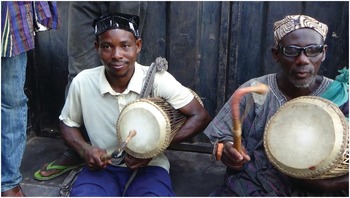
This arrangement of the ensemble, though not necessarily of the musical structures, is also consistent with the arrangement of Dagbamba political and family organisation, in which the ensemble is made up of separate groups of instruments, each group having a single leader and a number of support players.Footnote 23 The lead drummer (kambonluŋa), typically the senior-ranking drummer, plays the largest luŋa, calls the transitions between the pieces, marks beginnings and endings, and directs the rest of the ensemble with musical, aural, and visual cues. The lunbila drum is smaller and plays ostinato patterns which often interlock with the lundoɣu (Figure 1).
Sualey Abukari (L.) playing lunbila, Mba Buaru Alhassan Tia (R.) playing lundoɣu.

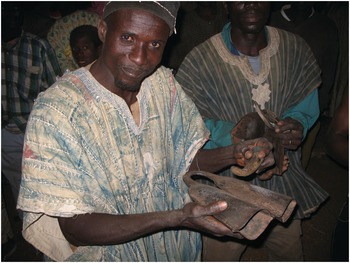
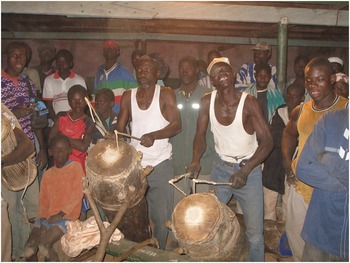
One dawoulɛ player will serve as the leader, improvising rhythms and honorific praise-names to create interlocking rhythms with two or more dawoulɛ playing repeating timelines in unison (Figure 2). The group is often augmented by one or two long, single-headed drums called dalega, a transverse flute called kalimbɔ, and any number of other traditional instruments (Figure 3).Footnote 24
Wulana Adam Baakɔ (L.) and Fuseini Abu (R.) playing dawoulɛ.

Unknown (L.) and Abukari Napodoo (R.) playing dalega.

Local Interpretations of the Gun Gon
The Gun Gon consists of six basic parts, structured by five musical pieces specific to each stage: travelling to the event (Sochendili); shooting guns (Chokwahili); individual dancing (Kambon-waa); celebratory singing and more dancing (Namyo); taking food and drink (Bandawuli); and returning the chief to his home (Namyo and Sochendili). According to Mba Buaru, each of the musical selections used in the course of contemporary Gun Gon rituals were originally played for specific sapashini chieftaincy offices to accompany them as they travelled, much the way that Sochendili is used now to accompany the movements of the Kambon-naa. While the Gun Gon is performed only during the final rites of a funeral, the sapashinima perform for several types of celebrations, including festivals and various life-cycle events.Footnote 25
Interpretations of the Gun Gon by my teachers, interlocutors, and research assistants provide some insight into how the ritual is perceived by contemporary Dagbamba. Although far from conclusive, they inform each other in their own ways. I was told by my assistant Fatawu that the performances are “a boast,” public demonstrations of the power of the Kambon-naa and his warriors, measured both in terms of their numbers and the ferocity of their performances. Several youth musicians spoke to me about possible motivations of individual performers rather than the meaning of the ritual as a whole. Abdul-Hanan, a kambonluŋa in his early forties suggested that younger sapashini males, like Dagbamba from other lineages, were taking up traditional culture as a means of elevating their own status in the absence of reliable wage labour. Through competent performances that contribute to a community’s quality of life, they are able to show their worth to Dagbamba society and make a name for themselves. Some, like Abdul-Hanan himself, may even be able to travel internationally to perform in folklore troupes. Others, like Sualey and Munkaila, told me that it was important to play for others’ funerals so that when the time inevitably comes, others will come play for you and yours.
My teachers Mba Buaru and WulanaFootnote 26 Adam Baakɔ told me that the Gun Gon, and performances of Sapashin-waa more broadly, are performed at funerals as a way to honour the surviving family members by elevating their status. As Buaru told me, “Gun Gon nye piɛlli shɛm,” that is, the Gun Gon is performed in order to bring happiness through celebration and revelry. The larger the celebration and more spirited the revelry, the better it reflects on the family putting on the funeral. He explained that when the sapashinima perform at a funeral,
The children of the deceased are so proud. It makes others know who the deceased was, and the family. Other people in the community will get to know what kind of people they are living with, that they are not any common people. The children of the deceased are going to feel proud of themselves, and others will also feel proud of them. It will raise up their names. That is wealth.
(Tia and Baakɔ, trans. Abdul-Fatawu, interview, 10 May Reference Salifu2014)The Gun Gon I analyse below is one particular instance of a ritual I saw performed dozens of times. Over the course of my fieldwork, I played dawoulɛ or lunbila in most of the performances I witnessed. As a student of Mba Buaru, and with the blessing and encouragement of the local chiefs, the bulk of my training consisted of “real world” experience, performing and moving shoulder-to-shoulder with many of these same senior musicians and fellow youths. However, on the day of this performance I was not feeling well, and so participated only as videographer of the event. The Gun Gon at Yemoo was, of course, a unique event in time, but it also adhered to the same overall ritual structure of all other Gun Gons I witnessed. I point out below those events that were uncommon.
The Production of Idealised Masculinities: “As If”
Sochendili: Walking the Path (4:52)
Once the Kambon-naa is seated in the cab and the other sapashinima are loaded into the truck bed we are on our way to the small village community of Yemoo, accompanied by the insistent rhythms of Sochendili. Musically, it is well suited for its place in the Gun Gon; the meaning of the dawoulɛ language seems to match the driving, forward motion of the piece: Chama, chama, chama! (Go, go go!). Sochendili is in duple metre, and the most common rhythms conform to a binary or quaternary division of the beat (notated below in 2/4 time, see Figure 4). It is generally played at a tempo of 155–170bpm, with the pulse accelerating towards the higher end of the range the longer it is played and the closer the group comes to the gun-shooting portion of the Gun Gon.
Sochendili dawoulɛ and lunbila parts.

Moving through the side streets of Tamale, the sapashinima are heard before they are seen. Buaru plays the leading lundoɣu drum, while Sualey plays the lunbila beside him and Napodoo straddles the long, single-headed dalega opposite the two drummers as he punctuates the music with the dry, clear sound of the drum. An old man plays short, repeating phrases on the kalimbɔ flute. As we continue across Tamale, through the Hausa zongo and into the centre of town, people turn to look as we pass international banks, street hawkers, and the central market. Within minutes the traffic and activity of the city are behind us and we speed through the green landscape en route to the funeral grounds in Yemoo.
Upon arrival, the driver parks and the warriors exit the truck, everyone taking his place to begin the procession towards the area designated for the shooting of the guns. The musicians continue to play Sochendili as the men slowly get into formation. The spatial configurations of the chiefs and the musicians are based on hierarchical status, which is closely aligned with age and seniority, and is an important component in the construction of relational Dagbamba masculinities, with each man literally “in his place” (27:53). The men further down in the hierarchy show their respect to those above them by positioning themselves accordingly within the procession. The chiefs and their attendants line up at the front of the group according to their rank: the lowest ranking elder walks in front, followed by the next in the hierarchy. Two young boys carrying chairs for the chiefs walk at the very head of the procession. As the highest ranking sapashini chief, Kambon-naa is last among them, with second-in-command Achiri just ahead of him.
For the musicians, hierarchy is displayed by which rhythms are played, at which times, and on which instrument. The musicians walk behind the chiefs, with the lead kambonluŋa at the front of the ensemble such that he is directly behind the Kambon-naa. From this position, Buaru can praise the chiefs as they process while also being in the line of sight of the other musicians, who must quickly respond to his musical and visual cues. The gunners are positioned together behind the musicians, without any observable internal order. While the more experienced elder musicians improvise and praise chiefs and ancestors, the novices take on the mundane yet crucial role of playing repeating rhythms to keep the musical time flowing. And so, these men of varying ranks and life-stages thereby collaboratively re-create traditional power structures in the course of constructing the masculinities fitting to their station: through the observation of these hierarchical norms, younger musicians perform their subordinate status as male youth, while also bestowing senior status, and thus, authority, upon their elders by following the directions of their section leader.
Yemoo is jammed with thousands of people, and we have to wait for another sapashini group to finish the gun-shooting portion of their own Gun Gon before we can move onwards. This is fairly typical of large funerals, which often attract sapashini ensembles from several different communities. As we wait, Sochendili continues unabated, and the tempo accelerates as the energy around the group builds. Women standing at the sides of the procession ululate, and a male praise-singer arrives and begins shouting praises to Kambon-naa, who acknowledges his presence only intermittently by handing him a few coins in reciprocation. Praise-names sung and drummed for sapashini chiefs also conjure images of traditional, idealised masculinities when they speak of warriors’ bravery, wisdom, and capacity to conquer their enemies.Footnote 27

A large crowd is pressing in on the group. Some dance, some record the music on their mobile phones, and others just watch and listen. All the while, some of the young men have been taking turns performing with the huge umbrella that marks Kambon-naa’s status as a chief. The umbrella, itself a material object denoting senior masculinity, acts as an agent in a competitive, masculine way becoming of these young men, while also adding to the chief’s status and public image. Measuring approximately three metres in diameter and made of red silk, the umbrella is being twirled as it is pumped up and down, making the silk billow impressively. The youths playfully compete with each other over who can most stylishly manipulate the umbrella, which is quite heavy and requires a combination of skill and strength to manipulate. The best among them balance the pole between their thighs as they move it up and down while straining to twist it. When one of them allows it to fall over, the others shout and laugh at his expense. This piece of theatre is another site for making masculinities. Twirling the umbrella is a job reserved exclusively for young men by virtue of the object’s weight. By besting one another in their performances, the youth momentarily establish dominance over each other. This activity also creates the Kambon-naa as a man of great status, since the umbrella is first and foremost a marker of his seniority and authority.
Chokwahili: Dramatized Combat (49:03)
After several minutes of drumming and dancing in a holding pattern of sorts, it is time for the Kakpagyili group to move on to the next stage. Buaru signals the musicians to transition from the duple metre Sochendili to the loping, three-beat metre of Chokwahili, the music for shooting guns (Figure 5).
Chokwahili dawoulɛ and lunbila parts.

We process into the designated area and the group circumambulates the space three times, the appropriate number for the funeral of a man (for a woman, the number would be four). As the procession moves, the chiefs take their seats at what has been deemed an optimal vantage point from which spectators will observe the action. A small altar has been constructed from a rock perched atop a few logs of firewood that have been singed but are no longer burning. A 20-cedi note has been placed on the altar. Kambon-naa approaches the altar and taps the rock three times with his foot (57:27). He then touches the money with a hand-held fly-whisk before waving it above his head in all four cardinal directions. My assistant Fatawu explained to me after the fact that this ritual-within-the-ritual was performed to placate the spirit or spirits resident in the land, or perhaps the grove, where the shooting is to be performed. The money represents a sacrifice to the resident spirits. I had only ever seen this sacrifice performed this one time, but I was assured that such occurences are not uncommon in Dagbamba traditional performances, especially in village communities where land gods are still worshipped.
One by one, the gunners approach the rock and fire their muskets directly at it. One of them crouches down and pretends to sneak up on his surrogate enemy. The muskets have been loaded with an excess of gunpowder, and so the sound of the guns is deafening and the performance space is filled with dense, white smoke. The musicians continue playing as the group circles the area again, and some of the young men are dancing inside the circle. The gunners once more take turns firing at the altar. At this point, the scene is becoming more and more frenetic. The tempo of the music has increased since the shooting began. A young man in his early twenties is now improvising the lead dawoulɛ rhythms while the senior bell player Wulana Adam walks next to him, closely scrutinising his playing.
Now more youths are dancing as they hold their muskets in the air and kick up dust. As the final round of gunshots approaches, the affective intensity of the event increases. As they circle for the third time, the gunners take positions around the perimeter of the circle, crouching as they wait their turn. One by one they fire into the centre of the circle, twenty-eight gunners in all. By the time the last gunshot fires, the whole performance area is filled with smoke, and the crowd erupts. Gunners race through the smoke-filled space, shouting in celebration.
This portion of the Gun Gon, called the kukolaata, is a dramatic re-enactment of the practices of warfare. The dense rhythmic and timbral textures produced by the musicians; the screaming, excited youths; the deafening sounds, and lingering white smoke from the guns; and the cacophony and general hyper-stimulation of the ritual all stand in for the intensity of battle. The kulolaata represents a microcosm of what Jonathan Z. Smith describes as the ritualised “creation of a controlled environment where the variables (i.e., the accidents) of ordinary life may be displaced” (Reference Smith1982:63; italics in the original). In the absence of an enemy, this subjunctive, idealised battle scenario has gone as it should: the warriors rode off to war, conquered their enemies, and emerged victorious and unharmed having established their reputations as formidable men deserving of respect.
Kambon-waa: The Victorious Warriors Dance
The musicians quickly transition to Kambon-waa, the warrior’s dance (1:11:10) to accompany the group’s relocation to an out-of-the-way spot where they can celebrate with dancing, food, and drink. The group moves slowly as the red umbrella is once again being floated above the crowd, and the mood is jovial and buoyant as the musicians begin playing Namyo, which is a typical accompaniment for celebratory moments such as this one (1:14:45). The drummers have been playing non-stop for well over two hours by this point, but they show no signs of slowing down. When they reach the dance space, the chiefs take a seat and a small circle forms with the drummers positioned opposite the seated chiefs (1:18:27). The music of Kambon-waa, more any other piece in the Gun Gon, displays the multi-determinancy (Chernoff Reference Chernoff1979; Friedson Reference Friedson1996, Reference Friedson2009; Locke Reference Locke1990; Monson Reference Monson2008), or multidimensionality (Locke Reference Locke2005, Reference Locke2010), so often associated with African rhythm. The rhythmic patterns of the individual instruments make frequent use of the archetypal 2:3 cross-rhythms, and several patterns resolve their phrases on the third beat of the 6/8 metre (Figure 6).
Kambon-waa dawoulɛ and lunbila rhythms.

Solo dancing is yet another opportunity for the sapashinima to establish difference among themselves according to age groups and genders. A young man, covered in dust and sweat, dances into the circle holding a kuli, a farmer’s hoe with a metal blade that also serves as an instrument of war (1:18:44). In this moment, this male body-with-weapon is a powerful warrior demanding respect. The drummers play with equal ferocity, providing the sonic and affective frame for this idealised version of youth masculinity. The tempo of Kambon-waa is relatively fast, notated as I have in the duple metre of 6/8. A typical youth step consists of a continually alternating pattern of step-kick, step-kick (R-r, L-l), where each step divides the metre in half. The timing of the steps corresponds to a dotted quaver (eighth-note each, punctuated by a quick kick outwards that creates a two-in-the-space-of-three rhythm in the physical movement (Friedson Reference Friedson2009:139–147; Locke Reference Locke2005:14–16). The movement is fast and results in generating considerable dust from the ground. As the feet move in time with the music, the dancers typically keep their backs straight, bent slightly at the waist, arms in front of their bodies. Often, as they do at Yemoo, the young men will hold a war-club as they dance, and each new entrant will seize it from the previous one on his way to greet the chief.
After about five minutes of dancing—a relatively short session—food and drink are provided by the family performing the funeral. The musicians would typically play Bandawuli as the sapashinima refresh themselves, but on this occasion they do not.Footnote 28 At this point, the drummers finally take a short break before the trip home. At Yemoo, we are served water sweetened with copious amounts of sugar, but on most other occasions plastic sachets of chlorinated “pure water” are supplemented by a bucket of pito (millet beer) or a few bottles of akpeteshie or other spirit.
As it starts getting dark, the group processes back to the truck and settles into the back of the lorry in more or less the same fashion as when we came. The musicians play the celebratory Namyo and the youth sing call-and-response songs (1:31:33). Songs in this genre include “Sonya Dam,” about the dangers of drinking bewitched alcohol, and “N’Pɛriba,” which makes light of the often contentious relationship between boys and their paternal aunts, joking that of all the terrible animals in the bush, the only one the warriors fear is their auntie.Footnote 29
Once back at Kambon-naa’s house (not included in the accompanying video), Buaru cues the musicians to cease Namyo and to begin Sochendili for the chief’s short walk from the truck cab into the receiving room of his palace. Once the chief is seated in his elder’s chair, Buaru brings the event to a close by ending Sochendili and delivering a few parting praises on his luŋa. With this final gesture, the Gun Gon is finished, and the time and space of the sapashinima’s shared “as if” world is brought to a close. The group is dismissed to return to the “as is” world they have left behind for the last few hours.
Conclusion: “As Is”
On the last night of my fieldwork period in July 2014, I went to visit my kambonluŋa teacher, Mba Buaru, and his family to say good-bye. Usually a congenial and playful figure, he was atypically somber that evening. His family sat around us silently as he laid out a long list of financial problems and familial responsibilities that he was finding more and more difficult to deal with. It seemed that every time he raised the money to pay his children’s and grandchildren’s school fees, another bill was coming due. His house needed significant improvements: he pointed to the crumbling walls of one of his compound’s rooms, but the cost of construction materials had risen sharply in recent months, making the repairs prohibitively expensive. A farmer by profession, he had not earned any agricultural income over the previous year because he had been unable to raise the capital necessary to pay for seed, fertiliser, and herbicides. His only income was from drumming, which as far as I could tell, could not have been more than a few dollars a day.
By the time I had returned in 2019, his housing situation had only got worse. The room with the crumbling walls had collapsed entirely, and his own room seemed likely to be next. When we met at his house for an interview, he led me inside to see for myself the many deep cracks in the concrete. Each of the four walls were held together by balli, a sort of Islamic calligraphy scrawled across all four walls, similar to sacred hatumere writings common across Islamic West Africa (Prussin Reference Prussin1986). The efficacy of such a treatment is in the belief that the words do not want to be separated, and so the writings will keep the walls from crumbling for much longer than they would last on their own.
Buaru had likely participated in thousands of Gun Gons over several decades, sometimes playing two or three in a day. For all his time spent in the subjunctive world of capable senior men, at the end of the day he still returned to his everyday life where broken walls needed repair and children needed to be fed, clothed, and educated. That’s the thing about ritual: the subjunctive world of the Gun Gon never permanently overcomes the “as is” world it temporarily transcends, for “the ordered world of flawless repetition can never fully replace the broken world of experience” (Seligman Reference Seligman2008:30). It is for this reason that the work of the Gun Gon carries such import, as “the world always returns to its broken state, constantly requiring the repairs of ritual” (ibid.).
That the utterly disordered state of the “as is” world will inevitably return does not necessarily mean that the ritual’s performance goes for naught. The Gun Gon not only allows Dagbamba men a moment to achieve an aspirational masculinity; the performance of the ritual is also an opportunity to practise and to model ethical conduct, impacting both themselves and spectators. I suggest that the masculinity-producing effects of the Gun Gon reverberate in ways that work inwardly and outwardly. First, through participation in the ritual of the Gun Gon, the men reinforce proper etiquette regarding their roles as men at their own particular life stations, while also teaching younger men how to behave in everyday life and as they age and gain seniority.
Second, because the Gun Gon takes place in a public setting, the participating sapashinima perform their masculinities in front of their communities. Chiefs, gun-bearers, and musicians are recognised as men of status, as members of respected familial and personal networks, as people with respect for tradition, demonstrably capable of behaving in an ethical fashion, and willing to give selflessly of their time and talents for the benefits of a grieving family that they may never meet. Furthermore, spectators are provided with an exemplary model of how to behave in a way that has been deemed to be in accordance with the actions and values of their ancestors, that is to say, in a culturally sanctioned, masculine way.
In the subjunctive space of the Gun Gon, intergenerational relationships between men are, according to dominant traditional values, as they should be. The junior members of the ensemble defer to the elders, and the elders tutor the next generation. The youth show strength, and the elders provide leadership. With a small drum in hand, a young musician performs both his youth masculinity and the lead drummer’s senior masculinity by walking behind, and musically responding to, the senior drummer. Kambon-naa walks in front of the lead drummer, behind his sub-chiefs, and alongside a young man flamboyantly twirling the umbrella, each a type of man created through the relations of these bodies, objects, and sounds. Within the subjunctive, “as if,” time and space of the Gun Gon, patriarchal hierarchies and the various junior and senior Dagbamba masculinities are, thus, collaboratively constructed and, in the process, re-created.
By reiterating the actions of the Gun Gon—through the repetition of the movements and sounds that constitute it, as well as the temporal and spatial framework within which these repetitions are enacted—a possible universe is made actual. Within the “as if” time and space of the Gun Gon, masculine virility can be exhibited without the economic and social conditions that limit mens’ potential to fulfill their roles as providers and authority figures. The sapashinima follow the traditional conventions of intergenerational behaviour that so many fear are breaking down in the “as is” world of everyday reality. They show the public that they are capable men, while at the same time demonstrate to each other that they know how to behave properly relative to their station in the group and in life. What makes the Gun Gon so important in reaffirming Dagbamba masculinities is that the most difficult aspects of being a man—the economics—are not present within the ritual.
While I contend that this ritual is best understood in terms of the subjunctive, I want to conclude this essay by pushing against the borders of this framing and suggest that the participating warriors are not just role-playing in a fantasy world. Although the ritual itself may be ephemeral and temporal, the masculinities-making work accomplished in the “as if” world of the Gun Gon is nevertheless real, with the potential to carry over into the “as is” world of everyday life. Indeed, Gun Gon performances, rather than reflecting ideals or wishing for manhood, do in fact make masculinities. The repetitions and reiterations of the Gun Gon constitute the discursive processes essential to the social construction of gender (Butler Reference Butler1993:20). Several times a year, the masculine identities of the sapashinima are not only constructed in the many performative iterations of masculine-coded behaviour, but are affirmed by the community through ululation and other sounded and bodily means of approval (Chernoff Reference Chernoff1979:esp. 36–37). The performances of powerful warriors and great leaders are not so quickly or easily forgotten by the spectators at these events, nor by fellow sapashinima. Buaru’s reputation and status as a titled elder, gifted musician, and culture-bearer afford him respect and notoriety well beyond Kakpagyili. Dagbamba men who demonstrate a commitment to tradition are revered for doing the difficult, largely un-remunerative, yet highly valued, work of keeping ancestral Dagbamba customs and values alive.
Participation in the Gun Gon does not solve the financial problems of men like Buaru—not the long-term ones, anyway. But it does establish a certain moral authority that he would lack if he were simply a struggling farmer with no demonstrable connections to traditional practices. As it is, he is known as a pillar of his community of Kakpagyili and recognised and respected as a titled elder throughout the whole of the Dagbon traditional area. This respect, as Buaru told me, constitutes wealth. In the absence of economic and material abundance, such social capital is critical in terms of crafting a social identity, earning the respect of the community, and building a legacy for descendants.
Moreover, performances like the Gun Gon represent meaningful work for young drummers like Sualey and Abukari: men with little education and limited resources, and with few or no job prospects. They allow these young men to be men, to feel useful to their communities, to lead dignified lives in a political economic climate that limits their potential to realise social manhood. The world created during the Gun Gon may be subjunctive, but it is not definitively bounded; although it is temporal, the impact of the work done is by no means temporary.
Acknowledgements
With deepest gratitude to Mba Buaru Alhassan Tia, Wulana Adam Baakɔ, the late Lun-naa Abubakari Wumbei Lunnaa, the late Dobihi-naa Amidu Abubakari, Idrisu Abubakari, and Mohammed Alidu for sharing their knowledge and expertise. For long-term research support I am heavily indebted to Fuseini Abdul-Fatawu, Alhassan Saeed Dawuni, and John Issah, without whom this project could not be possible. I am also thankful for support and advice from Marié Abe, David Locke, Brita Heimarck, Victor Coelho, Parker Shipton, Rebecca Dirksen, Damascus Kafumbe, Scott Linford, and Eric Schmidt. A debt of gratitude is owed to Michael Birenbaum Quintero, Panayotis League, Patty Tang, Kofi Agawu, and two anonymous reviewers for helpful comments on this article and its previous iteration as a conference paper. Support for the research upon which this article is based was given by a Fulbright-Hays Doctoral Dissertation Fellowship, a West African Research Association pre-doctoral fellowship, a Graduate Research Abroad Fellowship from Boston University, and funding from the Middlebury College Music Department.