

I. Introduction
The most famous opening line in all of literature is: “In the beginning, God …” In writing about craft beer, a fitting opening line would be: “In the beginning, Fritz Maytag …” Maytag did not, ex nihilo, create a new malt beverage. In fact, Maytag's brewing firm, the Anchor Steam Beer Company, had been in existence since 1896, well before he took ownership of the company in 1965. Maytag's innovation was in reconstituting a fading company and a dying product. In the course of doing so, he personified “the beginning” of the craft beer segment of the malt beverage industry. Although Maytag's pioneering endeavors took place in the United States, his influence on the market for beer has been global. Maytag and others who followed undermined the hypothesis that the U.S. beer industry was destined to have a highly concentrated market structure, a homogeneous output (i.e., lager beer), and be insulated from the prospect of new entrants to the market.
This paper can be likened to a three-legged stool. Each of the three legs can be read separately from the other two, but together they have an economic unity consisting of history, statistics, and geography. The first leg constitutes a mini-history of the craft beer segment in the United States—from its origins to its present portfolio of thousands of sellers. The second leg is a statistical analysis of craft beer in the United States and tracks its growth from 1979 to 2012. The third leg is an exercise in economic geography and portrays the spread of craft beer from its taproot in San Francisco to its branches elsewhere.
The term “craft beer” (or “craft beer segment”) is a portmanteau expression that merits unpacking. In his history of craft beer, Tom Acitelli defines a craft brewery this way:
This type of brewery includes any small, independently owned brewery that adheres to traditional brewing practices and ingredients. Craft brewers are distinct from larger regional and national breweries, which often use nontraditional ingredients and brew on a much vaster scale. (2013, p. xv)
This definition incorporates the two variables that distinguish or define craft beer: the type of beer and the size of the production facility (although both metrics, “kind” and “size,” are elastic). By type of beer, craft beer can mean different varieties of beer—ale, stout, porter, even lager—but never brewed with adjuncts or artificial ingredients. The trade group for craft brewers, the Brewers Association, defined a craft brewer as:
small, independent and traditional. Small means brewing less than 6 million barrels per year, the federal limit for the small brewers excise tax exemption. Independent means that less than 25% of the brewery is owned by a non-craft brewer. Traditional refers to a focus on beers that are made entirely or mostly from malt, and not diluted with adjuncts like corn or rice. (Brewers Association, p. 3)Footnote 1
To many consumers, craft beer is associated with the small scale of the brewing facility: microbreweries and brewpubs.Footnote 2 Home brewing is an extreme example of small-scale production and vertical integration. In the taxonomy of craft beer production, there also is the nanobrewery, which, unlike home brewers, brews beer for resale but on a very small scale (a capacity of three barrels or less; Woodske, Reference Woodske2012, p. 3).
The federal tax code defines craft beer by the size of the production unit. Prior to 1978, the federal excise tax on beer was $9.00/barrel. In 1978, Congress reduced the levy on small brewers to $7.00/barrel for the first 60,000 barrels produced by breweries with less than 2 million barrels in total annual sales. This was a windfall for craft brewers. At the time, no one could imagine that someday a craft brewer's output would ever approach (much less exceed) the 2-million-barrel cap.
Another way of defining craft beer is to compare craft beer to what it is not: “Big Beer” (or “MillCoorWeiser”), the beer produced by Anheuser-Busch InBev (ABI) and MillerCoors, the two major producers of malt beverages in the United States. ABI is the combination of the Belgian brewing firm InBev and Anheuser-Busch, which it acquired in 2008. MillerCoors is a joint venture between Coors and Miller, which took place in 2007. ABI's flagship brand in the United States is Budweiser (and the products and packages offered under that brand name). MillerCoors has two major brands: Miller and Coors (and the products and packages offered under those names).Footnote 3
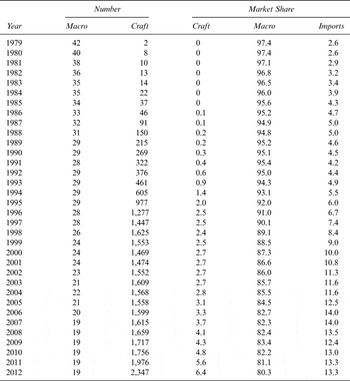
ABI and MillerCoors combined had a share of the market (SOM) of beer sales in the United States of 73% in 2013.Footnote 4 By contrast, the craft beer segment has less than 10% of the domestic beer market (see Table 1). ABI and MillerCoors can be thought of as producing a river of beer. According to this metaphor, the craft beer segment produces a tiny stream. But that “tiny stream” needs to be put in perspective, because craft beer is growing.Footnote 5 Sales of beer with the Budweiser, Miller and Coors brands have been flat or declining in recent years. To illustrate: from 2003 to 2013, ABI's SOM decreased from 49.6% to 45.6% of industry shipments; that of MillerCoors fell, from 29.1% to 27.0%; sales of Budweiser Light declined by 250,000 barrels; and sales of Miller Lite fell by 2 million barrels. In contrast, shipments from the craft segment leader, Boston Beer Company, increased from 1.2 million to 2.9 million barrels (excluding cider) in the same period.
Number and Market Share of Craft, Macro, and Import Suppliers in the United States, 1979–2012

II. Leg 1: A Chronicle of Craft Beer
While Fritz Maytag represents the Schumpeterian innovator of craft beer, three other brewers and three promoters of craft beer merit particular mention. In addition, two chemists played important roles in the development of craft beer.
Maytag had been a consumer of Anchor Steam Beer when he heard the firm was going to go dark. The closure would mean the demise of the last brewery in the United States producing what would now be called craft beer. Maytag bought the assets of the Anchor Brewing Company in 1965. According to Acitelli (Reference Acitelli2013), the firm had one employee at the time (p. 4), when Maytag began to learn the art and science of brewing in order to resurrect the firm and undertake the task of marketing the brand to on-premise accounts in the San Francisco Bay Area.Footnote 6
While other craft brewers who followed Maytag made important contributions to the development of the segment, Maytag deserves encomia for more than being the first to establish a craft beer brewery.Footnote 7 In addition to reviving steam beer, Maytag brewed the first American India Pale Ale (IPA), “brought back traditional porter, revived the custom of a spiced holiday beer, created the first American barley wine, and brewed the first American wheat beer since Prohibition” (Fritz Bows Out, 2010). Maytag also recognized at the outset that his small operation could never match the cost efficiencies of modern, large-scale brewing facilities. To cover high per-unit production and packaging costs, he knew that his beer would have to sell at retail prices matching those of expensive imported brands. The task was to brew beer that would be worth the candle. In the process, Maytag inspired others to line up behind him. Eight important “others” are cited below in groupings of three, three, and two.
A. The Early Brewers
If Jack McAuliffe had not been such an excellent welder, the craft beer segment might be different today. McAuliffe took beer-making skills that he had developed as a home brewer and combined them with his talent for welding, his training as an engineer, and his experience as an electrician to form New Albion Brewing Company in 1976, a little more than a decade after the start of Anchor Steam Beer. Stimulating McAuliffe's transition from home brewing to small-scale commercial production was a visit to Maytag's operation.
Having settled in Sonoma, California, McAuliffe was one of the first to recognize the demand for craft beer as a drink to be paired with food, which was the business model of the wine industry that was all around him. He also demonstrated that small-scale production could produce a product whose taste signature stimulated the demand for craft beer. In doing so, McAuliffe influenced other craft brewers. What economists call first-mover advantages did not work for McAuliffe. New Albion exited the market in 1982. Several of those who learned from McAuliffe enjoyed a second-mover advantage. Acitelli (Reference Acitelli2013) suggests that New Albion failed because it was too small to be profitable (p. 76).
As a high school student, Ken Grossman encountered a book by Fred Eckhardt, A Treatise on Lager Beers (Reference Eckhardt1983), and began home brewing. A few years later, he was teaching home brewing in Colorado. At this time, he visited the brewing facilities of McAuliffe and Maytag and left with both inspiration and information. Gifted with the same mechanical skills as McAuliffe, Grossman originally partnered with Paul Camusi to found the Sierra Nevada Brewing Company in Chico, California, which opened its doors in 1981. In 2014, the Sierra Nevada Company opened a brewery far from the Sierra Nevada mountains: a 350,000 barrel facility near Asheville, North Carolina. In Reference Grossman2013, the Sierra Nevada firm was the second-largest craft brewer, with sales of almost 1 million barrels.
Jim Koch was born into a family with a brewing history but began his career at the Boston Consulting Group, where his clients were anything but craft brewers. His family urged him not to consider brewing as a livelihood—advice that he took for a while and then rejected. Unlike McAuliffe and Grossman, Koch lacked skills in cobbling together pipes and kettles, but he had management expertise and experience when he founded the Boston Beer Company. Rather than build a craft brewery from scratch, Koch adopted the business model of using the facilities of an incumbent brewer (Pittsburgh Brewing Company) to produce craft beer to his specifications. He essentially bought capacity at marginal cost. The irony that Koch's brand, Samuel Adams, was being brewed at a facility accustomed to turning out the Iron City brand was not lost on some purists in the craft beer movement.Footnote 8
Eventually, the Boston Beer Company integrated vertically into brewing, but this was after the Samuel Adams brand portfolio had become the best-selling craft beer in the United States. The Boston Brewing Company's output of almost 2.3 million barrels in 2013 handily exceeded the cap for the tax exemption designed to aid the craft beer segment, allowing Koch to join the Bloomberg Billionaires Index the following year.
B. The Early Promoters
If Fritz Maytag was the John the Baptist of craft beer—a voice crying in the wilderness—three individuals brought the message of craft beer to a much broader audience. They did so not by starting craft breweries, as had been done by Maytag, McAuliffe, Grossman, and Koch. Instead they stimulated the demand for craft beer. The three who merit mention are Fred Eckhardt, Charles Papazian, and Michael Jackson.
The stimulation of demand for craft brewing was achieved through the dissemination of information about (1) home brewing, which weaned many beer consumers away from the lager products of Big Beer; (2) craft beer production; and (3) beer as a serious consumption good to be paired with food, rather than as a liquid that quenched thirst on a hot day or offered an inexpensive buzz.
Home brewing remains such an important introduction to the purchase of commercially produced craft beer that the Brewers Association (the trade association for craft brewers) promotes the American Homebrewers Association. One can hardly imagine Nike promoting the art and craft of making sports shoes at home.
After a visit to Maytag's brewery, Fred Eckhardt began to brew craft beer at home that was designed to mimic the quality of Anchor Steam. In addition to home brewing for his own consumption, Eckhardt taught home brewing to others and out of this came his book, A Treatise on Lager Beers, published in 1970 (which influenced Ken Grossman). Thousands of copies of this book were sold; the widespread practice of home brewing led in turn to the reversal of many state laws (rarely enforced) that banned home brewing. We are unaware of any U.S. industry in which home production led to more commercial start-ups than took place in craft beer. Those who engaged in home brewing changed their beer preferences; they became more likely to select brands of craft beer when consuming on premise. Home brewing acquainted many consumers with the flavors and organoleptic qualities of different kinds of beer. It also led pioneers like Jim McAuliffe and Ken Grossman to begin their own commercial ventures.
Like Eckhardt, Charles Papazian was not a producer of craft beer but, rather, a promoter of the product that others were commercially producing. He founded the American Homebrewers Association and also wrote about home brewing. While Eckhardt's book was called a treatise, Papazian's book was titled The Complete Joy of Homebrewing (Reference Papazian1984). Papazian also began Zymurgy, a magazine that was both a how-to and a paean to home brewing.Footnote 9 Those who joined the American Homebrewers Association or became subscribers to Zymurgy developed tastes for beers that made them customers of the craft beer segment. It also made them apostles of craft beer to their friends; those who did not home brew became customers of those who brewed commercially.
The first issue of Zymurgy was published in 1978, the same year in which Congress decriminalized the brewing of beer at home. Prior to 1978, home brewers and promoters of home brewing had no reason to fear raids on their houses by federal authorities. But the demise of this legislation left over from Prohibition was a social signal that the home production and consumption of beer had no taint of illegality.
Papazian's organization of the Great American Beer Festival, first held in 1982 in Boulder, was a harbinger of craft beer promotion. People came to sample beer and paid to do so. The beer festival was an eye opener for city officials because social events centered on craft beer did not turn into drunken brawls or occasions for municipal property damage. This was consistent with what Papazian observed when he was a University of Virginia college student experimenting with homebrewed beer: students who drank craft beer “got happy, not stupid” (Acitelli, Reference Acitelli2013, p. 56).
The Great American Beer Festival and its progeny were not like college spring breaks at beachside cities. Beer festivals brought people from out of town with discretionary income to be spent not only on craft beer but also restaurants and lodging. Today, no city would turn down an application for a beer festival. Indeed, a small industry has sprung up to organize and promote these festivals.
The writer Michael Jackson became to beer what Robert Parker Jr. was to wine. Jackson's book, The World Guide to Beer (Reference Jackson1988), was the first to reach a broad audience about the tastes of different beers. Commenting on the phenomenal sales of Jackson's book, Acitelli describes Jackson this way: “Beer in the twentieth century had its piper” (2013, p. 47). Although Jackson's book was not about the still-nascent craft beer industry in the United States (the book was published at about the same time that McAuliffe was starting the New Albion Brewing Company), Jackson did give favorable mention to Maytag's Anchor Steam Beer company.Footnote 10 Jackson's writings acquainted millions of readers with what he called the “beer style”—beers from Asia, Europe, and the Caribbean were discussed and explained. At the time that American readers were coming to understand beer other than Big Beer, the craft segment was starting to ramp up in order to provide this beer. Jackson, whose reputation was worldwide, occasionally contributed to Zymurgy and wrote a preface to The Complete Joy of Homebrewing.
The craft beer segment in the United States would not be what it is without Jackson's influence as an informant about the vast multiplicity of beers that were being brewed and, starting with Fritz Maytag, came to be brewed in the United States to satisfy curious or intrepid consumers.Footnote 11
C. The Brewmeister
In addition to the three brewers and three promoters just described, two other individuals played an important role in the craft beer segment, though they were not entrepreneurs and never operated a craft brewery. One was a professor, Michael Lewis, and the other was a brewer-consultant, Joseph Owades. Both were technically trained and scientifically versed in the application of chemistry to brewing. Both profoundly affected the impetus toward craft brewing in the United States.
In 1970, Lewis was hired as a professor of brewing science at the University of California Davis (Acitelli, Reference Acitelli2013, pp. 21–22). He was technically trained in microbiology and biochemistry. Lewis knew brewing was an art, but he also knew it was a science. The timing and location of his academic appointment was fortuitous. Five years earlier, Maytag had purchased Anchor Steam Brewing, not far away, in San Francisco. Lewis offered McAuliffe technical advice on how to start a craft brewing operation. Later, Lewis left UC-Davis to teach the science and production of craft beer on site at the New Albion Brewery Company.
Joseph Owades is a brewmeister of high repute in both Big Beer and craft beer. Associated with the Center for Brewing Studies, Owades was influential in the chemistry that produces light (or reduced-calorie) beer. Miller Lite, Bud Light, and Coors Light became the heavyweight brands at MillCoorWeiser. This alone would put Owades in a beer industry hall of fame. But on the craft side of the street, Owades also had an important role. First, he was a consultant to Maytag. Second, he is credited with the idea of a virtual brewery to serve the craft sector (Acitelli, Reference Acitelli2013, pp. 94–95). Owades counseled Matthew Reich (at the Old New York Brewing Company) to engage in contract brewing with a large, regional brewer that had excess capacity. The beer would be brewed in accordance with the Reich/Owades recipe. But Reich would not have to come up with the economic resources to finance the capital equipment. Under this business model, a craft brewer could sell his beer at marginal cost.
As mentioned earlier, the contract beer business model turned out to be a bonanza for Jim Koch and the Boston Beer Company, which became the largest craft brewer before ever owning a piece of capital equipment. Owades also was influential in designing the brewing recipe for the Samuel Adams brand, for which he became an equity owner in the Boston Brewing Company. After Maytag, all things considered, Owades is the most influential person in craft beer.
D. A Footnote on Capital Equipment
The production function for beer entails the economist's traditional triad of land, labor, and capital. The “land” constitutes such inputs as the grain and hops that go into the brewing process. The human input, in addition to the entrepreneur who starts the firm, consists of employees who see to it that the beer is brewed and packaged and then put into distribution. Capital equipment consists of storage facilities for natural ingredients, the vats needed for the brewing process, and the packaging equipment (for kegs, bottles, and, increasingly, cans).
In the early days of craft brewing, notably during the 1970s, an impediment to new entrants was the absence of a market for capital equipment. New entrants had to build or cobble together equipment to brew in small batches. Producers of brewing equipment at the time were geared up to meet the demand of Big Beer. An efficient modern packaging with a line speed of over 1,000 bottles or cans per minute is of no use to most craft brewers. For example, Schlafly uses a 16-valve filler that runs at 100 bottles per minute.
Absent a mature market for capital equipment, the early craft brewers regularly used machinery and equipment from other industries and adapted it to brewing and packaging malt beverages. As mentioned, Jack McAuliffe was a skilled welder, a talent that enabled him to build equipment not available in the marketplace. He refabricated equipment from dairy farms and put his welding skills to work fabricating 55-gallon metal drums into vats and kettles for his New Albion facility (Acitelli, Reference Acitelli2013, pp. 43–44). Early craft brewers often swapped ideas about how to gather the necessary capital equipment to brew and package their output. All this has changed. Today a craft brewer can purchase turnkey canning equipment that runs from 50 to 250 cans per minute (CPM).Footnote 12
The “Business of Beer Issue” Edition of The New Brewer (2014) illustrates the development of an organized capital equipment market serving new and incumbent craft brewers. Numerous vendors for malt, brewhouse technology, labeling equipment, and other services reveal that it is no longer necessary for a new entrant to have skills as a welder, plumber, and electrician to be a craft brewer or, absent these skills, find a large brewer with excess capacity. The trade show sponsored by the Brewers Association now has over 400 exhibitors; in 2014, it attracted over 9,000 attendees (15% of which were international) (Beer Marketer's Insights, 2014). An aspiring entrant could now order a turnkey plant to produce craft beer.
III. Leg 2: The Statistics of Craft Beer
This section uses our database to trace craft beer's economic trajectory from 1979 to 2012. The database measures the growth of craft beer in terms of the number of producers, the changing structure of the segment, and how the growth of craft beer stacks up against alternative beer products. The database is also used to estimate the influence of particular variables on the growth of the segment.
As shown in Table 1, after the pioneering endeavor of Fritz Maytag in 1965, the follow-on rate was slow. By 1983, the United States had only 14 craft brewers, counting brewpubs and contract brewers (half of them in California). The explosive growth in new entrants had not yet happened. As mentioned in Section II, only a handful of individuals were “present at the creation.” But as craft beer became more established in the second half of the twentieth century, those who followed now number in the thousands. They added new taste signatures, new packaging (e.g., Pete's Wicked Ale was canned in the mid-1990s, but cans were accepted more generally in the craft segment a decade later), and, as we show, much more geographic dispersion in supply.
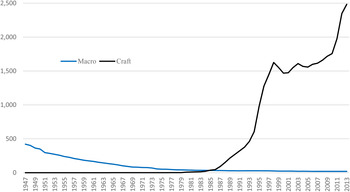
We begin our statistical description of the segment by the simplest of metrics: the number of brewers over time. Figure 1 compares the number of craft brewers with the number of big beer or macro beer producers from 1947 to June 2013. The number of macrobrewers declined steadily during the period. The reasons for this pattern of exit include advertising wars and scale-augmenting technological change that was reinforced by the homogenization of American beer from the 1950s to the 1970s (Elzinga, Reference Elzinga and Brock2009; Tremblay and Tremblay, Reference Tremblay and Tremblay2005). Brewers who produced large quantities of beer were able to take advantage of economies of scale. The scale and marketing advantages of the larger macros led to the ultimate demise of most of the smaller regional brewers of traditional lager beer. There were 421 macros in 1947; only 20 remained by 2006, one of the most dramatic transformations of an American industry on record.
Number of U.S. Macro and Craft Brewers, 1947–2013

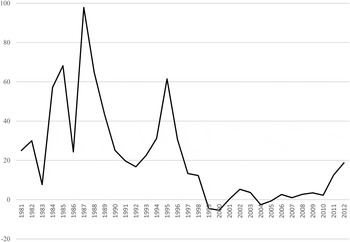
By 1985, the number of craft brewers (37) exceeded the number of macrobrewers (34). From the mid-1980s to the mid-1990s, the number of craft brewers increased exponentially. Figure 2 plots the annual growth rate of the number of craft brewers and shows a rate of more than 16% from 1984 to 1996.
Percentage Change in the Number of Craft Brewers, 1981–2012

Rapid growth came to an end in the late 1990s, when the craft segment experienced a shakeout. The number of craft brewers declined by approximately 10%, from 1,625 in 1998 to 1,469 in 2000. The primary reasons for the decline were distribution bottlenecks and the production of poor-quality products by brewers who rushed to enter the market in the mid-1990s (Tremblay and Tremblay, Reference Tremblay and Tremblay2005, 2011). At the time, it was trendy to be in the craft beer business, but achieving consistent product quality required serious brewing skills. After the decline, the number of craft brewers remained relatively constant until 2010, when it began to climb again. Craft brewers numbered 1,750 in 2010 and 2,483 by June 2013.
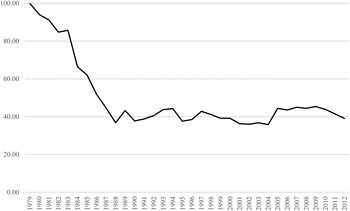
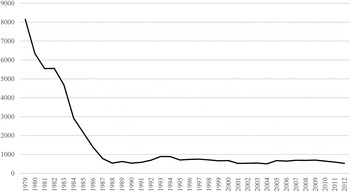
Continued entry has influenced the overall structure of the craft segment. Figures 3 and 4 depict the national four-firm concentration ratio and the Herfindahl-Hirschman index (HHI) of craft brewers. Although the market is regional and not national, these figures still provide interesting information: continued entry reduced overall concentration. In 1979, the four-firm concentration ratio was 100%. Since the late 1980s, the four-firm concentration ratio has remained at about 40%, and the HHI has been less than 1,000.
U.S. Craft Beer: Four-Firm Concentration Ratio, 1979–2012

U.S. Craft Beer: Herfindahl-Hirschman Index, 1979–2012

One reason for the early success of the craft segment is the homogenization of the lager beer produced by the macrobrewers. Beginning in the 1950s, the macros began to produce lighter and lighter styles of beer.Footnote 13 This culminated in 1974, with Miller's successful introduction of Miller Lite, which had a third fewer calories and 10–15 percent less alcohol than traditional macro lager beer. Miller Lite was such a remarkable success that all the major macrobrewers soon followed with their own brands of light beer.
The growth in the market share of the light beer segment is often overlooked because of the growth of the craft beer segment and the publicity it has received. But light beer represents a parallel transforming event in the industry. Light beer began with a 0.4% share of the market (SOM) in 1984, which grew to 22% in 1985 and 43% in 2000 (Tremblay and Tremblay, Reference Tremblay and Tremblay2005, pp. 138–139). The Miller, Coors, and Budweiser brands were so similarly reduced in alcohol and caloric content that one brand was nearly indistinguishable from another, thus the designation MillCoorWeiser.
Because the macros bet on consumers who preferred milder beer, the door was opened for craft brewers, who produced darker lagers and ales (which include light ales, porters, and stouts). Imported brands also benefited from the homogenization of macro beer, especially the darker lagers and ales from the United Kingdom. Imported beers in these styles are close competitors with craft beers.
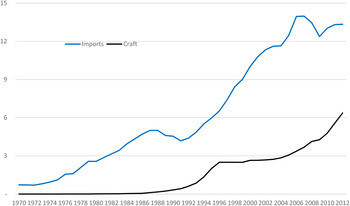
Figure 5 plots the SOM of the craft and import segments of the U.S. beer market. Before 1970, the share held by imports was less than 0.7%. Craft beer production was inconsequential. Over 99% of the beer consumed in the United States was the traditional lager beer from the macros. Imported and craft beer gradually gained in popularity, causing macros' share to fall to 80% by 2012. The consumption of imported beer rose first, because the only darker beers available in most parts of the country were imported. By 1988, imports' SOM reached 5% for the first time.
U.S. Import and Craft Beer: Market Share, 1970–2012

Although many new craft brewers entered the market in the 1980s, they had very small operations. From 1986 to 1995, total beer demand was fairly constant, ranging from 188 million to 190 million barrels. In 1986 the craft segment accounted for less than 0.6% of the total. By contrast, that year, Anchor Brewing produced 38,000 barrels. Of the remaining 90 craft brewers, none produced more than 10,000 barrels. As the expression goes, they were indeed “small beer.”
But by 1995, the number of craft brewers had increased to 977, and the scale of the leading craft brewers had increased substantially. The larger craft brewers, such as Sierra Nevada and Anchor, produced 200,000 and 103,000 barrels, respectively. The two largest contract-craft brewers, Boston and McKenzie River, produced 948,000 and 490,000 barrels, respectively. The SOM of the craft segment reached 2% by 1995 and experienced very little growth during the shakeout of the late 1990s, but has grown rapidly since 2005. By 2012, the SOM was 13.3% for imports and 6.4% for craft beer. If one had read only the popular press about the beer industry, one would guess that these figures were reversed. But craft continues to be in the shadow of imports, in large part because of the success of imports from Mexico.
Although the SOM of the craft segment was small in the 1990s, its continued growth gained the attention of the macrobrewers. In response, the major macros entered the craft segment through acquisition. Anheuser-Busch acquired a partial share of the Redhook Brewing Company in 1994 and the Widmer Brothers Brewing Company in 1997. Miller purchased a partial interest in the Celis and the Shipyard brewing companies in 1995. This arrangement gave the craft brewers access to broader distribution networks, but linking with a major corporate brewer did not sit well with consumers who preferred to buy locally produced beer. Debra Tropp (Reference Tropp2014) provides several reasons some consumers prefer to purchase locally produced food: it has purportedly higher quality, doing so supports local business, and its production involves less use of fossil fuels.
Another response by the macros to the growth of the craft segment was to introduce their own craft style brands but market them without the macrobrewery's name on the packaging. In the 1990s, pale versions of craft style beer were introduced by Anheuser-Busch under the Elk Mountain name, Miller under Plank Road, and Coors under Blue Moon. Known as “phantom” or “faux” craft beers, these products are not generally accepted by consumers as legitimate craft beers.Footnote 14 The notable exception is Blue Moon, which has annual sales of over 1 million barrels.
The homogenization of macrobrewery beer is only one reason for the early success of craft (and imported) beer (Tremblay and Tremblay, Reference Tremblay, Tremblay and Swinnen2011). Another is the continued growth in personal income. A 2009 survey of beer drinkers found that high-income consumers are more likely to buy craft beer (Beer Marketer's Insights, 2010, pp. 310–318). For these consumers, growing personal income increases the demand for craft beer.
In addition, growth in personal income increases consumer demand for variety (Silberberg, Reference Silberberg1985). The homogenization of big beer provoked some consumers to search for new styles and taste signatures in beer. Carroll and Swaminathan (Reference Carroll and Swaminathan2000) argue that greater economic prosperity increases consumer demand for locally produced products. Craft beer attempts to identify itself as locally produced.
Small-scale production comes at a cost because there are substantial economies of scale associated with beer production and packaging. Nevertheless, local brewers have lower transportation costs and, although the evidence is not clear, may pay lower wages as well. We are not aware of any craft brewers whose labor force is unionized.
Changes in laws and regulations also have contributed to craft beer growth. Or, to put it differently, laws and regulations that once would have thwarted the growth of the craft beer segment are being whittled away, albeit slowly.Footnote 15 With respect to this topic, tax rates favorable to craft brewers occupy center stage.
At the national level, the 1977 change in the excise tax rate on beer gave a sizable tax break to smaller brewers. In 2001, taxes account for about 5% of the cost of goods sold for the average small craft brewer and nearly 30% for the macrobrewers (Tremblay and Tremblay, Reference Tremblay and Tremblay2005, pp. 118–119). At the state level, 15 states gave a tax break to smaller brewers (Brewers Almanac, 2009).Footnote 16 Another factor is the legalization of home brewing. The art of making good beer requires experience, and most early craft brewers gained experience from home brewing. On October 14, 1978, President Jimmy Carter signed a bill that made home brewing legal, effective February 1, 1979. Both the tax break and the legalization of home brewing facilitated the birth of the craft segment.
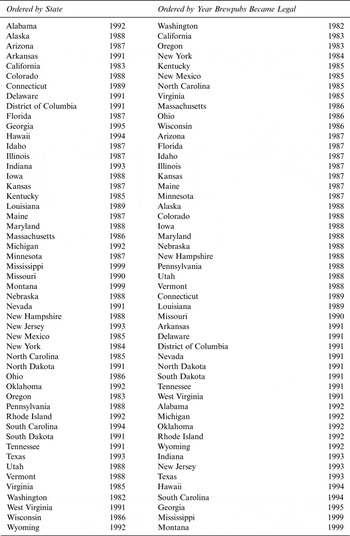
Changes in state laws and regulations also aided the craft segment. Although federal law made home brewing legal in 1979, states still retained the right to limit alcohol production and consumption. For example, Bert Grant opened the first brewpub in Yakima, Washington, in 1981, not realizing it was illegal at that time because his business model violated the three-tiered distribution system required by that state's codes (Acitelli, Reference Acitelli2013, pp. 84–85). The Washington State legislature legalized brewpubs in 1982, in view of the public support for doing so and the realization that the brewer-independent distributor-independent retailer regulatory model made brewpubs per se illegal. This induced other states to follow suit, as seen in Table 2. Continuing differences remain as to how states treat craft beer, and they are addressed in Section 3.
Year Brewpubs Became Legal by State

IV. Leg 3: The Geography of Craft Beer
In this section, our database on brewers and their locations is used to visualize and then analyze the geographic footprint of craft beer in the United States. The database is integrated into Geographic Information Systems (GIS) software to show the uneven spread of craft beer from its taproot in San Francisco to other areas with economic importance.
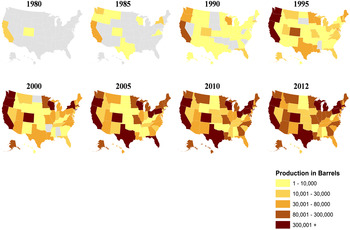
Figure 6 shows that craft beer production has spread across the United States. The maps in Figure 6 categorize states by production levels in 1980, 1985, 1990, 2000, 2010, and 2012.Footnote 17 Recall that craft beer originated in California, where 97% of craft beer was produced in 1980. Only one brewer was outside the state, Boulder Brewing of Colorado, but this firm also had roots in California. Its founder, Rudolph Ware, learned about home brewing while growing up in South Pasadena, and he started Boulder Brewing in 1980, while he was a graduate student at the University of Colorado (Acitelli, Reference Acitelli2013, p. 73).
Craft Beer Production by State, Selected Years

As the maps in Figure 6 indicate, craft beer production moved sequentially into the Pacific Northwest, the Northeast, and then the upper Midwest. By 1990, six states had production of more than 10,000 barrels of craft beer: California (156,000), Oregon (51,000), Washington (50,000), Wisconsin (46,000), Massachusetts (16,000), and Colorado (11,000). Maps for later years reveal that craft brewing was slow to move into lower Midwestern and Southern states. Not until 2001 was craft beer being brewed in every state.Footnote 18
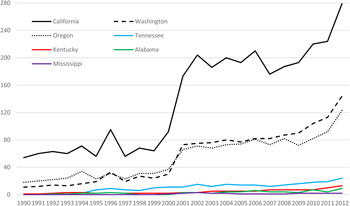
A similar geographic pattern emerges by examining the number of craft brewers rather than production by state. Figure 7 plots the number of brewers from Pacific states, which include the earliest entrants (California, Oregon, and Washington) and Southern states, where entry lagged the rest of the country (Alabama, Kentucky, Mississippi, and Tennessee). The plots reveal a striking difference. As early as 1996, every Pacific state had more craft brewers than any of the Southern states during the sample period.
Number of Craft Brewers in Pacific and Southern States, 1990–2012

The geographic distribution of craft beer production appears anything but random, raising the question: What caused the geographic clustering of economic activity in craft brewing, a topic within the field of economic geography?Footnote 19
Contagion, clustering, and industrial lifecycle models provide insight into the success of craft brewing in Northern California. The basic idea is explained by Frenken et al. (Reference Frenken, Defis and Stam2011) in their survey of economic geography: “even though the location of a new industry can be sensitive to the random location of exceptional entrepreneurs … , chance still favors the prepared region.”
Ground zero was Maytag's Anchor Brewing in San Francisco, but why? Acitelli (Reference Acitelli2013) documents that Maytag had the human and financial capital to run an efficient microbrewery. But his success also depended on location. He happened to be a graduate student at Stanford University in the 1960s, a time when Northern California was ready for craft brewing. Small boutique wineries had proven successful in Northern California, and there was no reason to think that boutique breweries could not do the same (at least in hindsight, when vision becomes much improved).
At the time, a disproportionate number of Californians were brewing homemade beer. The notable example was Ken Grossman of Sierra Nevada, who not only made his own beer but owned a home brewing store in Chico, California, several years before home brewing became legal (Acitelli, Reference Acitelli2013, p. 68). Most home brewers made darker or heavier-style beers and ales, suggesting that a demand for variety existed, at least among some Californians. Thus, it was fortuitous that Maytag started his craft brewery in San Francisco, rather than another part of the country. He was, as the saying goes, in the right place at the right time.
Home brewing was illegal from Prohibition until 1979, making it difficult for individuals to learn how to brew beer on a small scale. This forced early home brewers and subsequent small craft brewers to learn the art of brewing by trial and error and from each other. It is common for entrepreneurs to start a new business close to home (Costa and Baptista, Reference Costa and Baptista2012). Because many home brewers in California and Anchor were located in San Francisco, it offered greater brewing experience, more learning opportunities, and geographic charisma in this region of the country. Many early entrants clustered near Anchor Brewing to learn the art of craft brewing from Maytag. As mentioned in Section I, several of the pioneers in craft brewing were in geographic proximity to Maytag's operation, visited his facility, and learned (and received encouragement) from him.
In the long term, the location of production facilities is a strategic decision. After home brewing was legalized and the success of microbreweries became well known by the mid-1980s, why did entry occur in the Pacific, Northeast, and upper Midwest before other parts of the country?
Only three papers have been devoted to entry into the U.S. brewing industry. Manuszak (Reference Manuszak2002) investigated firm entry into small Western cities in the late 1800s. He found that population was an important determinant of the number of competing brewers in a city and that competition increased with the number of brewers. Swaminathan (Reference Swaminathan1998) examined the causes of entry into the brewing industry from 1939 to 1995. Finally, Carroll and Swaminathan (Reference Carroll and Swaminathan2000) investigated reasons for the microbrewery movement using industry data from 1939 to 1997.Footnote 20
We use regression analysis to further explore the influences on craft beer production and the number of craft brewers at the state level from 1980 to 2012.Footnote 21 Specifically, we use Tobit estimation for production and negative binomial estimation for the number of brewers.Footnote 22 The empirical models include a number of demand variables. The first is consumer income. Because craft beer is relatively expensive, one would expect craft breweries to locate and produce in states with higher incomes. The second is population. Demand will be higher (and transportation costs accordingly lower) when the firm locates in a region with a higher number of consumers. Third, in the case of beer, demand is strongly affected by age. A 2009 survey found that, on average, young adults (in their twenties and early thirties) prefer lighter beer styles, and older adults prefer darker beers and ales (Beer Marketer's Insights, 2010, pp. 310–318).Footnote 23
In addition, state governments can influence craft brewer production and location by affecting the cost of doing business through excise taxes and state regulations.
Strategic effects can also explain the location choices of craft beer producers. On the one hand, locating near competing beer producers may lead to more severe price competition. On the other hand, locating near other brewers can generate positive spillovers. Marshall (Reference Marshall1920) argued that such positive effects can come in the form of gains from having access to a larger pool of inputs (e.g., specialized labor) and from knowledge spillovers. To account for the potential effect of nearby craft firms and craft production, spatial lag variables are included in the empirical models.Footnote 24 The first relates to craft production for state i in a given year t and is defined as:
 $$spatial - prod_{it} = \sum\nolimits_{\,j = 1}^{k - 1} {\,prod_{\,jt}/distance_{ij}\,\forall j \ne i} $$
where distance ij refers to the distance from the centroid of state i to the centroid of state j, and K is the number of states. Production weighted by inverse distance is summed over all other states. The second spatial lag variable relates to number of craft brewers and is defined as:
 $$spatial - firms_{it} = \sum\nolimits_{\,j = 1}^{k - 1} {number \; of \; firms}_{\,jt}/distance_{ij}\,\forall j \ne i $$
The spatial-prod variable may better capture the competition effects of other brewers—that is, the amount of craft beer produced nearby. The spatial-firms variable may better capture the knowledge spillovers and what we call the exuberance effect of having peers nearby. The use of spatial variables is not without controversy.Footnote 25 As a result, models are estimated with and without the spatial terms.
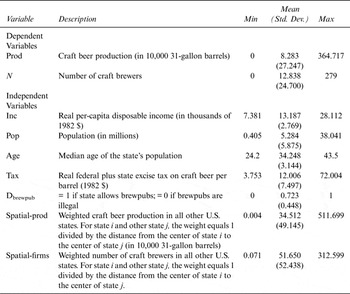
The data set consists of 50 states and the District of Columbia from 1980 to 2012 for a total of 1,683 observations.Footnote 26 Data sources are listed in the online supplementary data appendix. Production and spatial-prod are measured in 10,000 31-gallon barrels. Independent variables include real per capita disposable income (in thousands of 1982 dollars), population in millions, median age, and total (federal plus state) excise taxes per barrel in real terms (1982 dollars). Brewpub laws are represented by a dummy variable (D brewpub ), which equals 1 if brewpubs are legal in the state in a given year and 0 otherwise. Brewpub legality is a proxy for a state's overall regulatory control of craft brewing. Summary statistics for the variables are listed in Table 3.
Variable Definitions and Summary Statistics, State-Level Data, 1980–2012

Note: Production excludes contract brewing. The number of observations is 1,683, which includes the 50 states and the District of Columbia, with the exception of the spatial-prod and spatial-firms variables, which have 1,617 observations (Hawaii and Alaska are not included because the distance is too great to form a reasonable weight variable).
The production models are estimated using Tobit analysis, which is appropriate when the data consist of a large number of zeros and normally distributed nonzero observations.Footnote 27 The number of firms is a count variable, and negative binomial regression will be used to estimate the models of firm numbers.Footnote 28
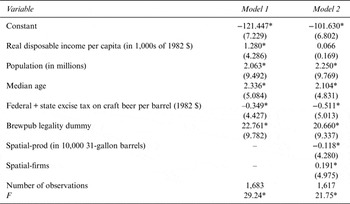
The production regressions are reported in Table 4. In Model 1, Tobit parameter estimates on income, population, age, taxes, and the brewpub dummy variable all have the expected signs and are significant at 1% or better. Higher state income, population, median age, and brewpub legality are predicted to increase production while higher taxes appear to reduce production, all else being equal. In addition to these variables, Model 2 contains the spatial variables. The results are consistent with Model 1, except that the income parameter loses significance. The parameter estimates on the spatial variables are significant at 1% and opposite in sign. The negative sign on spatial-prod may indicate that nearby production reduces output, perhaps due to increased competition. The positive sign on spatial-firms implies that brewers are more likely to congregate where more firms that produce similar products are nearby. This is consistent with the presence of knowledge spillovers.
Tobit Estimates of State-Based Panel Models of Craft Production, 1980–2012

Note: The absolute value of t-ratios, shown in parentheses, are derived using the robust (sandwich) variance estimator.
* Significant at 1 percent.
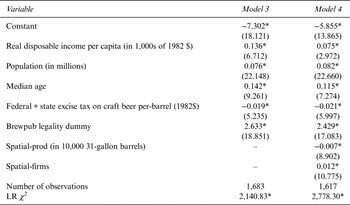
Negative binomial regression estimates of the determinants of number of craft brewers in a state for a given year are shown in Table 5.Footnote 29 In both Models 3 and 4, all parameter estimates have the expected signs and are significant at 1% or better.Footnote 30 Estimates indicate that states with higher incomes, larger populations, older citizens, lower taxes, and legalized brewpubs are likely to have more craft brewers, all else being equal. The interesting sign pattern of the spatial variable parameters continues: production nearby negatively affects the number of craft brewers while the number of brewers nearby positively affects the number of craft brewers.
Negative Binomial Estimates of State-Based Panel Models of Number of Craft Brewers, 1980–2012

Note: The absolute value of t-ratios, shown in parentheses, are derived using the robust (sandwich) variance estimator.
* Significant at 1 percent.
A number of alternative specifications are investigated. First, the spatial variables are constructed only for states within the continental United States. The distance to other states is so great in the case of Alaska and Hawaii as to make the spatial variables, which are constructed from inverse distance weights, minuscule. It is possible, of course, that omitting Alaska and Hawaii from the sample might bias results. To check for that bias, the models without the spatial variables, which were originally estimated with data on all 50 states and the District of Columbia, were re-estimated omitting Alaska and Hawaii. All signs and significance levels are the same as when Alaska and Hawaii are included.
As discussed earlier and shown in Figure 1, the trajectory of craft brewing over time can be divided into three periods: 1980–1998 (tremendous growth), 1999–2008 (shakeout), and 2009–present (resurgent growth). To capture the influence of factors during these periods but not already included in the models, two dummy variables were added, D9908 = 1 for observations in 1999–2008 ( = 0 otherwise) and D0912 = 1 for 2009–2012 (= 0 otherwise). Parameter estimates on these dummies are positive and significant in all models, indicating that craft brewer production and numbers are higher in these later periods than in the 1980–1998 period.Footnote 31 Significance levels are 1% for all, but D9908 in Model 2, where it is at 10%. The signs for parameters on income, population, age, tax, and the brewpub dummy in all models remain the same, although the income parameter becomes insignificant in the production models. The spatial-prod parameters are negative and significant at 1%, and the spatial-firms parameters are positive and significant at 1%, in the models with the time period dummies.Footnote 32
The t-ratios presented thus far were constructed using the heteroscedastic-robust variance estimator, also known as the sandwich, Huber/White, or simply robust estimator. If there is time-variant spatial dependence, however, the robust estimator is inconsistent, and our hypothesis tests are invalid. Time-invariant spatial dependence means that there may be spatial dependence at a given point in time, but the dependence does not vary over time. Bertanha and Moser (Reference Bertanha and Moser2014) propose a “spatial variance estimator” and a test for time-invariant spatial dependence for count data, such as our number of brewers variable. Estimation and testing rely on a Poisson model for panel data. Although the estimates of the negative binomial model indicate that there is overdispersion in our models, Poisson estimation is robust to overdispersion (Wooldridge, Reference Wooldridge2009). It might be interesting to conduct the Bertanha-Moser test using our data on numbers of craft brewers. Estimating Model 3 using fixed effects Poisson estimation, we find no significant time-variant spatial dependence.Footnote 33 This means that the usual robust variance estimator is consistent in that framework.
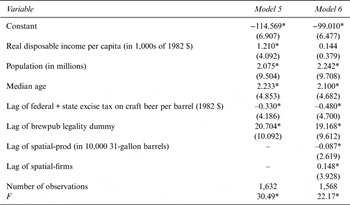
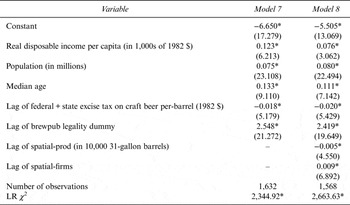
Finally, it might be possible that craft brewer taxes and the legality of brewpubs are endogenous variables, such that craft beer production or the number of brewers might affect these variables. To account for this possibility, we use predetermined values of taxes and the brewpub dummy variable. That is, we obtain estimates of our previous models by replacing taxes and the brewpub dummy with their values from the previous year. Table 6 displays estimates of the amended production models, and Table 7 shows the estimates for the number of firms. Comparing the results in column 1 in Table 6 with the results in column 1 in Table 4 shows that the significant signs are the same. Coefficient estimates are slightly smaller, with the exception of the population parameter. All coefficient estimates are significant at 1%. The number of firms' results in column 1 of Table 5 and column 1 of Table 7 reveal the same significant signs, slightly lower coefficient estimates on all variables, and a 1% significance level for all parameter estimates.
Tobit Estimates of State-Based Panel Models of Craft Production with Predetermined Variables, 1980–2012

Note: The absolute value of t-ratios, shown in parentheses, are derived using the robust (sandwich) variance estimator.
* Significant at 1 percent.
Negative Binomial Estimates of State-Based Panel Models of Number of Craft Brewers with Predetermined Variables, 1980–2012

Note: The absolute value of t-ratios, shown in parentheses, are derived using the robust (sandwich) variance estimator.
* Significant at 1 percent.
In additional models, we use time-lagged values of the spatial variables. It is possible that, at a given point in time, craft brewing in a state affects neighbors or that a third factor affects both state and a neighbor's craft brewing. Using the time-lagged spatial variables allows the influence of neighbors to predetermine firm decisions in a state. Estimates of these models are presented in column 2 of Tables 6 and 7. The coefficient estimates on the time-lagged spatial variables have the same signs as the coefficients on the spatial variables in the original models—negative for spatial-prod parameter and positive for the spatial-firms parameter—and are significant at 1%. The parameters on all the other variables also have the same significant signs as in the original models.
To summarize the regression results, estimates indicate that income, population, and median age encourage craft beer production and the number of craft brewers in a state. Further, the legal environment appears to matter a great deal: beer excise taxes have a negative effect, and legalized brewpubs have a positive effect, on craft production and numbers. An interesting result is that the spatial-prod variable, representing nearby production, appears to reduce production and the number of craft breweries in the state. In contrast, the spatial-firms variable, representing the number of firms nearby, appears to raise production and the number of craft brewers in a state. Because craft brewers are of unequal size, perhaps production better reflects the level of competition while knowledge spillovers depend on the number of neighboring brewers.
V. Conclusion
In 1976, Anheuser-Busch was operating several breweries with capacities of 4 million barrels or more apiece. That same year, Jack MacAuliffe opened New Albion Brewing, the first new craft brewing facility. The capacity of the New Albion facility was about 400 barrels.Footnote 34 In 2013, the total industry production of craft beer was about 13.2 million barrels, still less than the capacity of Coors' flagship brewery in Golden Colorado (over 20 million barrels).
But craft beer now has all the ingredients of a modern industry. There is an organized market for inputs. The recent Craft Brewers Conference had dozens of programs for the over four thousand participants with how-to sessions covering topics ranging from exporting beer to Thailand to methods for measuring product bitterness.
One signal of the maturity of the craft beer segment is that it has its own trade association: the Brewers Association. This association of brewers sponsors the Great American Beer Festival, the World Beer Cup, the Craft Brewers Conference & BrewExpo, and the American Homebrewers Association as well as representing craft brewers before state and federal authorities.
Another signal of the maturity of the craft beer segment is that it warrants the compilation of its own statistical database. The contribution of this paper is in offering a concise history of the craft beer segment and a foray into analyzing these data so as to allow a better economic understanding of this prominent development in the malt beverage industry.
Supplementary Material
For supplementary material accompanying this paper visit http://dx.doi.org/10.1017/jwe.2015.22.
Appendix Table: Rank of Production, Per Capita Production, and Number of Firms by State, 2012