


Introduction
Cognitive behavioural therapy (CBT) is a psychotherapeutic intervention with an established evidence base for the treatment of depression and anxiety problems (Butler et al., Reference Butler, Chapman, Forman and Beck2006; Hofmann and Smits, Reference Hofmann and Smits2008; Cuijpers et al., Reference Cuijpers, Berking, Andersson, Quigley, Kleiboer and Dobson2013). CBT has been shown to be effective when applied in routine public healthcare settings, although some patients drop out before completing treatment and tend to attain poorer outcomes (Stiles et al., Reference Stiles, Barkham, Twigg, Mellor-Clark and Cooper2006; Stiles et al., Reference Stiles, Barkham, Mellor-Clark and Connell2008). Attrition rates from CBT interventions reported in controlled trials tend to be lower (i.e. 17.2% average reported by Gloaguen et al., Reference Gloaguen, Cottraux, Cucherat and Blackburn1998) by comparison to routine psychological care (i.e. 25% average reported by Richards and Borglin, Reference Richards and Borglin2012). Similarly, in a meta-analytic review of wider psychotherapy studies, Swift and Greenberg (Reference Swift and Greenberg2012) found that mean dropout rates were significantly higher in routine care studies (27.9%) compared to efficacy trials (17.9%). Furthermore, it has been suggested that CBT has higher dropout rates in comparison to other psychological therapies for depression (Cuijpers et al., Reference Cuijpers, van Straten, Andersson and van Oppen2008), although there is also contradictory evidence that suggests no significant differences between therapy models (Swift and Greenberg, Reference Swift and Greenberg2012). Overall, there is convincing evidence that CBT can be effective in routine care but it is also recognized that treatment dropout is an important challenge for psychological services.
A number of strategies attempting to improve engagement with psychological interventions have been reported. One such strategy is pre-treatment preparation or induction training, which is based on psychoeducation. Walitzer and colleagues reviewed the empirical literature on this topic and explained that ‘preparatory strategies familiarize the client with the rationale for and process of therapy through lecture, individual interview, or guided group exercises in order to decrease the risk for dropout and increase the benefit derived from therapy’ (Walitzer et al., Reference Walitzer, Dermen and Connors1999, p. 133). Preparation strategies documented in the literature aim to clarify role expectations, outcome expectations, the rationale for therapeutic interventions and to enhance clients' motivation to engage with treatment.
Role induction strategies have mostly been developed to socialize patients to non-CBT interventions such as expressive, psychoanalytic or group psychotherapy (e.g. see Jacobs et al., Reference Jacobs, Charles, Jacobs, Weinstein and Mann1972; Heitler, Reference Heitler1973, Reference Heitler1976; Garrison, Reference Garrison1978; Stark and Kane, Reference Stark and Kane1985). Macaskill and collaborators have reported that educating patients about rational-emotive therapy in preparation for treatment can enhance cooperation and strengthen the therapeutic alliance (Macaskill and Macaskill, Reference Macaskill and Macaskill1983; Macaskill, Reference Macaskill, Dryden and Trower1989), but empirical tests of role induction approaches in CBT oriented interventions are lacking.
This paper describes the development and evaluation of a pre-treatment intervention aimed at patients with depression and anxiety problems, who were on waitlist to access CBT. This was a group-based, psychoeducational role induction informed by transdiagnostic theory (Harvey et al., Reference Harvey, Watkins, Mansell and Shafran2004), which proposes that several common processes (i.e. attention, reasoning, behaviour) influence the development and maintenance of mental disorders. The intervention covered generic aspects of CBT theory, socialization to therapy and common change methods for various mental health problems.
Method
Design
A random sample of patients with depression and/or anxiety problems who were on waitlist for CBT were invited to attend pre-treatment transdiagnostic seminars (TDS+CBT). TDS consisted of three 1.5-hour educational seminars delivered in a lecture-style setting. The clinical progress of consenting TDS+CBT participants was compared with a matched sample of usual CBT cases.
Hypotheses
Three hypotheses were formulated based on prior role induction studies and literature on transdiagnostic theory. (1) Patients with various diagnostic presentations will find TDS equally relevant and acceptable. (2) Significantly greater treatment completion rates will be observed in the TDS+CBT group compared to usual CBT. (3) Patients accessing TDS+CBT will have significantly greater post-treatment symptom reductions compared to usual CBT patients.
Participants and setting
The study involved patients who were referred for CBT in a primary care mental health service linked to the Improving Access to Psychological Therapies (IAPT) programme in England, UK. The service offered access to evidence-based psychological interventions organized in a stepped care model as described by Clark et al. (Reference Clark, Layard, Smithies, Richards, Suckling and Wright2009). Patients were eligible to take part if they met criteria for a depressive and/or anxiety disorder determined at routine assessment interviews supplemented by validated screening questionnaires (IAPT National Programme Team, 2011), and if they were deemed suitable for high intensity CBT according to established clinical guidelines (National Institute for Health and Care Excellence [NICE], 2011). This study sought to maximize external validity by including a typical primary care clinical sample and therefore few exclusions were imposed; namely the presence of psychotic disorders, bipolar disorder, acute suicidal risk, or post-traumatic stress disorder. Patients with the latter condition were excluded on the basis that people who may potentially dissociate or experience flashbacks in a large group setting may require more personalized and intensive support to manage such symptoms.
Interventions
Cognitive behavioural therapy
Consistent with clinical guidelines for the treatment of depression and anxiety disorders (NICE, 2007, 2010, 2011), qualified psychotherapists offered up to 20 sessions of protocol-driven CBT. This involved disorder-specific CBT interventions endorsed by the CBT competency framework published by Roth and Pilling (Reference Roth and Pilling2008). Study participants accessed individual therapy conducted in mainstream primary care practice, without any modifications or additional fidelity checks over and above routine clinical supervision (average of 3 hours per month).
Transdiagnostic seminars
Three seminars were developed based on role induction theory (Walitzer et al., Reference Walitzer, Dermen and Connors1999) and transdiagnostic theory (Harvey et al., Reference Harvey, Watkins, Mansell and Shafran2004). The content of the seminars included (1) clarification of the patient and therapist roles, as well as (2) psychoeducation about the role of transdiagnostic processes (thinking, behaviour, attention and memory) in the maintenance of psychological distress.
Informed by the role induction literature (Macaskill, Reference Macaskill, Dryden and Trower1989), we reasoned that patients could be prepared to hold realistic and accurate expectations of the CBT approach. The seminars therefore introduced key CBT concepts such as agenda, problem definition, targets, homework and formulation. Common misconceptions were also clarified, such as the notion that CBT is mechanistic, overly directive or simply orientated around ‘positive thinking’. Instead, the flexible, collaborative and evidence-oriented aspects of CBT were introduced using accessible (i.e. minimal jargon, plain English, simple formulation diagrams) and experiential material (i.e. videos, self-refection exercises about the participants’ presenting symptoms and problems). The presenters modelled approachability and humility, and clients were able to ask any questions they had on a one-to-one basis if they preferred. In doing so, we aimed to prepare clients for CBT by showing that they could expect their therapist to be approachable, open, friendly and knowledgeable. Thus, the role induction aspects of the seminars included introduction to CBT concepts (i.e. maintenance processes) as well as more general attitudes (i.e. collaboration) and behaviours (i.e. developing formulations and homework assignments) they may expect as part of the therapy process.
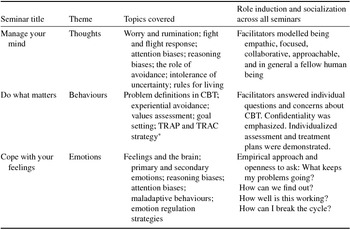
Each seminar had a central theme and covered psychoeducation about a range of common CBT strategies. The first seminar focused on understanding problematic thinking processes such as worry and rumination, the second focused on behaviour change, and the third focused on emotion regulation; further details are summarized in Table 1. The seminars were designed to be complementary but not necessarily contingent on each other, so patients could freely choose to access one or more of them.
Transdiagnostic seminars (TDS): summary of focal themes and content

*TRAP: Trigger, Response, Avoidance Patterns; TRAC: Triggers, Response, Alternative Coping.
Each seminar lasted 1.5 hours and was delivered in a lecture-style set-up, supported by presentation slides, videos and accompanying booklets. Participants were able to ask questions and to engage in brief discussions about the seminar content, though interaction among participants and self-disclosure of personal issues was not expected or encouraged. They were run in a cycle of three consecutive seminars, once per week, between 18:00 and 20:00 p.m., and were held in both healthcare and public venues (e.g. lecture theatres, colleges). The seminars were delivered by a group of four CBT practitioners. At the outset of the study, CBT practitioners co-facilitated seminars in pairs, and they later delivered the seminars alone (in a rotating schedule) as they gained experience. The group was supervised once per month by an experienced psychotherapist (author M.G.) who led on the writing of the seminar content and materials.
Measures
Primary outcome measures
The Patient Health Questionnaire (PHQ-9) is a nine-item measure based on DSM-IV criteria for major depression (Kroenke et al., Reference Kroenke, Spitzer and Williams2001). Each item is scored on an ordinal scale between 0 (not at all) and 3 (nearly every day), resulting in a total severity score ranging between 0 and 27. This measure has adequate sensitivity (88%) and specificity (88%) for the detection of major depressive disorder using a cut-off score ≥10 (Kroenke et al., Reference Kroenke, Spitzer and Williams2001). The Generalized Anxiety Disorder scale (GAD-7) is a seven-item measure which is scored in the same way as the above questionnaire, rendering a total anxiety severity score between 0 and 21 (Spitzer et al., Reference Spitzer, Kroenke, Williams and Löwe2006). The GAD-7 is a valid and reliable screening tool for a variety of common anxiety disorders such as generalized anxiety, social phobia, post-traumatic stress disorder and panic disorder (Kroenke et al., Reference Kroenke, Spitzer, Williams, Monahan and Löwe2007). A cut-off score ≥8 in this measure has been recommended to detect an anxiety disorder with adequate sensitivity (77%) and specificity (82%).
Secondary measures
Baseline functional impairment was measured using the Work and Social Adjustment Scale (WSAS), which is a self-report measure of functioning across five domains: work, home management, social leisure activities, private leisure activities, and family and relationships (Mundt et al., Reference Mundt, Marks, Shear and Greist2002). Each item is rated on a scale of 0 (no impairment) to 8 (very severe impairment), rendering a total severity score between 0 and 40. This measure was gathered to control for functional impairment, which has been shown to predict post-treatment outcomes in psychotherapy (Frank et al., Reference Frank, Cassano, Rucci, Thompson, Kraemer, Fagiolini, Maggi, Kupfer, Shear, Houck, Calugi, Grochocinski, Scocco, Buttenfield and Forgione2011). Guided by Lutz et al. (Reference Lutz, Leon, Martinovich, Lyons and Stiles2007), a single Likert scale question was included as part of routine intake assessments for all patients accessing the service, asking patients to rate their treatment outcome expectancy level (0 = not at all; 10 = completely confident). The question was: ‘How confident are you that this treatment will work for you?’.
In order to gather participants’ feedback about the TDS intervention, a brief acceptability questionnaire (AQ) was designed including three Likert-scale items rated on a 0 (low) to 10 (high) scale. The AQ asked participants to rate the relevance of the seminar, the quality of the presentation and the quality of the materials (audio-visual resources and booklets). A sample question is: ‘How relevant was the seminar to the problem for which you are seeking treatment?’.
Finally, de-identified demographic characteristics for all participants were gathered, as well as clinical pathway information including number of weeks on waiting list, number of weeks in CBT and reasons for discharge (completed treatment, dropped out).
Recruitment and selection of matched controls
All patients on waiting list for CBT were deemed eligible unless they met exclusion criteria described above which was verified in clinical records. A computer-generated schedule was used to derive a random sample of cases that received postal and email recruitment letters and were provided information about the rationale and content of seminars. The recruitment materials made it clear that accessing therapy was not conditional on attending the seminars, and patients had the choice of attending one or more seminars. Patients who consented to take part were included in the study.
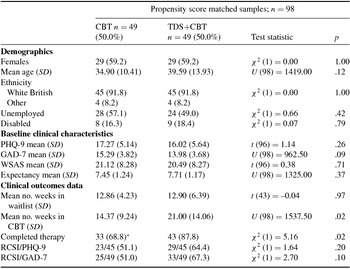
De-identified records for matched controls were obtained from the clinical database. A one-to-one propensity score matching method was applied to derive a subsample of usual CBT cases with comparable demographic and baseline clinical characteristics. This method relied on a logistic regression model predicting (TDS) group membership based on intake characteristics (baseline functioning, symptom severity, and demographic variables in Table 2), matching control group cases using a nearest neighbours approach with a conservative tolerance level (calliper = 0.2) specified a priori (informed by Hammond et al., Reference Hammond, Croudace, Radhakrishnan, Lafortune, Watson, McMillan-Shields and Jones2012) and allowing replacement to maximize matching precision (Smith and Todd, Reference Smith and Todd2005).
Sample characteristics and clinical outcomes data

*Estimates exclude one case with missing data; CBT: cognitive behavioural therapy; TDS: transdiagnostic seminars; SD: standard deviation; t: Student's t-test; U: Mann-Whitney U-test; χ 2: chi-square test; PHQ-9: depression severity; GAD-7: anxiety severity; WSAS: functional impairment; RCSI: Reliable and clinically significant improvement.
Data collection procedures
As per routine practice in the service, all patients completed self-reported measures of depression (PHQ-9), anxiety (GAD-7) and functional impairment (WSAS) at initial assessment interviews and at every therapy session thereafter to monitor progress. Patients also completed therapy expectancy measures at initial assessments. TDS participants additionally completed the AQ at the end of each seminar. Clinical records for all TDS participants included notes to confirm their participation in one or more seminars, so CBT therapists were aware about TDS participation.
Statistical analyses
In order to assess the integrity of case-control matching, demographic and clinical characteristics were compared between groups using chi-square tests for categorical variables, t-tests for normally distributed continuous variables and non-parametric Mann–Whitney U-tests for continuous variables with skewed distributions.
To assess the acceptability of the TDS intervention, mean ratings for each of the AQ items across all three seminars were summarized. Next, the internal consistency of the AQ items was tested using Cronbach's alpha to determine if we could aggregate these into a single index of acceptability (sum of all items divided by 3). The aggregated index was then computed for each case, which enabled the comparison of mean acceptability ratings across diagnostic groups applying analysis of variance (ANOVA).
Completion (versus dropout) rates were compared between groups using chi-square analysis. Primary outcome measures (PHQ-9, GAD-7) were obtained from routine clinical records at three time-points for all study participants: (1) at the time when patients were initially referred to CBT and placed on waitlist; (2) at the time of the first CBT session; and (3) at the last attended CBT session prior to discharge from the service. Missing data for one or more outcome measures (n = 2 at time-point (TP) 1; n = 1 at TP2; n = 2 at TP3) were dealt with using an expectation-maximization multiple imputation method (Schafer and Olsden, Reference Schafer and Olsden1998). Clinical effects were investigated in two steps. First, symptom changes were examined at TP2, comparing TDS versus a waitlist control group. Second, symptom changes were examined at TP3, where the intervention group completed TDS+CBT and the control group completed CBT. PHQ-9 and GAD-7 change scores were calculated for every patient at each of these two time-points (e.g. TP1 score – TP2 or TP3 scores), such that a positive change score denoted improvement and a negative score denoted deterioration. Symptom changes at these two steps were examined applying separate analysis of covariance (ANCOVA) models for each outcome measure. The ANCOVA models included change scores as the dependent variable and group as a fixed factor, controlling for the following covariates: age, gender, baseline symptom severity, baseline functional impairment (WSAS), baseline expectancy rating, number of weeks in waiting list. TP3 models additionally controlled for number of weeks in CBT, which was likely to vary across cases and is a well-known outcome predictor. Conventional ANCOVA assumptions were verified using formal tests for homogeneity of variance and by inspecting residual plots. Analyses were based on intention-to-treat principles, so they included completers and dropouts. Between-group differences were assessed at TP2 and TP3, both in terms of mean and adjusted symptom change scores.
Reliable and clinically significant improvement (RCSI) rates were calculated following the criteria proposed by Jacobson and Truax (Reference Jacobson and Truax1991) and based on reliable change indices for PHQ-9 (≥6) and GAD-7 (≥5) outlined by Richards and Borglin (Reference Richards and Borglin2011). Between-group RCSI rates at TP 3 (post-treatment) were compared using chi-square analysis.
Results
Sample characteristics
A total of 98 cases were included in the study; 49 consenting TDS+CBT participants (from a total of 200 CBT waitlist patients who received postal invitations) and 49 (usual waitlist) matched controls. TDS participants attended an average of 1.42 seminars (SD = .71, mode = 1, 28.7% ≥ 2 seminars). The number of seminars attended was determined by preference and by time spent in waiting list.
The study sample was characterized by a majority (59.2%) of female patients, with a mean age of 37 years (range 17–69 years), of whom 91.8% were from a White British background. Primary diagnoses noted in clinical records were mixed anxiety and depression (43.2%), depression (22.3%), generalized anxiety disorder (14.2%), obsessive compulsive disorder (8.8%), social phobia (5.4%), panic disorder with and without agoraphobia (4.1%), and specific phobias (2.0%). All baseline characteristics displayed in Table 2 were comparable between intervention and control groups.
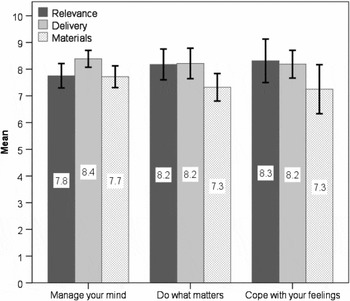
Acceptability
As shown in Fig. 1, mean ratings for the relevance and quality of delivery and materials were comparably high for all three seminars (range 7.3–8.4). The three items in the AQ measure were inter-correlated, with evidence of high internal consistency based on Cronbach's alpha (α = .80). Therefore these items were aggregated into a single index of acceptability and compared across diagnostic groups. No significant differences in mean AQ ratings were found between any of the diagnostic groups (F (5,83) = 2.35, p = .05).
Mean ratings of relevance, quality of delivery and materials for all three seminars

Clinical outcomes
As shown in Table 2, a significantly higher proportion of TDS+CBT cases completed treatment in comparison to controls; 87.8% versus 68.8%, χ2 (1) = 5.16, p = .02. Consistent with this result, the mean number of treatment weeks was higher in the TDS+CBT group; 21.00 versus 14.37, U (98) = 1537.50, p = .02.
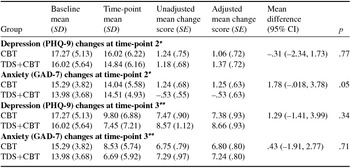
Intention-to-treat ANCOVA analyses predicting symptom changes at TP2 found no significant main effects for treatment group after controlling for covariates; PHQ-9 model, F (1,98) = .09, p = .77; GAD-7 model, F (1,98) = 3.87, p = .05. Similarly, no significant main effects were found for treatment group when examining symptom changes at TP 3; PHQ-9 model, F (1,96) = .90, p = .34; GAD-7 model, F (1,96) = .13, p = .71. Table 3 presents unadjusted and adjusted mean estimates of symptom change scores for each group.
Post-treatment changes in depression (PHQ-9) and anxiety (GAD-7) symptoms

*Adjusted for age, gender, baseline symptom severity, baseline functional impairment (WSAS), baseline expectancy rating and number of weeks in waiting list; **adjusted for all of the above covariates plus number of weeks in CBT; SD: standard deviation; SE: standard error of the mean; CI: 95% confidence intervals.
The overall proportions of patients meeting post-treatment RCSI criteria in the full sample were 53.1% for depression (PHQ-9) and 59.2% for anxiety (GAD-7). Greater proportions of patients met RCSI criteria in the TDS+CBT group (PHQ-9 = 64.4%; GAD-7 = 67.3%) in comparison to the usual CBT group (PHQ-9 = 51.1%; GAD-7 = 51.0%), although differences were not statistically significant; PHQ-9, χ2 (1) = 1.64, p = .20; GAD-7, χ2 (1) = 2.70, p = .10.
Discussion
Main findings
This study built upon prior research on role induction in psychotherapy by developing a transdiagnostic intervention aiming to prepare patients to make the most of CBT delivered in primary care. Our study hypotheses were partially supported. Consistent with transdiagnostic theory, patients with a variety of presenting problems rated the relevance and quality of the TDS intervention similarly, and no significant differences in acceptability were found between diagnostic groups. As expected, patients accessing TDS+CBT were significantly more likely to complete treatment. In comparison to usual CBT, the experimental intervention appears to improve treatment completion by approximately 19%. However, contrary to our assumptions, we found no significant between-group differences in symptom reductions or recovery (RCSI) rates after therapy.
Methodological considerations
The pragmatic design in this study is likely to enhance the external validity of results, particularly as the sample characteristics closely resemble those reported in large naturalistic studies in similar settings (e.g. Richards and Borglin, Reference Richards and Borglin2011). A down side of the pragmatic design and limited study resources was that it was unfeasible to closely monitor or rate treatment fidelity for numerous CBT practitioners seeing patients with a variety of disorders. We mostly focused our attention and resources in ensuring that the TDS intervention was competently delivered by training and supervising the facilitators to use standardized presentation materials, as well as by regularly sharing participants’ feedback with them on a weekly basis.
A considerable limitation was the lack of formal diagnostic interviews in this routine care setting, which raises some questions about the accuracy of diagnoses noted in clinical records. The distribution of diagnoses may differ across groups; and it was only possible to match cases and controls based on symptom severity and other demographic factors. A further limitation is that it was not possible to assess whether or not the practice of individual CBT therapists may have varied on the basis of knowing that their patients accessed TDS interventions. It is possible that some therapists may have directly discussed patients’ expectations and experiences of TDS, whilst others may not have done so.
Given our theoretical assumptions about the role of pre-treatment dispositions and expectations, the sampling and recruitment method was appropriate to minimize the chances that participants in the TDS group may feel pressured to attend the seminars as a pre-condition to therapy, or that control group patients may feel that a potentially helpful intervention was being withheld from them. In order to control for self-selection bias and selective dropout, we applied a robust intention-to-treat analysis and propensity score matching methods. Notwithstanding our efforts to minimize bias in the analysis, the study results inevitably can only be generalized to populations of patients who are amenable to group interventions and who choose to engage with pre-treatment seminars (approximately 25% of cases offered the option to take part). Future studies applying role inductions in CBT practice could incorporate preference-based designs or could consider testing group versus individual inductions to learn more about the determinants and effects of patient preferences. An alternative design could be to compare group role inductions versus a non-specific time and attention control condition such as healthy lifestyle lectures.
Theory, research and practice
This pilot study offers a proof of concept that augmenting usual CBT interventions with pre-treatment role induction is likely to improve retention and reduce dropout in mainstream out-patient care. To our knowledge, this is the first attempt to design and empirically test the utility of a transdiagnostic induction that could be acceptable and relevant to CBT patients with a heterogeneous set of problems and diagnoses.
The influence of role induction on treatment completion rates but not on symptomatic change raises questions about its mechanisms of action. As we have seen, the lack of between-group differences in symptom reductions by the first CBT session indicates that TDS does not operate as a conventional guided self-help (GSH) intervention. GSH interventions are known to help people to attain symptom reductions over a few sessions (typically <6), and it has been shown that early symptomatic improvements in GSH are associated with treatment retention and dropout (Delgadillo et al., Reference Delgadillo, McMillan, Lucock, Leach, Ali and Gilbody2014). Our findings suggest that the mechanism of action of TDS on treatment retention cannot be simply put down to early treatment gains typically seen in GSH interventions, as no early symptomatic changes were observed. It is plausible that TDS influences subtle dispositions such as hopefulness and expectancy, or perhaps it serves to allay common fears or concerns about therapy by clarifying what patients can expect from this form of treatment. For example, some authors have proposed that treatment non-attendance may be influenced by common anxieties and fears about therapy (Sheeran et al., Reference Sheeran, Aubrey and Kellett2007; Vogel et al., Reference Vogel, Wester and Larson2007). A previous study has also demonstrated that influencing expectations about treatment through didactic materials (i.e. leaflets) can improve attendance and retention (Swift and Callahan, Reference Swift and Callahan2011).
Our findings suggest that even when treatment completion can be maximized (as high as 85% in our experimental group) this does not guarantee greater treatment success. Length of therapy is one of the most well-established predictors of outcome in psychotherapy (Howard et al., Reference Howard, Kopta, Krause and Orlinsky1986; Maling et al., Reference Maling, Gurtman and Howard1995; Anderson and Lambert, Reference Anderson and Lambert2001; Lutz et al., Reference Lutz, Lowry, Kopta, Einstein and Howard2001; Hansen et al., Reference Hansen, Lambert and Forman2002). From this perspective, it is reasonable to assume that extending the duration of treatment may improve symptoms, as patients who drop out have been consistently found to attain poorer outcomes (Stiles et al., Reference Stiles, Barkham, Twigg, Mellor-Clark and Cooper2006, Reference Stiles, Barkham, Mellor-Clark and Connell2008). The finding that improved retention does not yield better outcomes could indicate that some patients who are more prone to drop out may indeed be less responsive to psychological interventions. This is consistent with recent evidence that patients with complex clinical profiles (i.e. severe symptoms, severe functional impairment, socio-economic deprivation, disabilities, etc.) are at considerably greater risk of drop-out and have a low probability of recovery (Delgadillo et al., Reference Delgadillo, Moreea and Lutz2016). Therefore, role induction appears to enhance retention, but this may have resulted in extending the length of treatment for both responders and non-responders. The observed recovery (RCSI) rates were higher in the TDS+CBT group (64 to 67%, versus 51% in usual CBT), but possibly did not reach statistical significance because of the influence of non-responders in the group-level comparisons. Future studies could use patient profiling to investigate if role inductions have differential effects in subgroups of patients with more or less complex presentations.
Conclusions
It is possible to prepare patients to engage with CBT and to considerably minimize drop-out using pre-treatment psychoeducation and role inductions. Delivered in a seminar format, role inductions such as the TDS programme can reach out to many patients, making the most of economies of scale that can be attained in group settings. However, retention does not guarantee improvement, and therefore we argue for a combination of role inductions and other strategies designed to enhance treatment outcomes. Future studies could combine role inductions plus troubleshooting strategies such as outcome tracking and feedback methods (Lambert et al., Reference Lambert, Whipple, Hawkins, Vermeersch, Nielsen and Smart2003; Shimokawa et al., Reference Shimokawa, Lambert and Smart2010), or systematic clinical supervision of cases with risk-signals (e.g. no reliable improvement half way through treatment episode) to inform decisions to refer them on to other practitioners or services in accordance with a stepped care model (NICE, 2011).
Acknowledgements
We gratefully acknowledge Janette Lewis, Georgina Ramseyer, Gail Smith and Abigail Coe who facilitated the TDS intervention. We also thank Bernie Bell, Laurence Gregory, Rachel Bos, Emma Ferguson and Alexander Teahan for organizational and administrative support.
Ethical statement: The authors assert that all procedures contributing to this work comply with the ethical standards of the English National Health Service and with the Helsinki Declaration of 1975 on human experimentation, and its most recent revision. This study was registered with Leeds Community Healthcare NHS Trust as a service improvement project, and did not require ethical approval.
Conflicts of interest: The authors have no conflicts of interest with respect to this publication.
Financial support: This work was funded and supported by Leeds Community Healthcare NHS Trust, Leeds, UK. The funding organization had no influence over the design of the study, data analysis methods or decision to publish the results.



Comments
No Comments have been published for this article.