Slow binocular rivalry in bipolar disorder
In the early twentieth century, it was reported that the rate of perceptual alternation of the Necker cube (shown in Fig. 1a) was slower in patients with manic depression than in patients with dementia praecox (Reference Ewen1,Reference Hunt and Guilford2). Despite several subsequent studies of perceptual alternation rates in psychiatric groups [see (Reference Miller, Gynther and Heslop3)], these observations remained relatively obscure until, independently and serendipitously, Pettigrew and Miller (Reference Pettigrew and Miller4) found similar slowing of alternation rate in bipolar disorder (BD) using binocular rivalry. Like the Necker cube, binocular rivalry involves perceptual alternations every few seconds (Fig. 1b), but occurs because of conflicting retinal input rather than conflicting depth perspectives.
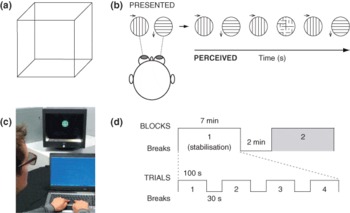
The Necker cube, binocular rivalry and data collection protocol. (a) The Necker cube is a well-known two-dimensional image that when viewed is perceived to alternate between two different depth perspectives. (b) To elicit binocular rivalry, two dissimilar images are presented, one to each eye. The observer alternates between perceiving one image for a few seconds, followed by the other image for a few seconds and so on, with occasional short periods of mixed percepts. High-strength (or more salient) binocular rivalry stimuli (e.g. moving gratings with a high spatial frequency) induce faster perceptual alternations in the same individual than lower-strength stimuli (e.g. stationary gratings with low spatial frequency). The small arrows next to each grating indicate the direction of movement. (c) Collection of binocular rivalry data is relatively straightforward. Research assistants do not require special skills to administer and supervise data collection. There is customised software available for binocular rivalry data collection and analysis. The hardware we currently use consists of a specialised monitor (True Opsis 3Di, includes passive polarised glasses), a standard PC (or laptop) and a compatible video card. The total cost of this equipment is around AUS$4000, with the monitor making up approximately two-thirds of this amount. Subjects are instructed to report their perceptions with one key for one percept, another key for the rival percept and a third key to indicate mixed percepts or incorrect responses (which are excluded). (d) Binocular rivalry data collection can occur over 20 min, including two blocks each consisting of 7 min of rivalry viewing with interspersed breaks. The second block is used for analysis because BRR requires the first block of testing to stabilise. The data in previous studies (Reference Miller, Gynther and Heslop3,Reference Pettigrew and Miller4) were collected over three blocks but with such high BRR reliability between blocks 2 and 3 (r = 0.93; Fig. 3c), we have now dropped the third block to shorten the testing sessions.

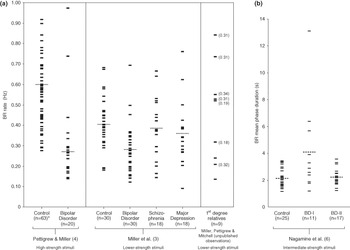
Pettigrew and Miller (Reference Pettigrew and Miller4) examined binocular rivalry rate (BRR) in a sample of euthymic subjects with BD-I and controls. Their first study used high-strength stimuli, i.e. drifting gratings of high spatial frequency, and found BRR was indeed significantly slower in BD. These high-strength stimuli produced excellent group separation, as shown in Fig. 2a, though with some clear false positives and false negatives. On average, control subjects would experience perceptual switches every 1–2 s, whereas for BD subjects this occurred every 3–4 s with some perceptual periods as long as 7–10 s.
Binocular rivalry in psychiatric groups. (a) In each subject group, the central tendency for BRR (expressed in Hz) is indicated by the dotted line [medians in Pettigrew and Miller (Reference Pettigrew and Miller4), and means in Miller et al. (Reference Miller, Gynther and Heslop3); with *four control outliers in the former not shown: 1.11, 1.11, 1.19 and 1.48 Hz]. BRR in first-degree relatives are shown in the far right panel, with proband rates (where available) indicated in brackets. (b) The BRR data from Nagamine et al. (Reference Nagamine, Yoshino, Miyazaki, Takahashi and Nomura6) is expressed in mean phase duration, and each subject group's mean is indicated by the respective dotted line.

In a subsequent study, Miller et al. (Reference Miller, Gynther and Heslop3) used lower-strength stimuli, i.e. stationary gratings of low spatial frequency, in a different sample and again found significantly slower BRR in BD-I compared with controls (Fig. 2a). However, group separation in this study was less than in their previous one, suggesting that high-strength stimuli better distinguish BD from control subjects.
The second study also examined BRR in schizophrenia and major depression (Reference Miller, Gynther and Heslop3), and found no significant differences in these groups compared with controls (though again with some individuals in all non-BD groups clearly showing slow BRR; Fig. 2a). Furthermore, although unpublished, BRR has also been assessed in a small number of first-degree relatives of BD probands using lower-strength stimuli. These data show that some relatives of BD probands exhibit slow BRR while others do not (Fig. 2a).
Since these BRR studies, there have been two independent replications reported. The first, by Krug et al. (Reference Krug, Brunskill, Scarna, Goodwin and Parker5), used an ambiguous structure-from-motion stimulus, which is a very low-strength stimulus, inducing alternations more than an order of magnitude slower than binocular rivalry stimuli, i.e. on average, just over every 30 s in controls and 40 s in BD. Their study, nevertheless, did report significantly slower alternation rate in BD-I compared with controls, though to a lesser extent than the previous studies of Pettigrew and Miller (Reference Miller, Gynther and Heslop3,Reference Pettigrew and Miller4). This disparity, in our view, was because of the use of such low-strength stimuli by Krug et al.
The second replication study, by Nagamine et al. (Reference Nagamine, Yoshino, Miyazaki, Takahashi and Nomura6), used binocular rivalry stimuli of intermediate strength and again reported significantly slower BRR in BD-I compared with controls. They also found that BRR in BD-II, a less severe form of the disorder, was similar to that observed in controls (Fig. 2b).
Slow BRR as an endophenotype for bipolar disorder?
BD is known to be a highly heritable psychiatric condition, with heritability estimates ranging from 0.59 to 0.85 (Reference Smoller and Finn7,Reference Lichtenstein, Yip and Björk8). The data presented above suggest that slow BRR should be explored as a potential endophenotype (or ‘intermediate phenotype') for BD. Identification of endophenotypes has become an important strategy in psychiatric genetics (Reference Gottesman and Gould9), including in BD research (Reference Hasler, Drevets, Gould, Gottesman and Manji10). It has been suggested that the criteria for a trait to be considered an endophenotype for a genetic condition (Reference Gottesman and Gould9,Reference Kendler and Neale11) include that it is (a) associated with the condition (i.e. sensitive), (b) heritable, (c) reliable, (d) unaffected by clinical state, (e) co-segregated with illness in families and (f) found in non-affected family members more commonly (or at a higher level) than in the general population.
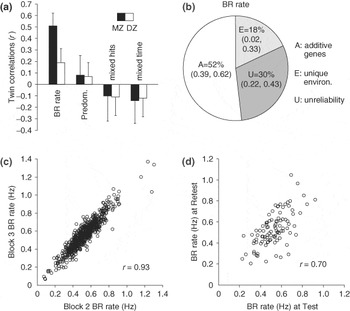
The first of these criteria, sensitivity, is now reasonably well established for slow BRR in BD (Fig. 2a), though a larger dataset using high-strength stimuli is still needed. The heritability and reliability of BRR were recently examined in a large, 10-year study of 14-year-old monozygotic (MZ) and dizygotic (DZ) twins (n = 722), around 100 of whom were re-tested 2 years later (Reference Miller, Hansell and Ngo12). Using high-strength stimuli and excluding twins with a history of any psychiatric disorder, this study showed a substantial genetic contribution to individual variation in BRR (Fig. 3b), with the best-fitting genetic model showing 52% of the variance in BRR was accounted for by additive genetic factors.
Genetics of BRR. These four panels show the population binocular rivalry and genetic modelling data from a sample of 722 twins (Reference Miller, Hansell and Ngo12). (a) Twin correlations for binocular rivalry measures in MZ and DZ twins (error bars indicate 95% confidence intervals, CIs). Correlations for BRR were significant. Correlations for predominance (i.e. the amount of time spent perceiving one image relative to the other) and for mixed hits/time (i.e. number of, and time associated with, mixed percepts or incorrect responses) were found to be not significant and therefore were not included in genetic modelling analyses. (b) The genetic modelling results indicate that the variance in BRR was because of a substantial additive genetic component; plus unique environment and measurement unreliability over a period of 2 years. (c) Reliability of BRR within a testing session was very high. Note also the high degree of BRR individual variation in this large dataset. (d) Reliability of BRR was also high between testing sessions 2 years apart (n = 97).

Miller et al. (Reference Miller, Hansell and Ngo12) also showed BRR to be very highly reliable within a half-hour testing session (r = 0.93; Fig. 3c), and to be highly reliable between testing sessions, 2 years apart (r = 0.70; Fig. 3d), confirming earlier reports of high BRR reliability (Reference Miller, Gynther and Heslop3,Reference Pettigrew and Miller4,Reference George13,Reference Enoksson14). Moreover, processing speed measures were found to bear no relationship to BRR (publication in preparation), thereby eliminating, as expected, reaction time differences as an explanation for individual variation in BRR [see also (Reference Nagamine, Yoshino, Miyazaki, Takahashi and Nomura6)]. Although not directly assessed in this study, differences in eye movement profiles are also unlikely to account for slow BRR in BD [discussed in (Reference Miller, Hansell and Ngo12)].
Currently, there are insufficient data on the BRR trait within families of BD probands to claim a genetic correlation between slow BRR and BD. However, as mentioned above and shown in Fig. 2a, the small amount of data available on this suggest that at least some of the tested first-degree relatives of BD probands do exhibit slow BRR. This clearly requires confirmation with further data, as well as examination of the prevalence of the slow BRR trait in BD relatives compared with the general population.
Possible effects of clinical state on an individual's BRR remain to be clarified; however, the slow BRR trait is clearly evident in euthymic BD-I subjects (Reference Miller, Gynther and Heslop3–Reference Nagamine, Yoshino, Miyazaki, Takahashi and Nomura6). Similarly, a confounding effect of medication cannot yet be excluded; however, available data suggest that medication effects, if they exist, at least do not account for the trait (Reference Miller, Gynther and Heslop3,Reference Nagamine, Yoshino, Miyazaki, Takahashi and Nomura6). Indeed, un-medicated BD patients have exhibited slow BRR, as have un-medicated (non-affected) first-degree relatives of BD probands [(Reference Miller, Gynther and Heslop3,Reference Pettigrew and Miller4); Reference Hunt and GuilfordFig. 2a]. Moreover, slow Necker cube alternations in BD were reported well prior to the advent of lithium and modern psychotropic agents (Reference Ewen1,Reference Hunt and Guilford2).
However, definitive assessment of state and medication effects requires BRR measurement before and after state or medication change, and ideally in medication-naïve patients. In practice, such studies are difficult, though not impossible, and the two issues can be confounded, i.e. with the onset of medication, state changes can occur, and with state changes, medication changes can occur. Moreover, patients in acutely unwell states may find task compliance challenging.
Use of the trait in genetic studies?
Demonstration of a genetic correlation between slow BRR and BD would suggest potential utility of the trait in genetic (gene-finding) studies of BD. There is a strong supposition that many complex traits, including BD, are highly heterogeneous in aetiology. BRR may enable dissection of this heterogeneity to define more homogeneous subsets for genetic analysis. Hence, slow BRR could be used to classify an individual as ‘affected' rather than requiring the presence of clinical BD, which may not have yet manifested in individuals who are, nevertheless, at high genetic risk of developing the disorder, and this could increase the power of gene-finding studies.
The ideal evidence to demonstrate utility of slow BRR as an endophenotype for BD would be to find overlap in the gene sets determining them. This can be done using a technique that involves estimating from a genome-wide association scan (GWAS), a prediction function from the most highly associated single nucleotide polymorphisms (SNPs) for trait A (‘discovery sample'), and applying it to results from an independent ‘target sample' for trait B (Reference Wray, Goddard and Visscher15). For example, using GWAS results from the International Schizophrenia Consortium as a discovery set, it was shown that the amount of variance predicted in an independent target set of subjects with schizophrenia increased as more and more SNPs were included – up to the top 40% of SNPs from the total scan. Most tellingly, the prediction function from subjects with schizophrenia was almost as effective when applied to a target sample of BD patients [International Schizophrenia Consortium; (Reference Purcell, Wray and Stone16)], confirming the long-held suspicion that there is a high degree of genetic overlap between these two disorders.
Thus, it is possible to apply the same sort of analysis to BD and BRR. Ideally, GWAS samples would be large for each variable, but most critical is that the discovery set should be large. For BD, this is on the verge of being achieved, with over 10 000 cases and a similar number of controls slated to be in the next meta-analysis from the International Psychiatric Genetics Consortium due by the end of 2010. From this discovery sample, a prediction function can be estimated and applied to GWAS results for BRR. Currently, the target sample is only around 800 (data collected at Queensland Institute of Medical Research), but this number will increase with time. Clearly though, it would be desirable for other groups to also collect GWAS data for BRR.
Use of the trait in clinical contexts?
There are currently insufficient data on BRR in schizophrenia and major depression to determine the specificity of the trait. Although overlap of the trait between these clinical disorders and BD may have interesting genetic implications, as mentioned above, high specificity of the trait for BD would be important with respect to potential clinical applications (detailed below). Two exceptions to this would be that (a) slow BRR predicts medication responsiveness, irrespective of underlying diagnosis, and (b) slow BRR predicts the development of transition to psychosis in those at high risk, irrespective of underlying diagnosis.
If further studies do, however, show high specificity of slow BRR for BD, several potential clinical applications are raised. First, slow BRR may aid in distinguishing the underlying disorder in presentations of first-episode psychosis (i.e. BD vs. schizophrenia), where the rate of misdiagnosis is high (Reference Joyce17,Reference Conus and McGorry18). This application would have important pharmacologic and education implications. Second, slow BRR may be able to distinguish the underlying disorder in presentations of depression (i.e. BD vs. major depression), again with pharmacologic and education implications. In addition, slow BRR may be able to distinguish which relatives of BD probands are at risk of going on to develop BD. This application would have education implications and, more controversially, potential pharmacologic preventive implications.
Putative clinical applications are elucidated here to stimulate further research rather than claim clinical utility. Further BRR studies are needed, initially with a cross-sectional design in patients with established psychiatric diagnoses (and relatives of BD probands), using high-strength stimuli. If high specificity is confirmed, subsequent studies could utilise prospective, longitudinal designs to assess potential clinical utility. Although binocular rivalry has traditionally been studied by highly skilled psychophysicists, the collection of BRR data in clinical populations is relatively simple and inexpensive to perform (Fig. 1c).
Neurobiology of the trait and pathophysiology of bipolar disorder
In addition to further genetic and clinical studies of the slow BRR trait, there is a requirement for further studies of neural mechanisms of binocular rivalry and of molecular aspects of the phenomenon (Reference Miller, Hansell and Ngo12). Neural mechanisms of binocular rivalry have yet to be conclusively delineated, despite a wealth of psychophysical, electrophysiological, brain-imaging and brain-stimulation studies of the phenomenon (Reference Blake and Logothetis19). The limited studies of molecular aspects of binocular rivalry have to date focused on serotonergic (Reference Carter, Pettigrew and Hasler20,Reference Nagamine, Yoshino, Miyazaki, Takahashi and Nomura21) and noradrenergic (Reference Einhäuser, Stout, Koch and Carter22) mechanisms. More recently, a brain-imaging study using an ambiguous structure-from-motion stimulus found that individual variation in alternation rate correlated with measures of cortical thickness, local grey-matter density and local white-matter integrity in bilateral superior parietal lobes (Reference Kanai, Bahrami and Rees23), consistent with previous structural brain-imaging findings in BD (Reference Lyoo, Sung and Dager24).
Studies of binocular rivalry mechanisms and molecular factors, and the gene sets determining BD and BRR, may facilitate understanding of BD pathophysiology and identification of new therapeutic targets. As an example, on the basis of (a) demonstrating slow BRR in BD, (b) a novel model of binocular rivalry (Reference Miller, Liu and Ngo25) and (c) convergent evidence of functional hemispheric asymmetries in mania and depression, Pettigrew and Miller (Reference Pettigrew and Miller4) proposed an integrated model of BD, with potential therapeutic implications (Reference Pettigrew and Miller4,Reference Dodson26,Reference Miller and Ngo27). Their model of BD has also been used to interpret recent findings in mood disorder research (Reference Bajwa, Bermpohl, Rigonatti, Pascual-Leone, Boggio and Fregni28–Reference Chepenik, Raffo and Hampson30), and is a pleiotropic genetic model, consistent with slow BRR as a liability-index (or ‘risk indicator') endophenotype (Reference Kendler and Neale11).
Conclusion
Slow BRR represents a novel candidate endophenotype for BD, appearing to already satisfy several key criteria for this role, such as high sensitivity, reliability and heritability. A great deal of further research is now warranted in large clinical psychiatric and control populations, using high-strength stimuli, to examine potential clinical, gene-finding and sub-typing utility. The slow BRR trait may ultimately contribute to a more biologically based psychiatric nosology.
Acknowledgements
Trung Ngo is supported by NHMRC (ID 490976). Steven Miller is supported by the Victorian Neurotrauma Initiative (DF05), and he is a co-inventor on granted University of Queensland, national and international patents concerning slow binocular rivalry in BD. There are currently no commercialisation activities.