On 6 September 1833 a celebrated Bengali visitor to Britain, Rajah Rammohun Roy, attended a service at Lewin's Mead Chapel in Bristol. There he listened to a commemorative sermon in honour of William Wilberforce delivered by its Unitarian minister, the Rev. Lant Carpenter, a keen supporter of abolition who had recently attended Wilberforce's impressive public funeral in Westminster Abbey. Just one month later, on 6th October 1833, Lant Carpenter delivered a commemorative sermon in honour of Rammohun Roy himself. Roy had died suddenly in Bristol, far across the ‘black waters’ from his Calcutta home, and had been buried in private grounds after a simple ceremony respecting Hindu rites which was attended by his adopted son, his Indian servants, and a few of his Bristol Unitarian friends.Footnote 1
Lant Carpenter commemorated both Wilberforce and Roy as exemplary men. However, as a Unitarian, a prominent member of a dissenting Protestant denomination that rejected the orthodox Christian doctrine of the Holy Trinity and emphasized the use of individual reason in establishing religious truth, Carpenter's religious stance was sharply divergent from that of his compatriot Wilberforce, a leading evangelical Anglican. In many ways, as his sermon in honour of Roy conveyed, he felt more spiritual affinity with Roy, the Bengali monotheist who campaigned for the reform of Hindu religious culture and social practices from within, than he did with evangelicals, who campaigned to open up the Indian subcontinent to British missionaries in order to save ‘heathen’ souls, and saw Christian conversion as the essential precursor to moral reform.Footnote 2
Carpenter was one of a group of leading British and American Unitarians who developed close connections with Roy from the 1810s onwards. Interchanges between Unitarians, who were in the vanguard of movements for liberal political reform, religious liberty, anti-slavery, and women's rights in Britain and the United States, and members of the Brahmo Samaj, the influential society for religious and social reform that Roy formed in Bengal, did not end with Roy's death, but persisted through the nineteenth century. As a number of studies have already demonstrated, these transoceanic links influenced the shaping of liberal religious traditions and social reform movements in Bengal, Britain, and the United States. David Kopf has emphasized the impact of Unitarians' distinctive approach to social reform on Brahmos, who played a leading role in the development of Hindu modernism in India.Footnote 3 Spencer Lavan has shown that influences did not only flow in one direction, but involved a two-way process of cultural interchange and ‘developing interrelationships among men and women on three different continents’.Footnote 4 Most recently, Lynn Zaspoutil has explored the rise of Rammohun Roy to transnational celebrity as ‘a mirror in which the making of Victorian Britain is reflected’, demonstrating that Roy was an influential figure in the ‘age of reform’ in Britain as well as in the history of India.Footnote 5
The implications of Brahmo–Unitarian connections for our broader picture of the dynamics of religion and reform in the nineteenth-century world are substantial. These transoceanic interchanges show that transnational networks of religion and reform were not restricted to the transatlantic Anglo-American networks that have formed the focus of scholarship thus far.Footnote 6 They demonstrate that imperial networks could link those positioned on opposite sides of the colonizer–colonized divide as well as cementing connections among white Britons.Footnote 7 Finally, they suggest that our interpretation of the relationship between Protestant missionaries and the British empire needs to be refined in order to take into account Protestants who were not part of the evangelical missionary mainstream and colonized people who drew inspiration from aspects of Christian teachings without becoming converts.Footnote 8
This article throws further light on the shaping of transoceanic networks of religion and reform, on the possibilities and limitations of cross-cultural co-operation in the age of empire, and on the complex relationship between Protestantism, missionary activity, and empire through exploring the crucial role played by the transoceanic commemoration of Rammohun Roy in sustaining and shaping relationships between Brahmos and Unitarians over the course of the nineteenth century. Since the work of sociologist Maurice Halbwachs, commemoration has been recognized as a key means through which members of social groups create frameworks essential to group identity and cohesion – in other words, commemoration is crucial to the formation of ‘imagined communities’.Footnote 9 Brian Hatcher has shown how the mobilization of collective memory around the figure of Rammohun Roy as founding father was crucial to the consolidation of Brahmo group identity in Bengal in the early 1840s.Footnote 10 This article, adopting a much broader chronological and geographical frame, aims to explore the intersections between the shaping of these ‘localized traditions of memory’ identified by Hatcher and the creation of globalized traditions around Rammohun Roy by religious liberals and social reformers.
Tracing the commemoration of Roy in the circulation of texts, images, relics, and people between Britain, Bengal, and America, the article explores whether Brahmos and Unitarians created shared collective memories of Roy or forged distinctive commemorative traditions, and examines the part played by British and American Unitarians in the creation of Brahmo collective memory. To what extent, it asks, was it possible for commemoration to create a sense of collective identity or imagined community among groups that had their roots in different religious traditions and social and cultural contexts and were also differently positioned in relation to British imperial power? What was the significance of British commemoration of a Bengali religious and social reformer in an era when the creation of ‘heroic reputations and exemplary lives’ was closely tied to attempts to secure collective emotional investment in nationalism and imperialism?Footnote 11 What did it mean for Britons to celebrate the character of a Bengali man within an ‘imperial social formation’ that, as Mrinilini Sinha has shown, constructed the opposing colonial images of effeminate Bengali and manly Englishman?Footnote 12 Did American Unitarians, living in a nation that had won independence from imperial Britain, differ from their British co-religionists in their sense of connection to Roy?
Commemoration is a contested process, shaped by a politics of memory that is embedded ‘in complex class, gender, and power relations that determine what is remembered (or forgotten), by whom, and for what end’.Footnote 13 Charting one such contested process, this article throws new light on the dynamics of cross-cultural interchange between religious groups and social activists through the nineteenth-century age of mission and empire.
I
The history of Roy's commemoration cannot be understood without providing some, albeit necessarily abbreviated, background on his life and his visit to Britain. Rammohun Roy was born in Bengal in 1772, the son of a zamindar (landholder) of the Brahmin (Hindu priestly) caste. Roy's family had served as revenue collectors under the Mughals, but his life covered the period when the East India Company (EIC), having gained control over Bengal in 1765, consolidated British rule over India. Initially opposed to British rule, Roy became convinced of the potential benefits to India of a modernizing form of colonial rule. Moving to Calcutta in 1797, he became a successful entrepreneur and worked for the EIC. A fluent linguist and pioneering writer of Bengali prose, he joined the circle of Bengali intellectuals at the College of Fort William and emerged as a prominent public figure, running two newspapers and campaigning for press freedom and an end to the EIC trade monopoly. A man of cosmopolitan and internationalist outlook, he corresponded extensively with leading intellectuals in Britain and the US and closely followed political developments overseas. He was also a highly innovative religious thinker and pioneering social reformer.Footnote 14 He has been celebrated by some as the ‘father of modern India’ and founder of the Bengal Renaissance, and debunked by others as a caste and class-privileged elitist and colonial collaborator, though more nuanced interpretations of Roy in the context of early nineteenth-century Bengal are now appearing, including studies establishing his pivotal role in the emergence of modern Indian liberal thought.Footnote 15
British and American Unitarians were drawn to Roy because of perceived affinities in religious beliefs, social reform commitments, and liberal perspectives on politics and economics. However, it was Roy as religious thinker and social reformer who became the focus of transoceanic commemoration after his death. Roy developed a religious universalism based on a conviction that a common belief in a supreme power as creator underlay different religious traditions. However, his main preoccupation was with reforming Hinduism.Footnote 16 He caused controversy by attacking the authority of Brahmin priests, translating Hindu sacred texts into the Bengali vernacular, and criticizing polytheism and image worship as corruptions of an original Hindu belief in the unity of God.Footnote 17 Roy's religious writings also brought him into direct conflict with evangelical Protestant missionaries. He was attracted to Christianity and initially established a good relationship with the pioneering group of British Baptist missionaries based at Serampore in Bengal, who hoped to gain a prestigious convert. However, in 1820 a bitter public dispute broke out between Roy and the Serampore Baptists following the publication of The precepts of Jesus, in which Roy argued that the Bible showed that Jesus was an inspirational moral leader, but not divine. The Baptist missionaries were further outraged when one of their number, William Adam, became convinced by Roy's objections to Trinitarianism and joined with Roy in 1821 to found the Calcutta Unitarian Committee. This attempt to bring together Christian and Hindu believers in the unity of God in one organization was sustained over a period of seven years. Tensions arose, however, when Adams gained financial support from American Unitarians to promote Christianity among Hindus. Formal collaboration collapsed in 1828, though personal relations between Adam and Roy remained warm, and Roy set up his own organization to promote his monotheistic religious beliefs among Hindus: the Brahmo Sabha or Brahmo Samaj (the assembly or society worshipping God).Footnote 18
Roy linked religious reform closely to social reform, and from 1818 he campaigned for improvements in the position of women, writing tracts condemning polygamy, promoting female education, and attacking sati, the practice of burning widows on the funeral pyres of their husbands. His series of anti-sati tracts attacked the practice both on humanitarian grounds and with the argument that, contrary to the claims of Hindu religious authorities, it was not sanctioned by Hindu religious texts. These tracts influenced the reformist Governor-General William Cavendish Bentinck in his decision to move ahead with prohibiting sati in 1829.Footnote 19
Roy's visit to Britain in 1831 was preceded by over a decade of correspondence and exchange of tracts with leading British and American Unitarians. Reviews of his work appeared in Unitarian periodicals, and many of his English-language works on religion and the position of women were rapidly republished in England and the United States.Footnote 20 Already a respected figure before his arrival in the country, the first Indian from a Brahmin caste background to visit Britain, and a remarkably cosmopolitan individual, Roy became a celebrity during his three-year stay. Winning friends in high places, thanks in part to his well-connected Unitarian friends, he sought to influence the British government in its dealings with India, and he was also keen to gain first-hand knowledge of Britain, inspired by the movement for domestic political reform in the build-up to the 1832 Reform Act. In addition, he took pleasure in meeting personally with Unitarians like Carpenter who shared his enthusiasms for rational religion, liberal politics, scientific progress, social reform, and women's education. After visiting England, he planned to travel on to Boston, the hub of Unitarianism in the US.Footnote 21
II
Roy's sudden death of meningitis in Bristol in 1833 meant that he was never able to carry out this plan. As a celebrity visitor to Britain, his death was widely reported in the national, local, and periodical press, but it was Unitarians who were particularly keen to commemorate a man with whom they felt such a close affinity. This was the height of a self-conscious age of reform in Britain, and reformers were becoming the new national heroes, their commemoration asserting Britain's status as the most progressive nation in the world. Evangelicals, too, were promoting the commemoration of missionary martyrs who were sacrificing their lives spreading the gospel to the ‘heathen’ overseas in the early years of the foreign missionary movement.Footnote 22 British Unitarians' commemoration of Roy immediately after his death in 1833 contributed to this new commemorative culture in Britain and its empire. At the same time, it implicitly called into question its ethnic exclusivity, narrow nationalism, and evangelical Christian slant through celebrating as an exemplary reformer of world stature a Bengali from a Hindu background rather than a British-born Protestant.
British Unitarians' commemoration of Roy took a variety of forms immediately after his death. Leading Unitarian ministers delivered sermons in Roy's honour that were subsequently published as tracts; women, excluded from the Unitarian ministry at this period, used the genres of verse and hymn. Lant Carpenter's sermon was the first to be delivered and became the most widely circulated. He had known Roy the best, had been with him during his final illness, and had helped arrange his burial. Carpenter also wrote a biographical memoir of Roy for the Bristol newspapers, and this was reproduced along with his sermon and extracts from Roy's own writings as A review of the labours, opinions, and character, of Rajah Rammohun Roy. This booklet was reviewed in the leading American Unitarian journal, the Christian Register, in 1834.Footnote 23 His daughter Mary Carpenter's set of five sonnets in Roy's honour, read out by her father after Roy's burial, were also published in the Bristol Gazette and included in A review.Footnote 24 William J. Fox, minister of South Place Chapel in London, had also known Roy well, having corresponded with him in his role as foreign correspondence secretary for the British and Foreign Unitarian Association. In that role, Fox was also in close contact with American Unitarians, and his sermon was prominently reproduced in the Christian Register in Boston, covering the entire front page of one issue, with an introduction by the editor describing Roy and Fox as ‘kindred spirits’.Footnote 25 The writer Harriet Martineau, already famous on both sides of the Atlantic for her series of tracts popularizing political economy, composed a hymn in honour of Roy, set to music composed by Eliza Flower, which was sung after Fox's commemorative sermon, printed with his published sermon, and reprinted in America in the Christian Register.Footnote 26 A number of poems in honour of Roy written by other Unitarian women after his death were, together with Carpenter's sonnets, published in the London-based Christian Reformer and Unitarian Magazine.Footnote 27 A set of commemorative tributes were thus generated in Britain and circulated in Unitarian circles both within the United Kingdom and across the Atlantic in the United States.
British Unitarians also arranged for republication of Roy's key tracts in support of a Unitarian rather than a Trinitarian interpretation of the Bible: The precepts of Jesus and his three subsequent responses to attacks on his interpretation by Baptist missionary Joshua Marshman. They prefaced these works with a memoir of the author culled from several sources including the Monthly Repository and Carpenter's Review.Footnote 28 The selection of this particular set of Roy's writings for republication is suggestive of the main focus of leading male Unitarians' commemoration of Roy: as a religious leader whose life and writings were of key significance to Western Christians.
As David Killingly has noted, Roy's own complex self-positioning in relation to different religious traditions gave scope for different groups to claim his legacy: he wrote for the Hindu public in Bengali and Sanskrit works which rooted his arguments in Hindu scriptures, and for a European public in English works which interpreted the Bible.Footnote 29 An examination of the published Unitarian sermons delivered in Roy's honour also reveals subtle differences among Unitarians as to Roy's legacy as a religious thinker. J. Scott Porter and William Hamilton Drummond, delivering their sermons in Belfast and Dublin at a time of intense struggle between the Unitarian and Trinitarian wings of Irish Presbyterianism, promoted Roy as the neutral external arbitrator from outside Western Christian tradition who had proved that support for the doctrine of the Trinity had no basis in the Scriptures.Footnote 30 Lant Carpenter, W. J. Fox, and Robert Aspland, delivering sermons in Bristol and London, presented a more rounded discussion of Roy's religious beliefs, using the opportunity to emphasize the Unitarian conviction that ‘true religion’ was marked by doing good in the world rather than by adherence to a particular creed or dogma. As Lant Carpenter stated in the introduction to his sermon: ‘There are “diversities of operations” but “it is the same God which worketh all in all”, and there are none of any clime or colour, who, according to the light given them, “fear him and work righteousness”, but are guided by his spirit.’Footnote 31 Robert Aspland asserted that religion ‘stands not in a creed, or in ceremonies and forms, but in a piously disposed mind, an honest heart, and a pure and upright life’. Wherever these may be found, ‘there is Christianity in its life and spirit’. In a tone very different from that of evangelicals who condemned both Islam and Hinduism as ‘false’ religions, he asserted: ‘Love to God and love to man, comprise all duty, all morality, all religion and all divine revelation' – this is the religion of true Christians and ‘substantially’ also that of pious Hindus and Muslims.Footnote 32
The English Unitarian ministers also used their sermons to critique the evangelical Protestant approach to Christian mission in India, and articulate a distinctive Unitarian approach which built on Roy's initiatives. Lant Carpenter stressed that Unitarians' belief in a merciful God means that, unlike evangelical missionaries, they are not obsessed with saving heathen souls from eternal torment; rather, they support a missionary focus on promoting social improvement. He commended Roy for showing a way for his countrymen to oppose idolatry and promote monotheism without losing caste and social position by renouncing their Hindu religion.Footnote 33 Similarly, Fox contrasted the success of Roy's ‘simple testimony’ in turning thousands of ‘men of education and character’ from idolatry with the failure of evangelical missionaries.Footnote 34
Unitarians also stressed Roy's independence of mind as a religious thinker, stating that his beliefs were arrived at through his own study rather than through Western tutelage. For Lant Carpenter, ‘his was a mind which, while looking to higher guidance, was to shape its own course’, for Aspland he had ‘delivered his own spirit from the enthralment of idolatry’, for Martineau, Roy was a man whom God himself had led to true religion.Footnote 35 Nevertheless, his religious self-development was presented as a progress from Hinduism through theism towards Unitarian Christianity. Fox argued that, through his own deep study of the Scriptures, Roy had ‘found in Christianity his own pure theism and morality, not overturned, but gloriously strengthened and illustrated’. This was part of his continual process of spiritual development rather than a conversion, ‘not a change, but an enlargement, and a new modification of his religion’.Footnote 36 Lant Carpenter stated that Roy in his dying days had expressed a belief that Jesus had been sent by God to save mankind and a belief in the resurrection of Christ. Acknowledging that Roy had continued to say Hindu prayers, and had requested Hindu observances after his death and asked not be buried in a Christian cemetery, he argued that Roy had not formally converted for practical reasons rather than religious objections. Roy, he claimed, needed to hold on to his caste status in order to safeguard his family's inheritance and to retain the religious authority to promote monotheism in India and thus ‘prepare the way for Christ’.Footnote 37 This sense of a man on a journey of spiritual progress towards Christianity was also conveyed in an impressive oil portrait of Roy, painted by the renowned portraitist Henry Perronet Briggs (Figure 1). Commissioned during Roy's lifetime by Catherine Castle, Roy's Unitarian hostess at Stapleton Grove in Bristol and donated after her death to the Bristol Institution, it shows Roy holding a gilt-edged book, presumably a Bible, standing in front of a classical column, with a Hindu temple and mosque set in the background.Footnote 38
Portrait of Rammohun Roy (1774–1833), 1832 (oil on canvas) by Henry Perronet Briggs (1792–1844). © Bristol City Museum and Art Gallery, UK/The Bridgeman Art Library.

Lant Carpenter's praise of Briggs's portrait for capturing ‘the expression of devout, reflecting, benignant philanthropy; hopeful, yet with a tinge of pensive solicitude’ formed part of a set of reflections by Unitarians on Roy's character that complemented their discussion on his religious beliefs.Footnote 39 In early nineteenth-century Britain, character was seen not simply as an individual trait but also as a product of ethnic and national identity.Footnote 40 Protestant Britons in the eighteenth century had tended to define themselves in contrast to the Catholic French, their main rivals for world power, but after the end of the wars with France in 1815, Britons increasingly defined themselves in contrast to their colonial subjects.Footnote 41 With the consolidation of rule over the Indian subcontinent, the figures of heroic Protestant missionary and just colonial governor were set in sharp contrast to the image of the mendacious, superstitious, tyrannous, woman-oppressing Hindu Brahmin priest.Footnote 42 Mary Carpenter's commemoration of Roy as the rescuer of widows from sacrifice on the funeral pyres of their husbands suggested that not all Indian men were oppressors of women, and offered an alternative to dominant evangelical representations of white men saving brown women from brown men – though Indian women themselves remain passive victims in her poem.Footnote 43 The Unitarian writer Lucy Aikin, too, in a letter to the leading American Unitarian, William Ellery Channing, commemorated Roy for his ‘constant advocacy of the rights and interests of the weaker sex’, which she considered to be ‘the very strongest proof of his moral and intellectual greatness.Footnote 44
Nevertheless, in commemorating Roy as a great man, British Unitarians did not challenge negative colonial stereotypes of Indians as a collective group; rather, they stressed Roy's exceptionality. Mary Carpenter's sonnets presented Roy as a shining figure, a saviour of the fallen, amidst a land of ‘pagan horrors’ and ‘dark'soul'd zealots’, and suggested that he had more affinity to Britain, the land of freedom ‘thron'd among the nations’.Footnote 45 Fox's discussion was more complex. On the one hand, he undermined negative stereotypes of the Orient by arguing that all the greatest benefactors of the world were characterized by ‘an Orientalism of nature and mental character’ that lifted them above worldly concerns to a higher spiritual plane: he characterized Roy alongside Christian philanthropists as having an Oriental character in this positive sense. On the other hand, he reiterated negative stereotypes of Indians, expressing amazement that a man of Roy's calibre should have emerged ‘from a people so timid, servile, and abject’, living ‘in a region of impurity and falsehood’, and indeed among Brahmins, ‘the proudest and most selfish tribe in the land of Caste’. He presented Roy as one of a class of universal spiritual reformers who stood above their own times and places: men of ‘intellectual and moral superiority’ who ‘have borne a solitary, or almost solitary, testimony against the pervading corruptions of their times’. Roy ‘was not so much of India, as for India’.Footnote 46
British Unitarians sought to foster a lasting collective memory of Roy that would act as an inspiration to his admirers in Britain, India, and America. Aspland asserted that ‘the name of Rammohun Roy will endure as long as the history of religious truth’.Footnote 47 Mary Carpenter concluded her set of sonnets by expressing her faith that Roy would be remembered both in Britain and in India, ‘where thy name/shall by thy countrymen be ever blest’.Footnote 48 Fox emphasized Roy's continuing power to influence ‘with a voice to which not only India but Europe and America will listen for generations.’ He suggested that the place of his interment in Bristol would become a worthy site of pilgrimage, ‘for it is good to weep over the grave of such a man, and makes the heart better’. These pilgrims should, he suggested ‘adopt as the rule of their own conduct his favourite quotation from a Persian poet, which he often wished should be inscribed on his tomb – “the true way of serving god, is to do good to man”’.Footnote 49
British Unitarian commemorations of Roy in the 1830s thus offered a heartfelt but rather complex resource for creating a shared collective memory of him among Brahmos and Unitarians. On the one hand, the stress on Roy as an independent and innovative religious thinker and benevolent social reformer of universal significance and world stature presented him in terms that gave him a place as an inspiration to both Unitarians and Brahmos and encouraged the two groups to imagine themselves as equal participants in a cross-cultural project of religious and social reform. On the other hand, attempts to appropriate Roy for Unitarian Christianity, to emphasize his exceptionality and his distance from Hinduism, and to link progress with a turn to Christianity and the West, inhibited the development of a sense of collectivity founded on equal respect for the different religious traditions in which the reformers were rooted. British Unitarians also conveyed a conviction that as Christians they were currently better placed than Roy's own Hindu countrymen to appreciate his true greatness: Aspland suggested that Indians would recognize him as soon as his country ‘shall stretch out her hands to the true God’.Footnote 50
III
The fact that these British Unitarian commemorative tributes were republished in Boston but not in Calcutta, despite the established circulation of texts between Britain and Bengal, suggests that Roy's Bengali associates found problematic Unitarian claims that Roy had become a Unitarian Christian, and the commemoration of Roy within the genre of the Christian sermon. Lant Carpenter's short biography of Roy was republished in Calcutta at this point, but his sermon on Roy was not.Footnote 51 James Sutherland, who had been active in the Calcutta Unitarian Committee and had travelled with Roy to England, also published his reminiscences of Roy's English visit in the India Gazette in February 1834, a radical Calcutta newspaper edited by Roy's former Unitarian collaborator, William Adam.Footnote 52 That April, the paper reported on a meeting held at the town hall in Calcutta attended by both Britons and Indians to consider ‘the most suitable manner of commemorating the public and private virtues of the late Rammohun Roy’. Following a proposal by Sutherland, a committee was formed to collect subscriptions from around India for a memorial. This initiative was reported in the Boston-based Christian Register, which expressed delight ‘in listening to the praises of the moral elevation, the disinterested benevolence, and religious sentiment and feeling of a great man of another hemisphere, who stands out as it were single and alone, even if, in regard to his faith, “he followed not us”’.Footnote 53 This clear acknowledgement by American Unitarians that Roy had not, in fact, become a Unitarian Christian, contrasted with earlier British tributes, reflecting a greater willingness to commemorate Roy as a reformer with his own distinct religious beliefs.
By the following year, sufficient subscriptions had been raised to erect a statue, but it was decided that a more fitting memorial would be an educational institution bearing his name, and plans were made to raise additional funds from prominent individuals in India, Europe, and America, a clear attempt to generate a shared transoceanic project of commemoration.Footnote 54 The memorial project stalled, however, with Calcutta newspapers in 1836 expressing frustration at the lack of progress both in raising funds for a testimonial and in amassing information for a sketch of his life.Footnote 55 Part of the reason for this lack of progress was clearly the depleted state of the Brahmo Samaj in the years after Roy's death: lacking his charismatic leadership, it had become a small and inward-looking religious sect.Footnote 56
In the end it was in Bristol, rather than Calcutta, that Brahmos created a permanent memorial to Roy. In 1842, on the eve of an extended visit to Britain by Roy's former close associate, the leading Bengali businessman, philanthropist, and public figure, Dwarkanath Tagore, an article appeared in the Friend of India urging Tagore to rescue Roy's grave from neglect and erect a memorial over it ‘to direct the steps of future pilgrims from India to England to the place where his remains rest’. The suggestion was taken up and approved at a public meeting held in Calcutta town hall to bid farewell to Tagore.Footnote 57 Brahmos' own enthusiasm for commemorating Roy at this precise juncture was associated with a revival of the Brahmo Samaj by Dwarkanath's son, Debendranath Tagore. Debendranath, who had formed his own reformist religious organization, the Tattvabodhini Sabha, in 1839, decided in 1842 to link up with the Brahmo Samaj and revitalize the movement for religious reform through republishing Roy's works. As Hatcher points out, this was effectively a re-founding of the Brahmo Samaj, but lent legitimacy and tradition by reference back to Roy as founding father.Footnote 58
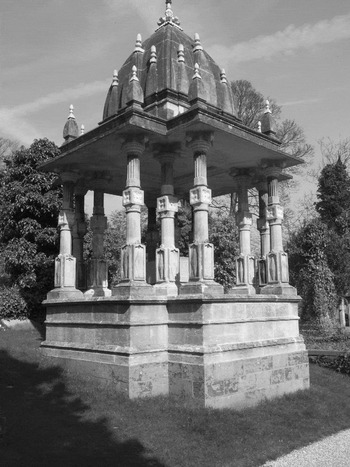
Tagore made a special visit to Bristol in September 1842 to visit Roy's burial place, and after returning to India he arranged in May 1843 that Roy's remains be disinterred and moved to a prominent position in the unconsecrated section of the recently opened Arno's Vale Cemetery on the outskirts of Bristol.Footnote 59 As Paul Pickering and Alex Tyrrell note, such cemeteries were designed in the nineteenth century as ‘places of public resort where memory combined with edification’, and the site was thus particularly appropriate for the erection of a commemorative memorial.Footnote 60 Tagore's plans to erect a monument excited local interest, bringing back memories of the commemoration of Roy following his death in the city a decade earlier. The Bristol Mercury, stating that ‘it will be an honour to our locality to contain the memorial’, drew attention to Briggs's portrait of the Rajah hanging in the Bristol Institution as faithfully representing the appearance and character of the ‘extraordinary man’, and reprinted ‘Stapleton Grove’, one of the poems written by women to commemorate Roy just after his death.Footnote 61 A impressive stone monument was built over Roy's grave, in the form of a chattri, a north Indian style of funerary monument comprising a dome supported on a set of columns (Figure 2).Footnote 62 Built at a period when Britain was using architecture to project its imperial power in India, and when Indians featured as subordinate figures in Anglo-Indian funerary monuments, this statement of indigenous Indian monumental style in the imperial metropole subverted the hierarchies of colonial representation.Footnote 63
Funerary monument to Rammohun Roy in Arno's Vale Cemetery, Bristol, erected 1843–4. Photograph taken by the author.

Roy's monument created a publicly accessible ‘lieu de memoir' – memory site – for Brahmos and Unitarians.Footnote 64 However, there is no evidence that it immediately become a place of pilgrimage. After Dwarkanath Tagore himself died in London in 1846, other Brahmos lacked the financial means and commercial incentives to travel to Britain.Footnote 65 Tagore's son, Debendranath Tagore, was preoccupied with combating the spread of Christianity among the Western-educated elite in Bengal through positioning the revived Brahmo Samaj as a localized movement to reform Hinduism from within, and as a result had no interest in fostering transoceanic connections with Unitarians.Footnote 66 Roy's Unitarian associate, William Adam, who had left Calcutta for America in 1838, was keen to keep Roy's memory alive in Unitarian circles, and in 1839 delivered a lecture on ‘the life and labours of Rammohun Roy’ to members of the Boston-based Society for the Promotion of Christianity in India. However, as Lavan points out, his celebration of Roy as Hindu reformer rather than Christian convert contributed to the decision by American Unitarians to abandon their missionary outreach to India.Footnote 67 In the 1840s, Unitarian memories of Roy were associated with co-operation among a transatlantic network of radical anti-slavery activists rather than connections with Brahmos: in 1844, American Unitarian minister and anti-slavery activist, Samuel May responded enthusiastically to the receipt from his friend, John Bishop Estlin of Bristol, of ‘relics’ of ‘the great Hindoo reformer’ in the form of locks of his hair that Estlin had cut off during Roy's final illness, and now sent for sale at the Boston Anti-Slavery Bazaar.Footnote 68
IV
Direct Brahmo–Unitarian links were not re-established until the mid-1850s, when American Unitarians decided to try to renew their missionary efforts in India.Footnote 69 The renewal of connections, however, proved to be a disputatious one, centred on rival claims to Roy's legacy. The Rev. Charles H. A. Dall attempted to gain Brahmo support for his project of converting Indians to Unitarian Christianity by pointing to Rammohun Roy's call to Bengalis to take the teachings of Jesus as their ethical guide. Not surprisingly, this antagonized Debendranath Tagore, who had revived the Brahmo Samaj around the image of Roy as a Hindu reformer and saw Dall as a dangerous rival. When Tagore barred Dall from attending the Brahmo Samaj, Dall inflamed the situation by setting up the Rammohun Roy Association for Brahmos interested in studying the teachings of Roy and Christianity, producing a tract entitled ‘The Christian testimony of Rammohun Roy’, and attacking Debendranath Tagore for betraying Roy's legacy.Footnote 70 It was in this contested commemorative context that Lant Carpenter's funeral sermon in honour of Roy, which suggested that Roy had effectively become a Unitarian Christian at the end of this life, was first published in Calcutta.Footnote 71
Two of Dall's close Indian associates, one a Hindu convert to Unitarian Christianity, the other a Brahmo whom Dall hoped to convert, became the first signatories in the leather-bound visitors' book for ‘Hindu Visitors to the Grave of Rajah Rammohun Roy in Arno's Vale Cemetery, Bristol’ that Mary Carpenter opened in 1860. Their visits initiated a new phase in the transoceanic commemoration of Roy that was to draw Lant Carpenter's daughter, by this time an internationally renowned social reformer, into active collaboration with Brahmo reformers in India.Footnote 72 Joguth Chunder Ganguli, the first visitor, was the first Brahmin to travel to America to train as a Unitarian minister. He stopped off in Britain on his way home to work as a missionary in India, and visited Bristol bearing a letter of introduction to Mary Carpenter from one of her American Unitarian friends.Footnote 73 Carpenter noted with excitement that, when Ganguli preached from the pulpit at Lewin's Mead, ‘the chapel was more crowded than I ever remember to have seen it, except when my father preached the funeral sermon for the lamented Rajah’.Footnote 74
The second entry in the visitors' book is that of Rakhal Das Haldar. Haldar had joined the Brahmo Samaj in 1852. An enthusiastic reader of American Unitarian writings, he disagreed with Tagore's ejection of Dall from meetings of the Brahmo Samaj. Dall hoped to persuade Haldar to convert to Christianity and asked him to accompany him to England in 1861.Footnote 75 The pair travelled together to Bristol, and Haldar noted in his diary that he was ‘bent on a pilgrimage to the tomb of Rammohun Roy’. Haldar called on Mary Carpenter, who presented him with pictures of both her and Roy, and then paid a visit to Unitarian anti-slavery activist, Mary Ann Estlin, who, after her father John Bishop Estlin's death, had taken over his role as custodian of relics of Roy. She showed him a cast of Roy's head, taken just after his death on the instructions of her father. She had also kept Roy's shawl turban: it was placed on Haldar's head and he was struck by its great diameter. This seems a knowing ritual, referencing comments on the size of his head as a mark of his greatness, made by the Edinburgh phrenologist to whom her father had sent a copy of the cast in the 1830s.Footnote 76 Estlin then gave the Bengali a memento in the form of a lock of Roy's hair. Haldar proceeded to Stapleton Grove to visit the room where Roy had died and, talking to Roy's surviving friends, he imaginatively evoked the deathbed scene, bringing tears to his eyes. Moving on to the spot where Roy was buried, he recalled Lant Carpenter's words and a set of lines from an anonymous Unitarian woman's poem anticipating such future Indian pilgrimages to Roy's grave: ‘Hither their pilgrim footsteps duly bound, / With fervent zeal these hallowed haunts shall trace, / And sweetly solemn tears bedew the ground, / Where sleeps the friend and prophet of their race!’Footnote 77 Here in Bristol, at a time when memories were still fresh of the Indian Uprising of 1857–8, which was commemorated in Britain in images of the heroic British soldier, the helpless English woman, and the violent and rapacious Indian man, and remembered among Indians for the heroism of the rebels and the violence of British reprisals, these commemorative rituals around Roy offered a contrastingly unified form of remembrance between Englishwomen and an Indian man.
This heartfelt pilgrimage, however, did not lead Haldar to convert to Unitarian Christianity. Rather, he contested Dall's appropriation of Roy's legacy, and took his own stand ‘on the same ground with Rammohun Roy, whose religious position, I suspect, is not distinctly understood in this country’.Footnote 78 He collected information and anecdotes concerning Roy during his time in Britain, hoping to write his biography on his return to India. While in London, he visited William Adam, Roy's old Unitarian collaborator in Calcutta, and obtained the manuscript of Adam's unpublished 1838 Boston lecture on Roy, which he belatedly got published in Calcutta in 1879, thus completing another circuit in the transoceanic commemoration of Roy. He doubtless appreciated Adam's own willingness to celebrate Roy as a Hindu reformer rather than a Christian convert.Footnote 79
Two years after Haldar's visit, two members of the Brahmo Samaj came to England in order to take exams for the Indian Civil Service. The visitors, Satyendranath Tagore, the son of Debendranath Tagore, and Monomohun Ghose, made the pilgrimage to Bristol and went with Mary Carpenter to visit Roy's grave. They aimed to collect in England all the remaining records of Roy with a view to preparing a full memoir of him on their return to India.Footnote 80 Their visit marked the beginnings of a rapprochement between Unitarians and a new generation of Brahmo activists. It was at their request that Mary Carpenter compiled an edited collection of primary source material relating to Roy's final years in England, The last days in England of the Rajah Rammohun Roy.
The last days was published simultaneously in London and Calcutta in 1866, a transnational tribute to Roy dedicated ‘To the countrymen of the Rajah Rammohun Roy, who, emancipating themselves from the thraldom of idolatry and superstition, have devoted themselves to promote the elevation of their country’. Carpenter presented her work as a commemorative volume, and stressed that she had personally known Roy. She included as a frontispiece a print of Briggs's impressive portrait of Roy. Conscious of producing the book at the request of her Brahmo visitors, she took care in her preface not to reiterate her father's earlier claim that Roy had become a Unitarian Christian in his last days; instead, she stressed his significance for Indians in these words: ‘We find Rammohun Roy to have been, not only a great and good man, but one whom future generations of his country men must regard as the First Hindoo Reformer.’Footnote 81
Carpenter asserted in her book that ‘the fact of the sacred remains of the Rajah Rammohun Roy being laid in our country forms a kind of tie of relationship between us’.Footnote 82 It was her experience of participating in a shared British–Bengali project of commemoration that firmed up her growing resolve henceforth to devote her ‘heart and soul and strength to the elevation of the women of India’, in whose plight Roy had first aroused her concern.Footnote 83 Commenting on her new Brahmo friends she stated: ‘Having seen them here has carried me back thirty years to Rammohun Roy and my father.’Footnote 84 For her, India was a land where she would be ‘working with the spirits of my beloved father and the noble Rajah for the elevation of woman, and perhaps also for the planting of a pure Christianity’.Footnote 85 For Carpenter, then, renewed commemoration of Roy and the redirection of her social reform activities to India were intimately linked.
Carpenter's visit to India in 1866 coincided with a split in the Brahmo Samaj, as the charismatic Keshub Chunder Sen split with Debendranath Tagore, leading the younger generation of Brahmos into a new society, the Brahmo Samaj of India.Footnote 86 The Keshubites, as they became known, were impatient with Tagore's approach of slowly reforming Hinduism from within. They defined Brahmoism as a religious movement that sought to reconcile all the sects and peoples of India and promoted a radical reform agenda focused on improving the position of women.Footnote 87 Sen visited Britain in 1870 and, like Roy before him, was lionized as a celebrity. For Unitarians, his enthusiasm for social reform and his openly expressed love for Jesus Christ as a spiritual leader for all humankind opened up prospects for collaboration that had not presented themselves since Roy's lifetime. On his visit to Carpenter in Bristol he was invited to preach a sermon to a crowded congregation of Unitarians in Lewin's Mead Chapel. Directly linking his visit with Roy's earlier presence in Bristol, he offered a prayer ‘for the soul of that illustrious man who came from my country to this country and whose remains lie here’; that same afternoon he made a pilgrimage to Roy's grave. According to a contemporary account, ‘Mr Sen was deeply interested in the beautiful spot and did not leave the tomb until, kneeling beside it, surrounded by his sympathizing friends, he had engaged in earnest prayer.’Footnote 88 It was on this visit that plans for the National Indian Association, to promote British support for social reform and particularly women's education in India, were first discussed.Footnote 89
Rituals of commemoration in Bristol in 1870 thus rooted a new phase of Brahmo–Unitarian co-operation in shared collective memories of Roy and new imaginings of a transoceanic community promoting liberal religion and social reform. Thirteen years later, in a lecture entitled ‘A voice from the tomb of Ram Rohun Roy’ delivered in Lewin's Mead Chapel in 1883 on the fiftieth anniversary of Roy's death, the Rev. A. N. Blatchford articulated Unitarians' continuing investment in this commemorative connection, stating that Roy ‘forged the first link of that chain of friendship and mutual respect which will bind England and India more closely together’, claiming that the campaigner against sati would have rejoiced in the continuing work of the National Indian Association, and suggesting that Roy's tomb in Bristol might become ‘to the Hindoo what Mecca was to the Mohammedan’.Footnote 90
V
In the period between Mary Carpenter's death in 1877 and Blatchford's Bristol lecture in 1883, however, the commemoration of Roy had once again become the focus of contention in Bengal. In 1878, many Brahmos were outraged by Sen's decision to marry off his very young daughter to the Maharajah of the princely state of Cooch Behar, in violation of his earlier stand against child marriage. The Brahmo Samaj of India split, with rival factions claiming to be Roy's rightful heirs. The Sadharan Brahmo Samaj, formed in opposition to Sen, inaugurated annual memorial meetings in honour of Roy that, as Kopf notes, sought to reinforce their ‘claim to authenticity by establishing a direct link with pre-Keshubite Brahmo doctrine’.Footnote 91 The question of a permanent memorial to Roy was discussed and a short popular biography of Roy, in Bengali, was published, portraying Roy as a spokesman of rational religion and social reform.Footnote 92 Meantime, on 14 January 1881, Sen's supporters, now known as the Nava Vidhan (New Dispensation), organized an anniversary festival in honour of Roy at which Sen unveiled a portrait of Roy, loosely based on Briggs's 1832 painting, at a ceremony in the Albert Hall in Calcutta.Footnote 93
British Unitarians sided with the Sadharan Brahmo Samaj against Sen and became embroiled in this contest over collective memories of Roy. In 1886, Mary Anne Estlin sent the group the original cast of Roy's death mask from Bristol.Footnote 94 Shivanath Sastri, leader of the Sadharan faction, visited Bristol Unitarians during his travels in England in 1888, and spoke at a meeting at Lewin's Mead Chapel to commemorate the fifty-fifth anniversary of Roy's death. Sophia Dobson Collet, a writer who, as a girl, had seen Roy at William J. Fox's South Place Chapel in London, also played an important part in cementing links between Sadharan Brahmos and Unitarians through the renewed commemoration of Roy. She began to gather together material for a comprehensive biography of the Bengali, drawing on her extensive network of Brahmo and Unitarian contacts in Britain, India, and the United States.Footnote 95 Collet had became fascinated by the Brahmo Samaj in the 1860s and had acted as the leading promoter of Keshub Sen's writings in England before breaking with him over the child marriage issue in 1878. Already accustomed to collaborating closely with Brahmos in her role as compiler of Brahmo Year-Books, she was ideally placed to undertake this task.Footnote 96
Collet's project complemented that of Jogendra Chunder Ghose, who was working at the same time in Bengal on compiling The English works of Raj Ram Mohun Roy. Ghose's work was completed first, published in Calcutta 1885–7 and distributed through European agents in London and Edinburgh. The Brahmo editor positioned his work as a transnational tribute to Roy, reasserting a sense of Unitarian–Brahmo community. He asserted that it was not Indians alone but also ‘civilized Europe and America’ which would find much in Roy's writings ‘to think seriously upon’. He also deplored the fact that Roy had not been honoured in India after his death, in contrast to his impressive memorial in Bristol. Noting that it was Mary Carpenter who first called upon Roy's countrymen to collect and publish his works, he expressed pleasure that India had ‘at last awaken to a sense of the great debt of gratitude it owes to Ram Mohun Roy’.Footnote 97
Collet herself died in 1894 with her meticulously researched life of Roy incomplete, but her book was eventually completed by her friend, the Congregational minister Rev. F. H. Stead, and privately published in 1900 as The life and letters of Raja Rammohun Roy. The book became highly valued by Brahmos as the most detailed and accurate account yet produced of Roy's life and work. Later editions of Chatterji's Bengali-language life of Roy drew extensively on Collet's text, and when her book went out of print the copyright was purchased by a Sadharan Brahmo, Hem Chadra Sarker, who produced a new edition in Calcutta in 1913, incorporating material from Carpenter's Last days.Footnote 98
VI
From Lant Carpenter's sermon in honour of Roy in 1833 to Collet's Life and letters in 1900, as this article has demonstrated, connections between Brahmos and Unitarians were sustained and shaped by the transoceanic commemoration of Rammohun Roy between Bengal, Britain, and America. Commemoration played a crucial role in maintaining what Mary Carpenter described in the 1860s as a ‘kind of tie of relationship’ between Unitarians and Brahmos. However, the relationship between the development of ‘localized’ and ‘globalized’ collective memories of Roy has been revealed as a complex one.
At times, Unitarians and Brahmos co-operated in creating shared collective memories of Roy, at others they articulated conflicting collective memories. Brahmos themselves disagreed about Roy's legacy: different factions of the Brahmo Samaj sought at different historical conjunctures to claim their place as the rightful inheritors of Roy's legacy through diverse interpretations of his religious beliefs and significance as a reformer. Unitarians, in turn, wavered between commemorating Roy as a reformer of Hinduism, as a religious universalist set above his Indian cultural background, or as a Unitarian Christian. Conflict between Unitarians and Brahmos arose in the 1850s when Debendranath Tagore positioned Roy as a reformer of Hinduism from within, while Charles Dall sought to appropriate Roy's legacy to promote Unitarian Christianity among Indians; possibilities for collaboration opened up in the 1860s when Keshub Sen celebrated Roy as a religious universalist and social reformer and Mary Carpenter linked commemoration of Roy with practical co-operation with Brahmos in improving Indian women's education. What remained constant between 1833 and 1900 was the focus on Roy as commemorative reference point: no later Brahmo leader displaced him in this role, and the focus by Brahmos on Roy as founding figure of the Brahmo Samaj helped maintain a sense of Brahmo collective identity through internal splits, while a focus by Unitarians on Roy as originator of the Brahmo–Unitarian connection lent the weight of history to attempts at cross-cultural co-operation.
Commemoration involves a simultaneous process of identification and distancing, positioning the celebrated individual as both exemplary and exceptional; commemorative processes thus enabled Unitarians to present Roy as an exemplary man while positioning him an exceptional Indian, expressing their identification with him while distancing him from the generality of ‘Hindus’. Unitarian commemoration of Roy thus offered only a limited challenge to the negative stereotypes of Indians current in colonial discourse. On the one hand, for Unitarians to describe Roy as a ‘kindred spirit’ was a radical assertion of kinship at a time when Bengali and Englishman were represented in colonial discourse in racially polarized terms. In memorializing Roy as a great religious leader and social reformer, Unitarians also helped to ensure that the creation of heroic reputations and exemplary lives in nineteenth-century Britain was not exclusively around the figures of dead white men. On the other hand, Unitarian commemoration of Roy shows that Western reformers could venerate a ‘great man’ of the East while reiterating dominant evangelical stereotypes of Hindus and India: Roy's exceptional qualities were highlighted by setting him in contrast to oppressive Brahmin priests living in a land of darkness and superstition, a land contrasted with progressive Britain. American Unitarians, though positioned outside Britain's empire, reproduced this language in their periodicals rather than articulating an alternative view.
A study of the transoceanic commemoration of Roy thus provides new insights into both the openings for, and limitations on, cross-cultural interchange and co-operation in an age of global Christian mission and British imperial power. Brahmo and Unitarian patterns of commemoration reveal the intertwined transatlantic and imperial webs of connection within which liberal religious movements and campaigns for social reform developed over the course of the nineteenth century. They also expose how conflicts between orthodox Christians and Hindus and racialized inequalities of power between colonizer and colonizer in India undermined attempts to create an imagined community based not on a common ethnic identity but on similar approaches to religious and social reform.