Introduction
Population ageing and the associated greater need for long-term care imply a challenge for policy makers to balance safeguarding financial sustainability and providing adequate long-term care for those in need. In many countries, part of the solution to this puzzle is sought in caring for impaired elderly in the community rather than in residential care settings (Pavolini and Ranci Reference Pavolini and Ranci2008; Rostgaard Reference Rostgaard2002, Reference Rostgaard2011) and, related to this, in maintaining or activating informal care-giving resources (Le Bihan and Martin Reference Le Bihan and Martin2012; Österle and Rothgang Reference Österle, Rothgang, Castles, Leibfried, Lewis, Obinger and Pierson2010). Particularly family members are increasingly perceived as important potential care-givers (Grootegoed, Duyvendak and Van Barneveld Reference Grootegoed, Duyvendak and Van Barneveld2015; Österle and Rothgang Reference Österle, Rothgang, Castles, Leibfried, Lewis, Obinger and Pierson2010; Pavolini and Ranci Reference Pavolini and Ranci2008).
In the current study, we explore the relationship between the availability of beds in residential care settings and the provision of care by adult children to impaired community-dwelling parents. When available, spouses are impaired persons’ preferred source for care (Litwak Reference Litwak1985; Messeri, Silverstein and Litwak Reference Messeri, Silverstein and Litwak1993; Stoller and Earl Reference Stoller and Earl1983). However, due to widowhood, divorce or never having been married, many older adults cannot fall back on a spouse when they are confronted with declines in functional capacities. Given that marital instability in European countries as well as in the United States of America has been increasing (Amato and James Reference Amato and James2010), the presence of a spouse when care needs occur is even less self-evident for future generations. Therefore, the role of adult children – the other main source of family care (Dykstra Reference Dykstra and Ritzer2015) – is likely to become even more central than it is today. Given the primacy of spousal care over intergenerational care-giving when spouses are present, we focus on intergenerational care-giving to community-dwelling parents lacking a spouse or partner.
Many scholars have explored the way the care that adult children provide to parents is related to formal care services. In the bulk of this work, the focus is on formal home care services. Recent research suggests, however, that the availability of beds in residential care settings also has an impact on intergenerational care-giving to impaired community-dwelling older adults. Pickard (Reference Pickard2012) noted a decline in intense care provision to older parents in England by co-resident adult children between 1985 and 1990, which she attributed to the risen numbers of people aged 80 and over in residential care. She also showed that between 1995 and 2000, when residential care became less widely available, the numbers of people aged 80 and over receiving intense care from co-resident children began to rise again. A similar finding was reported by Ulmanen and Szebehely (Reference Ulmanen and Szebehely2015), who showed that care provision by independently living adult children and friends to community-dwelling impaired older Swedes increased considerably in the first decade of the 21st century. The authors attributed the change to the dramatically declining coverage of residential care in Sweden over the same period.
The mechanisms underlying the negative association between the availability of residential care and the provision of care to community-dwelling older parents by their adult children have thus far not been explicated and tested. Pickard (Reference Pickard2012) and Ulmanen and Szebehely (Reference Ulmanen and Szebehely2015) have suggested that this negative association may in part be mediated by the levels of care needs among community-dwelling parents. Consistent with this idea, Haberkern and Szydlik's (Reference Haberkern and Szydlik2010) cross-national analysis of intergenerational care provision in Europe showed a negative association between the availability of residential care and care provision from adult children to their parents that was no longer statistically significant in a multivariate model which controlled for many characteristics of the parent and the adult child, including the parent's physical limitations. The studies summed up here, while providing valuable suggestions for a potential explanation of the negative association between the availability of residential care and intergenerational care-giving to community-dwelling older parents, do not provide a direct test of the supposed underlying mechanism. Furthermore, additional theoretical explanations can be developed and tested. The current study is a first attempt to do so. We use data from the Survey of Health, Ageing and Retirement in Europe (SHARE) enriched with country-level information from the MULTILINKS database of social policy indicators to answer the following research question:
-
• How does the availability of beds in residential care settings shape adult children's provision of care to community-dwelling impaired parents lacking a spouse or partner?
Theoretical background and hypotheses
In the current study, we follow Walker, Pratt and Eddy's (Reference Walker, Pratt and Eddy1995) conceptualisation of care. In their view, one can only speak of care when the receiving individual is dependent on another person for any activity essential for daily living, such as dressing, bathing, and getting in and out of bed (cf. Haberkern and Szydlik Reference Haberkern and Szydlik2010). Emotional support and practical help, for instance with regard to household tasks or paperwork, thus do not fall within the definition of care (cf. Brandt, Haberkern and Szydlik Reference Brandt, Haberkern and Szydlik2009). We use the term residential care settings for non-domestic residential or institutional settings where care services for older adults are provided (cf. Howe, Jones and Tilse Reference Howe, Jones and Tilse2013).
As Pickard (Reference Pickard2012) pointed out, most scholarly work on the relation between formal and informal care has focused on formal home care. The substitution model (Greene Reference Greene1983) holds that informal care provision to a person in need is lower when this person receives formal home care. Other scholars have argued that formal home care and informal care complement, rather than substitute, each other. Complementarity can come either in the form of task-specific division of labour (Litwak Reference Litwak1985; Messeri, Silverstein and Litwak Reference Messeri, Silverstein and Litwak1993; cf. Brandt, Haberkern and Szydlik Reference Brandt, Haberkern and Szydlik2009) or by formal home care professionals and informal care-givers sharing similar care tasks (Chappell and Blandford Reference Chappell and Blandford1991). In the former theoretical model, the provision of formal home care enables a division of labour, with formal care-givers taking on demanding care tasks for which they received professional training, e.g. nursing and personal care, allowing family members to focus on tasks for which they are best equipped, e.g. practical help and emotional support. In the latter theoretical model, there is a positive association between formal care and family care, because family members are more inclined to provide care to a relative when burdens are lightened due to the sharing of the overall care load with formal care-givers.
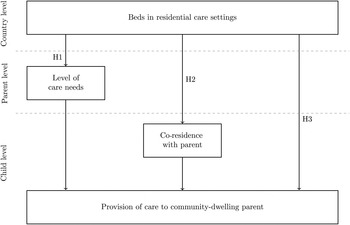
The substitution thesis and the models of complementarity suppose a relationship between actual receipt of formal care services and support from informal care-givers. Given that community-dwelling impaired older adults are by definition not in residential care settings, none of the models briefly described here helps to explain why family care-giving to community-dwelling older adults is less common when beds in residential care settings are more widely available. To understand better the association between the availability of beds in residential care settings and adult children's provision of care to community-dwelling impaired parents, new theoretical mechanisms need to be developed and tested. Drawing on the work of Pickard (Reference Pickard2012) and Ulmanen and Szebehely (Reference Ulmanen and Szebehely2015), we formulate an out-selection hypothesis. In addition, we describe two new potential mechanisms that we capture, respectively, in our in-selection and diffusion of responsibility hypotheses. A schematic overview of the three hypotheses to be tested in the current study is presented in Figure 1.
Conceptual model.

The availability of beds in residential care settings has an impact on who resides in the community and who does not. As described earlier, Pickard (Reference Pickard2012) and Ulmanen and Szebehely (Reference Ulmanen and Szebehely2015) have suggested that the negative association between the availability of residential care and the provision of care to community-dwelling older individuals by their adult children may in part be mediated by the prevalence of severe care needs among community-dwelling individuals. It is well-established that adult children are more likely to provide care to parents when the latter's care needs are more severe (Blomgren et al. Reference Blomgren, Breeze, Koskinen and Martikainen2012; Brandt, Haberkern and Szydlik Reference Brandt, Haberkern and Szydlik2009; Haberkern and Szydlik Reference Haberkern and Szydlik2010; Ogg and Renaut Reference Ogg and Renaut2006; Vlachantoni et al. Reference Vlachantoni, Shaw, Evandrou and Falkingham2015). When beds in residential care settings are relatively widely available, particularly older adults with severe needs will more often be admitted to residential care settings, and thus be selected out of the community (cf. Greene and Ondrich Reference Greene and Ondrich1990; Grundy and Jitlal Reference Grundy and Jitlal2007). As a result, the average level of need of those remaining in the community can be expected to be lower. These considerations lead us to formulate our out-selection hypothesis:
-
• Hypothesis 1: The impairments of community-dwelling older parents with care needs tend to be less severe in countries where beds in residential care settings are more widely available, and consequently their adult children are less likely to provide care.
The availability of beds in residential care settings may also determine the extent to which impaired older adults and their adult children select themselves into living arrangements with an optimal opportunity structure for intergenerational family care-giving. Unlike, for instance, emotional or financial support, the provision of care requires the physical presence of the care-giver. It is, therefore, not surprising that geographical distance between parent and the adult child hampers the adult child's provision of care (Brandt, Haberkern and Szydlik Reference Brandt, Haberkern and Szydlik2009; Haberkern and Szydlik Reference Haberkern and Szydlik2010; Leopold, Raab and Engelhardt Reference Leopold, Raab and Engelhardt2014; Ogg and Renaut Reference Ogg and Renaut2006). The barriers to provide care are lowest when the adult child and the parent share a household (cf. Silverstein Reference Silverstein1995). Co-resident adult children are more likely than their independently living counterparts to take on the role of care-giver (Leopold, Raab and Engelhardt Reference Leopold, Raab and Engelhardt2014). When an older parent is confronted with care needs, sharing a household with an adult child may therefore be a viable strategy. Research has shown, however, that other strategies are preferred. When receiving care in one's own home is no longer possible, people in West European countries generally prefer a move to a residential care setting over moving in with an adult child (Huber et al. Reference Huber, Rodrigues, Hoffmann, Gasior and Marin2008). This preferred option is less viable in countries where beds in residential care settings are less widely available. Under those circumstances, older adults might be compelled to move in with an adult child in order to receive the care that they need (cf. Choi Reference Choi2003; Silverstein Reference Silverstein1995; Smits, Van Gaalen and Mulder Reference Smits, Van Gaalen and Mulder2010). This brings us to our in-selection hypothesis:
-
• Hypothesis 2: Adult children are less likely to share a household with impaired community-dwelling parents in countries where beds in residential care settings are more widely available, and consequently they are less likely to provide care.
Finally, the availability of beds in residential care settings may have an impact on intergenerational family care-giving to community-dwelling older adults that goes beyond selection. It shapes the context in which adult children decide whether they will provide care to community-dwelling impaired parents. The bare presence of widely available beds in residential care settings may foster ‘social shirking’ (Sagan Reference Sagan2004; cf. Perrow 1985) or, in social-psychological terminology: diffusion of responsibility (Darley and Latané Reference Darley and Latané1968; Nadler Reference Nadler, Deaux and Snyder2012). Adult children may perceive the wide availability of beds in residential care settings as a back-up system guaranteeing adequate provision of care to impaired older adults when relatives cannot or do not provide the care needed. The awareness of the presence of this safety net may undermine adult children's sense of urgency to step in and provide care to their impaired parents (cf. Perrow Reference Perrow1984). This leads us to formulate a diffusion of responsibility hypothesis:
-
• Hypothesis 3: Adult children are less likely to provide care to impaired community-dwelling parents in countries where beds in residential care settings are more widely available, even when differences in the severity of care needs and the prevalence of parent–child co-residence are accounted for.
Data
Data for our analyses were taken from SHARE, a longitudinal, cross-national data-set on the health, socio-economic status and social relations of European individuals of 50 and older (Börsch-Supan et al. Reference Börsch-Supan, Brugiavini, Jürges, Kapteyn, Mackenbach, Siegrist and Weber2008, Reference Börsch-Supan, Brandt, Hunkler, Kneip, Korbmacher, Malter, Schaan, Stuck and Zuber2013). To increase statistical power and maximise the number of countries in our sample, data from the first and second waves were pooled.
Wave 1 data were collected in 2004 and 2005 in Austria, Belgium, Denmark, France, Germany, Greece, Israel, Italy, the Netherlands, Spain, Sweden and Switzerland. Wave 2 data were collected in 2006 and 2007 in the same countries, except Israel, and furthermore in the Czech Republic, Ireland and Poland. For countries that were also represented in the first wave, the SHARE team focused on re-contacting Wave 1 respondents. However, a ‘refresher’ sample was also drawn in all first-wave countries except Austria and the Flemish part of Belgium. We did not use the Wave 3 data-set, collected in 2008 and 2009, as it was not comparable with the prior two waves due to its focus on life histories. We did not use Wave 4 and Wave 5 data, collected, respectively, in 2010–11 and 2013–14, because information about the provision of personal care was not collected.
SHARE micro-data were enriched with a country-level indicator from the MULTILINKS database of comparative social policy indicators (Keck and Saraceno Reference Keck and Saraceno2011).Footnote 1 This database offers comparative social policy indicators for 27 European Union countries plus Norway, Russia and Georgia. It was created as part of the MULTILINKS research programme (Dykstra and Komter Reference Dykstra and Komter2012).
We selected respondents who had adult children but no non-adult children, were not living with a spouse or partner, and were coping with limitations performing at least one activity of daily living (ADL).Footnote 2 In the SHARE questionnaire, parents were asked to provide extensive information about up to four of their children. Per parent, we randomly selected one parent–child dyad observation. Respondents from Switzerland and Israel were excluded, because no country-level information was available in the MULTILINKS database. Furthermore, we excluded respondents with missing values on any of the variables of our interest. Our final sample consists of 1,214 impaired parent–child dyads nested in 12 countries: Austria, Belgium, Czech Republic, Denmark, France, Germany, Greece, Ireland, Italy, the Netherlands, Spain and Sweden.
Measures
Dependent variable
Our dependent variable is a dichotomous variable indicating whether or not an adult child provided care to the impaired parent. The design of SHARE's questionnaire necessitated us to code this dummy variable separately for adult children who shared a household with the impaired parent and for those who did not. Coding for the latter category was based on questions regarding out-of-household support received by the impaired parent. Impaired parents were asked whether they received any kind of support from any family member outside the household, or any friend or neighbour, during the last 12 months.Footnote 3 Parents who indicated that they received support from outside the household were asked to name up to three persons who gave support most often. For each mentioned person, respondents were asked whether the provided support included personal care, such as help with dressing, bathing or showering, eating, getting in and out of bed, or using the toilet. We coded a non-co-resident adult child as a provider of care when the impaired parent mentioned this child as an out-of-household provider of assistance with personal care tasks. For co-resident adult children, coding was based on questions regarding intra-household support with personal care. Impaired parents were asked whether there was someone living in their household who had helped them regularly during the last 12 months with personal care, such as washing, getting out of bed or dressing.Footnote 4 We coded a co-resident adult child as a provider of care when the impaired parent mentioned this child as an intra-household provider of assistance with personal care tasks.
Child characteristics
Our in-selection hypothesis supposes that parent–child co-residence mediates the negative association between the availability of beds in residential care settings and the likelihood that a given adult child will provide care. We therefore included a dummy variable that distinguished adult children who shared a household with the impaired parent from those who did not.
Drawing on Andersen and Newman's (Reference Andersen and Newman1973; Andersen Reference Andersen1995) behavioural model of health services’ use, we included several measures that capture predisposing and enabling factors for filial care-giving.Footnote 5 A dummy variable was included to distinguish daughters and sons. The adult child's age was recoded into a categorical variable with three categories. Adult children younger than 45 were assigned to the first category, those aged between 45 and 59 were assigned to the second category, and those of 60 years old and older were assigned to the third category.
Another dummy variable was included to capture whether or not the adult child was married. Furthermore, we created three dummy variables for the adult children's education level. Those with a lower secondary education degree or less were coded as being lower educated. Adult children with a higher secondary education or a vocational degree were coded as having an intermediate level of education. Those with a college or a university degree were coded as being higher educated. Dummy variables were also created to capture the adult child's employment status, distinguishing full-time employment, part-time employment and not being employed. A final dummy variable was included to capture whether or not the adult child had children.
Parent characteristics
Our out-selection hypothesis supposes that the severity of the parent's care needs mediates the negative association between the availability of beds in residential care settings and the likelihood that a given adult child provides care. To capture the severity of the parent's care needs, we used the number of limitations in performing ADLs and instrumental ADLs (IADLs). In the SHARE questionnaire, respondents were asked about possible difficulties performing six ADLs: (a) dressing, including putting on shoes and socks, (b) walking across a room, (c) bathing or showering, (d) eating, such as cutting up your food, (e) getting in and out of bed, and (f) using the toilet, including getting up or down. In addition, they could report limitations on seven IADLs: (a) using a map to figure out how to get around in a strange place, (b) preparing a hot meal, (c) shopping for groceries, (d) making telephone calls, (e) taking medication, (f) doing work around the house or garden, and (g) managing money, such as paying bills and keeping track of expenses. We performed a logarithmic transformation to adjust for the positively skewed distribution of the total number of ADL/IADL limitations.
Several parent characteristics were included because they are known predictors of intergenerational care (Blomgren et al. Reference Blomgren, Breeze, Koskinen and Martikainen2012; Brandt, Haberkern and Szydlik Reference Brandt, Haberkern and Szydlik2009; Haberkern and Szydlik Reference Haberkern and Szydlik2010; Ogg and Renaut Reference Ogg and Renaut2006). We included a dummy variable to distinguish mothers from fathers, as well as measures for the impaired parent's age and number of children. Parent's age was recoded into a categorical variable with three categories. Respondents younger than 65 were assigned to the first category, those aged between 65 and 79 were assigned to the second category and those of 80 and older were assigned to the third category. We included the number of children of the parent in our model, as this may be negatively related to the likelihood of a given adult child stepping in and providing care (Freedman et al. Reference Freedman, Wolf, Soldo and Stephen1991; Van Gaalen, Dykstra and Flap Reference Van Gaalen, Dykstra and Flap2008). In addition, we included two dummy variables indicating whether the parent received, respectively, formal home care services and professional household help during the last 12 months.
We created three dummy variables for the impaired parent's educational attainment. Those with a lower secondary education degree or less were coded as being lower educated. Respondents reporting having a higher secondary education or a vocational degree were coded as having an intermediate level of education. Those with a college or a university degree were coded as being higher educated. An indicator for poor financial status was derived from the question of whether the respondent's household was ‘able to make ends meet’. We created a dummy variable, coding it 1 when difficulty or great difficulty to make ends meet was reported and 0 when the household was able to make ends meet easily or fairly easily. Our analyses only pertain to impaired parents not living with a spouse or partner. We included a dummy variable to distinguish those who were divorced from those who were never married, widowed or living separated from the person they were married to. A final parent-level dummy variable was included to distinguish observations from the second wave from those from the first wave.
Country characteristics
To capture the availability of care beds in residential care settings at the country level, we enriched the SHARE micro-data with a country-level variable indicating the share of the national population of 65 years and older in residential care. This variable was taken from the MULTILINKS database of comparative social policy indicators (Keck and Saraceno Reference Keck and Saraceno2011).
Method
In our data, parent–child dyads are nested in countries. To account for the non-independence of parent–child dyads within countries when testing our hypotheses, we estimate multi-level logistic regression models. Given that our in-selection and out-selection hypotheses posit that the effect of the availability of beds in residential care settings on the likelihood of intergenerational care provision is mediated, we first estimate a reduced-form model in which the assumed mediators are omitted. We compare the total effect of the availability of beds in residential care settings in this model with the remaining direct effect in a full model that includes the assumed mediators. We use Karlson, Holm and Breen's KHB decomposition method (Kohler, Karlson and Holm Reference Kohler, Karlson and Holm2011) to assess whether the difference, i.e. the indirect effect, is significant and, if so, to what extent it can be attributed to each of the assumed mediators. Unlike traditional methods for mediation analysis (e.g. Sobel Reference Sobel1982), the KHB method accounts for attenuation bias that can occur when comparing nonlinear models like ours.
Results
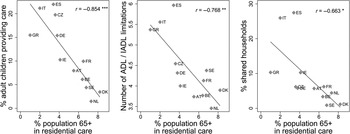
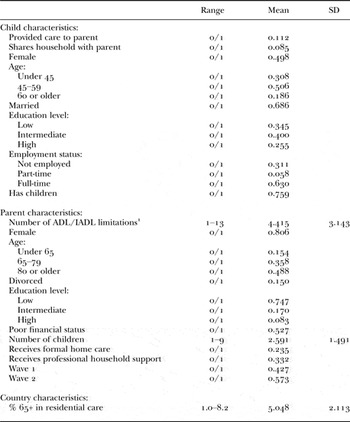
Table 1 provides descriptive statistics. One in nine adult children provided care to the parent, whereas one in 12 adult children shared a household with the parent. The average number of ADL/IADL limitations that parents in our sample coped with was 4.4 (on a scale from 0 to 13). The likelihood of care provision and intergenerational co-residence and the average number of ADL/IADL limitations varied markedly across countries, however. As Figure 2 illustrates, care provision and intergenerational co-residence were less likely and the average number of ADL/IADL limitations was lower in countries where beds in residential care settings were more widely available.
Intergenerational care, co-residence, severity of care needs and residential care.

Descriptive statistics

Notes: N = 1,214. SD: standard deviation. 1. Scores represent values before log-transformation.
Source: Survey of Health, Ageing and Retirement in Europe; MULTILINKS database of social policy indicators.
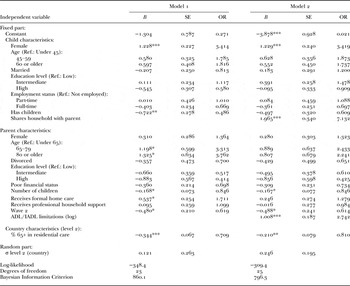
Results of our multi-level logistic regression analyses are presented in Table 2. Model 1 is the reduced-form model that does not include the mediators. We find a strong and statistically significant negative total effect of the availability of beds in residential care settings on the likelihood that an adult child provides care to an impaired parent. Keeping all other variables constant, every percentage point increase in the share of the population aged 65 and upwards living in residential care settings is associated with a 29 per cent (p < 0.001) decline in the predicted odds for an adult child to provide care. Model 1 further predicts that the odds of providing care to a parent are a factor 3.414 (p < 0.001) higher for daughters than for sons. Adult children with offspring of their own are less likely than their childless counterparts to provide care (odds ratio (OR) = 0.486, p < 0.01). Children of parents aged between 65 and 79 (OR = 3.313, p < 0.05) and of parents aged 80 or older (OR = 3.762, p < 0.05) have higher odds of providing care than children of parents younger than 65. The likelihood that a given child provides care is lower when the parent has a larger number of children (OR = 0.846, p < 0.05). The odds of providing care are a factor 1.711 (p < 0.05) higher for children of parents receiving formal home care than for children of parents who do not receive home care. None of the other parent and child characteristics included in Model 1 were significantly associated with adult children's provision of care.
Coefficient estimates of multi-level logistic regression models predicting intergenerational care-giving

Notes: N = 1,214. Number of countries: 12. OR: odds ratio. Ref.: reference category. ADL: activity of daily living. IADL: instrumental activity of daily living.
Source: Survey of Health, Ageing and Retirement in Europe; MULTILINKS database of social policy indicators.
Significance levels: * p < 0.05, ** p < 0.01, *** p < 0.001.
The second model is a full model that includes the severity of parents’ care needs and intergenerational co-residence. The model fit substantially improved with the addition of these two variables (χ2(2) = 78.0, p < 0.001). The model indicates that children are more likely to provide care to an impaired parent when the latter's care needs are more severe (OR = 2.742, p < 0.001). Furthermore, the odds of providing care are a factor 7.132 (p < 0.001) higher for adult children who share a household with the impaired parent than for children who do not live with the parent. As expected, the effect of the availability of beds in residential care settings is smaller in the full model than in the reduced-form model. In Model 2, every percentage point increase in the share of the population aged 65 and upwards living in residential care settings is only associated with a 19 per cent (p < 0.01) decline in the predicted odds for an adult child to provide care, when all other variables are kept constant. Furthermore, the coefficient estimates of adult children having offspring of their own and parents’ age and receipt of formal home care are smaller than in the reduced-form model and are no longer statistically significant. This suggests that the effects found in the first model can largely be explained by the level of parents’ care needs and intergenerational co-residence.
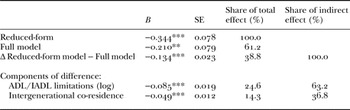
In Table 3, we decomposed the effect of the availability of beds in residential care on the likelihood of intergenerational care provision. Indirect effects make up 39 per cent of the total effect. Of these indirect effects, 63 per cent can be attributed to the natural logarithm of the number of ADL/IADL limitations of older parents (b = −0.085, p < 0.001) and 37 per cent to intergenerational co-residence (b = −0.049, p < 0.001). The former indicates that, consistent with our out-selection hypothesis (Hypothesis 1), the lower likelihood of intergenerational care provision in countries where beds in residential care settings are more widely available can partly be explained by the lower severity of care needs of impaired parents in such countries. The latter indicates that the lower likelihood of intergenerational co-residence in countries with widely available residential care also partly explains the lower likelihood of intergenerational care provision. This is consistent with our in-selection hypothesis (Hypothesis 2). Consistent with our diffusion of responsibility hypothesis (Hypothesis 3), a significant direct effect of availability of beds in residential care settings remains after the addition of the mediating variables to the model (b = −0.210, p < 0.01). This direct effect makes up 61 per cent of the total effect.
Decomposition of coefficient of availability of beds in residential care settings

Notes: SE: standard error. ADL: activity of daily living. IADL: instrumental activity of daily living.
Significance levels: ** p < 0.01, *** p < 0.001.
Discussion
A large body of research is devoted to the way the care that adult children provide to impaired parents is related to formal care services. In the bulk of this work, the focus is on formal home care services. Recent research suggests, however, that the availability of beds in residential care settings also has an impact on intergenerational care-giving. The underlying mechanisms are not well understood. In the current study, we described and tested three explanations for the negative association between the availability of beds in residential care settings and the likelihood that a given adult child provides care to a community-dwelling parent. We labelled these three mechanisms out-selection, in-selection and diffusion of responsibility. We focused on adult children's provision of care to community-dwelling parents lacking a spouse or partner, given the primacy of spousal care over intergenerational care-giving when spouses are present.
Our analyses indicate that adult children are less likely to provide care to impaired community-dwelling unpartnered parents in countries where beds in residential care settings are more widely available, (a) because parents’ care needs are less severe in such countries (out-selection hypothesis) and (b) because adult children and impaired parents are less likely to share a household in such countries (in-selection hypothesis). Finally (c), adult children remain less likely to provide care in countries where beds in residential care settings are more widely available when differences in the severity of the parent's care needs and the prevalence of parent–child co-residence are accounted for (diffusion of responsibility hypothesis). Plausibly, being able to rely on residential care undermines adult children's sense of urgency to step in and provide care to their parents.
Our results suggest that widely available beds in residential care settings directly and indirectly undermine the willingness of adult children to provide care to their impaired parents. It should be noted that adult children do not tend to stop providing support to impaired parents when the latter are admitted to residential care settings. Support to parents becomes more secondary after admission, however, and consists mainly of organising, managing and supervising care (Ross, Carswell and Dalziel Reference Ross, Carswell and Dalziel2001).
Whether stimulating family care-giving through reduction of beds in residential care settings is desirable depends on one's normative beliefs about how care ought to be provided (cf. Greene Reference Greene1983). Hochschild (Reference Hochschild1995) argues that residential care is a manifestation of a so-called cold-modern care ideal. In a cold-modern care ideal women and men focus fully on a career in paid labour, with the state enabling this by taking full responsibility for the provision of care for those in need, making family care-giving unnecessary. A recent study focusing on the Netherlands shows that the share of the Dutch population adhering to a cold-modern care ideal has increased, rather than decreased, in the first decade of the 21st century (Van den Broek, Dykstra and Van der Veen Reference Van den Broek, Dykstra and Van der Veen2015). This suggests that, at least in the Netherlands, the stimulation of family care-giving through the reduction of access to residential care may be increasingly at odds with normative beliefs of the general population (see also Grootegoed, Duyvendak and Van Barneveld Reference Grootegoed, Duyvendak and Van Barneveld2015).
Although the key focus of the current study was on the association between the availability of beds in residential care settings and adult children's provision of care to community-dwelling impaired parents, we also included measures for parental receipt of formal home care and professional household services in our model. We did so because countries where beds in residential care settings are widely available also tend to have relatively high shares of older adults receiving formal home care (Saraceno and Keck Reference Saraceno and Keck2010). Unlike what the substitution thesis and the models of complementarity described in the introduction would lead one to expect, our analyses show neither a negative nor a positive association between parental receipt of formal home care and the likelihood that a given adult child provides care. Possibly, competing mechanisms are cancelling each other out.
It has been argued elsewhere that legal obligations to support parents in need are positively associated with intergenerational care-giving (Haberkern and Szydlik Reference Haberkern and Szydlik2010). Thus, the association between the availability of beds in residential care settings and adult children's care provision may be overestimated in our model if countries where adult children are legally obliged to support parents in need also have relatively few beds in residential care settings. For that reason, we also estimated models that included a dummy variable for the presence of legal obligations to support parents in need at the country level. Models that included this indicator instead of or in addition to our indicator for the availability of beds in residential care settings did not fit the data better than the models presented in Table 2, and the presence of legal obligations to support parents was not significantly associated with the likelihood of intergenerational care provision in any of the models.Footnote 6 Plausibly, we did not find an effect of legal obligations, because legal obligations generally pertain to financial support of parents in need rather than to the actual provision of care.
This study has a number of limitations. Our measure of care provided by adult children was based on reports of parents, i.e. the recipients. It has to be borne in mind that recipients tend to report receiving less support than providers report giving (Mandemakers and Dykstra Reference Mandemakers and Dykstra2008). In addition, we have to consider the possibility that the associations between the availability of beds in residential care provision and the likelihood of intergenerational care provision may be confounded by culture. In his paper on family ties in Western Europe, Reher (Reference Reher1998) underlined the importance of cultural differences within Europe, with the south being characterised by ‘strong’ family links and the north-west by relatively ‘weak’ family links. He argued that these cultural differences are deeply rooted in the distinct histories of different European regions. In a cross-national study like ours, it is difficult to disentangle the relative impact of the cultural context and of the policy context because they are heavily intertwined (Pfau-Effinger Reference Pfau-Effinger2005). However, recent longitudinal studies conducted in England (Pickard Reference Pickard2012) and Sweden (Ulmanen and Szebehely Reference Ulmanen and Szebehely2015) have shown that changes in the availability of residential care in these countries were followed by changes in intergenerational care provision. Given that cultural factors tend to be highly resistant to change (cf. Reher Reference Reher1998), these findings suggest that the effects of the availability of beds in residential care settings on adult children's provision of care to impaired community-dwelling parents as found in this study are largely exogenous.
A contextual factor that we did not take into account in the current study is the design of cash-for-care programmes. Cash-for-care programmes vary greatly across countries on a range of important dimensions, such as entitlement criteria, benefit levels and how the benefits can be used (Da Roit and Le Bihan Reference Da Roit and Le Bihan2010; Le Bihan and Martin Reference Le Bihan and Martin2012). When the use of cash benefits is limited to the purchase of services under a formal contract or labour relationship, then they may encourage the use of professionally provided care and reduce the necessity of family members to provide care (Saraceno and Keck Reference Saraceno and Keck2011). When cash benefits can be used freely, they may stimulate the purchase of care services on the informal (often migrant) market, as has been noted in Italy, or they may foster family care-giving, as appears to be the case in Germany and Austria (Rodrigues, Huber and Lamura Reference Rodrigues, Huber and Lamura2012). The latter is also the likely outcome when the allowance is paid to family care-givers rather than to care recipients (Saraceno and Keck Reference Saraceno and Keck2011).
Finally, the extent to which residential care is available varies across regions and there are pronounced cross-national differences in the types of care that are offered in residential care settings, organisational structures (public, private non-profit, private for-profit) and the extent to which those in residential care have to contribute to the costs (Forder and Fernandez Reference Forder and Fernandez2011; Meijer, Van Campen and Kerkstra Reference Meijer, Van Kampen and Kerkstra2000; Ribbe et al. Reference Ribbe, Ljunggren, Steel, Topinkova, Hawes, Ikegami, Henrard and Jónnson1997; Robertson, Gregory and Jabbal Reference Robertson, Gregory and Jabbal2014; cf. Howe, Jones and Tilse Reference Howe, Jones and Tilse2013). Due to data limitations, we could not take these kinds of differences into account. The analyses presented here show associations between the availability of beds in residential care settings in general and adult children's provision of care to community-dwelling impaired parents. Future research is needed to provide insight into how various aspects of residential care may moderate the mechanisms underlying the negative association between the availability of beds in residential care settings and adult children's provision of care to community-dwelling impaired parents.
Acknowledgements
We would like to thank Niels Schenk, Romke van der Veen, Gunhild Hagestad and Anne Martin-Matthews for their valuable comments on an earlier version of this paper. The research leading to these results has received funding from the European Union's Seventh Framework Programme (FP7/2007–2013) under grant agreement number 320116 for the research project Families and Societies. This paper uses data from SHARE release 2.5.0. SHARE data collection in 2004–2007 was funded primarily by the European Commission through its fifth and sixth framework programmes (QLK6-CT-2001-00360, RII-CT-2006-062193, CIT5-CT-2005-028857). Additional funding by the US National Institute on Aging (U01 AG09740-13S2, P01 AG005842, P01 AG08291, P30 AG12815, Y1-AG-4553-01, OGHA 04-064, R21 AG025169) as well as by various national sources is gratefully acknowledged (see http://www.share-project.org for a full list of funding institutions).