INTRODUCTION
Major depressive disorder (MDD) affects approximately 9·5% of the North American population (Robins & Regier, Reference Robins and Regier1990). Although its effects are variable, MDD can cause impairment in cognitive functioning across multiple domains, including executive functioning and memory, with associated loss of productivity (Kessler et al. Reference Kessler, Akiskal, Ames, Birnbaum, Greenberg, Hirschfield, Jin, Merikangas, Simon and Wang2006). Among the most consistent deficits in patients with MDD is impairment on tests involving the conscious recollection of facts or events; this recollective memory deficit may be most severe in patients with long-standing illness or multiple episodes (MacQueen et al. Reference MacQueen, Galway, Hay, Young and Joffe2002). By contrast, performance on implicit memory tasks, involving unconscious recollection or learning, appears similar to that of healthy comparison subjects (Roediger & McDermott, Reference Roediger and McDermot1992). Recent studies also point towards executive dysfunction on tasks involving the selection, timing, monitoring and interpretation of behavior, including working memory and selective attention (e.g. Landro et al. Reference Landro, Stiles and Sletvold2001; Harvey et al. Reference Harvey, Le Bastard, Pochon, Levy, Allilaire, Dubois and Fossati2004; but see Zakzanis et al. Reference Zakzanis, Leach and Kaplan1998), in patients with MDD. Although these cognitive deficits persist into the euthymic state in some patients (e.g. Paradiso et al. Reference Paradiso, Lamberty, Garvey and Robinson1997), their implications for day-to-day functioning are not understood and targeted trials of cognitive remediation have not been conducted. Because cognitive dysfunction is not reliably present early in the course of illness, it may be amenable to strategies aimed at preventing or reducing functional impairment. In the present study, we administered the first reported course of cognitive remediation therapy to patients with MDD.
In brief, cognitive remediation involves the application of systematic instruction and structured experience to alter the functioning of cognitive systems, with the aim of improving the quality or quantity of cognitive processing in the targeted domain(s) (Robertson & Murre, Reference Robertson and Murre1999). Although the mechanisms underlying functional change are poorly understood, repeated stimulation of impaired cognitive functions through targeted, repetitive exercises has been shown to improve cognitive performance in patients with psychiatric illness, most prominently schizophrenia (Bell et al. Reference Bell, Bryson, Greig, Corcoran and Wexler2001, Reference Bell, Bryson and Wexler2003; Fiszdon et al. Reference Fiszdon, Bryson, Wexler and Bell2004, but see van der Gaag et al. Reference van der Gaag, Kern, van den Bosch and Liberman2002; Ueland & Rund, Reference Ueland and Rund2004 for exceptions). Indeed, the cognitive deficits in MDD are not unlike those observed in other patient populations suffering neurological illness or insult (e.g. schizophrenia, traumatic brain injury, healthy aging), where numerous studies show that targeted interventions can partially remediate altered function (Robertson & Murre, Reference Robertson and Murre1999; Levine et al. Reference Levine, Stuss, Wincur, Binns, Fahy, Mandic, Bridges and Robertson2007). The domains targeted in these interventions include memory, sustained attention, reaction time and executive functioning, all areas that are disrupted in chronic MDD (Veiel, Reference Veiel1997; Landro et al. Reference Landro, Stiles and Sletvold2001; Fossati et al. Reference Fossati, Ergis and Allilaire2002, Reference Fossati, Harvey, Le Bastard, Ergis, Jouvent and Allilaire2004; Garcia-Toro et al. Reference Garcia-Toro, Talavera, Gonzalez, Tejada, Blanco, Gonzalez and Saiz-Ruiz2003; Sevigny et al. Reference Sevigny, Everett and Grondin2003; Harvey et al. Reference Harvey, Le Bastard, Pochon, Levy, Allilaire, Dubois and Fossati2004; Lampe et al. Reference Lampe, Sitskoorn and Heeren2004; Stordal et al. Reference Stordal, Lundervold, Egeland, Mykletun, Asbjornsen, Landro, Roness, Rund, Sundet, Oedegaard and Lund2004; Paelecke-Habermann et al. Reference Paelecke-Habermann, Pohl and Leplow2005; Gorlyn et al. Reference Gorlyn, Keilp, Oquendo, Burke, Sackeim and John2006), perhaps as a result of altered hippocampal and frontal lobe functioning related to long-term illness (MacQueen et al. Reference MacQueen, Campbell, McEwen, Macdonald, Amano, Joffe, Nahmias and Young2003).
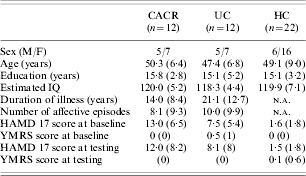
Here, we used PSSCogReHab, a computerized intervention package with demonstrated efficacy (Bracy, Reference Bracy1994), to provide computer-assisted cognitive retraining (CACR) to 12 MDD patients with long-term illness (see Table 1 for disease profile). This package has been implemented successfully across multiple disease profiles (see, for example, Chen et al. Reference Chen, Thomas, Glueckauf and Bracy1997), including in patients with psychiatric illnesses such as schizophrenia (Hogarty et al. Reference Hogarty, Flesher, Ulrich, Carter, Greenwald, Pogue-Geile, Kechavan, Cooley, DiBarry, Garrett, Parepally and Zoretich2004). Twelve matched patients with MDD who did not receive training and a group of healthy control participants were included for comparison, with performance measured at baseline and at the conclusion of the 10-week intervention period. The objective of this study was to evaluate the feasibility of using this program to remediate performance in four targeted domains: (i) memory, (ii) attention, (iii) executive functioning and (iv) psychomotor speed.
Demographic and clinical characteristics of the sample

Values are n or mean (standard deviation).
CACR, Computer-assisted cognitive retraining; UC, unipolar comparison; HC, healthy controls; M, male; F, female; IQ, intelligence quotient; n.a., not applicable; HAMD 17, 17-item Hamilton Depression Rating Scale; YMRS, Young Mania Rating Scale.
Patient groups did not differ significantly on any of these variables (p>0·05), with the exception of the HAMD.
METHOD
All participants provided written informed consent. The study was approved by the research ethics board of St Joseph's Healthcare Hamilton.
Participants
Patients with unipolar depression were recruited from the out-patient registry in the Mood Disorders Program at St Joseph's Healthcare in Hamilton. The diagnosis of MDD was confirmed by the Structured Clinical Interview for DSM-IV (SCID; First et al. Reference First, Spritzer, Gibbon and Williams2001). The CACR group consisted of 12 MDD patients (mean age=50·26 years, s.d.=6·41; seven women) who received PSSCogReHab training. A comparator group (unipolar comparison, UC) of 12 age- and gender-matched MDD patients (mean age=47·42 years, s.d.=6·78; seven women) did not receive the intervention.
None of the patients (CACR or UC) were acutely ill at the time of training but all had a long-term history of depressive illness. On average, patients in the CACR and UC groups had experienced 8·1 (9·3) and 10·0 (9·9) previous episodes of depression respectively; the number of previous episodes did not differ significantly across these patient groups (p>0·05). Both patient groups were treated with stable doses of antidepressant medication throughout the interval between assessments and none began a new program of structured psychotherapy over this period.
A second comparator group consisted of 22 healthy comparison participants (HC) with no history of psychiatric illness (mean age=49·1 years, s.d.=9·0; 16 women), as confirmed by the SCID. These participants were recruited from an established research database at our clinic. The National Adult Reading Test was used to estimate pre-morbid IQ (Nelson & Willison, Reference Nelson and Willison1991).
Exclusion criteria were: (1) receipt of electroconvulsive therapy within 12 months prior to assessment; (2) overt sensorimotor disturbances at time of the initial assessment; (3) anticholinergic or antipsychotic medication use; (4) history of closed head injury resulting in loss of consciousness; (5) untreated active medical illness (e.g. diabetes); (6) identified learning disability or diagnosis of attention deficit hyperactivity disorder (ADHD); (7) substance-related disorder within the past 6 months; (8) lifetime history of substance dependence; (9) use of alcohol or illicit psychoactive substance within 48 h of testing; and (10) history of neurological disease.
Demographic and clinical characteristics of the study sample are presented in Table 1. There were no significant differences in age, sex, years of education, and estimated IQ between the three groups at initial assessment (p>0·05; see Table 1). Participant scores on the clinical outcome measures are discussed later.
Cognitive measures
All participants received neuropsychological assessment at baseline and at conclusion of the 10-week intervention period. Because enrollees were known by the trainers to be patients, cognitive assessments were conducted by independent staff members trained in administration of the test battery. Collectively, the neuropsychological battery provided assessment of the four domains, memory, attention, executive functioning and psychomotor speed, targeted by the intervention program. The assessment battery included a number of measures: (i) the California Verbal Learning Test (CVLT; Delis et al. Reference Delis, Karmaer, Kaplan and Ober1987), a measure of episodic verbal learning and memory, retroactive and proactive interference and strategy used to remember the information; (ii) Ruff's 2&7 Selective Attention Test (Ruff & Allen, Reference Ruff and Allen1996), a speeded measure of voluntary visual selective attention; (iii) the Wechsler Adult Intelligence Scale – Revised (WAIS-R) Digit Span Forwards and Backwards subtests (Wechsler, Reference Wechsler1997), measures of maintenance and manipulation in working memory, and of attention span; (iv) the WAIS-R Similarities subtest (Wechsler, Reference Wechsler1997), a measure of abstract verbal reasoning (e.g. ‘In what way are an apple and a pear alike and/or unalike?’); (v) Trail Making Test – parts A and B (Reitan & Wolfson, Reference Reitan and Wolfson1985), measures of speed for attention, sequencing, mental flexibility and of visual search and motor function; and (vi) the phonetic and category (semantic association) versions of the Controlled Oral Word Association Test (COWAT; Benton et al. Reference Benton, Hamsher and Sivan1983), both speeded measures of verbal association fluency, where participants are required to produce spontaneously words beginning with a given letter (i.e. F, A and S) or of a given class (i.e. animals) within a limited amount of time.
Clinical measures
In order to equate the patient groups, mood was also assessed at each assessment using the 17-item Hamilton Depression Rating Scale (HAMD; Hamilton, Reference Hamilton1960) and the Young Mania Rating Scale (YMRS; Young et al. Reference Young, Biggs, Ziegler and Meyer1978; see Table 1). Scores on these scales confirmed the absence of subthreshold symptoms in the HC group.
Intervention
The PSSCogReHab cognitive remediation software program is described extensively elsewhere (Chen et al. Reference Chen, Thomas, Glueckauf and Bracy1997). In brief, intervention involves the administration of five software packages aimed at improving performance in four cognitive domains: attention, verbal memory, psychomotor speed and executive function. Initially, participants perform simple tasks in a single cognitive domain (e.g. memory), followed by multi-domain tasks (e.g. memory and attention) and, once successful, graduate to complex tasks that rely upon problem-solving skills. The hallmark of this program is repetition. The program begins with perceptual and attentional tasks, in both the auditory and visual modality. Within each domain, the tasks become increasingly more difficult, requiring, for example, greater periods of sustained attention, or the tracking of multiple cues. The client progresses through each domain, and from one domain to the next, at his or her own pace. Each task is repeated until the client has mastered it. The problem-solving tasks at the end of the training regimen build upon and integrate previously trained skills, such as memory, perceptual attention and visual imagination. For example, the Odd One Out task requires the client to choose one out of four cards that is different from the others in some way. To do so, the client must be able to visually attend to and logically compare the four cards, placing demands on working memory and other executive skills. The client also has to determine the dimension of comparison, which could be geometric or rely on some other abstract quality.
Both human and animal studies suggest a salutary effect of complex mental exercise on cognitive performance (e.g. Winocur et al. Reference Winocur, Moscovitch, Fogel, Rosenbaum and Sekeres2005; Willis et al. Reference Willis, Tennstedt, Marsiske, Ball, Elias, Koepke, Morris, Rebok, Unverzagt, Stoddard and Wright2006; but see Salthouse, Reference Salthouse2006). Following each training session, participants were given the option of engaging in a 15-minute session of a computer game (chess/checkers or Carmen Sandiego) to improve strategy, attention and problem-solving skills. In the commercial game Where in the World is Carmen Sandiego, players must decode and integrate complex cues to reach a specified goal within a set time.
Procedure
The treatment group completed the training sessions individually, in a quiet room, over a period of 10 weeks. PSSCogReHab training sessions ranged in duration from 45 to 60 minutes, after which participants were free to engage in computer games. On average, CACR participants completed two PSSCogReHab training sessions weekly, and were encouraged to supplement their formal training with ‘informal challenging’ games both on-site and at home. The PSSCogReHab software was installed on an IBM Pentium III computer and was presented on a 15-inch SVGA IBM monitor placed at a comfortable viewing distance from participants. Participants were asked to read the instructions as they appeared on the screen, with minimal input from the experimenter. Cognitive assessments, conducted pre- and post-remediation, were carried out independently of the trainers.
Statistical analyses
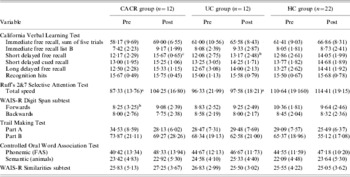
Change on the cognitive and clinical measures over the intervention period was analyzed using mixed-design analyses of variance (ANOVAs), treating Group (CACR, UC and HC) as a between-subjects variable and Time (pre and post) as a within-subjects variable. Paired-sample t tests were used as follow-up measures to compare the magnitude of performance change in each group. One-way ANOVAs treating group as a between-subjects variable were used to assess group differences in performance at pre- and post-testing. Follow-up comparisons were made using Tukey's Honestly Significantly Different Test. The results of these analyses are summarized in Table 2 and are not discussed further here.
Pre- and post-intervention performance of groups on cognitive measures

WAIS-R, Wechsler Adult Intelligence Scale – Revised; CACR, computer-assisted cognitive retraining; UC, unipolar comparison; HC, healthy controls;
a Performance significantly lower than HC group (p<0·05).
b Performance marginally lower than HC group (p=0·05).
c Performance marginally higher than HC group (p=0·06).
All tests were conducted with α set at 0·05.
RESULTS
Cognitive measures
CVLT performance
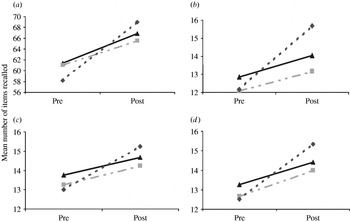
There was a main effect of Time on immediate free recall of the summed items recalled across all five learning trials [F(1, 43)=46·82, p<0·001]. This effect was mediated by group membership (see Fig. 1; Table 2). Although there was no main effect of Group, a significant two-way interaction emerged between Time and Group [F(2, 43)=3·34, p<0·05]. While all groups showed improvement on the summed items, the magnitude of this improvement was greater in the CACR group [t(11)=−5·17, p<0·001] compared to the UC [t(11)=−2·41, p<0·05] and HC groups [t(21)=−4·07, p<0·01].
Group performance on the California Verbal Learning Test (CVLT): (a) immediate free recall summed; (b) short-delay free recall; (c) short-delay cued recall and (d) long-delay free recall performance. —▲—, Healthy comparison group; – -■– -, unipolar comparison group; – –◆– –, computer-assisted cognitive retraining group.

There was a main effect of Time on interference List B learning [F(1, 43)=9·57, p<0·01] but no main effect of Group or interaction between Group and Time. All groups showed reduced interference at post-testing.
There were main effects of Time for short-delay free recall [F(1, 43)=35·99, p<0·001] and cued recall [F(1, 43)=32·45, p<0·001], which were mediated by group membership. Although there was no main effect of Group for either of these variables, a two-way interaction emerged between Time and Group for both free recall [F(2, 43)=5·65, p<0·01] and cued recall [F(2, 43)=3·04, p<0·06]. Here, the UC group showed no improvement on either measure but both the CACR [free recall: t(11)=−5·75, p<0·001; cued recall: t(11)=−4·19, p<0·01] and HC groups [free recall: t(21)=−2·97, p<0·01; cued recall: t(21)=−3·57, p<0·01] showed improved performance, with the greatest improvement in the CACR group. There was also a main effect of Time [F(1, 43)=37·28, p<0·001] for long-delay free recall performance in the absence of a Group main effect. A two-way interaction was observed between Time and Group [F(2, 43)=3·35, p<0·05], where the magnitude of improvement on long delay free recall was greatest in the CACR group [t(11)=−4·62, p<0·001] relative to the UC [t(11)=−3·28, p<0·01] and HC [t(21)=−2·72, p<0·05] groups.
Finally, there was a main effect of Time [F(1, 43)=5·01, p<0·05] on the number of recognition hits made, but no main effect of Group or interaction between Time and Group (p>0·05). All groups improved on this measure.
Ruff's 2&7 Selective Attention Test performance
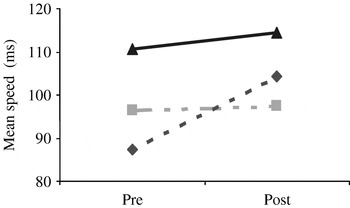
There were main effects of Time [F(1, 43)=22·42, p<0·001] and of Group [F(1, 43)=4·71, p<0·05] on total speed for this measure, mediated by a significant two-way interaction between these variables [F(2, 43)=8·87, p<0·001]. Total speed improved in the CACR group [t(11)=−4·33, p<0·01] but there was no improvement in the UC and HC groups (see Fig. 2).
Group performance on Ruff's 2&7 Selective Attention Test total search speed. —▲—, Healthy comparison group; – -■– -, unipolar comparison group; – –◆– –, computer-assisted cognitive retraining group.

WAIS-R Digit Span Forwards and Backwards performance
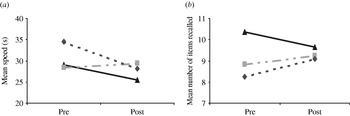
There was a significant interaction between Time and Group for Digit Span Forwards performance [F(2, 43)=3·98, p<0·05]. The main effects of Time and of Group were not significant, however. The CACR group improved on this measure [t(11)=−2·42, p<0·05], but the UC and HC groups did not (see Fig. 3).
Neither the main effects of Time or of Group nor the interaction between these variables achieved significance for Digit Span Backwards performance (p>0·05).
Trail Making Test: Parts A and B performance
There was a main effect of Time on speed of responding on Part A of the Trail Making Test [F(1, 43)=9·68, p<0·01], but no main effect of Group. The effect of Time was mediated by a significant two-way Group by Time interaction [F(2, 43)=4·29, p<0·05]. Whereas the UC group showed no improvement on this part of the measure, both the CACR [t(11)=3·21, p<0·01] and HC [t(21)=2·63, p<0·05] groups showed improved performance, although the magnitude was greatest in the CACR group (see Fig. 3).
Group performance on: (a) Part A of the Trail Making Task and (b) Digit Span Forwards. —▲—, Healthy comparison group; – -■– -, unipolar comparison group; – –◆– –, computer-assisted cognitive retraining group.

There was also a main effect of Time on speed of responding on Part B of the Trail Making Test [F(1, 43)=6·06, p<0·05] but no main effect of Group or interaction between Time and Group.
COWAT performance
There were main effects of Time on total score for the phonemic (FAS) version of the COWAT [F(1, 43)=10·24, p<0·01] but no main effect of Group (p<0·05) or interaction between Time and Group (p>0·05). The groups improved equally at post-testing on this measure.
Neither the main effects of Time or of Group nor the interaction between these variables achieved significance for performance on the semantic version of the COWAT.
WAIS-R Similarities subtest performance
Neither the main effects of Time or of Group nor the interaction between these variables achieved significance for performance on the WAIS-R Similarities subtest (p>0·05).
Clinical measures
Neither the CACR nor the UC group had changes in mood symptoms over the 10-week testing period; HAMD scores at pre- and post-testing did not differ significantly for either group (p>0·05). A between-subjects ANOVA revealed a main effect of group on HAMD scores at baseline [F(2, 43)=26·22, p<0·001]; however, Tukey post-hoc testing indicted that the CACR group had higher baseline HAMD scores than the UC group (p<0·05). Hence, we repeated our analysis using change in HAMD scores from pre- to post-testing as a covariate in an analysis of covariance (ANCOVA) design. All main effects and interactions remained significant at the p<0·05 level in this analysis, with the exception of the interaction between Time and Group for the total number of items recollected at immediate free recall on the CVLT, which became marginally significant [F(2, 42)=3·10, p=0·06], and the main effect of Group on total speed for Ruff's 2&7 test, which was no longer significant [F(2, 42)=2·31, p>0·05].
DISCUSSION
The main finding in this study is the improvement in cognitive performance observed in a group of patients with MDD following 10 weeks of cognitive remediation therapy. The improvement exceeded that observed over the same time period in a group of matched patients and healthy controls who did not receive the intervention and improvement was apparent on a range of tests targeting attention, verbal learning and memory, psychomotor speed and executive function. These results provide preliminary evidence that stimulation of cognitive functions through targeted, repetitive exercises is a viable method of cognitive remediation in patients with recurrent major depression. These effects cannot be attributed to improvements in patients' mood symptoms over the 10-week training period; neither the CACR nor the UC group had significant improvement in HAMD scores over pre- and post-testing. Moreover, when we controlled for minor changes in HAMD scores over pre- and post-testing, our results remained stable.
To our knowledge, this is the first study to probe the effects of cognitive remediation in patients with unipolar depression. Our intervention involved a bottom-up approach, targeting behavior in particular domains (Levine et al. Reference Levine, Robertson, Clare, Carter, Hong, Wilson, Duncan and Stuss2000). While this approach is less likely to promote generalization, it yields the benefit of impacting specific behaviors. Here, we saw improvement in the CACR group's performance that exceeded that of the comparator groups on the immediate free recall, short-delay and long-delay free recall subtests of the CVLT, a commonly administered test of verbal learning and memory. Similarly, the CACR group showed the strongest performance gains, relative to controls, on Ruff's 2&7 test, a speeded measure of selective and sustained attention, and on two indices of attention and working memory, the Digit Span Forwards subtest of the WAIS and Part A of the Trail Making Test. Collectively, these tasks tap executive functions involved in the selection, timing, monitoring and interpretation of behavior (Mesulam, Reference Mesulam, Stuss and Knight2002) and map readily onto the domains targeted by our intervention program.
The improvement in performance in the CACR group did not exceed that of the comparator groups on all tasks. The equivalent gains across groups on some tasks in our battery may stem from multiple factors, including the possibility that aspects of these tasks (e.g. WAIS Similarities subtest; COWAT task) tap cognitive functions (e.g. semantic knowledge; vocabulary) distinct from those targeted by the intervention program. Alternatively, it may be that some, but not all, of the cognitive functions measured by our assessment battery are amenable to the intervention taken here. Overall, however, our findings are in line with earlier reports that show that targeted, repeated interventions can partially remediate altered function in psychiatric illness, most prominently schizophrenia (Bell et al. Reference Bell, Bryson, Greig, Corcoran and Wexler2001, Reference Bell, Bryson and Wexler2003; Fiszdon et al. Reference Fiszdon, Bryson, Wexler and Bell2004; but see van der Gaag et al. Reference van der Gaag, Kern, van den Bosch and Liberman2002; Ueland & Rund, Reference Ueland and Rund2004 for exceptions), and extend these finding to MDD. Moreover, these performance gains occurred as the result of an easily administered, computerized intervention (Bracy, Reference Bracy1994) that minimizes the output of resources and is relatively inexpensive to acquire and to administer.
While it was not the case that our MDD patients showed clear-cut impairment on the cognitive measures prior to the onset of remediation, this pattern is consistent with the overall cognitive profile of MDD patients presented in the research literature, where deficits may be subtle and highly variable among patients (e.g. MacQueen et al. Reference MacQueen, Campbell, McEwen, Macdonald, Amano, Joffe, Nahmias and Young2003). This pattern is illustrated in Table 2, where patient scores on the cognitive measures fell consistently below that of the HC group, but in few cases were these scores found to differ by statistical testing. Although these differences were not wide at initial assessment, it was the CACR group who showed the most improvement following the application of remediation therapy, demonstrating the efficacy of this approach in improving what may be only subtly reduced performance in some MDD patients.
There were several limitations to our study, including the small sample size. Despite limited power, however, we found a number of significant performance improvements related specifically to the effects of the cognitive intervention. Our approach relied upon multiple analyses, raising the possibility of Type I errors. We consider this unlikely, however, given the consistency of positive findings both within and across our various cognitive measures, which arose from small samples, themselves unlikely to inflate the statistical indices.
Although future studies will undoubtedly incorporate randomized control trials, in the present probe, patients with a history of MDD were given the option of enrolling in the CACR trial or in the matched control group. While this approach added the potential for selection effects, it served to increase overall motivation and likelihood of adherence to the training regimen and it reflects the possible outcome of real-world patients who will, in future, self select whether to participate in such programs or not. We could not exclude the possibility that performance gains in the CACR group are related, in part, to the therapeutic effects of social contact. Social contact, however, was kept to a minimum by the fact that the remediation program was computer based. Moreover, if social contact was primarily responsible for increases in participant performance, we would predict a concurrent increase in mood scores in the CACR group relative to the control groups; this did not occur. Finally, because the study included both the formal computerized retraining and encouragement to engage in challenging games, we cannot estimate how much improvement was secondary to either component of the program.
This is a preliminary probe of the effects of targeted remediation on cognitive function in MDD. Future studies will be required to examine the generalization of similar interventions to non-targeted areas of cognitive functions, the long-term sustainability of performance improvements, and the functional significance of such improvement. Nonetheless, this study provides the first indication that successful treatment of cognitive deficits associated with MDD can be achieved through cognitive remediation. Importantly, these targeted cognitive interventions have no known adverse effects, rendering them safer than the use of pharmacological cognitive enhancers by avoiding the problems of drug–drug interactions and the side-effect burden that can occur with polypharmacy. Ultimately, cognitive retraining may translate to interventions aimed at decreasing medical-related disability, improving functional capacity, and enhancing the day-to-day functioning for the group of people with depression who experience significant cognitive disability associated with the illness.
ACKNOWLEDGMENTS
We are grateful to the patients and their families for their assistance. We thank Cathy Preete and Benjamin Doxtdator for their assistance in the preparation of this manuscript and Laura Garrick, Helen Begin, Cindy D'Amico, Scott Simons and Tana Pati for assistance with patient scheduling and testing. Charlene O'Connor and Gary Turner are also thanked for helpful conversations regarding these data. This study was supported by Canadian Institutes of Health Research and Ontario Mental Health Foundation grants to Dr Glenda MacQueen.
DECLARATION OF INTEREST
None.