Introduction
The increasing demand for food from limited land resources requires new sustainable ways of food production. Short-term needs of farmers must be balanced with long-term environmental sustainability. The solutions must be viable at the field, farm and community levels, and beyond. They need to take into account the complexity of the systems in which farmers operateReference Rufino, Tittonell, van Wijk, Castellanos-Navarrete, Delve and de Ridder 1 , Reference Tittonell, Scopel, Andrieu, Posthumus, Mapfumo, Corbeels, Van Halsema, Lahmar, Lugandu, Rakotoarisoa, Mtambanengwe, Pound, Chikowo, Naudin, Triomphe and Mkomwa 2 and the environmental implications their actions might haveReference Pretty, Toulmin and Williams 3 .
Farming systems in Southern Africa are constrained by numerous factors, including inherently infertile sandy soils in some areasReference Nyamapfene 4 , Reference Nyamangara, Mugwira and Mpofu 5 , droughtReference Edmeades, Chapman and Lafitte 6 and limited access to, and use of, mineral and organic fertilizersReference Morris 7 – Reference Sánchez 9 . Average annual fertilizer use in sub-Saharan Africa is below 10 kg ha−1 of NPK fertilizerReference Morris 7 , Reference Okoth, Murua, Sanginga, Chianu, Mungatu, Kimani, Ng'ang'a, Bationo, Waswa, Okeyo, Maina and Kihara 10 , significantly smaller than in Asia and Latin AmericaReference Sanchez 11 . Farmers own relatively small land holdings; e.g., in Malawi the average household land size is <1.2 ha 12 , and maize is often grown in monoculture with few legumes or other crops in rotationReference Thierfelder and Wall 13 , Reference Waddington 14 . Markets for both agricultural inputs and outputs are not well developed, leading to high input and low output prices 15 .
Since the 1920s, the moldboard plow has been used as a land preparation tool in Southern Africa in an attempt to reduce labor requirements, bury weeds, mobilize nutrients and prepare a fine soil tilthReference Alvord 16 , Reference Andersson, Giller, Sumberg and Thompson 17 . Intensive use of the plow is reported to have increased chemical, physical and biological soil degradationReference Lal 18 , Reference Montgomery 19 , and increased soil erosion and run-offReference Munyati 20 , Reference Elwell and Stocking 21 , soil crusting and sealingReference Thierfelder, Amezquita and Stahr 22 , reduced aggregate stabilityReference Thierfelder and Wall 13 , limited water infiltration and less available soil moistureReference Thierfelder and Wall 23 , Reference Rockström, Kaumbutho, Mwalley, Nzabi, Temesgen, Mawenya, Barron, Mutua and Damgaard-Larsen 24 have been documented. In manual systems since the 1930s in Malawi, smallholder farmers have been encouraged to plant crops on ridges, rather than on the flat or in mounds. Crop ridges are constructed using a broad-bladed hoe and, in the next season, the ridge is split and reformed in the previous furrow. There is a growing body of evidence that the continued use of a hoe to the same depth results in the formation of a compacted horizon immediately below the ridgeReference Douglas and Initiative 25 , Reference Materechera and Mloza-Banda 26 . The intensive cultivation of soils has led to losses in soil carbon and reductions in biological activityReference Thierfelder and Wall 13 , Reference Chivenge, Murwira, Giller, Mapfumo and Six 27 . However, there are also conflicting results from the regionReference Ngwira, Thierfelder and Lambert 28 and elsewhereReference Govaerts, Verhulst, Castellanos-Navarrete, Sayre, Dixon and Dendooven 29 that show no causal relationship between intensive tillage and carbon loss. Limited retention of surface crop residues adds to the decline in soil carbon in conventional systemsReference Thierfelder and Wall 30 . Furthermore, accelerated soil erosion in tilled systems decreases the amount of important plant nutrients (e.g. N, P and K) through the loss of arable top-soilReference McDowell and McGregor 31 .
Recently there has been increased demand for ‘greener’ solutions to tackle the soil fertility decline in Southern AfricaReference Gilbert 32 . The way to achieve this is uncertain and often contestedReference Sumberg and Thompson 33 . Different approaches have been proposed to increase the productivity of land, ranging from simple technology interventions, such as increased fertilizer use and/or improved seed varieties, to more systems-oriented solutions, such as agroforestry, permaculture, integrated crop-livestock systems or conservation agriculture (CA)Reference Garrity, Akinnifesi, Ajayi, Sileshi, Mowo, Kalinganire, Larwanou and Bayala 34 – Reference Kassam, Friedrich, Shaxson and Pretty 38 . Breeding improved varieties is often proposed as a direct route to increasing crop productivity and closing the yield gaps in the environments of smallholder farmers in Southern AfricaReference Evenson and Gollin 39 , Reference Evenson and Gollin 40 . However, it is rather unlikely that one single intervention such as seed or fertilizer will solve all of the smallholder farmers’ challenges and thus combinations of synergistic technologies are required.
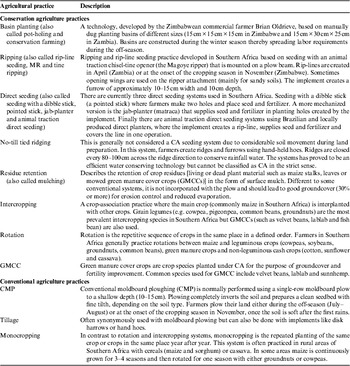
CA, a crop management system of three basic principles applied in a mutually reinforcing manner, has been proposed as one of the options to alleviate soil fertility declineReference Wall 36 . CA is based on a combination of: (1) minimum soil disturbance, i.e., no soil inversion with the plow or hoe; (2) surface crop residue retention as mulch with living or dead plants; and (3) crop rotations and associations of different crop species over timeReference Kassam, Friedrich, Shaxson and Pretty 38 , Reference Hobbs 41 . Commonly used terms in CA and conventional tillage systems are described in Table 1. CA is widely adaptable and the application of its principles may vary among individual farmers depending on the site and the farmer's circumstancesReference Wall 36 , Reference Erenstein, Sayre, Wall, Hellin and Dixon 42 .
Commonly used terms in conservation agriculture and conventional crop management systems of Southern Africa.

Note: seeding systems are described in Johansen et al.Reference Johansen, Haque, Bell, Thierfelder and Esdaile 103 and Sims et al.Reference Sims, Thierfelder, Kienzle, Friedrich and Kassam 147 .
Over the past 40 years, the application of CA within large-scale commercial farming systems has greatly expanded in Latin America, the United States and AustraliaReference Bolliger, Magid, Amado, Scora, Dos, Calegari, Ralisch and De Neergaard 43 – Reference Friedrich, Derpsch and Kassam 48 . Based on these successes there was a major push by the international donor community in the late 1990s to also adapt this cropping system for smallholder farmers in Southern AfricaReference Benites, Chuma, Fowler, Kienzle, Molapong, Manu, Nyagumbo, Steiner and Van Veenhuizen 49 . Nevertheless, concerns were raised about the widespread promotion of CA in Southern Africa without adequate (research) evidence that CA increases yields and livelihoods of farmers and improves soil quality indicatorsReference Bolliger 50 , Reference Giller, Witter, Corbeels and Tittonell 51 . Giller et al.Reference Giller, Witter, Corbeels and Tittonell 51 argued that farmers can only apply CA in certain ‘niches’ under very specific circumstances, which was contested by many scholars, with opinions summarized on this website 52 . Related studiesReference Andersson, Giller, Sumberg and Thompson 17 questioned the suitability of CA for the majority of farming systems in Southern Africa and stated that an ‘across-the-board recommendation of conservation agriculture’ would be wholly misplacedReference Gilbert 32 , Reference Giller 53 , and this sparked further debateReference Buffet 54 , Reference Kassam and Brammer 55 .
One of the main arguments against promoting CA in Southern Africa is that CA was successfully applied within large-scale, mechanized commercial farming systems in the Americas and Australia, and little was known about its potential to increase productivity and reduce soil degradation within the smallholder farming systems of Southern Africa, where small and fragmented landholdings are common and the farming systems are generally more complexReference Tittonell, Muriuki, Shepherd, Mugendi, Kaizzi, Okeyo, Verchot, Coe and Vanlauwe 56 , Reference Tittonell, Vanlauwe, de Ridder and Giller 57 .
Like all agricultural technologies, CA cannot be considered as a panacea to all farmers’ problems under all circumstances, and hence the ‘one-size-fits-all’ argument can hardly be defended. Nonetheless, there is increasing empirical research evidence on the merits and demerits of farm-level application of CA in Southern Africa. This review summarizes and synthesizes the immediate farm-level impact of CA in the region, focusing mainly on publications based on multi-year on-station and on-farm trials. The paper is structured as follows: the section ‘Effects of CA on Smallholder Cropping Systems’ synthesizes the effects of CA on smallholder cropping systems in Southern Africa and the section ‘Constraints to Adoption of CA Systems in Southern Africa’ presents a detailed analysis of the biophysical and socio-economic challenges that hinder the adoption of CA in the region. Finally, the brief conclusion focuses on the key lessons learned from the empirical evidence synthesized.
Effects of CA on Smallholder Cropping Systems
Initial research from 1988 to 2002 largely focused on the effects of CA on soil quality, such as the effects of selected CA and non-CA systems on soil erosion, carbon, weeds and water dynamicsReference Munyati 20 , Reference Vogel 58 – Reference Vogel, Nyagumbo and Olsen 60 . These studies from Zimbabwe highlighted that reduced tillage and mulch cover reduced erosion and increased soil moisture, which led to overall greater yields, especially in dry years. The results also showed that timing of planting and other operations was more important than the type of tillage system employed, particularly in the sub-humid parts of the countryReference Nyagumbo, Goddard, Zoebisch, Gan, Ellis, Watson and Sombatpanit 61 , Reference Oldrieve 62 .
Effects of CA on infiltration and soil water
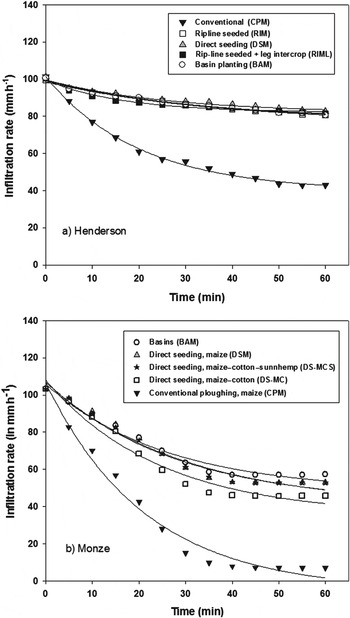
Rainfall distribution patterns during the growing season in Southern Africa are characterized by mid-season dry spellsReference Mupangwa, Walker and Twomlow 63 , Reference Usman and Reason 64 . Thus, higher infiltration rates under CA and surface crop residue retention have the potential to buffer growing crops against intermittent periods of drought stress. The effect of CA on water infiltration and soil moisture in Southern Africa has already been reported in detail by Thierfelder and WallReference Thierfelder and Wall 23 . No-tillage and residue retention increase infiltration rates, an effect which appears almost immediately when the soil is covered with mulch. Infiltration measurements at Henderson Research Station, Zimbabwe and Monze Farmer Training Centre, Zambia with a mini-rainfall simulator showed clearly that CA treatments were able to maintain higher infiltration rates compared with conventionally plowed treatments without residue retention across sites (Fig. 1). This increase in infiltration rate was mainly due to an increase in biological activity, reduction in soil surface disturbance and the continuity of macroporesReference Thierfelder and Wall 13 . Similarly, studies conducted under the semi-arid conditions of Zimbabwe showed that over time CA practices improved hydraulic properties (unsaturated hydraulic conductivity and capillary sorptivity) of a clay loam soilReference Mupangwa, Twomlow and Walker 65 . However, studies also showed that the effect of CA on water infiltration was dependent on soil type, with the potential negative effect of waterlogging on granitic sandy soils, which have a tendency to accumulate too much waterReference Thierfelder and Wall 23 , Reference Thierfelder and Wall 30 .
Infiltration rates measured with a mini-rainfall simulator at Henderson Research Station (a) and the Monze Farmer Training Centre (b) after 8 and 7 years of treatment, January 2012 (Thierfelder, 2012, unpublished data).

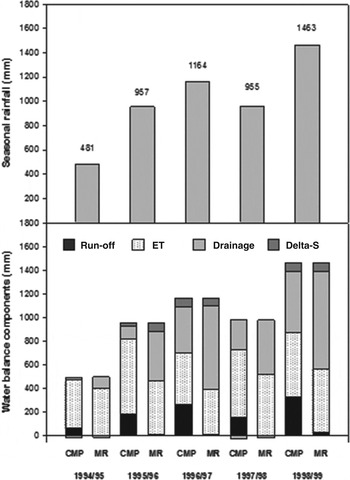
Water balance studies over a 5-year period (1994/5–1998/9) on clay soils at Hatcliffe, Zimbabwe by NyagumboReference Nyagumbo 59 , allowed water losses through runoff and evapotranspiration to be compared between a CA system in the form of mulch ripping (MR) and conventional moldboard plowing (CMP) (Fig. 2). Using an improved simple water balance technique derived in situ over five seasons (1994/5–1998/9), only 26% of the total rainfall under CMP was contributed to groundwater recharge compared with 50% under MR. Average runoff of seasonal rainfall was also reduced under MR, with only 1% of rainfall lost due to run off compared with 20% under CMP. Although the difference between seasonal evapotranspiration under CMP and MR was small (51% compared to 46%) soil moisture storage within the top 45 cm of soil was significantly greater under MR compared with CMPReference Nyagumbo 59 (Fig. 2). Field water balance modeling studies in South Africa showed that no-till systems (rip-line seeding systems without mulch retention) reduced surface runoff by 28% and increased deep drainage by 19% on a sandy clay loam soil compared to CMPReference Mupangwa and Jewitt 66 .
Effects of conventional moldboard plowing and mulch ripping on different water balance components over five seasons on a red fersiallitic clay soil at Hatcliffe, Zimbabwe. Note: delta-S, change in profile water storage down to 140 cm depth; ET, actual evapotranspiration (adapted fromReference Nyagumbo 59 ).

Studies on soil moisture by Thierfelder and WallReference Thierfelder and Wall 23 confirmed that CA treatments on an Arenosol at Henderson, Zimbabwe and a Lixisol at Monze, Zambia, had more available soil moisture than conventionally plowed treatments. The results of these studies showed that CA techniques increase soil water balance attributes when compared with conventional plowing. Furthermore CA systems often resulted in higher water productivity compared to conventional plow-based tillage systems, by up to ±10 kg ha−1 mm−1, depending on seasonal rainfall patternsReference Nyagumbo 59 . Only one study has been conducted on deep drainage and leaching on a granitic sandy soil, using lysimeters, at Domboshawa Training Centre, Zimbabwe. The results suggest no-till tied ridging system resulted in 21% more deep drainage and consequent nitrate leaching than CMPReference Vogel, Nyagumbo and Olsen 60 , which could potentially have negative effects on plant growth.
In summary, CA generally increases water infiltration and improves available soil moisture. This can potentially reduce the negative effects of in-season dry spells, reduce run-off and provide more available water for plant growth. Nevertheless, there are also findings that water infiltration in CA systems is dependent on soil type, with the potential negative effect of waterlogging on granitic sandy soilsReference Thierfelder and Wall 23 , Reference Thierfelder and Wall 30 .
Effects of CA on physical and biological soil quality attributes
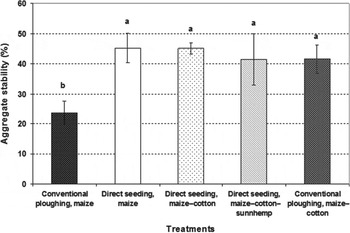
Studies on physical and biological properties in Zambia showed more stable soil aggregates (41–45%) in directly seeded CA systems compared with the conventional system (24%)Reference Thierfelder and Wall 13 (Fig. 3). This stability promoted better water infiltration and soil water storage in the directly seeded CA systems compared with the conventional practice. Stable soil aggregates protect soil organic carbon (SOC) and improve soil structure under CA or no-till systems on soils with 22% clay and 7% siltReference Nyamadzawo, Nyamangara, Nyamugafata and Muzulu 67 . In Zimbabwe, the positive impact of CA on soil aggregate stability was observed on both light and heavy textured soils under semi-arid and sub-humid conditionsReference Thierfelder and Wall 30 .
Effects of conservation agriculture and rotation on aggregate stability, Monze Farmer Training Centre, Zambia, April 2009Reference Thierfelder and Wall 13 .

In the semi-arid southern regions of Zimbabwe, bulk density of a clay loam soil decreased over time in CA systems (rip-line seeding systems and planting basins) compared with the conventional practiceReference Mupangwa, Twomlow and Walker 68 . Soil bulk density is a function of soil texture, SOC content and aggregate stabilityReference Baldock and Nelson 69 . In a long-term tillage experiment on both red clay and sandy soils under sub-humid climate conditions, NyagumboReference Nyagumbo 59 observed significantly lower top soil bulk densities under MR compared with CMP on both sandy soils and clay soils. In sandy soils, significant differences were apparent only in the top 0–10 cm and greater bulk densities were recorded under conventionally plowed plots. On clay soils, significantly lower bulk densities in MR compared to conventionally plowed plots were observed at depths of 10–40 cm. The higher bulk density of the top soil under plowed uncovered fields was attributed to faster disintegration of soil aggregates by the impact of raindrops, which resulted in surface compaction, particularly in sandy soils with poor soil structureReference Valentin 70 . These results suggested that physical benefits are associated with reduced tillage management, although soil type plays a critical role. Tillage is often promoted as a way of loosening up the soil before planting. The results do, however, suggest that this is only a temporary measure as most soils quickly lose their stability after tillage, slump and lead to even greater compactionReference Bolliger, Magid, Amado, Scora, Dos, Calegari, Ralisch and De Neergaard 43 , Reference McGarry, Garcia-Torres, Benites, Martinez-Vilela and Holgado-Cabrera 71 .
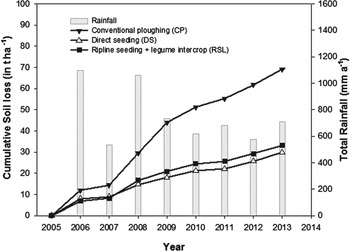
There is general agreement that no-tillage and residue retention increases infiltration and reduces surface run-off leading to lower erosion ratesReference Thierfelder and Wall 23 . A 4-year study under rainfed conditions in EthiopiaReference Oicha, Cornelis, Verplancke, Nyssen, Govaerts, Behailu, Haile and Deckers 72 , comparing CA and a conventionally plowed control (CP) showed that CA reduced soil erosion and run-off. In Zimbabwe, an 8-year study showed increased average annual soil losses of 5.1 t ha−1 under conventional plowing compared with 1.0 t ha−1 under MR without soil inversion but residue retentionReference Munyati 20 . Recently, Thierfelder et al.Reference Thierfelder, Cheesman and Rusinamhodzi 73 showed that larger increases of cumulative soil erosion occurred on conventionally plowed fields compared to rip-line seeded CA treatments with sole maize or maize–legume intercropping (Fig. 4).
Effects of two conservation agriculture and one conventionally plowed cropping system on cumulative erosion, Henderson Research Station, Zimbabwe, 2006–2012Reference Thierfelder, Cheesman and Rusinamhodzi 73 .

CA has also been associated with increased soil biological activity. NhamoReference Nhamo 74 showed that there was more abundance and activity of soil biota under maize-based CA cropping systems than with conventional practice, both on an experimental research station and on-farm in Zimbabwe. Under residue-covered fields, termites were more abundant, particularly in the sandy soils. Tillage and removal of residue disturb their habitats and also limit energy sources for termites, while different mulches (maize or grass residues) that contain cellulose and crude protein attract termites. Increases in termite numbers show a clear effect on increased biological activity. This does not necessarily translate into entirely positive effects (i.e., increased nutrient mobilization through residue decomposition) as crops (especially cereals) might be attacked by specialized termite species, especially toward harvest when residue cover would have diminishedReference Giller, Witter, Corbeels and Tittonell 51 . Furthermore, studies on two contrasting agro-ecologies in Zimbabwe showed that reduced tillage with residue cover yielded significantly greater species richness and macrofauna abundance than conventional systems, with a significant and positive correlation between residue application rates and species richnessReference Mutema, Mafongoya, Nyagumbo and Chakukura 75 .
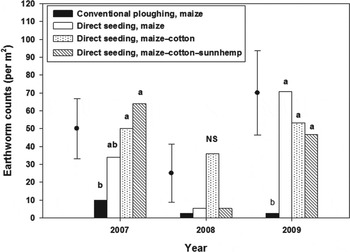
Although there are conflicting results on the effects of CA on termites, beetles and centipedesReference Nhamo 74 , increased earthworm activity has been observed in residue-covered fields compared to conventionally plowed fields in Zambia (Fig. 5)Reference Thierfelder and Wall 13 . Soil texture, moisture and organic matter have a significant effect on earthworm densities, with decreased density in soils with high clay content and organic matter in ZimbabweReference Nhamo 74 . Declining earthworm densities have been previously attributed to the effect of soil inversion by the plowReference Kladviko, Mackay and Bradford 76 , the effects of temporary reduction in soil pores, especially macroporesReference Ehlers 77 and lower soil moisture on conventional fields without mulch protection.
Impact of conventional and conservation agriculture on earthworm counts (per m2) in the first 30 cm in three consecutive years. Monze, Farmer Training Centre, Zambia, 2007–2009Reference Thierfelder and Wall 13 .

In summary, CA leads to greater aggregate stability and, in the long-term, also reduces bulk density. Studies on biological soil fertility are rare and show that CA increases biological activity which can be positive (more earthworms) or can be potentially negative if termites are a problem at the site.
Effects of CA on soil carbon
In-situ retention of crop residues coupled with no-tillage has the potential to increase SOC. The conversion of fields from conventional tillage to no-tillage has been shown to increase SOC in a sandy loam soil in farmers’ fields in MalawiReference Ngwira, Sleutel and De Neve 78 and on sandy soils in both ZimbabweReference Thierfelder and Wall 30 , Reference Mazvimavi, Twomlow, Belder and Hove 79 and ZambiaReference Thierfelder and Wall 13 . However, consistent and sufficient carbon inputs are a major determinant of changes in SOC rather than tillageReference Chivenge, Murwira, Giller, Mapfumo and Six 27 , and lack of sufficient carbon inputs can lead to no, or very slow, increaseReference Nyamangara, Masvaya, Tirivavi and Nyengerai 80 .
Intercropping legumes and maize increased SOC under no-till, largely due to increased biomass production compared to no-till continuous maize cropping. On a sandy soil in Zimbabwe, SOC in the first 30 cm increased when maize was intercropped with pigeonpea compared to continuous maize under no-till (+12%) and conventional tillage (+34%)Reference Thierfelder, Cheesman and Rusinamhodzi 73 . Furthermore in central Mozambique on similar soil types, Rusinamhodzi et al.Reference Rusinamhodzi, Corbeels, Nyamangara and Giller 81 reported a significant increase in SOC after 5 years of intercropping (Table 2). Farmers can use a pigeonpea–ratoon crop, reducing the need for tillage while increasing biomass accumulation, which together have the potential to significantly increase SOC. These results suggest that in the long-term CA may be important for maintaining SOC relative to conventional agriculture. However, the greatest increase might only be achieved when crops are adequately fertilized, sufficient biomass is produced and adequate residue amounts are retainedReference Thierfelder and Wall 30 , Reference Nyamangara, Masvaya, Tirivavi and Nyengerai 80 . Without sufficient fertilization (e.g., through mineral fertilizer, manure and/or compost) farmers cannot raise their productivity to a level that enables them to retain at least 2.5–3 t ha−1 of biomass, which is needed to cover at least 30% of the soil surface. Rotations and intercropping systems might also add to the carbon pool, but their potential to increase SOC largely depends on the agro-ecological environment and their overall biomass productionReference Thierfelder, Cheesman and Rusinamhodzi 73 , Reference Rusinamhodzi, Corbeels, Nyamangara and Giller 81 .
Selected top-soil (0–20 cm) properties of fields under different durations of maize–pigeonpea intercropping in Ruaca, central Mozambique (source: Reference Rusinamhodzi, Corbeels, Nyamangara and Giller 81 ).

* Corresponds to continuous sole maize production.
It is worth noting, that while reduced tillage helps to reduce decomposition rates, it may also play a negative role in SOC stratification within the soilReference Thierfelder and Wall 30 . SOC increases are expected over time if the amount of crop residues retained is more than the loss through the oxidation processReference Thierfelder and Wall 30 . However, the importance of CA in the short term might be more in the maintenance of SOC rather than in its absolute increase. Nyamangara et al.Reference Nyamangara, Masvaya, Tirivavi and Nyengerai 80 generally found no significant increase in soil carbon and phosphorus in their study from Zimbabwe, although there was some accumulation in organic carbon in one agro-ecological region in CA fields relative to conventionally plowed fields when CA was practiced for a longer period.
Pest and disease dynamics
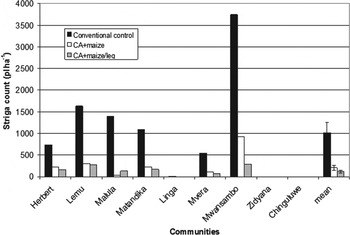
CA has been associated with increased insect pests and diseases. However, one of the main principles, crop rotation, is the most important strategy available for the smallholder farmer to break pest and disease life cyclesReference Thierfelder and Wall 13 , Reference Jordan, Hutcheon and Titi 82 . The parasitic weed striga (Striga asiatica (L) Kuntze) is associated with large losses in maize production throughout Southern AfricaReference Kanampiu, Kabambe, Massawe, Jasi, Friesen, Ransom and Gressel 83 . Estimates for grain yield loss due to striga in farmers’ fields range between 15 and 95%Reference Mloza-Banda and Kabambe 84 . The effects of striga have also been associated with declining soil fertilityReference Vanlauwe, Kanampiu, Odhiambo, De Groote, Wadhams and Khan 85 . A study comparing CA with herbicides and conventional treatments with manual weeding only on 54 paired demonstration plots in MalawiReference Thierfelder, Chisui, Gama, Cheesman, Jere, Bunderson, Ngwira and Eash 86 showed a drastic reduction in striga emergence under CA fields (Fig. 6). Rusinamhodzi et al.Reference Rusinamhodzi, Corbeels, Nyamangara and Giller 81 also observed a significant decrease in striga when intercropping was used in a no-till system compared to continuous cropping of maize.
Incidence of striga (S. asiatica L.) on CA plots (with and without legume intercropping) and conventionally plowed field after 5–8 years of treatment, central and southern Malawi (Thierfelder, 2012, unpublished data).

No-till, residue retention and increased soil moisture at the surface can promote the survival of pathogens until the next crop is plantedReference Sturz, Carter and Johnston 87 . Predominant insect pests and diseases of maize in Southern Africa include grey leaf spot (GLS), maize streak virus (MSV), rust, ear rots and strigaReference Cairns, Sonder, Zaidi, Verhulst, Mahuku, Babu, Nair, Das, Govaerts, Vinayan, Rashid, Noor, Devi, San, Prasanna and Sparks 88 . GLS is caused by the fungal pathogen Cercospora zeae-maydis and is a serious foliar disease associated with yield loss in Southern AfricaReference Meisel, Korsman, Kloppers and Berger 89 . The increase of GLS in temperate maize has been linked to reduced tillage practicesReference Ward, Laing and Cairns 90 . With crop residue retention, the fungal pathogen responsible for GLS remains in the debris of diseased plants, providing an earlier and more extensive source of inoculum for the next maize crop. This facilitates earlier infection of the next maize crop and allows more secondary cycles of the fungusReference Payne 91 . Work is currently underway in Southern Africa to determine if there is increased prevalence of GLS in CA-based systems and what can be done with conventional and molecular breeding to overcome this challengeReference Cairns, Sonder, Zaidi, Verhulst, Mahuku, Babu, Nair, Das, Govaerts, Vinayan, Rashid, Noor, Devi, San, Prasanna and Sparks 88 . MSV is transmitted through leafhoppers (Cicadulina spp.). Little is known about the effects of CA on leafhopper populations and MSV infection and further research is required. Ear rots are caused by a range of fungi including Fusarium graminearum, F. verticillioides, Aspergillus flavus and A. parasiticus Reference Savary, Nelson, Sparks, Willocquet, Duveiller, Mahuku, Forbes, Garrett, Hodson, Padgham, Pande, Sharma, Yuen and Djurle 92 . Lipps and DeepReference Lipps and Deep 93 showed that reduced tillage decreased the prevalence of F. graminearum.
The incidence of white grubs (larvae of Phyllophaga ssp. and Heteronychus spp.) has been highlighted as a potential pest under CAReference Giller, Witter, Corbeels and Tittonell 51 based on one observation in farmers’ fields in Barue, Mozambique. This was also observed on an on-station, long-term trial at Chitedze, Malawi. However, when maize–legume rotations (i.e., maize–cowpea rotations) were introduced on these sites, white grub damage was not observed. Together these results suggest that while pests and diseases carried over through residues can be a threat to successful implementation of CA systems, appropriate rotations and chemical control measures can be used to overcome most of these challenges for the smallholder farmer.
Effects of CA on productivity
Significant yield benefits under CA in Southern Africa are possible, although they may be site-specific and in response to different agro-ecological environmentsReference Thierfelder and Wall 30 . Studies have shown that rotationReference Thierfelder, Cheesman and Rusinamhodzi 94 as well as appropriate fertilizationReference Nyamangara, Masvaya, Tirivavi and Nyengerai 80 are critical for CA results to become significant. This was successfully shown in component omission trials in Malawi, Mozambique and ZimbabweReference Thierfelder, Mombeyarara, Mango and Rusinamhodzi 95 .
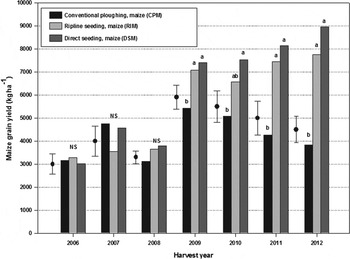
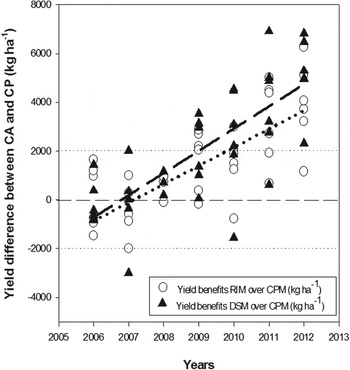
In some environments the benefits of CA started after 1–2 seasons, whereas in other environments the benefits required more seasons for effects to build up Reference Thierfelder and Wall 23 , Reference Thierfelder, Cheesman and Rusinamhodzi 94 , which is in agreement with a recent meta-analysisReference Rusinamhodzi, Corbeels, van Wijk, Rufino, Nyamangara and Giller 96 . For example, in the high-rainfall environment of Zidyana EPA, Malawi, characterized by sandy loam soils, substantial maize yield benefits were obtained after five seasonsReference Ngwira, Thierfelder and Lambert 28 . This lag period between implementation and effects of CA is mainly related to the need to produce sufficient crop residues and improve degraded soil fertility, applying the right fertilizer and seed, equipment, planting at the right time and inclusion of a systematic rotation scheme. In on-farm trials in Monze, Zambia, incremental benefits of CA systems compared to CP treatments were significant following the third cropping seasonReference Thierfelder, Mwila and Rusinamhodzi 97 (Figs. 7 and 8), contrary to the suggestion that CA needs a very long time until yield benefits materializeReference Giller, Witter, Corbeels and Tittonell 51 .
Effects of rip-line and direct seeding CA treatments as compared to conventionally plowed control treatments at Malende Agriculture Camp, Monze, Zambia, 2006–2012 (adapted fromReference Thierfelder, Mwila and Rusinamhodzi 97 ).

Effect of two CA treatments and a conventional plowed control treatment on maize grain yield at Malende Agriculture Camp, Monze, Zambia, 2006–2012 (adapted fromReference Thierfelder, Mwila and Rusinamhodzi 97 ).

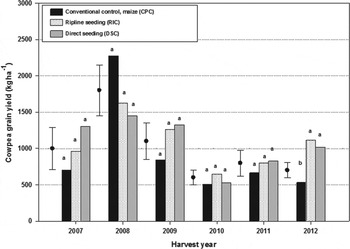
Although maize yield benefits in CA systems take 3–5 seasons to occur, with some exceptions in unfavorable environments, the trend is not as clear when maize is intercropped or rotated with legumes, which tend to respond less to fertility increases and water conservation. Increased water accumulation in the soil can cause root rot, thereby reducing the yield of legumesReference Cocks 98 . Legume yield data from Malende, Monze (Zambia) from 2007 to 2012 showed very variable results between two CA treatments and the conventional controlReference Thierfelder, Mwila and Rusinamhodzi 97 , with significant yield differences only after the sixth cropping season (Fig. 9).
Effect of two CA treatments and a conventional plowed control treatment on cowpea grain yield at Malende Agriculture Camp, Monze, Zambia, 2006–2012 (adapted fromReference Thierfelder, Mwila and Rusinamhodzi 97 ).

In low-yielding environments CA has potential to double the maize yields obtained under conventional tillage, which was previously shown by Thierfelder and WallReference Thierfelder and Wall 30 in a study carried out at Zimuto Communal Area, Zimbabwe. Under semi-arid conditions of southern Zimbabwe, CA (planting basin and rip-line seeding systems) produced 102–142% more cowpea grain compared to conventional practice in a drought yearReference Mupangwa, Twomlow and Walker 68 . However, in a season with above average rainfall, CA and conventional systems produced similar cowpea yields.
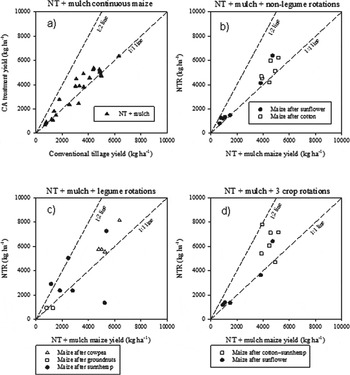
Maize yields under no-till with mulch retention were marginally better than under conventional tillage in a regional study on long-term trials in Southern AfricaReference Thierfelder, Cheesman and Rusinamhodzi 94 , i.e., closer to the 1:1 line (Fig. 10) but the inclusion of rotation or intercropping systems led to yields that were closer to the 1:2 line, implying that in some instances yield under CA was almost double that in conventional tillage. The results also highlighted the importance of legumes within a rotation and crop diversity. Substantial yield increases were observed, and in some cases maize yields following legumes were almost double that of continuous maize under no-till. At Henderson Research Station in Zimbabwe, there was a significant increase in maize yields planted after sunnhemp after several yearsReference Thierfelder, Cheesman and Rusinamhodzi 73 .
Effects of conservation agriculture on maize grain yield: (a) yield advantage of no-till plus mulch over conventional tillage, (b) yield advantage of no-till and residue retention with non-legume rotation over no-till and residue retention without rotation, (c) yield advantage of no-till and residue retention with legume rotation over no-till and residue retention without rotation and (d) yield advantage of no-till and residue retention with 3-year rotation over no-till and residue retention without rotation (source:Reference Thierfelder, Cheesman and Rusinamhodzi 94 ).

CA has generally been reported to increase labor use efficiency and returns per unit labor compared to conventional agricultureReference Mazvimavi 99 . For instance, significantly higher labor productivity (in kg person-day−1) and returns to labor (USD person-day−1) for CA were observed compared to conventional farming across low, average and high seasonal rainfall levels in ZimbabweReference Mazvimavi 99 – Reference Mazvimavi and Twomlow 101 . Mazvimavi et al.Reference Mazvimavi, Twomlow, Belder and Hove 79 also showed that farmers practicing CA increased yields by 10–100% compared with conventional, depending on fertilizer rates and management, experience of the farm household and seasonal rainfall patterns.
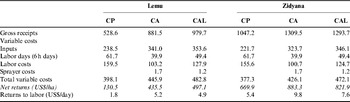
Similar results were reported by Ngwira et al.Reference Ngwira, Thierfelder and Lambert 28 in Malawi, where the cost of producing a kilogram of maize was shown to be less under CA systems compared to conventional practices. Although labor input in this study was small compared with previous studies, they showed that CA reduced farm labor requirements (Table 3). Related studies in Malawi showed that returns to labor were more than twice as high under CA using monocropping and intercropping with legumes, both on and off farm, as under conventional tillage practice using the conventional ridge and furrow systemReference Ngwira, Thierfelder and Lambert 28 , Reference Ngwira, Aune and Mkwinda 102 .
Farm enterprise budget analysis for conservation agriculture and conventional tillage practices, Malawi, 2005–2011. (source: Reference Ngwira, Thierfelder and Lambert 28 ).

Note: CP, conventional practice; CA, conservation agriculture sole maize; CAL, conservation agriculture maize–legume intercrop. Labor data (in person hours and minutes) was obtained from one on-farm trial per site for each operation (laying crop residues, tillage, herbicide application, planting, fertilizer application, weeding, harvesting, etc.). Price data were based on all applied inputs (seed, herbicides, fertilizers, etc.) from each of the plots during the entire period of the study.
The use of planting basins, a technology promoted by most development organizations in Zambia and Zimbabwe, based on manually dug planting holesReference Johansen, Haque, Bell, Thierfelder and Esdaile 103 , spreads out the labor requirement for land preparation and encourages timely planting, thereby reducing the peak labor load at plantingReference Twomlow, Hove, Mupangwa, Masikati, Mashingaidze, Humphrey and Bayot 104 . Although using basins required more labor for smallholder farmers in Zambia as compared to the hand hoe and animal traction systemReference Umar, Aune, Johnsen and Lungu 105 , Haggblade and TemboReference Haggblade and Tembo 106 highlighted that the major advantage of using basins was the disaggregation of peak labor times. However, Umar et al.Reference Umar, Aune, Johnsen and Lungu 105 stressed that farmers perceived labor requirements very differently and, whereas basin planting was perceived to be more labor intensive, significant labor reductions were recorded on animal traction ripping. Results for manual CA systems in MalawiReference Ngwira, Thierfelder and Lambert 28 , Reference Ngwira, Aune and Mkwinda 102 showed labor savings of about 9 and 19 person days ha−1 in land preparation and weeding under CA. Manual CA systems practiced in Malawi involve direct seeding using a dibble stick, which requires significantly less labor than preparing the traditional ridges and furrows manually.
Other results do, however, highlight that reduced labor requirements around planting in CA systems can be offset by increased labor for weeding, particularly in the early stages of adoptionReference Twomlow, Hove, Mupangwa, Masikati, Mashingaidze, Humphrey and Bayot 104 , Reference Siziba 107 . Nevertheless herbicides can be used to reduce labor requirements under CA if they are available and affordable to smallholder farmersReference Ito, Matsumoto and Quinones 108 , Reference Muoni, Rusinamhodzi and Thierfelder 109 .
Although it is true that CA often conforms to what Pampel and van EsReference Pampel and van Es 110 termed as an ‘environmentally profitable practice’ (i.e., good for the environment and profitable), this is not always the case. Particular location-specific constraints might result in reduced yields, or institutional factors may favor alternative practicesReference Giller, Witter, Corbeels and Tittonell 51 , Reference Stonehouse 111 . Thus, it is necessary to consider site-specific conditions in determining the financial attractiveness of CA. Even where the financial incentives may appear attractive, a consideration of non-financial factors (e.g., risk of crop failure) is required to understand the actual and potential adoption of CAReference Ngwira, Thierfelder, Eash and Lambert 112 .
Constraints to Adoption of CA Systems in Southern Africa
Although the practice of CA can provide many benefits for smallholder farmers in Southern Africa, large-scale spontaneous adoption has been hampered by a number of constraintsReference Wall 36 , Reference Giller, Witter, Corbeels and Tittonell 51 . These constraints include trade-offs between residue retention and livestock feed in mixed crop–livestock systems, the need for crop rotations and intercropping, weeding intensity and control, labor constraints and lack of access to complementary inputs. Often, significant knowledge gaps and the perception of farmers that tillage is necessary to produce crops are major impediments to widespread adoption of CAReference Wall 36 .
The majority of studies on CA in Southern Africa highlighted the beneficial effects of CA on selected parameters. However, these past researches were largely conducted within experimental stations and did not take into account socio-economic constraints in real farm situations that could hinder the widespread adoption of CA. Recently, more studies reporting results from on-farm and on-station trials have been published concentrating on some of the above-mentioned challenges and constraintsReference Ngwira, Thierfelder and Lambert 28 , Reference Valbuena, Erenstein, Homann-Kee, Abdoulaye, Claessens, Duncan, Gérard, Rufino, Teufel, van Rooyen and van Wijk 37 , Reference Mupangwa, Twomlow and Walker 68 , Reference Thierfelder, Cheesman and Rusinamhodzi 73 , Reference Thierfelder, Chisui, Gama, Cheesman, Jere, Bunderson, Ngwira and Eash 86 , Reference Thierfelder, Cheesman and Rusinamhodzi 94 , Reference Rusinamhodzi, Corbeels, van Wijk, Rufino, Nyamangara and Giller 96 , Reference Thierfelder, Mwila and Rusinamhodzi 97 , Reference Mazvimavi 99 , Reference Mazvimavi and Twomlow 101 , Reference Ngwira, Aune and Mkwinda 102 , Reference Twomlow, Hove, Mupangwa, Masikati, Mashingaidze, Humphrey and Bayot 104 , Reference Mashingaidze, Madakadze, Twomlow, Nyamangara and Hove 113 – Reference Mazvimavi, Ndlovu, Nyagumbo and Dimes 116 .
Trade-offs in mixed crop–livestock systems
Crop and livestock production are closely integrated in mixed smallholder farming systems of Southern AfricaReference Romney, Thorne, Lukuyu and Thornton 117 – Reference Shumba, Wallgren, Carlson, Kuona and Moyo 119 . Crops supply residues to feed livestock during the dry season while livestock, in turn, provide draft power and manure for crop productionReference Valbuena, Erenstein, Homann-Kee, Abdoulaye, Claessens, Duncan, Gérard, Rufino, Teufel, van Rooyen and van Wijk 37 , Reference Shumba, Wallgren, Carlson, Kuona and Moyo 119 – Reference Njarui and Mureithi 121 . The judicious use of livestock manure could greatly enhance crop productivity in these nutrient-deficient systemsReference Rusinamhodzi, Corbeels, Zingore, Nyamangara and Giller 122 . For example, a study in the semi-arid Shurugwi region of Zimbabwe showed that banded application of manure in a rip and pot-hole system without any residue cover resulted in almost a three-fold yield increase compared to the unfertilized conventional controlReference Nyagumbo 123 .
In Southern Africa, livestock also plays a crucial role in the livelihoods of smallholder farmers as a source of draught power, cash income and as a risk bufferReference Rufino, Rowe, Delve and Giller 124 , Reference Sumberg 125 . Crop residues are also used for bedding in kraals (animal paddocks) during the rainy season, construction (fencing and thatching) and as a source of fuelReference Mazvimavi, Twomlow, Belder and Hove 79 , Reference Rufino, Dury, Tittonell, van Wijk, Herrero, Zingore, Mapfumo and Giller 126 .
With the advent of CA systems, Southern Africa smallholder farmers face the challenge of trade-offs between keeping crop residues for application on the field as mulch and feeding them to livestockReference Valbuena, Erenstein, Homann-Kee, Abdoulaye, Claessens, Duncan, Gérard, Rufino, Teufel, van Rooyen and van Wijk 37 . Contribution of communal rangelands toward livestock feed requirements is reduced by the poor quality and seasonal variability of forage biomass quantities producedReference Rufino, Rowe, Delve and Giller 124 , Reference Delve, Cadisch, Tanner, Thorpe, Thorne and Giller 127 . Innovative ways of enhancing already developed legume, grass and agroforestry species as fodder are therefore required and need to be integrated into CA systems. This will allow part of the crop residues to be used in CA systems and to feed livestock as fodder during the dry seasonReference Njarui and Mureithi 121 , Reference Sumberg 125 , Reference Delve, Cadisch, Tanner, Thorpe, Thorne and Giller 127 . New ways of additional residue production through intercropping and relay cropping are other alternatives that should be explored.
Intensification
Rotations in land-constrained farming systems
Although farmers are aware of the benefits of crop rotations, socio-economic factors often hinder integrating rotations within their farmsReference Snapp, Blackie, Gilbert, Bezner-Kerr and Kanyama-Phiri 128 , Reference Snapp, Rohrbach, Simtowe and Freema 129 . In Malawi, for example, the government subsidized maize seed and inputs (inorganic fertilizer, agrochemicals) to achieve maize self-sufficiency at the national level, which encouraged monocroppingReference Ngwira, Aune and Mkwinda 102 . In areas where farm sizes are small, farmers often dedicate most of their land area to the staple food crops (maize, sorghum) rather than rotational crops such as legumesReference Thierfelder and Wall 13 , which has serious implications for the nutrition of smallholder farmers. Where the size of the land holdings are greater, such as in Zambia, there is greater potential for crop rotations, although markets may limit successful implementationReference Thierfelder, Cheesman and Rusinamhodzi 94 . The income generated through a range of different crops (including legumes) can be less than the production costs. Furthermore, seed companies are often not interested in seed production of most legume crops. These crops are self-pollinating, so farmers can easily recycle rather than buy new seed.
Intercropping systems—the struggle to produce more from given land
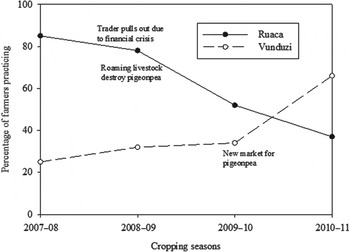
Intercropping maize and legumes is another way to achieve food security and cash income for smallholder farmers, and abundant literature from Southern Africa supports this observationReference Rusinamhodzi, Corbeels, Nyamangara and Giller 81 , Reference Ngwira, Aune and Mkwinda 102 , Reference Sakala 130 – Reference Rusinamhodzi, Murwira and Nyamangara 133 . Although intercropping with legumes is associated with many benefits, including improving soil structure and fertility and the potential to increase farm income through selling legume grain, the potential of legumes within farming systems of Southern Africa is currently limited by a plethora of constraints. These include poorly developed markets for seed and produce, lack of appropriate germplasm and phosphorus-deficient soilsReference Giller 134 , Reference Graham and Vance 135 . Intercropping maize and pigeonpea has been shown to be highly profitable in Southern Africa, with a tripled rate of return compared to maize cropping alone, although the new spatial arrangement increased labor requirements for weeding by 36%Reference Rusinamhodzi, Corbeels, Nyamangara and Giller 81 . In a maize–pigeonpea intercropping system, Ngwira et al.Reference Ngwira, Aune and Mkwinda 102 also reported higher rates of return compared to maize cropping alone, although maize yields were lower in this study due to drought stress competition between main- and intercrop. The authors concluded that intercropping maize and pigeonpea under no-till was an attractive option due to associated maize yield improvement and economic returns when the prices of maize and pigeonpea grains are favorable. However, the late maturity of pigeonpea can be a problem in mixed crop–livestock systems as free-grazing of cattle and goats can destroy the entire crop before harvest.
In contrast, Waddington et al.Reference Waddington, Mekuria, Siziba and Karigwindi 132 showed intercropping was an unattractive option compared to growing maize in monoculture, based on the results of a 12-year study on conventional agriculture in Zimbabwe. This was attributed to the small yield benefits compared to the relatively high investment costs for legume intercropping. In central Mozambique (Fig. 11) the emergence of a market for pigeonpea was a major driver for intercropping, despite destruction by livestock of the late maturity pigeonpea cropReference Rusinamhodzi, Corbeels, Nyamangara and Giller 81 . It is important to note that the crop used for intercropping is crucial, and poorly chosen intercrops and the timing between both crops may have a negative effect on productivity, particularly when the farmer has limited access to already scarce resources. Intercropping maize and cowpea can potentially reduce maize yields by up to 86% as compared with a sole maize standReference Shumba, Dhilwayo and Mukoko 131 if the timing between both crops is poor (e.g., when cowpea is seeded too early, competition is too high), or can reduce the cowpea yield when cowpea is seeded too late and maize is shading too much. These results suggest that the benefits of intercropping are not universal but vary across locations, seasons, timing between the main crop and the intercrop, and the crops used for intercropping. Socio-economic constraints can also have an overriding effect on the widespread uptake of intercropping. Thierfelder et al.Reference Thierfelder, Cheesman and Rusinamhodzi 73 observed that despite the plot-level benefits of intercropping as reported in literature, the benefits were only measured at the field scale and lacked proper integration at the farm and community levelReference Snapp, Blackie, Gilbert, Bezner-Kerr and Kanyama-Phiri 128 , Reference Snapp, Rohrbach, Simtowe and Freema 129 .
The proportion of farmers practicing maize–legume intercropping between 2007 and 2011 in Ruaca and Vunduzi communities in central Mozambique. Proportions are based on a total of 52 households in Ruaca and 43 households in Vunduzi (adapted from:Reference Rusinamhodzi, Corbeels, Nyamangara and Giller 81 ).

Weed incidence when converting to CA
A major challenge to the adoption of CA in smallholder farming in Southern Africa is related to weeds and their managementReference Giller, Witter, Corbeels and Tittonell 51 , Reference Umar, Aune, Johnsen and Lungu 105 , Reference Mashingaidze, Madakadze, Twomlow, Nyamangara and Hove 113 . The dynamics of weed populations under CA are different from conventional tillage practices, including more complex interactions between weeds and crops under CAReference Chauhan, Gill and Preston 136 , Reference Vogel 137 . In the semi-arid south of Zimbabwe annual and perennial monocotyledonous and dicotyledonous weed species (e.g. Cynodon dactylon L., Richardia scabra L. and Commelina benghalensis L.) were found to thrive differently under conventional and no-tillage practicesReference Mashingaidze, Madakadze, Twomlow, Nyamangara and Hove 113 and have been reported to be major problems when tillage is minimized and residues are retainedReference Vogel 138 . Weed density varied across crops, with the density of annual and perennial weed species higher under sorghum compared to cowpeaReference Mashingaidze, Madakadze, Twomlow, Nyamangara and Hove 113 . However, during periods of low rainfall, crop residue retention was found to be associated with increased mid-to-late season weed growth, in part due to improved soil moisture conservation in a clay-loam soil (Cambisol) in ZimbabweReference Mashingaidze, Madakadze, Twomlow, Nyamangara and Hove 113 . Mulch initially suppressed annual weeds but perennial rhizomes and their extensive root structure persisted under no-tillage and led to increased late-season weed growths. Weed species found in Southern Africa are affected differently by mulching, and mulch levels of >4 t ha−1 suppress a wider spectrum of weedsReference Mashingaidze, Madakadze, Twomlow, Nyamangara and Hove 113 .
The application of pre-emergence herbicides can limit weed development under CA, although there are potential problems of evolved weed resistance to herbicidesReference Rahman, James and Grbavac 139 . MwaleReference Mwale 140 reported a greater reduction in weed populations and weed seed banks under CA with herbicide application compared with conventional tillage systems, particularly during the first 55 days after planting maize. Herbicide use in CA can therefore potentially relieve farmers from weeding operations during the critical times that coincide with periods of food insecurity in most households. In a study carried out in Zimbabwe, the use of herbicides in combination with manual weed control was found to be beneficial both in time spent on weeding, reduction in weed densities and overall gross marginsReference Muoni, Rusinamhodzi and Thierfelder 109 . However, labor reductions as such have little benefit to farmers if the saved labor is not used for additional income generation. Discussions with farmers revealed that the saved labor is used for additional cultivation, dedication of land area to higher-value crops, production and value addition to farm products (e.g., making doughnuts, jam or marmalade and drying cowpea leaves to sell as relish on the market), and off-farm labor, which in turn has a direct impact on farmers’ livelihoods. Although chemical weed control can be (but does not need to be) a component in CA systems, the suitability of promoting such a system among resource-poor farmers has been questioned due to accessibility and affordabilityReference Gowing and Palmer 141 , as well as the dangers of handling herbicidesReference Ngwira, Aune and Mkwinda 102 .
The use of green manure cover crops such as oats (Avena sativa L.), grass pastureReference Flower, Cordingley, Ward and Weeks 142 and velvet beans (Mucuna pruriens L.) has been shown to be effective in managing weeds in maize/cover crop rotationsReference Caamal-Maldonado, Jiménez-Osornio, Torres-Barragán and Anaya 143 . However, legumes that do not contribute to the household food basket have often been rejected by farmers in the past, which indicates a constraint to integrate green manure cover crops (GMCCs) into the smallholder farming systemsReference Giller 134 . There is therefore a need to evaluate the profitability and sustainability of these cropping systems over a longer period under different farmers’ circumstances.
Labor constraints
The availability and costs of labor play a pivotal role in the likelihood of farmers to adopt a new technology. Certain forms of CA practices (e.g., the basin systems, based on manually dug planting basin) can be more labor intensive than conventional agriculture if compared to animal traction moldboard plowing, particularly during the initial stages of adoptionReference Mazvimavi, Ndlovu, Nyathi and Minde 115 , which can be a huge constraint to the widespread adoption on large farm areas. When CA includes planting basins and manual weeding, high labor demand is largely associated with the digging of planting basins and weeding practicesReference Mazvimavi 99 , Reference Siziba 107 .
The labor intensity of manual CA systems is, however, expected to decline, especially on loam and clay soils as farmers gain experience in using the technology. Once the initial digging in undisturbed soil is done the soil becomes softer in the basins in the following seasonsReference Mazvimavi and Twomlow 101 , Reference Haggblade and Tembo 106 . This does not, however, apply to the sandy soils, as basins cannot be maintained throughout the winter period. In summary, labor constraints are one of the major impediments to widespread adoption of CA, which has been shown in recent studies by both ICRISAT and Foundations of Farming, which reported that farmers in Zimbabwe tended to have only 0.5 ha or less of their farms under CA from land sizes of 4–6 haReference Mazvimavi, Ndlovu, Nyagumbo and Dimes 116 .
Lack of access to complementary farm inputs and an enabling environment
The effect of the intertwined challenges discussed above is compounded by lack of access to complementary farm inputs, such as fertilizer, herbicides and pesticides, that could offset some of the adversities. Lack of access to inputs in Southern Africa are due to low purchasing power, distorted or missing markets and lack of social infrastructureReference Kassie, Erenstein, Mwangi, LaRovere, Setimela and Langyintuo 8 , Reference Kassie, Erenstein, Mwangi, MacRobert, Setimela and Shiferaw 144 .
Perceived economic constraints to the adoption of CA are likely to vary between countries as well as market environments as they are determined by the distance to markets, infrastructure and an overall enabling environment. To discover these relationships a Qualitative Assessment Tool for Conservation Agriculture (QAtoCA) was tested in Malawi and Zimbabwe to identify the major constraints to adoption of CA and to dissect complex interactions within the community, markets and political environmentReference Ndah, Schuler, Uthes, Zander, Triomphe, Apina and Corbeels 145 , Reference Ndah, Schuler, Uthes, Zander, Traore, Gama, Nyagumbo, Triomphe and Corbeels 146 . Focus group discussions in a guided process revealed that the overall likelihood of adoption for CA in Malawi was 86% compared to only 64% in Zimbabwe (Fig. 12a and b). These results showed that the environment for adoption of CA at both the village and regional scale is much more positive in Malawi than Zimbabwe, where constraints such as competition for residues between livestock and CA tended to reduce adoption. Malawian farmers use manual seeding technologies and herbicides for weed control and found CA to be an attractive option because of the reduced labor requirements during land preparation. Zimbabwean farmers, on the other hand, use more animal traction for land preparation and found that, with no access to herbicides, manual requirements for basin preparation and weed control were more labor demanding under CAReference Mazvimavi and Twomlow 101 , Reference Mashingaidze, Madakadze, Twomlow, Nyamangara and Hove 113 . Other economic factors in Zimbabwe were also a major deterrent to the CA adoption compared to Malawi, where the markets were perceived to be more favorable (Fig. 12a and b). At the time of the study Zimbabwean farmers faced serious problems accessing attractive markets for maize, the most common crop, that were not governmentally controlled. In summary, access to complementary farm inputs and an enabling economic and political environment are crucial for farmers in the decision process to adopt CA. If the adversities are too challenging, the likelihood of farmers adopting the technologies will be slim.
An evaluation of the likelihood of CA adoption using the QAtoCA in (a) Nkotakota District, Malawi and (b) Goromonzi District, Zimbabwe in 2011 (adapted fromReference Ndah, Schuler, Uthes, Zander, Traore, Gama, Nyagumbo, Triomphe and Corbeels 146 ).

Conclusion
This review highlights recent advances in understanding the practice of CA in Southern Africa. Results show that CA has many environmental sustainability benefits, which can be summarized as: increases in infiltration, resulting in greater available soil moisture and a higher potential for groundwater recharge; reduced soil erosion and run-off; improved soil structure, more biological activity, e.g., through greater macrofauna abundance and diversity for system resilience; better soil quality. CA was also shown to offer direct benefits to farmers, including increased crop productivity, which could lead to better yields and hence increased food security, although there is often a time delay until yield increases in maize and other crops become significant. Regional labor productivity studies show benefits of CA systems over conventional practices, although little work has been done so far to clearly understand the risk implications of CA at the farms and on a larger scale. In cropping systems traditionally based on manual land preparation, CA offered an opportunity for labor savings to other economic activities through reduced labor on land preparation, particularly when applied in combination with herbicides. However, where animal traction is common (e.g., in large parts of Zimbabwe and Zambia), hoe-based CA systems suffered setbacks of increased labor compared to moldboard plowing. In similar circumstances, where farmers used only the hoe for land preparation, CA still offered huge advantages in terms of enabling farmers to plant timely, as basin preparation was carried out in winter and reduced labor at peak labor times.
Nevertheless, the review also shows that CA promotion and adoption is constrained by a number of biophysical, socio-economic and socio-cultural factors, which are varied and depend on the site and the farmer's circumstances. These constraints include challenges of retaining residues in areas where mixed crop–livestock systems are common; application of rotations and sustainable intensification strategies due to dysfunctional input and output markets; the control of weeds in CA systems; pests and diseases; institutional, labor and market constraints. Often the mind-set and knowledge of smallholder farmers about no-tillage and residue retention plays a critical role in the adoption process of this relatively new way of farming.
If sustainable intensification through CA should be one of the pathways to agricultural development in Southern Africa, there is a need to better understand farmer decision processes, and more research is essential to overcome, or at least find solutions for, these critical biophysical and socio-economic challenges.
Generalizing the economic performance of CA under different circumstances is not appropriate. Site-specific factors determine technologies that offer the best results for individual farmers. Given the glaring paucity of empirical evidence about the farm-level impact of CA on labor productivity and the financial viability of CA in Sub-Saharan Africa, it is imperative to suggest a case-by-case analysis of CA impacts on labor productivity over time and from a society-wide perspective.
This review of CA as a crop management system for smallholder farmers in Southern Africa revealed that it is not a ‘one-size-fits-all’ solution to all of the farmers’ problems, and often there is a need for significant adaptation and flexibility in its application. CA is therefore not a fixed recipe but a set of principles that have to be adapted and fine-tuned to the needs of the farmers. However, the benefits of practicing CA can potentially reduce future soil fertility decline, the effects of seasonal dry-spells and socio-economic constraints, and may have a large impact on food security and farmers’ livelihood if the challenges can be overcome.
Acknowledgements
This work was financially supported by the International Fund for Agriculture Research (IFAD), the German Government (BMZ), the Climate Change, Agricultural and Food Security (CCAFS) and MAIZE Consultative Group on International Agriculture Research (CGIAR) research programs and by the work of numerous farmers, field extension officers and researchers in Southern Africa. Their contribution is gratefully acknowledged.