1. THE PROMISE AND DISAPPOINTMENT OF LABOR REFORM IN THE 1960S
Lyndon Johnson's 1964 presidential race ended in an unprecedented landslide and brought with it one of the most lopsided congresses of the twentieth century. Democrats possessed huge majorities in both the House (294–141) and Senate (68–32). In addition to pure numbers, the overall composition of the 89th Congress gave liberal Democrats a considerable advantage over the Conservative Coalition, the alliance of Republicans and Southern Democrats that operated as a powerful legislative bottleneck throughout the post-WWII era.Footnote 1 Under the banner of Johnson's Great Society, the 89th Congress pursued an ambitious set of issues tailored to new groups in the expanding Democratic coalition. In the first session alone, Congress passed the Voting Rights Act, Medicare, the Elementary and Secondary Education Act, and a host of regional poverty packages.
As the most organized group within the party, labor played a significant role in the electoral success of Democrats up and down the ticket. After the elections, union leaders believed that their demands for labor reform were at last within reach. Indeed, business groups wary of the coming year also echoed the view that unions were due for a good legislative term.Footnote 2 Initially, Johnson suggested that labor's top issue, the repeal of the Taft-Hartley Act's right-to-work clause, would take high priority in the 89th Congress.Footnote 3 The right-to-work section, 14b, empowered states to pass statutes prohibiting a “union shop,” thus undermining unionization efforts in those states and the national labor movement as a whole.Footnote 4 The repeal of Section 14b was a major issue for unions and their allies alike, as evident in its position in the Democratic platform. Despite his early assurances that Section 14b would receive high priority, Johnson quickly moved away from his pledge once the 1965 term began. In consciously choosing to delay the bill, H.R. 77, Johnson and other Democrats helped the legislation's opponents by providing additional time to mobilize against the repeal effort. In the end, I argue, agenda setting came to play a pivotal role in shaping the debate and, thus, the legislative prospects of the Section 14b repeal. Though rarely included in most histories of the U.S. labor movement, this understudied episode represents an important moment for organized labor and, more broadly, the coalitional dynamics of the Democratic Party.
Before jumping into this case study, I begin by reviewing recent work on agenda setting and party coalitions, two literatures that often address similar issues without necessarily speaking to one another. Scholarship on agenda setting offers considerable insight into why some issues receive attention and how party leaders implement their agenda.Footnote 5 While valuable to the study of agenda setting and policy change, these existing accounts rarely address the intensity of support, or priority, that party elites ascribe to specific proposals in a given session. To appreciate what happens after an issue emerges or why the majority party is defeated at final passage, we must first understand how coalitional politics affect the ordering of the agenda. Unfortunately, roll call votes and commonly used measures of issue attention cannot capture how intensely parties support one issue or group over another.
Building on recent work by Bawn et al., I contend that to understand agenda setting we must examine how party leaders develop their legislative priorities in dialog with the groups that make up their coalition.Footnote 6 These studies argue that interest groups and activists play an important role in developing the party's agenda, and then select candidates to advance those interests. How the “party decides” who to run or what position to take are important lines of inquiry, but neither question provides insight into why party elites choose to prioritize some groups over others, or how such decisions affect an issue's legislative prospects.Footnote 7 The real question for parties, then, is which issue or group tops the agenda? By incorporating Frymer's work on “captured groups,” we can begin to appreciate how these decisions play out within a coalition.Footnote 8 Partisan alliances, as Frymer observes, are not always beneficial to a coalition partner, particularly when that group has nowhere else to turn. Parties strategically develop the agenda around coalitional demands, and then structure its order to advance the goals of groups with which they either strongly align or seek to court.
For researchers, the challenge is how to measure which groups receive this coalitional priority. Assessing priority calls for a more qualitative analysis that considers not only what comes up for a vote but also the position ascribed to a group's legislative goals. This approach, though limited in scope, utilizes the agenda's strategic design to infer the party's intensity of support for a given group, a question of particular import for broad coalitions that must juggle the competing interests of numerous groups. In short, the ordering of the legislative agenda affords an opportunity to evaluate these intraparty coalitional dynamics. How these decisions play out is highly consequential to the legislative process. Choosing which issues to push and when has huge repercussions for whether a policy is enacted or not.
After discussing the logic behind coalitional agenda setting, I then apply the framework to the case of labor reform during the 89th Congress. For much of the post-WWII era, conservative forces in Congress ensured that the only labor bills to reach a floor vote were those that sought to retrench progressive labor policy.Footnote 9 During the 89th Congress, however, Democrats nearly repealed Section 14b when H.R. 77 passed the House. Though eventually blocked by a filibuster in the Senate, the result of the 1965 repeal effort was by no means a foregone conclusion. Before the term began, most observers, including LBJ, believed that the legislation would likely pass.Footnote 10 Instead of sailing through, however, the Taft-Hartley repeal met with considerable obstruction by labor's allies. Drawing on the congressional record, contemporary news coverage, and archival evidence, I show how President Johnson and his congressional leaders consciously privileged the demands of other groups ahead of organized labor's central issue. With numerous groups clamoring for a piece of the pie, Democrats placed little priority in passing H.R. 77. The decision to wait, I argue, all but sealed the bill's fate. The delay signaled to the opposition that Democrats attached little priority to the bill. Moreover, the extra time provided business organizations an opportunity to deploy their two-pronged strategy. While prominent business leaders lobbied members of Congress, the Chamber of Commerce and other groups waged a slow-building, grassroots campaign to mobilize wider public opposition. By the time the bill reached the Senate, Minority Leader Everett Dirksen (R-IL) was in need of a win. Having read the delay as a sign of weak support and feeling pressured by his base, Dirksen eventually agreed to organize the filibuster that would end the repeal effort.
2. PARTY COALITIONS AND THE AGENDA
Before considering which issues receive legislative priority, it is important to recognize that partisan elites use the agenda to bolster their political and organizational goals.Footnote 11 When viewed through the lens of partisan politics, the structure of the legislative agenda takes on a strategic ordering rich with coalitional dynamics and electoral implications. As recent work by Bawn et al. suggests, parties should not be seen as static collections of voters and office-seekers, but coalitions that include “intense policy demanders.”Footnote 12 A party, as Bawn and her colleagues contend, is a constellation of several distinct groups of actors, all of whom want something from the party, be it a job or some sort of policy change. In many ways, these policy demanders undergird much of the intellectual, financial, and emotional foundations of the party. Consequently, party elites must consciously weigh the policy positions of pressure groups in order to sustain their material support. For evidence of this account, Cohen et al. examine the party nominating process and find that groups continue to play a key role in determining the party's candidates for office.Footnote 13 Nominees for office, they argue, are expected to represent the interests of these policy demanders, but how aggressively the candidate is expected to push any one issue is unclear.
Moving away from electoral politics, Karol expands on this theory of parties in examining why elites change positions over time.Footnote 14 Instead of remaining ideologically fixed, he finds that party elites alter their positions on issues, sometimes quite radically, when signaled by intense policy demanders. To maintain or expand their coalition, parties routinely moderate, switch, and even experiment with how they position themselves. The implications of such position change are important for understanding which groups enter a coalition, as well as how parties evolve in response to group pressures. Short of actual position change, how do we measure partisan support for a group's demands? To observe a drop in support, the party must first record a vote on the group's issue, and then take a position in opposition to the group's interests. This is a fairly high bar. In most cases, party leaders will avoid votes that anger their coalitional allies, making evidence of position change the exception rather than the norm. Consequently, even during periods of apparent coalitional bliss, support for one group or another is potentially in flux. While roll calls are undoubtedly important, scholars should also weigh how much party leaders decide to emphasize the interests of a given policy demander. Legislative effort on behalf of a group provides unique insight into the party's priorities. But, how does the coalition sort out which issues and groups to focus on? This question is particularly problematic when considering well-entrenched groups, like unions, that lack a credible exit option from the coalition.
Bawn et al. and Karol are correct in redirecting attention to policy demanders, but to understand why some groups receive lower priority than others, we must consider how party leaders value different coalitional actors. Frymer's research on party competition is instructive here as it provides a framework for understanding why some groups (African Americans in Frymer's work) are taken for granted by party elites.Footnote 15 When groups are “captured,” he argues, they continue to serve important electoral functions for the party, but have little influence over which policies officeholders prioritize. With members of a group voting in large numbers for one party or the other, alliances between parties and groups often appear very stable. However, if policy demanders cannot threaten to leave the party, then their allies in office feel less pressure to aggressively promote the group's interests. Parties are even more reluctant, as Frymer contends, when the appearance of pushing these policies can alienate other segments of the electorate, particularly swing voters.Footnote 16 To appreciate these dynamics, studies must engage in a more focused analysis of the agenda-setting process. The party's agenda serves as a venue for constant struggle among the coalition's groups, all of which expect their pet issue to take priority. More than any other phase in the legislative process, setting the agenda reveals the tension between balancing the demands of coalitional pressure groups and the reelection needs of its members.
Despite significant research into agenda setting, existing approaches largely ignore this coalitional dynamic by failing to identify policy-motivated groups as central actors in the process. Using easily countable measures of issue attention, Baumgartner and Jones develop a model chronicling why interest in some policies rises while interest in others falls.Footnote 17 But, again, there is little discussion regarding how organized groups work with and against parties to promote specific issues ahead of others. The focus on large trends, though adept at capturing general patterns, is often subject to misleading interpretations. Attention indicators, such as the topic of a committee hearing or number of sentences discussed in the State of the Union, while interesting, speak to neither the order of the agenda nor the intensity of the commitment to ensure that the policy eventually passes.
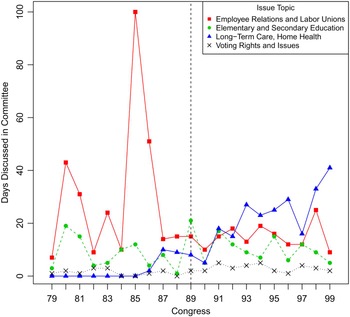
Take four key issues addressed in the session following Lyndon Johnson's defeat of Barry Goldwater. In addition to considering the Section 14b repeal, the 89th Congress passed Medicare, the Voting Rights Act, and the Elementary and Secondary Education Act. Yet, if one were to examine the amount of “attention” they received in committee, as Figure 1 shows, there is no reason to think that these issues were top priorities during the 89th Congress. Despite receiving more attention than voting rights and Medicare, labor issues, as the following case study will show, were of much lower priority for the party.Footnote 18 Snapshots of larger trends offer little insight into which issues receive legislative priority by party elites, let alone which bills eventually become law. Indeed, of the four issues shown, only the labor bill failed to pass.Footnote 19 These attention-based approaches, while valuable for understanding long-term change, cannot answer important questions as to why specific issues are prioritized, or how the order of the agenda will play out.
This figure tracks the number of days that four salient issues were discussed in committee between the 79th and 99th Congresses. All but one of the issues, Employee Relations and Labor Unions, saw a major piece of legislation passed during the 89th Congress. Source: Policy Agendas Project, http://www.policyagendas.org.

Structuring the agenda, particularly in terms of issue order, is a crucial but often overlooked part of policymaking. With finite space on the party's legislative agenda, some policies must receive lower priority, and these decisions have real consequences for both the issues and the policy demanders that support them. How do parties strategically decide which groups and issues to privilege ahead of others? Is this done through a cost-benefit analysis in which the “value” of the group is dependent upon its political and electoral benefits? Coalitional groups with broad-based, popular support often receive higher priority, but there are limits to the extent that these large groups can credibly commit to punish the party for failures. Captured groups, as Frymer's study of the relationship between Democrats and African Americans suggests, have a more difficult time extracting policy concessions from their partisan allies.Footnote 20 When forced to choose between emerging groups and captured ones, the choice is clear, but this gamble runs the risk of alienating a core supporter. Exit may not be an option, but discontinued support or “reprisals” can and do happen.Footnote 21
3. MEASURING COALITIONAL AGENDA SETTING
In order to establish whether a specific group commands priority on the agenda, studies of coalitional agenda setting must first develop a more detailed account of what different groups want from government and the extent to which these policy demands are supported by party elites. This form of analysis requires two sets of data to assess the party's intensity of support for various groups: (1) We need a better sense of what policy demanders want from government. Ideally, this source should reflect the group's true preferences, not simply their realistic expectations of what is feasible. (2) We need to know which issues party leaders have selected as their most pressing legislative goals.
For information on the position of groups, scholars should whenever possible use internally generated sources, such as newsletters, mission statements, and press releases. These records provide more insight into what specific interest groups want from the congressional term. In order to dispel any fear that the interest group's demands are more a reflection of political reality, one should go back to the last annual meeting in which the group's top legislative issues were addressed in full. Instead of relying on concurrent media coverage or, worse yet, whether the group regarded a roll-call vote as favorable or not, this level of analysis offers additional leverage over a group's true preferences.Footnote 22
Compared to establishing group demands, assessing the degree to which these issues map onto partisan priorities is relatively straightforward. Party platforms, for a more long-term perspective, offer one basis for comparison. Inclusion in a party platform can serve as an important signal to groups who expect legislative returns from seeing their party in government.Footnote 23 Moreover, platforms are, in a sense, commitment mechanisms by which party elites offer some sort of tangible, public overture to meet the demands of various constituencies.Footnote 24 When parties face conflicting demands, platforms can also provide evidence to questions of coalitional divisions within a party. In a study using state party platforms, for instance, Feinstein and Schickler find that the conventional view of the 1960s racial realignment is deeply flawed.Footnote 25 By examining the views of midrange party elites at the state-level, they demonstrate how a gradual transformation among Northern Democrats, and their coalitional partners, made the Democratic Party the more natural home for African Americans in the years to come. As Feinstein and Schickler's work suggests, attention to party platforms can be very informative of the underlying tensions within a party's coalitional structure. Which issues make a platform is an important question, particularly when assessing gradual change over long periods, but what about legislative priority in a single congressional term?
The analysis of a more narrow window allows for greater appreciation of the priority attached to different issues within a given Congress. The sequence of the legislative agenda is an important, albeit overlooked, aspect of policymaking. Whether an issue received a floor vote is sometimes less interesting than when the vote occurred. Parties have a finite set of resources, particularly time, to advance their interests. Greater scrutiny should be paid to understanding when an issue is determined to come up for a vote. More than strategic considerations alone, the timing of the legislative agenda reflects the general ranking of different issues in terms of coalitional importance. For potential indicators of priority, scholars should consider when the issue comes up in the term, whether the bill is close to a recess, and the overall order vis-à-vis other important and controversial legislation. The first point, a late calendar date, follows from the idea that a party or president's political capital is greatest at the beginning of a term. Second, proximity to a congressional recess, election, or other major event is important in shaping the degree to which different actors are willing to fight. Finally, legislation can be affected by what precedes it, especially if the bill reaches the floor after a series of major enactments. Low marks on these measures reflect poorly on both a bill's prospects for passage and the party's commitment to the group's policy demands.
The agenda's sequence is more than a mere list of which issues receive a vote, and it plays an integral role in shaping a policy's eventual outcome. Agenda setting, however, often means that some issues are privileged over others, and that some groups receive high priority while others do not. During the 89th Congress, organized labor was one of these losing groups. In the following section, I apply this framework of coalitional agenda setting to a study of labor politics under the Great Society. To appreciate why labor reform did not materialize during such a moment of Democratic dominance, greater attention must be paid to the strategic decisions made by party elites when crafting the legislative agenda. Whether party members supported the repeal legislation at final passage was, in some regards, less important after it received such low priority during the agenda-setting phase. Indeed, the Section 14b repeal scored low on all three priority indicators: it received a floor vote late in the year, it ran up against a scheduled recess, and it followed on the heels of numerous big-ticket items, including Medicare and the Voting Rights Act. While by no means the entire reason for the bill's failure, the legislative delay signaled 14b's low priority to the opposition and provided business groups with critically important time to mobilize against the repeal.
4. LABOR POLICY IN THE POSTWAR ERA
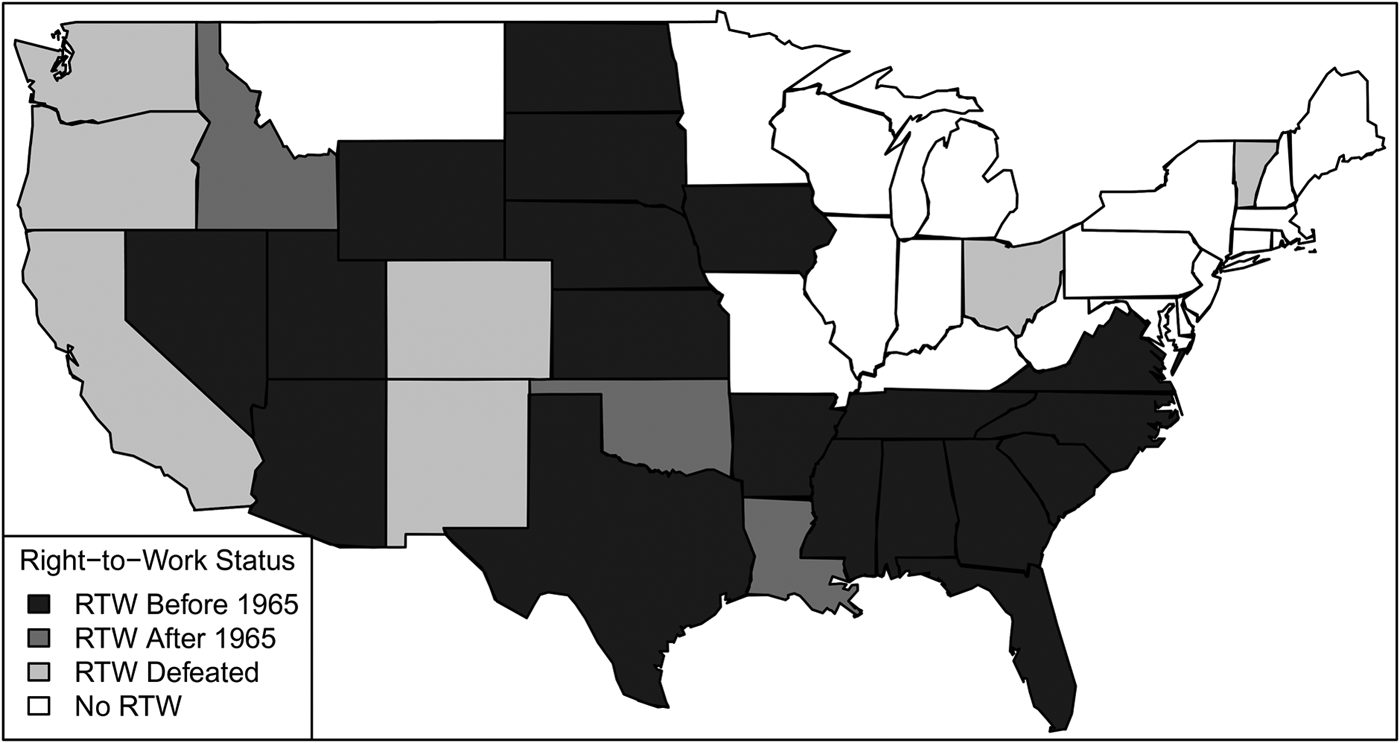
For organized labor, the decade after Taft-Hartley's passage was difficult both organizationally and politically. Under Section 14b—the part of the statute that grants states the ability to pass right-to-work laws—the labor movement became fragmented into two spheres: a pro-union North and West, and a collection of anti-union, right-to-work states in the Midwest and South (see Figure 2). Despite investing considerable time and more than a million dollars into the campaign, the CIO (Congress of Industrial Organizations) effort to organize the South, dubbed “Operation Dixie,” failed to make any significant progress.Footnote 26 When labor began its push in 1946, it faced a coordinated opposition by business groups at local and state levels. Individual unions, by contrast, competed with one another as the CIO and AFL (American Federation of Labor) worked to organize new workers into their respective camps.Footnote 27 Without a well-organized South, unions in the North were vulnerable to capital flight. Businesses could cut costs by moving, or merely threatening to move, to states where labor unions were weaker.
By 1965, the nineteen states in black had already adopted right-to-work statutes. Not all efforts had been successful, however, as the seven states in light gray had all voted down right-to-work provisions before the 89th Congress. The three states in dark gray—Louisiana, Idaho, and Oklahoma—have since adopted right-to-work provisions.

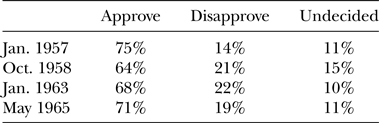
In the court of public opinion, organized labor was on the defensive as well. Throughout the 1950s, the image of unions became tarnished as headlines continually publicized the abuses of big labor. This reputation of corruption was particularly salient in late 1957 when the Senate's McClellan Committee began investigating the International Brotherhood of Teamsters.Footnote 28 Though primarily targeted at the Teamsters, the hearings marked a noticeable shift in the public's perception of unions in general. In January 1957, before the hearings started, Gallup found that 75 percent of respondents generally approved of labor unions. As Table 1 shows, public support for unions fell more than 10 percent throughout the year, reaching its nadir in October 1958. Drawing upon the McClellan Committee's findings, Congress passed the Landrum-Griffin Act in 1959, placing heavier restrictions on the accounting and finances of unions. In the end, the decade concluded as the post-WWII period began, with the passage of antilabor legislation.
Question: “In general, do you approve or disapprove of labor unions?” Source: Gallup Poll (AIPO), Retrieved February 16, 2011, from the iPOLL Databank, The Roper Center for Public Opinion Research, University of Connecticut. http://www.ropercenter.uconn.edu/data_access/ipoll/ipoll.html

Despite possessing legislative majorities in Congress, Democrats made very little progress on pro-union labor reform. Scholarship on this policy inactivity often emphasizes union complacency, the institutional stickiness of Truman-era policies, and obstruction by southern members of Congress.Footnote 29 These works, while important, tell only part of the story. For the most part, the existing literature focuses on the 1940s and 1950s when the Conservative Coalition was strongest. Few studies examine labor's position within the Democratic Party during the 1960s—a period in which we should expect to see labor legislation not only pass out of committee, but reach the president's desk.Footnote 30 The organized working class, a central force in the coalition, seemed poised to reap the benefits of Democratic rule, but instead saw little legislative success.
In the remainder of the article, I detail how Democratic leaders in the executive and legislative branches consciously decided to prioritize other issues to the detriment of the Section 14b repeal. To that end, Johnson persuaded a reluctant labor movement to support the primary endeavors of the Great Society before addressing labor's specific demands. With few alternatives, union leaders were compelled to ignore H.R. 77 until after Congress finished with Medicare, voting rights, education reform, and poverty assistance. Before the term began, supporters and opponents alike believed that the issue would sail through. They were wrong. Delaying consideration proved pivotal for three important reasons. First, by giving H.R. 77 low priority on the agenda, Democrats signaled their relatively weak support for the issue.Footnote 31 Opposition forces consciously considered this ill-conceived signal in both the initial debate over strategy and the later discussions of whether a second filibuster could succeed.
Second, beyond merely putting off the vote, these dilatory tactics provided business organizations with the time necessary to mobilize and coordinate antirepeal efforts. Inside the Beltway, business advocates lobbied members from right-to-work states to vote against H.R. 77. Meanwhile, the National Right to Work Committee (NRTWC) and other umbrella groups engaged in an effective grassroots campaign that applied outside pressure on Congress. While unions spent the year promoting other Great Society programs, the NRTWC directed its resources exclusively toward defeating H.R. 77.Footnote 32 Legislative delay was particularly important for the opposition as their grassroots strategy required time to sway public opinion, which had grown more favorable toward organized labor since the Eisenhower years (see Figure 1). By fall 1965, Congress was awash with letters pressuring members to vote against repeal.
Third, when H.R. 77 finally reached the Senate floor in October 1965, the bill came on the heels of a long session of progressive victories. The Great Society was in full swing, and coupled with the disastrous 1964 elections, many Republicans were deeply concerned that the party lacked power, direction, and prestige.Footnote 33 Tired of capitulating to Democrats and needing a victory to recharge his base, Minority Leader Everett Dirksen agreed to organize a bipartisan filibuster that unequivocally ended the bill's progress.Footnote 34 Throughout the session, Dirksen's opposition to 14b was clear; however, it was not until September that he began to formulate plans to filibuster the bill. Under the combined pressure from constituents, business groups, and other senators, and assuming that the delays revealed weak support among Democrats, Dirksen eventually came to see H.R. 77 as an opportunity to score a win before the congressional recess. Party leaders attempted to overcome the filibuster then and in the following session, but were met with unyielding resistance. The 1965 filibuster was the closest unions ever came to repealing Taft-Hartley's right-to-work statute.
4.1 Agenda Priorities in the Great Society
After a resounding victory in the polls, President Lyndon Johnson began his first elected term with even “grander expectations” of the Great Society to come.Footnote 35 Under the auspices of fulfilling the Kennedy legacy, Democrats made tremendous strides in the first years of the Johnson administration. As Johnson declared five days after taking office, “No words are strong enough to express our determination to continue the forward thrust of America that he [Kennedy] began.”Footnote 36 True to his word, Johnson used his first year to pass important legislation to fight poverty and racial injustice, the two primary social ills identified in his historic Great Society speech.
Despite the rhetoric invoking JFK's legacy, Johnson's aspirations went far beyond what Kennedy originally set out to achieve. Johnson had waited for his opportunity to move out from the shadows of his Democratic predecessors.Footnote 37 For Johnson, the Great Society would be his New Deal. Aided by a booming economy, Johnson targeted a wide variety of social problems long forgotten since Franklin D. Roosevelt's New Deal.Footnote 38 With his support of unemployment insurance and reforms to the Fair Labor Standards Act, Johnson appeared committed to FDR's core labor policies. In many regards, a Current History article proclaimed, President Johnson “was picking up [on labor issues] where the New Deal left off in 1938.”Footnote 39 Once his term began, however, Johnson seemed more interested in how unions could help build his Great Society and less wedded to the idea of spending political capital on their top issue, the repeal of Taft-Hartley's right-to-work clause.
With passage of the Wagner Act in his first term, Franklin Roosevelt did more to advance the interests of unions than any other president before and since. During the Eisenhower years, business advocates used Taft-Hartley to undo many of the gains secured under the Wagner Act. Without national labor legislation to curb the post-14b decline, unions would only continue to shrink and fragment as a movement. Johnson's administration was the first moment since Taft-Hartley's passage that the repeal of Section 14b seemed plausible. For Johnson, however, the Great Society came first, and that meant a different approach to social problems. The Roosevelt administration made strengthening the labor movement a centerpiece of its agenda for addressing the country's social and economic woes. Johnson turned this logic around, arguing, “what's good for this country, is good for the American labor movement.”Footnote 40
Lyndon Johnson, while never organized labor's strongest supporter, was a reliable pro-union vote during his ascent through the party ranks. Yet, as president, LBJ's agenda priorities demonstrated how he viewed unions among the vast chorus of interest groups clamoring for attention. Years of AFL-CIO support had taught Johnson that labor would support the party regardless of his actions.Footnote 41 Instead, Johnson adopted a strategy designed to court new constituencies entering the electorate. Labor's demands took a backseat to the ambitious programs designed to meet the needs of other emerging left-of-center groups.
Johnson and the Democratic leadership had formulated their legislative agenda well before the 89th Congress began.Footnote 42 When Congress adjourned for its pre-election recess the previous fall, many of the party's legislative goals were incomplete. After making initial progress, Medicare was stuck in conference committee, to the disappointment of liberals.Footnote 43 The health reform was especially popular among seniors, an important electoral group, as Johnson reminded his congressional leaders.Footnote 44 In addition to Medicare's issues, the Great Society's first round of poverty packages, the “Appalachia Bill,” was experiencing problems as well. LBJ expressed frustration with the bill's delay in an October conversation with House Appropriations Chair George Mahon (D-TX).Footnote 45 The president explained that he had already promised the spending, and that he did not want people from those states believing that he was “neglecting them.” In the end, both Johnson and the groups agitating for these policies were committed to early passage in the following year. When Congress returned in January, Medicare was the administration's top priority, and it even received the honorary designations of H.R. 1 and S. 1 when the session began.Footnote 46 Appalachian Assistance was out of committee even quicker, passing both chambers by the first week of March. These items only marked the first step, as LBJ assured Martin Luther King, Jr., in January.Footnote 47 The administration was also pushing for early passage of its education bill and the Voting Rights Act, two issues of top concern for low-income, African American communities.
Everything from civil rights to medical coverage for the elderly found its way into Johnson's expansive domestic agenda. Even labor issues were framed and addressed in these terms. For instance, Johnson pushed for a substantial minimum wage increase and the expansion of unemployment insurance in order to provide assistance to low-income and unemployed workers.Footnote 48 Organized labor's most important issue, H.R. 77, received far less support, and union leaders had little rebuttal for why industrial relations reform should take precedence over the many other issues demanding immediate attention. Given this calculus, and a realistic understanding of the limits to his post-election political capital, President Johnson wanted to ensure that his priorities were the first issues addressed when the 1965 session began.Footnote 49
Shortly after his inauguration, Johnson dispelled any lingering ambiguity whether H.R. 77 would lead off his legislative agenda. Johnson first hinted at a reluctance to push hard on the divisive issue in his 1965 State of the Union. Instead of aggressively backing the bill, Johnson briefly mentioned that he “recommended” repeal in a two-line reiteration of the party platform.Footnote 50 Compared to education and health care, both of which received their own sections in the speech, H.R. 77's obligatory endorsement stood as an early testament to the low priority Johnson gave to labor's demands. Though publicly supportive of the bill, Johnson's “White House nod” indicated a reluctance to move “as fast as the big labor federation [AFL-CIO] wants.”Footnote 51 President Johnson's position toward H.R. 77 was unofficially confirmed a few days later when the administration leaked that Congress was not to concentrate its initial efforts on early passage of H.R. 77.Footnote 52
While leaked in January, the decision to delay action on H.R. 77 was reached even before the term began. In a private conversation with United Auto Workers President Walter Reuther, the president explained his decision to delay as one of strategy. Early attempts to pass H.R. 77, Johnson claimed,
will wreck everything ... if we can get those things [Medicare, tax reform, unemployment insurance, and Appalachian relief] going, why then we can get to the other thing [H.R. 77], but if we bring that up first that will drive the South and the Republicans together in an old bloc again. It will give them a much top heavier coalition.Footnote 53
Johnson continued to explain how initial success with other legislation would “get the ball rolling” for the Taft-Hartley repeal. Though justified as the best way to ensure H.R. 77's passage, Johnson's plan was ultimately motivated by unwillingness to risk other legislative priorities of the Great Society. Johnson further elaborated on this fear of an eventual filibuster when speaking to Martin Luther King, Jr., in January.Footnote 54 LBJ made no mention of the labor bill, but he did list his top priorities in explaining the need to push for early passage before “the vicious forces concentrate and get them a coalition that can block them [education reform, poverty spending, and Medicare].” With such an ambitious agenda, it was only natural that conservative forces would find an issue with which they could “really swat the President.”Footnote 55
The decision to delay H.R. 77, while framed to labor as beneficial to their efforts, would prove to be the bill's undoing. At this point in the term, most onlookers believed that the Taft-Hartley repeal would pass.Footnote 56 Regardless of its internal justification, the strategy did little but signal the White House's low priority of H.R. 77 to opposition forces.Footnote 57 What is more, this delay provided business groups with more time to engage in a small-business, grassroots lobbying campaign.
4.2 Further Delay by Labor's Coalitional Allies
When a window to repeal finally presented itself in 1965, most union leaders believed that Section 14b should top the legislative agenda.Footnote 58 The decision to delay infuriated labor leaders who, on the electoral front, had campaigned for Democrats in the 1964 elections. In the legislative arena, unions provided grassroots support in passing controversial legislation like the Civil Rights Act.Footnote 59 During a meeting to brief labor on the Section 14b strategy, Johnson later recounted, AFL-CIO President George Meany insisted that the president place H.R. 77 higher on the agenda since “we [labor] elected you and we elected you by ourselves.” Johnson proudly responded that he was “not going to put a few men in this room's interests ahead of seventy million workers in this country.”Footnote 60 Johnson refused to risk his policies that were geared toward other policy demanders in order to help labor, as he saw it, win a few more certification elections. Unable to change the president's decision, unions could either support Johnson's programs and work toward clearing the agenda or turn their backs on the party and campaign entirely on the issue of Section 14b.
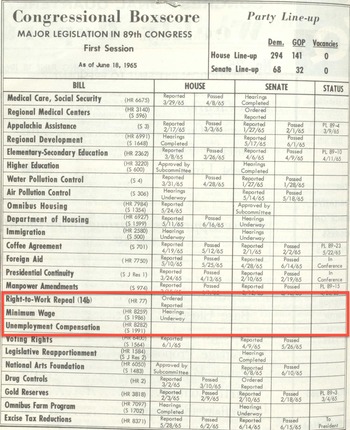
After briefly opposing Johnson's plan, labor fell back into its supportive role once the 89th Congress began. With a vast network of local unions to draw upon, labor divided its energy and resources on Johnson's various bills. To this end, George Meany met with or spoke to the president on more than thirty occasions between the January meeting and the October filibuster.Footnote 61 Many of these conversations with the AFL-CIO leader had little to do with issues related to labor and instead focused on how unions could assist the president with other central issues of his agenda.Footnote 62 By mid-1965, many of Johnson's key goals had been met, but organized labor's issues, as the boxed part of Figure 3 shows, had yet to receive attention from the full Congress. Instead of holding up just H.R. 77, the “Congressional Boxscore” shown in Figure 3 reveals that very little progress had been made as of mid-June 1965 on any of labor's legislative issues. To Johnson, unions were not the all-important constituency to whom he needed to offer high priority on the agenda. While labor issues lingered in committee, many controversial bills cleared both houses of Congress early in the term.
In June 1965, CQ Weekly's “Congressional Boxscore” summed up the 89th Congress's progress to date. Labor's legislative issues remained notably incomplete compared to a wide array of other issues. Source: CQ Weekly, June 18, 1965.

In mid-May, Johnson gave Congress the freedom to move on H.R. 77 when he sent his “Labor Message” to Congress, “But if union leaders wanted forceful and enthusiastic support for their campaign, they were disappointed.”Footnote 63 Johnson took less than ten lines of the message, out of more than two hundred, to address the Taft-Hartley repeal. With a congressional battle imminent, Johnson's concentration on other issues again signaled weak support for H.R. 77. By ignoring repeal of Section 14b, the omission demonstrated that the administration had no interest in dragging the issue out if Congress could not readily secure the votes.Footnote 64 As one news account observed, “There remains a reasonable doubt that President Johnson is fiercely determined to twist the arms that may need twisting.”Footnote 65 In the end, these signals only reinforced the opposition's view that the repeal coalition was far less motivated than the right-to-work forces.
After considerable delay by the executive branch, H.R. 77's legislative progress continued to face resistance within committee by more of labor's supposed allies. Looking to extract policy concessions for other groups, Adam Clayton Powell (D-NY), Chair of the House Education and Labor Committee, unexpectedly halted H.R. 77. Wielding unilateral control over the committee's agenda, Powell continued to block H.R. 77 even after the committee voted in favor of the legislation. Despite joining with other Democrats to support the bill, he nonetheless refused to send H.R. 77 to the Rules Committee until the House took up legislation on racial discrimination in unions.Footnote 66 Having assured labor of his support in December 1964, Powell's tactics surprised and angered labor.Footnote 67 Normally a strong supporter of labor, Powell used H.R. 77 as a vehicle for advancing antidiscrimination policy omitted from the previous civil rights bills. When it came to issues of union racism, as Frymer contends, the Democratic coalition was deeply divided.Footnote 68 With Powell chairing the committee, organized labor found its legislative goals receiving lower priority. Following pleas from Democrats, labor leaders, and even the NAACP (National Association for the Advancement of Colored People), Powell finally dropped his insistence on antidiscrimination legislation and released the bill from committee in mid-June.
Aside from signaling weak support, this stasis provided business groups with additional time to mobilize through private channels. While unions spent the spring trying to get their Democratic partners to take action, the opposition coalesced around a potent outside lobby strategy targeted at the House. In an April press release, the National Association of Manufacturers (NAM) informed its members that the organization “urged ‘an all-out defense’ of Section 14(b).” Appealing to businesses in right-to-work and union shop states alike, NAM went on to remind its members that “the very possibility that such a statute can be enacted now serves as some check on extreme union behavior.”Footnote 69 Motivating affiliates to take action was the first step in this strategy. In a personal letter to business magnate John Howard Pew, NAM Arizona Director Oscar Palmer similarly claimed that the “repeal of 14–b has more than a fifty-fifty chance of passing.” To prevent a “bigger Union Boss Empire,” Palmer insisted that the Republican donor “use every contact” personally and professionally to lobby Congress.Footnote 70
After President Johnson released his May labor message, the U.S. Chamber of Commerce's Labor Relations Department issued a “Special Report on [the] 14(b) Crisis,” which stated, “Despite the heavy weight the AFL-CIO has in this Congress, we have a fighting chance to win on this vital issue.” Moreover, given House Speaker John McCormack's (D-MA) recent admission that the bill will come down to ten votes, the Chamber went on, “Any race this close could change with a grassroots response from constituents.”Footnote 71 With the continued delay, business organizations had more time to mobilize their members to take action in their states and districts.Footnote 72 These higher-level efforts took time, but they eventually reached a point where concerned citizens were “carrying on the fight from here,” as one zealous supporter put it after boasting of the 500 personalized letters he had written on behalf of 14b.Footnote 73
Following a round of committee testimonies, H.R. 77 moved to the House floor on July 28, 1965.Footnote 74 Despite facing stiff opposition in the House, the bill passed in a tight 221–203 vote. Aided by a farm-labor coalition reminiscent of the New Deal, the Democratic majority voting aye included 18 members from right-to-work states. In addition to right-to-work Democrats, the coalition included 21 Republican defectors from the highly unionized industrial North. The bare majority sent yet another signal to opposition forces that the Taft-Hartley repeal would be vulnerable when it moved to the Senate.
4.3 Section 14b Reaches the Senate
By the time H.R. 77 left the House, the stage for a drawn-out Senate fight was all but set. Yet, even with a legislative battle imminent, Johnson continued to express little concern for the bill's prospects. In a conversation with Labor Secretary Willard Wirtz, Johnson obliquely asked, “You doing alright in the Senate, I saw some ticker stuff where they were opposing it?” He went on to advise that there was “no rush, I think you ought to get rid of some of the other stuff [unemployment insurance and the minimum wage].”Footnote 75 What is more, in the lead-up to the Senate battle, the usually assertive president made no effort to use his persuasive skills to wrangle votes.Footnote 76 In the House battle, administration officials had been instrumental in crafting a compromise by trading votes on the Omnibus Farm Bill. Whether more could have been done to secure enough votes is unclear, but this only reaffirms the notion that the president's greatest power is in setting the agenda, not through arm twisting over close votes.Footnote 77 When H.R. 77 reached the Senate in October 1965, there were few undecideds left.Footnote 78 That said, pro-repeal forces still commanded a majority, albeit a slim one. For most issues other than civil rights, that would have been enough.
Over the past year, labor had diffused its lobbying efforts among Johnson's many legislative goals. Right-to-work advocates, by contrast, waged an effective single-issue campaign devoted entirely to blocking the Section 14b repeal. The opposition applied what had been a close, but losing, strategy in the House to the Senate. This time it worked. Between Johnson's State of the Union address and the Senate vote, Congress received thousands of letters from “small businesses” opposed to H.R. 77.Footnote 79 To assume that the business community did not oppose the bill because large firms like General Motors and Ford remained publicly silent overstates the case. As internal documents by NAM and the U.S. Chamber of Commerce demonstrate, businesses of all sizes were aggressively supporting the NRTWC antirepeal efforts with “an avalanche of letters and telegrams to Congress.”Footnote 80 Far from being indifferent to the issue, these groups saw the defense of Section 14b as a top priority. In a survey of the Chamber of Commerce's members, 189 associations listed the defense of Section 14b as a major issue. Right to work was the third most important issue to Chamber members, trailing only overtime pay and minimum wage increases.Footnote 81
To garner broader public support, the antirepeal campaign complemented its congressional lobbying with a public relations war using pamphlets, fliers, and films.Footnote 82 Opposition letters were sent by individuals representing every occupation from lawyer to farmer. Many of these appeals indeed came as form letters provided by their respective business associations, who in turn were following the lead of the Chamber and NRTWC.Footnote 83 Unions attempted to reach out as well, but this additional time was much more important for the opposition's campaign. With unions fairly popular and most observers assuming that the bill would pass at the start of the term, business groups needed to play catch-up. They capitalized on the bill's delay by decrying the perils of compulsory unionism to the public writ large. These successful appeals brought together such disparate groups as the General Federation of Women's Clubs and Association of Regular Baptist Churches.Footnote 84 As the issue gained notoriety, the balance of support gradually shifted under the pressure of the “grassroots” opposition forces. When the bill reached the Senate floor, Minority Leader Everett Dirksen had already received thousands of letters from small business owners, concerned citizens, and disgruntled union members alike.Footnote 85
As the longtime minority leader, Everett Dirksen was a crucial voice on controversial legislation. It was often remarked that Dirksen shared a closer working relationship with Johnson than the president's successor in the Senate, Majority Leader Mike Mansfield (D-MT).Footnote 86 Although instrumental in passing Johnson's civil rights legislation, Dirksen proved less pliable on the right-to-work issue. On policy related to organized labor, Northern Democrats and Republicans were deeply polarized, with Southern Democrats siding alongside the GOP. Yet, even with these ideological leanings, Dirksen was undecided on whether to aggressively oppose the bill in the months leading up to H.R. 77's vote. If anything, the minority leader's office spent these days cultivating potential substitute amendments, a common tactic Dirksen used when working with the much larger Democratic majority.Footnote 87 The Senate leader openly opposed the measure, but among his many speeches that year, Dirksen never gave the slightest indication that he intended to mount a filibuster. In speaking on the issues and challenges of the upcoming session, the Section 14b repeal was initially quite low on the Dirksen's radar.Footnote 88
The Dirksen filibuster was not only unexpected, wrote AFL-CIO lobbyist Andy Biemiller, but “wholly unforeseeable.”Footnote 89 For much of the term, the opposition believed that if H.R. 77 was going to be stopped, it would happen in the House, not the Senate.Footnote 90 Democrats commanded a sizable majority in the Senate, and a filibuster seemed highly unlikely given that most controversial bills during this period, except for civil rights, passed without filibuster-proof majorities.Footnote 91 Never in history had either party attempted to filibuster an industrial relations bill. The filibuster was seen to many at the time as a tool of the South, and not something Dirksen would resort to, particularly after leading the cloture efforts on behalf of the 1964 Civil Rights Act.Footnote 92 Despite these reservations, Dirksen was eventually convinced to not only support but also lead the H.R. 77 filibuster. After a year of legislative victories for the Democrats, Dirksen was aware that his party, as well as the senator himself, needed a victory. “Many people,” a news anchor pressed Dirksen, “feel that the President has you unequivocally in his corner any time he really wants you.”Footnote 93 As a more blunt account put it, the “Senate GOP Leader Everett Dirksen has been tongue-lashed in private by his more partisan Republicans for playing footsie with President Johnson on most legislative matters.”Footnote 94 The divisive issue was a perfect opportunity to reunite the base and redeem his image.Footnote 95
Looking to dispel these appearances, the minority leader consented to mount a filibuster in late August. In a private meeting, Senators Curtis (R-NE) and Fannin (R-AZ) presented Dirksen with a list of eighteen senators prepared to obstruct the legislation in the Senate.Footnote 96 The filibuster coalition at that time was sizable, but not unbeatable, as Dirksen was reminded on CBS's Face the Nation.Footnote 97 Indeed, even at this juncture, “the best professional opinion at the Capitol was in agreement that the Administration's bill ... could not be stopped.”Footnote 98 Dirksen's hesitation ended during a September strategy meeting when an additional eight senators, mostly Southern Democrats, joined the filibuster coalition. After the meeting, Dirksen announced for the first time his intentions to engage in an “extended discussion of the subject.”Footnote 99 He acknowledged that the first session's “hectic pace” had proven to be highly productive, but that the term would end in a “whimper” if Democrats pursued 14b. Having interpreted the repeated delay of the issue as a sign of the bill's low priority, Dirksen concluded, “There are dangers in the indiscriminate use of presidential power to compel action from a reluctant Congress—particularly when the President showed little interest in the legislation until relatively late in the session.”
Although they possessed enough votes to pass H.R. 77, the Democrats had no way of reaching the super majority necessary for breaking a filibuster.Footnote 100 Having chosen to delay the legislation, Democrats had provided the opposition with months to prepare at both the grassroots and congressional levels. Small businesses and concerned citizens had flooded their members of Congress with letters in opposition to H.R. 77. The timing of the issue was further complicated by the fact that it reached the Senate just before a scheduled recess, one that Senate Majority Leader Mike Mansfield intended to keep. As with LBJ's unintentional signals, Mansfield failed to consider how this would be perceived. Just before Dirksen officially declared his intentions to filibuster, a leaked report detailed Mansfield's plans to adjourn before Labor Day, a decision that many interpreted as Mansfield “throwing in the towel.”Footnote 101 Attempts to backtrack and move forward with the issue could not erase this image that the Democrats were tired and lacking the intensity for a drawn-out fight. With the calendar favoring them, the intense and sizable minority defiantly asserted that it would block lawmaking until the legislative break.Footnote 102 Had the bill reached the floor earlier, and with a stronger show of support from Democrats, it would have had a better chance of passing before the filibuster coalition could form.Footnote 103
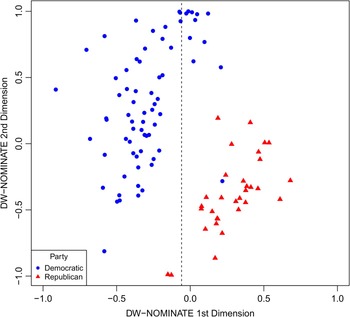
As a counterfactual thought experiment on this question of timing, Figure 4 uses Poole and Rosenthal's “Common Space” NOMINATE Scores to imagine how the Senate vote might have looked if taken on the House bill.Footnote 104 By using the House vote to pin down H.R. 77's ideological placement, we can examine how many senators are ideologically to the left (aye) or to the right (nay) of the bill. This figure offers a crude, hypothetical look into how the Senate would have behaved if given the chance to vote on the House bill from earlier in the term. Taking these scores seriously, this analysis suggests that the House vote would have commanded a 60–40 majority among the Senate, the same number LBJ predicted in November 1964.Footnote 105 While by no means conclusive, it is safe to say that the sooner the bill had reached the Senate, the better its prospects for passage would have been.
Using Poole and Rosenthal's “Common Space” NOMINATE scores, I plotted senators from the 89th Congress along the two ideological dimensions. Instead of using the individual chamber DW-NOMINATE scores, the Common Space places all legislators on the same scale, thus allowing for comparisons across the House and Senate. By laying the House vote atop the senators' scores, we have a rough picture of how the Senate may have divided on the House bill. The x axis plots the 1st dimension, and the y axis uses the 2nd dimension. The dashed cutting line shows the 1st dimension ideological midpoint for the H.R. 77 vote that passed in the House on July 28, 1965. Those to the left of the line would conceivably vote aye, while those to right would vote nay. For more on these data, see http://voteview.com/dwnomjoint.asp

In spite of suffering a defeat in October 1965, party leaders resumed efforts to pass H.R. 77 when the second session began. As a sign of the party's continued support, President Johnson again brought up the issue during his 1966 State of the Union. In some ways this gesture was little more than an attempt to mollify a frustrated coalition partner.Footnote 106 Nonetheless, the Senate struggle to pass H.R. 77 began anew in January 1966. Determined to wear down the opposition, Senate Majority Leader Mansfield employed numerous procedural tools in an attempt to break the filibuster. By refusing to allow the chamber into recess from one day to the next, Mansfield hoped to force a showdown over the bill.Footnote 107 With hostilities in Vietnam beginning to ramp up, Mansfield sought to exploit the fact that many in the Senate wanted to move on to debating the procurement of emergency funding. From January 27 through February 3, Mansfield endeavored to physically exhaust the obstructionists by convening the Senate at 10 a.m., two hours earlier than normal. In the end, Mansfield's tactics proved unsuccessful, and the repeal effort officially ended on February 11, following a third failed cloture vote.
4.4 Losing Before the Vote
In publicly suggesting that H.R. 77 was not a central issue, the Johnson administration signaled that it was unlikely to turn the issue into a major fight. By February 1966, no amount of lobbying by unions or pressure from administration officials could win enough votes to break Dirksen's filibuster coalition. Without early support from Democratic leaders, the bill was defeated before it reached the Senate. While unable to break the filibuster, the 51–48 cloture vote that ended the Taft-Hartley repeal was not a foregone conclusion. Earlier in the year, policymakers on both sides of the aisle believed that H.R. 77 would ultimately pass. As one commentary flatly proclaimed, “The overwhelming liberal complexion of the new 89th Congress makes it a virtual certainty that Section 14 (b) will be repealed, provided that President Johnson gives his full support to this primary objective of his labor supporters.”Footnote 108 Johnson and others, however, failed to play their parts. Both Johnson and Labor Committee Chairman Powell intentionally delayed the bill's progress in order to advantage other intense policy demanders. In the end, it seems that organized labor's industrial relations agenda may have suffered as much from the ambitious political goals of its allies as it did from the obstructionist tactics of the opposition.
Johnson's Great Society programs offered coalitional benefits that worked well within his larger goals to tackle poverty and racial injustice. By prioritizing these other issues, party elites undermined a bill that stood to benefit an important coalition partner and a sizable portion of the electorate for years to come. Rather than reaping the varied benefits from a strengthened labor movement, Johnson spent the next year defending against criticism for his “insincere” commitment to unions.Footnote 109 Despite claims to have “done his best,” Johnson's weak support for H.R. 77 served only to alienate many in the labor movement. After vigorously campaigning for the party's legislative agenda, many union members believed that the administration had used them to support Medicare and other legislation without any intention of passing labor reform. This reaction, while understandable, was not entirely fair. Democrats spent considerable time and effort during both the first and second sessions of the 89th Congress trying to pass H.R. 77. Unfortunately for labor, those efforts came too late in the term. The delay did not reveal a secret desire to see the legislation fail, or even a belief that it would fail. Section 14b was simply a lower priority than Medicare, education reform, poverty assistance, and voting rights.
The 89th Congress presented a rare moment in which even the most radical departures from the status quo seemed feasible. How Democrats proceeded during this formative period would have lasting effects on both public policy and their coalition for years to come. Unable to meet every group's demands at once, the Johnson administration had to decide which issues to prioritize and which to ignore. Few guessed that organized labor would fall into the latter category. Despite continued electoral support, unions failed to command the same attention under Johnson's Great Society as they enjoyed within Roosevelt's New Deal coalition. Without a focused scrutiny of the coalition's priorities, much of this story would have been missed. To appreciate such shifts within a coalition, future work must pay greater attention to how parties structure their legislative agenda around the demands of key interest groups.
5. CONCLUSION
In a break from older candidate-centric models of parties, Bawn et al.'s recent work posits that pressure groups play an important role in shaping a party's core values and institutions.Footnote 110 According to their framework, politicians serve the needs of intense policy demanders who strategically insert themselves into intrapartisan debates over candidate selection, platform development, and even the procedural rules that govern electoral competition. The model's focus on groups is an important contribution to the study of parties, but the authors ultimately strip away much of the independent action left to elected officials. Policy discretion over which groups to cater to is particularly relevant when the coalition is composed of numerous groups clamoring for representation on the agenda. Intraparty divisions, though uncommon when a coalition is relatively homogeneous, pose a real threat when numerous groups of varying interests all demand something from their partisan allies. How do party elites adjudicate between competing sets of intense policy demanders? Who gets their issue onto the agenda, and which issues receive top priority?
It is not enough to merely claim that parties represent the interests of policy-minded groups. Further work must consider how politicians weigh which groups to advantage and why. Karol's attempt to demonstrate how parties change positions to satisfy or court coalitional partners is a step in this direction.Footnote 111 Conceptualizing party leaders as strategic coalition managers is an important addition to Bawn et al.'s theory, but this complication warrants empirical substantiation. To really capture the changing contours of a party coalition, we must look more closely at the agenda-setting process to understand the priorities given to different groups. The party's legislative agenda is finite—only some issues can receive attention in any given year. If the party must balance the demands of various groups, then we must evaluate this early stage in the legislative process to understand the party's priorities. It was, as Frymer's work on captured groups would predict, one of the Democratic Party's most established coalition partners that lost out.Footnote 112 In this earlier period, it was organized labor that served the role of loyal but unrewarded coalition partner, not African Americans.
This article's case study of the relationship between organized labor and the Democratic Party underscores why some vote-based measures can overlook significant features of coalition management. If one were to look merely at roll-call votes on labor issues, Democrats, conditional on the region, would appear very consistent over the 20th century. Moreover, this type of analysis says nothing of the content of the legislation passed or promoted in committee. Even when labor legislation made the agenda, unions were frustrated to see their policy goals placed at the end of a long legislative calendar. Indeed, little has changed on this front. Despite mobilizing in large numbers for the 2006 and 2008 elections, organized labor's demands for “card check” have gone largely unheeded.
Roll call and trend analysis, though tractable, cannot get at the more nuanced features of the agenda's substance and sequence. Nor can these approaches capture the important relational aspects of coalition management, such as the Democratic Party's decision to host the 2012 convention in North Carolina. As a right-to-work state, this location infuriated labor and signaled yet again the party's indifference to its interests. To study the dynamics between groups and parties, we must employ methods that can appreciate these shifts in partisan priorities. Additionally, new measures of legislative priority should be considered when scrutinizing the agenda-setting process. As the case study demonstrates, questions about when an issue reaches the floor, and what other bills precede it, are often more revealing of the party's priorities than the outcome of any roll call vote.
Despite its ultimate failure, this understudied episode represented the first moment since Taft-Hartley's passage that repeal had a viable chance to succeed. The Great Society's “lost opportunity” for social democratic progress was not as predetermined as others have claimed.Footnote 113 Yet, rather than return to the New Deal, Democrats sought to enlarge the coalition by catering to emerging groups not yet captured by the party. Looking to please these electorally important policy demanders, President Johnson and his congressional leaders strategically developed their agenda accordingly, to the detriment of organized labor's key issue. In the end, the 89th Congress's tepid repeal effort stands as an early example in which unions saw their policy demands subsumed by the legislative ambitions of a more expansive coalition.