Introduction
Schizophrenia is a complex genetic disorder as indicated by studies of genetic epidemiology in twins and other family members (Freedman et al. Reference Freedman, Leonard, Olincy, Kaufmann, Malaspina, Cloninger, Svrakic, Faraone and Tsuang2001). Phenotypic expression of the disorder includes deficits in the domain of cognition (Goldberg et al. Reference Goldberg, David, Gold, Weinberger and Harrison2011) that are, in part, determined genetically (Toulopoulou et al. Reference Toulopoulou, Picchioni, Rijsdijk, Hua-Hall, Ettinger, Sham and Murray2007) and are associated with impaired quality of life and poor outcome (Green, Reference Green1996). It has been proposed that brain activity associated with cognitive deficits may represent a heritable, susceptibility-related phenotype, pathophysiologically intermediate between genes that increase susceptibility to schizophrenia and the symptoms of this brain disorder (Gur et al. Reference Gur, Calkins, Gur, Horan, Nuechterlein, Seidman and Stone2007).
Episodic memory is a form of declarative memory that consists of the ability to store and recall a seemingly endless series of experiences, many of which occur only once (Tulving, Reference Tulving1983). A large body of evidence has demonstrated that activity of the hippocampus–parahippocampus (H-PH) supports encoding of episodic memory and behavioral accuracy at retrieval (Schacter & Wagner, Reference Schacter and Wagner1999). Several studies have also indicated that patients with schizophrenia, regardless of general intellectual functioning or executive functioning (Kopald et al. Reference Kopald, Mirra, Egan, Weinberger and Goldberg2012), suffer from deficits in episodic memory (Aleman et al. Reference Aleman, Hijman, de Haan and Kahn1999; Lepage et al. Reference Lepage, Sergerie, Pelletier and Harvey2007; Leavitt & Goldberg, Reference Leavitt and Goldberg2009), especially in the encoding domain (Goldberg et al. Reference Goldberg, Egan, Gscheidle, Coppola, Weickert, Kolachana, Goldman and Weinberger2003; Gold, Reference Gold2004; Danion et al. Reference Danion, Huron, Vidailhet and Berna2007). These deficits seem to be relatively stable across time, largely independent of psychotic symptoms (for a review, see Ranganath et al. Reference Ranganath, Minzenberg and Ragland2008), less responsive to currently available antipsychotic treatment, and at least in part heritable as suggested by findings in adolescent and adult siblings of patients (for reviews, see Faraone et al. Reference Faraone, Seidman, Kremen, Pepple, Lyons and Tsuang1995, Reference Faraone, Seidman, Kremen, Toomey, Pepple and Tsuang1999; Toulopoulou et al. Reference Toulopoulou, Morris, Rabe-Hesketh and Murray2003a, Reference Toulopoulou, Rabe-Hesketh, King, Murray and Morrisb; Snitz et al. Reference Snitz, MacDonald and Carter2006; Gur et al. Reference Gur, Calkins, Gur, Horan, Nuechterlein, Seidman and Stone2007).
Converging data from post-mortem (Harrison & Lewis, Reference Harrison, Lewis, Hirsch and Weinberger2003), animal lesion (Lipska & Weinberger, Reference Lipska and Weinberger2000) and imaging studies (Wright et al. Reference Wright, Rabe-Hesketh, Woodruff, David, Murray and Bullmore2000; Honea et al. Reference Honea, Crow, Passingham and Mackay2005) indicate that schizophrenia is associated with abnormalities of H-PH biology (Weinberger, Reference Weinberger1999). Consistently, in vivo studies with functional imaging have related dysfunction of the H-PH to deficits in memory encoding (for a meta-analysis, see Achim & Lepage, Reference Achim and Lepage2005), even in patients at their first episode (Achim et al. Reference Achim, Bertrand, Sutton, Montoya, Czechowska, Malla, Joober, Pruessner and Lepage2007) and in subjects with an at-risk mental state (ARMS; Allen et al. Reference Allen, Seal, Valli, Fusar-Poli, Perlini, Day, Wood, Williams and McGuire2011, Reference Allen, Chaddock, Howes, Egerton, Seal, Fusar-Poli, Valli, Day and McGuire2012). Recently, we have demonstrated an abnormal pattern of H-PH activity and differential PH physiology based on the catechol-O-methyltransferase (COMT) genotype during encoding of episodic memory in patients with schizophrenia and healthy subjects (Di Giorgio et al. 2011). However, the association of H-PH function with genetic risk for the disorder remains relatively underexplored.
First-degree relatives of patients offer a complementary perspective from which to search for putative biological traits associated with genetic risk for schizophrenia. First-degree relatives harbor some of the risk genes, they share on average 50% of their affected probands' alleles, and they are free of confounding factors related to the state of the disease. Therefore, studying healthy siblings of patients may help to address the question of whether the phenotype at hand may be used as a schizophrenia susceptibility-related phenotype. Only a few studies have investigated H-PH physiology in relatives of patients with schizophrenia (for a review, see MacDonald et al. Reference MacDonald, Thermenos, Barch and Seidman2009), and none of them so far has provided support for aberrant H-PH activity during episodic memory in this population (Thermenos et al. Reference Thermenos, Seidman, Poldrack, Peace, Koch, Faraone and Tsuang2007). Thus, it is unclear whether this imaging phenotype is related to risk for schizophrenia.
In the present study we investigated H-PH-mediated behavior and physiology, assessed with blood oxygenation level-dependent functional magnetic resonance imaging (BOLD fMRI), during episodic memory in patients with schizophrenia, in clinically unaffected siblings and in healthy subjects. Consistent with earlier neuropsychological and imaging studies (reviewed by Gur et al. Reference Gur, Calkins, Gur, Horan, Nuechterlein, Seidman and Stone2007; MacDonald et al. Reference MacDonald, Thermenos, Barch and Seidman2009), we hypothesized that: (1) unaffected siblings and patients with schizophrenia have deficits in behavioral performance of verbal episodic memory; and (2) abnormal activity of the H-PH during memory encoding is related to genetic risk for schizophrenia and that it is also found in unaffected siblings.
Method
Subjects
Patients with schizophrenia, unaffected siblings and healthy subjects entered the study. All participants were white Caucasians, from the province of Bari, and provided written informed consent after a complete description of the study, in accordance with the Declaration of Helsinki. Protocols and procedures were approved by the local Institutional Review Board (Comitato Etico Locale Indipendente Azienda Ospedaliera ‘Ospedale Policlinico Consorziale’ Bari). A DSM-IV-based Structured Clinical Interview (First et al. Reference First, Gibbon, Spitzer and Williams1996) was used to confirm the diagnosis of schizophrenia for patients, and to exclude any psychiatric Axis I disorder for healthy subjects and siblings. Additional exclusion criteria were: inability to give informed consent, mental retardation, a history of substance abuse within the past 6 months, and any significant neurological and medical conditions revealed by clinical and MRI evaluation. Absence of psychotic disorders in first-degree relatives of healthy subjects was assessed by using the Family Interview for Genetic Studies (FIGS; Maxwell, Reference Maxwell1992). All patients had been on stable pharmacological treatment, with first- or second-generation antipsychotics, for at least 8 weeks before entering the study. The severity of schizophrenia symptoms was evaluated by a certified psychiatrist (G.C.) with the Positive and Negative Syndrome Scale (PANSS; Kay et al. Reference Kay, Fiszbein and Opler1987).
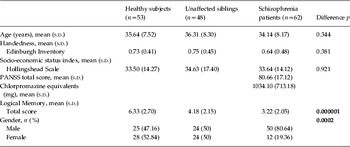
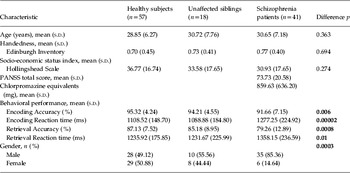
A sample of 62 patients with schizophrenia (50 males; mean age 34.14 ± 8.17 years), 48 unaffected siblings (24 males; mean age 36.31 ± 8.30 years) and 53 healthy subjects (25 males; mean age 35.64 ± 7.52 years) underwent neuropsychological testing for verbal episodic memory assessment. Another sample of 41 patients with schizophrenia (35 males; mean age 30.65 ± 7.18 years), 18 unaffected siblings (10 males; mean age 30.72 ± 7.76 years) and 57 healthy subjects (28 males; mean age 28.85 ± 6.27 years) underwent fMRI during performance of a task of encoding in recognition memory, which represents the simplest form of episodic memory. The siblings studied were not biological relatives of the patients with schizophrenia, with the exception of 12 sib pairs in the neuropsychological dataset and four sib pairs in the fMRI dataset. There was minimal overlap between the neuropsychological and fMRI samples, in that 40 subjects (10 patients with schizophrenia, 16 healthy subjects and 14 siblings) were in both cohorts. Finally, given that gender distribution was significantly different across the three diagnostic groups in both the neuropsychological and fMRI samples (see Tables 1 and 2 respectively for details), all subsequent analyses were covaried for this variable.
Demographics and episodic memory performance

PANSS, Positive and Negative Syndrome Scale; s.d., standard deviation.
Bold indicates statistically significant values.
Demographics and behavioral performance (fMRI)

fMRI, Functional magnetic resonance imaging; PANSS, Positive and Negative Syndrome Scale; s.d., standard deviation.
Bold indicates statistically significant values.
Data acquisition
Neuropsychological testing
A battery of cognitive tests was administered by an experienced clinical neuropsychologist (B.G.). The Logical Memory subtest of the Wechsler Memory Scale (WMS; Wechsler, Reference Wechsler1954) was used as a measure of verbal episodic memory (Egan et al. Reference Egan, Kojima, Callicott, Goldberg, Kolachana, Bertolino, Zaitsev, Gold, Goldman, Dean, Lu and Weinberger2003; Kopald et al. Reference Kopald, Mirra, Egan, Weinberger and Goldberg2012). Subjects listened to two short passages and were then asked to recall each one immediately. Each passage contains about 25 elements of information and the score used is the mean of the memory elements recalled immediately. Performance on the subtest was calculated as the mean of the scores at the two stories. The Logical Memory subtest requires approximately 5 min to complete, including time to recall.
fMRI experimental paradigm
The fMRI paradigm consisted of the incidental encoding and subsequent retrieval of novel, complex scenes, a task that has consistently been shown to produce activation of the H-PH network in human neuroimaging experiments (Hariri et al. Reference Hariri, Goldberg, Mattay, Kolachana, Callicott, Egan and Weinberger2003; Bertolino et al. Reference Bertolino, Rubino, Sambataro, Blasi, Latorre, Fazio, Caforio, Petruzzella, Kolachana, Hariri, Meyer-Lindenberg, Nardini, Weinberger and Scarabino2006, Reference Bertolino, Di Giorgio, Blasi, Sambataro, Caforio, Sinibaldi, Latorre, Rampino, Taurisano, Fazio, Romano, Douzgou, Popolizio, Kolachana, Nardini, Weinberger and Dallapiccola2008). Four encoding blocks were followed by four retrieval blocks in an interleaved design with a passive rest condition, resulting in a total of 16 blocks. Each block lasted 20 s, producing a total scan time of 11.2 min. During encoding blocks, subjects viewed six images, presented serially for 3 s each, and determined whether each image represented an ‘indoor’ or an ‘outdoor’ scene (Bertolino et al. Reference Bertolino, Rubino, Sambataro, Blasi, Latorre, Fazio, Caforio, Petruzzella, Kolachana, Hariri, Meyer-Lindenberg, Nardini, Weinberger and Scarabino2006). Equal numbers of ‘indoor’ and ‘outdoor’ scenes were presented in each encoding block. All scenes were of neutral emotional valence and were derived from the International Affective Picture System (IAPS; Lang et al. Reference Lang, Bradley and Cuthbert1997).
During subsequent retrieval blocks, subjects again viewed six images, presented serially for 3 s each, and determined whether each scene was ‘new’ or ‘old’. In each retrieval block, half the scenes were ‘old’ (i.e. presented during the encoding blocks) and half were ‘new’ (i.e. not presented during the encoding blocks). The order of ‘indoor’ and ‘outdoor’ scenes and also of ‘new’ and ‘old’ scenes was distributed randomly throughout the encoding and retrieval blocks respectively. During the interleaved rest blocks, subjects were instructed to fixate on a centrally presented cross-hair. Before the beginning of each block, subjects viewed a brief (2-s) instruction: ‘Indoor or Outdoor?’, ‘New or Old?’ or ‘Rest’.
However, because of the blocked paradigm, the retrieval phase is in fact a mixture between encoding and retrieval: subjects in this phase view an equal number of new and old stimuli. The new stimuli are likely to engage encoding mechanisms in the H-PH, and this activity would be mixed in with any retrieval related activity (for review, see Schacter & Wagner, Reference Schacter and Wagner1999; Squire et al. Reference Squire, Stark and Clark2004). Therefore, given the objective of the study and this limitation, we decided not to analyze the imaging data during retrieval. During scanning, all subjects responded by button presses with their right hand, allowing for the determination of behavioral accuracy (% correct responses) and reaction time (ms).
fMRI data acquisition
fMRI images were acquired on a General Electric (USA) 3-T scanner with a gradient echo–planar imaging pulse sequence [24 4-mm-thick axial slices, repetition time/echo time (TR/TE) 2000/28 ms, flip angle 90°, field of view 24 cm, matrix 64 × 64] while subjects were performing the experimental paradigm. For all participants who had visual refractive abnormalities, correction was achieved with prescription contact lenses or MRI-compatible plastic lenses in a plastic frame.
Data analysis
Demographic and behavioral data analysis
One-way ANOVAs and χ2 tests were performed as appropriate in Statistica (StatSoft, USA) to compare demographic and behavioral data at the Logic Memory subtest and at the fMRI task. Tukey's Honest Significant Difference (HSD) test was used for all post-hoc analyses.
fMRI data analysis
fMRI data were preprocessed and analyzed using SPM8 (www.fil.ion.ucl.ac.uk; Wellcome Department of Cognitive Neurology, UK; Friston, Reference Friston, Frackowiak, Friston, Frith, Dolan, Friston, Price, Zeki, Ashburner and Penny2003) running under Matlab 7.2. The first four volumes were discarded to allow for T1 equilibration effects. In brief, images for each subject were realigned to the first volume in the time series to correct for head motion, normalized to the standard Montreal Neurological Institute (MNI) − 305 template and spatially smoothed with a 10-mm full-width at half-maximum isotropic three-dimensional Gaussian kernel to minimize noise and residual differences in gyral anatomy. After realignment, data were also screened for high quality (scan stability) as demonstrated by small motion correction (<2.5 mm translation, <2° rotation). fMRI data were then analyzed as time series modeled by a sine wave shifted by an estimate of the hemodynamic response. For each experimental condition, a box car model convolved with the hemodynamic response function at each voxel was used. Subject-specific movement parameters obtained from the realignment procedure were included in the model as covariates, taking into account the effects of subject motion.
In the first-level analyses, predetermined condition effects at each voxel were calculated using a t statistic, producing a statistical image for the contrasts of encoding versus rest for each subject. These individual contrast images were then used in second-level random effects models (one-sample t test) to determine task-specific regional responses at the group level for the entire sample. Furthermore, to characterize the main effect of the diagnostic group, the contrast images of all subjects were entered into an ANCOVA. In particular, given that the diagnostic groups differed not only in terms of gender distribution but also in encoding behavioral performance, we included in the design gender, encoding accuracy and reaction time as covariates of no interest. For all these fMRI analysis we used a statistical threshold of p < 0.05 family-wise error (FWE) within the bilateral H and PH, identified with the Wake Forest University PickAtlas 1.04 (www.fmri.wfubmc.edu/cms/software#PickAtlas), minimum cluster size (k) = 3. This statistical approach was based on our strong a priori hypothesis on modulation of neuronal activity in the H and PH at encoding of recognition memory (Schacter & Wagner, Reference Schacter and Wagner1999; Bertolino et al. Reference Bertolino, Rubino, Sambataro, Blasi, Latorre, Fazio, Caforio, Petruzzella, Kolachana, Hariri, Meyer-Lindenberg, Nardini, Weinberger and Scarabino2006, Reference Bertolino, Di Giorgio, Blasi, Sambataro, Caforio, Sinibaldi, Latorre, Rampino, Taurisano, Fazio, Romano, Douzgou, Popolizio, Kolachana, Nardini, Weinberger and Dallapiccola2008; Krach et al. Reference Krach, Jansen, Krug, Markov, Thimm, Sheldrick, Eggermann, Zerres, Stocker, Shah and Kircher2010). BOLD responses were extracted from significant clusters using MarsBar (http://marsbar.sourceforge.net/) to further explore significant effects outside SPM. As we did not have other a priori hypotheses regarding brain activity outside the H-PH, we used a statistical threshold of p = 0.05, FWE corrected for multiple comparisons across all voxels, for these whole-brain comparisons. Because no effects were detected with this threshold, and for the sake of completeness, we report results found at p = 0.001 uncorrected k = 10.
Correlation analyses
Spearman's rank-order correlation analysis was performed in the whole sample to evaluate the relationship between BOLD fMRI activity at encoding and behavioral performance at retrieval as predicted by earlier studies (Wagner et al. Reference Wagner, Poldrack, Eldridge, Desmond, Glover and Gabrieli1998). Additional correlation analyses (Spearman's) were also performed to exclude the potential confounding effect of clinical variables onto the H-PH function in patients with schizophrenia. In particular, we tested the relationship between antipsychotic treatment (chlorpromazine equivalents) or clinical symptoms (PANSS total score) and performance at the Logic Memory subtest and at the fMRI task.
Results
Demographic data
Neuropsychological sample
There was no significant difference among patients with schizophrenia, siblings and healthy subjects in terms of age, handedness and socio-economic status (SES) index (all p > 0.4) but there was a strong effect for unequal distribution of gender (χ2 = 14.12, p = 2 × 10⁻⁴). Demographic and clinical data are summarized in Table 1.
fMRI sample
There was no significant difference among patients with schizophrenia, siblings and healthy subjects in terms of age, handedness and SES index (all p > 0.2), but again there was a strong effect for unequal distribution of gender (χ2 = 12.98, p = 3 × 10⁻⁴). Demographic and clinical data are summarized in Table 2.
Neuropsychological data
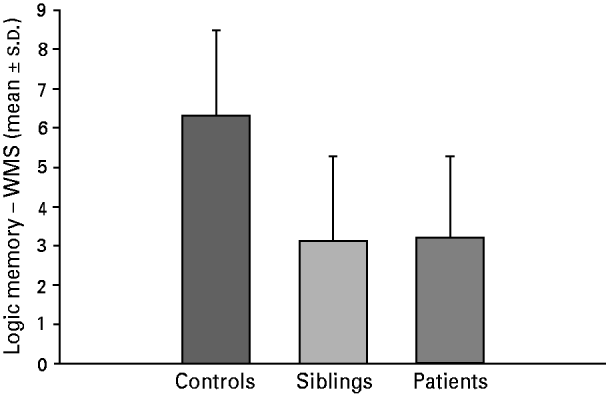
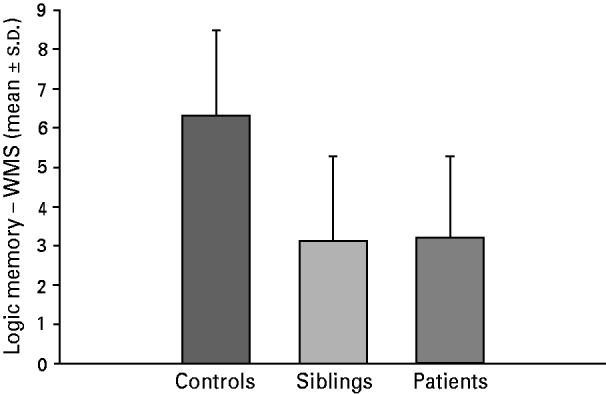
ANCOVA indicated a main effect of diagnosis on Logical Memory total score (F 2,153 = 19.69; p = 1 × 10⁻⁶) (Fig. 1). In particular, post-hoc Tukey HSD analysis demonstrated that healthy subjects performed better than siblings (p = 3 × 10⁻⁴) and better than patients with schizophrenia (p = 1 × 10⁻⁴), whereas no difference was evident between siblings and patients (p = 0.19).
Effect of diagnosis on the Wechsler Memory Scale (WMS) Logical Memory Total score. Unaffected siblings and patients with schizophrenia have reduced performance compared with healthy subjects (controls). Error bars show the standard deviation (s.d.) of the mean.
fMRI
Behavioral data
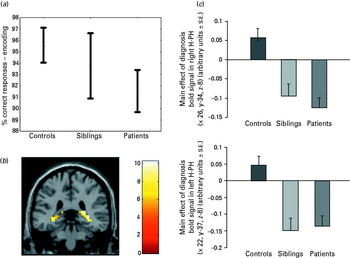
Behavioral performance at encoding indicated a main effect of diagnosis on accuracy (F 2,113 = 5.32, p = 6 × 10⁻³) and reaction time (F 2,113 = 11.80, p = 2 × 10⁻⁵). More specifically, post-hoc Tukey HSD analysis indicated that patients with schizophrenia performed worse than healthy subjects in terms of accuracy (p = 4 × 10⁻³) and reaction time (p = 1 × 10⁻³), and worse than siblings only in terms of reaction time (p = 1 × 10⁻²), whereas no significant difference resulted between siblings and healthy subjects (all p > 0.09). Similar results were found for behavioral performance at retrieval. Details of these analyses and related post-hoc tests are reported in the online Supplementary Table S1.
BOLD response
Effect of task (one-sample t test)
Consistent with prior reports (Hariri et al. Reference Hariri, Goldberg, Mattay, Kolachana, Callicott, Egan and Weinberger2003; Bertolino et al. Reference Bertolino, Rubino, Sambataro, Blasi, Latorre, Fazio, Caforio, Petruzzella, Kolachana, Hariri, Meyer-Lindenberg, Nardini, Weinberger and Scarabino2006, Reference Bertolino, Di Giorgio, Blasi, Sambataro, Caforio, Sinibaldi, Latorre, Rampino, Taurisano, Fazio, Romano, Douzgou, Popolizio, Kolachana, Nardini, Weinberger and Dallapiccola2008), we found an effect of task in the right (x, y, z, MNI coordinates) [(22, −30, −7), k = 59, Z = infinite, FWE-corrected p = 1 × 10⁻⁴)] and left H-PH [(−22, −30, −4), k = 62, Z = Inf, p = 1 × 10⁻⁴)].
Main effect of diagnosis
ANCOVA indicated a main effect of diagnosis in the right (x, y, z, MNI coordinates) [(26, −34, 8), k = 23, Z = 3.75, FWE-corrected p = 8 × 10⁻³)] and left H-PH [(−22, −37, 8), k = 27, Z = 3.48, p = 2 × 10⁻²)] (Fig. 2 b). Inspection of the BOLD signal change extracted from significant clusters allowed further characterization of the directionality of effects (Fig. 2 c). In more detail, healthy subjects had greater BOLD signal change compared to siblings in the right (post-hoc Tukey HSD, p = 4 × 10⁻³) and left (p = 1 × 10⁻²) H-PH, and greater BOLD signal change relative to patients in the right (p = 1 × 10⁻⁴) and left (p = 2 × 10⁻⁴) H-PH. No statistical difference was found between siblings and patients in terms of H-PH activity (all p > 0.1). The results of the uncorrected exploratory whole-brain analyses are reported in the online Supplementary Table S2.
Encoding task performance and imaging data of controls, unaffected siblings and schizophrenia patients. (a) Behavioral accuracy (mean ±95% confidence intervals) at encoding for the three diagnostic groups. (b) Effect of diagnosis on hippocampal–parahippocampal (H-PH) activity during memory encoding. Color bar represents t score values. (c) Blood oxygenation level-dependent (BOLD) signal change extracted from clusters with the main effect of diagnosis in the right H-PH and left H-PH during memory encoding. Error bars show the standard error of the mean.

Correlation analyses
Potential correlation between H-PH activity and behavioral performance at the fMRI task in the whole sample
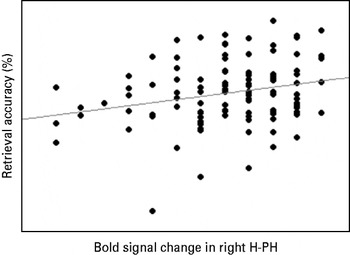
Similar to previous studies of recognition memory, BOLD signal change in the right H-PH at encoding predicted behavioral accuracy at retrieval in the whole sample of subjects (ρ = 0.21, p = 0.02) (Fig. 3).
Scatterplot showing the positive correlation between behavioral accuracy at retrieval and blood oxygenation level-dependent (BOLD) signal change in the right hippocampus–parahippocampus (H-PH) at encoding in the entire sample.

Potential correlation between Logical Memory performance and clinical variables in patients
No significant correlations were found between Logical Memory total score and dose of antipsychotics (ρ = −0.44, p = 0.38) or PANSS total score (ρ = −0.25, p = 0.30) in patients.
Potential correlation between H-PH activity and clinical variables in patients
No significant correlation was found between BOLD signal change in the right H-PH and dose of antipsychotics (ρ = 0.29, p = 0.19) or PANSS total score (ρ = 0.09, p = 0.57). In addition, no significant correlation was found between BOLD signal change in the left H-PH and PANSS total score (ρ = −0.16, p = 0.35). A positive correlation was found between BOLD signal change in the left H-PH and dose of antipsychotics (ρ = 0.42, p = 0.01). However, this correlation would not survive correction for the number of statistical comparisons made (p > 0.05).
Discussion
The present findings suggest that the inability of patients with schizophrenia to properly engage the H-PH complex during episodic memory is not related to clinical state and is also evident in healthy siblings. In particular, we found that patients with schizophrenia and unaffected siblings performed significantly worse than the control group at the Logical Memory subtest of the WMS, used here as measure of episodic memory, whereas no difference was observed between siblings and patients. These neuropsychological data are consistent with previous studies indicating that adolescent and adult non-psychotic siblings, similar to their relatives with schizophrenia, have impaired performance on tests of verbal declarative memory including episodic memory (Cannon et al. Reference Cannon, Zorrilla, Shtasel, Gur, Gur, Marco, Moberg and Price1994; Faraone et al. Reference Faraone, Seidman, Kremen, Pepple, Lyons and Tsuang1995, Reference Faraone, Seidman, Kremen, Toomey, Pepple and Tsuang1999; Toulopoulou et al. Reference Toulopoulou, Morris, Rabe-Hesketh and Murray2003a, Reference Toulopoulou, Rabe-Hesketh, King, Murray and Morrisb). This deficit is stable over time (Faraone et al. Reference Faraone, Seidman, Kremen, Toomey, Pepple and Tsuang1999), and seems to be greater in relatives from multiplex as compared to singleplex families (Faraone et al. Reference Faraone, Seidman, Kremen, Toomey, Pepple and Tsuang2000). Accordingly, a recent genetic study in the largest international familial schizophrenia cohort to date (Toulopoulou et al. Reference Toulopoulou, Goldberg, Mesa, Picchioni, Rijsdijk, Stahl, Cherny, Sham, Faraone, Tsuang, Weinberger, Seidman and Murray2010) has indicated that a substantial proportion of the phenotypic correlation between schizophrenia and cognition is explained by shared genetic effects and that memory deficits are part of genetic vulnerability to the illness. Thus, our results provide support to previous research suggesting that episodic memory deficits can be considered a phenotype for vulnerability to schizophrenia.
We also found that patients with schizophrenia and unaffected siblings showed abnormal H-PH engagement during memory encoding (fMRI) compared with healthy subjects. Despite the deficit in episodic memory indicated by lower performance at the WMS Logic Memory, performance at the very simple fMRI task used here did not differ significantly between unaffected siblings and healthy subjects. Therefore, the reduced H-PH activity observed in siblings cannot be ascribed to behavioral performance deficits in accuracy or reaction time, which were also covaried in our analyses. Although earlier twin studies have indicated a heritable component to episodic memory deficits in schizophrenia that indirectly implicated dysfunction of the H-PH complex (Owens et al. Reference Owens, Picchioni, Rijsdijk, Stahl, Vassos, Rodger, Collier, Murray and Toulopoulou2011), the current data provide direct evidence of a physiological abnormality in information processing by the H-PH in relatives of patients with schizophrenia, even in the absence of manifest deficits in performance. Moreover, this physiological abnormality at encoding has meaningful behavioral relevance as demonstrated by the correlation between right H-PH activity at encoding and behavioral performance at retrieval.
At the neurobiological level, several imaging studies have demonstrated reduced neuronal integrity, as indicated by reduced N-acetylaspartate levels in the hippocampus of unaffected first-degree relatives of patients with schizophrenia (Callicott et al. Reference Callicott, Egan, Bertolino, Mattay, Langheim, Frank and Weinberger1998), in addition to H-PH shape abnormalities (Nelson, Reference Nelson, Cermak and Craik1979) and volume reductions (Keshavan et al. Reference Keshavan, Dick, Mankowski, Harenski, Montrose, Diwadkar and DeBellis2002; Seidman et al. Reference Seidman, Faraone, Goldstein, Kremen, Horton, Makris, Toomey, Kennedy, Caviness and Tsuang2002; Karnik-Henry et al. Reference Karnik-Henry, Wang, Barch, Harms, Campanella and Csernansky2012), that seem to be correlated to the severity of episodic memory deficits, at least in part (O'Driscoll et al. Reference O'Driscoll, Florencio, Gagnon, Wolff, Benkelfat, Mikula, Lal and Evans2001; Keshavan et al. Reference Keshavan, Dick, Mankowski, Harenski, Montrose, Diwadkar and DeBellis2002; Seidman et al. Reference Seidman, Faraone, Goldstein, Kremen, Horton, Makris, Toomey, Kennedy, Caviness and Tsuang2002; Karnik-Henry et al. Reference Karnik-Henry, Wang, Barch, Harms, Campanella and Csernansky2012). However, only three functional imaging studies have investigated brain activity during memory encoding in non-psychotic siblings of patients with schizophrenia and none of them has reported group differences in hippocampal activity (including a direct region of interest analysis) (Whyte et al. Reference Whyte, Whalley, Simonotto, Flett, Shillcock, Marshall, Goddard, Johnstone and Lawrie2006; Bonner-Jackson et al. Reference Bonner-Jackson, Csernansky and Barch2007; Thermenos et al. Reference Thermenos, Seidman, Poldrack, Peace, Koch, Faraone and Tsuang2007). Only one study has reported abnormal parahippocampal activity (Thermenos et al. Reference Thermenos, Seidman, Poldrack, Peace, Koch, Faraone and Tsuang2007). Differences in the design of the study and strength of the magnetic field (our study is the first with a three-group comparison performed at 3 T) and also in the experimental paradigm used, which may affect modulatory effects of other brain regions on H-PH, may be invoked to explain such inconsistencies.
The H-PH finding in unaffected siblings may also help to clarify three criticisms directed at previous findings of abnormal H-PH activity in patients with schizophrenia. Patients in this study and in prior samples were mostly on antipsychotic treatment and it has been suggested that such medications may have an effect on the nature of the functional and behavioral abnormalities observed in patients (for a review, see Di Giorgio et al. 2009). Recent evidence in drug-free patients with schizophrenia suggests that antipsychotic treatment tends to normalize absent or blunted hippocampal activation to novel stimuli (Tamminga et al. Reference Tamminga, Thomas, Chin, Mihalakos, Youens, Wagner and Preston2012). Our present results in patients suggest a positive correlation between H-PH activity and chlorpromazine equivalents; that is greater activity for a given dose. Hence, the reduction in H-PH activity in patients is, if anything, underestimated. However, these results would not survive appropriate statistical correction for multiple comparisons. Finally, healthy siblings of patients with schizophrenia have similarly reduced activity in H-PH and they are free of antipsychotic treatment. Therefore, this phenotype is more likely to be related to genetic risk for schizophrenia. Another concern has been whether H-PH dysfunction is associated with chronicity of psychotic illness. Again, the significant reduction in H-PH activity in siblings suggests that abnormalities in H-PH physiology may contribute to, but are transmitted independently of, manifest schizophrenic illness. Finally, the directionality of H-PH dysfunction during memory encoding in schizophrenia has not yet been established, with some studies showing increased and other decreased H-PH activity during memory encoding (for a meta-analysis, see Achim & Lepage, Reference Achim and Lepage2005). In an attempt to understand the nature of H-PH dysfunction in schizophrenia, other studies have explored the role of risk genes in H-PH modulation during episodic memory tasks in healthy volunteers (Egan et al. Reference Egan, Straub, Goldberg, Yakub, Callicott, Hariri, Mattay, Bertolino, Hyde, Shannon-Weickert, Akil, Crook, Vakkalanka, Balkissoon, Gibbs, Kleinman and Weinberger2004; Callicott et al. Reference Callicott, Straub, Pezawas, Egan, Mattay, Hariri, Verchinski, Meyer-Lindenberg, Balkissoon, Kolachana, Goldberg and Weinberger2005; Goldberg et al. Reference Goldberg, Straub, Callicott, Hariri, Mattay, Bigelow, Coppola, Egan and Weinberger2006; Di Giorgio et al. Reference Di Giorgio, Blasi, Sambataro, Rampino, Papazacharias, Gambi, Romano, Caforio, Rizzo, Latorre, Popolizio, Kolachana, Callicott, Nardini, Weinberger and Bertolino2008; Huffaker et al. Reference Huffaker, Chen, Nicodemus, Sambataro, Yang, Mattay, Lipska, Hyde, Song, Rujescu, Giegling, Mayilyan, Proust, Soghoyan, Caforio, Callicott, Bertolino, Meyer-Lindenberg, Chang, Ji, Egan, Goldberg, Kleinman, Lu and Weinberger2009; Bigos et al. Reference Bigos, Mattay, Callicott, Straub, Vakkalanka, Kolachana, Hyde, Lipska, Kleinman and Weinberger2010; Jansen et al. Reference Jansen, Krach, Krug, Markov, Thimm, Paulus, Zerres, Stocker, Shah, Nothen, Treutlein, Rietschel and Kircher2010; Krach et al. Reference Krach, Jansen, Krug, Markov, Thimm, Sheldrick, Eggermann, Zerres, Stocker, Shah and Kircher2010; Krug et al. Reference Krug, Markov, Krach, Jansen, Zerres, Eggermann, Stocker, Shah, Nothen, Treutlein, Rietschel and Kircher2010; Thimm et al. Reference Thimm, Krug, Markov, Krach, Jansen, Zerres, Eggermann, Stocker, Shah, Nothen, Rietschel and Kircher2010). Again, none of these studies to date has established H-PH physiology as an intermediate phenotype related to risk for schizophrenia or the directionality of the risk allele effect. In some studies the risk allele has been associated with reduced hippocampal activity during episodic memory (Egan et al. Reference Egan, Straub, Goldberg, Yakub, Callicott, Hariri, Mattay, Bertolino, Hyde, Shannon-Weickert, Akil, Crook, Vakkalanka, Balkissoon, Gibbs, Kleinman and Weinberger2004; Callicott et al. Reference Callicott, Straub, Pezawas, Egan, Mattay, Hariri, Verchinski, Meyer-Lindenberg, Balkissoon, Kolachana, Goldberg and Weinberger2005; Goldberg et al. Reference Goldberg, Straub, Callicott, Hariri, Mattay, Bigelow, Coppola, Egan and Weinberger2006; Krach et al. Reference Krach, Jansen, Krug, Markov, Thimm, Sheldrick, Eggermann, Zerres, Stocker, Shah and Kircher2010), whereas in others it has been associated with greater hippocampal activity (Di Giorgio et al. Reference Di Giorgio, Blasi, Sambataro, Rampino, Papazacharias, Gambi, Romano, Caforio, Rizzo, Latorre, Popolizio, Kolachana, Callicott, Nardini, Weinberger and Bertolino2008; Huffaker et al. Reference Huffaker, Chen, Nicodemus, Sambataro, Yang, Mattay, Lipska, Hyde, Song, Rujescu, Giegling, Mayilyan, Proust, Soghoyan, Caforio, Callicott, Bertolino, Meyer-Lindenberg, Chang, Ji, Egan, Goldberg, Kleinman, Lu and Weinberger2009; Bigos et al. Reference Bigos, Mattay, Callicott, Straub, Vakkalanka, Kolachana, Hyde, Lipska, Kleinman and Weinberger2010; Jansen et al. Reference Jansen, Krach, Krug, Markov, Thimm, Paulus, Zerres, Stocker, Shah, Nothen, Treutlein, Rietschel and Kircher2010; Krug et al. Reference Krug, Markov, Krach, Jansen, Zerres, Eggermann, Stocker, Shah, Nothen, Treutlein, Rietschel and Kircher2010; Thimm et al. Reference Thimm, Krug, Markov, Krach, Jansen, Zerres, Eggermann, Stocker, Shah, Nothen, Rietschel and Kircher2010). The overlap of the directionality of H-PH dysfunction in patients with schizophrenia and in siblings in our study suggests that reduced H-PH activity memory encoding is probably associated with genetic risk for schizophrenia.
There are some limitations to our study. First, it remains unanswered whether H-PH dysfunction during episodic memory is a ‘heritable’ intermediate phenotype. Although cognitive and BOLD fMRI measures have related such dysfunction to genetic risk for schizophrenia, the heritability of this phenotype is still unclear. Unfortunately, we could not perform any test of heritability in our samples because only a small number of siblings were biological relatives of patients with schizophrenia. A better understanding of the heritability of this phenotype and its co-segregation within families would go a great distance toward understanding how the unexpressed genetic liability to schizophrenia is manifested in the functioning brain. Second, we used a block design paradigm in our fMRI experiment, which did not allow for distinction between activity relating to the period of encoding for subsequently remembered versus subsequently forgotten items, to identify regions in which activity relates to successful encoding of items and compare this memory index among the three diagnostic groups. Finally, our imaging results are based on a relatively small group of siblings, thus replication of the study is warranted.
Notwithstanding these limitations, our data suggest that H-PH dysfunction during episodic memory is related to genetic risk for schizophrenia, and as such can be assumed as a schizophrenia susceptibility-related phenotype.
Supplementary material
For supplementary material accompanying this paper visit http://dx.doi.org/10.1017/S0033291712002413.
Acknowledgments
We are grateful to R. Masellis, R. Lomuscio and Dr G. De Simeis for data acquisition, and to all of the patients and siblings who participated in the study.
Declaration of Interest
None.