Introduction
Studies emanating primarily from the cognitive science literature suggest both advantages and disadvantages of bilingualism for cognitive performance. According to the Inhibitory Control Model, bilinguals must suppress the non-target language to allow production of the intended language (Green, Reference Green1998). This constant experience with linguistic conflict resolution can be seen as practice of executive and attentional control, thus predicting a bilingual advantage on tasks requiring these abilities. While most of the work in bilingual neurocognition has been conducted using experimental paradigms, often with college students, translation into clinical applications for linguistically diverse groups requires understanding how these performance predictions hold when using tests that are commonly administered in clinical settings and with a broader demographic representation. Given that Spanish speakers in the United States vary in their English proficiency, it is important to understand how this second language ability affects neuropsychological (NP) performance in the first language. This has implications for the interpretation of test results when diagnosing brain dysfunction in bilingual patients, as bilingualism may affect NP test performance beyond what would be predicted by normative corrections for age, education, sex and ethnicity. To this end, the current study examined the effects of English fluency on performance in Spanish on a test that measures executive and attentional functioning.
In support of the Inhibitory Control Model (Green, Reference Green1998), research (Bialystok, Reference Bialystok2001, Reference Bialystok2010, Bialystok & Viswanathan, Reference Bialystok and Viswanathan2009, Carlson & Meltzoff, Reference Carlson and Meltzoff2008) has shown bilingual advantages in young children on tasks measuring selective attention and inhibition. When tested in a language in which they are proficient, bilingual advantages can also be demonstrated in adults, particularly on tasks measuring inhibition of an unwanted response (e.g., flanker task and Simon task). For example, Bialystok, Craik, and Luk (Reference Bialystok, Craik and Luk2008) showed that bilinguals who learned English as a second language but were considered proficient in English (with a variety of languages as their first language), showed smaller Stroop interference effects, compared to matched monolingual English speakers. This effect was particularly prominent in older bilinguals, who also displayed more facilitation (i.e., words printed in their own color relative to neutral condition) and less costs (i.e., incongruent condition relative to neutral condition), relative to older monolinguals. These effects remained robust after controlling for the effects of aging on speed of information processing, suggesting that bilingualism may attenuate the expected age-related decline in certain executive functions.
Tzelgov, Henik, and Liser (Reference Tzelgov, Henik and Liser1990) documented robust proficiency effects in a bilingual Stroop task as measured by reaction time differences between the congruent and incongruent trial, considering both within and between language Stroop effects in Hebrew–Arabic bilinguals. Relatively balanced bilinguals exhibited Stroop interference within-languages and between languages, but Stroop effects were larger within- than between-languages. In contrast, for unbalanced bilinguals, Stroop effects (both within- and between-languages) tended to be smaller when the stimulus language (i.e., reading) was not their native language. In addition, Tzelgov and colleagues showed that the size of the Stroop effect was modulated by second language proficiency such that some minimum proficiency level is required for interference effects to emerge, but at higher levels of proficiency, bilinguals also become better at controlling target language activation.
By contrast, some studies examining the differences on the Stroop task between bilingual and monolingual groups have failed to find a bilingual advantage. For example, the Stroop Color–Word incongruent trial was administered in both English and Spanish at separate times to a sample of 36 cognitively intact Hispanic American bilingual adults who were classified as either English-dominant, balanced bilinguals, or Spanish-dominant (Gasquoine, Croyle, Cavazos-Gonzalez, & Sandoval, Reference Gasquoine, Croyle, Cavazos-Gonzalez and Sandoval2007). The main aim of this study was to examine differences in neuropsychological performance according to language dominance and language of test administration (English vs. Spanish). Among balanced bilinguals, no main effect of language of administration was found on the Color–Word incongruent trial as measured by number of colors named in 45 s. While this study made no direct comparisons between balanced bilinguals and Spanish-dominant participants, calculation of an effect size with the data provided yielded only a small effect (Cohen's d = 0.22). On average, Spanish-dominant participants were able to name two more colors on the Spanish Stroop incongruent condition than did the bilingual participants.
Along the same lines, Rosselli et al. (Reference Rosselli, Ardila, Santisi, Arecco Mdel, Salvatierra, Conde and Lenis2002) examined the Stroop effect in Spanish-English bilinguals who were tested in both English and Spanish on the Word Reading and Color Naming conditions, and an inter-language condition (e.g., word written in English and asked to name color in Spanish) for the Color–Word incongruent trial. Spanish and English monolingual groups were also tested with the Stroop administered only in their native language. The outcome variable was the number of correct words named in 45 s. Comparisons between the bilingual and monolingual participants were made using the monolinguals’ language as the stimuli language for the bilingual group (e.g., performance of monolingual Spanish speakers vs. performance of bilinguals on the Spanish version). The results showed no bilingual advantage or disadvantage on the incongruent condition. While bilinguals were significantly slower than the monolinguals by approximately 10 to 15% in the English Color Naming condition, they performed comparably on the incongruent trial, performing only 5 to 10% slower, based on time to complete the task, when compared to monolinguals. Thus, bilinguals may have exhibited somewhat better ability to manage interference in this study (given their relatively better performance on the incongruent trial than expected based on their slow Color Naming times). However, as noted by Rosselli and colleagues, their failure to find significant differences between the bilingual and monolingual groups could have resulted from a small number of Spanish monolinguals tested (n = 11), and a larger sample may have yielded different results.
While bilingual effects on inhibitory and attentional control are increasingly well documented in controlled experimental settings, it remains to be understood how these findings apply to natural populations with varying degrees of second language fluency, such as might be the case with immigrant groups in the United States. It is important to note that in the existing literature, bilingualism has been treated as a dichotomous variable, and research has been conducted primarily with college age students along with a few studies with elderly populations and children. Thus, the present study addresses gaps in the literature by examining effects of second language fluency on Stroop performance in the first language in a sample with a range of age and education that is presumably more representative of the general population. In addition, relative English fluency will be treated as a continuous variable, which is a closer reflection of the state of second language fluency that would be encountered in typical clinical situations in the United States.
Spanish-speakers in the United States vary in degree of English proficiency. However, it is not well understood whether levels of English proficiency affect test performance in native Spanish speakers who prefer to be evaluated in Spanish. To examine the effects of English proficiency when Spanish speakers are performing in their native language, we developed an index based on measures of phonemic fluency in each language (i.e., English letter fluency, FAS; and Spanish letter fluency, PMR). A dominance index was calculated as the number of total words produced in English compared to total words uttered in both English and Spanish. This index makes it possible to examine second language fluency in relation to first language fluency as a continuous variable, as opposed to quantifying persons as strictly bilingual or monolingual, balanced or unbalanced. Moreover, treating relative English fluency as a continuous variable provides a potential way of adjusting neuropsychological test scores for this variable when assessing Spanish speakers. We hypothesized that greater relative English fluency among native Spanish speakers would be associated with a smaller Stroop effect on the Golden version of the Stroop Test administered in Spanish. More specifically, greater second language fluency would be associated with better ability to inhibit the automatic reading response in the native language on the Color–Word incongruent trial as measured by a speed score. Since demographic variables (i.e., years of education, sex, and age) have been found to predict performance on the Stroop Test (Artiola i Fortuny, Hermosillo, Heaton, & Pardee, Reference Artiola i Fortuny, Hermosillo, Heaton and Pardee1999), we also examined how much of the variance in each outcome measure is explained by these predictive variables.
Method
Subjects
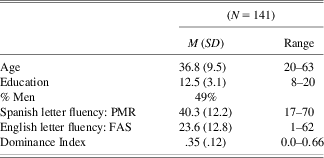
Participants were selected from two larger normative studies of native Spanish speakers of Mexican descent from the U.S.–Mexico border region (see Table 1). To be selected from these normative samples, subjects were required to have valid scores for the Stroop test, PMR in Spanish, and FAS in English, have at least 7 years of education, and be between 18 and 65 years old. This resulted in inclusion of 118 subjects from San Diego, California, and Tucson, Arizona, that were participants in a norming effort for an expanded Halstead-Reitan battery in Spanish, as well as 23 participants from the normative group for La Batería Neuropsicológica en Español (Artiola i Fortuny et al., Reference Artiola i Fortuny, Hermosillo, Heaton and Pardee1999). As part of the larger normative studies, efforts were made to recruit participants into the approximate same sized cells according to sex as well as pre-set age and education ranges. The resulting sample for the present study was made up of 70 men and 71 women ranging in age from 20 to 63 years (M = 36.8; SD = 9.5), and with educational attainment between 8 and 20 years (M = 12.5; SD = 3.1) (see Table 2).
Demographics for entire sample

Frequency distribution of age and sex by education groups

Study participants responded to flyers or direct contact with recruiters in community settings. They were selected on the basis of having reason to spend time in the United States on a regular basis (e.g., for work, school, place of residence). All participants expressed a desire to be tested in Spanish and a language use questionnaire was used to confirm that Spanish was their preferred language. As suggested by Artiola i Fortuny et al. (Reference Artiola i Fortuny, Hermosillo, Heaton and Pardee1999), The Controlled Oral Word Association Test (COWAT) (Benton & Hamsher, Reference Benton and Hamsher1989) was administered in both English and Spanish to provide an objective measure of the degree of verbal fluency in each language. Subsequently, a measure of relative English fluency was calculated to confirm language dominance. On average, participants generated 40.3 (SD = 12.2) words in Spanish with letters P-M-R, compared to 23.6 (SD = 12.8) words in English using the letters F-A-S. These letter sets are roughly matched for difficulty across languages (Artiola i Fortuny et al., Reference Artiola i Fortuny, Hermosillo, Heaton and Pardee1999). Subjects enrolled in the normative studies were carefully screened to ensure that they had no significant history of medical, psychiatric, developmental, or substance abuse disorders that could confound neuropsychological performance.
The Dominance Index
As we were interested in the effects of second language ability on native language test performance, we calculated a continuous language dominance index reflecting relative English fluency, as follows: (FAS/FAS+ PMR). Thus, the index provides the ratio of English words to total words produced in both languages. A ratio is preferred over a raw English fluency score because it avoids using level of performance on one neuropsychological test (phonemic fluency) to predict level of performance on another neuropsychological test (Stroop, Reference Stroop1935), which would be expected to be correlated for reasons not related to bilingual language control. With this measure, two participants with very different levels of overall ability could have comparable indices of language dominance. To illustrate, a person who produced 25 words in English and 50 words in Spanish (25/75 = 0.33) would have a comparable level of relative English-to-Spanish fluency to that of a person who produced 5 words in English and 10 words in Spanish (5/15 = 0.33). While their overall levels of performance are quite different, relative English-to-Spanish fluency is equivalent. Moreover, using overall fluency as the denominator makes the range of English ability easy to interpret, with 0 corresponding to no English fluency (i.e., complete Spanish dominance), 0.5 reflecting identical English and Spanish ability, and 1 corresponding to complete English dominance (i.e., no Spanish fluency).
The dominance index scores ranged from 0 to 0.66 (M = 0.35; SD = 0.12) with a higher score corresponding to higher relative English fluency. Because there is no established cutpoint for deciding what degree of difference between Spanish letter fluency (PMR) and English letter fluency (FAS) scores ought to be considered a meaningful difference, and because we wanted to capture a wider range of English fluency, we included 11 participants with scores above 0.50 but not exceeding the upper tertile of the distribution on the dominance index (>.66), which would indicate strong English dominance. Although these few individuals obtained higher English than Spanish COWAT scores, all preferred to be tested in Spanish and reported being Spanish-dominant on the language use assessment questionnaires.
For analyses, the relationship between the dominance index, sex, age and years of education was first explored using pairwise correlation analyses between the predictive variables and each outcome variable. In the analyses of primary interest, the effects of relative English fluency on a Spanish version of the Stroop test were examined with simultaneous regression analysis including the dominance index, sex, education, and age as predictors.
Procedure and Measure
This study was approved by the institutional human research protections program. Participants received the Spanish version of the Stroop Test (Artiola i Fortuny et al., Reference Artiola i Fortuny, Hermosillo, Heaton and Pardee1999) as part of a larger battery of neuropsychological tests. The Stroop test is widely used to assess executive function (i.e., selective attention and cognitive flexibility). Instructions were administered according to the test manual by Artiola i Fortuny et al. (Reference Artiola i Fortuny, Hermosillo, Heaton and Pardee1999). Testing was performed by trained bilingual psychometrists using standardized procedures. Each trial was scored as the number of correct responses achieved within 45 seconds, according to published guidelines (Golden & Freshwater, Reference Golden and Freshwater2002). For the Word Reading trial, the examinee is asked to read the names of colors written in black ink on a piece of paper containing five columns and 20 rows of words. For the Color Naming trial, the stimulus sheet contains the same number of rows and columns with stimuli made up of 4 Xs printed in red, green, or blue ink. In the Color–Word incongruent trial, the names of the colors appear in different ink color than the typed color word (e.g., the word “red” printed in blue ink). Participants are asked to inhibit reading the word and name the color of the ink instead. For all trials, participants were instructed not to stop until instructed by the examiner. They were told to go back to the first column should they complete all 5 columns. This occurred only in the Word Reading condition where participants, on average, finished reading the five columns plus six words (M = 106.7; SD = 14.3). When an error was made, the participant was corrected immediately and instructed to continue with the task. The number of correct responses in 45 seconds was recorded by the examiner for each trial.
Results
Pairwise bivariate correlations among predictors revealed that higher education was associated with higher dominance index (r = .41; p < .001). Age was not correlated with either years of education or the dominance index. Men and women did not differ significantly in age, years of education or the dominance index. Univariate correlations between each outcome variable and independent variables were followed by simultaneous multiple regression analysis with the dominance index, years of education, age, and sex as predictive variables.
Color–Word Incongruent Trial
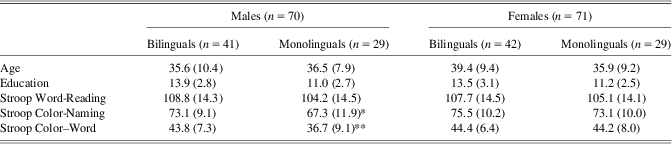
Men and women differed significantly on the Color–Word incongruent trial. Pairwise correlation analysis showed that age was not associated with incongruent trial performance, while better educated and more English-fluent speakers, performed better. Scores on the Color–Word incongruent trial were significantly correlated with the dominance index (r = 0.27; p = .001) and years of education (r = 0.18; p = .03). However, the dominance index seemed to be a more powerful predictor than education, which did not explain any unique variance in Stroop performance in a multivariate model. That is, simultaneous regression analysis revealed that, after controlling for education and age, only the dominance index (β = 15.86; p = .008) and sex (β = 1.78; p = .008), predicted incongruent trial scores [R 2 = 0.12; F(4,136) = 4.87; p = .001]. See Table 3. On average, women (M = 44.3; SD = 7.1) named three more colors in the incongruent condition than did men (M = 40.9; SD = 8.8). This difference was not driven by education or age differences in men and women, since their overall means were comparable for both demographic variables. However, as a possible explanation for the unanticipated sex difference, we considered the possibility that the effects of bilingualism could be different at the lower versus higher levels of education for men and women. For this purpose, we dichotomized participants into bilingual and monolingual based on the dominance index. Based on our original rationale of dividing the dominance index into tertiles to exclude persons who were strongly English dominant (>0.66), we decided to classify participants into Spanish-dominant and bilingual based on these tertiles. As such, participants in the lower tertile (index ≤0.33) were classified as Spanish-dominant and those with indices in the middle tertile (between 0.34 and 0.66) were classified as bilingual. However, when we dichotomized the groups into bilingual and monolingual, we found that bilingual men and women tended to be more educated than the Spanish dominant men and women, with no interaction by sex (p = .51). The difference in years of education between bilinguals and Spanish dominants was the same for both sexes (see Table 4). Thus, gender differences could not be explained by education effects. Similarly, age does not account for these differences either. Still, the bilingual effect for this sample appears to be driven by the bilingual effect in men, which is absent in the women. That is, both bilingual and monolingual females, on average, were able to produce the same number of ink colors (while inhibiting the prepotent reading response) than did the bilingual man. The monolingual men, on the other hand, named approximately six less number of ink colors (while inhibiting the prepotent reading response).
Beta weights for each predictor

*p < .05.
Means and standard deviations for education and each Stroop condition by sex and bilingualism

Note. Participants in the lower tertile (index ≤0.33) were classified as Spanish-dominant and those with indices in the middle tertile (between 0.34 and 0.66) were classified as bilingual.
*p < .05.
**p < .005.
Word Reading and Color Naming
On average, women (M = 74.5; SD = 10.1) were faster, producing approximately 4 more color names than men (M = 70.6; SD = 10.7), but no significant differences were found in their ability to read words.
In contrast with the Color–Word trial, the dominance index was not significantly correlated with Word Reading (p = .46) or Color Naming scores (p = .26), nor were education or age significantly correlated with these measures (all ps > .05). Simultaneous regression results indicate that only gender was a significant predictor of the Color Naming score (β = 1.96; p = .03) with a marginally significant overall model, [R 2 = 0.07; F(4,136) = 2.57; p = .04].
Discussion and Conclusions
Previous studies examining the effects of bilingualism on the Stroop test have mostly been conducted with young and well-educated college samples, where bilingualism has been treated as a dichotomous variable, and often based on self-report measures of language proficiency. Additionally, most studies of this sort have looked for effects of bilingualism in the individual's non-native language. Because there is great heterogeneity in the definition of bilingualism, the current study aimed to understand how different degrees of English proficiency, as are commonly observed in immigrant populations, would affect performance on the Stroop task administered in Spanish. We tested these effects in a group of adults with a broad range of age and education who identified Spanish as their first language. Results revealed smaller Stroop effects for participants who had higher degree of relative English fluency. Thus, participants with greater relative second-language ability were better at suppressing the automatic reading response in their native language. Given that the dominance index and education were moderately correlated in our sample, education would have also been expected to predict Stroop performance, as has been previously found (Anstey, Matters, Brown, & Lord, Reference Anstey, Matters, Brown and Lord2000; Moering, Schinka, Mortimer, & Graves, Reference Moering, Schinka, Mortimer and Graves2004). However, the effect of second language fluency on the Stroop trial requiring inhibitory control appeared to be independent of education once both variables were included in a regression model. On the other hand, performance on the trials that require simple processing speed was unrelated to second language fluency or education. These combined results suggest that better second language fluency confers a true advantage in the ability to suppress the unwanted prepotent response in the native language, and this effect is not explained by differences in level of education.
An alternate explanation for these findings could be that as English fluency increases, word reading abilities in Spanish decline, thereby reducing the Stroop effect and improving incongruent trial scores. This could be particularly true in those people who had somewhat better English fluency compared to Spanish (n = 11). However, this explanation seems unlikely since scores on the Spanish (PMR) and English (FAS) letter fluency tasks were positively correlated. That is, there was no subtractive effect of bilingualism (instead, increased English fluency was associated with increased Spanish fluency). Additionally, when dichotomized as monolingual and bilingual as described earlier, both groups had comparable PMR (38.7 and 41.5, respectively) and Word Reading scores (104.6 and 108.2, respectively; bilinguals, in fact, had slightly better reading scores). This suggests that the advantage conferred by greater second language fluency is related to improved inhibitory control rather than a handicap in the first language.
Previous studies examining the Stroop effect in bilingual individuals have shown mixed results. When bilingual advantages are not found, studies have often been based on small sample sizes, and as the methods have differed from those in our study, results are not directly comparable (Gasquoine et al., Reference Gasquoine, Croyle, Cavazos-Gonzalez and Sandoval2007; Roselli et al., 2002). Other studies with larger and more representative samples have also failed to find a bilingual effect on the Stroop test (Razani, Burciaga, Madore, Wong, Reference Razani, Burciaga, Madore and Wong2007). In this study, unlike the study conducted by Bialystok et al. (Reference Bialystok, Craik and Luk2008), the ethnically diverse groups (Hispanics, Asian, Middle-Eastern) may have varied significantly in level of English ability and that may have accounted for the better performance of monolingual English speakers. Entry criteria for the ethnically diverse group required that participants be fluently conversant in English and this included people who were born, raised, and fully educated in the United States but also people who received all of their education in their native countries and who may not have been highly proficient in English. The current study is novel in that it associates better second-language fluency with better Stroop performance in the native language, along the full range of second language knowledge, and including relatively unbalanced bilinguals.
The clinical implication of the findings reported here is that neuropsychological assessments should include thorough information about a patient's level of second language ability, since the bilingual advantage found in this study and other recent studies suggests that the interpretation standards for measures of executive function may need to take into account second language fluency. That is, declines in executive functions may be underestimated in speakers of a second language when using norms based on monolinguals. Therefore, in the future, we may want to consider adjusting normative standards for degree of second-language knowledge as part of the demographic corrections (i.e., education, age, and sex). This study suggests that clinicians testing native Spanish speakers in the United States should gather information about their English fluency. An index of the type used in the current study can serve to guide a clinician regarding Stroop test performances that deviate from normal in this population. For this purpose, Table 4 provides means and standard deviations for participants who were classified as either bilingual or monolingual based on the dominance index.
Additionally, in agreement with previous findings (Moering et al., Reference Moering, Schinka, Mortimer and Graves2004; Strickland, D'Elia, James, & Stein, Reference Strickland, D'Elia, James and Stein1997) showing differences in men and women's ability to name colors, this study also suggests that performances between bilinguals and monolinguals should be interpreted separately for men and women (see Table 4). The findings for sex differences in the Color–Word incongruent trial in other studies have been mixed (Mitrushina, Boone, Razani, & D'Elia, Reference Mitrushina, Boone, Razani and D'Elia2005). However, in the current study women had better ability to suppress the unwanted response than did men, despite having equal levels English dominance and education levels. Upon closer examination of the data, the relationship between the dominance index and the incongruent trial score was found to be significant for men but not for women. Moreover, this bilingual effect appears driven by the men with lower relative English fluency ratios when compared to other males with higher fluency ratios or women overall. We also considered a possible differential effect of age for men and women, but the distribution of scores for the incongruent trial across ages did not differ for the two groups. As previously mentioned, while higher levels of education where associated with higher relative English fluency (i.e., bilingualism), men and women had comparable levels of education. Therefore, no demographic variables that could account for this apparent interaction in this sample. Given that women significantly outscored men in the Color Naming and Color–Word incongruent trial, it is possible that women may not benefit from the bilingual experience as much as men do since their baseline performance is already better. Rather than speculate further about the nature of this finding with our limited sample size, we await replication of this effect in larger independent samples.
In summary, our most significant finding suggests that second language proficiency should not be ignored even when testing people in their native language, since second language proficiency seems to improve inhibitory control. As suggested by Bialystok and colleagues (Reference Bialystok, Craik and Luk2008), the Stroop incongruent trial would be analogous to the process in which a bilingual person engages when trying to speak in a second language while suppressing their first language. It remains to be understood whether individuals who became bilingual are better at inhibiting non-target behavior to begin with, and therefore have an easier time acquiring a second language, or if the ability to inhibit unwanted behavior becomes easier as the person becomes more bilingual and increasingly practices inhibitory control. The effects reported here are consistent with each of these possibilities.
Future research might also focus on the biological underpinnings of how second language acquisition modifies brain function, and should explore whether socio-economic conditions that differentiate monolinguals from bilinguals among immigrant groups are related to the bilingual advantage rather than (or in addition to) any biological mechanisms associated with bilingualism, per se. These studies would be improved by using both objective and subjective measures of bilingualism and measures of acculturation, which are often included in studies where performance of bilinguals is examined. Such measures would have enhanced the current study since it is likely that participants with higher degrees of bilingualism were also more acculturated and therefore possibly more “test savvy.” Last, future research should examine the effects of bilingualism on neuropsychological performance in other Hispanic groups, since English–Spanish bilinguals are a heterogeneous group and results of the current study may not be generalizable to bilinguals in other parts of the United States
Acknowledgment
The authors thank the members of the HIV Neurobehavioral Research Program and the participants of this study. This manuscript and information contained in this manuscript have not been published previously . This work was supported by NIH Grants MH62512, MH064907, and HD062163. The authors have no conflict of interest.