Introduction
Discovered during Woolley's first season (1922–1923) and excavated during 1926–1932, the Royal Cemetery at Ur is one of the most impressive third millennium B.C. burial sites to be discovered in southern Mesopotamia.Footnote 1 Although a great deal of work has been carried out on the ED IIIA “royal graves” (e.g., Baadsgaard et al. Reference Baadsgaard, Monge, Cox and Zettler2011; Cohen Reference Cohen2005; Dickson Reference Dickson, Hill, Jones and Morales2013; Moorey Reference Moorey1977; Pollock Reference Pollock and Laneri2007; Zettler and Horne Reference Zettler and Horne1998), less effort has been employed to fully understand the graves dated to the final part of the third millennium B.C. (see, for example, Moorey Reference Moorey1984).
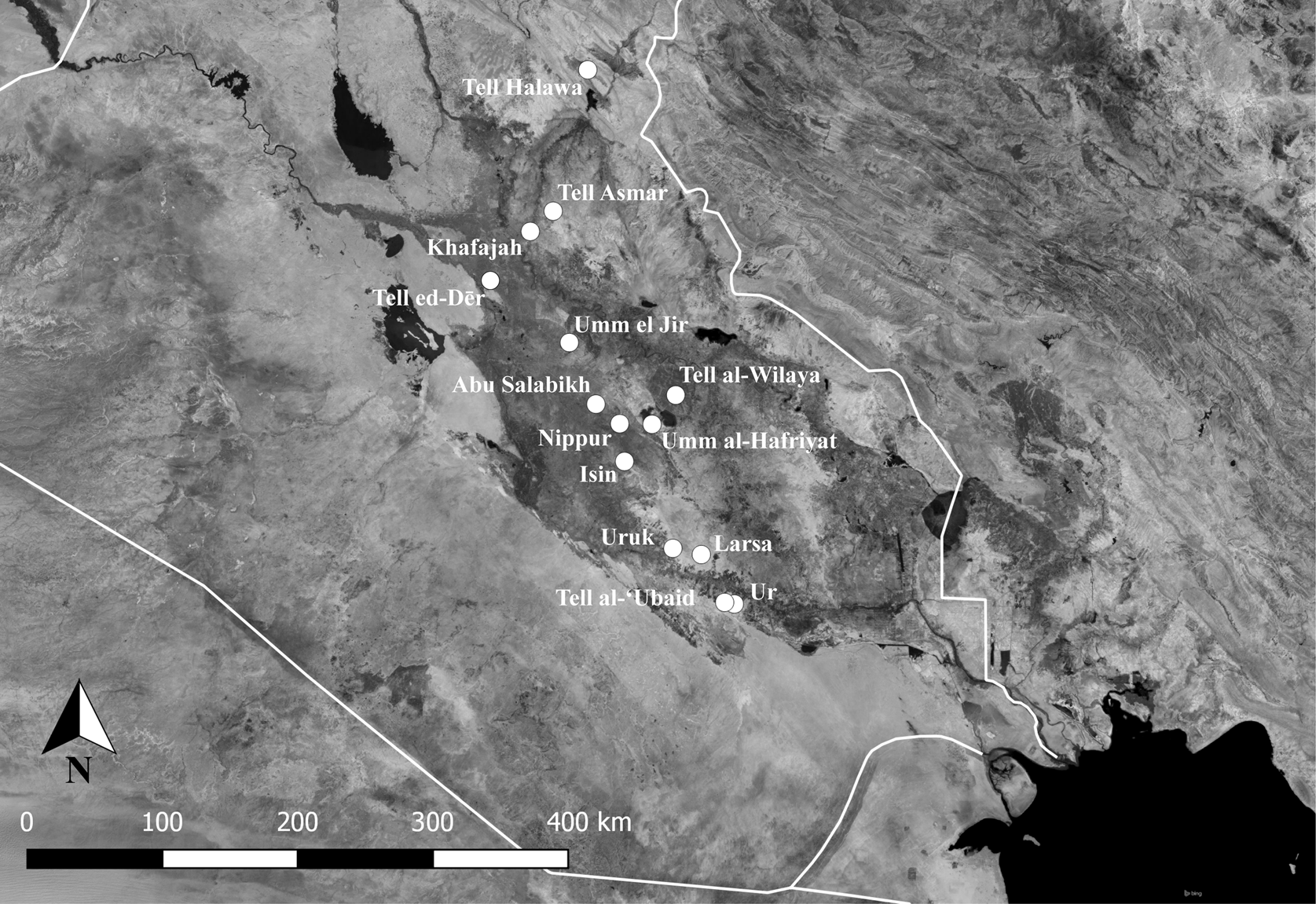
This article proposes a seriation of some of these graves in order to better define their exact chronological range. The analysis is based on archival documents made accessible by the Ur Digitization Project, including field notes and object catalogues,Footnote 2 and it is primarily built upon a ceramic analysis realised through the pottery drawings sketched in the Field Notes. The contextualisation of the pottery assemblages and seriation of the vessels result in a seriation of the graves. Principally, pottery has been taken into consideration, and, where necessary, glyptic and other artefacts, in order to refine appraisal of chronological determinants. In addition, the pottery has been compared to finds from contemporaneous sites excavated in southern Mesopotamia after Woolley's last campaigns at Ur in 1933 to 1934 (see Fig. 1 for sites mentioned in text).
Plan of southern and central Mesopotamia, with sites cited in text (by author using QGis with Bing Aerial BaseMap).
In central and southern Mesopotamia, the second half of the third millennium B.C. is characterised by the development of two supra-regional territorial states. These states were led respectively by the Akkadian Dynasty (c. 2350–2200 B.C.)Footnote 3 and the Ur III Dynasty (c. 2112–2004 B.C.), with a chaotic intermediate period, the so-called Gutian Period, occurring between them. The entire period in question spans about four centuries, and it was a period of great change when compared to the Early Dynastic Period (c. 2900–2350 B.C.).
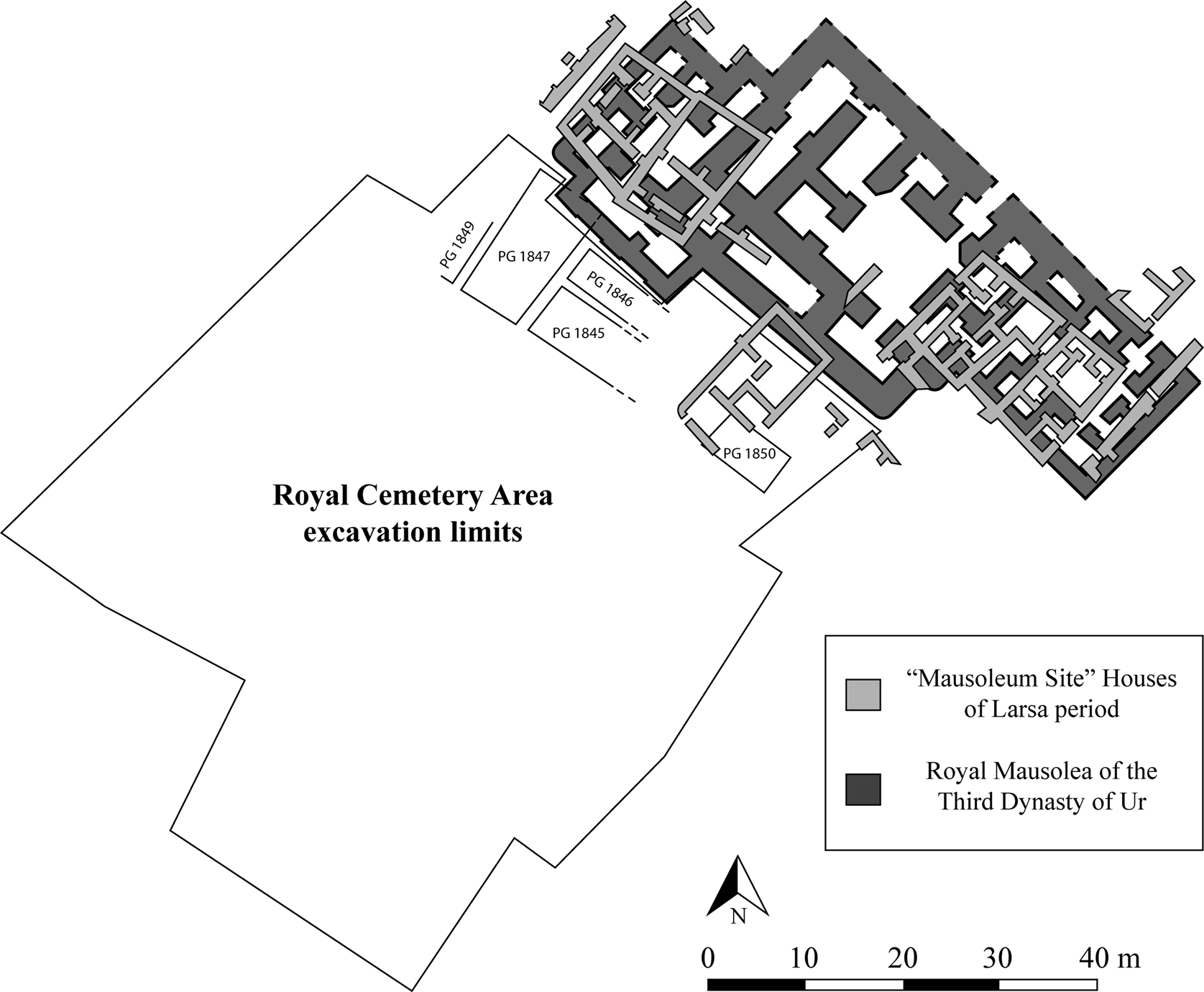
Archaeological evidence from the second half of the third millennium B.C. is limited. At Ur, levels that could be assigned to the Ur III Period were difficult to identify in the domestic areas, while the public buildings, for example the Ur III Mausolea, the early structure of the Ziggurat, the Enunmaḫ, and part of the Edublalmaḫ and the Gipar (Woolley Reference Woolley1974; Zettler and Hafford Reference Zettler and Hafford2015), were mostly uncovered due to the presence of inscribed baked bricks bearing the names of the Ur III Dynasty kings. However, per Woolley, all the public buildings have “been so often and so radically repaired that very little of their Third Dynasty contents could possibly have survived” (Woolley Reference Woolley1974: vii). The Ur III Mausolea and part of the Cemetery area were covered by houses dating to the Isin-Larsa Period (c. 2000–1800 B.C.),Footnote 4 and many Isin-Larsa graves were dug into the Cemetery area, for example from the remains of House 30A-E (“Mausoleum Site” houses; Woolley and Mallowan Reference Woolley and Mallowan1976: 166–168, pl. 128) (Fig. 2). Several other graves were discovered by Haneen (Reference Haneen2003–2004) during his excavations around the mausoleum site in 2001–2002.Footnote 5 These houses are probably the reason for the presence of some Isin-Larsa graves, excavated by Woolley (Reference Woolley1934), in the Cemetery area (see discussion of Graves PG 972 and PG 1789, below).
Reconstructed plan of the Royal Cemetery Area overlaid with the “Mausoleum Site” Houses, the Royal Mausoleum, and the “shaft-graves with multiple burials” (by author after Benati et al. Reference Benati, Leoni and Mantellini2016: fig. 3; Woolley Reference Woolley1974: pl. 53; Woolley and Mallowan Reference Woolley and Mallowan1976: pl. 117).

The lack of clear archaeological contexts for the late third millennium B.C. is reflected in the difficulties experienced in pottery seriation, a problem already addressed by Woolley who, in fact, did not identify many pottery types for this period (Woolley Reference Woolley1974: pl. 51–52). While considering the difficulties in understanding the late third millennium B.C. at Ur, the present work proposes a revised seriation and chronology for a selection of graves from the Cemetery area.
The chronology of graves in the Royal Cemetery at Ur
The Cemetery at Ur was identified during the first season of archaeological work carried out at Ur (1922–1923), but it was only extensively investigated between the fifth (1926–1927) and the tenth campaigns (1931–1932; Zettler and Hafford Reference Zettler and Hafford2015: tab. 1). Approximately 1850 graves were identified, not including those found in Pit X in 1933–34 (Woolley Reference Woolley1955: 127–145; Zettler and Hafford Reference Zettler and Hafford2015: 376).Footnote 6 Woolley dated the graves to the period from the beginning to the end of the third millennium B.C. This dating, especially for the group of burials assigned to the end of the third millennium B.C., is controversial. According to Woolley (Reference Woolley1934: 411–509), the most recent group of graves should be dated to the “Sargonid” Period. Fifteen graves, considered slightly older, were assigned to the “Second Dynasty” Period, a dynasty only known from the Sumerian King List (Jacobsen Reference Jacobsen1939; Marchesi Reference Marchesi2010; Michalowski Reference Michalowski1983). Out of these fifteen graves, five were “shaft-graves with multiple burials” (Woolley Reference Woolley1934: 181–203).
Buchanan (Reference Buchanan1954) was the first to revise the dating of the “Sargonid” and “Second Dynasty” graves at Ur. Regarding this latter group, he suggested a dating to a Post-Akkad–Third Dynasty chronological range for the “shaft-graves with multiple burials” (Buchanan Reference Buchanan1954: 149). Nissen (Reference Nissen1966) proposed a complete re-assessment of the data from the Cemetery area, re-plotting the location of the graves and revising the chronology of most of them mainly on the basis of stratigraphic and glyptic evidence. According to Nissen, 330 graves belong to the final phase of the Cemetery, dating from the post-Akkadian to the Ur III Period. Sixty graves were assigned to the Neo-Sumerian (NS) Period,Footnote 7 while 34 of them were considered “properly” Ur III, contemporary with the last ruling dynasty of Ur at the end of the third millennium B.C. (Nissen Reference Nissen1966: pl. 37). The remaining 270 graves belong to an intermediate stage between the Late Akkadian and the beginning of the Neo-Sumerian Period (Late-Akkadian/Neo-Sumerian; SA/NS), also defined as the Post-Akkadian Phase (equivalent to EJZ 4c in the ARCANE periodisation; Lebeau Reference Lebeau2011).
Pollock (Reference Pollock1985) has also revised the chronology of the Cemetery. Contra Nissen, she states that “one cannot reconstruct plans and sections with the degree of accuracy that this approach demands” (Pollock Reference Pollock1985: 130). Rather than stratigraphic evidence, she revised the chronology of the Royal Cemetery through ceramic seriations. She applied a “non-metric, multi-dimensional scaling” technique, a statistical technique based on a dissimilarity matrix, obtained from a presence-absence table of the occurrence of vessel types within the grave contexts. The result is a division of the Cemetery into six phases, from the ED IIIA to a more general Post-Akkadian Period. In part due to the quality of the data, many inconsistencies are noted when the results of Woolley, Nissen and Pollock are compared.
First, the positioning of the graves, as proposed by Nissen in 1966, differs from the plan published by Woolley. Nissen's re-analysis was based on a new arrangement of the graves, on the assumption that Woolley made an error in the orientation of the main point of reference in the Cemetery area, the Neo-Babylonian temenos wall (also see Benati et al. Reference Benati, Leoni and Mantellini2016: 14–16; Zimmerman Reference Zimmerman1998: 30). Mallowan and Parker (Reference Mallowan and Parker1970) strongly criticised this re-evaluation, stating that the supposed error made by Woolley was insignificant and, for this reason, Nissen's plan should be considered unreliable.
The analysis of pottery from Ur is affected by certain issues. In 1923–1924, during his second season at Ur, Woolley also excavated at Tell al-Ubaid. Noticing similarities in some pottery types from the two sites, Woolley occasionally used the notation “TO” (Tell Obeid), together with a Roman numeral corresponding to the type identified in the analysis of the al-Ubaid repertoire, in the Ur Field Notes (Benati Reference Benati2015: 95; Gokel Reference Gokel1983: tab. 1; Martin Reference Martin1982: 153). The notation is sometimes overwritten with a different enumeration corresponding to a revised system of letters and numbers established before final publication. The recognised types are very general, with limited attention to internal variability, and there is no reference to the number of vessels used to create the typology. Moreover, the pottery vessels from the Royal Cemetery at Ur, housed in the British Museum and in the University of Pennsylvania Museum, are a selection of the vessels found during the excavations, and it is only possible in a very few cases to trace them back to their original grave context.
Methodological approach
The Ur Digitization Project has digitised and made available the documentation and objects stored at the British Museum in London and at the University of Pennsylvania Museum of Archaeology and Anthropology in Philadelphia. For the present study, two collections of documents have been fundamental. They are: (1) the Field Notes, in the form of excavation notebooks, divided by area and context, and containing the elevations, stratigraphic relationships, and all other information related to the excavation, including drawings of some of the finds; and (2) the Catalog Cards, the documentation related to the objects selected for the collections housed in the museums of London, Philadelphia and Baghdad. They contain a brief description of each object, with notes detailing their dimensions and materials.Footnote 8 Some objects, stored in the British Museum and assigned to the contexts under investigation, have been analysed first-hand by the author.
In writing this paper, analysis was limited to the group of graves dated by Nissen to the late third millennium B.C. (“SA-NS”, “NS” and “Ur III”, following his terminology). Nissen's work was the starting point for the selection of graves, since he was the first to recognise the presence of a considerable post-Akkadian phase in the Cemetery (see also Karstens Reference Karstens1987).
Regarding the positioning of the graves, at present it is not possible to provide exact locations. When comparing the positions of the same graves in the publications of Woolley (Reference Woolley1934: pl. 274) and Nissen (Reference Nissen1966: pl. 41), one notes that the differences are quite consistent for various groups of graves, with the position generally shifting from north (Woolley) to south (Nissen) (Fig. 3). In many cases, the relative placement of each group does not change. On this basis, it is still possible to analyse the graves that have a direct stratigraphic relationship in both Woolley's and Nissen's plans. The depth of each grave from the surface was noted by Woolley in the Field Notes and checked in the reconstructed sections presented by Nissen (Reference Nissen1966: pl. 24–36).
Reconstructed plan of the Royal Cemetery Area with the positioning of graves cited in the text. It is not possible to place some graves. PG 26, PG 323, PG 869A, PG 1793, PG 1817A are based on Woolley (Reference Woolley1934: pl. 274); PG 26, PG 323, PG 715, PG 1784, PG 1789, PG 1793, PG 1817A are based on Nissen (Reference Nissen1966: pl. 41).

As outlined above, it is not possible to directly analyse the pottery assemblages from selected contexts within the Ur Cemetery. However, the shapes of the vessels are identifiable thanks to the drawings in the Field Notes. Despite the poor quality of some of these drawings, the vessels are reproduced to scale, together with a brief description and notes of measurements. Therefore, the Field Notes are relevant for morphological comparisons, although it is not easy to recognise “internal” variations within types. But not all the vessels listed in the Field Notes were drawn and, in many cases, the sections of the vessels were not reproduced. Nevertheless, the drawings in the Field Notes make up the closest example known to modern pottery documentation for selected contexts in the Royal Cemetery at Ur.
As a case-study, a selection of 18 graves has been chosen, including graves that: (1) are in a direct stratigraphic relationship on both Woolley's and Nissen's plans, and according also to the depth noted in the Field Notes; and/or (2) present more than one pottery vessel drawn in the Field Notes. The graves selected are (in numerical order): PG 26, PG 620, PG 695, PG 715, PG 735, PG 746, PG 825, PG 829, PG 871, PG 888, PG 972, PG 1003, PG 1422, PG 1425, PG 1784, PG 1789, PG 1793, and PG 1817A. Apart from PG 1422, these graves have never been analysed in detail.
For this paper, graves considered problematic for various reasons have been excluded, including graves PG 641 and PG 643. Woolley included the latter (1934: 181–182) in the “Second Dynasty Graves” group. PG 643 is covered by PG 641 on both Woolley's and Nissen's plans. Despite the stratigraphic relationship, PG 643 was “plundered before PG 641 was made, possibly on that occasion”, to quote Woolley in the Field Notes. That said, it is not possible to establish whether the objects found in PG 643, which were drawn in the Field Notes, are the original repertoire of the grave, or are, for example, part of Grave PG 641 and became mixed during plundering.
Proposing stratigraphic re-appraisals through the use of archival data: The peculiar case of Grave PG 1849
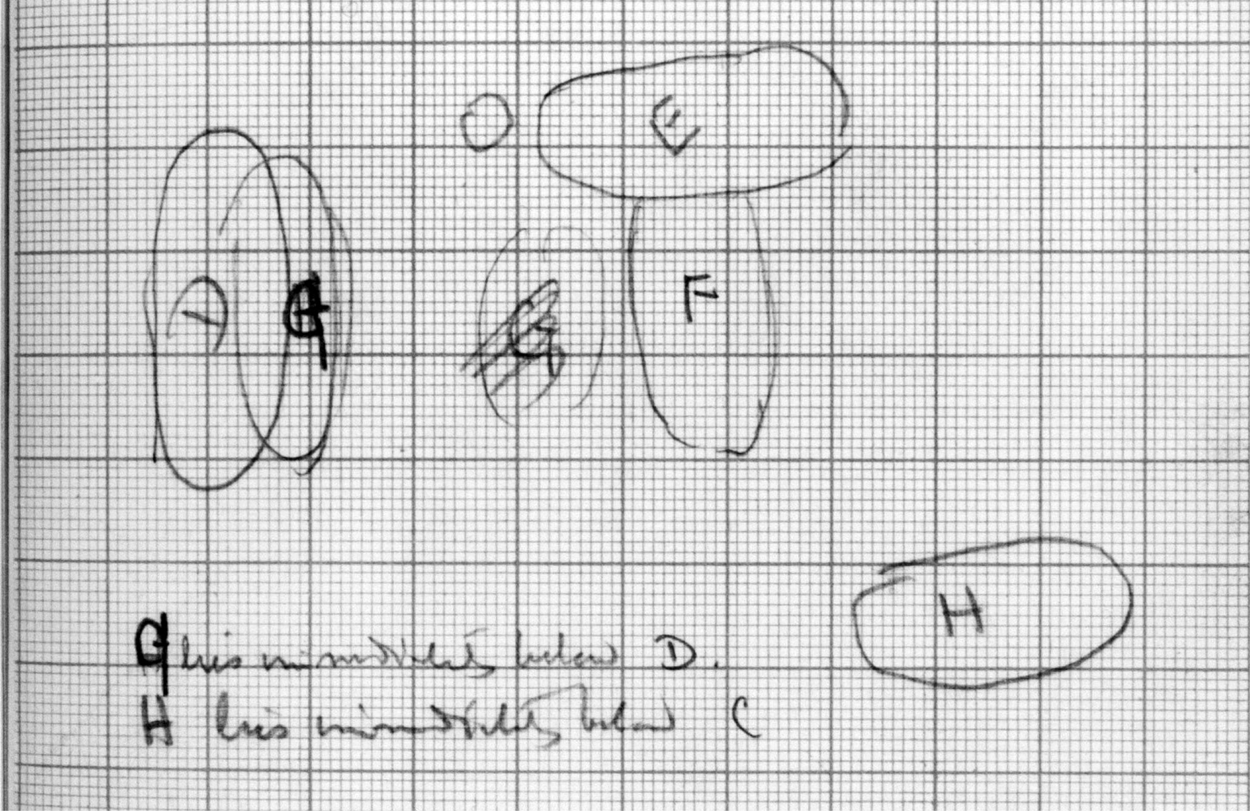
In some more fortunate cases, the archival data are also relevant for re-appraising certain other contexts. For example, the discovery of a sketch with no reference number in the Field Notes (Fig. 4) is useful for a re-evaluation of Grave PG 1849. Woolley included this grave in the “shaft-graves with multiple burials” (PG 1845 to PG 1850), which were originally assigned to the “Second Dynasty” Period. Woolley considered these graves to be contemporary, each composed of several burials arranged on different levels, together with hearths and other ritual facilities.
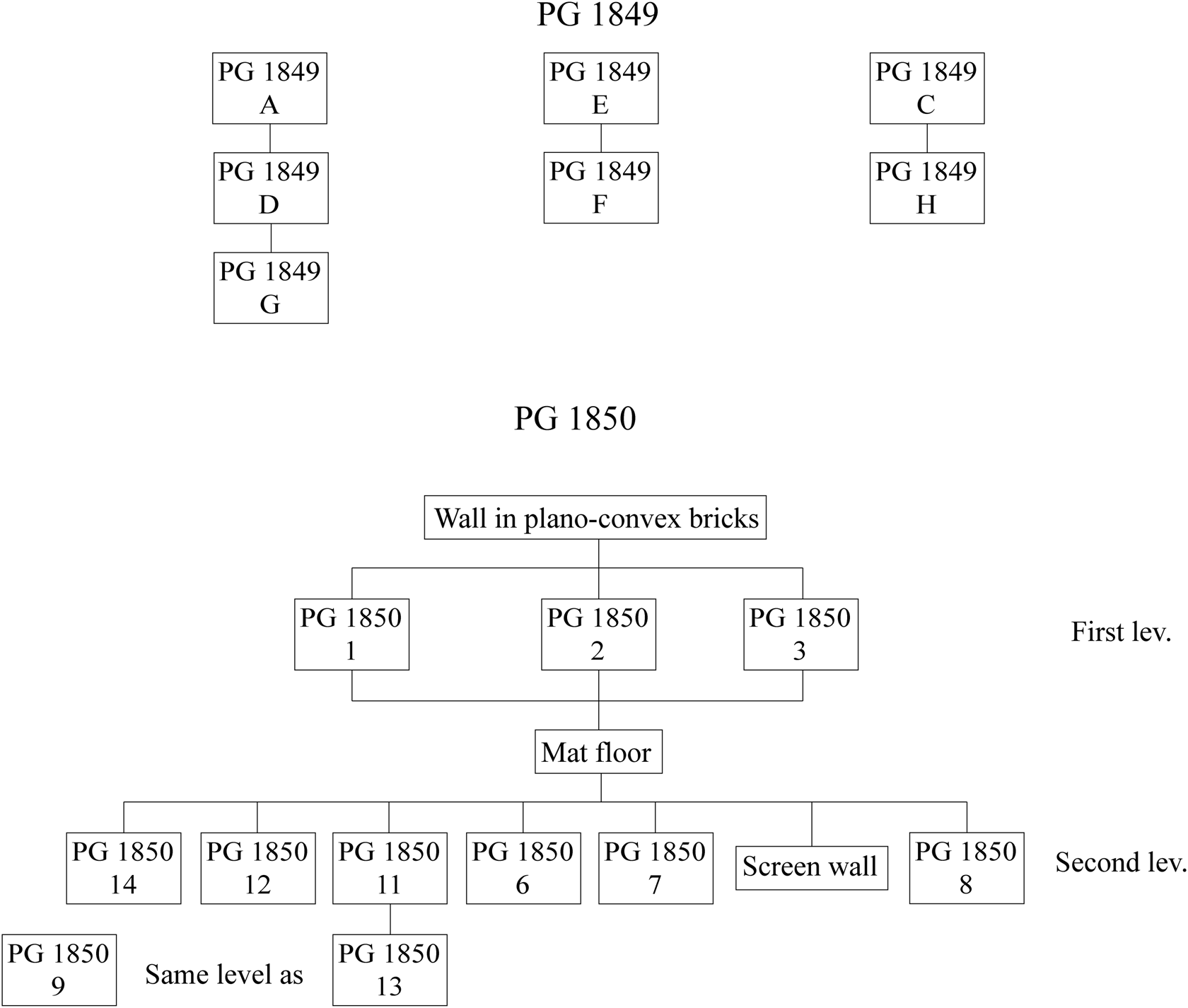
Sketch in the Ur “Field Notes” with the placement of burials probably assigned to PG 1849. Courtesy of the Ur Digitization project, http://www.ur-online.org/media_item/263364/.
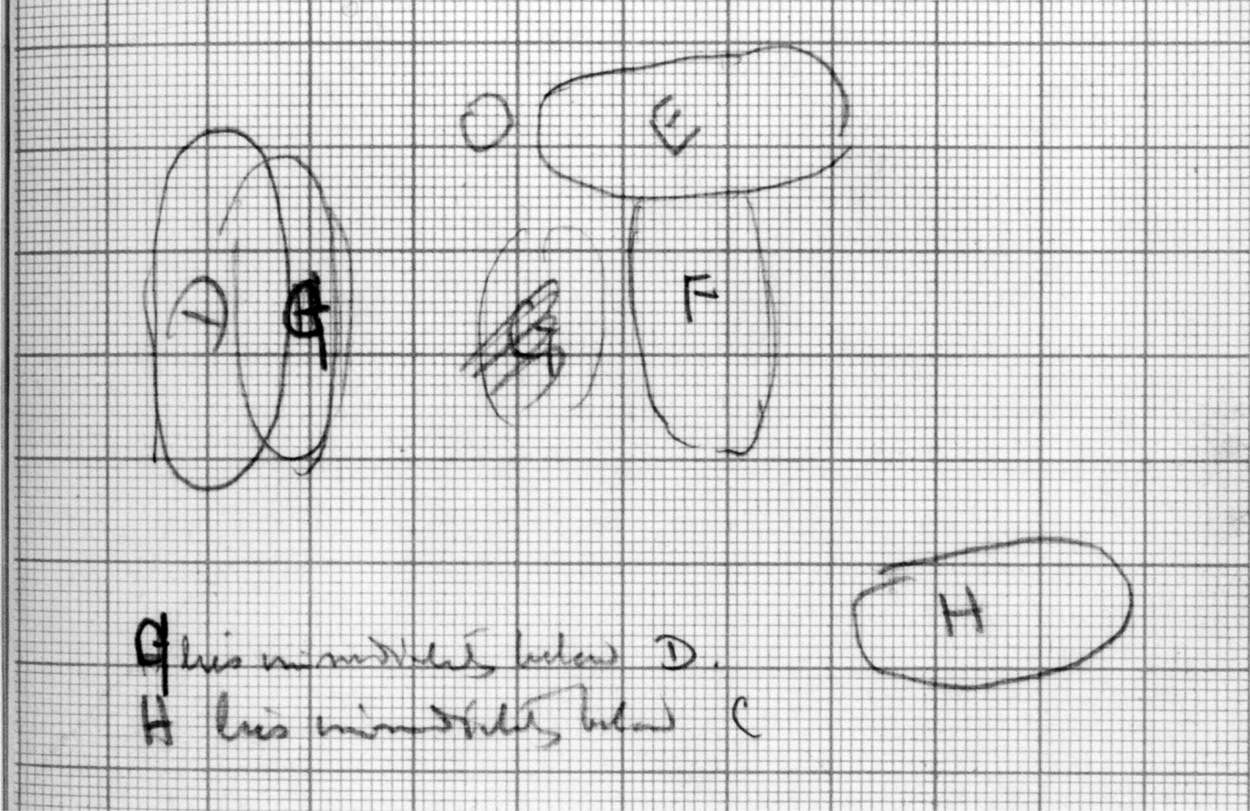
During the excavations, the difficulties in recognition of the limits of Graves PG 1847 and PG 1849, together with the proximity of the two graves and the absence of any planimetry for shaft-grave PG 1849, may have caused confusion in the assignment of burials to the two graves. Moreover, initially, during the excavations, another shaft-grave was labelled PG 1848. This shaft-grave appears in the Field Notes, but it is not mentioned in the final publication (it is only mentioned in error in Woolley Reference Woolley1934: 594, U.17808). The material finds and burials initially listed as belonging to PG 1848 were subsequently divided between Graves PG 1847 and PG 1849, with some discrepancies.
With regard to Burial F, which is labelled PG 1848 in the Field Notes, it is noted that “the body lay just below (Burial) E”. The inventory number (U. 17810) associated with this burial was assigned to both PG 1847 and PG 1849 in the final publication. In Grave PG 1847, according to the plan proposed by Woolley, Burials E and F are far apart, without any direct relationship. However, the sketch identified in the Field Notes (Fig. 4) shows two burials (labelled E and F) with a direct stratigraphic relationship.
A similar issue is observed for Burial H, the objects from which were catalogued using the reference U.17812 and published as belonging to PG 1847. In the Field Notes, the burial is marked as belonging to PG 1847 (overwritten to an initial PG 1849), whereas in the publication it is said that “the grave lay directly below C, separated from it by only a few centimetres of soil” (Woolley Reference Woolley1934: 198). Nevertheless, in the plan of PG 1847, the two burials have no relationship with each other, and the letter “H” seems to indicate a hole cut in the third floor level, rather than a proper burial. Conversely, on the Field Notes sketch, a burial labelled H lies immediately below Burial C.
Based on this analysis, it is suggested that the sketch in the Field Notes refers to the situation uncovered during the excavations of PG 1849. Therefore, it is possible to suggest a coherent placement for the burials assigned to the grave in question. Although, in the author's opinion, the “shaft-graves with multiple burials” cannot be considered a reliable context (see below), the single burials within them can be analysed as unique contexts with their own “proper” stratigraphic relationships.
The pottery assemblage from the graves
The results presented here are based on analyses of both the stratigraphic position (where relevant) and the pottery assemblages from the graves selected for study. The ceramic repertoire has been analysed using a chronological-typological approach in order to identify pottery markers that would be useful for creating a periodisation of the selected graves. From the Late Akkadian Period to the beginning of the second millennium B.C., the ceramic horizon is characterised by no clear breaks in the pottery sequence, and thus only certain types are relevant for an accurate chronological evaluation (Casadei Reference Casadei, Stucky, Kaelin and Mathys2016, Reference Casadei, Coppini and Simi2020; Casadei and Volpi Reference Casadei and Volpiin press).
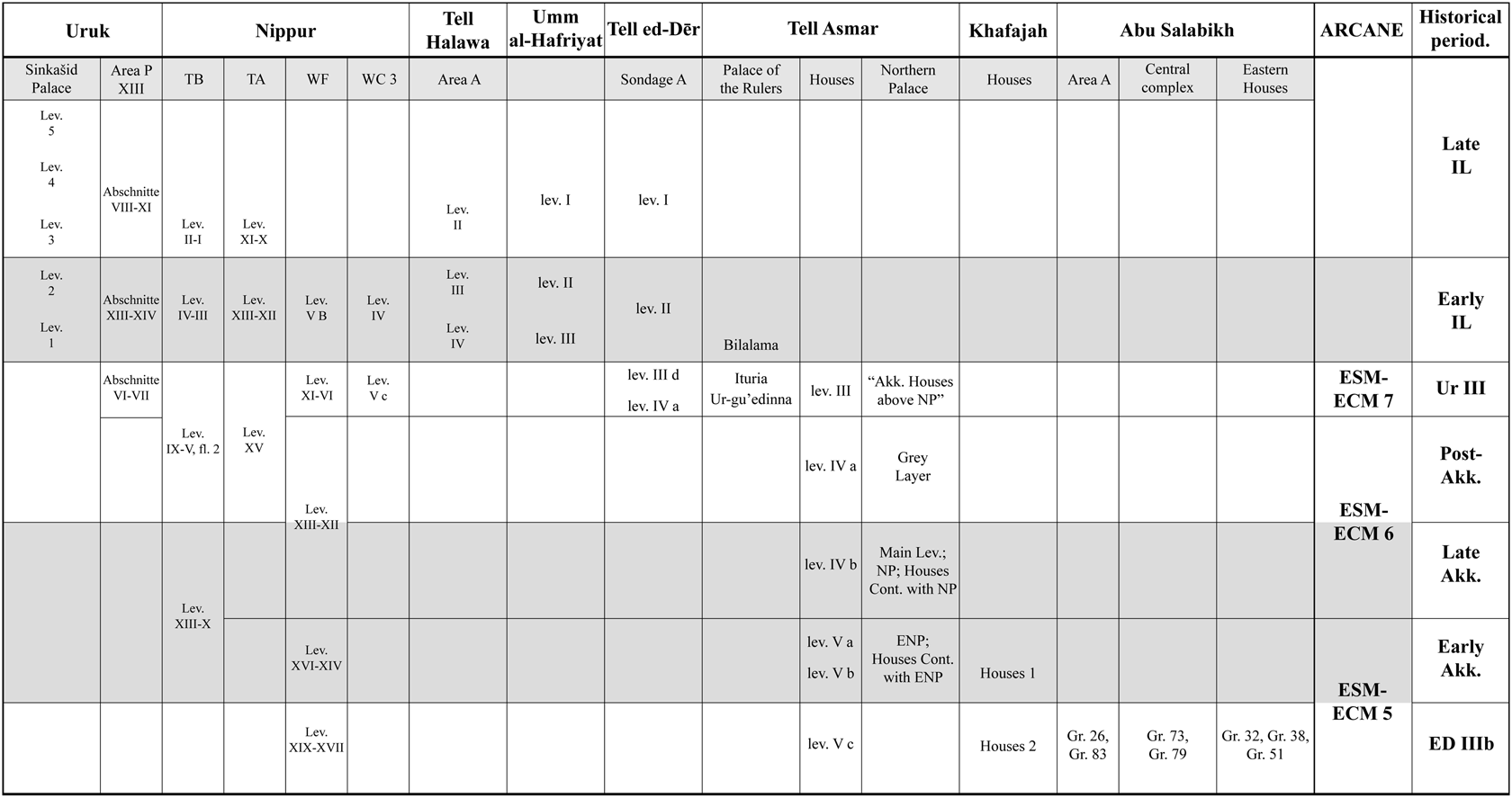
Three main groups of graves have been identified. They have been associated, respectively, with the first quarter of the second millennium B.C. (Group 1); the period between the Late/Post Akkadian Period and the end of the third millennium B.C. (Group 2); and the ED III/Early Akkadian Period (Group 3). Comparisons have been made with the main central and southern Mesopotamian archaeological sequences covering the second half of the third millennium B.C. (for a comprehensive list of sites and their well-stratified contexts, see Fig. 5) and have also been based on the works of Delougaz (Reference Delougaz1952), Ayoub (Reference Ayoub1982), and Armstrong and Gasche (Reference Armstrong and Gasche2014).Footnote 9
Main archaeological sequences considered in the text. The sequence of Nippur TB is based on Zettler (Reference Zettler1991); the sequence of Tell Asmar is based on Gibson (Reference Gibson1982) and Reichel (Reference Reichel2018).
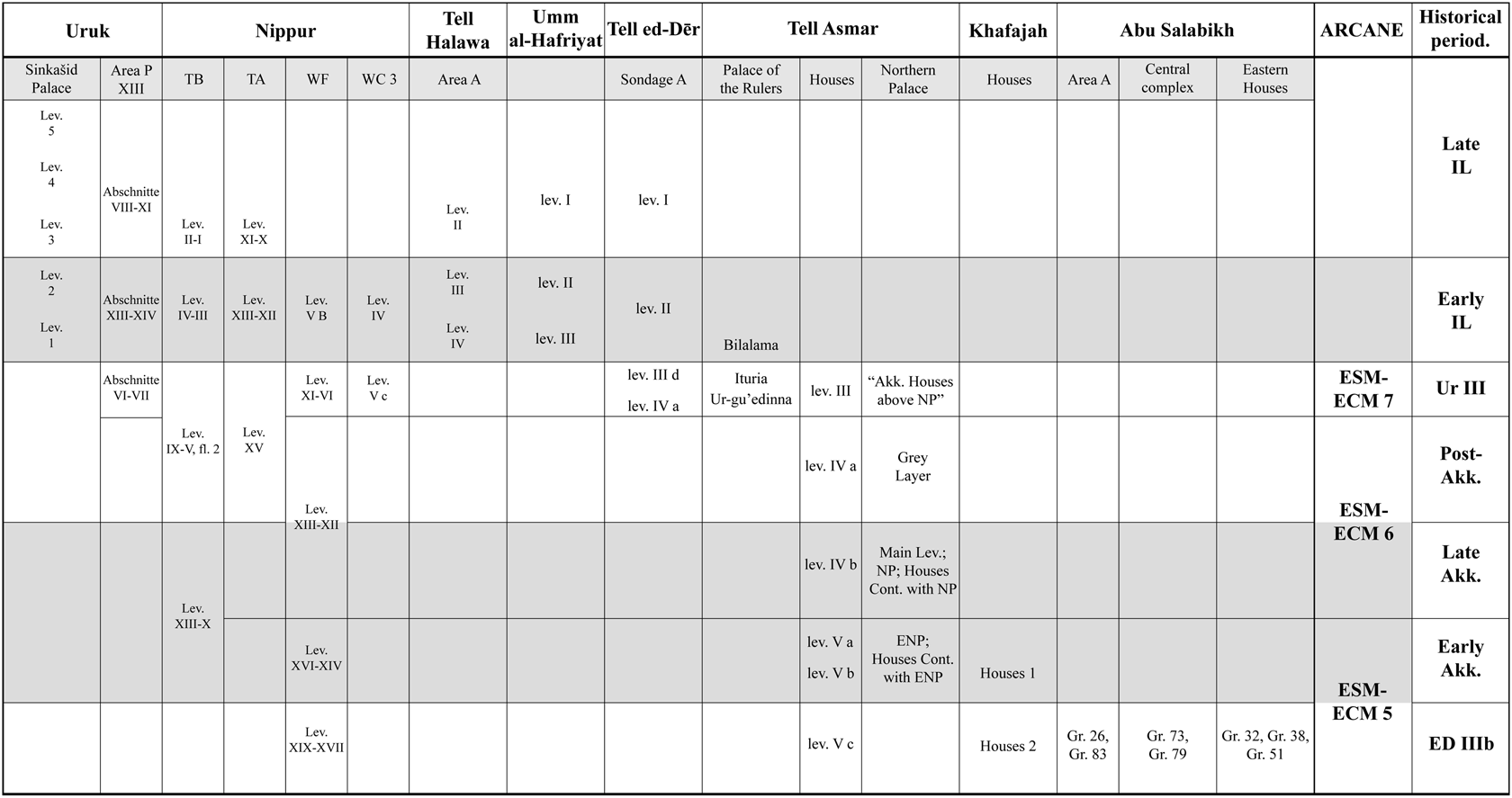
Whenever possible, more specific dating has been provided for the graves within each group. In most cases, the drawings in the Field Notes enable comparisons to be made on the basis of the general vessel shapes without going into specific detail.
Group 1: Isin-Larsa (IL) Period
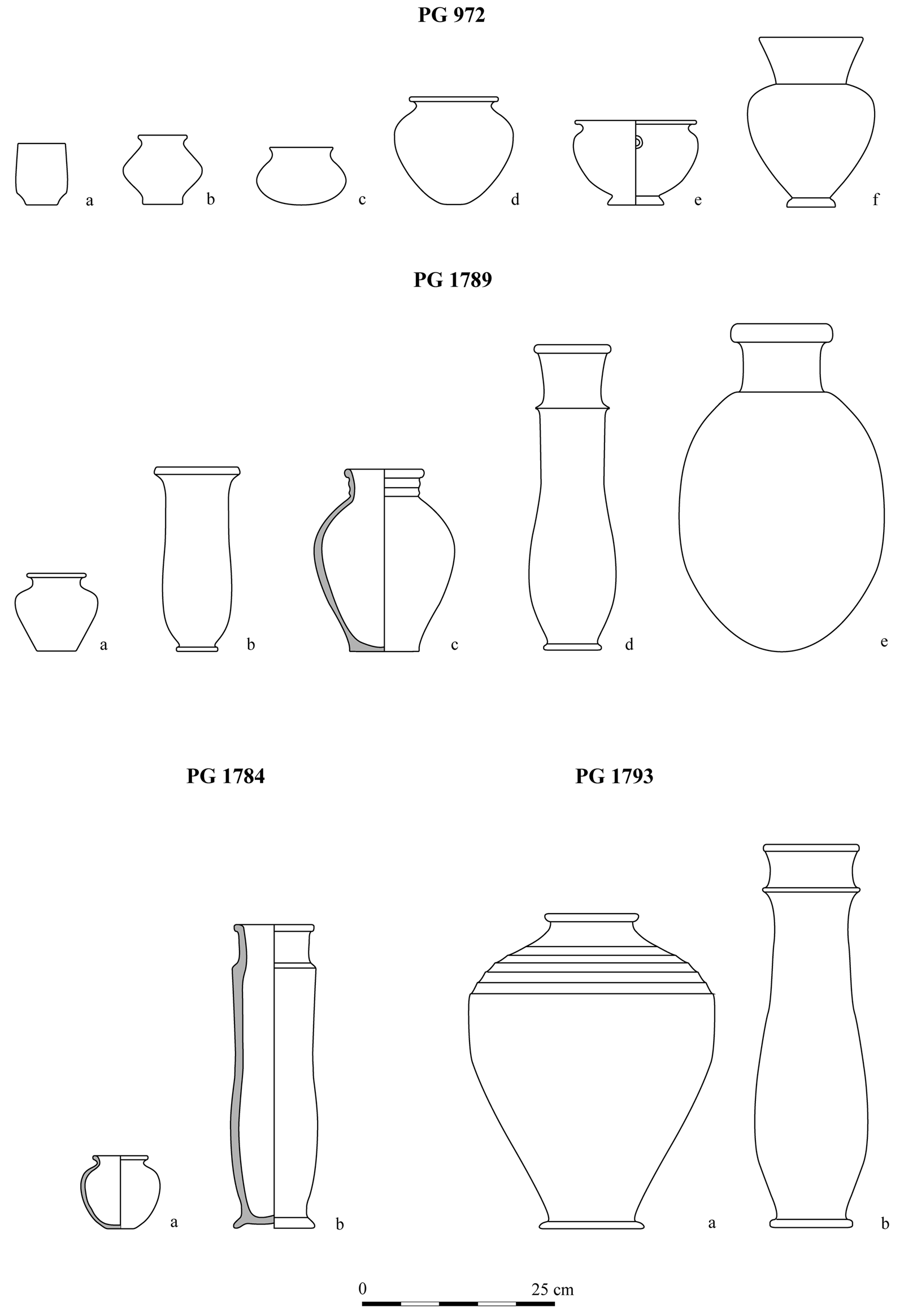
Group 1 is composed of two graves (PG 972 and PG 1789; see Fig. 6), which have been assigned to the beginning of the second millennium B.C. thanks to their pottery assemblages.
Graves assigned to Group 1 (PG 972 and PG 1789) and group 2b (PG 1784 and PG 1793). The vessels are scaled based on the measurements given in the Field Notes.

Grave PG 972 is described by Woolley as being a group of pots rather than a proper grave. Its pottery assemblage is composed of a small cup with straight sides and a low carination close to its base (Fig. 6: PG 972 a; Group 65 B1; Armstrong and Gasche Reference Armstrong and Gasche2014: 34–35); a small jar with inverted pyriform sides (Fig. 6: PG 972 b; Group 200 A1; ibid.: 57–58); and a “footed” jar with high shoulder and flaring neck (Fig. 6: PG 972 f; Group 240 C2-3; ibid.: 65–66). Cups with low carinations near their bases do not appear before the IL Period (Uruk Sinkašid 3, van Ess Reference van Ess1988a: fig. 36, no. 208; Nippur TB II, McCown and Haines Reference McCown and Haines1967: pl. 89, no. 2), while the jars with inverted pyriform sides are attested in levels assigned to both the Ur III and IL Periods (Nippur TB VII-V and TA XIII-XII, McCown and Haines Reference McCown and Haines1967: pl. 85, nos. 7-8 and 14; pl. 91, nos. 4-5; Umm al-Hafriyat level II, Armstrong and Gasche Reference Armstrong and Gasche2014: pl. 91). Although the “footed” jars with high shoulder and flaring neck only seem to appear during the Ur III Period (Nippur TB VIII, McCown and Haines Reference McCown and Haines1967; Nippur WC-3 Vc, Armstrong and Gasche Reference Armstrong and Gasche2014: pl. 109), their relationship with the other two vessel types enables the entire context to be assigned to the IL Period.
Described as a larnax grave, Grave PG 1789 was found above the “shaft-graves with multiple burials”. Woolley marked PG 1789 (and PG 1784 from Group 2b) on the general plan of the Cemetery, while Nissen reported that they are “über Ur II-Schachtgräbern”, but their exact location is unknown (Nissen Reference Nissen1966: 190–191). As regards the pottery assemblage, the tall vessel with straight and slightly flaring sides, with a small band on its everted rim (Fig. 6: PG 1789 b; Group 90 B2-C2; Armstrong and Gasche Reference Armstrong and Gasche2014: 37–39), is comparable to jars found in Uruk Area P XIII (Abschnitt IX; van Ess Reference van Ess1988b: fig. 4, nos. 9 and 13) and in the area of the Sinkašid Palace, Level 4-5 (van Ess Reference van Ess1988a: fig. 36, nos. 207–208 and 210–211) in levels assigned to the Late IL Period. In addition, the jar with unpronounced shoulder and a characteristic multi-grooved neck (Fig. 6: PG 1789 c) is comparable with vessels from the Sinkašid Palace, Level 5 (van Ess Reference van Ess1988a: fig. 19, no. 134) and from Tell Halawa, Area A (Yaseen Reference Yaseen1995: pl. 88, nos. 211–214). Inside the grave, there is also a globular jar with a cylindrical neck (Fig. 6: PG 1789 e). This jar finds comparison with a jar in Grave 39 at Uruk (Boehmer et al. Reference Boehmer, Pedde, Salje, Kúcher, Maul and Meinert1995: pl. 21), and a tall “collared” jar with a sinuous body (Fig. 6: PG 1789 d; Group 110 A2; Armstrong and Gasche Reference Armstrong and Gasche2014: 43–44). This pottery type is distinctive of the transition between the Ur III and IL Periods (see below). However, thanks to its association with more recent pottery types, it is possible to assign the grave to the IL Period.
The discovery of private houses dating to the Isin-Larsa Period in the area of the Mausolea (Haneen Reference Haneen2003–2004; Woolley and Mallowan Reference Woolley and Mallowan1976: 166–168, pl. 128) could explain the later use of the area, as connected to these structures (Fig. 2).
Group 2: Late Akkadian Period to the Ur III Period
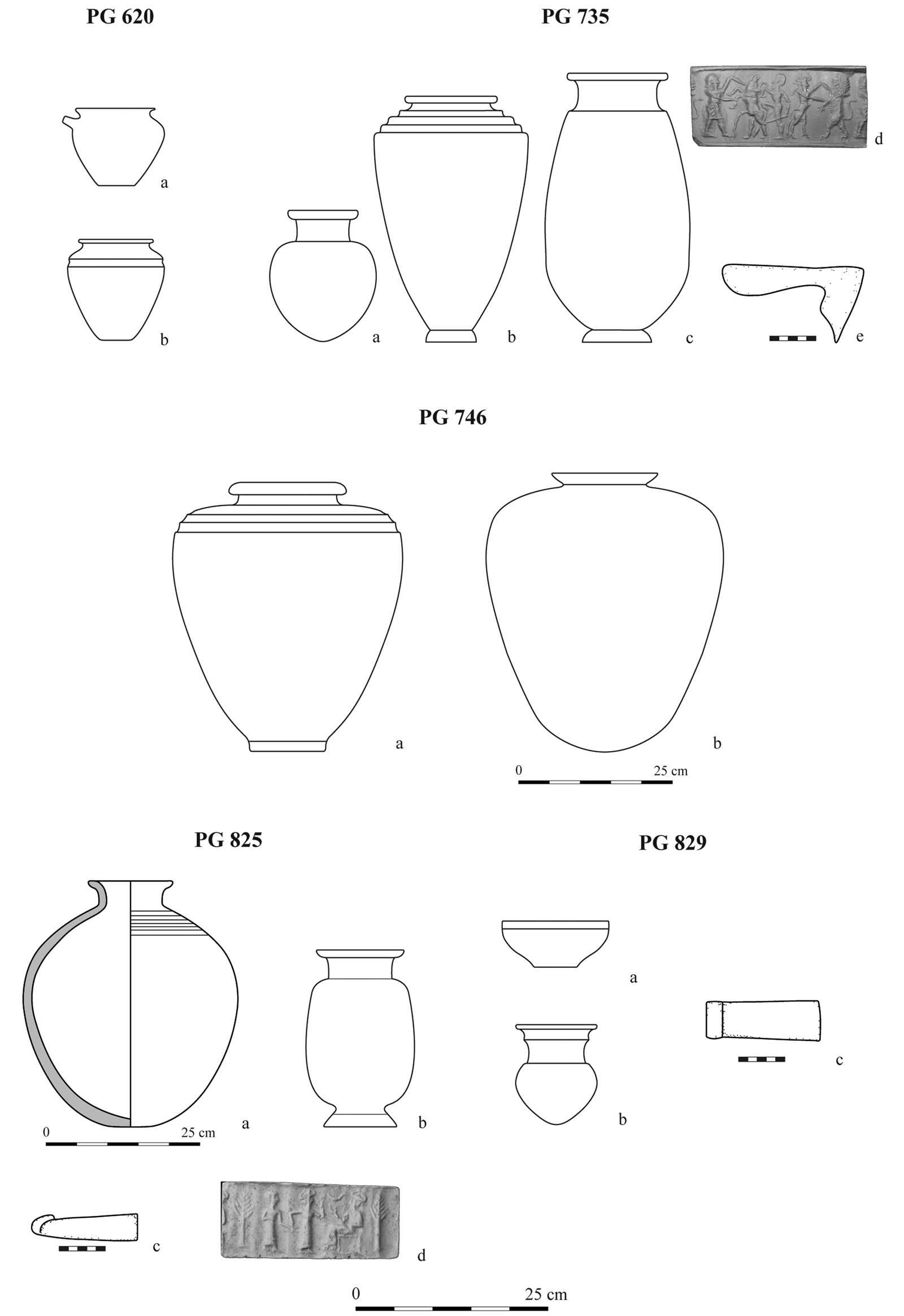
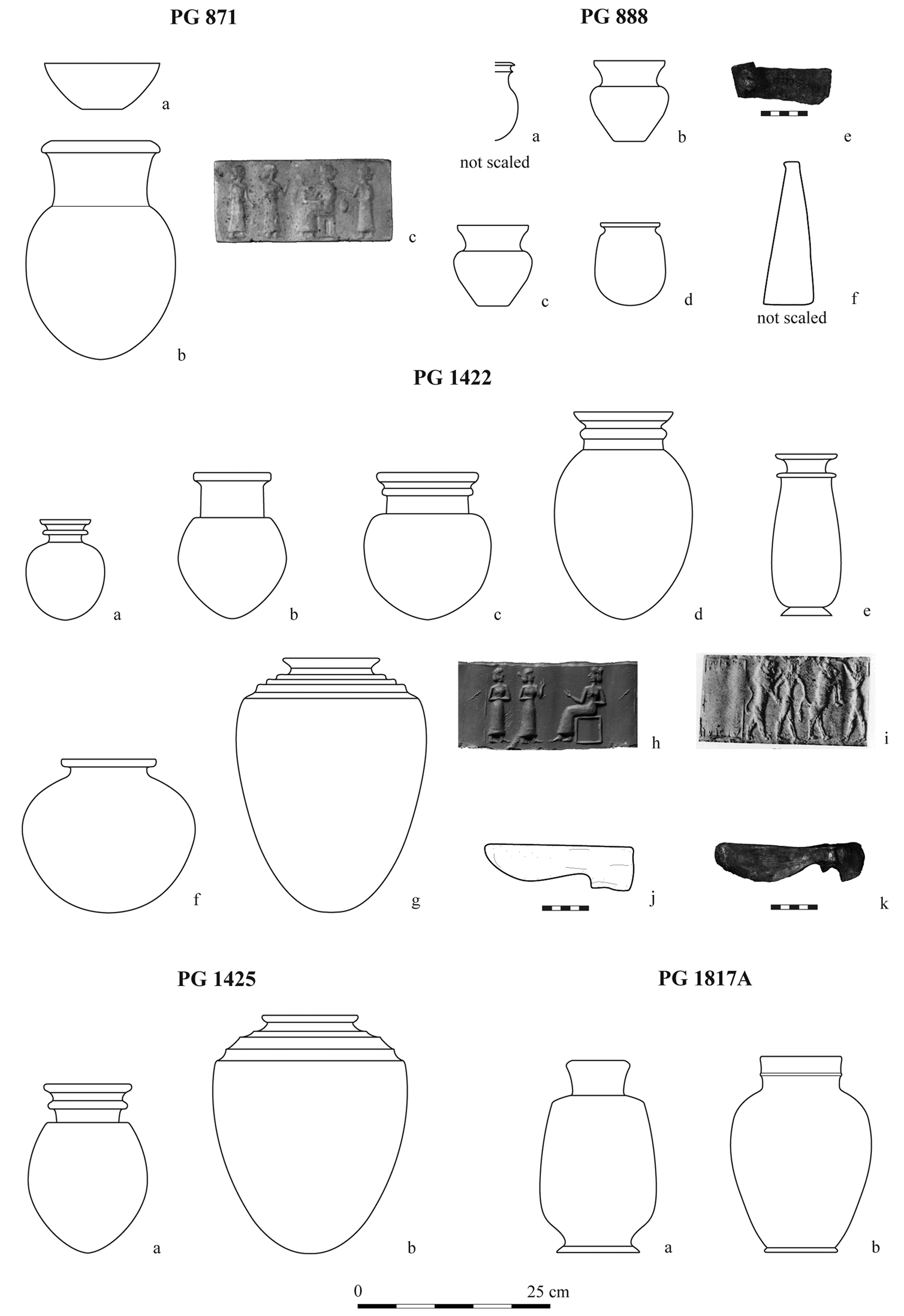
The Group 2 graves are the most consistent (PG 620, PG 735, PG 746, PG 825, PG 829, PG 871, PG 888, PG 1422, PG 1425, PG 1784, PG 1793 and PG 1817A; Figs. 6–8) and have been dated to the period from the Late/Post-Akkadian Period until the very end of the third millennium B.C. The presence/absence of some pottery types allows division of the group into two sub-groups (2a and 2b). In instances where it proves impossible to refine the dating, the grave in question is simply assigned to Group 2.
Graves assigned to Group 2. Pictures by the author at the British Museum, London (courtesy of the British Museum) and from the online database of the Penn Museum, Philadelphia (courtesy of the University of Pennsylvania Museum of Archaeology and Anthropology). Sketches from Ur “Field Notes” and “Catalog Cards”. For the objects stored at the Iraqi Museum of Baghdad, the images are from Woolley Reference Woolley1934.

Graves assigned to Group 2.

Two pottery types are usually found in the Group 2 graves, that is, the so-called “Akkadian” jars with ridged shoulders (e.g., Fig. 6: PG 1793 a; McMahon Reference McMahon and Lebeau2014: 245–252), and “tall collared” jars (e.g., Fig. 7: PG 735 c). Regarding the duration of their presence in the pottery sequence, they both occur from Level XIV to Level VI in Nippur WF (McMahon Reference McMahon2006: 113, 115). A specimen of a “collared” jar has been attested at Tell ed-Dēr in a level assigned to the very end of the third millennium B.C. (Level III d; De Meyer Reference De Meyer1984: pl. 11, no. 1). The form of this jar varies significantly, especially as regards the presence or absence of a ridge on the neck or shoulder.
The “Akkadian” heart-shaped beakers with double-ridged rims (e.g., Fig. 7: PG 829 b; Arrivabeni Reference Arrivabeni and Lebeau2014: 237–243) are considered typical of the first part of the period (Group 2a), because their presence has not been attested at the very end of the third millennium B.C. They cease to appear in the Nippur WF sequence beyond Level VIII (McMahon Reference McMahon2006: 112).
Two forms have been assigned to the second part of the period (Group 2b). They are the so-called “beakers” with a triple-ridged rim (e.g., Fig. 8: PG 1422 c-d), and carinated “footed” jars with a sinuous body (e.g., Fig. 6: PG 1784 b). These two types were found together in Grave 34 at Uruk, together with two carinated bowls (Boehmer et al. Reference Boehmer, Pedde, Salje, Kúcher, Maul and Meinert1995: pl. 17). The beakers with triple-ridged rims appear in small amounts in Levels XI-X, and at a higher percentage in Levels VII-VI, of Nippur WF (McMahon Reference McMahon2006: 117). A very interesting example was found at Tell Asmar/Eshnunna (Delougaz Reference Delougaz1952: pl. 163, no. B.645.540a; Frankfort et al. Reference Frankfort, Lloyd and Jacobsen1940: pl. XIX, no. 3). According to the reconstruction proposed by Reichel (Reference Reichel2018: 36), the Ur III governor's palace was built by Ur-gu'edinna, a governor of Eshnunna under Shulgi. Thus, the palace was built before the Shu-Sin Temple, constructed by Ituria for the royal cult. The beaker with a triple-ridged rim was found in Room M 32:11, in a context allocated to the “lower than Bilalama level” by Frankfort (Frankfort et al. Reference Frankfort, Lloyd and Jacobsen1940: 250). At the very beginning of the second millennium B.C., under King Bilalama, the palace was substantially refurbished (Reichel Reference Reichel2018: 40), giving a precise terminus ante quem for the context. Considering that the beakers with a triple-ridged rim belong to the very end of the third millennium B.C., the specimen described here has thus been assigned to a context between the reigns of Bilalama and Ituria. A specimen of this type was also found in Grave PG 643, but due to problems related to the documentation (see above), it has not been included in the present analysis.
In this overview of the pottery types associated with the Group 2 graves dating to the Late/Post-Akkadian–Ur III Periods, it is interesting to underline the total absence of “carinated bowls”, a vessel considered “typical of the Ur III through Isin-Larsa periods” (Types O-17 and O-22 from Nippur WF; McMahon Reference McMahon2006: 80; Type 8B from Nippur TB; McCown and Haines Reference McCown and Haines1967: tab. II; pl. 82, nos. 19, 20, 23).
Grave PG 1784 covers one of the “shaft graves with multiple burials” (see above, as well as Nissen Reference Nissen1966: 190–191). Found in PG 1784, the carinated “footed” jar with an elongated and sinuous body (Fig. 6: PG 1784 b) is also present in PG 1789 (Fig. 6: PG 1789 d) and PG 1793 (Fig. 6: PG 1793 b) and is distinctive of the transition phase between the third and second millennia B.C. It finds comparisons at Nippur Area TB, Levels V-IV (McCown and Haines Reference McCown and Haines1967: pl. 85 nos. 5–6), at Uruk Sinkašid Palace, Level 2 (van Ess Reference van Ess1988a: fig. 40, no. 231–232), and at Uruk Area P XIII, Abschnitt XII (van Ess Reference van Ess1988b: 463, no. 48).Footnote 10 In addition, the globular, wide-mouthed pot with a rounded rim (Fig. 6: PG 1784 a; Group 55 A3; Armstrong and Gasche 204: 32–33) is attested in the transitional Ur III-IL Period at Nippur (WF VI; McMahon Reference McMahon2006: pl. 116, no. 16; TB IV; McCown and Haines Reference McCown and Haines1967: pl. 90, no. 4). Thus, the grave has been assigned to Group 2b.
Grave PG 1793 was initially considered a “Larsa? grave” (noted in relevant page of the Field Notes), and it covered one of the “shaft-graves with multiple burials” (Nissen Reference Nissen1966: 191). In contrast to Graves PG 1784 and PG 1789, the author was not able to locate this particular grave on Woolley's general plan. A carinated “footed” jar with an elongated and sinuous body was found in the grave (Fig. 6: PG 1793 b). As noted above, this type is distinctive of the very end of the third and the beginning of the second millennia B.C. In PG 1793, the carinated “footed” jar with a sinuous body is associated with the “Akkadian” jar (Fig. 6: PG 1793 a), which is not found beyond the end of the third millennium B.C. This link allows this grave to be dated to the very end of the third millennium B.C. (Group 2b).
From Grave PG 888, an “Akkadian” beaker (Fig. 8: PG 888 a) and small jars with everted necks and flat bases (Fig. 8: PG 888 b-c) have comparanda in the Nippur TB sequence from Levels VIII to IV (McCown and Haines Reference McCown and Haines1967: pl. 85, nos. 7–8). The small pear-shaped jar (Fig. 8: PG 888 d) finds exact comparison with a jar at Tell Asmar Houses Va (Delougaz Reference Delougaz1952: pl. 152 no. B.225.540; the level was assigned to the Early Akkadian Period by Gibson [1982]). The link between the “Akkadian” beaker and the small jar with an everted neck is particularly influential in assigning PG 888 to Group 2a.Footnote 11
With regard to Graves PG 1422 and PG 1425, analysis of the pottery indicates that their assemblages are contemporaneous, even though Grave 1422 covers Grave 1425. An “Akkadian” jar (Fig. 8: PG 1422 g) and some “Akkadian” beakers (Fig. 8: PG 1422 c-d) were found in PG 1422, together with a “tall collared” jar (Fig. 8, PG 1422: e). An “Akkadian” jar (Fig. 8: PG 1425 b) and an “Akkadian” beaker (Fig. 8: PG 1425 a) were also found in PG 1425. Based on the presence of these vessels, the two graves can be assigned to the same group, Group 2a. PG 1422 is obviously slightly more recent due to its stratigraphic position. The entire group of graves that have been assigned to Group 2, together with their associated vessels, is presented in Figs. 6–8.
For some of the graves, PG 620, PG 871 and PG 1817A, the assignment to Group 2 is not certain due to the absence of relevant pottery markers (as with PG 1817A). Mainly due to its stratigraphic position (on top of PG 695), PG 620 has been assigned to Group 2. PG 871's repertoire is composed of two shapes of long duration, a globular bowl (Fig. 8: PG 871 a) and a beaker with a simple, cylindrical neck (Fig. 8: PG 871 b),Footnote 12 as well as a cylinder seal with a “presentation” scene (Fig. 8: PG 871 c)Footnote 13. Although, in the author's opinion, dating on the basis of glyptic evidence does not allow for the same accuracy as that based on pottery (see below), glyptic evidence may be used to identify at least a chronological range, in the absence of distinctive ceramic traits.
Group 3: ED III to the Early Akkadian Period
Group 3 includes only four graves (PG 26, PG 695, PG 715, and PG 1003; Fig. 9). The Group 3 diagnostic pottery types are comparable to forms from contexts that have been dated to the ED III-Early Akkadian Period elsewhere, for example, House 1 at Khafajah and the Northern Palace at Tell Asmar (Delougaz Reference Delougaz1952), and some graves at Abu Salabikh (Martin et al. Reference Martin, Moon and Postgate1985; Moon Reference Moon1987).
Graves assigned to Group 3.

Principally due to its position under Grave PG 620 (assigned to Group 2, but not described in detail; see Fig. 7), Grave PG 695 has been assigned to Group 3. Unfortunately, the pottery assemblage in this case does not allow refinement of this assignment. The beaker with a simple, cylindrical neck (Fig. 9: PG 695 a) is a long-lasting shape (see above). The large, pear-shaped jar with high shoulder (Fig. 9: PG 695 b) finds comparisons with vessels from Khafajah and Tell Asmar in contexts dated from the Early Akkadian to Gutian-Ur III Periods (Delougaz Reference Delougaz1952: pl. 184, no. C.555.510; pl. 194, no. D.546.540b; pl. 194, no. D. 555.510b).
The jar with a short, cylindrical neck and a globular body (Fig. 9: PG 715 a) found in PG 715 has been found in many graves at Abu Salabikh (Graves 26, 32, 38, 51 and 73; Martin et al. Reference Martin, Moon and Postgate1985) that were assigned by the excavators to the ED III Period. The jar with a grooved rim also found in this grave (Fig. 9: PG 715 b) can be compared to a specimen from Tell al-Wilaya, which was assigned to the Early Akkadian Period (Hussein et al. Reference Hussein, Altaweel and Rejeb2009: fig. 30, no. c).Footnote 14 High shoulders seem to be a distinctive feature of this period.
The “footed” jars in Grave PG 1003 are quite distinctive. The example with a high band-rim and high shoulder (Fig. 9: PG 1003 c) finds comparison with upright jars in Grave 26 at Abu Salabikh (Martin et al. Reference Martin, Moon and Postgate1985: 68, pl. 126, no. 30–31), while the smaller example, with a thickened rim and high shoulder (Fig. 9: PG 1003 b) is comparable to an example found in Grave 79 at Abu Salabikh (ibid. 1985: 139, pl. 135 no. 13) and House 1 or above at Khafajah (Delougaz Reference Delougaz1952: pl. 186, no. C.596.440a). The jar with a short, cylindrical neck and globular body often has a round base as well, for example, as in Grave PG 715. A variant of this form with a ring base found in Grave PG 1003 (Fig. 9: PG 1003 d) is also found in contexts assigned to the ED III–Early Akkadian Period, such as Grave 83 at Abu Salabikh (Martin et al. Reference Martin, Moon and Postgate1985: 155, pl. 209 no. 9–10) and House 1 or above at Khafajah (Delougaz Reference Delougaz1952: pl. 160, no. B.556.420).
As regards Grave PG 26, its attribution to Group 3 is based on the presence of a “contest” scene cylinder seal (Fig. 9: PG 26 c), as well as a shaft-hole axe-head (Fig. 9: PG 26 d; see below).
Preliminary results: Cylinder seals and metal artefacts
In addition to the pottery assemblages, other artefacts can be used as chronological markers, for example, cylinder seals and various metal weapons, including axe-heads. Cylinder seals have long been considered one of the main elements for establishing a chronological sequence. However, while a seal may be used to establish a sequence over a somewhat lengthy period of time, the style and images on the seal itself refer to the exact moment it was created (McCarthy Reference McCarthy and Lebeau2011: 287).
With regard to the second half of the third millennium B.C., some seminal works (Boehmer Reference Boehmer1965; Collon Reference Collon1982; Frankfort Reference Frankfort1955) have established a distinction between the “contest scene” of Akkadian origin and the “presentation” or “worship scene” of Neo-Sumerian tradition. The first is characterised by men and animals set against each other with large, aggressive gestures, while the “presentation scene” is a standardised composition in which an individual figure, often accompanied by an interceding goddess, is introduced to a seated figure.
However, the nature of the artefact itself, as well as the existence of very few stratigraphic sequences in which it is possible to follow the stylistic evolution of seals, does not allow their chronological determinants to be refined to the same level of detail as pottery assemblages. As noted by Frankfort in 1955, “the chronological order is not a simple datum; it is a construction based upon extrinsic, stratigraphic, as well as intrinsic, stylistic, evidence. And the two by no means always coincide” (Frankfort Reference Frankfort1955: 4). Indeed, in Frankfort's sequence of seals, recorded according to the contexts and levels of the finds, the stylistic compositions of the seals do not correspond to the stratigraphic sequences. For example, in Houses III-II at Tell Asmar (dated to the Gutian/Ur III Period thanks to the tablets found therein), ten cylinder seals were unearthed. Most of these seals display “combat scenes”, while three exhibit “presentation scenes” (ibid.: pl. 64, no. 683–691).
The presence of cylinder seals with both “combat” and “presentation scenes” in the same context is attested in both the WF and TB sequences at Nippur. Five cylinder seals were found in the WF levels, while three other seals were found in burial contexts (McMahon Reference McMahon2006: 119). Only one “presentation scene” seal was found; it is part of the grave goods of Skeleton 1 of Burial 14 (Level XIII B, Late Akkadian Period), together with a “contest scene” cylinder seal (ibid.: pl. 157, no. 2 and pl. 157 no. 1). Regarding the TB sequence, no cylinder seals were discovered in the levels assigned to the Akkadian phase. However, in the post-Akkadian Level TB V, “combat scene” seals (McCown and Haines Reference McCown and Haines1967: 80, pl. 109, no. 5 and no. 8) were found together with “worship scene” seals (ibid.: pl. 111, no. 1 and no. 6; pl. 118, no. 19). Thus, iconography is useful when attempting to establish a chronological range for artefacts of unknown origin, or when better chronological markers are absent, such as pottery.
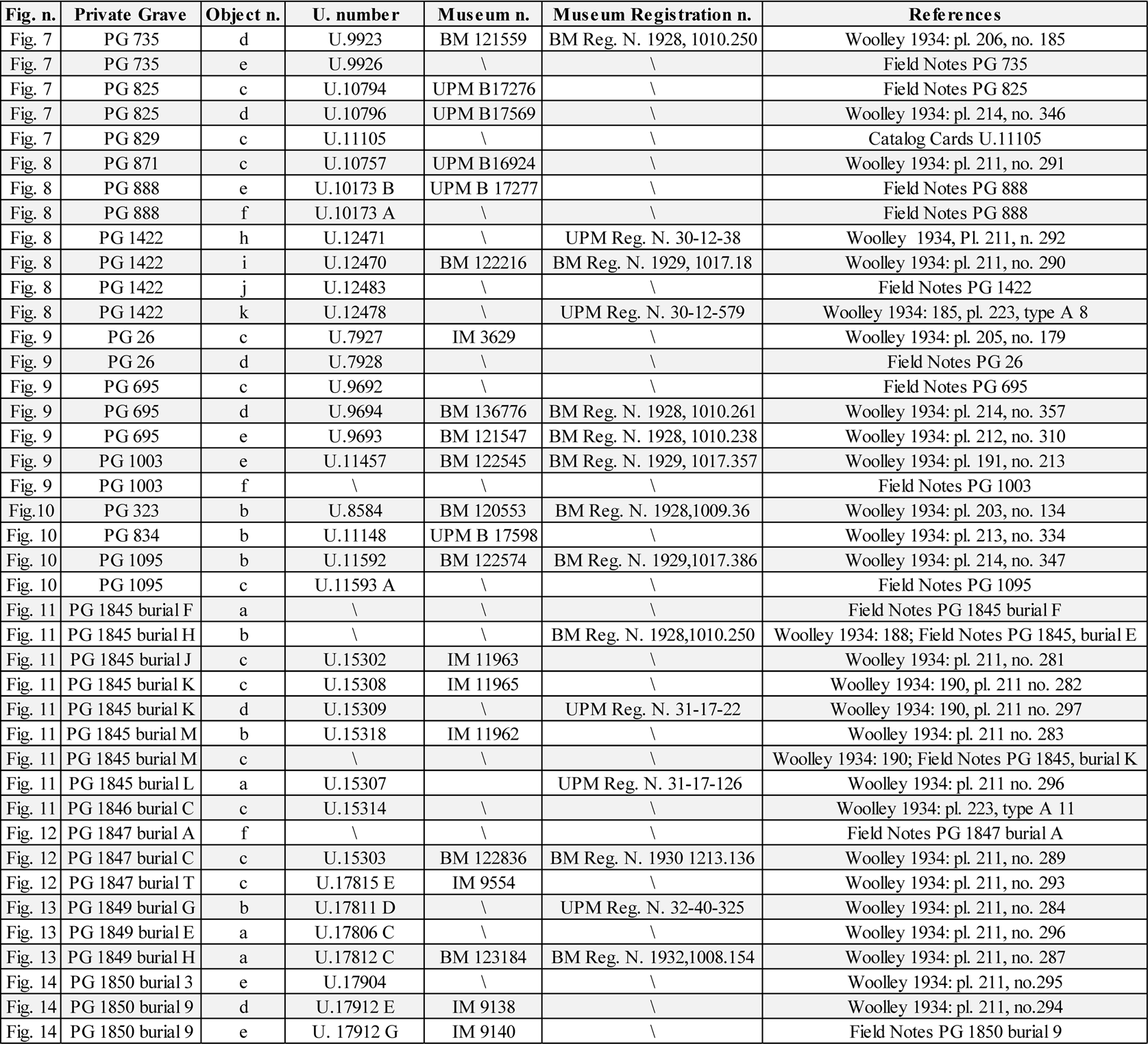
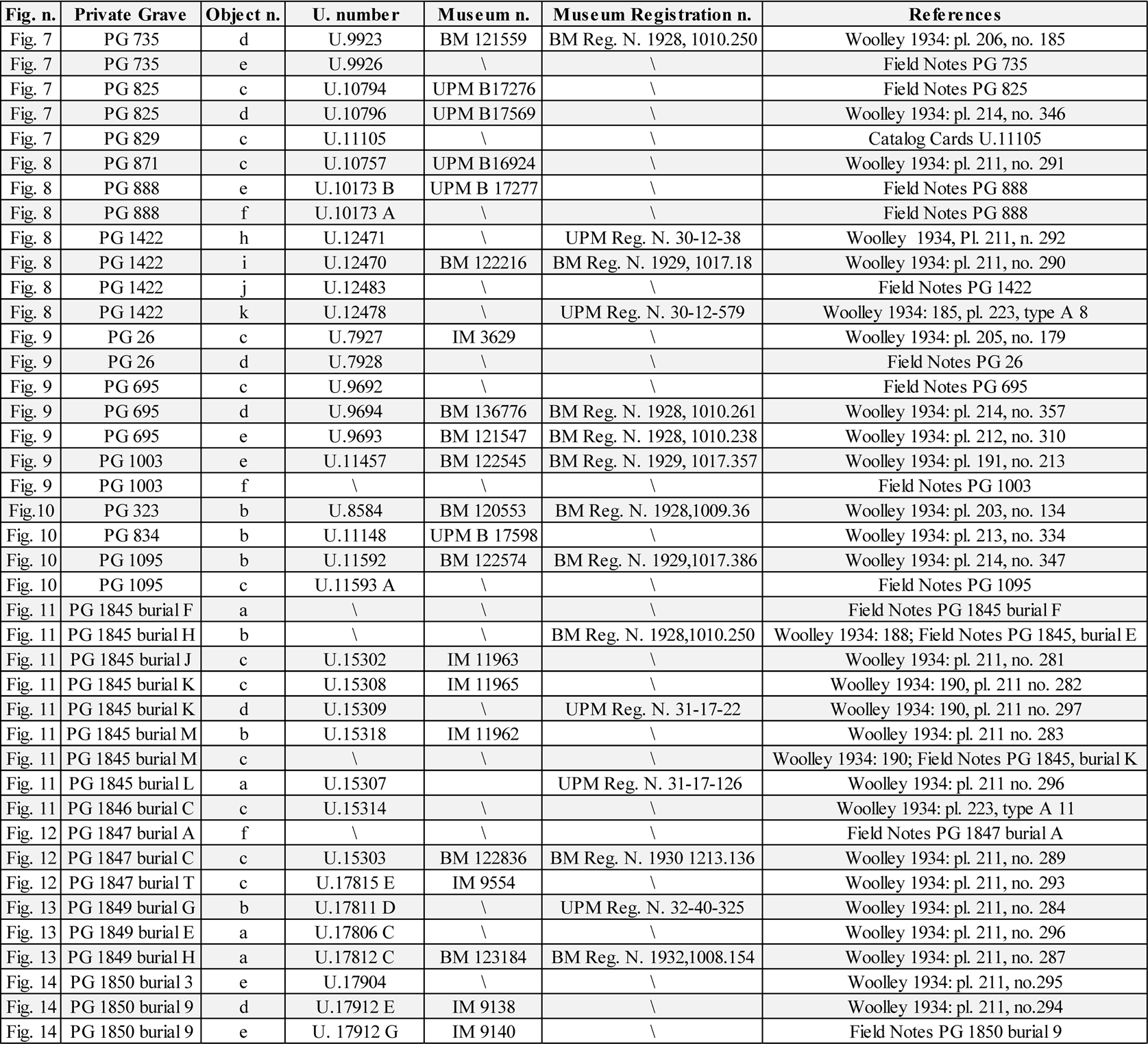
Nine cylinder seals were found in the Ur graves selected. Graves PG 1422 and PG 1003 each contained two seals. In both cases, there is a “contest scene” seal (Fig. 8: PG 1422 i, U.12470, Woolley 1934: no. 290. Fig. 9: PG 1003 e, U.11457, Woolley 1934: no. 317) together with a “presentation scene” seal (Fig. 8: PG 1422 h, U.12471, Woolley 1934: no. 292. Not illustrated, PG 1003, U.11458, Woolley 1934: no. 339). The seals in Grave PG 26 (Fig. 9: PG 26 c, U.7927, Woolley 1934: no. 179) and in Grave PG 735 (Fig. 7: PG 735 d, U.9923, Woolley 1934: no. 185) have “contest scenes”, while the seals in Graves PG 825 (Fig. 7: PG 825 d. U.10796, Woolley 1934: no. 346), PG 829 (U.11104, no drawings or pictures are known for this object) and PG 871 (Fig. 8: PG 871 c, U.10757, Woolley 1934: no. 291) display “introduction scenes”.
Given the pottery evidence discussed, there is no reason not to assign the “contest scene” seals found in Graves PG 26 and PG 735 to Groups 3 and 2 respectively. The contextual presence of both a “contest scene” cylinder seal and a “presentation scene” cylinder seal in Graves PG 1003 and PG 1422 is coherent. In this case, the comparative analysis of pottery enables assignment of Grave PG 1003 to an earlier period (Group 3) compared to Grave PG 1422 (Group 2).
The “contest scene” seal in Grave PG 1003 (Fig. 9: PG 1003 e) has the inscription, “ad-da ì-du8”,Footnote 15 “Adda, the doorkeeper”. It shows a bearded hero and a bull-man holding an inverted water buffalo and an inverted lion, respectively, by their rear legs. The two pairs are symmetrical, with the inscription positioned between them. The traits of the seal are Akkadian in style; the elbows have sharp angles, and the leg muscles of the bearded figures are taut.
The “contest scene” cylinder seal found in the rich grave PG 1422 (Fig. 8: PG 1422 i) also has a frame for an inscription, but it had been almost completely erased before the seal was deposited in the grave. The seal shows two pairs of standing figures composed of two bearded heroes positioned frontally, together holding a lion and a bull. One of them holds the lion by the forelegs and the bull by its tail; the other is seizing the bull by the horns. The seal appears to be Akkadian in style, but the detail of the erased inscription and the pottery assemblage suggest an assignment of the grave to Group 2.
Many metal artefacts have been recorded in the graves selected, but the documentation available is inadequate in many cases. Moreover, only a few metal artefacts can be used as chronological markers. Ten axe-heads were recorded for the graves selected, and the main distinction is between “shaft-hole axes”, moulded with a circular hole where the handle was inserted, and “hammered axe-heads”, with a tang bent around the handle. Five “shaft-hole” axes were found in Graves PG 26 (two examples: Fig. 9: PG 26 d, U.7928; the second with no U. number), PG 735 (Fig. 7: PG 735 e, U.9926) and PG 1422 (two examples: Fig. 8: PG 1422 j, k, U.12478, U.12483), while five “hammered” axes with bent ends have been recorded in Graves PG 825 (Fig. 7: PG 825 c, U. 10794); PG 829 (Fig. 7: PG 829 c, U.11105), PG 888 (two examples: Fig. 8: PG 888, e, f, U.10173A, U.10173B) and PG 1003 (Fig. 9: PG 1003 f, no U. number).
Although the “hammered” type axe was thought by Woolley to be later than the “shaft-hole” type (1934: 305-308; for arguments against this see Gernez Reference Gernez2007: 214), this chronological distinction is only used in the absence of better chronological markers. In fact, by referring to the groups identified on the basis of pottery assemblages, it is notable that “hammered” axe-heads are more common in the graves assigned to Group 2, but some “shaft-hole” axe-heads are present in the same contexts, for example in Graves PG 735 and PG 1422. Furthermore, one “hammered” axe-head was found in Grave PG 1003, a grave assigned to Group 3 based on its pottery assemblage.
The assemblages of other relevant graves
The analysis of the pottery presented above provides a chronological framework into which other relevant graves can be inserted. These other relevant graves were not selected in the first instance due to stratigraphic problems and/or inadequate documentation. The graves in question are: PG 323, PG 834, PG 869A, PG 907, PG 908, PG 1062, PG 1071, PG 1095, PG 1384, and PG 1398 (Fig. 10). Some of these will be described in detail below.Footnote 16 Most have been assigned to Group 2 based on their pottery assemblages.
Other relevant Ur graves and their assemblages.

Grave PG 323 was identified in the TTF trench during the fifth season at Ur (1926-1927). The graves identified during this season were never noted on a plan. The presence of an Akkadian beaker (Fig. 10: PG 323 a) enables Grave PG 323 to be assigned to Group 2. In this grave, a seal depicting two rampant animals (Fig. 10: PG 323 b, U.8584; BM 120553 [1928.1009.36]; Woolley Reference Woolley1934: pl. 203, n. 134) was also found; Collon assigned it to the Akkadian Period (1982: 51, no. 61).
Grave PG 869A was an infant burial containing two ceramic vessels: a “tall collared” jar (Fig. 10: PG 869A b) and a beaker with ridges on its body (Fig. 10: PG 869A a). This type of beaker has also been found in a burial in Nippur WF Level XIV (McMahon Reference McMahon2006: pl. 142, no. 1), which dates to the Late Akkadian Period. Other comparisons come from Tell Asmar Houses Va and Above Northern Palace (Delougaz Reference Delougaz1952: pl. 170, no. C.213.200), the street outside the Northern Palace or Houses Vc, (ibid.: pl. 171, no. C.215.210); and the Northern Palace (ibid.: pl. 172, no. C.303.200), and from Khafajah Houses I (ibid.: pl. 171, no. C.213.210). Nissen located PG 869A in his publication, while Woolley does not appear to have included it on his final plan.
Graves PG 1062, PG 1071 and PG 1095 have all been assigned to Group 2 on the basis of analyses of their pottery. The three graves are in the same stratigraphic sequence in both Woolley's and Nissen's plans, with Grave PG 1062 superimposed on the other two, while Graves PG 1071 and PG 1095 do not have any direct stratigraphic relationship. Grave PG 1062's ceramic assemblage consists of a jar with a flat base (Fig. 10: PG 1062 a) and a jar with an outwardly bevelled rim and a round base (Fig. 10: PG 1062 b), but these forms are chronologically unhelpful. Grave PG 1071 appears to have been damaged in ancient times. Its ceramic repertoire is composed of a small bottle with a rectangular body (Fig. 10: PG 1071 a) and a medium-sized elongated jar with horizontal, comb-incised bands on the shoulder (Fig. 10: PG 1071 b). According to Pruβ (Reference Pruβ, Matthiae, Pinnock, Nigro and Peyronel2007: 481–484), the latter type is characteristic of the southern Mesopotamian Late Akkadian/post-Akkadian Period. Although he mainly refers to the comb-incised decoration with undulating bands, pots decorated with comb-incised horizontal bands can also be assigned to the Late/post-Akkadian Period. Grave PG 1095 presents three useful chronological indicators. A hammered axe-head (Fig. 10: PG 1095 c; U.11593 A) and a lapis lazuli cylinder seal with a “presentation scene” (Fig. 10: PG 1095 b, U.11592; Collon 1982: no. 309; Woolley Reference Woolley1934: no. 347) were found in the grave, while the ceramic repertoire includes a “tall collared” jar (Fig. 10: PG 1095 a). The co-occurrence of this jar, hammered axe-head and “presentation scene” cylinder seal is important and enables Grave PG 1062 to be dated; its dating is later than both Graves PG 1071 and PG 1095.
The case of Grave PG 907 is somewhat unusual. The grave, excavated during the sixth campaign, was located 6.2 m below the surface. According to Woolley (Reference Woolley1934), PG 907 was below the “shaft-grave” PG 1847, while according to Nissen (Reference Nissen1966: 99, pl. 41), the grave was partially covered by PG 1849 (Fig. 3); for further details on uncertainties relating to the “shaft-graves”, see the following section. Grave PG 907 is described here because its pottery assemblage is well-recorded graphically in the Field Notes. The assemblage is composed of a clay ring base (Fig. 10: PG 907 d), a small jar with a flat base (Fig. 10: PG 907 b), a small bottle (Fig. 10: PG 907 a) and a “footed” jar with high shoulder and a grooved rim (Fig. 10: PG 907 c). The same type of jar was found in Grave PG 715 (described above; Group 3). This parallel, together with the stratigraphic position of Grave PG 907, allows this grave to be assigned to Group 3.
The “shaft-graves with multiple burials” (PG 1845 to PG 1850)
The same methodology was applied to analysis of the “shaft-graves with multiple burials”. These are located in the north-eastern part of the Cemetery, and Woolley considered them to be rectangular shafts with multiple burials, belonging to the “Second Dynasty” (1934: 18, 31, 187–203, 211). It is in this same area that Shulgi constructed his “Mausoleum” (evidence for this dating is the large number of inscribed bricks; Woolley Reference Woolley1974: 1). The Mausoleum was later flanked by two smaller annexes built with inscribed bricks of Amar-Sin (Woolley Reference Woolley1974: 22). The north-west annex of the Mausoleum of Amar-Sin stands on top of part of the shaft-grave PG 1847. This stratigraphic relationship and the pottery (Woolley Reference Woolley1934: 31) have been considered sufficiently distinctive to date all the shaft-graves to the period prior to the Ur III Dynasty.
From an archaeological perspective, the “shaft-graves with multiple burials”, when viewed in their totality, are problematic. The identification of the spatial limits of the shafts during the excavations is unclear. This is relevant because, as in the case of Grave PG 1845, many graves (including PG 879, PG 904, PG 905 and PG 908) seem to have cut or to have been cut by the shaft (see the sections in Nissen Reference Nissen1966: pl. 24–36). These graves were found during the sixth campaign (1927–1928), but at a lower depth in relation to the supposed depth of Grave PG 1845 (discovered in 1929–1930 during the eighth campaign). Thus, there is no certainty as to whether or not they are part of Grave PG 1845. Further, it is not clear why the shaft-grave PG 1845 had not already been identified during the sixth campaign.
A similar situation occurs regarding Grave PG 1847 (excavated during the eighth campaign). Beginning with the identification of the original spatial limits, Woolley states that the south-east side of the pit was identified at a depth of only 0.40 m from the surface, while the other limits of the pit were detected at a lower but unspecified depth (Woolley Reference Woolley1934: 192). However, Grave PG 727, discovered during the sixth campaign at a depth of about 1.80 m from the surface, is located within the south-eastern part of Grave PG 1847; it seems to have been placed inside the limits of the pit itself. The same can be said for other graves investigated during the sixth campaign. Grave PG 888 was found at a depth of 4 m and, according to Nissen, it seems to have covered Grave PG 1847 in its south-western limit. In addition, Graves PG 865 and PG 847 were respectively discovered at depths of 8.2 m and 8.55 m from the surface along the north-western edge of Grave PG 1847. Nissen (Reference Nissen1966: 99) had already expressed doubts regarding the position of all these graves when related to Graves PG 1845, PG 1847 and PG 1849.
Aside from recognition of the original spatial limits of the shaft graves, Woolley thought that these graves (especially PG 1845 and PG 1846) had been plundered in antiquity, during the construction of the Mausolea. This is because he had found a thick layer of bitumen fragments and broken bricks above them; some of the bricks bear inscriptions of the Ur III kings (Woolley Reference Woolley1934: 187, 191). Moreover, within the shafts of certain graves (PG 1845, PG 1847 and PG 1850), he found some screen walls and a series of mud floor levels. He believed that the shafts had a number of filling levels, and that the burials were placed on top of or in the filling above the various mud floor levels. Woolley described the situation as regards Grave PG 1847 in these terms: “in no case was it possible to detect any cutting of the grave down into the filling; it looked as if the graves had been made while the filling was in progress, i.e. the dead was laid out on whatever happened to be the surface at the moment, and then the earth was piled in above him; […]. Certainly the mud floor has not been cut through to make the graves but has been laid down above the graves after they were already in position; similarly the enclosure wall, the foundations of which start some 1.00 m. above the bottom of the shaft and rest on mixed filling, can only have been built after the burials were complete; the burials, therefore, must all have taken place at about the same time, while the filling-in of the shaft was going on.” (Woolley Reference Woolley1934: 194). In his reconstruction, the screen walls, the enclosure wall and the hearths (ibid.: 192–194) were intended as places for offerings.
This overview has highlighted some of the uncertainties in recognising the real nature of Graves PG 1845 to PG 1850. Rather than being contemporary “shaft-graves with multiple burials”, it seems more reasonable to consider them as a group of different graves that, over time, became grouped together by the excavators. For this reason, it is preferable to analyse the burials inside these “shaft-graves” as singular contexts (Figs. 11–14).
“Shaft-graves” with multiple burials: PG 1845 and PG 1846.

“Shaft-graves” with multiple burials: PG 1847.

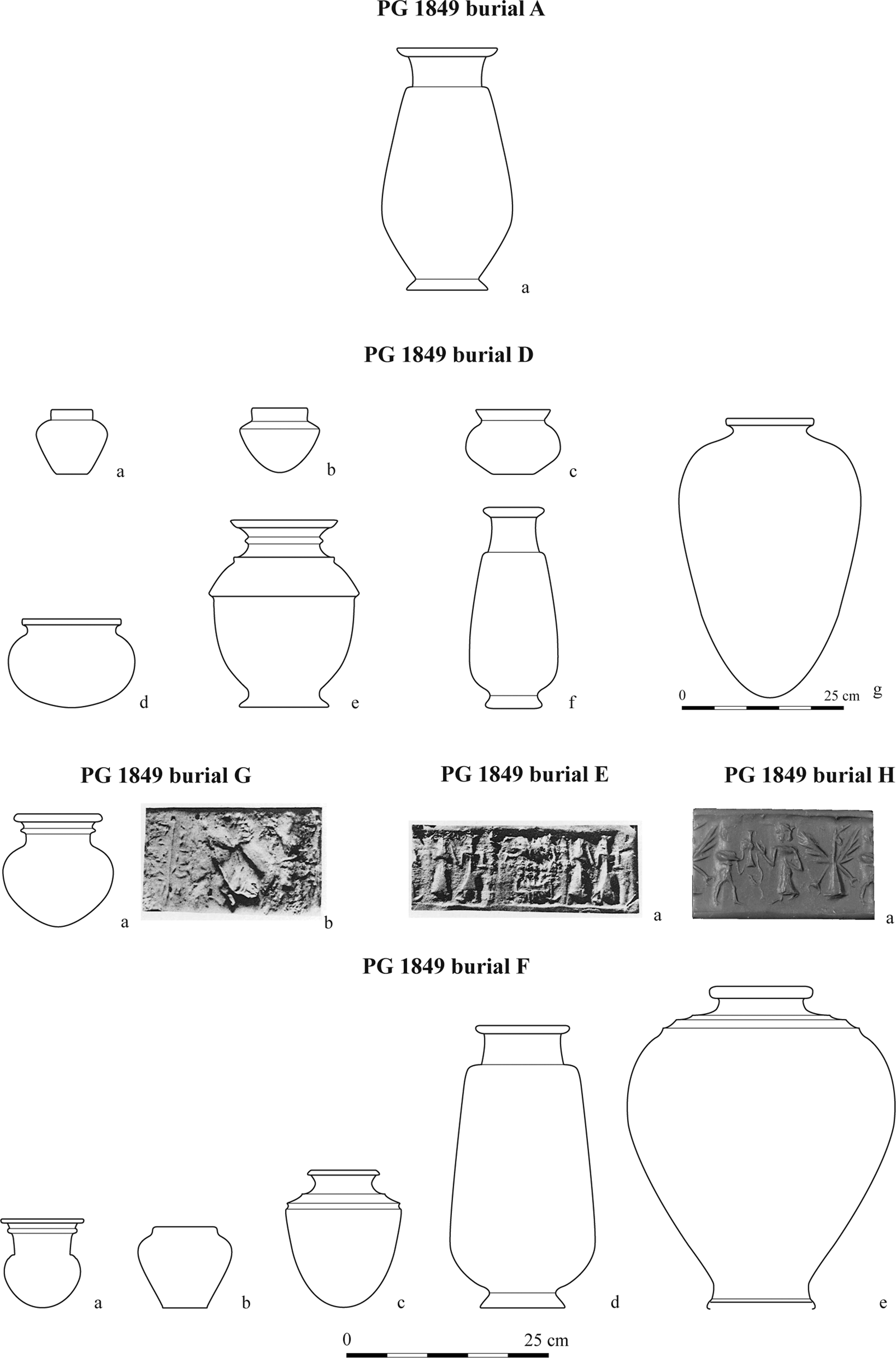
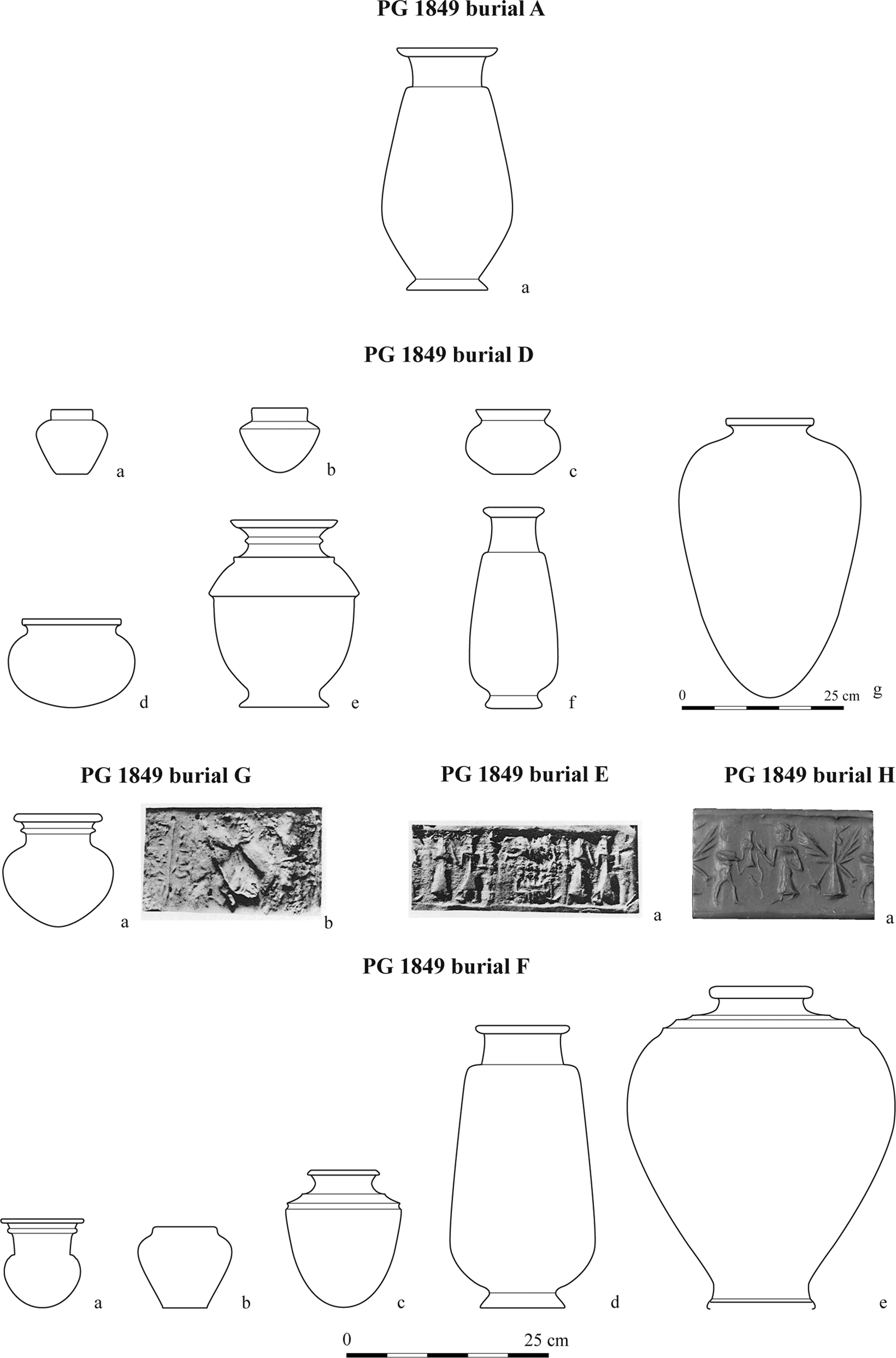
“Shaft-graves” with multiple burials: PG 1849.
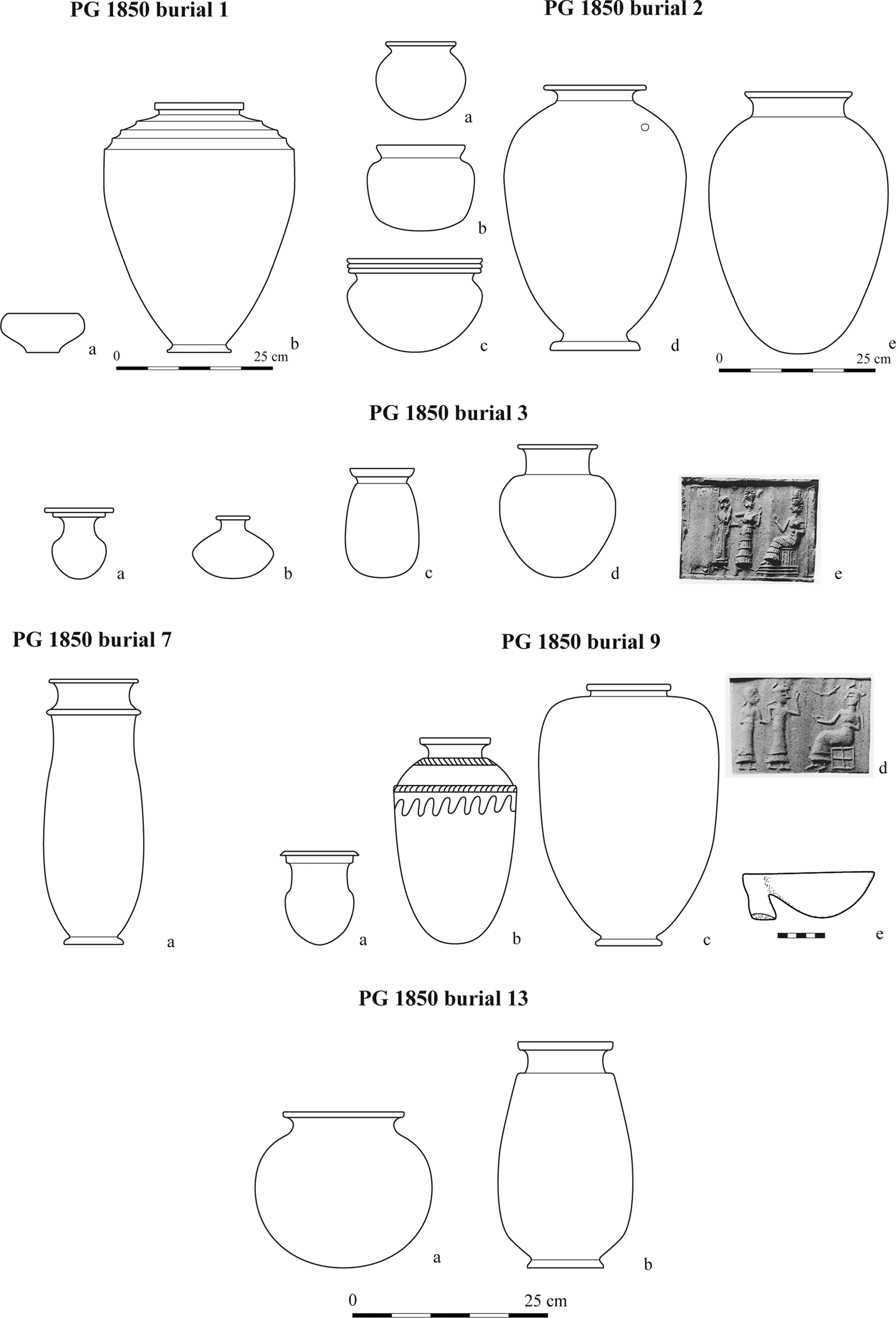
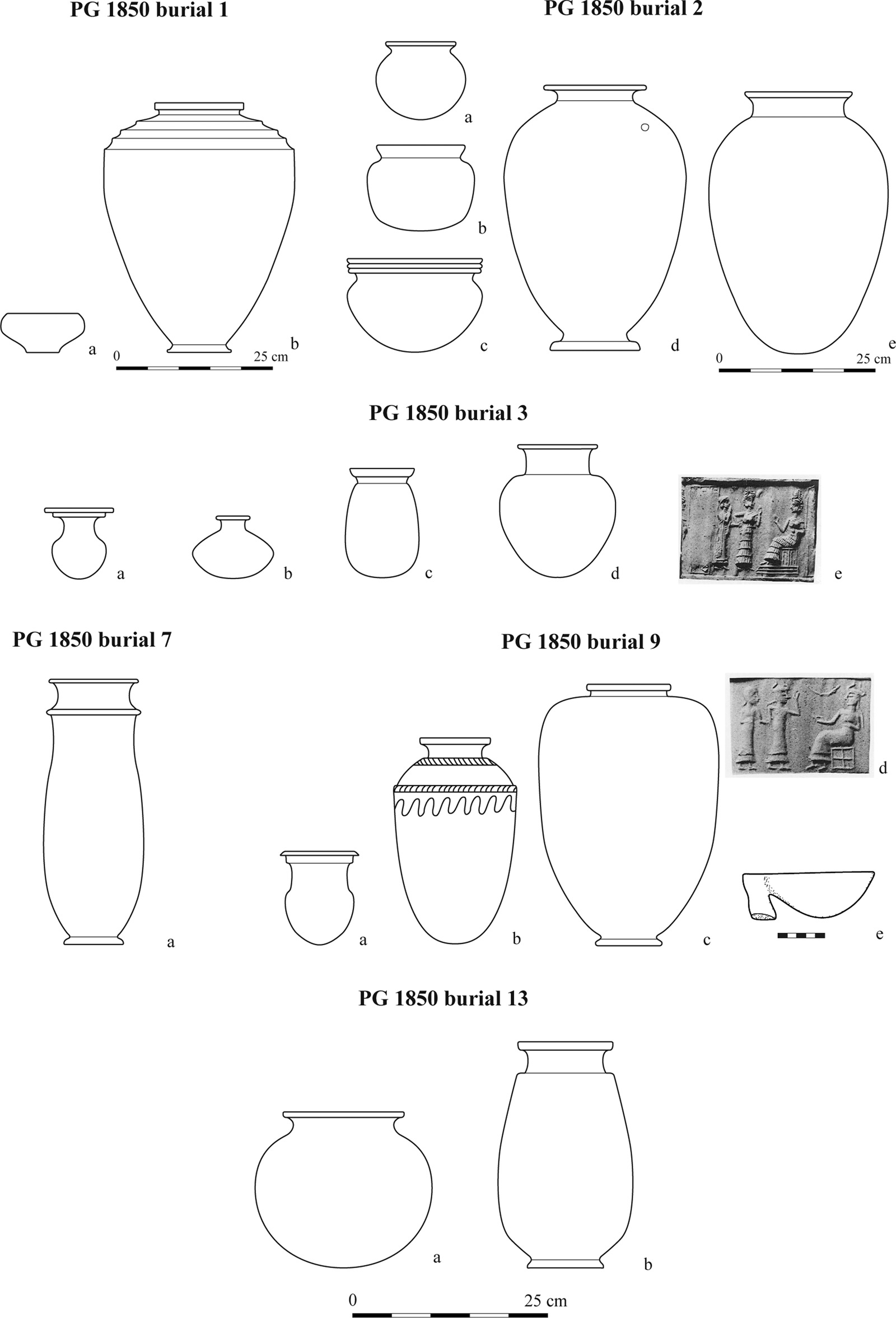
“Shaft-graves” with multiple burials: PG 1850.
Twelve burials were found in three different deposition levels and were grouped together in Grave PG 1845 (Fig. 15).Footnote 17 The burials from A to F have been assigned to the upper level; burials G and H to the second deposition (middle) level; and burials from J to M to the lower level (Woolley Reference Woolley1934: 187–190). Pottery analysis has enabled all the burials in PG 1845 to be assigned to Group 2. The Field Notes offer some interesting documentation for a few of these burials. The labelling system for the burials changed between the Field Notes and Woolley's Reference Woolley1934 publication. In this paper, the notation assigned by Woolley (Reference Woolley1934) is used; the corresponding reference is given in Fig. 17.
Reconstructed sequence of graves in PG 1845 and PG 1847 based on Woolley (Reference Woolley1934) and the Ur “Field Notes”.

The burials assigned to the upper level do not present any distinctive material.
In the middle level, Burial H contained a hammered axe-head (Fig. 11: PG 1845 H b; no U. number) and a jar with a multi-grooved neck (Fig. 11: PG 1845 H a).
In the lower level, Burial J contained a cylinder seal with a “worship scene” (Fig. 11: PG 1845 J c; U.15302, Woolley 1934: no. 281) and a tall jar with a carination (Fig. 11: PG 1845 J a) comparable to Type C-20 in the Nippur WF sequence (found in Levels XIV to VI, from the late Akkadian Period onwards; McMahon Reference McMahon2006: 115). Burial K contained two seals bearing “presentation scenes” (Fig. 11: PG 1845 K c, d; U.15308, Woolley 1934: no. 282, and U.15309, Woolley 1934: no. 297), an “Akkadian” ridged-shoulder jar (Fig. 11: PG 1845 K a) and a “tall collared” jar (Fig. 11: PG 1845 K b). Burial M contained a “presentation scene” seal with an erased inscription (Fig. 11: PG 1845 M b; U.15318, Woolley 1934: no. 283), another very damaged seal (U.15320), a hammered axe-head (Fig. 11: PG 1845 M c; no U. number), and a copper alloy razor (U.15633). Burial L contained a seal decorated with two men and two scorpions (Fig. 11: PG 1845 L a; U.15307, Woolley 1934: no. 296). On the basis of the grave goods, the other burials included in Grave PG 1845 have been allocated to Group 2.
In the Field Notes (http://www.ur-online.org/media_item/263291/), a “group of pots” is reported, composed of two “tall collared” jars, a jar with high shoulder and flat base, and a beaker with a triple-ridged rim. Their presence is characteristic of the very end of the third millennium B.C. and is distinctive of the graves assigned to Group 2b. According to Woolley,Footnote 18 this group of pots was associated with the screen wall found in the second deposition level. In that case, although the location and the depth from the surface is uncertain, the context could be considered as a terminus post quem for the graves of the first level.
Grave PG 1846 is composed of three burials, but graphic documentation in the Field Notes is only available for the vessels in Burial C. The presence of a tall “carinated” jar (Fig. 11: PG 1846 C d) and an “Akkadian” jar (Fig. 11: PG 1846 C e) enables the burial to be allocated to Group 2.
Grave PG 1847 (Fig. 15) is characterised by a sequence of three mud floor levels (Woolley Reference Woolley1934: fig. 60a). Burial R was placed inside an enclosure pit dug into the lower mud floor. All the other burials were found below this lower level. However, this situation does not allow determination of a reliable relationship between the installations found above the graves and the graves located below the mud floor. On the basis of pottery analysis, all the burials have been assigned to Group 2. In certain cases, Burials A, P and T, the presence of “Akkadian” beakers allows the burials to be allocated more precisely to Group 2a.
As regards the grave goods, an “Akkadian” beaker (Fig. 12: PG 1847 A c), a “tall collared” jar (Fig. 12: PG 1847 A e), two small bottles without carination (Fig. 12: PG 1847 A a, b) and a hammered axe-head (Fig. 12: PG 1847 A f, no U. number) were found in Burial A. In Burial G, a “tall collared” jar (Fig. 12: PG 1847 G b) and an “Akkadian” jar (Fig. 12: PG 1847 G a) were found, while Burial P contained two “tall collared” jars (Fig. 12: PG 1847 P d, e) and an “Akkadian” beaker (Fig. 12: PG 1847 P a). Burial T contained an “Akkadian” beaker (Fig. 12: PG 1847 T a), a “tall collared” jar (Fig. 12: PG 1847 T b) and a cylinder seal with a “presentation scene” (Fig. 12: PG 1847 T c, U. 17815 E). For assemblages of all the burials assigned to PG 1847, see Fig. 12.
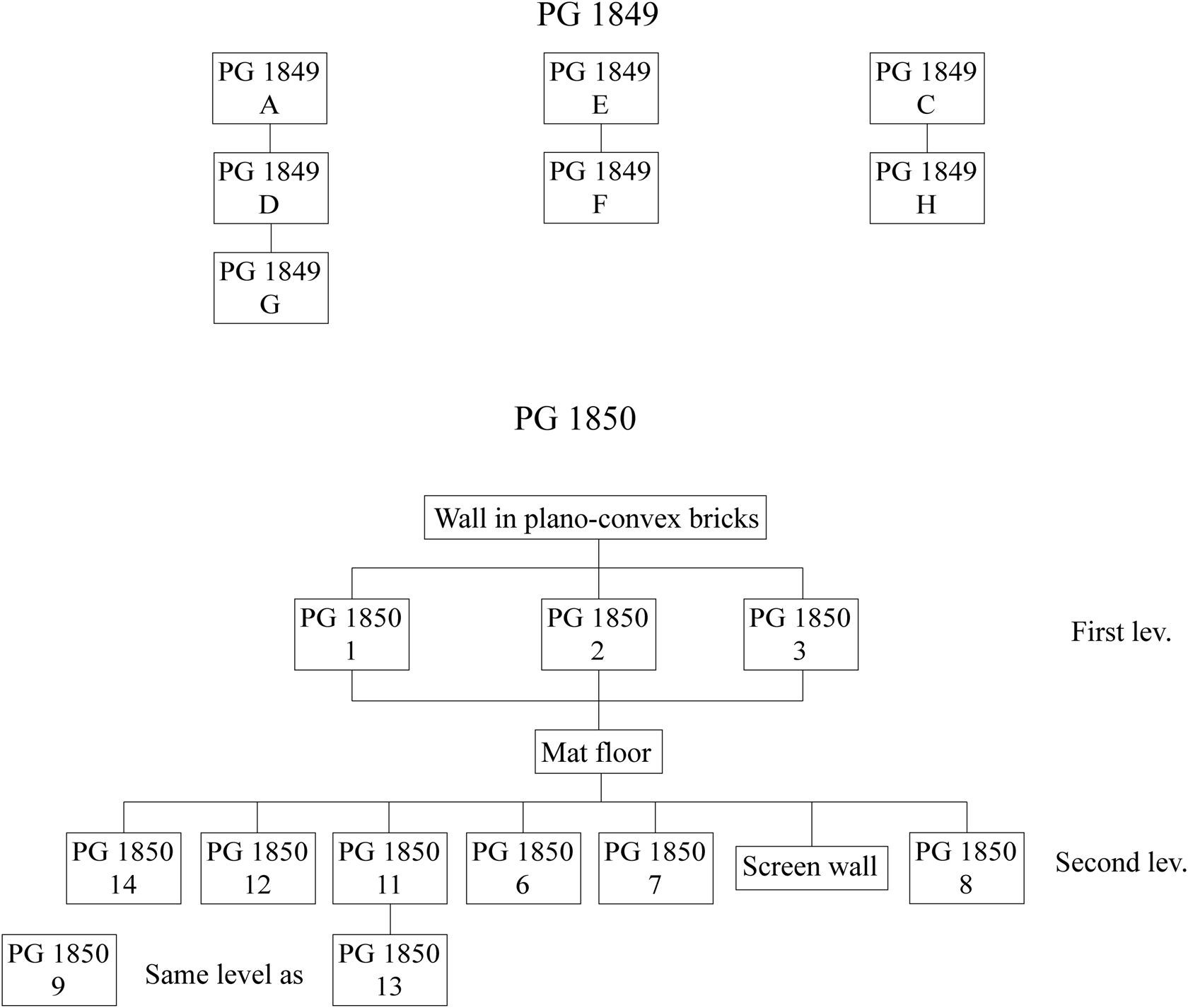
The situation of Grave PG 1849 remains unclear (Fig. 16), as only its southeast portion appears to have been identified. Further, the internal position of its burials can only be defined on the basis of the sketch in the Field Notes (Fig. 4). Thanks to this sketch (see above), it is possible to assume that Burial A covered Burial D, which in turn covered Burial G. Burial E covered Burial F, while Burial C covered Burial H. The burials in PG 1849 have been allocated to Group 2 on the basis of their pottery. Due to their stratigraphy and the presence of some “Akkadian” beakers, Burials F and G could probably be assigned to Group 2a.
Reconstructed sequence of graves in PG 1849 and PG 1850 based on Woolley (Reference Woolley1934) and the Ur “Field Notes”.
Several personal items, as well as four “tall collared” jars (Fig. 13: PG 1849 A a; only one was drawn) were found in Burial A. A very rich pottery assemblage was found in Burial D, which was covered by Burial A, including four small pots (Fig. 13: PG 1849 D a-d), a “collared jar” (Fig. 13: PG 1849 D f; very small compared to the others of the same type), and a tall “footed” jar, with a ridge on the neck and another ridge on the shoulder (Fig. 13: PG 1849 D e); this type of pot has been found in a burial in Nippur TB, Level IV 1 (Burial 1 B 293; McCown and Haines Reference McCown and Haines1967: pl. 95, no. 14). A cylinder seal was also found in this burial; it was not catalogued. In Burial G, apart from several luxury items of a personal nature, an “Akkadian” beaker (Fig. 13: PG 1849 G a) and a cylinder seal with a “contest scene” (Fig. 13: PG 1849 G b, U. 17811 D) were found.
According to the sketch in the Field Notes, Burial E seems to have covered Burial F. Only one cylinder seal, bearing a scene of men and scorpions (Fig. 13: PG 1849 E a, U. 17806 C), was found in the former, while Burial F contained two “Akkadian” jars (Fig. 13: PG 1849 F c, e), an “Akkadian” beaker (Fig. 13: PG 1849 F a), a “tall collared” jar (Fig. 13: PG 1849 F d) and a small pot with a vertical rim and a flat base (Fig. 13: PG 1849 F b). Lastly, Burial C seems to have covered Burial H but, unfortunately, none of the finds were useful for refining the chronology of the burials in question.
Grave PG 1850 presents two main depositional levels (Fig. 16). Three burials have been assigned to the first level. Of particular note is a triple-ridged rim basin found in Burial 2 (Fig. 14: PG 1850 2 c). This type of rim is characteristic of the very end of the third millennium B.C. and enables the allocation of the burial to Group 2b. A cylinder seal with a “presentation scene” and an erased inscription (Fig. 14: PG 1850 3 e, U. 17904) and a small bottle without carination (Fig. 14: PG 1850 3 b) were found in Burial 3. Burial 1 contained a small bowl (Fig. 14: PG 1850 1 a) and an “Akkadian” jar (Fig. 14: PG 1850 1 b).
Concerning the second depositional level, Burial 9 can probably be assigned to Group 2. Its assemblage is composed of three “Akkadian” beakers (Fig. 14: PG 1850 9 a; only one was drawn), a jar with wavy-combed and applied decoration (Fig. 14: PG 1850 9 b) and a cylinder seal with a “presentation scene” (Fig. 14: PG 1850 9 d). The comb-incised wavy bands combined with applied horizontal ribs have chronological implications as, according to Pruß (2007: 484), they are present from the Ur III Period onwards. Most of the other burials belonging to the second depositional level could be assigned to Group 2, as they do not present any chronological markers to enable a more detailed assignment.
Conclusion
The data described here are relevant for a revised chronology for some of the graves in the Royal Cemetery at Ur (Fig. 19). Although the question of chronology has been viewed as pivotal by many scholars following the publication of Woolley's excavations (Woolley Reference Woolley1934), dating has often been determined on the basis of glyptic evidence. Pottery evidence, especially due to the previously limited documentation, has always been considered secondary. Largely due to the drawings in the Field Notes, it has been possible to re-analyse the pottery assemblages from the graves at Ur, and this has resulted in a re-evaluation of the chronology for many of them. The results obtained using a typological approach to pottery evidence have enabled the refining of chronological determinants to a greater level of detail than that provided by other artefacts.
Correspondence between the burial numbers of PG 1845 written in the Ur “Field Notes” and in Woolley (Reference Woolley1934).

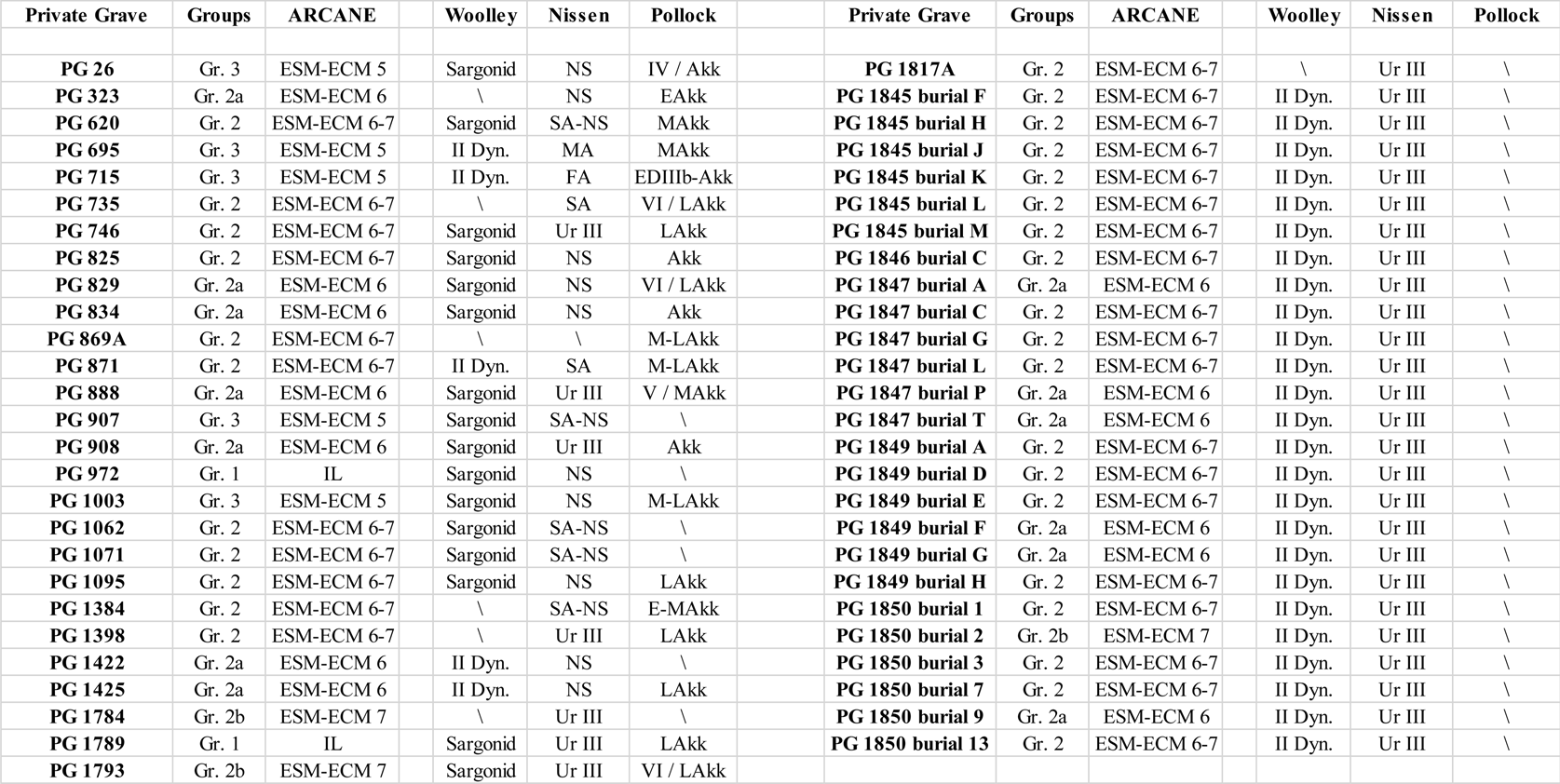
Reference table of selected graves related to the ARCANE periodization, compared with Woolley (Reference Woolley1934), Nissen (Reference Nissen1966) and Pollock (Reference Pollock1985).
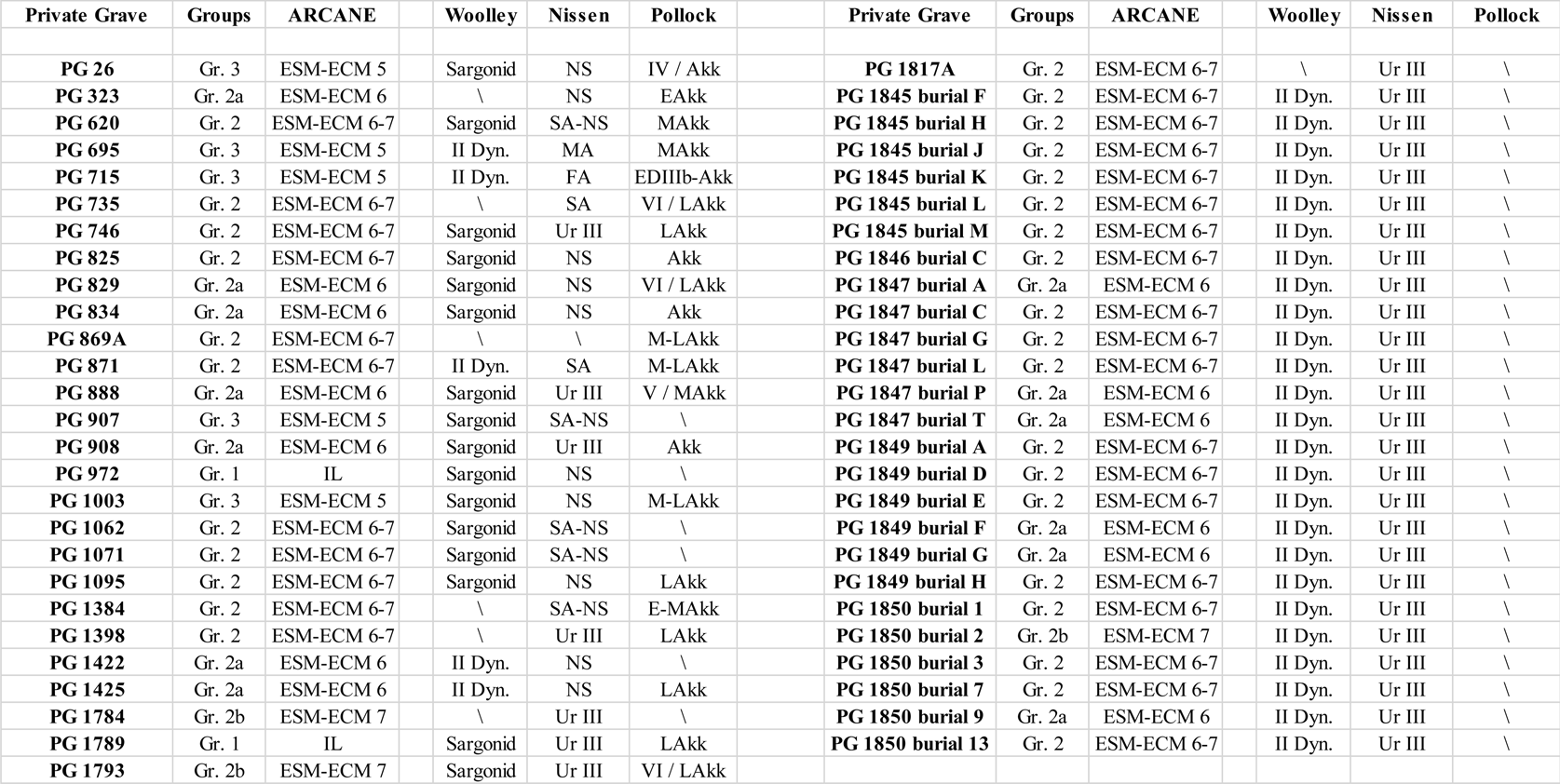
The three main groups of graves identified here can be compared with the most recent periodisation for the region, from the ARCANE project.Footnote 19 Group 3 corresponds to phase ESM-ECM 5, dated to the ED III/Early Akkadian Period. Group 2 corresponds to the Late/Post-Akkadian–Ur III Period and covers phases ESM-ECM 6 and 7. An internal division of Group 2 has only been possible for a few graves, but it does not suffice to propose a split between the two ARCANE phases for the graves analysed. The two Group 1 graves belong to the Isin-Larsa Period, but in the present study it is not possible to specify if they belong to the early or late part of that period.
The correspondence between historical terminology (ED III/Early-Late-Post Akkadian/Ur III/Isin-Larsa) and a division based on material culture is purely indicative, as it must be remembered that “any division into phases depends on the data on which it is based. So the archaeologist, who draws his conclusions from assemblages of well stratified contexts, may propose a phase division that differs from that of the historian, who studies lengths of reigns and dynasties, while the art historian may propose yet another, different division of phases” (Sallaberger and Schrakamp Reference Sallaberger and Schrakamp2015: 4).
The division into groups presented here is based on archaeological material from well-selected grave contexts in the Royal Cemetery at Ur. This division is important in order to establish a better seriation of the graves and to bring these contexts into the current debate on the re-evaluation of southern Mesopotamian chronology for the second half of the third millennium B.C.