Introduction
It is surprising that Italy, a country with a strong tradition in social movement studies, completely lacks any contribution regarding animal advocacy,Footnote 1 a phenomenon that Italian sociological research has often either forgotten or considered as a branch of environmentalism (Della Porta and Diani Reference Della Porta and Diani2004).
In addition to the lack of literature, the more general reason justifying this study lies in the growing interest among Italian public opinion in the existence, rights and wellbeing of non-human animals (see Eurobarometer 2010Footnote 2 and Eurispes 2016Footnote 3 ). For example, according to Eurispes 2016, 80.7 per cent of Italians are against vivisection, 68.5 per cent are against hunting and 71.4 per cent are against the use of animals in circuses. In addition to this, in 2016 the number of vegans reached 600,000, revealing a rather widespread phenomenon. Because of these aspects, we consider it important to focus on the peculiarities of the Italian case: Italy has not historically been one of the main ‘centres’ of animal advocacy (such as the US, northern European countries or the UK), but this type of activism is growing, and it has also been taken into consideration in an electoral context by very different political parties, such as Forza Italia and the 5 Star Movement (Bertuzzi Reference Bertuzzi2018).
Having established these general reasons for the study, the main objective of this article is to offer a panorama of Italian animal advocates, underlining above all their varied nature and proposing a stratification to be tested in three areas, of which more details follow. To this effect, we will focus on some particularly important results about the following two aspects: 1) ethical values; 2) political ‘careers’ and multi-memberships. Even more specifically, we will try to answer the two following research questions:
1) Are there any specificities in the ethical values of Italian animal advocates when compared with the general population? And further: what are the differences between the various areas of Italian animal advocacy?
2) Does a previous affiliation to one or more collective groups (both for animal advocacy and other forms of political commitment) influence present activity in animal advocacy?
As already mentioned, the reference population was stratified in three areas: welfare, protectionism and anti-speciesism. One of our main objectives was to test this tripartition, often understood as implicit by many associations and activists, but effectively lacking empirical confirmation. We decided to include such a vast and diverse number of subjects in the sample, because we wanted to consider the whole spectrum of those who in various ways question the role of non-human animals in contemporary society, since this macro-container represents a strategic action field (Fligstein and McAdam Reference Fligstein and McAdam2012) within which different actors move with strategies that are often quite distinct. Such differences among Italian animal advocates will be taken into consideration: to prepare the ground for the discussion, we summarise here the specific characteristics of these three areas.
Welfare
This area represents the evolution of classical zoophilist animal advocacy. In our study, we have referred to this area as including specialised structures and small groups working for the welfare of single species (often domestic animals) and focusing especially on stray animals.
Protectionism
Within the protectionist area are mostly larger organisations, which, although separate from the zoophilist tradition, continue to pursue a policy of small wins (Weick Reference Weick1984). Owing to the pragmatic planning that it promotes, the institutional relationships and the type of actions undertaken, the protectionist area often tends involuntarily towards anthropocentric positions.
Anti-speciesism
This area contrasts with the forms of proto-zoophilism as well as more organised and developed twentieth-century protectionism. Campaigns on specific issues are not considered sufficient; instead, anti-speciesism proposes a radical change of the existing order, of social structures and power relationships in order to go beyond anthropocentrism. However, the internal differences among Italian anti-speciesism are also important and have several dimensions: for example, many groups do not take a completely anti-institutional stance, but certainly make anti-systemic proposals.
We defined these three strata starting from philosophical/militant contributions (Maurizi Reference Maurizi2011) and from previous typologies elaborated in other national contexts (see, for example: Jasper and Nelkin Reference Jasper and Nelkin1991; Francione Reference Francione1996; Rowlands Reference Rowlands2002; Regan Reference Regan2005). However, the Italian case contains some peculiarities: a very relevant one, for example, is that the use of the label ‘anti-speciesism’ is particularly widespread, while in other countries terms such as ‘animal rights movement’ or ‘vegan movement’ are preferred. This is probably due to the late but wide diffusion of anti-speciesism in Italy, also visible in the delay in the appearance, at a national level, of the most important international texts proposing such a definition (Caffo Reference Caffo2017).
Methodology
A mixed qualitative-quantitative methodology was adopted to collect and analyse data. The main sources were:
1) A structured questionnaire through the online software Limesurvey, answered by 704 individuals. Only the questionnaires that were at least 75 per cent complete were considered for the study. Since the online questionnaire was composed of four sections, only those with at least three sections completed were used.
2) 20 semi-structured interviews with important group members in Milan, from welfare, protectionist and anti-speciesist groups, divided into: 4 activists for welfare (2 groups: 2 individuals per group), 4 protectionist activists (2 groups: 2 individuals per group), 12 anti-speciesist activists (4 groups: 3 individuals per group).
Two clarifications must be made. First, in designing the survey, we used a recent study on associations in Italy (Biorcio and Vitale Reference Biorcio and Vitale2016) as a basis. This questionnaire, which already included items applicable to our research, was completed and modified with ad hoc questions.Footnote 4 Second, the non-representative nature of the data that will be presented derives from the way it was gathered, using a non-probabilistic sample. This is due to the lack of a national census and a sampling frame both on an organisational and on an individual level, a common problem in the study of so-called hard-to-reach or hard-to-sample populations (Marpsat and Razafindratsima Reference Marpsat and Razafindratsima2010).
Before presenting the results, in the next section we will recall some studies from other national contexts concerning animal advocacy as a political phenomenon: the panorama offered is only partial, but useful to frame the empirical section that follows.
Theoretical references
As mentioned in the introduction, there is practically no Italian sociological literature on this subject, the only exception being the volume I diritti animali by Sabrina Tonutti (Reference Tonutti2007). However, various studies with a juridical (Mannucci Reference Mannucci2001; Pocar Reference Pocar2005; Tallacchini Reference Tallacchini2010; Castignone and Vallauri Reference Castignone and Vallauri2012) and philosophical approach (Caffo Reference Caffo2011, Reference Caffo2013; Maurizi Reference Maurizi2011) have been conducted. We will not dwell here on the literature from these other disciplines, but we will instead offer a brief summary of some international studies on animal advocacy, useful for framing our analysis. However, we want to specify that even in this context, several authors have highlighted how socio-political movements are still under-represented in the field of so-called human animal studies (Shapiro and DeMello Reference Shapiro and DeMello2010; Munro Reference Munro2012).
Some quantitative research outlining the socio-demographic profiles of activists in various national contexts (Plous Reference Plous1991, Reference Plous1998; Munro Reference Munro2001), as well as qualitative studies mostly focusing on the practices and discourses (McDonald Reference McDonald2000; Turina Reference Turina2010; Dubreuil Reference Dubreuil2009, Reference Dubreuil2013; Jacobsson and Lindblom Reference Jacobsson and Lindblom2013), have been carried out.
Beginning with the qualitative studies, it is important to mention the comparative work of Cherry (Reference Cherry2010) in which the similarities between the French and US situations are highlighted. Both of these national movements propose a boundary shifting operation (Wimmer Reference Wimmer2008), which represents the activists’ main goal, not only connected with current strategies, but above all with long-term cultural change: for example, this perspective is exemplified by campaigns by PETA (People for the Ethical Treatment of Animals, the largest global animal advocacy association), which compare the treatment of animals in slaughterhouses to that of Jews in Nazi concentration camps. Such dramatically visible protest practices were studied both in their appeal to public opinion as a ‘positive’ moral shock (Jasper and Poulsen Reference Jasper and Poulsen1995), and in their counterproductive effect (Mika Reference Mika2006; Cherry Reference Cherry2010).
Another element often analysed, and a typical aspect of social movement studies, is the reasons for being part of one group rather than another (Einwohner Reference Einwohner2002). Some authors have highlighted motivations closely connected to the individual’s network (Maurer Reference Maurer2010; Cherry Reference Cherry2006, Reference Cherry2010), while others have observed the importance of emotional choice and interest in specific issues (Herzog Reference Herzog1993; Jasper and Poulsen Reference Jasper and Poulsen1995; Herzog and Golden Reference Herzog and Golden2009; Jacobsson and Lindblom Reference Jacobsson and Lindblom2013).
Moving on to quantitative studies that analyse empirical evidence of the socio-demographic characteristics of animal advocates, in several cases researchers have observed that a higher number of women are part of animal advocacy organisations (Plous Reference Plous1991; Jasper and Nelkin Reference Jasper and Nelkin1991; Eldridge and Gluck Reference Eldridge and Gluck1996; Herzog Reference Herzog1993; Peek, Bell, and Dunham Reference Peek, Bell and Dunham1996; Kruse Reference Kruse1999; Munro Reference Munro2001; Gaarder Reference Gaarder2011a, Reference Gaarder2011b). Women’s greater interest in the wellbeing of non-human animals and their rights is also a characteristic of the general population (Gallop and Beckstead Reference Gallop and Beckstead1988; Herzog, Betchart, and Pittman Reference Herzog, Betchart and Pittman1991; Driscoll Reference Driscoll1992; Hills Reference Hills1993; Peek, Bell, and Dunham Reference Peek, Bell and Dunham1996; Kruse Reference Kruse1999; Munro Reference Munro2001). According to several studies (Serpell Reference Serpell2004; Bjerke and Kaltenborn Reference Bjerke and Kaltenborn1999), greater sensitivity towards and interest in non-human animals is also connected to urban living and a higher educational level. Furthermore, in comparative studies with the general population, animal advocates were more favourable than non-animal advocates to women’s, homosexual and African-American rights (Nibert Reference Nibert1994), more empathetic and ecumenical in participation choices (Jasper and Poulsen Reference Jasper and Poulsen1995) and more connected to moral involvement (Mathews and Herzog Reference Mathews and Herzog1997; Jacobsson and Lindblom Reference Jacobsson and Lindblom2013).
Finally, and in very general terms, the presence of two opposing visions within animal advocacy about using a welfare approach or more radical and direct strategies was detected. In the latter view, the literature has often abandoned an analytical spirit, adopting explicitly political and partisan stances. Several authors have criticised the reformist approach because of its complicity with a speciesist political system based on so-called indirect arguments, often directed at alleviating animal suffering based on a calculation of benefits for human beings (Francione Reference Francione1996; Nibert Reference Nibert2002; Best Reference Best2014). There are fewer contributions championing the importance of welfare actions, and stressing that they would have a greater impact on public opinion (Garner Reference Garner2008; Munro Reference Munro2005). The different practices and political action strategies correspond to real conflicting reference paradigms: on the one hand, a tout court radical protest against neo-liberalism and the capitalist system, on the other hand, an approach that, although trying to alleviate non-human animal exploitation, is not anti-systemic.
The empirical results of the Italian case, which follow, should also be read in light of the differences which emerged in the international literature. Our initial hypotheses were that, regarding ethical values, quite different positions would emerge among the three different areas of Italian animal advocates, going from a widespread progressivism among anti-speciesists to a conservative approach well diffused among protectionists and even more among welfarists; as regards political careers and multi-membership affiliations, the hypothesis was that previous and contemporary memberships of other groups would exercise a strong influence.
Ethical values
Before focusing on this article’s central arguments (ethical values and political careers), it is useful to outline here the main socio-demographic characteristics of the respondents. In line with the hypotheses in the literature, there emerged a large majority of women, respondents of medium-high education (high school diploma and Bachelor’s Degree), office workers and those belonging to the middle class, and individuals who are married and resident in urban territories. All these aspects allow us to consider Italian animal advocacy in the same way as so-called new social movements (environmentalism, pacifism, feminism and so on), which, from the 1970s onward, began to characterise western democracies (Kriesi et al. Reference Kriesi, Koopmans, Duyvendak and Giugni1995). In fact, as is well known, while the capital/labour conflict was central in more classical movements, post-materialist values and issues have made the middle class and the intellectual bourgeoisie important actors in the processes of social movements (Inglehart Reference Inglehart1977; Melucci Reference Melucci1996).
The reconstruction of ethical values was performed through several questions in the survey. We will first focus on the aspects that the entire sample have in common and then on other more distinctive results according to membership areas, and via the identification of some ideal/typical profiles.
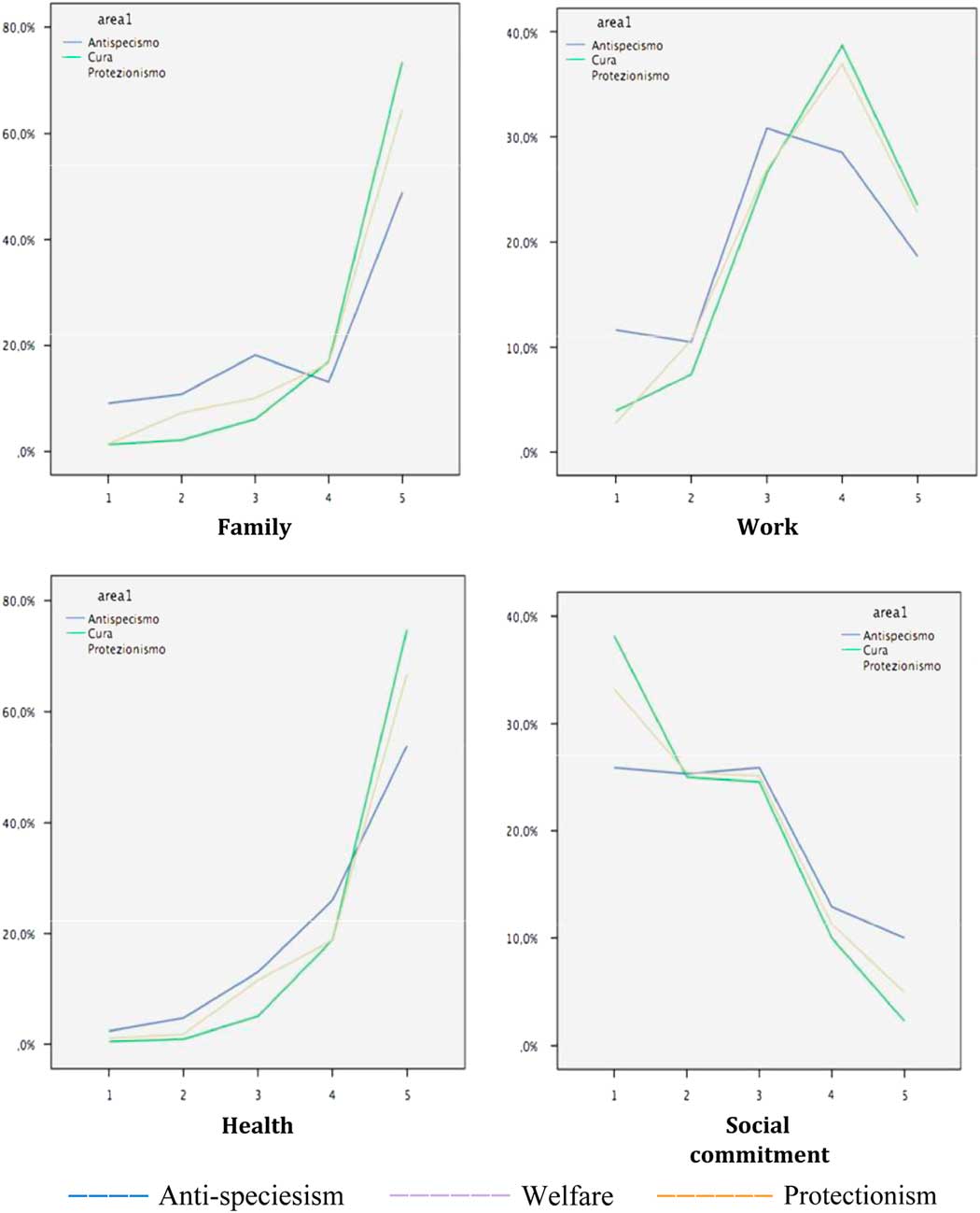
First, the respondents were asked to position themselves on a scale from 1 (not very important) to 5 (very important) concerning individual values. Differences emerged only in relation to some aspects, while others appeared to be shared among the three areas. Specifically, friendship, leisure and free time, studies and cultural interests, and activities of social commitment were transversally considered important values, while personal success and economic wealth were not considered relevant by the entire sample. A substantially uniform framework emerged among most of the individual values that were investigated. However, some items recorded differences that are worth highlighting (see Figure 1). While the curves follow a similar course here, the distance between the responses located at the extremes (positive or negative) are more relevant. Specifically, family is extremely important in the welfare area, work and health in the welfare and protectionism areas, and activities of social commitment in anti-speciesism. The last aspect deserves special attention: 10 per cent of anti-speciesist respondents attributed a value of 5 in the scale of importance to activities of social commitment and in labour unions, much higher than the other two areas. This is further proof of the more ‘political’ characteristic of this area. Proportionately, the greater importance taken on by aspects related to the personal dimension, or even the family dimension (health, work, family) in other areas confirms their more moderate nature.
Distribution of answers to the question: ‘What importance do you give to these aspects of life?’ Source: our survey, Italian animal advocates, 2015

As a further indicator of ethical orientations, we used a series of questions where respondents were asked to express themselves about topics connected to civil rights and specific behaviours. For these questions, a series of behaviours were proposed. For each, it was possible to assign a value from 1 (totally unacceptable) to 5 (totally acceptable). Here too, the items referring to ‘classical’ civil rights seemed to provide a rather uniform image of Italian animal advocates, without any particular differences between the areas. This was particularly true for the acceptability of divorce and of having homosexual experiences, topics of which the entire population is substantially in favour, although to different degrees: anti-speciesists show greater tolerance, followed by the protectionists and members of the welfare area. However, we must underline the precaution of considering the comparison between this study and those based on probabilistic samples whose results can be extended to the entire reference population. With this important caveat in mind, we can state that, as a whole, animal advocates in Italy are also clearly more progressive than the general population, as has been reported in other countries (Nibert Reference Nibert1994; Munro Reference Munro2012). In fact, 77 per cent of our respondents gave a value of 4 or 5 to the acceptance of homosexuality and 86.6 per cent a value of 4 or 5 to the acceptance of divorce, while the numbers are clearly lower for the national population (16 per cent and 29.6 per cent).
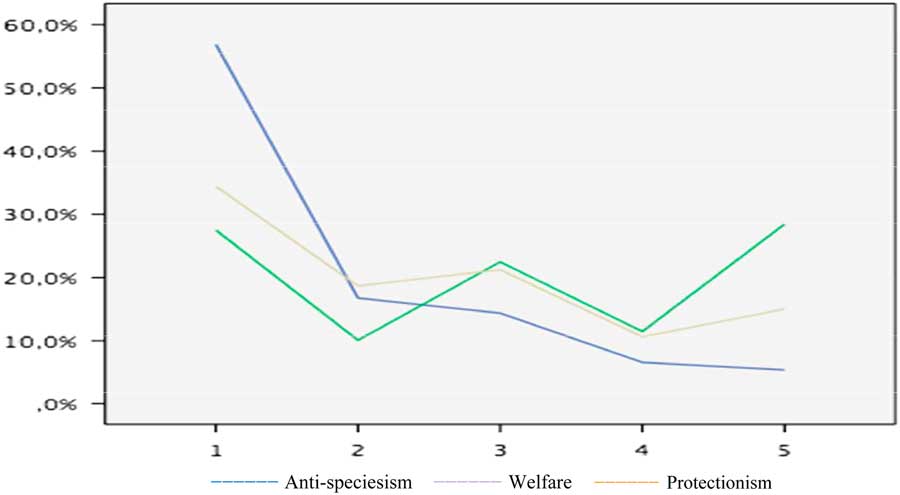
The main differences between the three animal advocacy areas were found in other issues, mainly concerning the macro-topics of immigration and the job market. With all questions, the respondents were asked to indicate their level of agreement, from a minimum of 1 (completely disagree) to a maximum of 5 (completely agree). There was a split between the anti-speciesists and the other two areas, which had more conservative positions, especially about the immigration issue, in particular when connected to an ‘unemployment crisis’ (see Figure 2).
Distribution of the answers (scale 1-5) to the following question: ‘When the job market is in difficult situation, should Italians be prioritised over immigrants?’ Source: our survey, Italian animal advocates, 2015

The dichotomy between anti-speciesism and the other two areas reappears in typical libertarian topics, such as personal drug use and, to an extent, the possibility of resorting to the death penalty. As regards this last issue, the curves appear to be less diversified, but the difference between those respondents who state that they are entirely against its use among the anti-speciesists in comparison to members of the other two areas is still important. Furthermore, with respect to another individual behaviour that is classically at the centre of ideological conflicts, that is abortion, the deviations are relatively more substantial. In this case, the curves are less linear: many respondents positioned themselves in the middle of the 1–5 scale, since this can be interpreted both as an endorsement of freedom of thought, as well as a more cautious position in comparison to other items.Footnote 5 Therefore, while the responses from the anti-speciesist area were often more progressive, it is generally clear that a difference also emerges between the protectionists and respondents in the welfare area, which is characterised by more conservative positions. However, the protectionists’ progressivism rarely reaches high levels and is often expressed in moderate positions (responses 2–3).
In addition to the previous series of questions, which are typical of political sociology studies, a few specific questions about non-human animals were added. While a general rejection of experimentation on animals and the use of animals in circuses, aquariums and zoos was noted, there were striking differences in the tolerance, and even in the acceptance, of pet therapy and the consumption of animal products by individuals in the protectionism and above all the welfare area. Regarding the consumption of animal products, an over-representation of veganism emerged among anti-speciesists (89 per cent) in comparison to the average, and of omnivores in the welfare area (31.8 per cent), and positions closer to the percentages of the entire sample in the protectionist area with a slightly higher concentration of vegetarians (37.1 per cent). As far as pet therapy is concerned, a particularly delicate topic where the exploitation of non-human animals may seem less evident, the sample is clearly divided in a way that no other item in the list is. The responses from anti-speciesists and members of the welfare area are diametrically opposed (on the one hand an aversion to the possibility of using animals to cure human pathologies, on the other a favourable opinion towards it), while the protectionists once again take a more cautious and moderate position, with a high number of respondents (25.9 per cent) placing themselves in the middle of the 1–5 scale.
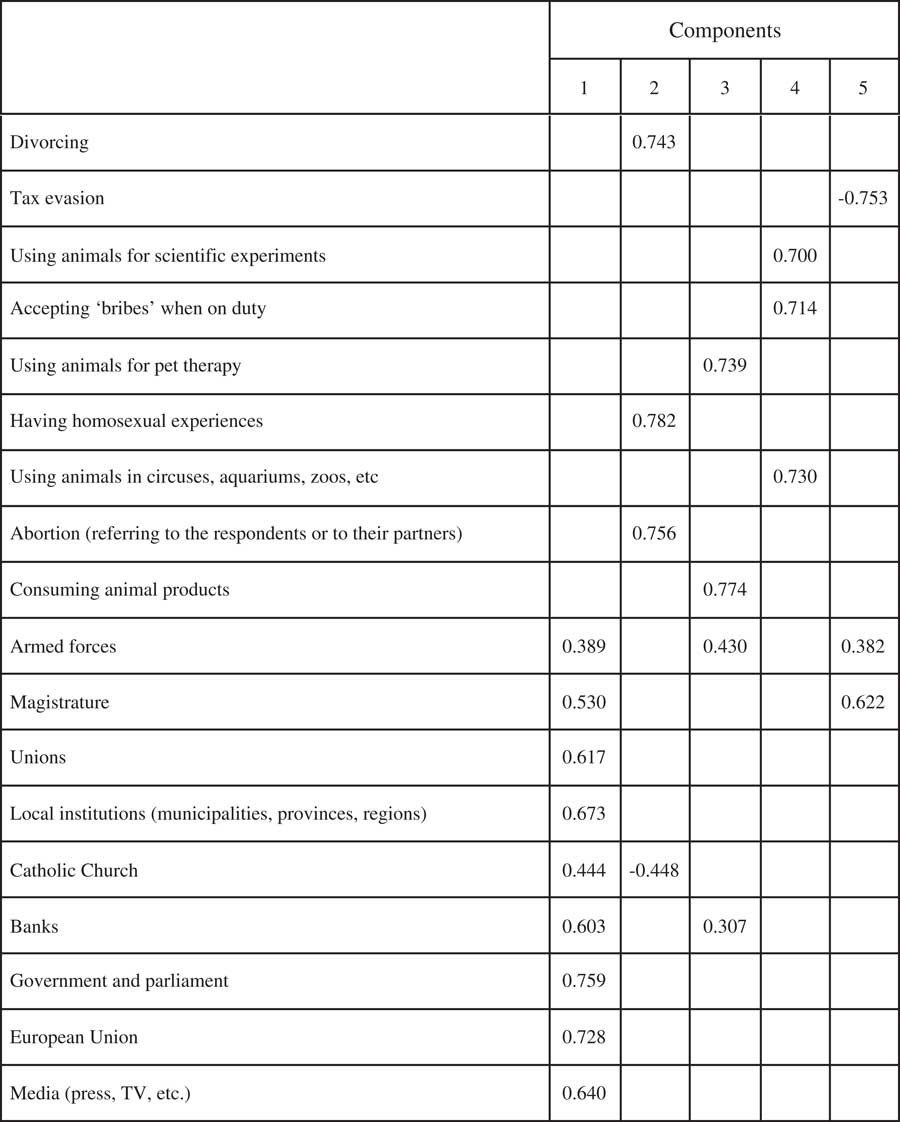
The data presented in this section shows the similarities and differences between the respondents (and between the different areas) on specific topics. To summarise, we tried to identify some ideal/typical profiles of respondents based on their responses to some of the main questions in the survey. Eighteen items were considered for this process:Footnote 6 to synthesise the information, we used a principal component analysis (De Lillo Reference De Lillo, Argentin, Lucchini, Sarti and Terraneo2007). In this way, five main components emerged, able to explain 56.8 per cent of the variance in the starting variables. Such a number of dimensions should explain a higher variance percentage. However, with various attempts using other methods of rotation and other reference questions, the results were similar, if not lower. On the other hand, it was considered appropriate to limit the main components to five, since a higher number would be too dispersive, would not contribute to a synthesis of the starting information, and would not produce any improvement in terms of the quota of explained variance of the phenomenon. Figure 3 shows the correlation between the single variables used for the analysis and the main components extracted.
Matrix of the components (varimax) Source: our survey, Italian animal advocates, 2015

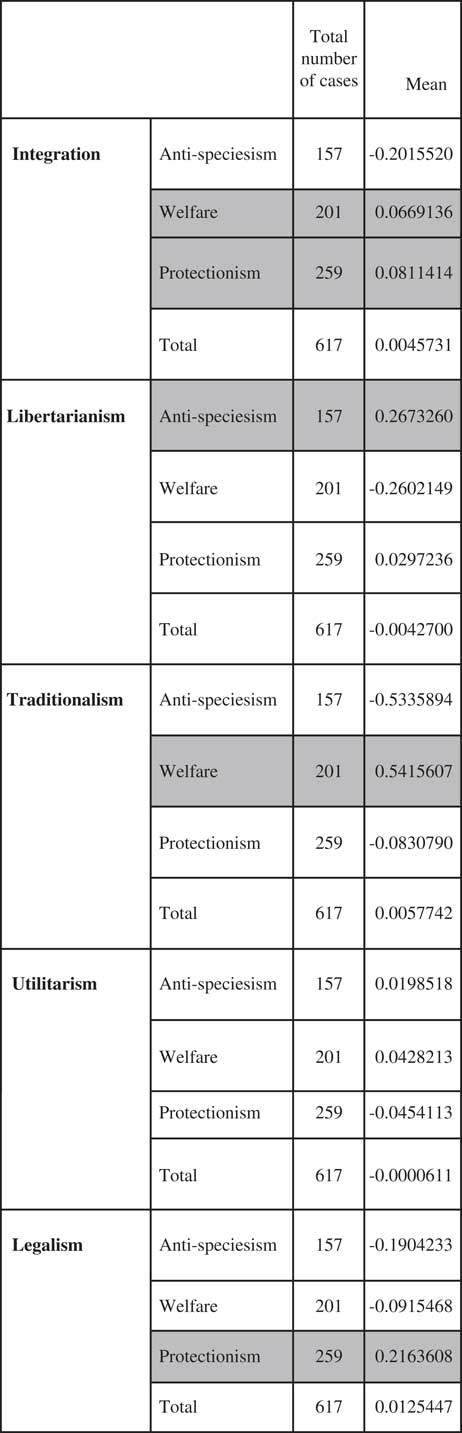
Considering the analysis of the components matrix, the factors that emerged were renamed as: integration, libertarianism, traditionalism, utilitarianism and legalism. It was then verified whether these components effectively explained membership of the different areas. The averages per area of the factor analysis associated with each of the five dimensions were calculated: this operation allowed for the verification of how these orientations are distributed among the members of the various areas (see Figure 4).
Mean value of factorial scores associated with principal components extracted Source: our survey, Italian animal advocates, 2015

The fourth component, utilitarianism, is the only one that does not explain membership of an area, and is mostly equally distributed among the three areas. Two types of individuals are related to this component: those who approve the use of animals for scientific experiments and in circuses/aquariums/zoos, allowing a sui generis approach to the protection and rights of non-human animals, presumably connected to a calculation in terms of benefits for the human species; and those who are particularly tolerant about accepting ‘bribes’. The two cases may appear to be rather distant and to be hardly related, but each of these behaviours recalls a utilitarian approach. With the label ‘utilitarian’, we mean those individuals who base their positions on a cost-benefits calculation more than on an ethical dimension: in Weberian terms, their actions are instrumentally rational more than value-rational.
A clear anti-political component and diffidence towards institutions appear among the anti-speciesists, while there does not seem to be a large prevalence of anti-political opinions or, by contrast, strong political adherence, in the other two areas. Even the libertarians, who are characterised by strong anti-clericalism, express progressive positions and approval of civil rights (abortion, homosexuality, divorce), are found, above all, in the anti-speciesist area. The traditionalists, that is those individuals who trust a few specific institutions (for example, the military and the banks) and at the same time perpetuate speciesist behaviours, although strongly present among the general population (with practices such as eating animal foods and using forms of pet therapy), are mostly found in the welfare area. They are probably decisively influenced by references to traditional values and by a lack of desire to challenge shared norms. The protectionists are substantially neutral in comparison to libertarianism and traditionalism and dominate the component connected to legalism, ‘opposed’ by the other two areas (especially by anti-speciesists) and characterised by a strong trust in institutions appointed to maintain public order (the courts and the police) and by a certain antipathy to tax evasion.
Multi-membership affiliations and political careers
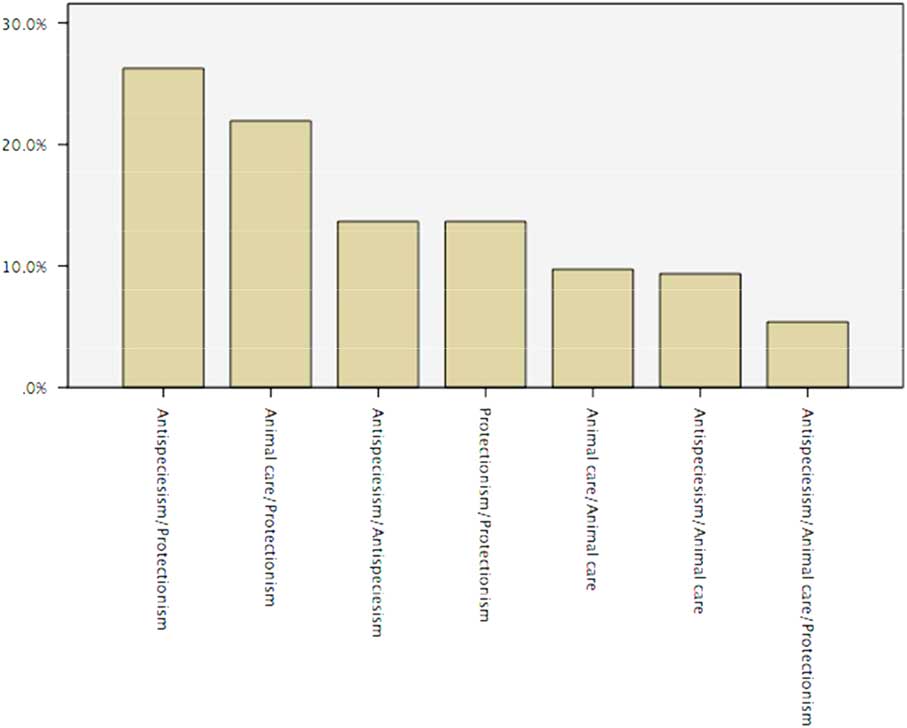
Moving from the ethical aspect to that of existing connections, we investigated the ‘careers’ of Italian animal advocates and their current multi-membership affiliations – memberships of different groups, both within a single area and in more than one area, were considered. We asked the respondents to specify what group they were members of and, if they belonged to more than one group, how they evaluated their involvement in the first three most important ones.Footnote 7 As was predictable, a specific number of members, activists and volunteers stated that they belonged to more than one group. Therefore, we recoded the multiple memberships for the three areas. In an attempt to provide the most synthetic framework, we looked at the memberships by area to evaluate which combinations were most frequent. We did this without considering the order in which respondents placed their group memberships, but simply by evaluating their current affiliation to more than one organisation. Figure 5 shows the various animal advocacy multi-memberships subdivided by area.
Multiple memberships in animal advocacy areas Source: our survey, Italian animal advocates, 2015

Although we must mention that multi-membership respondents constituted less than 40 per cent of the entire sample (total number=278) and that, therefore, the majority of the respondents indicated their adherence to only one group, the data can be associated with two important dimensions: the elevated commitment in terms of time of a large portion of the respondents (about 50 per cent of respondents stated that they dedicate a few hours every day or almost every day to animal advocacy activities), and the ‘personalisation’ of advocacy, supported only partially by the old logic of collective action (Olson Reference Olson1965) and mostly characterised by adherence to patchworks and mixtures of often very diverse groups. In fact, it is notable how belonging to more than one group in the same area is confirmed as less frequent than certain transversal multi-memberships, in line with the paradigm of connective action theorised by Bennett and Segerberg (Reference Bennett and Segerberg2013): the most frequent combination among the respondents included at least one protectionist group and one anti-speciesist group (10.1 per cent, total=73).
Looking instead from a longitudinal point of view at the analysis of the ‘careers’ of Italian animal advocates, adherence to welfare and anti-speciesist groups were mostly recent, the first occurring on average in 2007 and 2008, respectively. Furthermore, in both cases, over 50 per cent of the respondents stated that they had been members of their own group for no longer than five years. On the other hand, as regards protectionism, membership was longer term, although there was an increase from 2010 onward; these types of associations had been developing over the previous decades. The data, therefore, seem to highlight the change represented by the diffusion of anti-speciesism in larger areas of the population (above all, among younger cohorts), and also a strong commitment in the welfare area, an element that is in line with the recent increase of pets in Italian households and, more generally, with the importance taken on by domestic animals in the daily life of contemporary society (Bertuzzi Reference Bertuzzi2018).
Considering the respondents’ interest in other social issues, we refer to their current membership in groups that (also) work on other issues apart from animal advocacy. In an attempt to provide summarised information, a specific multi-membership index was created, beginning from the current affiliation of individuals in animal advocacy groups and other types of associations, organisations and social movements in a broader sense. First, it should be noted how the average value of the multi-membership index depends significantly on the membership area. Overall, anti-speciesists have a higher level of involvement in forms of collective engagement, followed by the protectionists and then members of the welfare area (see Figure 6).
Multi-membership index by animal advocacy area membership Source: our survey, Italian animal advocates, 2015

Having established this general framework concerning simultaneous membership in animal advocacy groups and other forms of activist engagement, we then investigated what (non-animal-related) issues are most important to Italian animal advocates. These data were obtained by asking the respondents to state the first three ‘campaigns’ that they are willing to spend time and energy on in addition to animal advocacy. Respondents stated they are closest to environmental protection, distantly followed by world peace and the fight against poverty. They are least interested in the construction of a united Europe, religious faith and LGBTQ rights. Based on recent ‘militant’ animal-rights literature (Nibert Reference Nibert2002; Simonsen Reference Simonsen2012; Best Reference Best2014), these data are interesting, since in recent years, this tendency has proposed a strong closeness to LGBTQ topics and, more generally, the intersection of the two campaigns. However, disaggregating by area, important distinctions emerge that partially reshape the apparent deviation between the militant literature and the data collected. A notable number of anti-speciesists are engaged in LGBTQ issues (15.6 per cent) and in the fight against racism (38.3 per cent). Furthermore, a rather intense relationship emerges between multi-membership and age: it is mostly younger individuals who are not satisfied with only one group reference in animal advocacy and belong to more than one group. Although this is in part explained by the fact that they have more time available, the data can be interpreted in the light of the larger political awareness of new cohorts, and of a general endorsement of the change brought about by the so-called second wave of anti-speciesism, which identifies specific connections between human exploitation and animal exploitation, and pursues the intersection with other social issues (Nibert Reference Nibert2002) and liberation struggles (Wrenn Reference Wrenn2014). On the other hand, a further gradual transition towards a third wave of anti-speciesism seems possible: this is based on the notable importance given to LGBTQ rights, above all in the anti-speciesist area (Simonsen Reference Simonsen2012).
Broadening our view to recent decades, further details emerge. We asked the respondents to specify their involvement in other social movements in previous periods: from 2010 on, from 2000 to 2010, and before 2000. We consider our method useful and convincing, even though we are aware that other more sophisticated methods could be adopted: for example, in the study already mentioned on Italian voluntary associations (Biorcio and Vitale Reference Biorcio and Vitale2016). Activist careers and previous associative socialisation have been considered as well (Tosi Reference Tosi2016; Claps and Vitale Reference Claps and Vitale2016), by looking at quite different indicators such as the longitudinal analysis of interest in (and discussions about) politics or the relation between associative membership and political trust (Claps and Vitale Reference Claps and Vitale2016). Our perspective is more limited, but this is justified by two factors: first, the novelty represented by animal advocacy and thus our attempt to simply identify the political background of animal advocates outside animal advocacy during the past decades; second, the absence of previous data regarding, for example, the interest in (and discussions about) politics of our population. For this reason, we analysed the past of present activists by asking them to specify their previous affiliations, also in order to identify specific differences among the three areas we identified.
The most important differences that we found are the following: an increase in protectionists and anti-speciesists close to pacifism/environmentalism from 2000 on, and a notable increase in anti-speciesists in close contact with social centres from 2000 on and with feminist/LGBTQ movements from 2010 onwards. Other different forms of associative and socio-political engagement that were investigated gave less important percentages and were not marked by a particular evolution over time. Thus, summarising with a brief discourse about animal advocates’ ‘careers’, a certain intersectional trend appears to emerge, above all from 2010 on. This once again confirms the ‘change’ brought about by the second wave of anti-speciesism, which focused on pointing out the necessity to unite the struggles for the rights and liberation of human and non-human animals (Best Reference Best2014; Wrenn Reference Wrenn2014) and whose founding moment is considered by many to be David Nibert’s Reference Nibert2002 volume Animal Rights/Human Rights, just as Animal Liberation by Peter Singer (Reference Singer1975) is normally taken as the milestone and the starting point of (first) anti-speciesism.
Briefly retracing what has been shown in this section, the phenomenon of membership in more than one group dealing with non-human animals appears to be fairly transversal in the three areas, with a relative predominance of individuals who are members of a grassroots anti-speciesist group and a large protectionist group at the same time. Affiliation and interest in other types of issues and struggles is more distinguishing, with more anti-speciesists involved than members and volunteers in the other two areas. Great importance in recent years has been assumed by LGBTQ issues and by the closeness to the world of social centres and the main anti-fascist and anti-capitalist movements in Italy (No-Tav, No-Muos, No-Expo, and so on). Conversely, protectionists have also acquired more experience in the institutional arena, which confirms the importance assumed by political careers and the welfare and lobbyist spirit in this area, in which the members in important positions are the ones who express stronger involvement. On the other hand, those who are involved in grass-roots groups have rarely followed formal paths and have more often gained their movement/membership experience in other issues and mobilisations over time.
Conclusion
The hypothesised tripartition into anti-speciesism, welfare and protectionism was generally confirmed by much of the data presented in this article, in addition to other parts of the study that have not been included in here (Bertuzzi Reference Bertuzzi2018). Numerous analyses confirmed the three sub-samples, each distinct and characterised by quite diverse approaches to the specific ‘animal issue’, and to other important political and ethical dimensions.
Summarising some of the results, it has emerged how activism and engagement in animal advocacy was and remains characteristic, above all, of the middle class, both as regards certain socio-demographic variables (level of education and occupation) and most of the ethical values investigated. As is well known, beginning in previous decades, these are the subjects who have shifted the conflict from the capital/labour dichotomy to issues of individual self-determination and, generally speaking, to the pursuit of progressive perspectives, of which both classical animal advocacy and (at least mainstream) anti-speciesism are current examples. On the other hand, some more conservative positions emerged precisely on topics connected to the job market: in fact, opinions were expressed in favour of greater deregulation of union protection (a position, to be honest, nowadays supported not only by conservative actors!), in addition to the necessity of prioritising Italian citizens over immigrants in conditions of economic crisis.
It must be stressed again how, generally speaking, the intersectional progressive vocation of the members, activists and volunteers is still an important element. The literature about the ideologically ‘progressive’ position of animal advocates (Nibert Reference Nibert1994; Munro Reference Munro2012) was confirmed by our data. This is also deduced from the inclination for commitment to various issues, a typical characteristic of contemporary mobilisation (Della Porta and Diani Reference Della Porta and Diani2015), and from the search for a link between human and animal liberation (Wrenn Reference Wrenn2014).
Returning to the analytical structure of this paper, we would like to briefly focus on the two main dimensions analysed. Beginning with the ethical values, we often observed more of a dichotomy than a tripartition. In fact, on many occasions, the areas of welfare and protectionism provided similar responses while the anti-speciesists were shown to be more distinct. In brief, the ‘cleavage’ in Italian animal advocacy could be confirmed (Lipset and Rokkan Reference Lipset and Rokkan1967), as an internal fragmentation on economic/political positions, and only in part as a radical differentiation with the ‘world outside’, as in its original meaning. Therefore, it is more prudent to limit ourselves to analysing this diversification, from which we infer the difficulty in speaking of an unequivocal and uniform phenomenon. In fact, while the general picture is recognisable as a dichotomy, further important details emerged such as from the principal component analysis. In a very schematic way and recalling the labels previously introduced in the empirical analysis, we can summarise as follows: libertarians are anti-speciesists, legalists are protectionists, traditionalists belong to the welfare area, those individuals belonging to the integration category are evenly distributed between welfare and protectionism, while utilitarians are found in all three areas. This last aspect is particularly relevant, precisely for its transversal dimension. In some respects, it is common in the different sub-cultures of Italian animal advocacy highlighting an instrumental approach, even if differently declined: in a political-economical way among anti-speciesists and looking at practical animal-related aspects in the other two areas.
Regarding the multiple affiliation of members, activists and volunteers, a certain importance in previous experiences in associations and social movements emerged, both within the specific strategic action field of animal advocacy (or of its various components) and elsewhere, but still in groups dealing with issues of social interest. Therefore, although within a framework that is different from past decades and, in particular, influenced by opportunities offered by the internet and the emerging logic of connective action (Bennett and Segerberg Reference Bennett and Segerberg2013), the importance of previous political and organisational experience is still valid, and therefore a tighter network still gives a higher possibility of being involved (McCarthy and Zald Reference McCarthy and Zald1977; Oberschall Reference Oberschall1973; McAdam Reference McAdam1988; Kriesi Reference Kriesi1988; Melucci Reference Melucci1988; Fernandez and McAdam Reference Fernandez and McAdam1989; Diani Reference Diani1995). However, an important distinction that was not strictly considered in our hypotheses concerns the different origins of animal advocates and their movement/associative paths. More moderate activists appear to come from long careers within the strategic action field of Italian animal advocacy, developing a real ‘animal-advocacy social capital’ and reproducing the dynamics of social centrality (Milbrath Reference Milbrath1965). On the other hand, a considerable number of anti-speciesists developed their political commitment in other movement environments, especially in social centres and oppositionist movements, and are actually characterised by a strong intersectional trend. These different paths could be better understood by looking at the debate on political cultures (Verba and Almond Reference Verba and Almond1963; Tosi and Vitale Reference Tosi and Vitale2008; Vitale Reference Vitale2009): in this sense, one remarkable difference lies in the varied nature of social innovators (Vicari Haddock and Moulaert Reference Vicari Haddock and Moulaert2009) and of antispeciesist activists opposed to the ‘pitying’ frame assumed by protectionist and welfarist areas in the previous decades (Boltanski and Thévenot Reference Boltanski and Thévenot1991; Vitale Reference Vitale2009). Such difference is not only due to the ethical differences and to the practical strategies related to the animal question, but also to the historical paths and visions of the world that were constructed across the decades and by means of alliances with other collective actors who perform(ed) different kinds of contentious politics (Tarrow and Tilly Reference Tarrow and Tilly2007; Tarrow Reference Tarrow2013).Footnote 8
To conclude, also referring to other parts of our research (Bertuzzi Reference Bertuzzi2018) it is possible to prove the existence of different types of engagement and the plurality of approaches within Italian animal advocacy, once again confirming its internal differentiation. The anti-speciesist area is characterised by very political, volatile and innovative dynamics, which are reflected in the indication of revolution as the main reason for the activists’ adhesion to the cause and in a lower experience of animal-advocacy ‘careers’. Those who are members of the welfare area are instead more driven by personal motivations and charitable approaches, in line, although with all the due updates, with classical zoophilism, which was characterised as a form of welfare with a strong aristocratic/bourgeois ancestry, often born from the initiative of individual philanthropists aiming to fill gaps in the public sector. Finally, the protectionist area is made up of longer-standing members, today particularly interested in pursuing legislative objectives and the improvement in the living conditions of non-human animals (above all certain species), and is therefore characterised by a strong reference to animal advocacy identity. This identity has had time to establish itself, since many of these subjects have been animal advocates for a long time, and for the most part owe their current experience as animal advocates to their pre-existing connections.
Acknowledgments
I thank the editors for their support and patience, and I am also very grateful to the anonymous reviewers.
Niccolò Bertuzzi is a Post-doctoral Research Fellow at COSMOS (Centre of Social Movement Studies) based at the Scuola Normale Superiore, where he is currently conducting research on youth participation and visions of Europe from below. He obtained his PhD in Applied Sociology and Methodology of Social Research at the University of Milano-Bicocca, and studied at the Universities of Bologna, Turin, Paris-Sorbonne, Barcelona-Pompeu Fabra and Nacional de Bogotà. His main research interests are political sociology, social movement studies, sociology of the body, cultural studies and history of social theory. His PhD dissertation, on animal advocacy in Italy, has been recently published, but he also investigated other social movements, protests and forms of participation, and in particular those against Expo 2015 in Milan and the Italian LGBT mobilisation in favour of same-sex marriage.