Introduction
Obtaining intravenous (IV) access in patients presenting with hemorrhagic shock is often difficult and time-consuming. Failed IV access attempts delay administration of life-saving treatment.Reference Muir, Sheppard, Maika-Wilson, Burgert, Garcia-Blanco, Johnson and Coyner 1 The American Heart Association (AHA; Dallas, Texas USA), the American College of Surgeons (ACS; Chicago, Illinois USA), the International Liaison Committee on Resuscitation (Edegem, Belgium), and the European Resuscitation Council (Niel, Belgium) recommend establishing intraosseous (IO) access if IV access is not readily obtainable.Reference Anson 2 - Reference Neumar, Otto and Link 4
The medullary compartment or IO space of the bone contains a matrix of distensible endothelium continuous with the systemic circulation. 5 Compared to the IO space, capacitance vessels are readily collapsible when intravascular volume is depleted, as in hemorrhagic shock. Several studies have established the safety, reliability, and effectiveness of the IO routeReference Laroche 6 - Reference Vassallo, Horne and Smith 8 for the administration of resuscitation drugs, crystalloid solutions, packed red blood cells, whole blood, and 6% hetastarch.Reference Santos, Carron and Yersin 9 - Reference Burgert, Mozer and Williams 13 The speed and ease in which IO access may be established makes it an exceptionally useful route for the infusion of colloid solutions when performing low-volume resuscitation in prehospital and mass-casualty scenarios.
Low-volume fluid resuscitation may be performed using colloid solutions such as 5% albumin and 6% hetastarch (Hextend). In a study comparing Dextran70, 5% albumin, and Hextend, the investigators found use of 5% albumin did not adversely affect coagulation. Further, its use was associated with decreased blood loss and increased survival time in a rabbit model of splenic injury.Reference Hoskins, do Nascimento and Lima 14 Another study compared the performance of rabbit plasma, Hextend, and 5% albumin. This study found resuscitation with plasma or 5% albumin better preserved coagulation function than Hextend. Further, the survival rate for animals receiving 5% albumin was 89% compared to 40% in animals receiving plasma or Hextend.Reference Kheirabadi, Crissey and Deguzman 15 These studies suggest 5% albumin may be an attractive option for treating hemorrhagic shock with the benefits of increasing survival without adversely affecting coagulation. However, neither of these studies compared the IO to the IV route of administration.
Theoretically, the viscosity of 5% albumin coupled with the inherent resistance of the bone marrow matrix could result in slower IO infusion times, delaying the onset of therapeutic effect. Although the endothelium of the IO space can accommodate a five-fold increase in volume, the noncompliant bony cortex limits expansion. 5 The marrow compartments of various IO infusion sites possess different ratios of red to yellow bone marrow, with variable vascularity, which may impact the rate of 5% albumin infusion.Reference Kheirabadi, Valdez-Delgado and Terrazas 16 No studies have determined whether the IO administration of 5% albumin differs from IV administration relative to infusion time and the effects on hemodynamic measurements in a hemorrhage model. The investigators of this study hypothesize that tibial intraosseous (TIO) infusion of 5% albumin will be slower than IV infusion, resulting in a delay of therapeutic effect.
The specific aims of this study were to: compare the infusion times of 500 mL of 5% albumin administered by the TIO and IV routes; and compare the effects of TIO and IV administration of 500 mL of 5% albumin on hemodynamic measurements, including heart rate (HR), mean arterial pressure (MAP), cardiac output (CO), and stroke volume (SV) in a swine model of hemorrhage.
Methods
This study was a prospective, experimental, mixed design. Sixteen male Yorkshire-cross swine were assigned to one of two groups using computer-generated random numbers: TIO group (n=8) or the IV group (n=8). Subjects weighed between 60 and 75 kg, approximating the weight of an average adult human.Reference Blebea, Houseni and Torigian 17 Animals were housed at the research facility for three days and closely observed by veterinary professionals to ensure satisfactory health. Subjects were fed a standard diet during the 3-day acclimation period and received nothing by mouth except for water ad libitum starting at midnight the night prior to the experiment. The Institutional Animal Care and Use Committee of the Navy Medical Research Unit – San Antonio (Texas USA) approved the study protocol. The animals were housed and received care in compliance with the Animal Welfare Act and the Guide for the Care and Use of Laboratory Animals.Reference Paquette, Gordon and Bradtmiller 18
On the day of the experiment, each animal was sedated, anesthetized, and placed on mechanical ventilation 30 minutes prior to instrumentation. Induction of general anesthesia proceeded with an intramuscular injection of tiletamine (4-8 mg/kg) and inhaled isoflurane 4% to 5%. Following endotracheal intubation, isoflurane was reduced to 0.5 to 2% for the remainder of the experiment. Subjects were ventilated with a tidal volume of 8-10 mL/kg with an Aestiva anesthesia machine (Datex-Omheda Inc.; Madison, Wisconsin USA) and respiratory rate was maintained between 10-14 breaths per minute. Heart rate, systolic blood pressure (SBP), diastolic blood pressure (DBP), MAP, electrocardiography, end tidal carbon dioxide, oxygen saturation (SpO2), and rectal temperature (°C) were monitored continuously with a GE Marquette Solar 800 monitor (GE Healthcare; Pittsburgh, Pennsylvania USA). Normothermia was maintained with the use of a forced-air warming blanket (Bair Hugger Model 505, Arizant Inc.; Prairie, Minnesota USA). Cardiac output and SV were monitored continuously using a Vigileo hemodynamic monitor (Edwards Lifesciences; Irvine, California USA).
An 18-gauge IV catheter was placed in the left auricular vein of all subjects and patency maintained with an infusion of lactated Ringer’s solution at a rate of 10 mL per hour. Subjects in the IV group received 5% albumin via this access site. The femoral artery of each subject was cannulated with an 8.5 French x 10 cm central venous catheter (Arrow International; Reading, Pennsylvania USA) and was used for exsanguination of blood. The left carotid artery was exposed surgically and an arterial catheter was inserted and connected to the Marquette Solar 800 monitor for continuous arterial blood pressure (ABP) monitoring. The arterial line was also connected to the Vigileo monitor using a 3-way stopcock to facilitate simultaneous ABP, CO, and SV measurements. Intraosseous access in the TIO group subjects was achieved with a 2.5 cm, 15-gauge EZ-IO device (Teleflex Medical; San Antonio, Texas USA) placed in the proximal, medial aspect of the tibia. Successful placement was confirmed by aspiration of bone marrow and easy administration of 10 mL of normal saline flush.
Subjects were allowed to stabilize for 15 minutes following placement of vascular access. An ACS Class III hemorrhage was achieved by exsanguinating of 31% of estimated blood volume (EBV) via gravity drainage and controlled suction via the femoral artery catheter. Estimated blood volume was calculated using a factor of 70 mL/kg of body weight. For example, a subject weighing 65 kg has an EBV of 4550 mL. Thirty-one percent of 4550 mL is equal to 1410 mL. To ensure exact measurement of exsanguinated blood, the investigators used a TIF electronic scale (Thermal Industries of Florida; Owatoona, Minnesota USA) to measure shed blood volume. The TIF scale was zeroed with a collection canister in place to control for variation in container weight. The TIF scale is accurate and precise within 0.5%. Suction was applied and regulated so that approximately 100 mL of blood was exsanguinated per minute. The mean time for exsanguination to the 31% of EBV goal was 15 minutes.
Initiation of the 5% albumin infusion began immediately after exsanguination. Vital signs and hemodynamic data were collected before (baseline) and after (post-bleed) exsanguination. Upon beginning the 5% albumin infusion, the investigators collected data every 20 seconds for 180 seconds. Albumin (500 mL) was administered via the IV or TIO route with the use of a pneumatic pressure infusion bag. One member of the research team continuously monitored the infusion and maintained the pneumatic pressure infusion bag at a constant pressure of 300 mmHg. Another team member used a stopwatch to time the infusion from beginning to completion.
Multivariate Analysis of Variance (MANOVA) was used to determine if there were significant differences in pre-test data between the groups. An independent t-test was used to analyze data relative to infusion times. The MANOVA was also used to determine if there were significant differences relative to hemodynamic data between the groups. Statistical significance was indicated by a P value≤.05. Results from MANOVA and independent t-testing were reported as means and standard deviations (SD). Statistical analysis was performed using IBM SPSS Statistics for Windows v. 21.0 (IBM Corp.; Armonk, New York USA).
Results
The MANOVA performed on baseline data indicated there were no significant differences between the IO and the IV groups relative to age, weight (kg), EBV, HR, SBP, DBP, MAP, CO, SV, body temperature °C, SpO2, and volume of shed blood (P>.05).
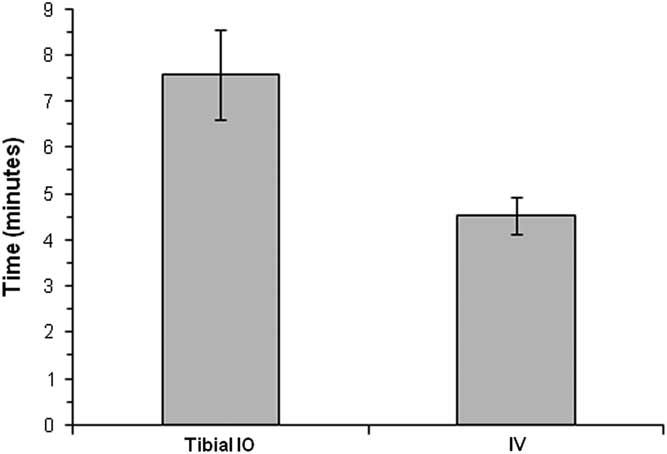
An independent t-test indicated that 5% albumin infusion was faster when administered IV compared to TIO (P=.01). Mean infusion time of 5% albumin in the TIO group was seven minutes 35 seconds (SD=two minutes 44 seconds) compared to four minutes 32 seconds (SD=one minute 08 seconds) in the IV group (Figure 1). The IV infusion of 5% albumin was approximately 40% faster than infusion by the TIO route.
Mean 5% Albumin Infusion Time (SD). Note: infusion time was significantly longer for the TIO group: 7 minutes 35 seconds (SD=2 minutes 44 seconds), compared to the IV group: 4 minutes 32 seconds (SD=1 minute 08 seconds); (P=.01). Abbreviations: IV, intravenous; TIO, tibial intraosseous.

The MANOVA performed on hemodynamic data, collected immediately after exsanguination and every 20 seconds for 180 seconds during the infusion of 5% albumin, indicated there were no significant differences between the TIO and the IV groups relative to HR, MAP, CO, and SV (Tables 1-4). Measures of significance were greater than .05 in all instances.
Heart Rate (bpm) Reported as Mean (SD) of TIO and IV Groups at each Time Point during Data Collection (Note: there was no significant difference between the groups at all time points)

Abbreviations: IV, intravenous; TIO, tibial intraosseous.
Mean Arterial Pressure (mmHg) Reported as Mean (SD) of TIO and IV Groups at each Time Point during Data Collection (Note: there was no significant difference between the groups at all time points)

Abbreviations: IV, intravenous; TIO, tibial intraosseous.
Cardiac Output (L/min) Reported as Mean (SD) of TIO and IV Groups at each Time Point during Data Collection (Note: there was no significant difference between the groups at all time points)

Abbreviations: IV, intravenous; TIO, tibial intraosseous.
Stroke Volume (mL) Reported as Mean (SD) of TIO and IV Groups at each Time Point during Data Collection (Note: there was no significant difference between the groups at all time points)

Abbreviations: IV, intravenous; TIO, tibial intraosseous.
Discussion
Hemorrhage is the leading cause of preventable mortality in both civilian and military traumas. 19 - Reference Dubick 21 In addition to controlling the source of bleeding, treatment of hemorrhagic shock requires rapid vascular access and fluid resuscitation. The easily accessible and non-collapsible properties of the medullary compartment make the IO route an appropriate method for volume resuscitation until definitive vascular access can be obtained. Albumin may be an attractive option for the replacement of intravascular volume in low-volume resuscitation of hemorrhagic shock because it does not adversely affect coagulation and platelet function as 6% hetastarch may.
This study, performed in a swine model of ACS Class III hemorrhage, had two aims. The first aim was to determine whether there was a significant difference in time of albumin administration between the TIO and IV routes. The second aim was to determine whether subjects receiving 5% albumin via the TIO route exhibited differences in hemodynamic measures compared to subjects that received albumin via the IV route. Both aims of this study were addressed successfully.
The infusion of 500 mL of 5% albumin via the IV route was 1.67 times faster than the TIO route. The slower TIO infusion rate likely is caused to a lesser extent by the increased viscosity of the 5% albumin solution and to a greater extent by the inherent resistance of the bone marrow circulatory matrix. There are conflicting studies regarding which infusion route is faster for various colloid solutions. One study suggests 6% hetastarch is more quickly infused via the TIO route when compared to an 18 gauge peripheral IV.Reference Lairet, Bebarta and Mathis 11 Another study examining the infusion time of whole blood suggests IV infusion is faster compared to the humeral IO route.Reference Johnson, Dial and Ard 12 Intravenous infusion time and the ease of obtaining vascular access varies greatly based on the size and integrity of the vein as well as the size and length of the IV catheter.Reference Schafer, Driessen and Frohlich 22 In hemorrhagic shock, the loss of intravascular blood volume coupled with activation of the sympathetic nervous system decreases vessel radius, resulting in difficulty obtaining IV access. Regardless of the solution being infused, faster IV infusion time may be negated by the amount of time required to establish IV access in a patient in hemorrhagic shock. During hemorrhage, obtaining rapid vascular access for blood product or colloid administration is crucial to ensuring optimal resuscitative outcome. Lengthy attempts at IV access are arguably unwarranted when IO access can be obtained between 10 and 60 seconds.Reference Muir, Sheppard, Maika-Wilson, Burgert, Garcia-Blanco, Johnson and Coyner 1 , Reference Lairet, Bebarta and Mathis 11 Given the speed and ease in which IO access may be placed, clinicians trained in IO insertion should consider the use of the IO route as a short-term bridge until definitive vascular access can be obtained. Particularly, during mass-casualty scenarios where limited personnel and resources do not permit consumption of large amounts of time devoted to obtaining IV access and where it is essential to stop hemorrhage and aid circulation before addressing airway matters.
With respect to hemodynamics, analysis of the data suggests there are no differences between the TIO and IV routes for the administration of 5% albumin. Despite the significant difference in infusion time of 5% albumin between TIO and IV routes, both routes demonstrated equal effects on hemodynamic variables in a swine model of Class III hemorrhage. Based on these data, the investigators suggest the TIO route should be considered a viable option for 5% albumin administration when it is difficult or time-consuming to establish IV access.
Limitations
Although rigorous measures were used to prevent the introduction of bias, the investigators acknowledge there were limitations that may affect generalization of the results of this study to humans. The cardiovascular system of swine is anatomically and physiologically similar to humans, making them a suitable subject for this type of study. 23 However, swine in this study were young, free of disease, and likely better able to compensate for acute blood loss compared to a representative human population. Hemodynamic measurements were collected for only three minutes. This accounted for the immediate effects of low-volume 5% albumin resuscitation but did not consider oncotic effects that may take longer to appear. Future investigations could consider collecting hemodynamic measurements for at least 30 minutes post-infusion.
Another possibility for future investigations could be comparison of the infusion rates and hemodynamic effects of IO versus IV administered albumin, 6% hetastarch, and reconstituted freeze-dried plasma (FDP) in a model of hemorrhagic shock. Hextend is recommended by the US military Committee on Tactical Combat Casualty Care (CTCCC) guidelines for treating hemorrhagic shock if blood products are unavailable.Reference Swindle, Makin and Herron 24 While effective, use of 6% hetastarch solutions has disadvantages, including adverse effects on coagulation factors and platelet function, fibrin polymerization, and increased risk of acute kidney injury leading to need for renal replacement therapy.Reference Butler, Holcomb and Schreiber 25 , Reference Mutter, Ruth and Dart 26 The use of 5% albumin as a substitute for 6% hetastarch for treatment of hemorrhagic shock in prehospital environments may be an attractive alternative as recent studies have demonstrated.Reference Hoskins, do Nascimento and Lima 14 , Reference Kheirabadi, Crissey and Deguzman 15 Use of 5% albumin as a resuscitation fluid is limited as it is not indicated for use in patients with traumatic brain injury (TBI) because of the risk of increased mortality.Reference Martini, Dubick and Blackbourne 27 Particularly in military trauma, hemorrhagic shock and TBI often present in the same patient.Reference Swindle, Makin and Herron 24 More recently, FDP has been demonstrated to be an alternative for low-volume resuscitation because of its stability in austere environments and its positive effects on coagulation and restoration of intravascular volume.Reference Cooper, Myburgh and Heritier 28 , Reference Martinaud, Ausset and Deshayes 29 Because of limited available data on IO administered FDP, researchers may consider directing effort toward examining the effects of FDP in small volume resuscitation and compared to 6% hetastarch and albumin (5% and 25%) administered by the IV and IO routes of infusion.
Conclusions
The time to infuse 500 mL of 5% albumin via the TIO route was significantly longer than the IV route. Clinically, the disadvantage of longer infusion time associated with the TIO route may be negated as an IO device can be placed more quickly compared to repeated, prolonged, and futile attempts to obtain IV access. The lack of significant difference between the TIO and IV routes relative to hemodynamic measures indicate the TIO route is a viable route for the infusion of 5% albumin in a swine model of ACS Class III hemorrhage.