I. INTRODUCTION
To cope with the energy and environmental problems, magnesium alloys have been served as lightweight structural metallic materials in the field of automotive, electronic products, portable tools, sporting goods, and aerospace vehicles in the past few years,Reference Mordike and Ebert1,Reference Aghion, Bronfin and Eliezer2 due to their light weight, excellent castability, damping capacity, machinability, and so on.Reference Eliezer, Aghion and Froes3 Nevertheless, the rapid loss of the strength at elevated temperature, low wear, and creep resistance of the magnesium alloys are the critical obstacle which limits the extended applications of magnesium alloys in industry.Reference Luo and Pekguleryuz4,Reference Decker5 Magnesium-based composites, which combine the properties of magnesium with ceramic characteristics, were considered likely to solve these shortcomings of magnesium alloys,Reference Lloyd6,Reference Chen and Yao7 and thus their importance has been recognized accumulatively. It has been developed several methods to fabricate the magnesium-based composite, such as self-propagating high temperature synthesis, mechanical alloying, reaction spontaneous infiltration, in situ synthesis, and so on.Reference Wang, Guo and Chen8–Reference Wang, Jiang, Zhao, Zhao, Ma and Wang12 Alternatively, the in situ synthesis technology produces the desired reinforcements via reaction synthesis in melting alloy, which is proved to be effective and maneuverable so as to achieve the magnesium-based composites. The commonly used reinforcements, such as Mg2Si, TiC, TiB2, and Mg2Ni, can be obtained through this method.Reference Dong, Chen and Zhao13–Reference Iwakura, Nohara, Zhang and Inoue17 Among these reinforcements, Mg2Si phase is thought to be more suitable than others on account of its high melting point, high hardness, low density, high elastic modulus, low thermal expansion coefficient, extensive source, and nontoxicity.Reference Li, Gill and Varin18,Reference Wang, Jin, Chu and Guo19 Till now, because of its good combination of castability, low cost, and favorable mechanical properties, AM60B alloy is the most widely used commercial magnesium alloy in industry.Reference Eliezer, Aghion and Froes3 Therefore, the fabrication of in situ Mg2Sip/AM60B composite can further extend its applications. Unfortunately, the existence of porosities deteriorates the mechanical properties of this composite excessively which is not acceptable in industry. Thus, it is essential to develop effective approaches to take full advantage of this composite.
Thixoforging is a combination of casting and forging, in which the semisolid ingot is injected steadily and solidified under applied pressure.Reference Xia and Tausig20 As a result, the entrapped gases and shrinkage porosities are eliminated. It has been pointed out that thixoforging is especially suitable for the forming of aluminum and magnesium alloys.Reference Xia and Tausig20–Reference Liu, Atkinson, Kapranos, Jirattiticharoean and Jones22 Thus, it is theoretically expected that thixoforging should be a responsible way to promote the tensile properties of this composite. In the author's previous investigations,Reference Zhang, Chen, Cheng and Li23 the thixoforging technology is proved to be an effective method for fabrication of the in situ Mg2Sip/AM60B composite with high tensile properties. Till now, the investigations focus on the relationships between the processing parameter and the resultant microstructure and tensile properties, which include the magnesium-based composite during thixoforging, are relatively scarce. Most of the investigations are concentrative on aluminum alloys and their composites,Reference Xia and Tausig20,Reference Liu, Atkinson, Kapranos, Jirattiticharoean and Jones22,Reference Youn, Kang and Seo24 only a few of them have involved magnesium alloys.Reference Li, Ma, Chen and Xu25–Reference Jiang, Wang, Qu, Du and Luo28 However, the results to date are still unsatisfactory. It can be expected that due to the difference in microstructural constituents, the processing technique and the related fundamental knowledge for magnesium-based composites should also be different. Therefore, it is increasingly urgent clarifying the fundamental knowledge for the magnesium-based during thixoforging. In addition, for the researchers, the semisolid deformation is particularly interesting due to the mushy zone mechanics influence the quality of the resultant products dramatically. Although the semisolid deformation has been studied for many years,Reference Phillion29 the high temperature and the opacity of the semisolid melt pose strong challenges which require sustained research effort.
It is known that the quality of the semisolid ingot is a dominant influence factor in thixoforging,Reference Chen, Fu and Hao30–Reference Brabazon, Browne and Carr32 in which the quality is determined by the reheating temperature and time. In this study, the effects of reheating temperature on the microstructure and tensile properties of the thixoforged in situ Mg2Sip/AM60B composites were detailedly discussed. The semisolid deformation mechanisms were also investigated. To clarify the advantages of thixoforging technology, these informative results are compared with those for identical composite which are prepared by the traditional permanent mold casting.
II. EXPERIMENTAL
Commercial AM60B, Al–30 wt% Si, and pure Mg were used to prepare the as-cast ingot. Homemade Mg–30 wt% Sr master alloy and Mgp–25SiCp pressed cake (mixture powder) were served as grain refiner for Mg2Si phase and α-Mg, respectively. The nominal composition of the AM60B matrix was 5.5–6.5% Al, 0.24–0.6% Mn, ≤0.22% Zn, and ≤0.01% Cu. A quantity of AM60B, pure Mg and Al–30 wt% Si ingots were melted in an electric resistance furnace. 0.5 wt% Sr (using Mg–30 Sr master alloy) was added into the melt at 790 °C for purpose of modification of Mg2Si phase. After the melt was isothermally held for 20 min, 0.2% SiCp (using pressed cake of Mgp–25SiCp mixture powders) was introduced to refine the α-Mg phases and stirred for 3 min to achieve homogeneous chemical composition distribution. Subsequently, the resulting melt was degassed using C2Cl6 and pour into a steel mold with a cavity of ϕ 50 mm × 500 mm after it has been held for 10 min. A covering agent of RJ-2 designed for magnesium alloys was used for protecting the melt from oxidation during melting.
The as-cast ingots were machined into small ingots with dimensions of ϕ 42 mm × 30 mm as the starting ingots for thixoforging. Those ingots were reheated in a resistant furnace under argon gas protection at different semisolid temperature for 60 min. The used temperatures were ranging from 585 to 610 °C. Then the semisolid ingots were quickly transferred into a die with a cavity of ϕ 50 mm × 20 mm and then thxioforged using a hydraulic pressing machine under 192 MPa. Before thixoforging, the die was preheated to 300 °C. The pressure was applied to the semisolid ingot within 5 s and held for 20 s. Repeating the above experimental, thixoforged products with different processing parameters were obtained. The products were annealed at 430 °C for 60 min to study the semisolid deformation during thixoforging. Some typical semisolid ingot was also water-quenched to analyze the semisolid microstructures.
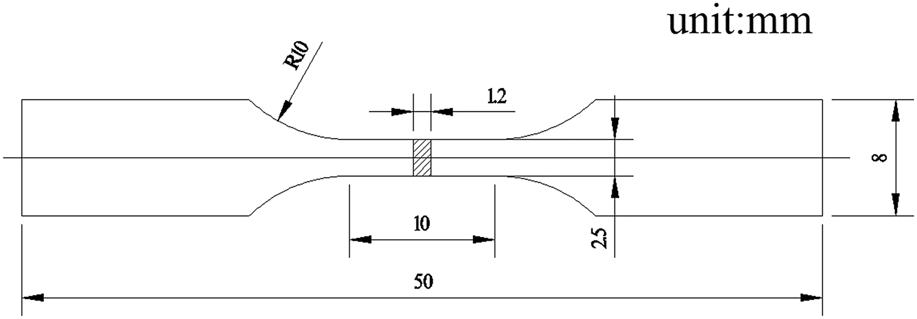
Microstructural specimens were cut from the center and edge of the thixoforged products. One cross-section parallel to the forging direction was prepared with standard metallographic procedures. Microstructural characterization was carried out with optical microscopy (OM) and scanning electron microscopy (SEM). Some typical OM micrographs are quantitative examined by Image-Pro Plus 5.0 software. The compositions of the α-Mg particle were analyzed by energy dispersive spectroscopy using spot scan mode in this SEM. The testing positions were in the center of the primary α-Mg particle. At least ten particles were tested in one image and the average of which was taken as its composition. To examine the fraction of eutectic β phase (Mg17Al12), the related SEM images were also analyzed by Image-Pro Plus 5.0 software. Rectangular tensile specimens were machined by computer numerical control (CNC) wire-cut machine from the center of each thixoforged products parallel to the forging pressure, the schematic of which was shown in Fig. 1. The tensile testing was conducted on a universal material testing machine at a cross head speed of 1 mm/s. The average of at least five testing values was taken as the mechanical properties of a thixoforged composite. Some typical fracture surfaces and side-view of them were also observed on SEM and OM.
Schematic of the tensile testing specimen.

III. RESULTS AND DISCUSSION
A. The microstructures of in situ Mg2Sip/AM60B composite under as-cast, semisolid and thixoforged conditions
To study the effects of reheating temperatures on microstructure of the thixoforged in situ Mg2Sip/AM60B composite, the microstructures under different conditions should be first clarified. As shown in Fig. 2(a), the as-cast microstructure is composed of equiaxed α-Mg dendrite (marked by A), eutectic structures (marked by B), and fine Mg2Si particles (marked by C). After the composite reheated at 600 °C for 60 min, the α-Mg dendrite evolves into spheroidal primary α-Mg particle (marked by D) suspending in the liquid [marked by E in Fig. 2(b)]. The liquid not only locates in the intergranular regions, but also be entrapped by the primary α-Mg particle, which results from the melting of the eutectic structures entrapped by dendrite-arms. The microstructural evolution of α-Mg phase and the formation mechanisms of the liquid pools during partial remelting have been detailedly discussed in the previous work.Reference Chen, Ma, Wang, Li and Hao31,Reference Zhang, Chen, Ma, Li and Hao33,Reference Chen, Lu, Ma, Huang and Hao34 Subsequently, the semisolid ingot is thixoforged. Then the liquid solidifies again to form the secondarily solidified structures [Fig. 2(c)]. Therefore, the thixoforged microstructure is consisted of primary α-Mg particle, Mg2Si particle, and secondarily solidified structure. It can be expected that the black spots within the primary α-Mg particle originate from solidification of the entrapped liquid pools [marked by F in Fig. 2(c)]. The effects of reheating temperatures on microstructures of thixoforged composites will be discussed in the following.
Microstructures of the composites: (a) as-cast, (b) partial remelted at 600 °C for 60 min and (c) thixoforged condition.
B. Effects of reheating temperature on microstructures
Figure 3 presents the microstructures in the center of the in situ Mg2Sip/AM60B composites thixoforged at different temperatures. It indicates that all of the microstructures are composed of primary α-Mg particles (marked by arrow A), Mg2Si particles (marked by arrow B), and secondarily solidified structures (marked by arrow C). As shown in Fig. 3(a), when the reheating temperature is 585 °C, the primary α-Mg particles almost completely connect with each other, of which the boundaries are indiscernible. Innumerable small black spots (marked by arrow D in Fig. 3) distribute within the primary α-Mg particles. As the reheating temperature rises to 595 °C, the boundaries of the primary α-Mg particles gradually appear while the amount of secondarily solidified structures increases [Fig. 3(b)]. When the reheating temperature reaches to 600 °C, the boundaries between the primary α-Mg particles become more discernible. Besides, the number of those spots decreases while the size of which increases [Fig. 3(c)]. As the reheating temperature further rises to 610 °C, the microstructure exhibits a typical thixoforged characteristic. The individual primary α-Mg particles are separated by the secondarily solidified structures and the number of those spots further decreases [Fig. 3(d)].
Central microstructure of the composite thixoforged at different temperatures for 60 min: (a) 585 °C, (b) 595 °C, (c) 600 °C, and (d) 610 °C.
For the purpose of systematic discussion of the microstructural evolution, the microstructures in the edge of the in situ Mg2Sip/AM60B composites thixoforged at different temperatures are also observed. The results are shown in Fig. 4. It confirms that the microstructures in the edge belong to a typical thixoforged microstructure, in which the amount of the secondarily solidified structures is always larger than that in the center regions (comparing Fig. 4 to Fig. 3). In addition, the change trend of those spots within the primary α-Mg particles in the edge is similar to that in the center. The quantitative examinations for the average size and number of those spots are shown in Fig. 5. When the reheating temperature is 585 °C, most of the primary α-Mg particles are individual and fine, which are only separated by thin secondarily solidified structures [Fig. 4(a)]. As shown in Fig. 4(b), some large primary α-Mg particles with irregular shape form at 595 °C. The coarsening of primary α-Mg particles should be attributed to their mergence during partial remelting [marked by arrows in Fig. 4(b)]. As the reheating temperature further rises to 600 °C, the mergence of neighboring primary α-Mg particles only operates at some local regions, and most of the primary α-Mg particles are separated from each others [Fig. 4(c)]. As shown in Fig. 4(d), the grain size of the primary α-Mg particles, and the amount of secondarily solidified structures increase dramatically when the reheating temperature reaches 610 °C.
Microstructures in the edge of the composite thixoforged at different temperatures for 60 min: (a) 585 °C, (b) 595 °C, (c) 600 °C, and (d) 610 °C.
Variations of the average size and number for the spots in the center and edge with reheating temperatures.
The differences in microstructures between the center and edge regions should be resulted from the following reasons. First, more liquids generate in the edge regions of the semisolid ingot during partial remelting. Second, the liquids flow toward the edge along the radial direction during partial remelting, and the flowage become more dominant during mold filling. Thus more liquid in the edge and more secondarily solidified structures are thereby generated in the edge after being thixoforged. Third, the solidification rate in the center region is slower than that in the edge region during thixoforging. Thus, more secondarily primary α-Mg phases (to differentiate from the primary particles, the primary α-Mg phase solidified from the liquid phase is named secondarily primary α-Mg phase) may attach on the primary α-Mg particle surface. Therefore, the primary α-Mg phase cannot be distinguished from the secondarily solidified structure from the OM image. Based on the above discussion, the microstructural difference shown in Figs. 3 and 4 can be well interpreted. However, for the primary α-Mg particles, it is reasonable expected that they have a similar change trends in both center and edge regions.
The level of reheating temperature determines the liquid fraction and the ability of atom diffusion during partial remelting. At low reheating temperature, the amount of liquid is small and the distance between the primary α-Mg particles is short. The neighboring primary α-Mg particles are easily connecting with each other. However, the mergence only occurs at some local regions [Fig. 4(a)] since the atom diffusion ability is at a low level. The increase in reheating temperature results in promotion of atom diffusion ability. Therefore, the connected primary α-Mg particles easily coarsen through mergence either by grain boundary migration or grain rotation (driving by minimize the interfacial energy of the semisolid system).Reference Tzimas and Zavaliangos35–Reference Martinez and Flemings37 Thus, the large primary α-Mg particles with irregular shape are generated at 595 °C [Fig. 4(b)]. As the reheating temperature further rises, the distance of the primary α-Mg particles increases owing to the increase in liquid amount which results from the requirement of temperature rise. So the possibility of mergence decreases and the primary α-Mg particles are individual [Fig. 4(c)]. Generally, the microstructural evolution during partial remelting should be divided into four stages in sequence of rapid coarsening, structure separation, spheroidization, and coarsening from Ostwald ripening.Reference Chen, Ma, Wang, Li and Hao31,Reference Chen, Lu, Ma, Huang and Hao34 The essence of each stage is related to the phase transformations, the rate of which is determined by atom diffusion ability.Reference Chen, Ma, Wang, Li and Hao31,Reference Chen, Lu, Ma, Huang and Hao34 As the reheating temperature rises, the atom diffusion is accelerated, and the rate of phase transformations is thereby increased. So the microstructural evolution process is speeded up. Therefore, the coarsening from Ostwald ripening becomes more dominant when the composite being reheated at a high temperature. As shown in Fig. 4(d), the coarsening of primary α-Mg particles at 610 °C should be attributed to this regime. Therefore, it can be expected that the reheating temperature of 600 °C is appropriate for this composite. The lower temperature results in the insufficient liquid phase and coarsening of the solid particles, while the higher temperature generates too much liquid phase and also the coarsening. Both of these are deteriorating for mechanical properties and this will be further demonstrated in the following section.
As mentioned above, these black spots within the primary α-Mg particles result from the solidification of the liquid pools within the primary α-Mg particles which originate from the melting of the entrapped eutectic structure. With regard to one as-cast ingot, the dendrite in the center is always larger than that in the edge. It means the longer dendrite-arms in the center. In this case, the possibility of the entrapped eutectic structure is higher and resulting in the more liquid entrapped in the primary particles. Therefore, average size and number of those spots in the center are higher than that in the edge (Fig. 5). As reheating temperature rises, these liquid pools gradually grow up owing to the connecting of them and the melting of more α-Mg phases. Thus, the size of these spots increases while the number of them decreases (Fig. 5). When the temperature rises to 610 °C, the liquid pools are connected with the intergranular liquid, and thus, the amount of these spots further decreases [Figs. 3(d) and 4(d)].
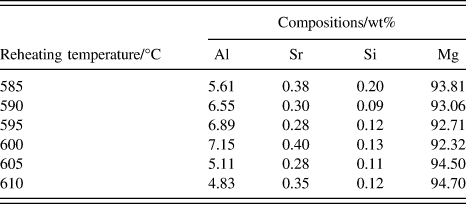
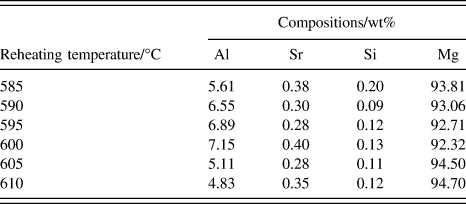
According to the Mg–Al binary equilibrium phase diagram,Reference Massalski and Okamoto38 the AM60B matrix experiences a single α-Mg interval during partial remelting. The β phase (Mg17Al12) dissolves toward the primary α-Mg particles. So the level of reheating temperature is also an important factor in determining the compositions of primary α-Mg particles. Table I shows the compositions of primary α-Mg particles under different reheating temperatures. It confirms that the Al content in the primary α-Mg particles increases as the reheating temperature rises from 585 to 600 °C and then decreases as the reheating temperature further rises. Namely, the Al content in the liquid must decrease as the temperature rises from 585 to 600 °C and then increase. As shown in Mg–Al binary equilibrium phase diagram, the Al content in the α-Mg should decreases as the temperature rises for the Mg–6Al alloys.Reference Massalski and Okamoto38 However, the current experimental results are not in conformity with that shown in Mg–Al binary equilibrium phase diagram.Reference Massalski and Okamoto38 This phenomenon is also observed in the other thixoforged Mg–6Al alloy,Reference Chen, Huang, Huang, Ma and Hao27 which is attributed to the following reasons. The first is the difference in compositions between these two systems. The Mg–Al binary equilibrium phase diagram provides the information about Mg–6Al based on the Mg–Al binary alloys, while the used composite contains many other alloying elements, such as Si and Mn. The second is the different state of the two systems. The information according to Mg–Al binary equilibrium phase diagram results from its equilibrium state. However, the previous investigation confirms that the semisolid system reaches its equilibrium state until it be reheated for 70 min at 600 °C,Reference Chen, Zhang, Chen, Li, Ma and Hao26 that is the semisolid system before thixoforging under disequilibrium condition. So, the compositions of both the primary α-Mg particles and liquid phases are also not up to their equilibrium value. Namely, the Al content in the primary α-Mg particles is lower than its equilibrium value, while that in the liquid is higher. With the reheating temperature rising from 585 to 600 °C, the promotion of atom diffusion ability results in the semisolid system trending to its equilibrium state. That is, the Al content is increased in the primary α-Mg particles and decreased in the liquid phases (Table I). It can be expected that the semisolid system will achieves its equilibrium state when the reheating temperature exceeds to a certain value. Therefore, as the reheating temperature further rises from 600 to 610 °C, the change tendency of Al content in primary α-Mg particles is reversed, which will be consistent to that indicated in Mg–Al binary equilibrium phase diagram, i.e., the Al content in the primary α-Mg particles will decrease, and that in the liquid will increase. Therefore, it is easy to understand the variations of the compositions in the primary α-Mg particles with reheating temperatures (Table I).
Compositions of the primary α-Mg particles of the composites thixoforged under different reheating temperatures.
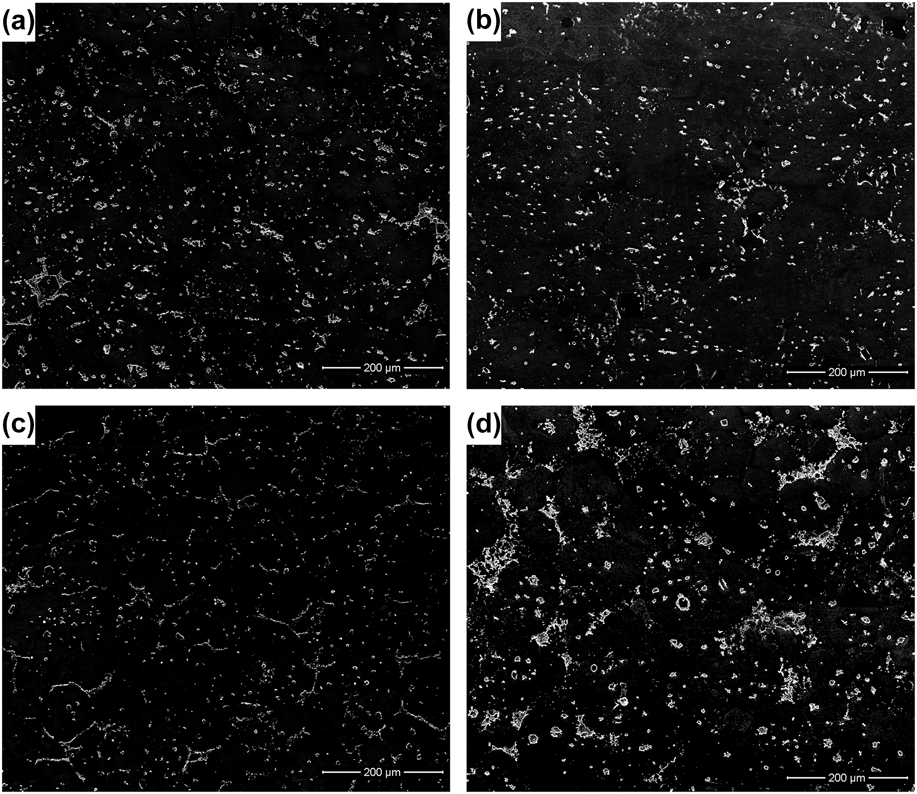
For the Mg–Al series alloys, the Al element is a necessary constituent for forming eutectic β phase (Mg17Al12). Thus, the amount of eutectic β phase should also be changed as the reheating temperature rises. Figure 6 gives the related SEM images. The formed eutectic β phases (in bright contrast) gradually decrease as the reheating temperature rises from 585 to 600 °C, and then increase [comparing Fig. 6(a) to Fig. 6(d)]. The corresponding quantitative examinations are shown in Fig. 7 which is completely according with the change tendency of the Al content in liquid phases. During thixoforging, the secondarily primary α-Mg phases preferentially grow up on the surface of the primary α-Mg particles, and then the eutectic α-Mg phases also attach on the surfaces of the formed secondarily primary α-Mg phases. The residual liquid phases solidify into eutectic β phase at the finally solidified regions. The more Al atoms are dissolved in the liquid, the more eutectic β phases are formed in the thixoforged microstructure. Inversely, the more eutectic α-Mg phases are formed. The change tendency of eutectic β phases further demonstrate the variation of compositions with reheating temperature discussed above.
SEM images of the composite thixoforged under temperatures of: (a) 585 °C, (b) 595 °C, (c) 600 °C, and (d) 610 °C.
Variations of the eutectic β phase amount with reheating temperatures.
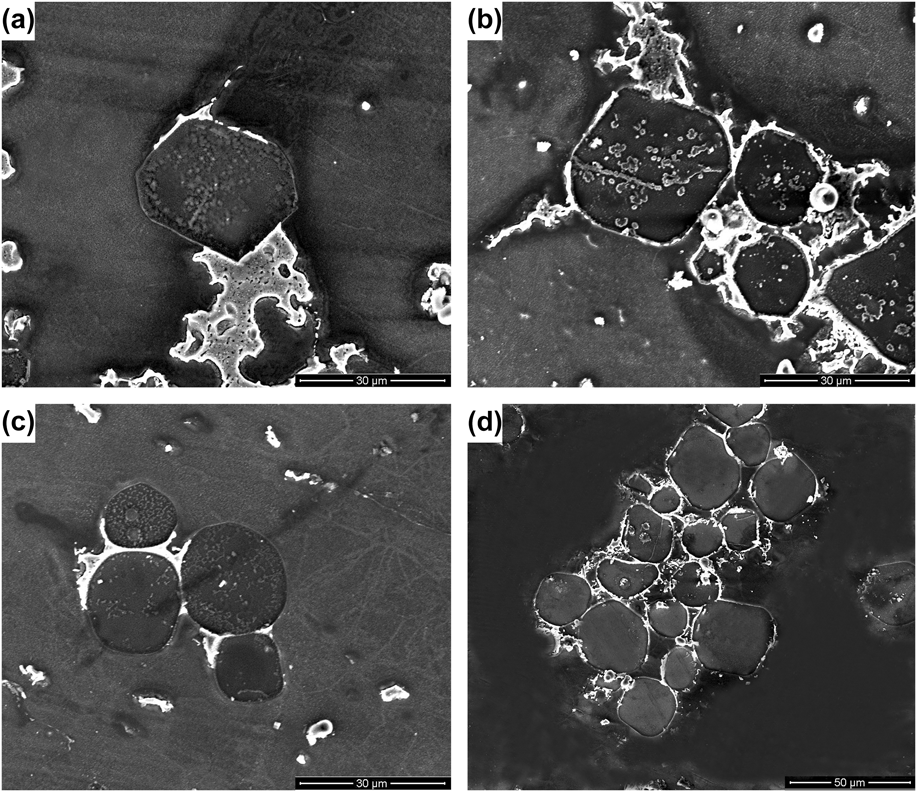
With regard to the Mg2Si particles, the morphological change with the reheating temperatures is shown in Fig. 8. It indicates that the Mg2Si particles exhibit an irregular shape with sharp edges and corners at 585 °C [Fig. 8(a)]. As the reheating temperature rises, the edges and corners of the Mg2Si particles obviously become blunt [Fig. 8(b)]. It has been known that the eutectic point of the Mg2Si phases is 637.6 °C.Reference Yu, Chen, Tang, Wang and Shi39 Although the used reheating temperature is lower than the eutectic point, it can also be expected that the Mg2Si particles are partial remelting, which may preferentially operates at the sharp edges and corners owing to the effect of curvature on melting point.Reference Chen, Zhu and Li40 Therefore, the sharp edges and corners become blunt [Fig. 8(b)]. As the reheating temperature further rises, the more Mg2Si particles should be melted and then reprecipitate at the sunken zones of the primary Mg2Si particle. So the Mg2Si particles become more and more spheroidal [Fig. 8(c)]. The Mg2Si particle clusters form at 610 °C [Fig. 8(d)] and a few of them merges with the neighboring particles. It can be inferred that the clusters and mergence have a negative effect on the mechanical properties of the thixoforged composite, and this will be detailedly discussed in the following section.
SEM images shown Mg2Si particles thixoforged under temperatures of: (a) 585 °C, (b) 595 °C, (c) 600 °C, and (d) 610 °C.
Another factor that should not be ignored is the semisolid deformation during thixoforging, since the plastic deformation of the solid particles influences the mechanical properties dramatically. The thixoforged composites are subjected to an annealed treatment at 430 °C for 60 min. If the plastic deformation has been actually occurred during thixoforging, the small sized grains will be formed at the deformed regions through recrystallization during annealed treatment and the related images are shown in Fig. 9. When the composite reheated at 585 °C, unnumbered small grains uniformly distribute in the annealed microstructure [Fig. 9(a)]. As the reheating temperature rises, the amount of these small grains decreases and they mainly distribute like a chain within the primary α-Mg particles [marked by arrows in Fig. 9(b)]. The amount of the small grains further decreases and they distribute surrounding the primary α-Mg particles at 600 °C [Fig. 9(c)]. As shown in Fig. 9(d), these small grains only distribute in some small local regions (marked by arrows), inside the primary α-Mg particles. Thus, it can be expected that the plastic deformation has been actually occurred during thixoforging, and its degree and regions change with the reheating temperature rises.
OM micrographs of the composites thixoforged under different temperatures and then annealed at 430 °C for 60 min: (a) 585 °C, (b) 595 °C, (c) 600 °C, and (d) 610 °C.
Generally, there are four deformation mechanisms for semisolid ingot during thixoforging: liquid flow, flow of liquid incorporating solid particles, sliding between solid particles (SS), and plastic deformation of solid particles (PDS).Reference Chen and Tsao41 The former two mechanisms operate under the condition that the solid particles are surrounded by the liquid phase and the latter two are valid when the solid particles are in contact with each other.Reference Chen and Tsao41 When the reheating temperature is 585 °C, the least liquid is generated in the semisolid ingot. The semisolid deformation operates in PDS mechanism dominantly. As the reheating temperature rises, the more liquid forms in the semisolid ingot. Thus semisolid deformation is easily achieved through SS mechanism. As a result, the amount of these small grains in the annealed microstructure is decreased [comparing Fig. 9(a) to Fig. 9(b)]. However, as mentioned above, the large sized primary α-Mg particles are formed in the semisolid ingot at this reheating temperature. It can be expected that these large sized particles exhibit a bad harmony and have to plastically deform during semisolid deformation. Therefore, the semisolid deformation is achieved via SS mechanism of small sized primary α-Mg particles and PDS mechanism of large sized primary α-Mg particles. So the small grains are formed within the large sized primary α-Mg particles after the composite being annealed treatment [Fig. 9(b)]. Based on the above mentioned, the amount of eutectic α-Mg phases is the largest. The growth of eutectic α-Mg phases results in the connecting of α-Mg phases and the decrease in eutectic liquid phases. During sliding, the connected α-Mg phases preferentially participate in the plastic deformation. Thus, the small grains are surrounding the primary α-Mg particles in the annealed microstructure at 600 °C [Fig. 9(c)]. As the reheating temperature further rises, the amount of eutectic liquid phases increase due to the increase of Al content in liquid phases. Therefore, most of the primary α-Mg particles do not plastically deform owing to the lubrication of the eutectic liquid phases between them. The large sized primary α-Mg particles are also formed at this reheating temperature before thixoforging. These coarse primary α-Mg particles should also plastically deform as well as that under 595 °C. So, in the annealed microstructure, the small grains are also generated inside the primary α-Mg particles [Fig. 9(d)].
C. Effects on tensile properties
Figure 10 presents the variation of tensile properties with the reheating temperatures. It confirms that both the ultimate tensile strength (UTS) and elongation increase to their peak value at 600 °C and then decrease. The composite thixoforged under 600 °C has the best comprehensive tensile properties, UTS of 209 MPa and elongation of 11.9%.
Variations of UTS and elongation with reheating temperatures.
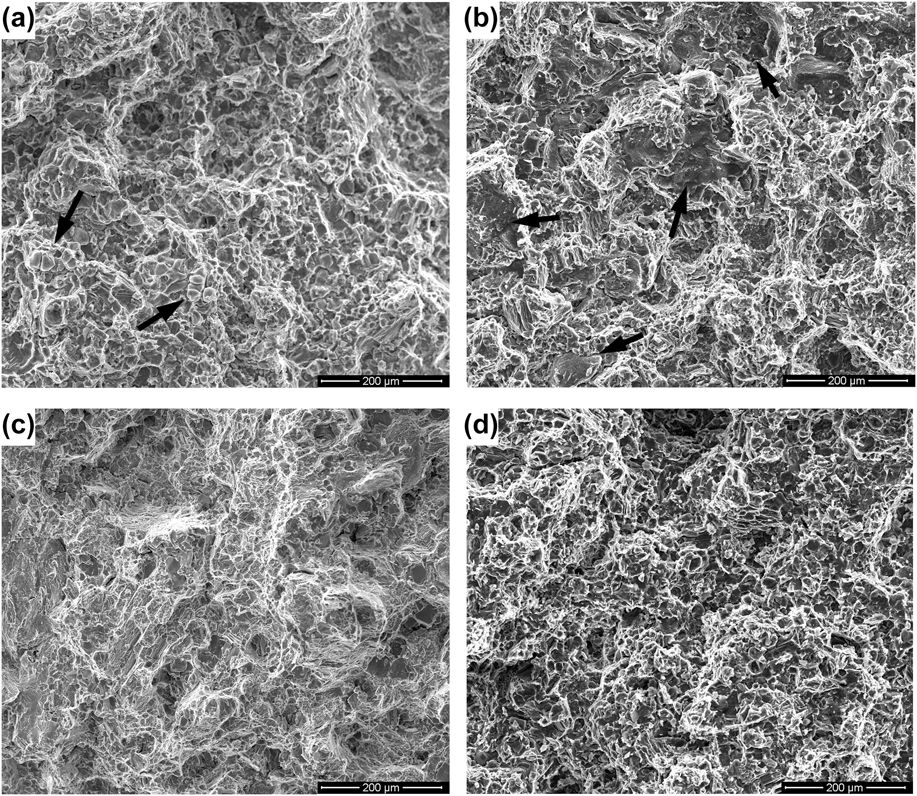
The fractograph shown in Fig. 11(a) presents that the fracture surface of the composite thixoforged under 585 °C exhibits a typical porosity features [marked by arrows in Fig. 11(a)]. The side view of the fracture surface indicates that the cracks frequently grow between the α-Mg particles during tensile testing [Fig. 12(a)]. That is, the fracture mode of this composite belongs to intergranular mode. When the composite is thixoforged under 585 °C, the amount of the liquid before thixoforging is the least. Therefore, the flowability, mold filling ability, and the feeding ability to the solidification shrinkage are thereby the worst. The porosities must easily generate between the α-Mg particles. Even if the liquid feeds these porosities, the eutectic β phases are formed in the last solidified regions. In this case, the bonding strength between the α-Mg particles is the weakest. The α-Mg particles are easily debonding during tensile testing, and then resulting in the eventual fracture. Therefore, the existence of the porosities and the hard and fragile eutectic β phases between the α-Mg particles is responsible for the low tensile properties of the composite thixoforged under 585 °C (Fig. 10).
Fractographs of the composites thixoforged under reheating temperatures of (a) 585 °C, (b) 595 °C, (c) 600 °C, and (d) 610 °C.
Side views of the fracture surface of the composites thixoforged under reheating temperatures of (a) 585 °C, (b) 595 °C, (c) 600 °C, and (d) 610 °C.
As the reheating temperature rises, the flowability, mold filling ability, and especially the feeding ability to the solidification shrinkage are promoted from the increase in the amount of liquid phases before thixoforging. Thus, the bonding strength between the α-Mg particles is enhanced, which has a positive effect on the tensile properties, especially in UTS. Furthermore, the decrease in the plastic deformation degree results in the reducing of working hardening role. This leads to the decrease in UTS and the increase in elongation. However, the UTS decreasing from reduced working hardening role should be minor in comparison with that increasing from the enhanced bonding strength between α-Mg particles. Therefore, the tensile properties are significantly improved when the composite thixoforged under 595 °C (Fig. 10). Moreover, the α-Mg particles obviously coarsen owing to the mergence of them at 595 °C. The large sized α-Mg particles cannot bear large deformation during tensile testing. A high stress concentration should be generated inside the α-Mg particles. The cracks easily initiate from these sites and develop across the α-Mg particles. As a result, the large sized flats are then generated on the fracture surface [marked by arrows in Fig. 11(b)]. Those flats should correspond to the cracks pass through the α-Mg particles [marked by arrows in Fig. 12(b)]. In addition, the cracks also propagate occasionally along the secondarily solidified structures [Fig. 12(b)]. So as the fracture of this composite belongs to a mixture of transgranular and intergranular modes. Owing to the enhanced compactness of secondarily solidified structures, the tensile properties are thereby increased (Fig. 10).
As shown in Fig. 11(c), the fracture surface of the composite thixoforged under 600 °C is covered by the uniform small dimples. The crack growth path develops completely across the α-Mg particles and passes by the black spots within them [Fig. 12(c)]. When the reheating temperature further rises, the α-Mg particles are significantly refined and the liquid amount further increases before thixoforging. Thus the compactness of the secondarily solidified structures is further improved. The debonding of the α-Mg particles is seldom observed [Figs. 11(c) and 12(c)]. That is, the fracture of this composite transforms into a completely transgranular mode. In addition, the increase of the Al content in the primary α-Mg particles must be accompanied by the decrease in the amount of eutectic β phases. The former behavior can enhance the solution strengthening role, and the latter one should decreases the harmfulness of eutectic β phases to tensile properties.Reference Cheng, Chen, Qi, Zhang and Yao42 All of these changes must bring impressive improvement in tensile properties of this composite (Fig. 10). The cracks frequently pass by the black spots within the α-Mg particles [marked by arrows in Fig. 12(c)]. As mentioned above, these spots result from the solidification of the liquid pools inside the primary α-Mg particles. There is no extra liquid to feed solidification shrinkage of the liquid pools during thixoforging, and thus, the porosities also easily generate in these spots. As the reheating temperature rises, the black spots grow up as well as these porosities within these spots. Therefore, the black spots become weak point of this composite and cracks easily initiate from these sites and then across the α-Mg particles.
The higher reheating temperature must results in the more liquid in semisolid ingot before forming, and thus the solidification behavior during thixoforging is closer to that of full liquid melt. In this case, the more porosity easily generate in the secondarily solidified structures. Therefore, the bonding strength between the α-Mg particles is weakened and the α-Mg particles are easily debonding during tensile testing. As a result, the fracture surface of this composite is characterized by large pits in which many porosity exist [Fig. 11(d)]. Correspondingly, the cracks always propagate along the secondarily solidified structures between the α-Mg particles [Fig. 12(d)]. That is, the fracture of this composite obeys intergranular mode. Furthermore, the Mg2Si particle clusters are formed between the α-Mg particles. It brings a harmful factor in tensile properties because a large stress concentration is easily generated near these sites. All of these factors have a negative effect on the tensile properties of the thixoforged composite, and thus both of the UTS and elongation decrease (Fig. 10).
D. Effects of Mg2Si particles on tensile properties
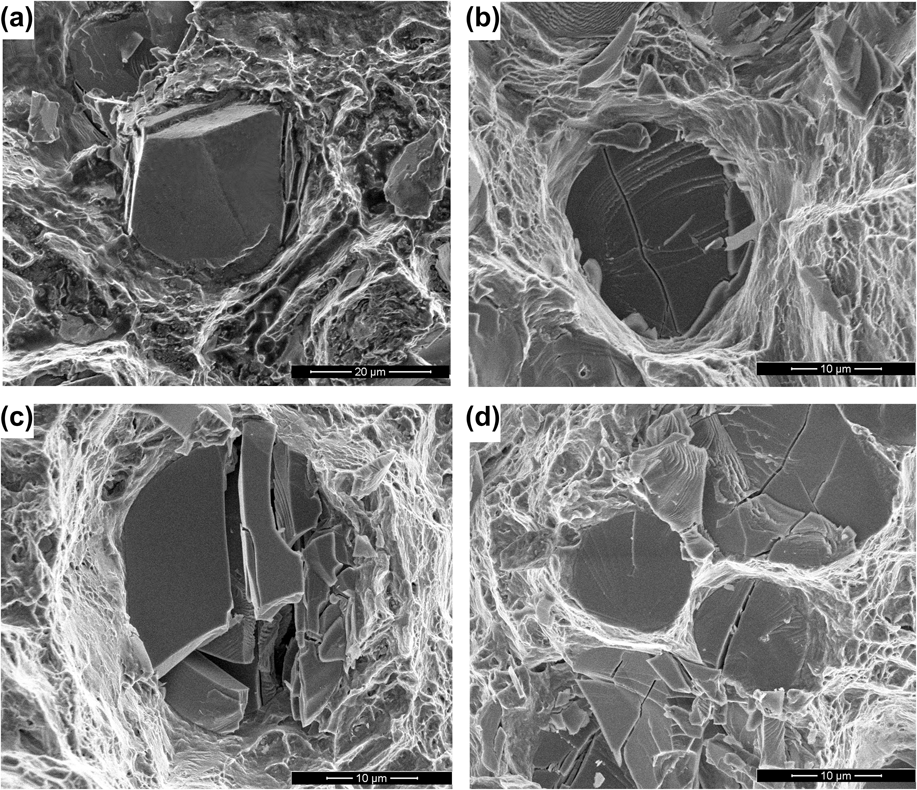
As the reinforcements of Mg2Si particles, the mechanical behaviors of them are necessary to be investigated. Some typical fracture surfaces are shown in Fig. 13. It indicates that the Mg2Si particles with relatively sharp edges and corners keep their original morphology at 585 °C [Fig. 13(a)]. The interfaces of the Mg2Sip/matrix belong to an incoherent interface, since the differences of the crystal structures and the lattice constants.Reference Yu, Chen, Tang, Wang and Shi39 During tensile testing, a large stress concentration preferentially generates near the sharp edges and corners of the Mg2Si particles. Thus, microvoids should generate in the surrounding matrix under this stress concentration. As the tensile testing proceed, these microvoids grow up resulting in the debonding of the Mg2Sip/matrix interfaces. On the other hand, the bonding strength between the interfaces of Mg2Sip/matrix should be the weakest owing to the existences of porosities near the Mg2Si particles, and then these interface also easily debonding during tensile testing. Consequently, the interfacial debonding should be the main damage pattern of the Mg2Si particles in this composite. The Mg2Si particles have not fully take part in strengthening the matrix.
The SEM images show the Mg2Si particles on the fracture surface of the composites thixoforged under reheating temperatures of: (a) 585 °C, (b) and (c) 600 °C, (d) 635 °C.
As the reheating temperature rises to 600 °C, the Mg2Si particles gradually become spheroidal (Fig. 8) and the bonding strength between the interfaces of the Mg2Sip/matrix is improved. In this case, the interfacial debonding of the Mg2Sip/matrix is seldom found on the fracture surface. There are two kinds of damaged Mg2Si particles: either fracture parallel to the fracture surface of the whole tensile bar [Fig. 13(b)] or break up into several parts [Fig. 13(c)]. During tensile testing, the soft α-Mg particles deform plastically while the Mg2Si particles deform only elastically. Therefore, a high stress concentration generates at the interfaces of Mg2Sip/matrix and increases as the tensile strain increases. It has been reported that this stress concentration is 2–4 times higher than that in the surrounding matrix,Reference Arsenault43,Reference Arsenault44 and finally results in the fragmentation of the Mg2Si particles. Then the stress concentration is relaxed. It is just due to the formation of stress concentration at the Mg2Sip/matrix interface and the subsequent relaxation, the growth rate and nucleation of the crack in the surrounding matrix are delayed. Namely, the Mg2Si particles effectively prevent the cracks from initiation in the matrix through load transfer mechanism. The main damage pattern of the Mg2Si particles is their fragmentation.
The Mg2Si particle clusters are formed as the reheating temperature further rises (Fig. 8). A high stress concentration is also formed near the Mg2Si particle clusters, and results in the fragmentation of the Mg2Si particles [Fig. 13(d)]. These fractured Mg2Si particles easily connect with each other, eventually leading to the final fracture of this composite. The Mg2Si particle clusters cannot protect the matrix. This should be avoided through adjusting the reheating temperature or/and reheating temperature.
E. Comparison with the traditional permanent mold casting
To demonstrate the improvement of thixoforging technology in tensile properties, the composite is also prepared via traditional permanent mold casting and its tensile properties are examined. The results confirm that the traditional permanent mold casting composite has relatively poor UTS of 108 MPa and elongation of 5%. Compared with the tensile properties of thixoforged composite under optimum conditions in Fig. 10, it is obvious that the thixoforged composite exhibits significantly better tensile properties. The UTS and the elongation of the thixoforged composite is 93 and 138% higher than that of traditional permanent mold casting, respectively. The excellent tensile properties of the thixoforged composite primarily ascribe to the elimination of shrinkage porosities by applied pressure. In addition, the solution strengthening role and working hardening role should also take part in improvement in tensile properties of thixoforged composite.
IV. CONCLUSIONS
(1) The reheating temperature has large effects on microstructure and tensile properties of the thixoforged composites. The change of microstructure is attributed to the variation of liquid amount and composition, and subsequently solidification behavior during thixoforging. The tensile properties are related to the shrinkage porosities, the working hardening mechanism from plastic deformation and the stress concentration.
(2) The Mg2Si particles become more and more spheroidal as reheating temperature rises. The morphological change of the Mg2Si particles is owing to the partial remelting of their edges and corners.
(3) The fracture mode of the thixoforged composite changes from intergranular mode in turn to a mixture of intergranular and transgranular modes, and completely transgranular mode, and finally intergranular mode again as the reheating temperature rises from 585 to 610 °C. The Mg2Si particle strengthens the matrix through load transfer mechanism.
(4) The appropriate reheating temperature is 600 °C. The lower temperature results in the insufficient liquid and coarsening of the α-Mg particles, while the higher temperature generates too much liquid and also the coarsening. The corresponding UTS and elongation are 209 MPa and 11.9%, respectively.
(5) In comparison with the traditional permanent mold casting, the UTS and elongation of the thixoforged composite are 93 and 138% higher. The super tensile properties of the thixoforged composite result from the elimination of shrinkage porosities, the solution strengthening and working hardening roles.
ACKNOWLEDGMENTS
The authors wish to express thanks to financial support from the National Basic Research Program of China (Grant No. G2010CB635106), the Program for New Century Excellent Talents in University of China (Grant No. NCET-10-0023) and the Program for Hongliu Outstanding Talents of Lanzhou University of Technology.