The British empire was linked in worship. Across the overseas colonies, protectorates, dominions and in India, churches of various denominations followed the weekly patterns of worship originating from the parent churches in Britain. The links were especially evident in special acts of worship. From the first settlements in North America during the early seventeenth century to the worldwide commonwealth and empire at the coronation of Queen Elizabeth in 1953, the peoples of particular overseas territories – or more strikingly still, those of the whole empire – were asked at times of exceptional crisis or celebration to join together in prayer and praise to God. These acts of special worship took different forms. Special prayers, either of petition or thanksgiving, might be added to the usual church services. More often, days of prayer were ‘set apart’ on specified dates, for attendance at special services and sermons and for private devotions. During periods of anxiety or crisis, days of fasting, ‘humiliation’, intercession or national prayer were observed to implore God's intervention or to seek better understanding of the divine purposes.Footnote 1 At times of relief or celebration, days of thanksgiving were ordered to thank God for blessings received or for his guidance in the achievement of righteous aims. Until the late nineteenth century, these special days of prayer were normally ordered by governments, and were appointed for days in the middle of the week, requiring the closure of public offices and the stoppage of business and employment.
Special acts of worship might be imperial in one of several senses. Some special days or prayers initiated in Britain were ordered or recommended for observance throughout the empire, and later the commonwealth. Others were initiated by authorities in the overseas territories in order to associate their colonies or dominions with special worship that had been appointed in Britain, or to mark events that they regarded as having imperial significance. Councils, governors or churches in the colonies also ordered special worship for causes which were specific to their particular region.
Studies of these special acts of worship have considerable potential for deepening understanding of various themes in the religious, political and cultural history of empire. They provide a register of what the authorities in colonies considered, or judged that their peoples considered, to be matters of such exceptional importance as to require, and to be remediable by, divine intervention or guidance. They reveal how notions of collective sin and God's active providence persisted well into the twentieth century. They offer new perspectives on religious authority, on relationships between civil and ecclesiastical authorities, and on relations between different churches and faith groups. Studies of special days and prayers might also draw attention to varied senses of community, and to the sense of identification that colonial peoples developed with their colonies, with new colonial nations and with the empire. They emphasize that among the elements that held together a heterogeneous empire were shared religious beliefs and emotional responses, a common monarchical culture and a language of British ‘subjecthood’.Footnote 2
Studies of these occasions might draw on a range of sources. The religious meanings that individuals attached to the great events marked by special worship can be found in devotional diaries and especially in the fast and thanksgiving sermons which have so far been the main means by which special worship has attracted historical attention.Footnote 3 The proclamations that appointed days of prayer and special services, as well as the forms of prayer issued for use in Anglican churches on these occasions, reveal much about changing conceptions of divine providence and of the higher purposes claimed for the empire. As the stated expectation was that all adult inhabitants should participate in these special acts of worship, newspaper reports of these occasions provide valuable indications of the extent of popular religious observances.
These are just some indications of an agenda for future research. The purpose of this article is the preliminary but fundamental task of outlining the patterns in the appointment and causes of acts of special worship across the empire.Footnote 4 It will establish the main chronological phases of this practice, consider the complications caused by religious pluralism, and direct attention to significant shifts that began during the late nineteenth century. It will also reflect upon the reasons for the longevity of the practice.
Phases of Imperial Special Worship
Special worship in the British empire can be divided into three phases: first, from the beginnings of colonial settlement in America to 1776; second, from the American Revolution through the period of the expanding ‘second empire’ (i.e. post-1783) in Asia, Australasia and Africa; and third, from the 1850s to decolonization in the 1950s.
The practice of observing fast and thanksgiving days was carried across the Atlantic by English settlers during the early seventeenth century. In the plantation colonies of Virginia and the West Indies, both special and annual fasts and thanksgivings were soon ordered for regional causes and, with the Church of England as the dominant church, from the 1660s the English annual religious commemorations (thanksgivings for the failure of the Gunpowder Plot on 5 November and for the restoration of the monarchy on 29 May, and a fast day marking Charles I's execution on 30 January) became official public observances.Footnote 5 Days of special worship also proliferated among the Puritan colonies of New England, with their keen sense of providential governance and freedom from the constraints of the crown and the Church of England, which also meant that they rejected the English anniversary commemorations. But by the time that royal government became established in the late seventeenth century, the New England colonies had their own entrenched customs of seasonal fast days early in the year and thanksgiving days in the autumn, as well as special days for exceptional events.Footnote 6 These customs later spread through the other North American colonies, with the days of prayer now ordered by the royal governors and councils.Footnote 7
The first special worship across the whole empire was in 1688, when during June the Roman Catholic King James II ordered that thanksgiving days for the birth of the Prince of Wales should be observed not only in England and Wales, Ireland and Scotland, but also in the nine colonies in America and the West Indies. Colonial governors duly proclaimed thanksgiving days once the orders reached them, for various dates from July to December. Even Congregational churches in New England obeyed the order, sharing the incongruity of Protestant churches thanking God for the birth of a Catholic heir to the throne.Footnote 8 From 1702 to 1706 the governors of what were now fourteen colonies similarly acted on orders to proclaim colonial versions of the thanksgiving days already arranged in Britain for the early military victories during the War of the Spanish Succession.Footnote 9
Colonial observances of these orders from London, which enclosed copies of the English thanksgiving proclamation, were striking demonstrations of imperial authority, yet the issue of such orders did not become a settled practice. Numerous thanksgiving days were appointed in Britain between 1706 and 1759, but no orders were sent for colonial observances during this period, although they were resumed for the military victories of 1759 and the Peace of Paris in 1763.Footnote 10 Why imperial orders for thanksgivings were interrupted is unclear; but it may well be that governments in London, which received regular reports from each colony, understood that the colonial authorities would themselves order special worship to mark significant events in Britain. From the 1640s to the 1760s, assemblies, councils and governors in colonial America independently proclaimed special fast or thanksgiving days for such episodes as the Civil War, the Restoration, the Popish and Rye House plots, the 1688 revolution, the war of 1689–91 in Ireland and the Jacobite rebellions, as well as for campaigns against, victories over, and peace treaties with, other European powers. Sometimes these colonial proclamations were prompted by reports of British fasts or thanksgivings; just as often the colonial authorities acted simply on news of crises or causes for celebration in Britain.Footnote 11 References to British events and military campaigns and to the royal family were also regularly added to the fast and thanksgiving proclamations which they issued chiefly for causes that were specific to their own colony.Footnote 12
From the texts of these proclamations and from the prayers and sermons heard on the fast and thanksgiving days, the inhabitants of the American colonies were encouraged to regard the British empire as a single spiritual body under divine providence.Footnote 13 Yet special worship could also become a means to claim divine sanction during disputes over imperial policies, as became evident with the American fasts and thanksgivings appointed during the Stamp Act crisis in 1765–6, and the fast days ordered by colonial assemblies, ‘patriot’ provincial congresses and then the Continental Congress after the Boston ‘Tea Party’ in 1774. During 1776 rival fast days were proclaimed by the Continental Congress for all the American colonies and by the British crown for the British Isles, in a competition for the favour of God as political disputes escalated into war.Footnote 14
During the second phase, from 1776 to the 1850s, the appointment of special worship in the newer areas of British control in Canada, Australasia, India and Africa was left to governors and executives; the Colonial Office files for this period contain no imperial orders for thanksgivings. Colonial governments nevertheless tended to take their lead from reports of proclamations or acts of special worship in Britain, and to do so more regularly than had been the case earlier in colonial America. In the Canadian colonies from 1789 to 1816 the acts of special worship were, with few exceptions, repeats or anticipations of those arranged in Britain: special prayers during the illness of George III in 1788–9 and thanksgivings for his recovery, annual fast days during the wars with France from 1793 to 1815, and thanksgivings for peace treaties in 1802 and 1815–16. In Nova Scotia and the other Atlantic provinces, the governors’ proclamations often stated explicitly that the purpose was ‘to extend the effect’ of the king's proclamations in Britain.Footnote 15 Similar patterns developed later in the Australian colonies and elsewhere.Footnote 16 In these ways, appointment of special worship matched the conservatism of British authorities in the early second empire; it may also have contributed to a broader policy that sought to align colonies with the social structure and values of the mother country.Footnote 17
The appointment of Anglican bishops in the colonies from 1787 helped to connect colonial special worship with its British counterpart. As the first of these bishops, Charles Inglis of Nova Scotia and Jacob Mountain of Quebec, regarded the colonies as integral parts of the British nation and the Church of England, they routinely and successfully asked the governors of the Atlantic Canadian colonies and of Upper and Lower Canada to emulate British fasts and thanksgivings by the issue of proclamations for their own territories.Footnote 18 The Canadian bishops also initiated days of prayer for regional causes, notably during the cholera epidemics of the early 1830s.Footnote 19 Although Anglican monopoly over special worship collapsed after the 1830s, as the model of a single privileged religious establishment was abandoned in the colonial world,Footnote 20 governors continued to repeat British acts of worship. In 1842, even the news of thanksgiving prayers in Britain for a good harvest prompted proclamations of days of thanksgiving in Canadian Atlantic provinces.Footnote 21 Special prayers for the births of Queen Victoria's children and her escape from attempted ‘assassinations’ were marked in various overseas territories, and special days of prayer were also called in the colonies for the Irish famine, the Crimean War, and the Indian ‘Mutiny’.Footnote 22 Colonial observances of British acts of special worship were intended to remind colonists that they were British subjects, living in an extended British nation. Colonial proclamations addressed colonists as the ‘loving subjects’ of the crown, and preachers told churchgoers on imperial fast days that great calamities, like the famine and the ‘Mutiny’, resulted from the collective sins of a far-flung British people.Footnote 23 This imperial nation was a ‘virtual’ one, held together by ties of belief and sentiment and not by a formal political union, nor by an overarching imperial state that ordered worship in its territories.Footnote 24
The third phase, from the 1850s to the 1950s, was marked by improvements in communication, and by more direct and frequent actions by authorities in the imperial centre to evoke colonial attachment to the empire. Until the mid-nineteenth century, colonial observances of British acts of special worship had taken place weeks later than the date of the observance in Britain. Now faster ships and the spread of telegraph cables made it possible for these occasions to be observed simultaneously in Britain and the colonies. The first arrangements to bind the empire in this way were made for royal events. In 1872 governors and churches in many territories spontaneously arranged thanksgiving days for the prince of Wales's recovery from illness.Footnote 25 For Queen Victoria's golden and diamond jubilees in 1887 and 1897, the Colonial Office took an active part, despatching copies of the English orders and forms of prayer to governors for their ‘information’, accurately assuming that governors and churches would act upon these by organizing public holidays and thanksgiving services. Messages from the queen were telegraphed to the governors for communication to their communities: in 1887 asking that her thanks to God should be expressed during the special services in the churches and chapels of the empire, in 1897 asking God to bless her ‘beloved people’.Footnote 26 Similar arrangements were made to mark the funerals and coronations of sovereigns, and the thanksgivings for George V's recovery from illness in 1929 and for his silver jubilee in 1935. The Dominion and Colonial Offices sent the governors increasingly detailed information on the arrangements for these occasions.Footnote 27
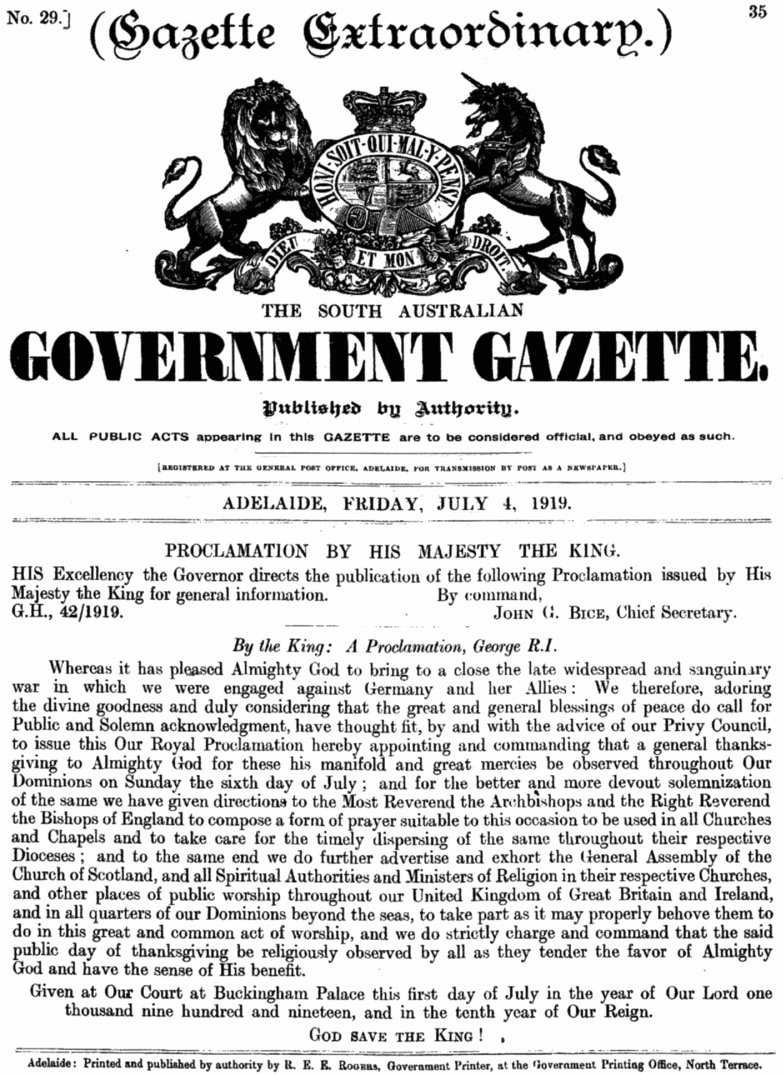
Still more urgent efforts to nurture imperial patriotism by acts of special worship were made in wartime. In February 1900, during the South African War, a day of intercession arranged by the Church of England was imitated by colonial bishops and some non-Anglican churches in the overseas empire.Footnote 28 During the First World War, a new type of ‘national day of prayer’ was created. These were initiated by consultation among the leaders of all the main churches in Britain (including the Roman Catholic Church), announced with the king's personal support, and then proclaimed or encouraged by governors in the colonies, dominions and India. By stages, this type of occasion became not only more ecumenical, but also still more ‘imperial’, with increased participation of the crown and government. Uniquely, for the peace treaty in July 1919 a single royal proclamation ordered religious thanksgivings for both the United Kingdom and the overseas empire (Fig. 2). During the Second World War, government ministers in London became directly involved, taking decisions on appointment of national days of prayer and asking governors to ensure that, wherever possible, religious services took place everywhere in the empire on the same day.Footnote 29
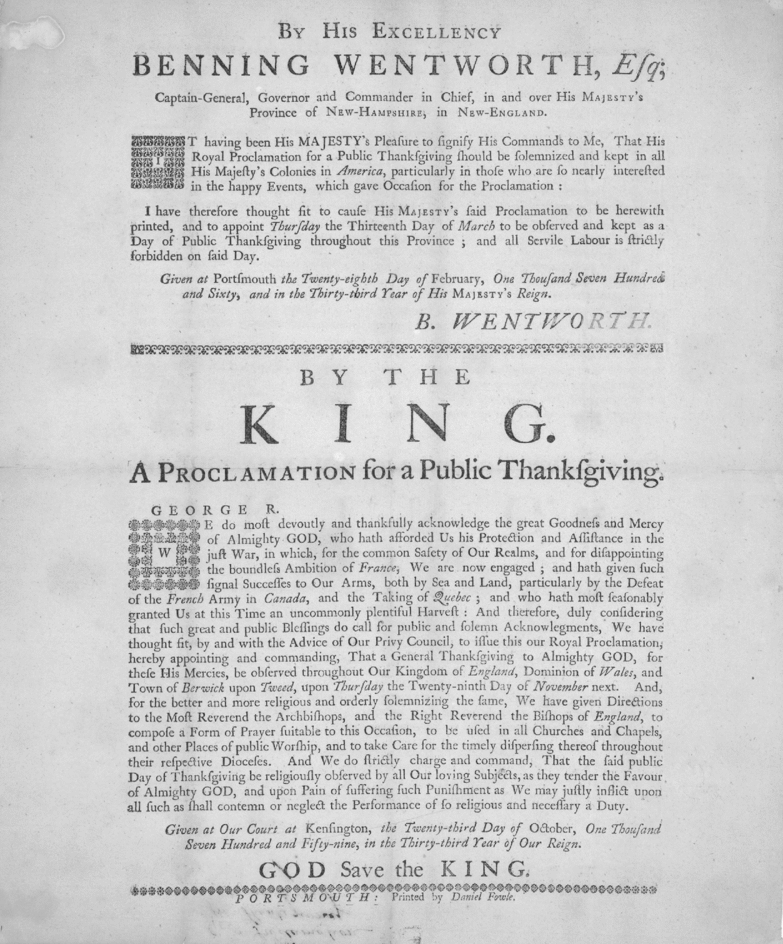
Proclamation for a thanksgiving day by Benning Wentworth, governor of New Hampshire, 28 February 1760, containing the English proclamation of 23 October 1759 for the military victories in Canada. Library of Congress, Printed Ephemera Collection, portfolio 87, folder 9. Reproduced by permission of the Library of Congress.

Proclamation for the day of thanksgiving for the peace treaty of Versailles, 1919, to be observed throughout the empire, as printed in The South Australian Government Gazette, 4 July 1919. Reproduced by permission of the Government of South Australia.

All this demonstrates the importance of the monarchy and war for ‘Greater Britain’. But special worship during this third phase also reveals the empire's centrifugal tendencies. Colonial governors in the ‘second empire’ had continued to appoint special days of prayer for regional causes, such as natural calamities,Footnote 30 emancipation from slavery in the West Indies,Footnote 31 and wars with indigenous peoples, notably in India and southern Africa.Footnote 32 But during the late nineteenth and early twentieth centuries the appointment of regional fast, humiliation or thanksgiving days multiplied in many parts of the empire. Canadian provinces regularly observed seasonal thanksgivings after 1859, and on twenty-three occasions between 1866 and 1914 Australian governments marked droughts by setting aside days of humiliation and thanksgiving.Footnote 33 Moreover, as the following section explains, an increasing number of these occasions came to be organized by churches rather than by governments.
The Effects of Religious Pluralism
Until the mid-Victorian period, the orders issued by the crown for special worship in the British Isles assumed that everyone was a member of an established church. Instructions for services or prayers were addressed to the clergy of the Church of England, the Church of IrelandFootnote 34 and the Church of Scotland, although by the nineteenth century most other religious communities also observed these occasions, on their own terms.Footnote 35 The realities of religious pluralism were accepted much earlier in the colonies and in India. This was often inescapable. Some imperial territories had originally been settled by critics of or separatists from the established churches, and many contained populations of mixed religious and ethnic composition. From the seventeenth century, governors in several colonies in New England issued a distinctive style of proclamation. These were addressed in non-denominational terms to all ‘ministers and people’, and often consisted less of an order than an encouragement or exhortation to observe the fast or thanksgiving.Footnote 36 Elsewhere, in colonies where the Church of England was dominant, governors used the traditional language of English proclamations, with their assertions of royal supremacy in matters of religion. Accordingly, proclamations in the Canadian Atlantic colonies from the 1790s ‘charged’ and ‘commanded’ inhabitants to observe fasts and thanksgivings, with threats of God's ‘wrath and indignation’ for non-observance.Footnote 37 This wording suited a counter-revolutionary empire, and in some territories was retained for a surprisingly long time,Footnote 38 but it became increasingly outmoded as the empire came to include more peoples not of British origin, and as religious toleration was widened in overseas territories. The emergence of an atheistic revolutionary regime in France after 1789 may also have encouraged the adoption of more inclusive forms of special worship. For fasts and thanksgivings in Upper and Lower Canada from the 1790s, governors issued proclamations that embraced Catholics as well as Protestants.Footnote 39 The Catholic archbishops of Quebec ordered special masses on these days, as did the Catholic bishops in Ireland and the vicars-apostolic in England and Wales.Footnote 40
Religious pluralism was belatedly acknowledged in Britain; the last use of the traditional style of proclamation was in 1857.Footnote 41 The arrangements for the 1887 and 1897 jubilees were clearly intended to appeal to all Christian communities across the empire. In India from the 1850s governors-general had gone still further, issuing proclamations that were addressed simply to ‘all loyal subjects’, encompassing not only the numerous missionary churches but also, by avoiding Christian references, encouraging observances among the Indian religions.Footnote 42 Governments across the empire became more sensitive to the varying beliefs and interests within their colonies. The development and extension of representative forms of government during the 1830s and 1840s prompted the replacement of orders for special worship with official encouragement to observe these occasions. The clergy of New South Wales were ‘invited’ to hold divine services for an 1838 fast, and after 1850 Canadian governments would ‘earnestly exhort’ their inhabitants to observe days of prayer.Footnote 43 Given the increasing religious pluralism in areas of British settlement, governments were wary of privileging the Church of England, and from the late 1840s applications for special days of prayer that came from its clergy alone might be declined. In 1847, for example, the governor of the province of Canada refused to mark the Irish famine with a fast because the request was made without Roman Catholic support.Footnote 44
Increasingly, government initiatives gave way to arrangements made by other authorities. In Ontario during the 1850s, town mayors ordered days of fasting and humiliation. Australian mayors did the same during times of drought.Footnote 45 More generally, churches either arranged special days of prayer or special prayers for their own denominations, or, more significantly, leaders of various local churches co-operated in organizing multi-denominational days of prayer, sometimes with the same effect as earlier orders by civil authorities. In 1872, for example, a thanksgiving day arranged by Montreal's Protestant churches resulted in the closure of businesses and offices.Footnote 46 The popularity of church-appointed days of prayer, even those appointed on weekdays, reveals much about the public authority wielded by institutional churches in the colonial world.Footnote 47
For some churches, the practice of setting aside special days of prayer was an extension of their historical independence from the state: for example, in Presbyterian churches in Australia, synods appointed days for fasting or thanksgiving.Footnote 48 The appointment of these colonial Presbyterian occasions mirrored developments in Scotland, where from the 1820s more members of the Church of Scotland (as well as the Free Church after the Disruption of 1843) came to insist that appointment of acts of worship was a matter for the Church itself, not the state. Anglicans, by contrast, were unfamiliar with days of prayer appointed on church authority alone. In England and Wales, the archbishops only began to make their own ‘national’ appointments of special worship, independently of the crown, during the 1870s.Footnote 49 By then, Anglican bishops in the colonies and in India had been issuing forms of prayer on their own authority for several decades. Moreover, by mid-century colonial bishops, among them John Strachan of Toronto, were arguing that they could appoint days of prayer in their own dioceses, as these were free from colonial government control and independent of the church at home.Footnote 50
Although no count has yet been undertaken of the special days of worship appointed independently by churches across the empire, they appear to have multiplied after 1850. For Strachan and other Anglican bishops, such occasions were a means to stiffen denominational identities in a competitive religious environment. But often churches had no choice but to arrange their own occasions, as after 1850 governments were wary of appointing special days of prayer for many types of cause. To understand this shift, more comment is needed on how the causes of special worship changed over time.
Causes of Special Worship
Special days of prayer survived into the twentieth century because the colonial authorities continued to sanction, in some form, the doctrine of ‘national providentialism’.Footnote 51 Everything in the human and natural worlds was believed to be subject to God's superintendence, and so the hand of God could be read in the fortunes and misfortunes of communities, nations and empires. God's dealings with ancient Israel showed how misbehaving ‘nations’ were punished for their ‘national sins’ by ‘special providences’, such as epidemics, storms and famines.Footnote 52 Belief in national providentialism took more positive forms too. Britain's victory over Napoleon and escape from revolution revived the idea that Britain had been providentially favoured to improve and Christianize the world.Footnote 53 Such themes remained important elements in the fasts and thanksgivings observed across imperial territories during the nineteenth century, but colonists also developed readings of divine providence that worked independently of the grander imperial narrative. Days of prayer set aside for regional occurrences nurtured the view that God treated colonial communities differently from those elsewhere.Footnote 54 Not every colonial community conceived of itself as distinctly ‘favoured’ or ‘special’,Footnote 55 but days of humiliation and thanksgiving called by colonies could deepen community attachments, as well as a sense of separation and distinctiveness.
Special worship was ordered for a variety of causes, although their range gradually shrank during the nineteenth century. In colonial America, proclamations for fasts and thanksgivings tended to gather several causes together: these could include regional causes relating to the particular colony and more general causes that also affected British subjects elsewhere or all inhabitants of a ‘Protestant Christendom’ that reached into continental Europe.Footnote 56 During the ‘second empire’ orders issued by colonial governors usually followed the English style of single or few causes. From 1789, royal occasions and war came to dominate empire-wide special worship. Few other causes outside particular colonies now attracted special worship, with the notable exception of the ‘Mutiny’ in 1857, and later support of relief funds during famines.Footnote 57
After 1850 a larger number of special days or prayers in colonies were arranged for causes that related only to their particular regions. In the late nineteenth century, governments in Australia and South Africa responded to requests from church delegations by setting aside midweek days of prayer for drought, plague and cattle disease.Footnote 58 Elsewhere, however, the civil authorities became more hesitant. Some requests were too controversial. Canadian governments, for instance, refused requests for special thanksgiving prayers after the North-West Rebellion of 1885. Other causes were too parochial. Until 1879 the Canadian Dominion government would not appoint a harvest thanksgiving for the whole of Canada, because the crop yields were unlikely to be good everywhere.Footnote 59 Colonial authorities were also increasingly alert to public opinion. The appointment of days of prayer might be ignored; days might lead to levity rather than penitence and humility; they might open up divisions in colonial societies. In late nineteenth-century Australia requests for special days of prayer were sometimes turned down, as state authorities feared that a proclamation would anger workers who would lose a day's wages.Footnote 60 Civil authorities in Canada increasingly left it to churches to appoint special prayers and days of prayer for calamities, such as the 1885 smallpox epidemic which killed 3,000 people in Montreal.Footnote 61 In Australia, the ecumenical Evangelical Alliance and regional Councils of Churches appointed days of prayer in times of drought and economic depression.Footnote 62
While the civil authorities were attuned to the divisive potential of special worship, churches and other colonial organizations were free to appoint days of prayer that reflected their particular interests and agendas. The range of causes of church-appointed special days and prayers remained much broader than for state occasions, and included famines, natural disasters, overseas missions and financial crises. In the early twentieth century disenfranchised colonial communities organized special days of prayer as a means of protest. In South Africa, ‘Vigilance Associations’, formed to defend and extend the rights of Black and Coloured communities, organized days of ‘humiliation and prayer’ to petition God to ‘deliver’ them from their ‘difficulties, oppressions and disabilities’. Circulars for these days of prayer appealed to all the oppressed ‘sons of Africa’, and suggested plans for prayer meetings. Blacks, Indians and Coloureds observed 31 May 1910 (the day the four South African colonies were brought into union) as a day of humiliation, mourning and prayer.Footnote 63 In these ways, special worship expressed the diverse and disparate nature of the empire.
Changes in the causes of special worship were not just a result of political developments. A decline in days of humiliation appointed for natural disasters reflected gradual shifts in religious belief. Such occasions became increasingly controversial as the old theology of fear gave way to a new religiosity that placed less emphasis on judgements, ‘special providences’ and a vengeful deity. Increasingly, God tended to be regarded as a benevolent figure who had created the human abilities to understand the operations of ‘general providence’ and take steps to avoid or remedy natural disasters. Developments in natural science also had an effect, particularly in relation to disease. As a greater range of occurrences were ascribed to a general providence that worked through natural laws, and as less scope was allowed to unpredictable special providences, the justification for days of religious humiliation for these causes was weakened.
The long history of special worship ordered by the British crown during natural disasters ended in 1866,Footnote 64 yet such occasions continued into the twentieth century in some parts of the empire. Australian states and the Union of South Africa appointed midweek days of prayer in times of drought and insect infestation during the 1920s.Footnote 65 In these places natural disasters were far-reaching and often had more serious effects than in Britain. However, here too there was an important change of emphasis, towards a stronger sense of human agency beyond acts of worship. For example, during the 1900 bubonic plague outbreak in New South Wales, congregations were asked to pray not for divine intervention, but that ‘wisdom and insight’ would be provided to ‘experts’, and that everyone would learn to live by ‘the lessons taught by science’.Footnote 66 By the late nineteenth century, the traditional idea, taken from the Old Testament, that judgements were visited on communities for their ‘collective’, ‘accumulated’ or ‘national sins’ was hard to maintain as colonial societies became more diverse, both ethnically and religiously. During droughts, Australian town dwellers wrote to newspapers saying they had no reason to observe days of humiliation because the visitation had been sent to punish sinful farmers, not innocent townspeople.Footnote 67
The proliferation of days of prayer appointed for regional causes and the occasions observed by particular churches and communities indicate the growing strength of centrifugal tendencies in the empire. They also suggest the extent to which imperial inhabitants identified with regions, discrete communities and faith groups that, in the case of the episcopal churches, were now organized into metropoles, provinces and dioceses. Yet observances for these regional and sectional events continued to coexist with days of prayer or special prayers for more far-reaching purposes. These layers of imperial special worship demonstrate that the inhabitants of empire were capable of holding multiple identities and several loyalties simultaneously.Footnote 68
The Persistence of Imperial Special Worship
Paradoxically, despite greater degrees of self-government, wider acceptance of religious diversity and the increased independence of the various churches, from the late nineteenth century to the coronation of 1953 acts of special worship organized in London for observance across the empire were more common than they had been during earlier periods. The imperial days of prayer of the late Victorian period possibly expressed in part the anxieties about empire and British geopolitical vulnerability that lay behind the contemporary appeals to a ‘Greater Britain’.Footnote 69 Some late Victorian Anglican leaders assumed that the Church of England could be recast as an imperial church, with a special role in spreading an ‘imperial Christianity’ across the empire.Footnote 70 These ambitions were manifested in the more active role of the church in arranging imperial acts of special worship. Since the 1790s, some colonial bishops had borrowed the text of the special forms of prayer issued by the church in England for use in their own dioceses, using copies sent to them by the archbishop of Canterbury or the government printers.Footnote 71 For Victoria's golden jubilee in 1887, the arrangement became more centralized: not only did Archbishop Benson and the Society for Promoting Christian Knowledge distribute the English form to the colonial bishops, but the Colonial Office sent copies to the colonial governors. For Edward VII's coronation in 1902, Archbishop Temple composed and circulated a Form and Order of Service Recommended for Use in the Churches of the Church of England throughout His Majesty's Empire. The formulation in Temple's title turned out to be unique to this occasion, but it became usual for the chief occasions of special worship arranged by the church in England to be observed also by colonial dioceses, often using the services or particular prayers issued by the English archbishops. Other churches (including Scottish Presbyterian, the various Free Churches and Roman Catholic) organized their own services in response to calls for special prayer from London. Even more impressively, the national days of prayer organized during wartime by consultation among the leaders of the main British churches became imperial days of prayer, much assisted by the public support of successive kings.Footnote 72
The sense of a unified and righteous empire under God remained strong. During the two world wars, this was because imperial peoples were drawn into the war effort, with great numbers of dominion, colonial and Indian troops serving in the imperial armed forces. The popularity of the royal occasions indicates that monarchy remained the empire's key integrative force. Indeed, the evidence from observances of special worship suggests that loyalty and attachment to monarchy were intensified by distance.Footnote 73 For instance, for Victoria's jubilees colonies set aside thanksgiving days when only thanksgiving services had been ordered in Britain. Unlike other causes that had led to special worship in the past, royal occasions had broad appeal and appeared uncontroversial. For coronations and royal funerals, governments appointed civil holidays, and ministers of religion organized the religious observances. These occasions suggested that the empire was, as its advocates liked to think, an empire of voluntary action and religious liberty. Irish Catholics in Canada branded the 1887 jubilee for ‘Evictoria’ a ‘mockery and a fraud’,Footnote 74 but elsewhere royal occasions attracted observances from the varied colonial publics. The monarchy was an integrative force because the inhabitants of empire had varied reasons to identify with it, as a protector of indigenous communities, defender of Protestant liberties, focus for imperial unity, and symbol of Christian values in the struggles against paganism, barbarism, communism and fascism.